
Note Taking Putting the pieces together Listen Observe
Note Taking Putting the pieces together. Listen Observe Comprehend Read/Think/Select Notetake Sort & Number Notes
Let’s focus on: Notetaking
Concepts to consider: What is a note? What is the purpose of notes? What makes a note “good”? What do good notes look like? How can I take good notes? Notetake

There are many forms of notes Note cards Notebook paper notes Cornell-style note sheet
What is a note? It’s short! It’s a simple key that unlocks lots of ideas and information. It’s new! It is information that your brain has never known before. It’s important! It’s information that supports the topic and subtopics. Notetake

What is the purpose of notes? When information changes form…learning occurs! During notetaking, information changes form twice: from source to notes…from notes to writing. Notetaking is therefore a doorway to: information ownership. YOUR information! notes Information ownership prevents: plagiarism! notes Author’s information Notetake
When first starting research, a student might ask, “Is this a good note? ” To empower the student, the instructor can ask, “What is the purpose of notes? ” Notes make you… • concentrate on what you are learning • put ideas into your own words and so aid understanding • and help you remember things Notetake better
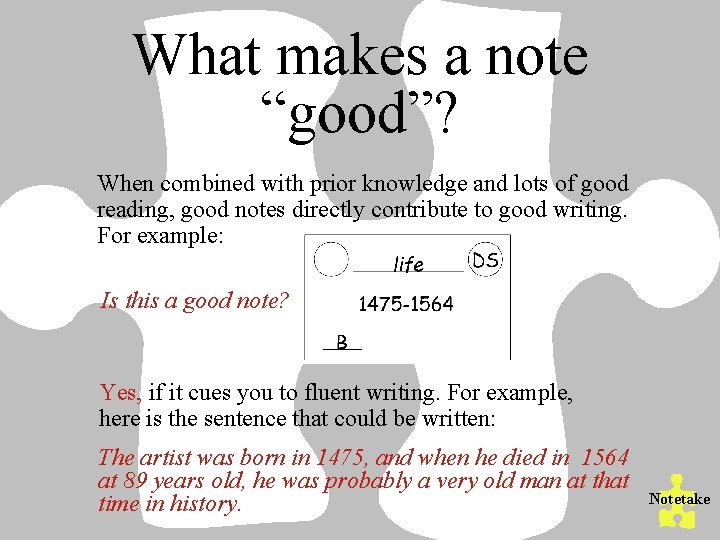
What makes a note “good”? When combined with prior knowledge and lots of good reading, good notes directly contribute to good writing. For example: Is this a good note? Yes, if it cues you to fluent writing. For example, here is the sentence that could be written: The artist was born in 1475, and when he died in 1564 at 89 years old, he was probably a very old man at that time in history. Notetake

Let’s change a “bad” note: Van Gogh’s paintings of Provencal sunflowers, like blazing circles of energy and joy, will surely remain his most popular and inspiring images. , , …to a “good” note: paintings -- Provencal sunflowers-- blazing circles energy, joy -- remain -- most popular, inspiring images Notetake
With a really good note, juicy sentences… flow from your head! Notetake
With a really bad note, your brain is tied up…with nowhere to go! What did that note say? Notetake
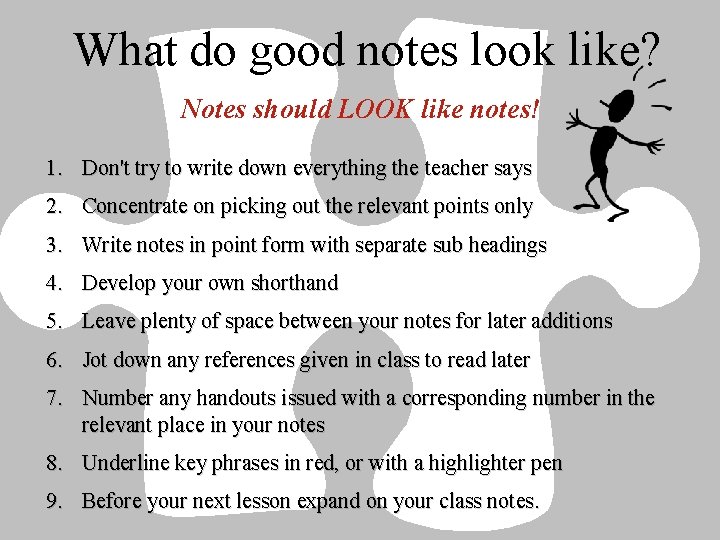
What do good notes look like? Notes should LOOK like notes! 1. Don't try to write down everything the teacher says 2. Concentrate on picking out the relevant points only 3. Write notes in point form with separate sub headings 4. Develop your own shorthand 5. Leave plenty of space between your notes for later additions 6. Jot down any references given in class to read later 7. Number any handouts issued with a corresponding number in the relevant place in your notes 8. Underline key phrases in red, or with a highlighter pen 9. Before your next lesson expand on your class notes.
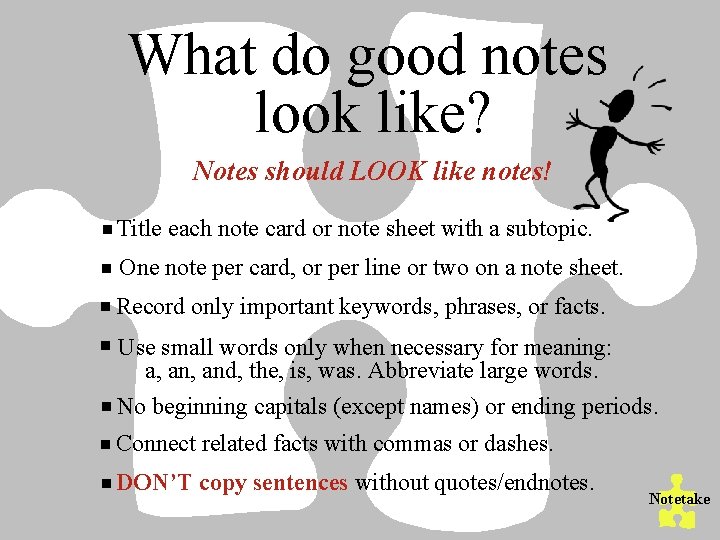
What do good notes look like? Notes should LOOK like notes! Title each note card or note sheet with a subtopic. One note per card, or per line or two on a note sheet. Record only important keywords, phrases, or facts. Use small words only when necessary for meaning: a, and, the, is, was. Abbreviate large words. No beginning capitals (except names) or ending periods. Connect related facts with commas or dashes. DON’T copy sentences without quotes/endnotes. Notetake
Kinds of Good Notes Using a projection system and the notetaking template, your instructor can demonstrate examples of what good notes look like: Keyword note List note Quoted note (needs accurate citation) Summarized or paraphrased note Notetake
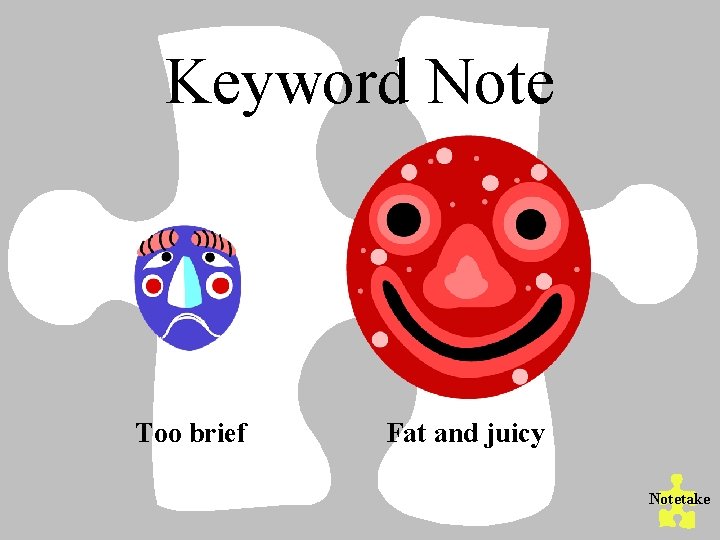
Keyword Note Too brief Fat and juicy Notetake
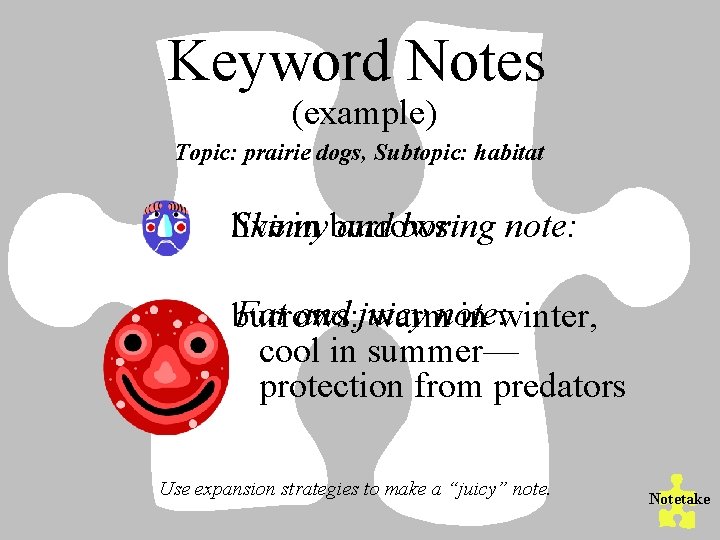
Keyword Notes (example) Topic: prairie dogs, Subtopic: habitat live Skinny in burrows and boring note: Fat and juicy burrows: warmnote: in winter, cool in summer— protection from predators Use expansion strategies to make a “juicy” note. Notetake
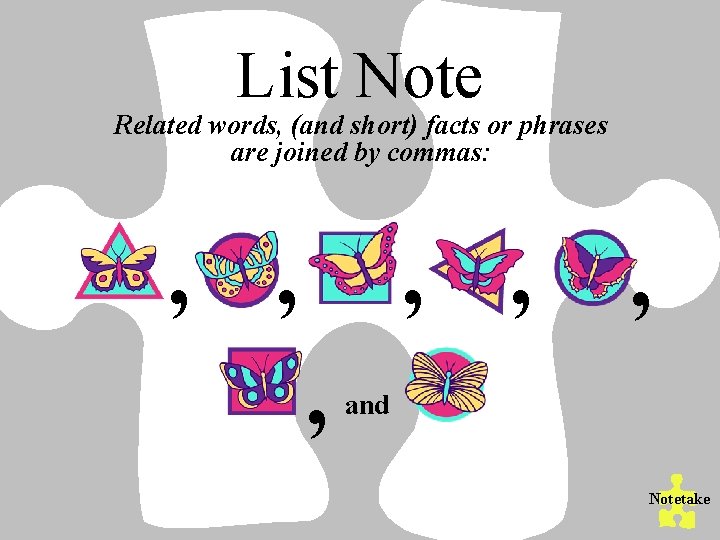
List Note Related words, (and short) facts or phrases are joined by commas: , , , , and Notetake
![Quoted Note “…sunlight is a mixture of all colors. [I] passed a beam of](http://slidetodoc.com/presentation_image_h2/42b3fe696f602b9332fbf689a30d19b7/image-18.jpg "Quoted Note “…sunlight is a mixture of all colors. [I] passed a beam of")
Quoted Note “…sunlight is a mixture of all colors. [I] passed a beam of sunlight through a glass prism and studied the colors that were produced. ” In his studies of prisms and light, Newton found that… Margaret C. Jacob, 1999. Requirements for citing quotations: quotation marks and endnote. Notetake
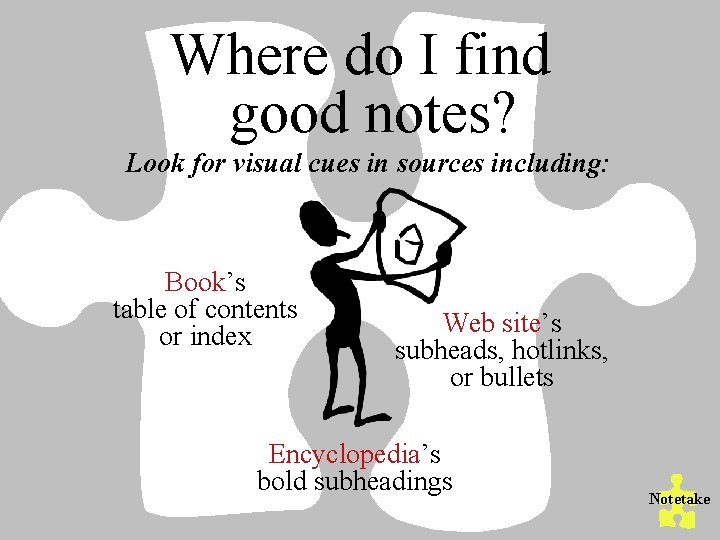
Where do I find good notes? Look for visual cues in sources including: Book’s table of contents or index Web site’s subheads, hotlinks, or bullets Encyclopedia’s bold subheadings Notetake
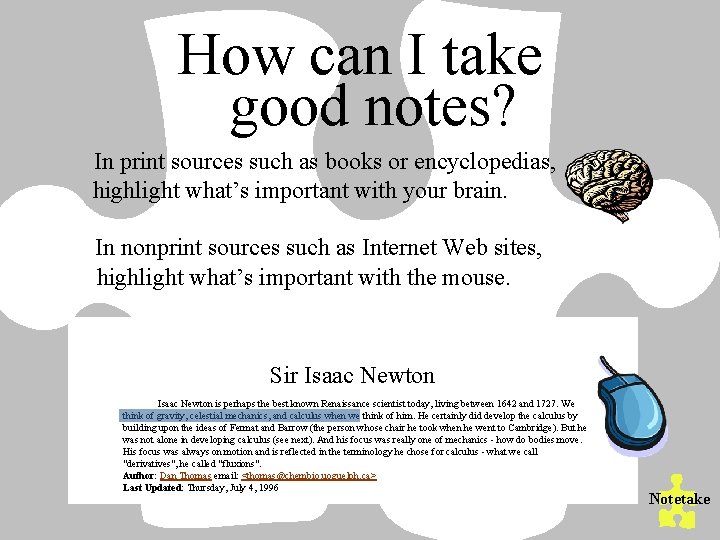
How can I take good notes? In print sources such as books or encyclopedias, highlight what’s important with your brain. In nonprint sources such as Internet Web sites, highlight what’s important with the mouse. Sir Isaac Newton is perhaps the best known Renaissance scientist today, living between 1642 and 1727. We think of gravity, celestial mechanics, and calculus when we think of him. He certainly did develop the calculus by building upon the ideas of Fermat and Barrow (the person whose chair he took when he went to Cambridge). But he was not alone in developing calculus (see next). And his focus was really one of mechanics - how do bodies move. His focus was always on motion and is reflected in the terminology he chose for calculus - what we call "derivatives", he called "fluxions". Author: Dan Thomas email: <thomas@chembio. uoguelph. ca> Last Updated: Thursday, July 4, 1996 Notetake
Now you try it! Notetake
- Slides: 21