
NOTE ON MARKETING STRATEGY MARKETNG STRATEGY Marketing The
- Slides: 43
NOTE ON MARKETING STRATEGY & MARKETİNG STRATEGY
Marketing The central role of marketing in the enterprise stems from the fact that marketing is the process via which a firm creates value for its chosen customers. Value is created by meeting customer needs.
Marketing Strategy The firm must sustain the process of creating and capturing value over time. Within this framework, the plan by which value is created on a sustained basis is the firm’s Marketing Strategy.
Strategy A strategy is a plan of action designed to achieve certain defined objectives. In business firms, objectives may be stated in such terms as sales volume, rate of growth, profit percentages, market share, and return on investment (ROI), among others.
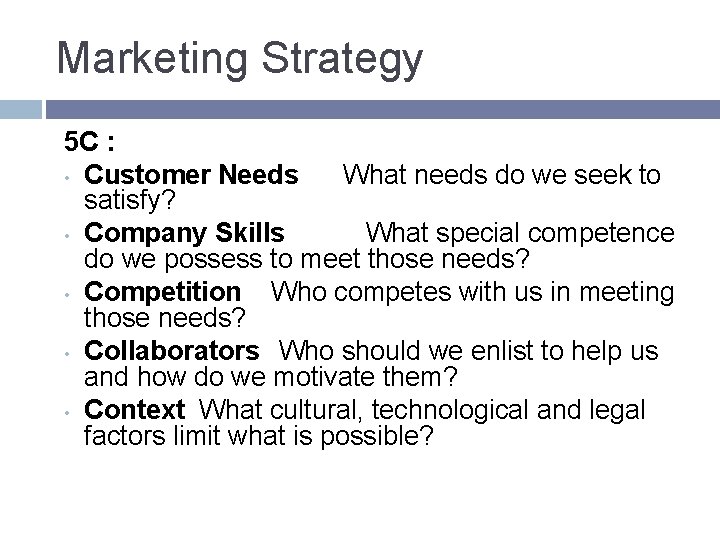
Marketing Strategy 5 C : • Customer Needs What needs do we seek to satisfy? • Company Skills What special competence do we possess to meet those needs? • Competition Who competes with us in meeting those needs? • Collaborators Who should we enlist to help us and how do we motivate them? • Context What cultural, technological and legal factors limit what is possible?
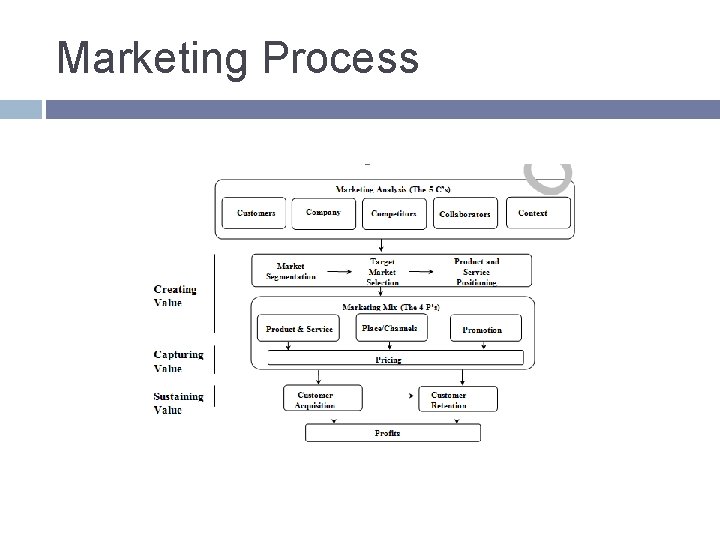
Marketing Process
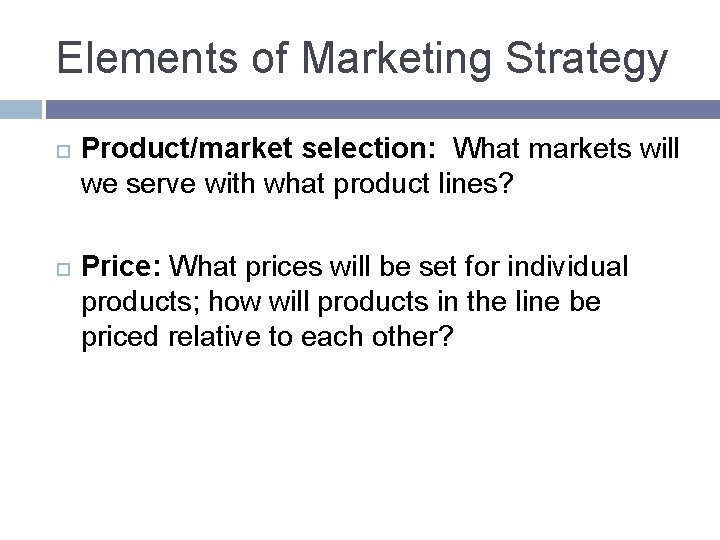
Elements of Marketing Strategy Product/market selection: What markets will we serve with what product lines? Price: What prices will be set for individual products; how will products in the line be priced relative to each other?
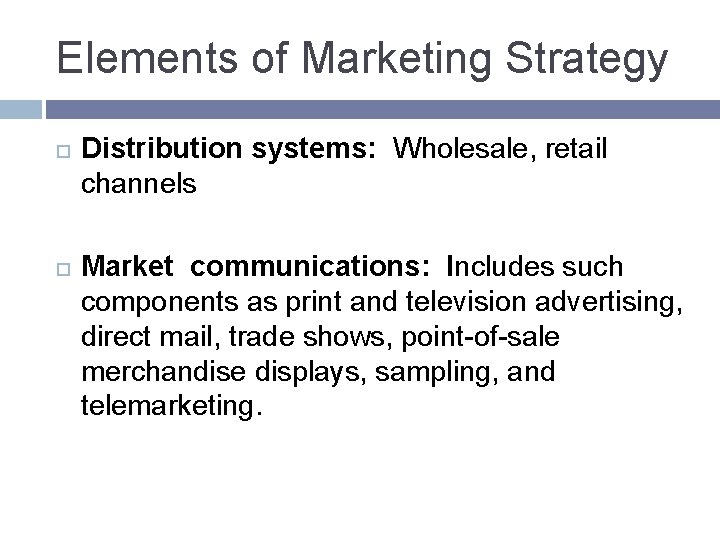
Elements of Marketing Strategy Distribution systems: Wholesale, retail channels Market communications: Includes such components as print and television advertising, direct mail, trade shows, point-of-sale merchandise displays, sampling, and telemarketing.
Product/ Market Selection A market segment is a set of potential customers alike in the way they perceive and value the product, in their buying behavior, and in the way they use the product.
Target Market Selection and Product Positioning Which potential buyers should the firm attempt to serve? How much customization should the firm offer in its programs? Mass Market Segments Market Niches Individuals
Segmentation • Demographic (e. g. , age, income, gender, occupation) • Geographic (e. g. , nation, region of country, urban vs. rural) • Lifestyle (e. g. , hedonistic vs. value oriented).
Segmentation User Status: Non-User vs. User Usage Rate: Light, Medium, Heavy User Benefits Sought: Performance-Oriented vs. Price-Oriented Loyalty Status: None, Moderate, Strong, Totally Loyal Attitude Toward Product: Unsatisfied, Satisfied, Delighted
Target market selection • • The firm’s comparative strengths and weaknesses Competition given the target market’s purchase criteria. Long run growth potantial of the market Identify the segments that value the product most highly The firm’s corporate goals and the fit of the segment with these goals. Company-product/market fit The resources necessary to market successfully to the target segment. The likely financial returns from the segment.
The Marketing Mix The advantage of solving the positioning problem is that it enables the company to solve the marketing mix problem.
The Marketing Mix 4 P: 1. Product 2. Place (Channels of Distribution) 3. Promotion (Communications Strategy) 4. Pricing
Product The product offering is not the thing itself, but rather the total package of benefits obtained by the customer. For marketing strategy development purposes, the product has to be considered from the pointof-view of value delivered to the customer.
Product Value can be delivered simultaneously by a number of vehicles; • the physical product itself • the brand name • the company reputation • post-sale technical support • repair service • financing plans • convenient availability • word-of-mouth references • reputation of outlet where purchased
Product Line Planning Decisions • Product Line Breadth (e. g. A desktop manufacturer considers also selling laptops) • Product Line Length (e. g. A beer producer in th mass part of the market is considering to develop an entry in the premium segment) • Product Line Depth (e. g. The men’s golf attire manufacturer considers whether to offer its $110 crew neck sweater in five colors or just three. )
Individual Item Decisions • Delete an item from the line • Reposition an existing product within the line • Improve the performance of an existing product to strengthen its positioning • Introduce a new product within an existing line • Introduce a product to establish a new line
The New Product Development Process • 1. Opportunity Identification • 2. Design • 3. Testing ( e. g. surveys, taste tests, simulations) • 4. Product Introduction • 5. Life Cycle Management
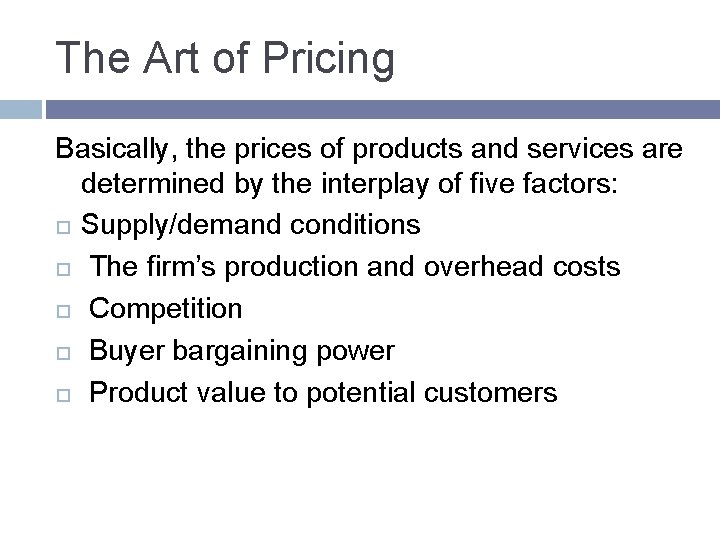
The Art of Pricing Basically, the prices of products and services are determined by the interplay of five factors: Supply/demand conditions The firm’s production and overhead costs Competition Buyer bargaining power Product value to potential customers
Pricing Basis and Objective Skim pricing Penetration pricing
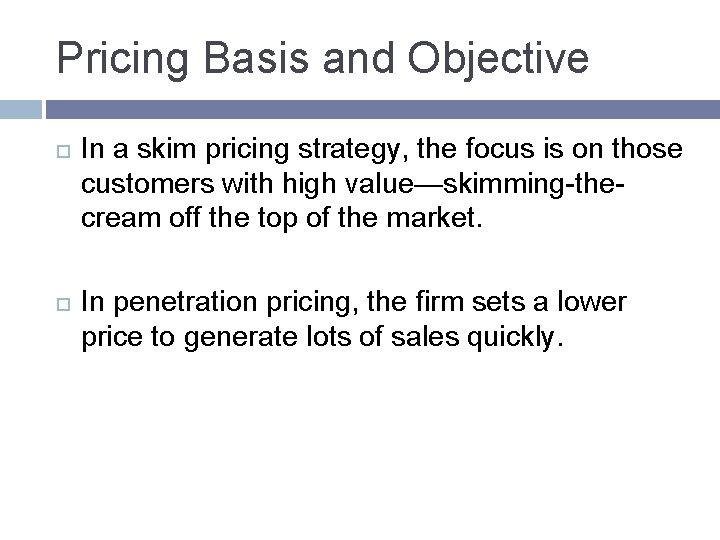
Pricing Basis and Objective In a skim pricing strategy, the focus is on those customers with high value—skimming-thecream off the top of the market. In penetration pricing, the firm sets a lower price to generate lots of sales quickly.
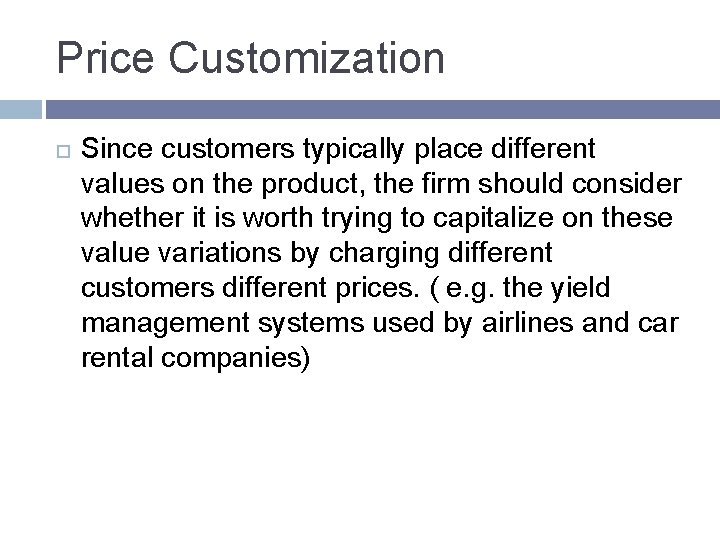
Price Customization Since customers typically place different values on the product, the firm should consider whether it is worth trying to capitalize on these value variations by charging different customers different prices. ( e. g. the yield management systems used by airlines and car rental companies)
Price Leadership In some industries, legal and effective price leadership has been displayed as firms avoided price cutting in pursuit of share gains. In other industries, price wars have destroyed the profitability of nearly all the players. The tendency toward excessive price competition is particularly acute when;
Price Leadership Firms have high fixed, but low variable costs, There is little differentiation among competitors’ products, and thus consumers largely buy on price, Industry growth rate is low, There are barriers to capacity adjustment, and economies of scale are important.
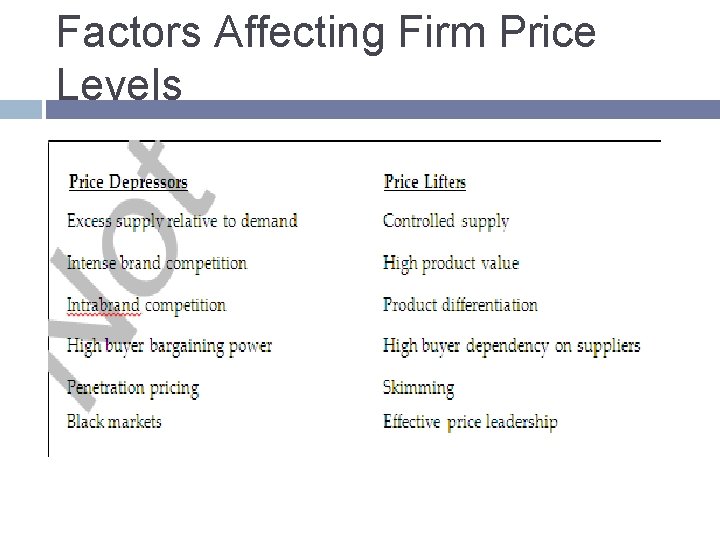
Factors Affecting Firm Price Levels
Place: Marketing Channels The marketing channel is the set of mechanisms or network via which a firm “goes to market, ” i. e. , is “in touch” with its customer for a variety of tasks ranging from demand generation to physical delivery of the goods. Distribution systems include the firm’s personal salesforce, with wholesale distributors and retail outlets providing geographically structured market coverage.
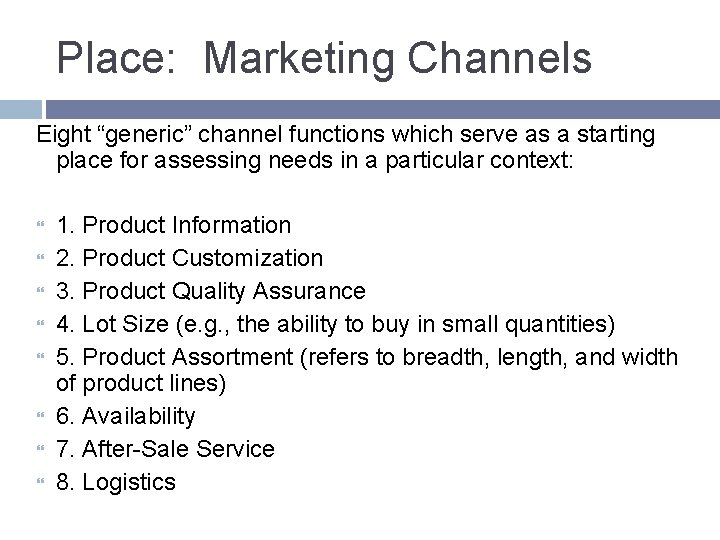
Place: Marketing Channels Eight “generic” channel functions which serve as a starting place for assessing needs in a particular context: 1. Product Information 2. Product Customization 3. Product Quality Assurance 4. Lot Size (e. g. , the ability to buy in small quantities) 5. Product Assortment (refers to breadth, length, and width of product lines) 6. Availability 7. After-Sale Service 8. Logistics
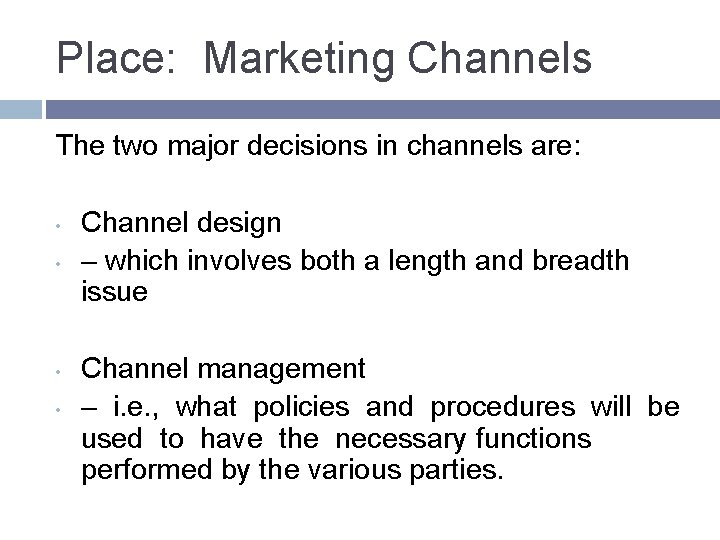
Place: Marketing Channels The two major decisions in channels are: • • Channel design – which involves both a length and breadth issue Channel management – i. e. , what policies and procedures will be used to have the necessary functions performed by the various parties.
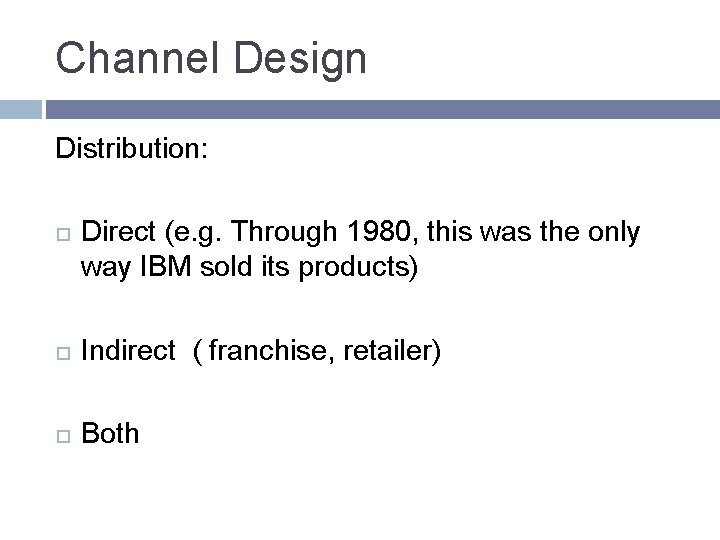
Channel Design Distribution: Direct (e. g. Through 1980, this was the only way IBM sold its products) Indirect ( franchise, retailer) Both
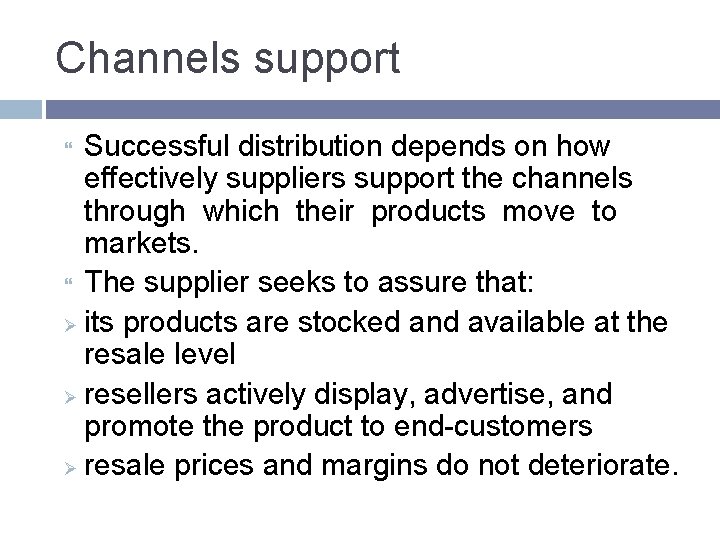
Channels support Successful distribution depends on how effectively suppliers support the channels through which their products move to markets. The supplier seeks to assure that: Ø its products are stocked and available at the resale level Ø resellers actively display, advertise, and promote the product to end-customers Ø resale prices and margins do not deteriorate.
Channels support In dealing with the channels environment, suppliers gain strength under these conditions: Ø Selective rather than intensive distribution. Ø Superior product line breadth and quality. Ø A high degree of supplier/reseller interdependency. Ø A supplier salesforce presence at the resale level. Ø End-market demand development.
Promotion: Marketing Communications This element of the marketing mix is deciding the appropriate set of ways in which to communicate with customers to foster their awareness of the product, knowledge about its features, interest in purchasing, likelihood of trying the product/and or repeat purchasing it.
Tasks and Tools • • • 1. Market – addressed? to whom is the communication to be 2. Mission – communication? what is the objective of the 3. Message – communicated? what are the specific points to be 4. Media – which vehicles will be used to convey the message? 5. Money –how much will be spent in the effort? 6. Measurement – how will impact be assessed after the campaign?
Nonpersonal Vehicles Advertising in media is particularly effective in: • • • Creating awareness of a new product Describing features of the product Suggesting usage situations Distinguishing the product from competitors Directing buyers to the point-of-purchase Creating or enhancing a brand image.
Sales Promotions Consumer promotions (e. g. , a cents-off coupon sent in the mail or contained in print media or a continuity program such as collecting proofs-of-purchase to redeem for a gift. ) Trade promotions (e. g. , temporary off-invoice price discounts or cooperative advertising allowances. ) Retail promotions (e. g. offering a discount and displaying or advertising the brand. )
Personal Selling A salesperson as the communication vehicle presents the advantage of permitting an interaction to take place between the firm and a potential customer rather than just the broadcast of information. The importance of personal selling in the communications mix typically increases with the complexity of the product and the need for education of potential customers.
Personal Selling A salesperson can also have a role after-thesale, providing technical support or transmitting customer data to the firm as a form of market research.
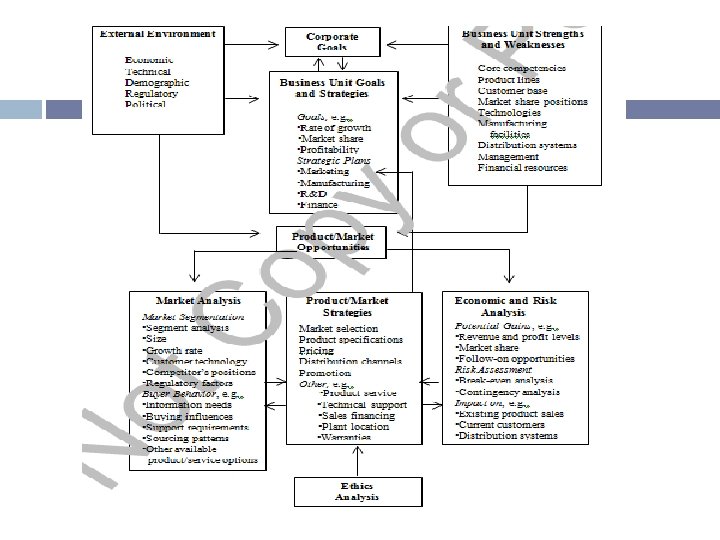
A Model for Strategic Planning Corporate goals External environment Business unit strengths and weaknesses Product/market opportunities Market analysis Economic and risk analysis Ethics analysis Product/market strategies
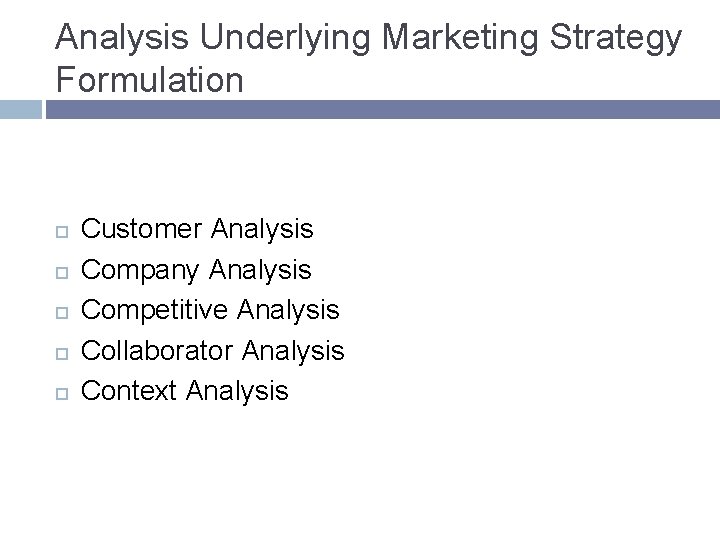
Analysis Underlying Marketing Strategy Formulation Customer Analysis Company Analysis Competitive Analysis Collaborator Analysis Context Analysis
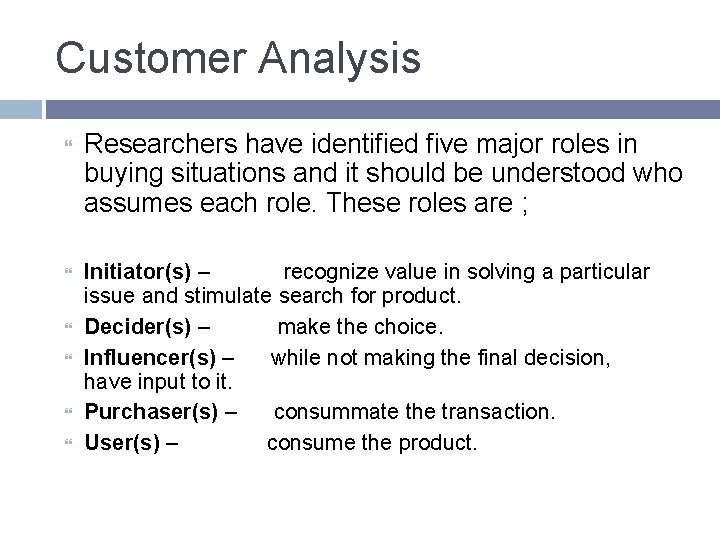
Customer Analysis Researchers have identified five major roles in buying situations and it should be understood who assumes each role. These roles are ; Initiator(s) – recognize value in solving a particular issue and stimulate search for product. Decider(s) – make the choice. Influencer(s) – while not making the final decision, have input to it. Purchaser(s) – consummate the transaction. User(s) – consume the product.