
Note No WIKIPEDIA You must not record share


- Slides: 70
Note No WIKIPEDIA You must not record, share, post, or distribute any links posted for this course’s content on moodle or Dr. Barre’s website. You must not record, share, post, or distribute any ms teams links associated with this course.
Please note that only the online course syllabus version is the official version. please check the online version periodically to make sure that you have the most recent information.
PSYCHOLOGY OF NUTRITION
PSYCHOLOGY OF NUTRITION • Why do we eat and drink? • What controls how much (or little) we eat and drink? • Why do we consume certain foods and drinks? • What stops us from eating and drinking?
Why do we eat and drink? Hunger Chemical signals from stomach, small intestine and blood dictate when we are hungry Thirst Concentration (water content of blood dictates thirst sensation) We lose water before we become thirsty
Why do we eat and drink? Sociology Religion -eat and drink-communion Social occasions -we eat to be social and not offend
What controls how much (or little) we eat ? Satiation -feeling of satisfaction (fullness) Satiety-chemical signals from stomach small intestine and blood dictate when we are still full and not yet ready to eat
What controls how much (or little) we eat ? Pregnancy-increased metabolic demands of baby combined with the increased weight that mother must carry around means mother must consume more food to keep up with those demands Mental Illness- e. g. depression including bipolar disorder-sometimes eat comfort food to console depression - eating disorders
What controls how much (or little) we eat ? Physical Illness -people who are not feeling well will eat less -what are the implications for this ? Politics -ethnic cleansing in the Balkans-Milosevic -Russia/Poland case
What controls how much (or little) we eat ? Anthropology -undernutrition-affects ability to work and hence obtain food -perception of value of food
What controls how much (or little) we eat ? Sociology -rumours/gossip about best quantities of food to eat -society (or subsets e. g. ethnic groups) have certain foods they prefer or can have -culture of thinness as beauty at the moment (in the past) -culture is fueled by media advertising
What controls how much (or little) we eat ? Desire for Health -weight control -avoiding heart disease, diabetes and cancer Economics -we eat what we think we can afford (not always accurate)
What controls how much (or little) we eat ? Reading Food Labels -calories -nutrient content -what about illiteracy? Activity-specific (athletics) -carbohydrates are the limiting nutrient for athletes -proteins-necessary for building muscle -all other nutrients to meet requirements for particular activity
What controls how much (or little) we eat ? Information available to the consumer -taste -health -smell -texture -visual
Why do we consume certain foods and drinks ? Nutrient Deficiencies -pica-consumption of clay, ice chips when people are iron deficient-these foods contain no iron -clay inhibits iron absorption-found particularly in poor women and children who are iron deficient
Why do we consume certain foods and drinks ? Anthropology/Sociology Religion -Communion -bread and wine (body and blood of Christ) -Jewish –kosher -what is left over after the forbidden items
Why do we consume certain foods and drinks ? Mental Illness -the belief that somebody may be trying to poison us with certain foods but not others Physical Illness -the desire to get well
Why do we consume certain foods and drinks ? Politics -what is available Desire for Continued Health -fish -fruit and vegetables -fibres -supplements -food allergies and intolerances
Why do we consume certain foods and drinks ? Economics-what we think we can afford or can actually afford Reading food labels -calories -nutrient composition -avoiding food allergies and intolerances and food-drug interactions
Why do we consume certain foods and drinks ? Activity-specific (athletics) -carbohydrate-most limiting nutrient for performance -protein-muscle building Information available to the consumer -taste(flavour), health, smell, texture
Why do we avoid certain foods and drinks ? Anthropology/Sociology -religion -Middle East-pork -India-Hindus-beef -Jews-certain foods must be kosher -Mormons-no alcohol and no caffeine drinks (tea, coffee, colas) Mental Illness - a belief that someone is trying to poison us or hearing voices telling us not to eat certain foods
Why do we avoid certain foods and drinks ? Physical Illness -unwell feeling- e. g. pain, nausea -coma Pregnancy-e. g. alcohol - avoid fetal alcohol syndrome (facial deformities and learning disabilities)
Why do we avoid certain foods and drinks ? Desire for Health -high fat foods in excess and low nutrient density foods to be avoided Economics -reality or perception that we cannot afford a particular food
Why do we avoid certain foods and drinks ? Reading food labels -calories -nutrient composition -avoiding food allergies and intolerances and food-drug interactions Activity specific (athletics) -e. g. high fat foods –inhibit performance if taken just before a competition
What stops us from eating (starving ourselves) Illness -physical -elderly-may not feel well or terminally ill who have the “ I just want to die” outlook -mental -eating disorders mainly -anorexia -bulimia
What stops us from eating (starving ourselves) Politics e. g. Bobby Sands in 1981 in Northern Ireland to protest the British presence
Eating Disorders Introduction Anorexia Nervosa Bulimia Nervosa Obesity Attention deficit hyperactivity disorder Mood Disorders Schizophrenia
Introduction -define eating disorder -a situation where a person eats or overeats non-nutritious amounts of foods and/or deliberately vomits foods -vomiting may include ridding the body of non-nutritious or nutritious amounts of foods -leads to disease or disability -classified on basis of visible end result (extreme thinness or fatness) or on the basis of variation of eating patterns (fasting, binging, food restriction)
Introduction continued -what causes eating disorders -psychiatric/psychological or biochemical aberration
Anorexia Nervosa -define -characterised by self-imposed weight loss, hormone function, and distorted psychopathological attitude towards eating and weight -epidemiology -typically occurs in females shortly after puberty or later in adolescence -but can be before puberty or later in life
Anorexia Nervosa -causes -biological -unexplained physiological (possibly hormonal changes) with possible genetic predisposition -psychological -family dynamics causing intrapsychic conflicts -social -the belief that the person is too heavy -the view that heavy is ugly and thinness is beautiful -self-esteem may be low -ties in with onset of puberty
Anorexia Nervosa -consequences -similar to other states of semi-starvation -adaptive responses by the body that allow the person to survive decreased dietary energy intake -such adaptive measures have their costs -such costs are limitations on mental and physical abilities of person -these limitations come about because sparing of utilisation of glucose and proteins and the shift to the utilisation of fat stores in the body
Anorexia Nervosa Consequences -shift in fluid and electrolyte (mineral) balance in body -disturbances in hormones leading to lack of a period and infertility, cold intolerance, dry skin and hair, and constipation
Anorexia nervosa Treatments -done jointly with physician and dietitian -mild cases -counselling about adolescent growth and nutrition education and consequences of starvation -more severe cases -psychiatrist and dietitian who specialise in eating disorders and provide psychological and dietary counselling, and general support -very severe-hospitalisation including feeding by other than mouth combined with above
Anorexia Nervosa outcomes - must follow for at least 4 years - 50 -60 % of patients are back to normal weight after 4 years - after 6 years have 50 % recovery from disease (previous point? ) - 6 - 12 years of illness 75 % recover - after 12 years of illness recovery unlikely - mortality rate- 0 – 5 %
Bulimia nervosa Defined -Characterised by frequent binge eating and purging associated with the loss of control over eating and the persistent overconcern about body shape and weight. Occurs predominately in young adult women -Milder forms of binging and purging (vomit and laxatives) are common in normal weight females.
Bulimia Nervosa Multiple determinants -Depression -Impaired hormonal regulation suggesting really full when not -Reduced post-prandial satiety - if person once maintained a higher weight and if they are in the normal range due to binge and purge now it will be sub-optimal for them -therefore in a state of semi-starvation -Binge and purge can also occur in in normal weight persons who have never had anorexia nervosa-some may have been overweight or desire slimmer figure. Meal skipping and calorically restricted meals often starts the process.
Bulimia nervosa Consequences -Clinically changes similar to anorexia nervosa occur -Diversity of eating patterns among bulimics makes it difficult to generalise regarding the physiological consequences Epidemiology -1 -9% among young adult women; rare in males -mean age for diagnosis 23 years -among 15 -24 yr females bulima nervosa is 2 x as common as anorexia nervosa
Bulimia nervosa Treatment As per anorexia nervosa Outcomes Few studies that follow patients for more than one year after treatment In the short term there is 66 % recovery.
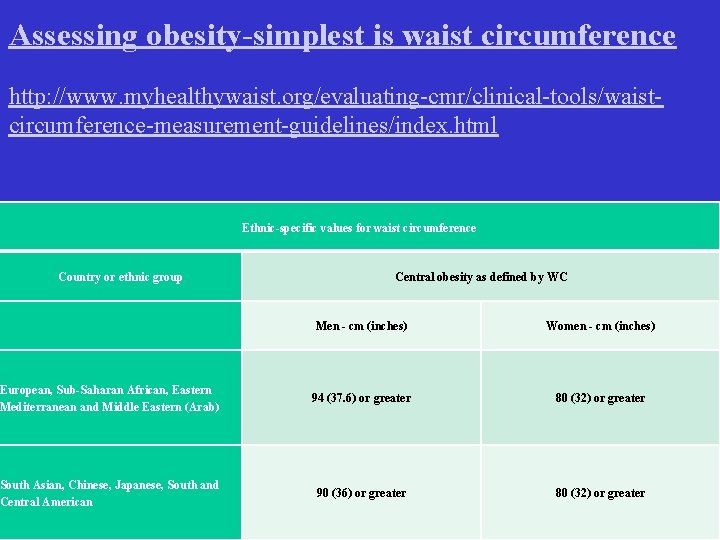
Obesity -define -excessive accumulation of fat in the body -body mass index of greater than or equal to 30 -body mass index is kg/m 2 -greater than or equal to 94 cm males and 80 cm females
Obesity Prevalence Children in Canada 1978 In 1978/79, 23% of children aged 2 -17 were overweight or obese. 2004 In 2004, 35% of children aged 2 -17 were overweight or obese. 2017 30% of children aged, 5 -17 are overweight or obese.
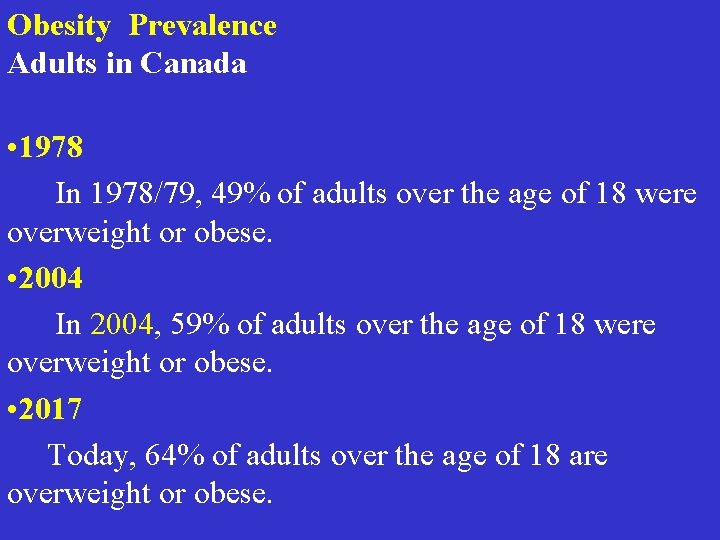
Obesity Prevalence Adults in Canada • 1978 In 1978/79, 49% of adults over the age of 18 were overweight or obese. • 2004 In 2004, 59% of adults over the age of 18 were overweight or obese. • 2017 Today, 64% of adults over the age of 18 are overweight or obese.
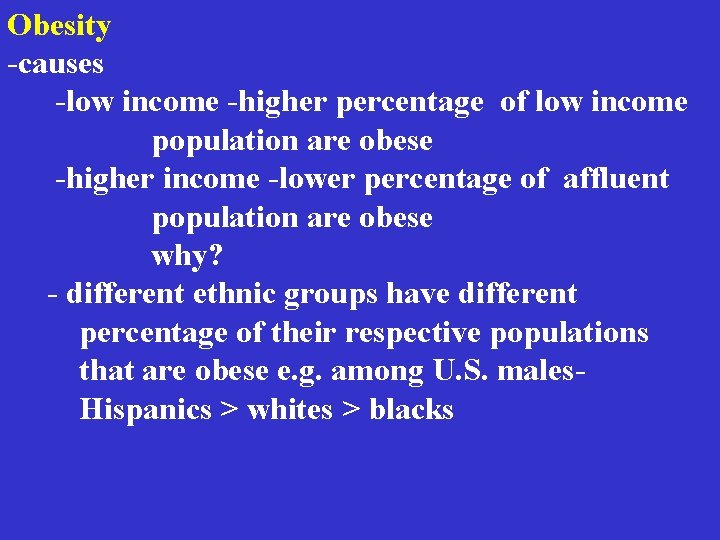
Obesity -causes -low income -higher percentage of low income population are obese -higher income -lower percentage of affluent population are obese why? - different ethnic groups have different percentage of their respective populations that are obese e. g. among U. S. males- Hispanics > whites > blacks
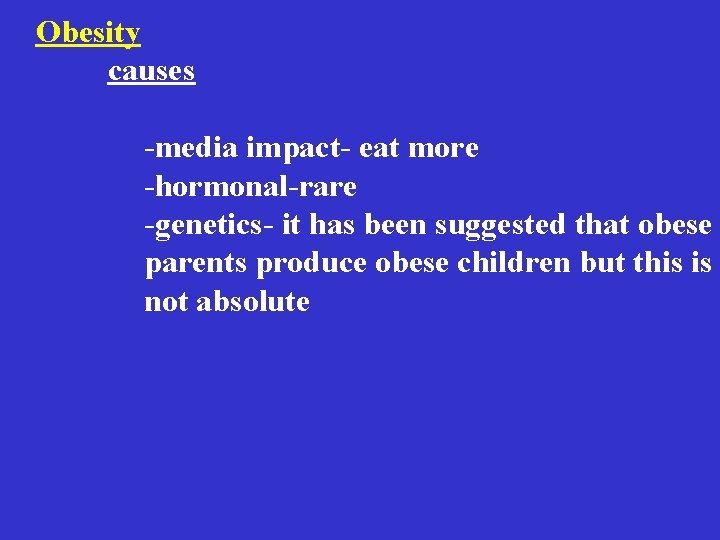
Obesity causes -media impact- eat more -hormonal-rare -genetics- it has been suggested that obese parents produce obese children but this is not absolute
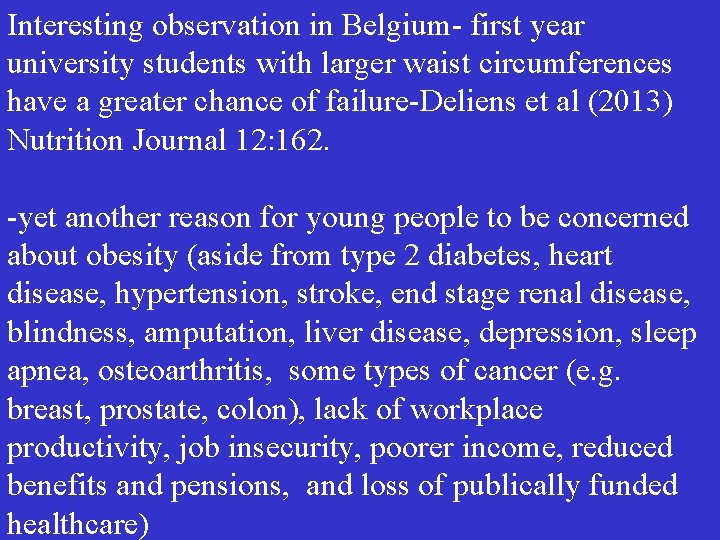
Interesting observation in Belgium- first year university students with larger waist circumferences have a greater chance of failure-Deliens et al (2013) Nutrition Journal 12: 162. -yet another reason for young people to be concerned about obesity (aside from type 2 diabetes, heart disease, hypertension, stroke, end stage renal disease, blindness, amputation, liver disease, depression, sleep apnea, osteoarthritis, some types of cancer (e. g. breast, prostate, colon), lack of workplace productivity, job insecurity, poorer income, reduced benefits and pensions, and loss of publically funded healthcare)
Contributing to Obesity are: Five food felons 1) saturated fats 2) trans fats 3) added sugars 4) syrups 5) any grains that aren’t 100% whole
BOTTOM LINE Not all Canadians are walking the talk. They know what has to be done but cannot bring consistently themselves to do it. Canadians as a population just do not get it. Obesity continues to rise in Canada Perspective on Obamacare
Obesity Treatments -caloric restriction and exerciseotherwise yo yo effect -appetite suppressing drugs -psychotherapy -behaviour modification- eg only eating in dining room -surgery-stomach stapling Outcomes of treatments -highly individual
Attention deficit hyperactivity disorder -define -developmentally inappropriate activity levels -low frustration tolerance -impulsivity -poor organisation of behaviour -inability to sustain attention and concentration
Attention deficit hyperactivity disorder -consequences -medication can reduce appetite and hence affect growth -treatments -reduce drug dose
Mood Disorders -define -depression or manic-depression -causes -brain biochemical disorder -consequences -depression- loss of appetite and anorexia -manic depression- lithium used to treat-gives weight gain
Mood Disorders Treatments -depression- treat via counselling and medication -manic depression-keep dietary sodium up because lithium rises in blood if dietary sodium is restricted
Schizophrenia -define chronic hallucinations, delusions, illogical thinking and bizarre behaviour -causes -biochemical disorder in brain -consequences -voices telling people not eat- weight loss -treatments -counselling and medication
PSYCHOLOGY OF NUTRITION Psychological consequences of under- and over-nutrition
Undernutrition -sleep -waking due to hunger -benefits of sleep are lost
Under nutrition -concentration -sleep loss and hunger combine to reduce attention span
Undernutrition -disease-renal disease -if one is on dialysis generally one does not feel well -being on dialysis changes the taste of food -the combination of not feeling well and changing the taste of food results in a vicious cycle of not feeling well and eating less which makes one feel worse
Undernutrition -arrest of psychological maturation -if one is focussed on hunger one’s ability to behave in an age-specific (acceptable) manner is diminished -related to arrest of cognitive development and intellectual ability
Undernutrition -intellectual capacity -brain runs largely on glucose-ability to think and reason is limited -social interaction with others-juniors, peers, adults -lost capacity due to focus on hunger -aggressiveness brought on by hunger
Undernutrition -poor self esteem -one is subject to ridicule -not only a cause but an effect-how? -autonomy-become so weak that one is unable to do anything for oneself -physical activity-play is limited due to lack of energy- so benefits of play eg relaxation are lost
Undernutrition -appearance, smell, taste, texture of food -as one becomes hungry one’s perception of appearance, taste, smell and texture of food are altered leading to the rejection of some nutritious foods and consumption of nonnutritious foods (eg clay, dirt, grass) -fear, anger, worry slow gut motility -so eat less (fullness) and more nutrient extraction
Undernutrition -guilt arises due to loss of control and panicked attempts to obtain calories leads to vicious cycle
Obesity
Assessing obesity-simplest is waist circumference http: //www. myhealthywaist. org/evaluating-cmr/clinical-tools/waistcircumference-measurement-guidelines/index. html Ethnic-specific values for waist circumference Country or ethnic group Central obesity as defined by WC Men - cm (inches) Women - cm (inches) European, Sub-Saharan African, Eastern Mediterranean and Middle Eastern (Arab) 94 (37. 6) or greater 80 (32) or greater South Asian, Chinese, Japanese, South and Central American 90 (36) or greater 80 (32) or greater
Overnutrition (obesity) -sleep apnea- reduction of oxygen -concentration-feeling of lack of energy -diseases-heart disease -renal disease heart disease can lead to renal disease and both frequently result in depression
Overnutrition (obesity) -anxiety and other negative emotions(fear, anger) -those problems solved with the creation of …?
Overnutrition (obesity) -social interaction with others-one’s juniors, peers, adults Many people think that obese individuals are gluttonous, lazy, or both, even though this is not true. Children are cruel (jokes), peers may avoid you (they fear being labelled as supporting the obese person), adults may discriminate against you in the job market, school. All this can give feelings of depression, rejection, shame leading to more eating which gives rise to
Overnutrition (obesity) -poor-self esteem-a feeling of worthlessness -lowered autonomy-extreme obesity can eliminate this giving rise to depression -decreased physical activity-play and its enjoyment is progressively curtailed and ultimately lost
Overnutrition (obesity) -appearance, smell, taste, texture of food -everything looks, smells, tastes good and has a pleasing texture and if there a satisfaction gained do we eat more -fear, anger, worry- slow gut motility leading to increased obesity
Please bring your grocery receipts next class