
Note In moduloN arithmetic we use only the
- Slides: 61
Note In modulo-N arithmetic, we use only the integers in the range 0 to N − 1, inclusive. 1
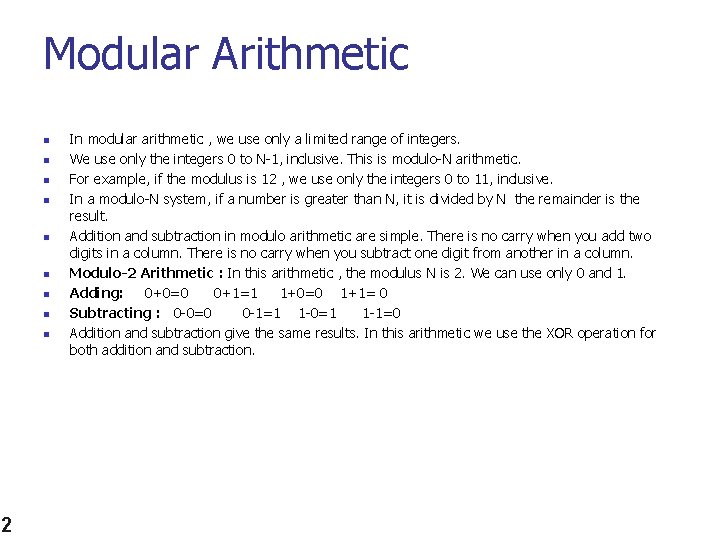
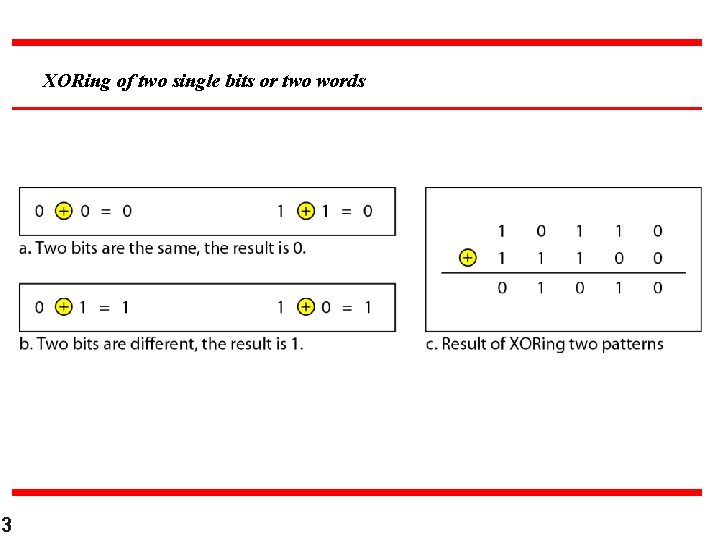
Modular Arithmetic n n n n n 2 In modular arithmetic , we use only a limited range of integers. We use only the integers 0 to N-1, inclusive. This is modulo-N arithmetic. For example, if the modulus is 12 , we use only the integers 0 to 11, inclusive. In a modulo-N system, if a number is greater than N, it is divided by N the remainder is the result. Addition and subtraction in modulo arithmetic are simple. There is no carry when you add two digits in a column. There is no carry when you subtract one digit from another in a column. Modulo-2 Arithmetic : In this arithmetic , the modulus N is 2. We can use only 0 and 1. Adding: 0+0=0 0+1=1 1+0=0 1+1= 0 Subtracting : 0 -0=0 0 -1=1 1 -0=1 1 -1=0 Addition and subtraction give the same results. In this arithmetic we use the XOR operation for both addition and subtraction.
XORing of two single bits or two words 3
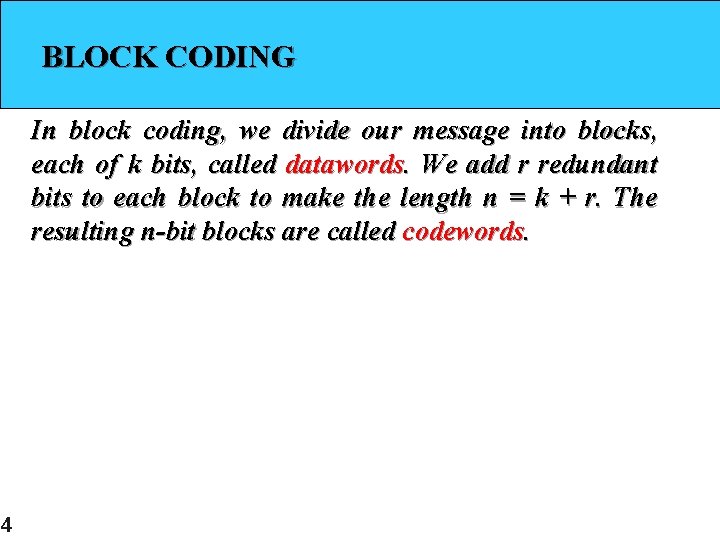
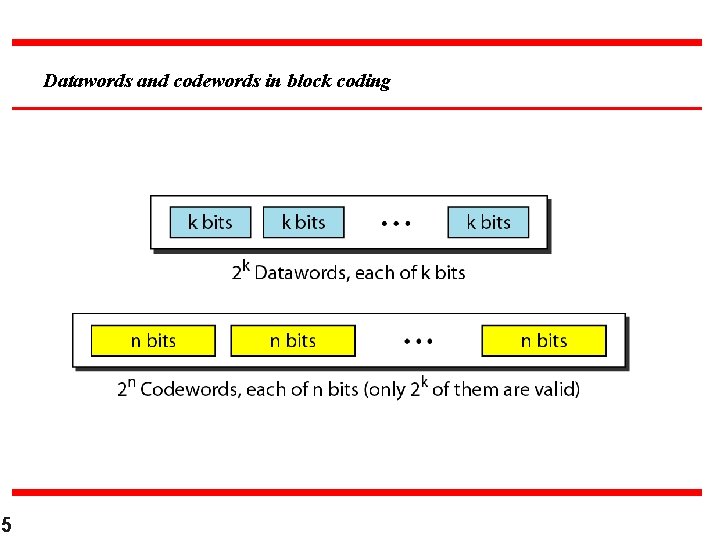
BLOCK CODING In block coding, we divide our message into blocks, each of k bits, called datawords. We add r redundant bits to each block to make the length n = k + r. The resulting n-bit blocks are called codewords. 4
Datawords and codewords in block coding 5
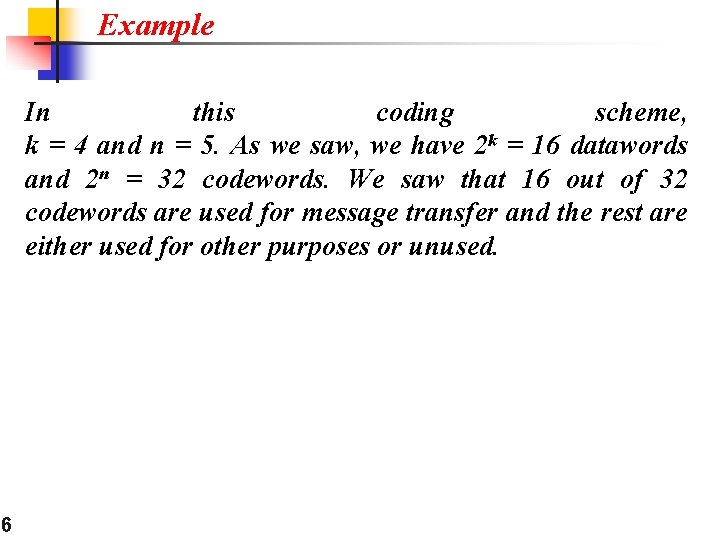
Example In this coding scheme, k = 4 and n = 5. As we saw, we have 2 k = 16 datawords and 2 n = 32 codewords. We saw that 16 out of 32 codewords are used for message transfer and the rest are either used for other purposes or unused. 6
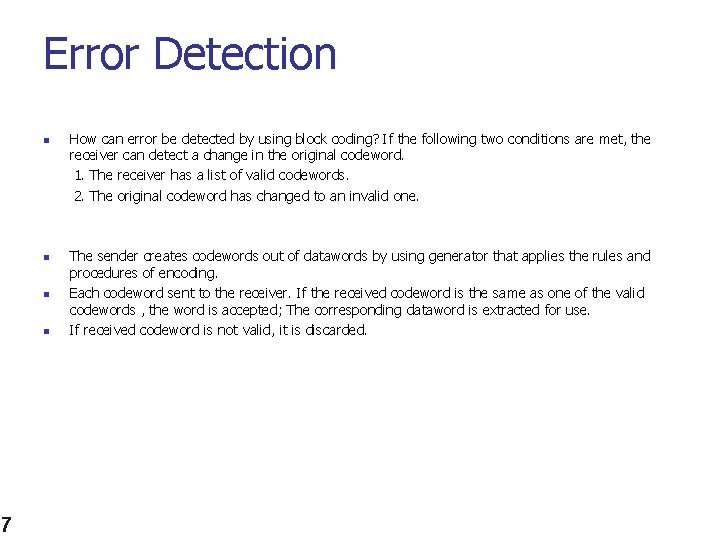
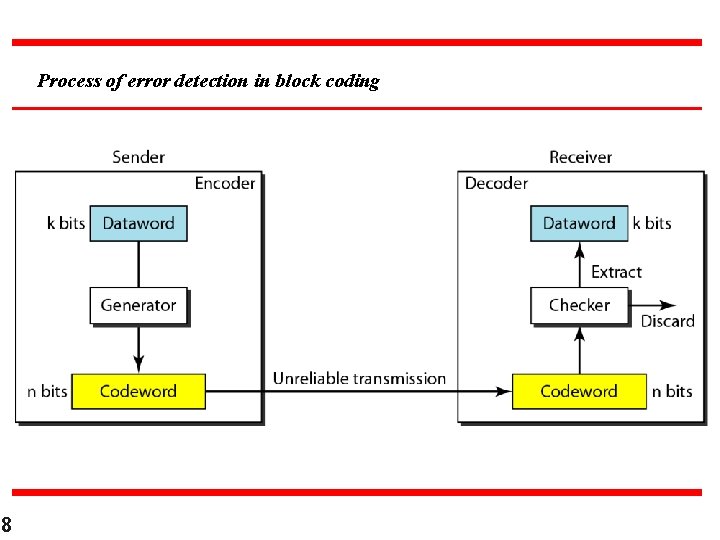
Error Detection n n 7 How can error be detected by using block coding? If the following two conditions are met, the receiver can detect a change in the original codeword. 1. The receiver has a list of valid codewords. 2. The original codeword has changed to an invalid one. The sender creates codewords out of datawords by using generator that applies the rules and procedures of encoding. Each codeword sent to the receiver. If the received codeword is the same as one of the valid codewords , the word is accepted; The corresponding dataword is extracted for use. If received codeword is not valid, it is discarded.
Process of error detection in block coding 8
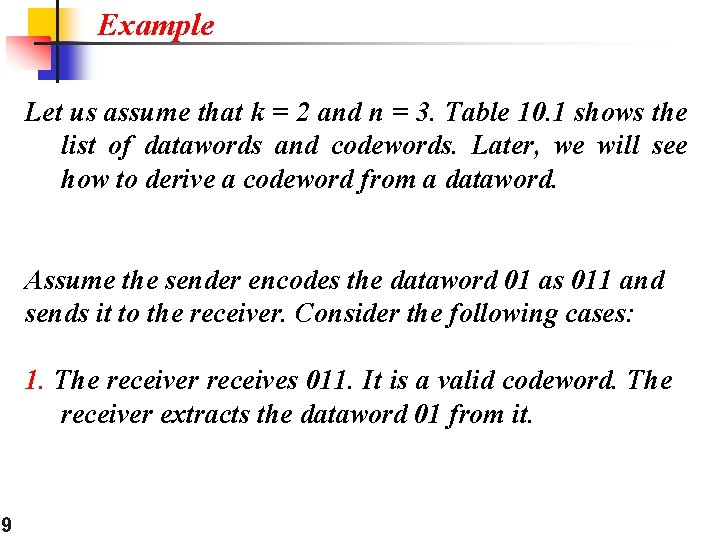
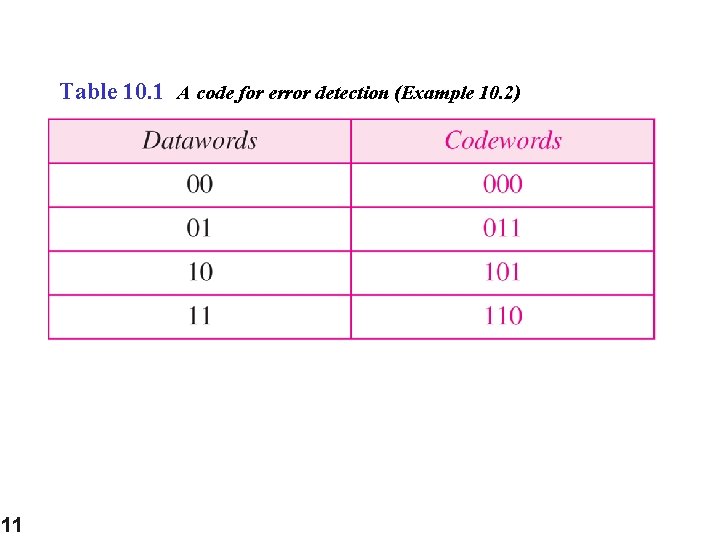
Example Let us assume that k = 2 and n = 3. Table 10. 1 shows the list of datawords and codewords. Later, we will see how to derive a codeword from a dataword. Assume the sender encodes the dataword 01 as 011 and sends it to the receiver. Consider the following cases: 1. The receiver receives 011. It is a valid codeword. The receiver extracts the dataword 01 from it. 9
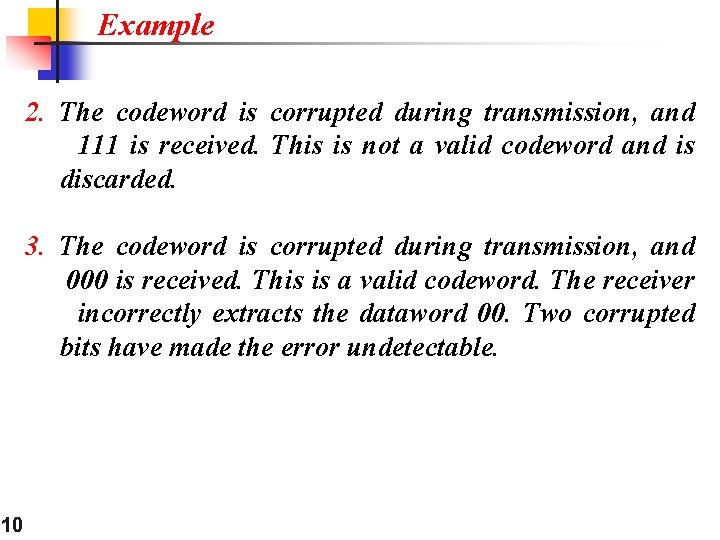
Example 2. The codeword is corrupted during transmission, and 111 is received. This is not a valid codeword and is discarded. 3. The codeword is corrupted during transmission, and 000 is received. This is a valid codeword. The receiver incorrectly extracts the dataword 00. Two corrupted bits have made the error undetectable. 10
Table 10. 1 A code for error detection (Example 10. 2) 11
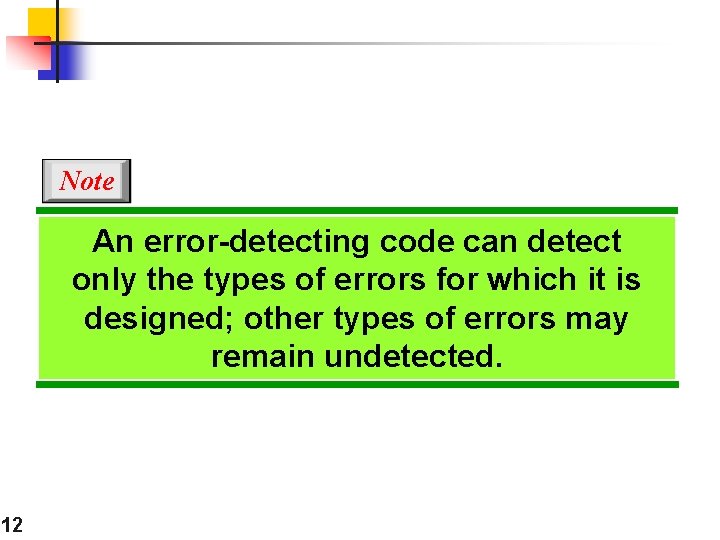
Note An error-detecting code can detect only the types of errors for which it is designed; other types of errors may remain undetected. 12
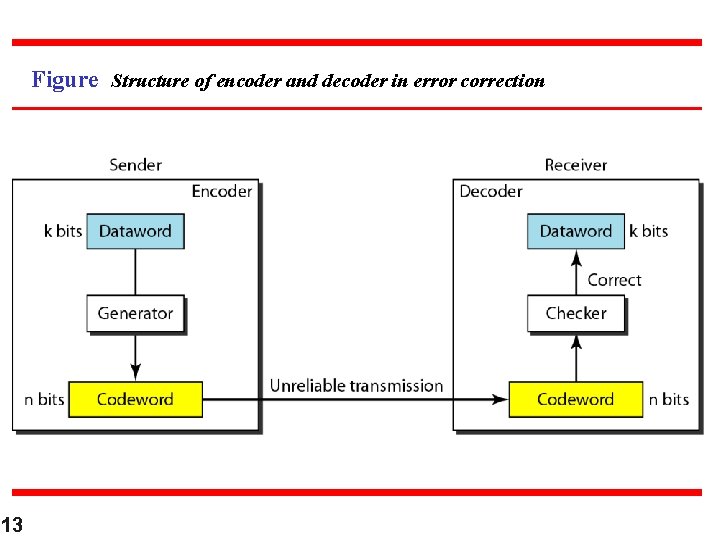
Figure Structure of encoder and decoder in error correction 13
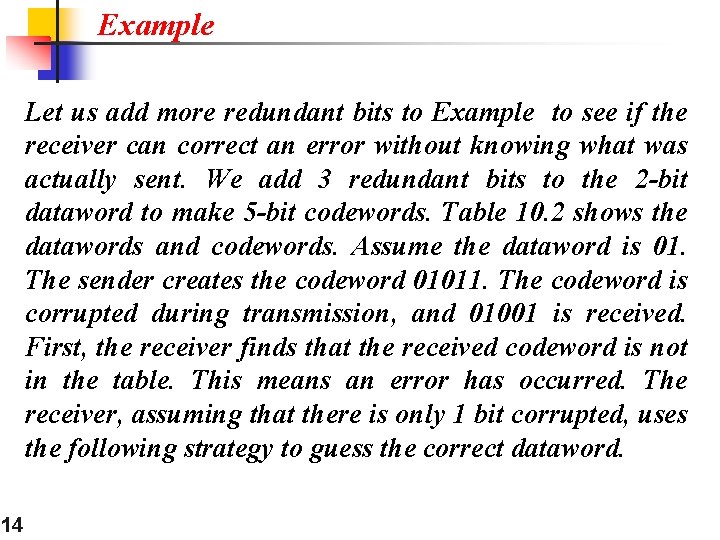
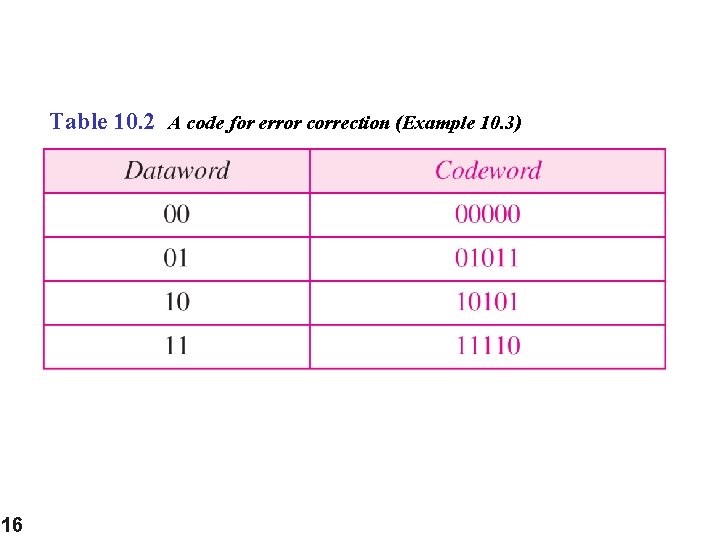
Example Let us add more redundant bits to Example to see if the receiver can correct an error without knowing what was actually sent. We add 3 redundant bits to the 2 -bit dataword to make 5 -bit codewords. Table 10. 2 shows the datawords and codewords. Assume the dataword is 01. The sender creates the codeword 01011. The codeword is corrupted during transmission, and 01001 is received. First, the receiver finds that the received codeword is not in the table. This means an error has occurred. The receiver, assuming that there is only 1 bit corrupted, uses the following strategy to guess the correct dataword. 14
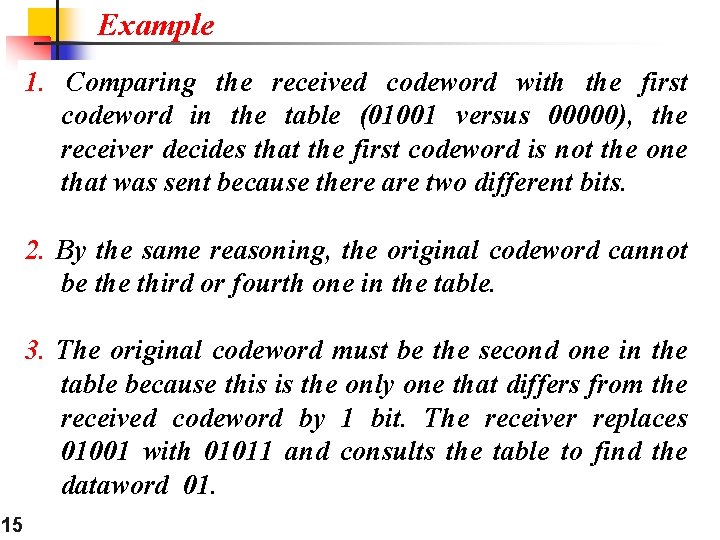
Example 1. Comparing the received codeword with the first codeword in the table (01001 versus 00000), the receiver decides that the first codeword is not the one that was sent because there are two different bits. 2. By the same reasoning, the original codeword cannot be third or fourth one in the table. 3. The original codeword must be the second one in the table because this is the only one that differs from the received codeword by 1 bit. The receiver replaces 01001 with 01011 and consults the table to find the dataword 01. 15
Table 10. 2 A code for error correction (Example 10. 3) 16
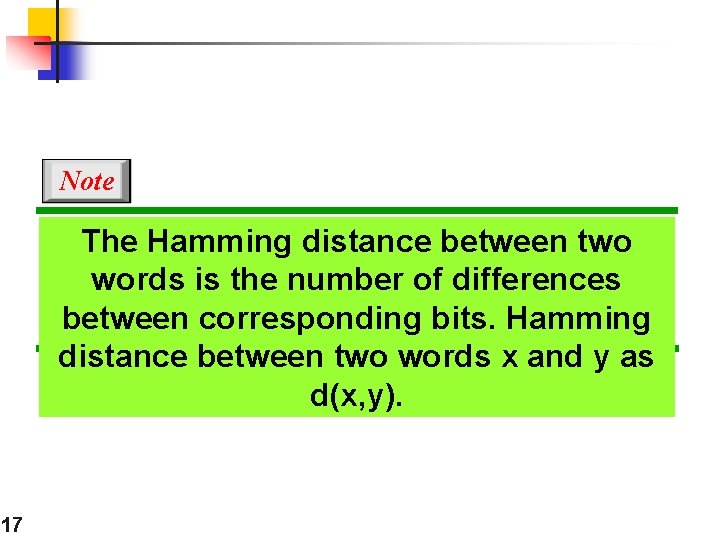
Note The Hamming distance between two words is the number of differences between corresponding bits. Hamming distance between two words x and y as d(x, y). 17
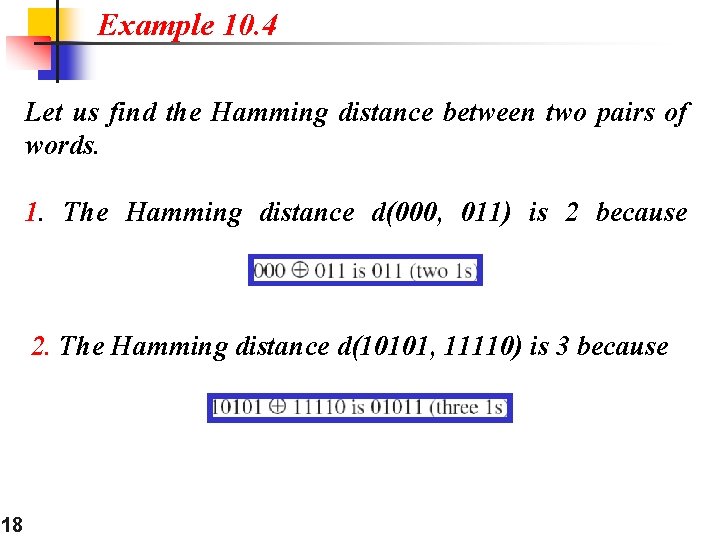
Example 10. 4 Let us find the Hamming distance between two pairs of words. 1. The Hamming distance d(000, 011) is 2 because 2. The Hamming distance d(10101, 11110) is 3 because 18
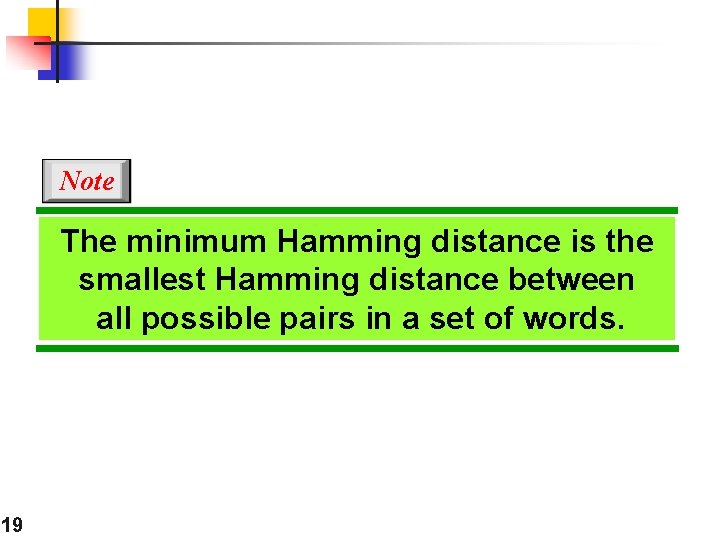
Note The minimum Hamming distance is the smallest Hamming distance between all possible pairs in a set of words. 19
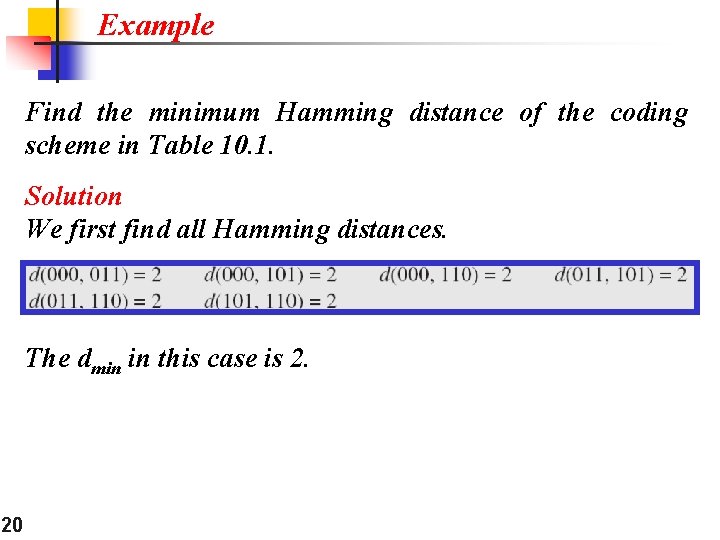
Example Find the minimum Hamming distance of the coding scheme in Table 10. 1. Solution We first find all Hamming distances. The dmin in this case is 2. 20
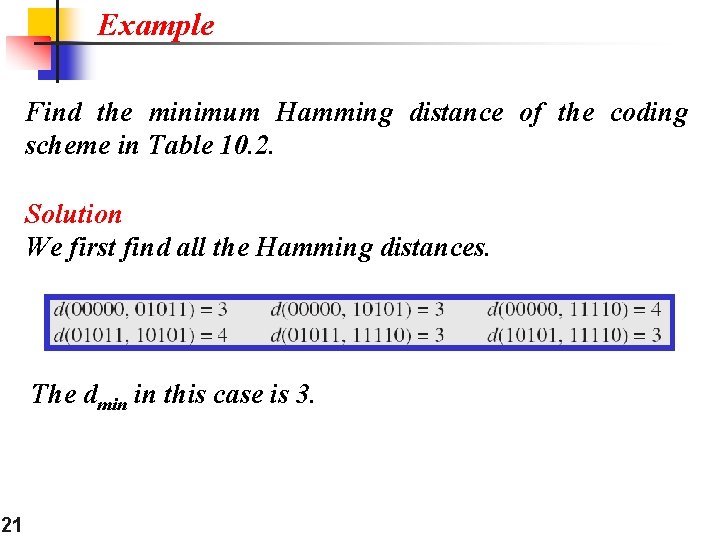
Example Find the minimum Hamming distance of the coding scheme in Table 10. 2. Solution We first find all the Hamming distances. The dmin in this case is 3. 21
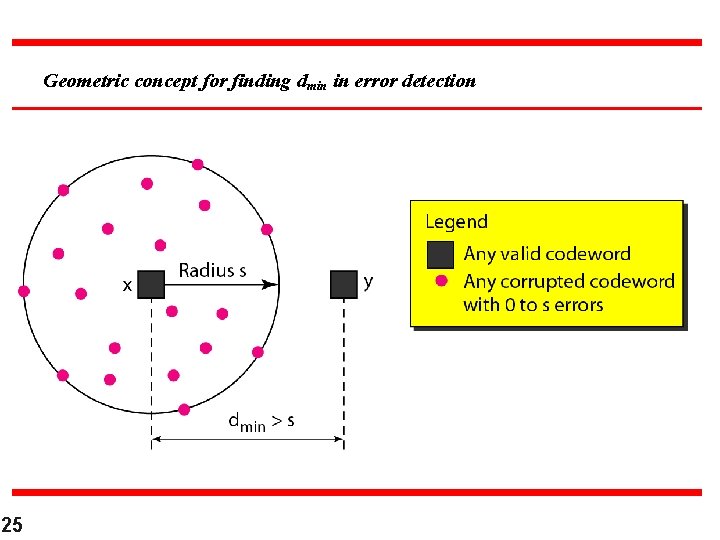
Note To guarantee the detection of up to s errors in all cases, the minimum Hamming distance in a block code must be dmin = s + 1. 22
Example The minimum Hamming distance for our first code scheme (Table 10. 1) is 2. This code guarantees detection of only a single error. For example, if the third codeword (101) is sent and one error occurs, the received codeword does not match any valid codeword. If two errors occur, however, the received codeword may match a valid codeword and the errors are not detected. 23
Example Our second block code scheme (Table 10. 2) has dmin = 3. This code can detect up to two errors. Again, we see that when any of the valid codewords is sent, two errors create a codeword which is not in the table of valid codewords. The receiver cannot be fooled. However, some combinations of three errors change a valid codeword to another valid codeword. The receiver accepts the received codeword and the errors are undetected. 24
Geometric concept for finding dmin in error detection 25
Note To guarantee correction of up to t errors in all cases, the minimum Hamming distance in a block code must be dmin = 2 t + 1. 26
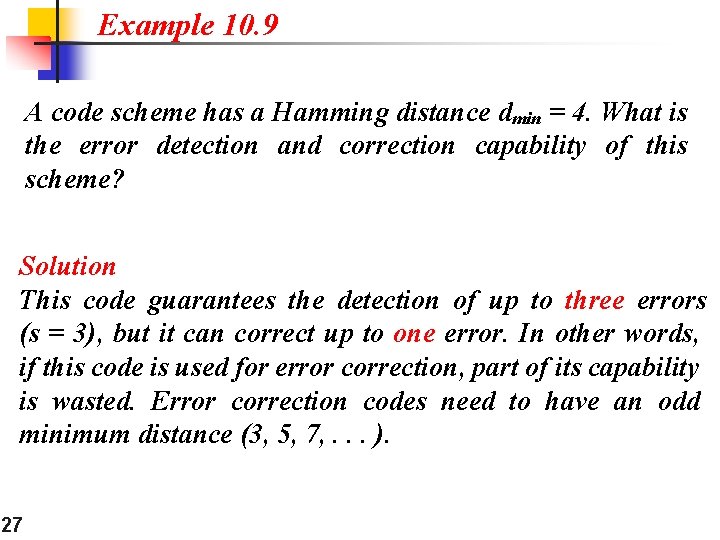
Example 10. 9 A code scheme has a Hamming distance dmin = 4. What is the error detection and correction capability of this scheme? Solution This code guarantees the detection of up to three errors (s = 3), but it can correct up to one error. In other words, if this code is used for error correction, part of its capability is wasted. Error correction codes need to have an odd minimum distance (3, 5, 7, . . . ). 27
LINEAR BLOCK CODES Almost all block codes used today belong to a subset called linear block codes. A linear block code is a code in which the exclusive OR (addition modulo-2) of two valid codewords creates another valid codeword. 28
Note In a linear block code, the exclusive OR (XOR) of any two valid codewords creates another valid codeword. 29
Example Let us see if the two codes we defined in Table 10. 1 and Table 10. 2 belong to the class of linear block codes. 1. The scheme in Table 10. 1 is a linear block code because the result of XORing any codeword with any other codeword is a valid codeword. For example, the XORing of the second and third codewords creates the fourth one. 2. The scheme in Table 10. 2 is also a linear block code. We can create all four codewords by XORing two other codewords. 30
Example In our first code (Table 10. 1), the numbers of 1 s in the nonzero codewords are 2, 2, and 2. So the minimum Hamming distance is dmin = 2. In our second code (Table 10. 2), the numbers of 1 s in the nonzero codewords are 3, 3, and 4. So in this code we have dmin = 3. 31
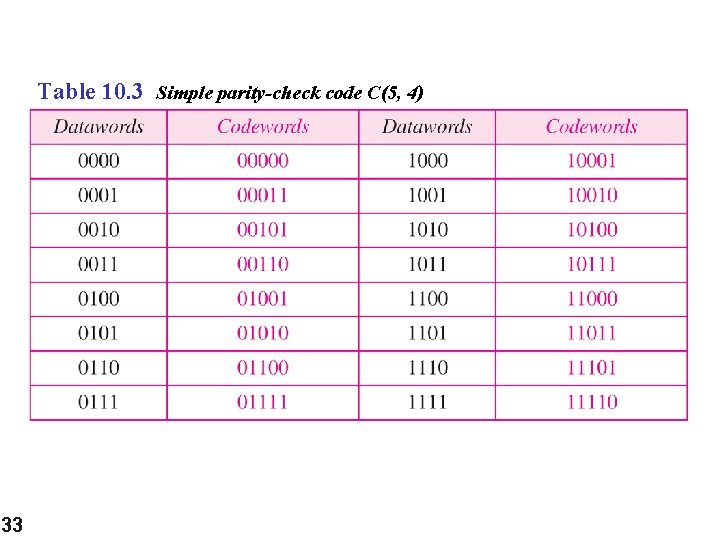
Note A simple parity-check code is a single-bit error-detecting code in which n = k + 1 with dmin = 2. 32
Table 10. 3 Simple parity-check code C(5, 4) 33
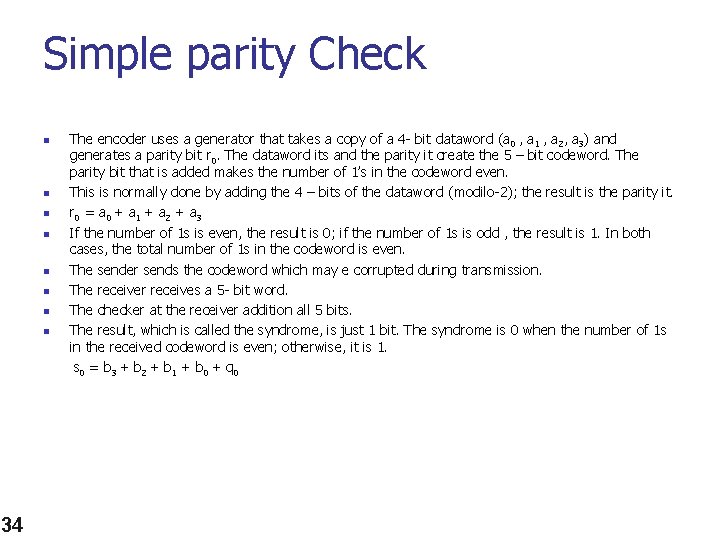
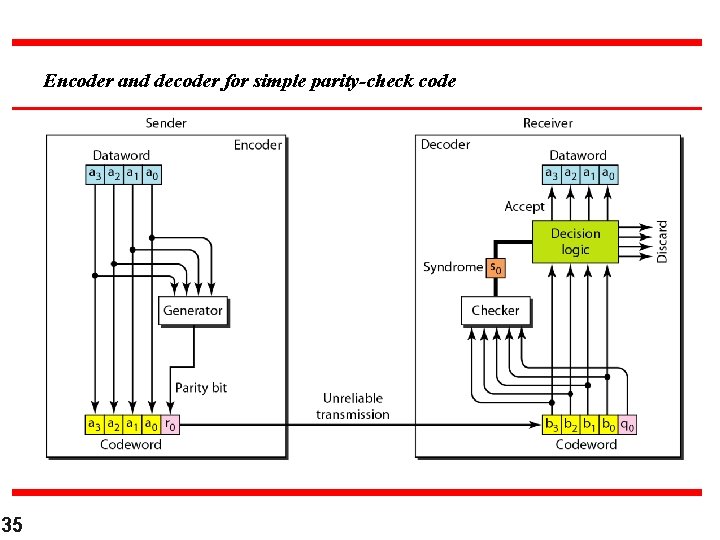
Simple parity Check n n n n 34 The encoder uses a generator that takes a copy of a 4 - bit dataword (a 0 , a 1 , a 2, a 3) and generates a parity bit r 0. The dataword its and the parity it create the 5 – bit codeword. The parity bit that is added makes the number of 1’s in the codeword even. This is normally done by adding the 4 – bits of the dataword (modilo-2); the result is the parity it. r 0 = a 0 + a 1 + a 2 + a 3 If the number of 1 s is even, the result is 0; if the number of 1 s is odd , the result is 1. In both cases, the total number of 1 s in the codeword is even. The sender sends the codeword which may e corrupted during transmission. The receiver receives a 5 - bit word. The checker at the receiver addition all 5 bits. The result, which is called the syndrome, is just 1 bit. The syndrome is 0 when the number of 1 s in the received codeword is even; otherwise, it is 1. s 0 = b 3 + b 2 + b 1 + b 0 + q 0
Encoder and decoder for simple parity-check code 35
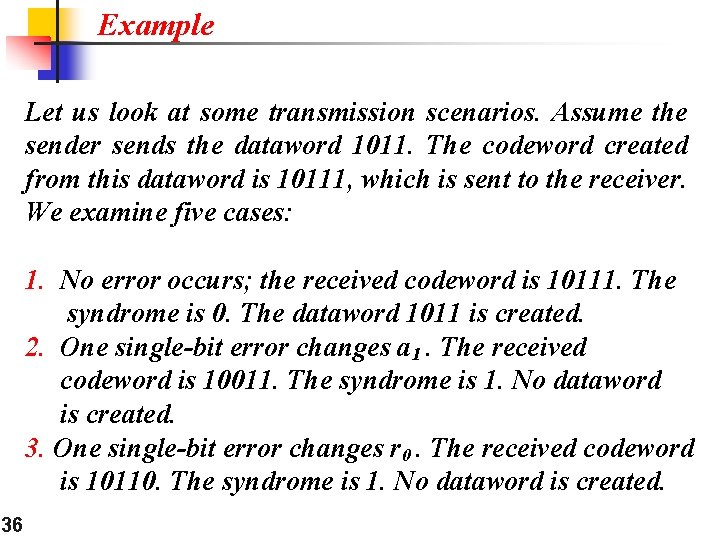
Example Let us look at some transmission scenarios. Assume the sender sends the dataword 1011. The codeword created from this dataword is 10111, which is sent to the receiver. We examine five cases: 1. No error occurs; the received codeword is 10111. The syndrome is 0. The dataword 1011 is created. 2. One single-bit error changes a 1. The received codeword is 10011. The syndrome is 1. No dataword is created. 3. One single-bit error changes r 0. The received codeword is 10110. The syndrome is 1. No dataword is created. 36
Example 4. An error changes r 0 and a second error changes a 3. The received codeword is 00110. The syndrome is 0. The dataword 0011 is created at the receiver. Note that here the dataword is wrongly created due to the syndrome value. 5. Three bits—a 3, a 2, and a 1—are changed by errors. The received codeword is 01011. The syndrome is 1. The dataword is not created. This shows that the simple parity check, guaranteed to detect one single error, can also find any odd number of errors. 37
Note A simple parity-check code can detect an odd number of errors. 38
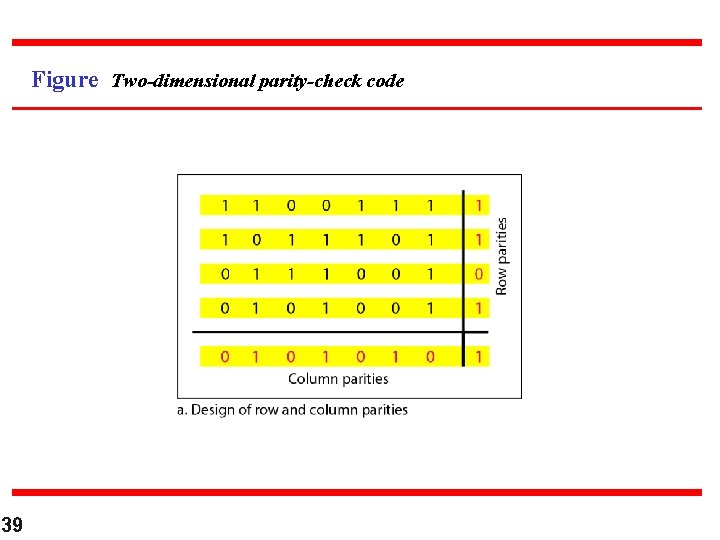
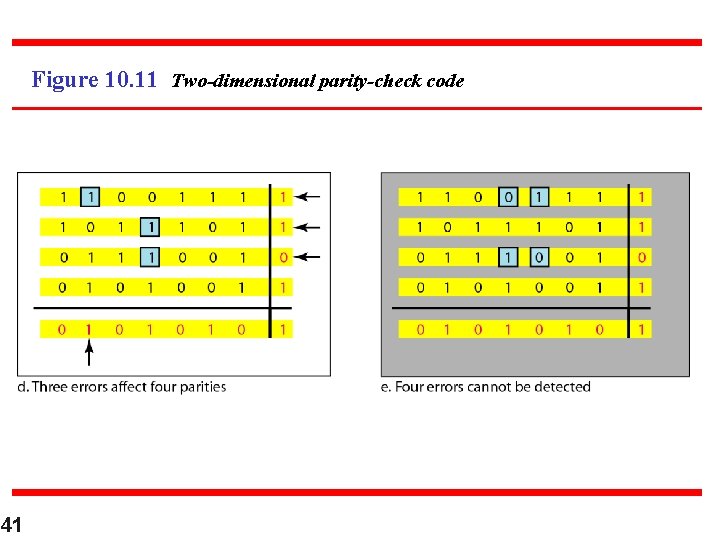
Figure Two-dimensional parity-check code 39
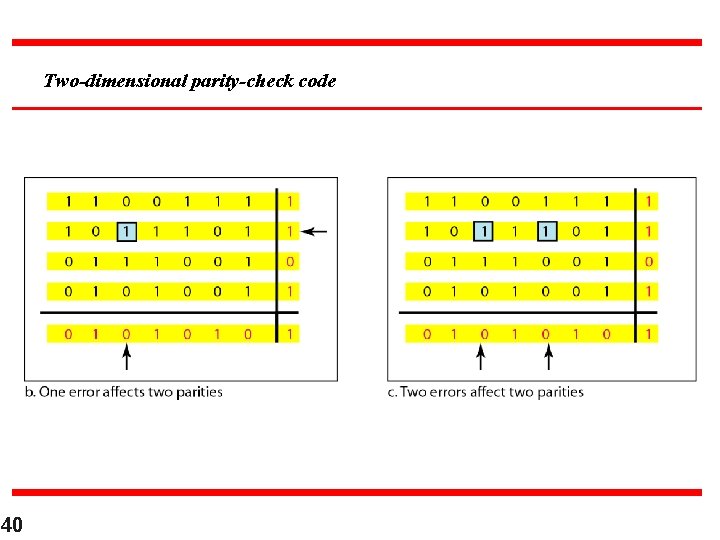
Two-dimensional parity-check code 40
Figure 10. 11 Two-dimensional parity-check code 41
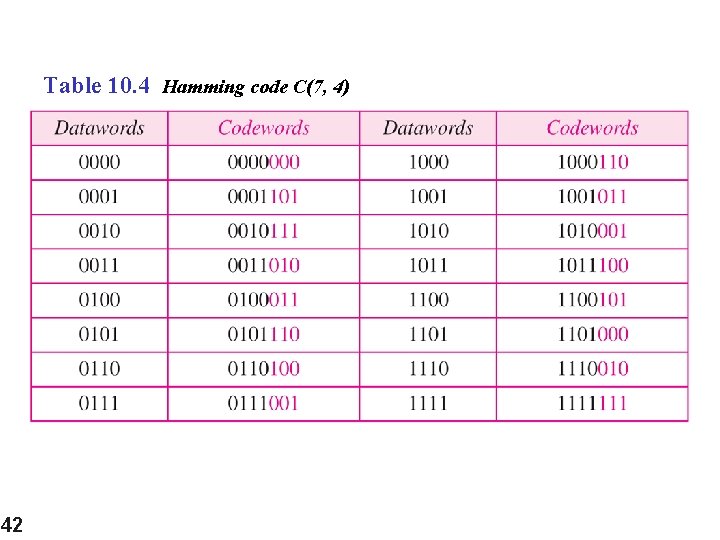
Table 10. 4 Hamming code C(7, 4) 42
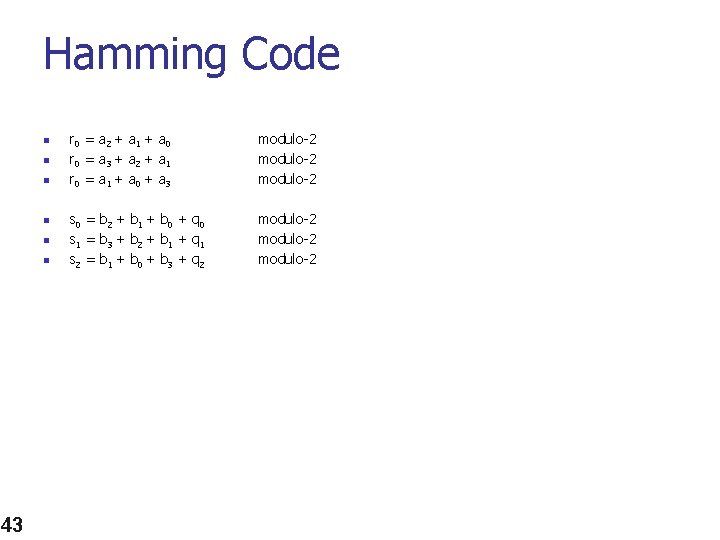
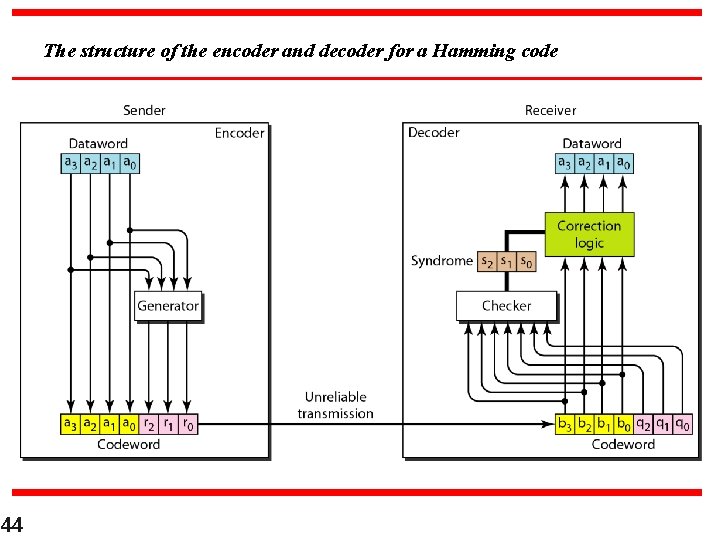
Hamming Code n n n 43 r 0 = a 2 + a 1 + a 0 r 0 = a 3 + a 2 + a 1 r 0 = a 1 + a 0 + a 3 modulo-2 s 0 = b 2 + b 1 + b 0 + q 0 s 1 = b 3 + b 2 + b 1 + q 1 s 2 = b 1 + b 0 + b 3 + q 2 modulo-2
The structure of the encoder and decoder for a Hamming code 44
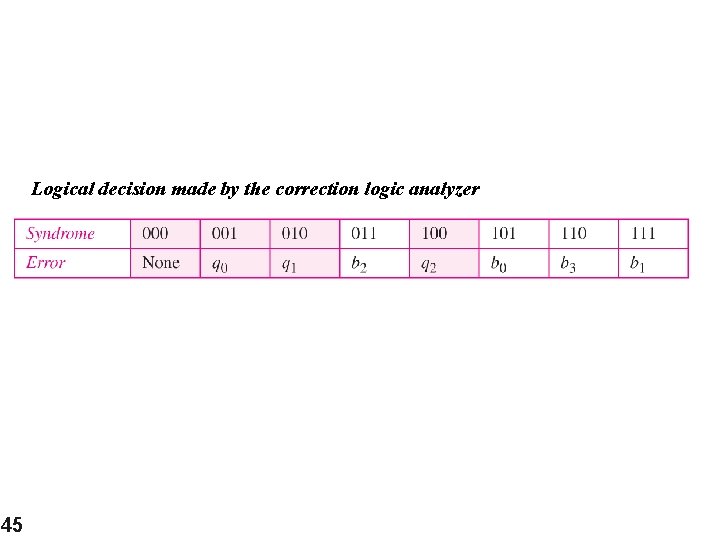
Logical decision made by the correction logic analyzer 45
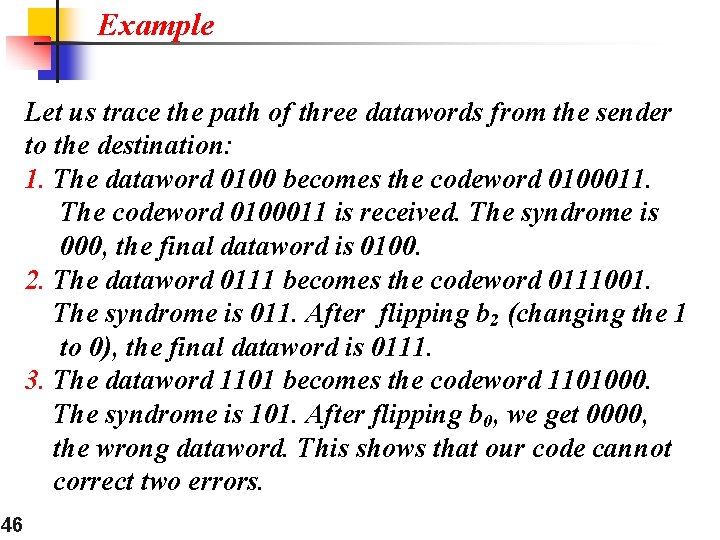
Example Let us trace the path of three datawords from the sender to the destination: 1. The dataword 0100 becomes the codeword 0100011. The codeword 0100011 is received. The syndrome is 000, the final dataword is 0100. 2. The dataword 0111 becomes the codeword 0111001. The syndrome is 011. After flipping b 2 (changing the 1 to 0), the final dataword is 0111. 3. The dataword 1101 becomes the codeword 1101000. The syndrome is 101. After flipping b 0, we get 0000, the wrong dataword. This shows that our code cannot correct two errors. 46
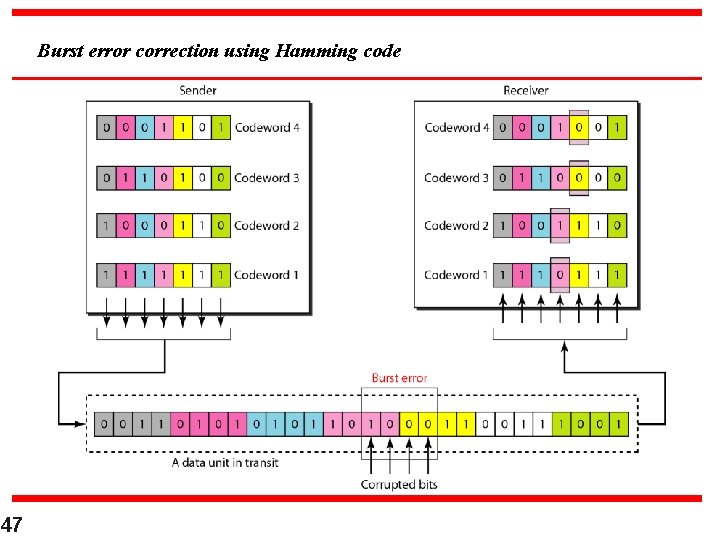
Burst error correction using Hamming code 47
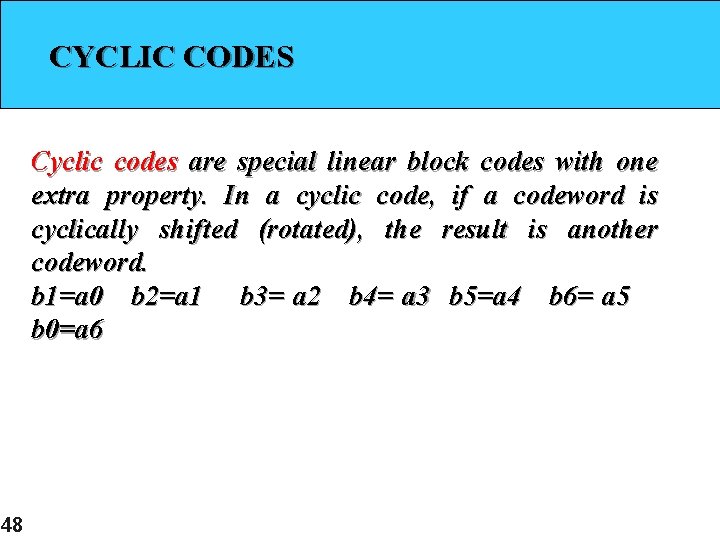
CYCLIC CODES Cyclic codes are special linear block codes with one extra property. In a cyclic code, if a codeword is cyclically shifted (rotated), the result is another codeword. b 1=a 0 b 2=a 1 b 3= a 2 b 4= a 3 b 5=a 4 b 6= a 5 b 0=a 6 48
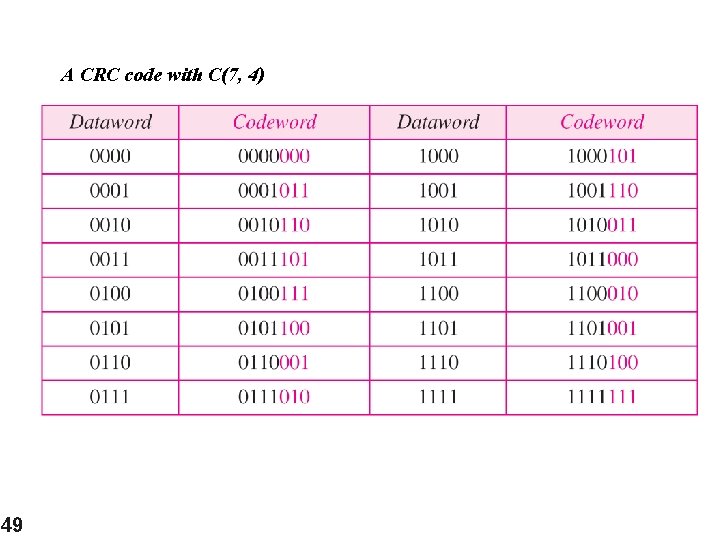
A CRC code with C(7, 4) 49
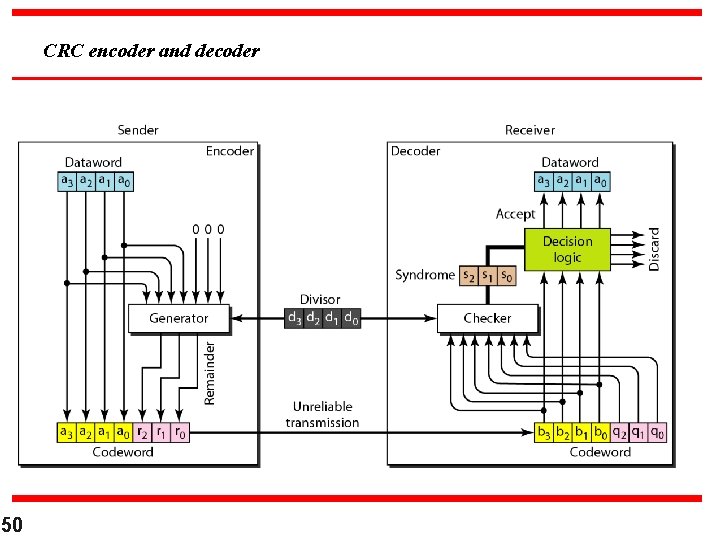
CRC encoder and decoder 50
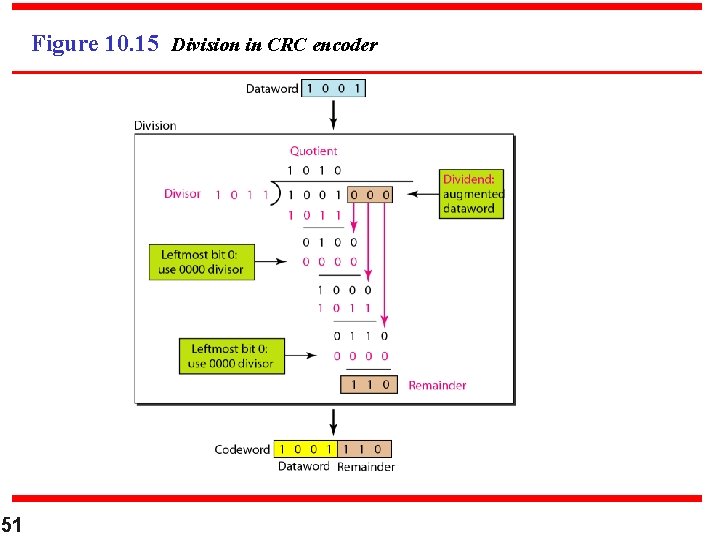
Figure 10. 15 Division in CRC encoder 51
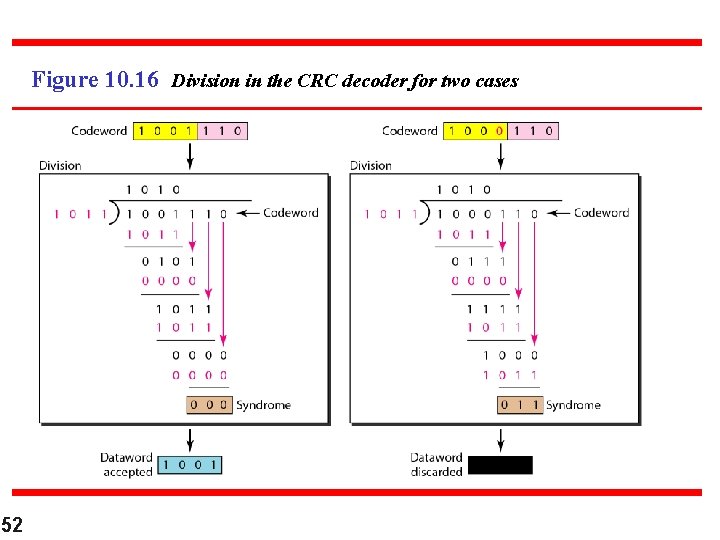
Figure 10. 16 Division in the CRC decoder for two cases 52
CHECKSUM The last error detection method we discuss here is called the checksum. The checksum is used in the Internet by several protocols although not at the data link layer. However, we briefly discuss it here to complete our discussion on error checking 53
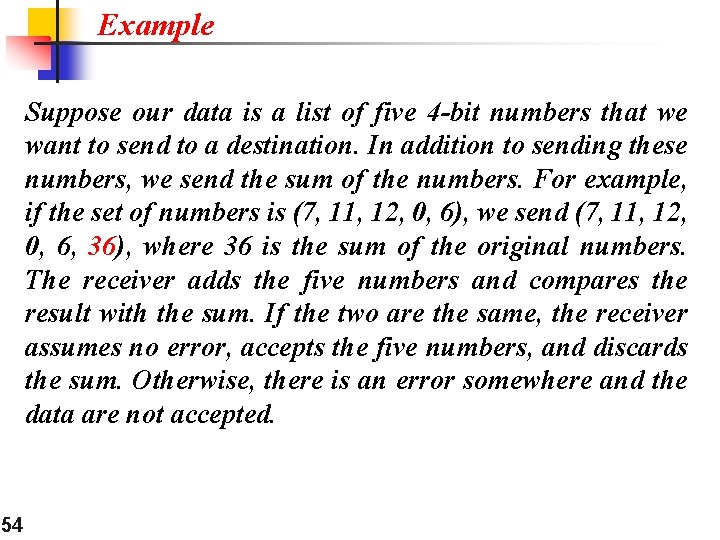
Example Suppose our data is a list of five 4 -bit numbers that we want to send to a destination. In addition to sending these numbers, we send the sum of the numbers. For example, if the set of numbers is (7, 11, 12, 0, 6), we send (7, 11, 12, 0, 6, 36), where 36 is the sum of the original numbers. The receiver adds the five numbers and compares the result with the sum. If the two are the same, the receiver assumes no error, accepts the five numbers, and discards the sum. Otherwise, there is an error somewhere and the data are not accepted. 54
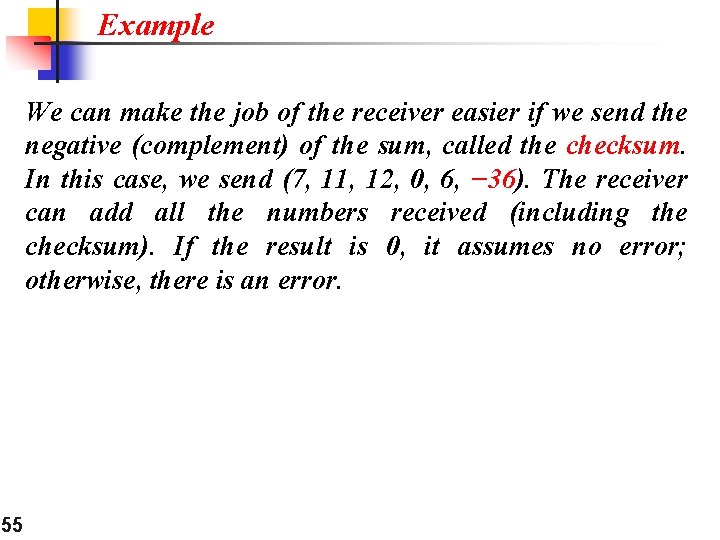
Example We can make the job of the receiver easier if we send the negative (complement) of the sum, called the checksum. In this case, we send (7, 11, 12, 0, 6, − 36). The receiver can add all the numbers received (including the checksum). If the result is 0, it assumes no error; otherwise, there is an error. 55
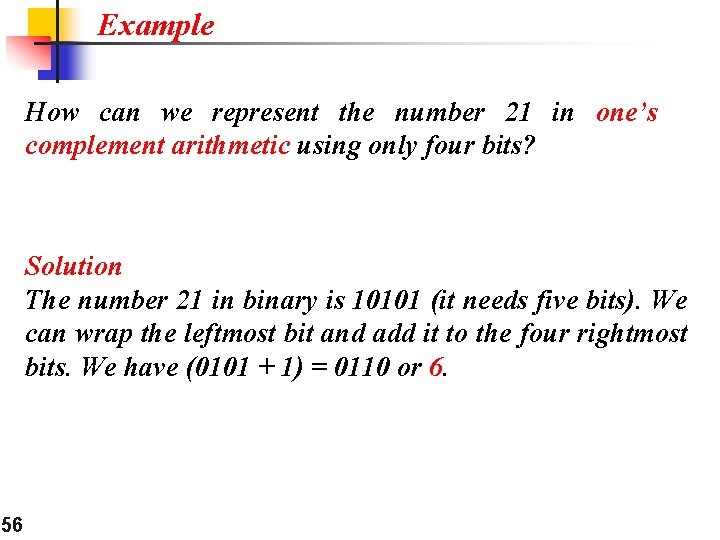
Example How can we represent the number 21 in one’s complement arithmetic using only four bits? Solution The number 21 in binary is 10101 (it needs five bits). We can wrap the leftmost bit and add it to the four rightmost bits. We have (0101 + 1) = 0110 or 6. 56
Example 10. 21 How can we represent the number − 6 in one’s complement arithmetic using only four bits? Solution In one’s complement arithmetic, the negative or complement of a number is found by inverting all bits. Positive 6 is 0110; negative 6 is 1001. If we consider only unsigned numbers, this is 9. In other words, the complement of 6 is 9. 57
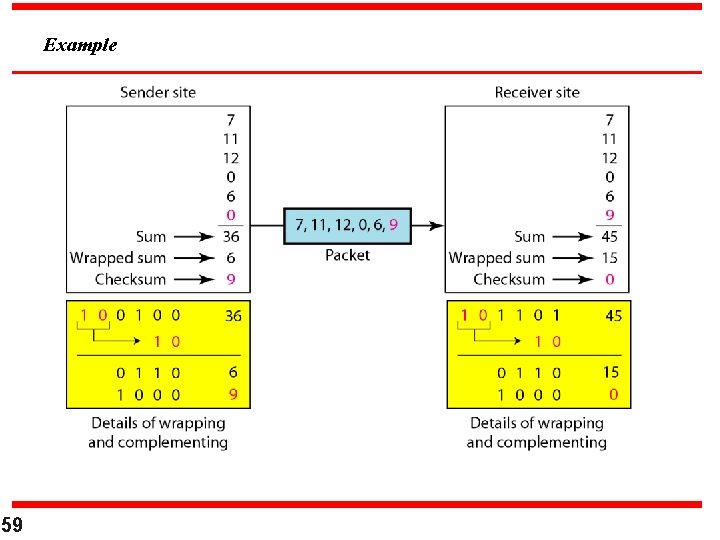
Example Let us redo Exercise 10. 19 using one’s complement arithmetic. Figure 10. 24 shows the process at the sender and at the receiver. The sender initializes the checksum to 0 and adds all data items and the checksum (the checksum is considered as one data item and is shown in color). The result is 36. However, 36 cannot be expressed in 4 bits. The extra two bits are wrapped and added with the sum to create the wrapped sum value 6. In the figure, we have shown the details in binary. The sum is then complemented, resulting in the checksum value 9 (15 − 6 = 9). The sender now sends six data items to the receiver including the checksum 9. 58
Example 59
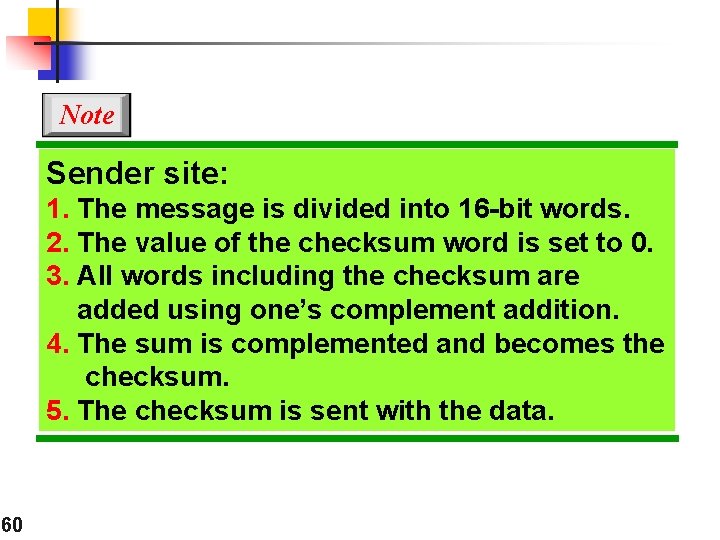
Note Sender site: 1. The message is divided into 16 -bit words. 2. The value of the checksum word is set to 0. 3. All words including the checksum are added using one’s complement addition. 4. The sum is complemented and becomes the checksum. 5. The checksum is sent with the data. 60
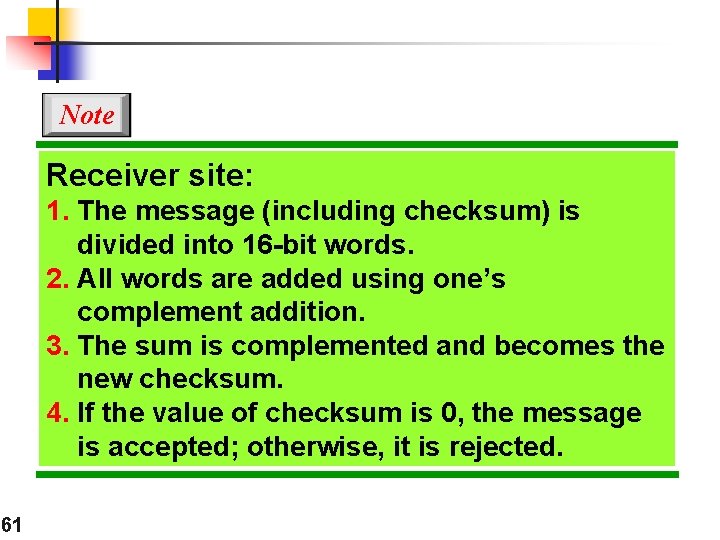
Note Receiver site: 1. The message (including checksum) is divided into 16 -bit words. 2. All words are added using one’s complement addition. 3. The sum is complemented and becomes the new checksum. 4. If the value of checksum is 0, the message is accepted; otherwise, it is rejected. 61