
Not to promote war but to preserve peace
“Not to promote war, but to preserve peace by intelligent and adequate preparation. . To study and confer on the great problems of national defense, of military science, and of responsible command. ” --Elihu Root, 1903 Leadership Development in the U. S. Army Dr. Richard A. Lacquement Jr. Dean, School of Strategic Landpower 20 May 2018
Agenda Leadership and the Professional Military Education Current era • • Missions: Army and Army War College Leadership War and Strategy The Army Professional Education U. S. Army War College approach Current environment Insights and Challenges 2
Missions The U. S. Army’s mission is to fight and win our Nation’s wars by providing prompt, sustained land dominance across the full range of military operations and spectrum of conflict in support of combatant commanders. The U. S. Army War College educates and develops leaders for service at the strategic level while advancing knowledge in the global application of Landpower.
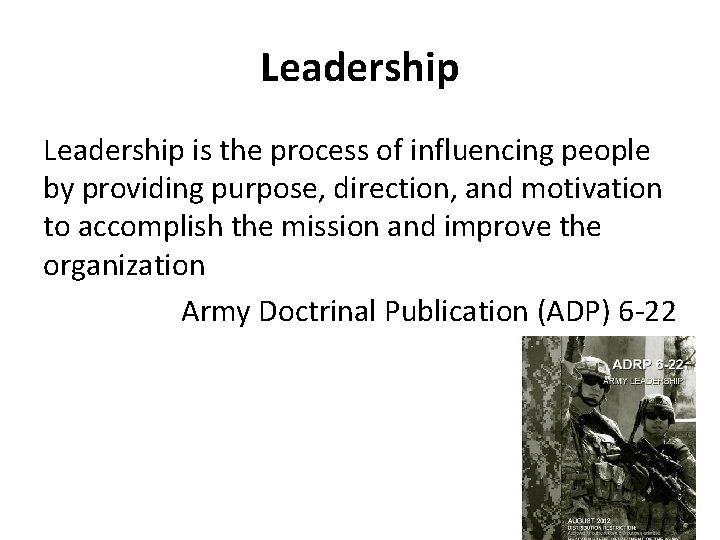
Leadership is the process of influencing people by providing purpose, direction, and motivation to accomplish the mission and improve the organization Army Doctrinal Publication (ADP) 6 -22
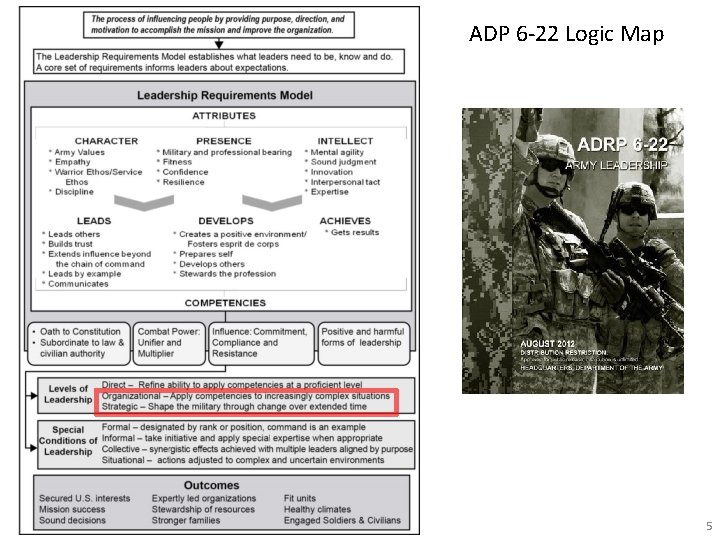
ADP 6 -22 Logic Map 5
Strategic Leaders “Strategic leaders represent a finely balanced combination of high-level thinkers, accomplished warfighters, and geopolitical military experts. Strategic leaders simultaneously sustain what is necessary in the current environment, envision the future, and convey that vision to a wide audience. They often personally spearhead change. America’s complex national security environment requires an in-depth knowledge of the diplomatic, informational, military, and economic [DIME] instruments of national power. Strategic leaders understand the interrelationships among these instruments and use them to achieve strategic ends. ” ADRP 6 -22 (2012)
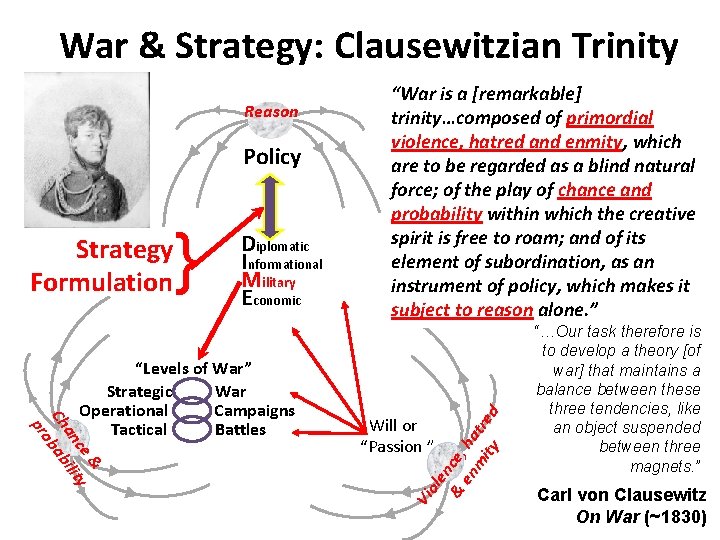
War & Strategy: Clausewitzian Trinity Strategy Formulation } Diplomatic Informational Military Economic & ce y an ilit Ch bab o pr “Levels of War” Strategic War Operational Campaigns Tactical Battles ole n & ce, en ha mi tre ty d Policy Will or “Passion ” Vi Reason “War is a [remarkable] trinity…composed of primordial violence, hatred and enmity, which are to be regarded as a blind natural force; of the play of chance and probability within which the creative spirit is free to roam; and of its element of subordination, as an instrument of policy, which makes it subject to reason alone. ” “…Our task therefore is to develop a theory [of war] that maintains a balance between these three tendencies, like an object suspended between three magnets. ” Carl von Clausewitz On War (~1830)
Army Professional Expertise Refined to reflect this quintessentially human endeavor, the core expertise of American officers can be restated as follows: The peculiar skill of the military officer is the development, operation, and leadership of a human organization—a profession—whose primary expertise is the application of coercive force on behalf of the American people; for the Army officer, such development, operation, and leadership occurs incidentally to sustaining America’s dominance in land warfare. In abbreviated form, … “Leadership of Army soldiers in the organized application of coercive force. ” Future of the Army Profession, p. 215
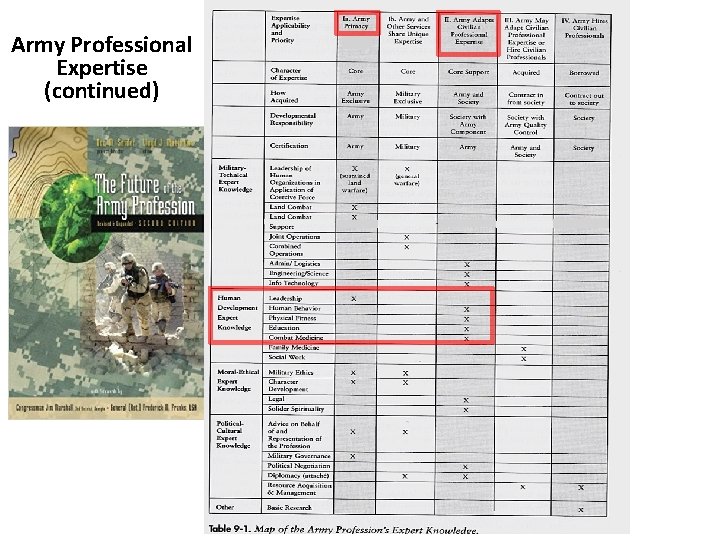
Army Professional Expertise (continued)
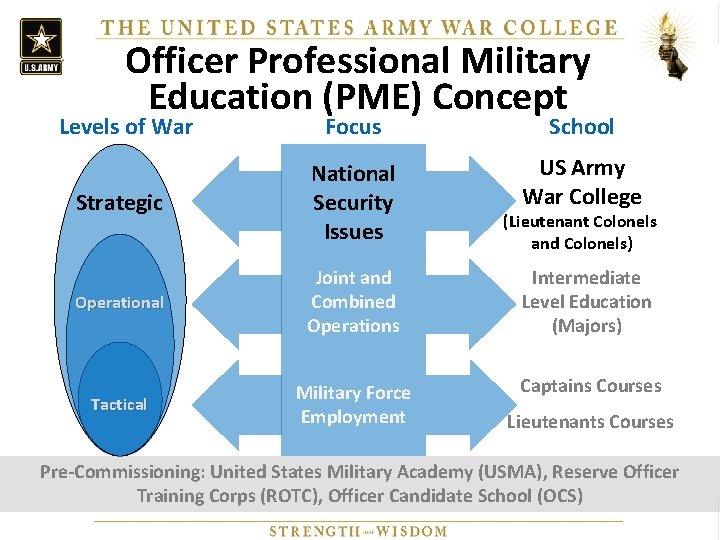
Officer Professional Military Education (PME) Concept Levels of War Focus School Strategic National Security Issues US Army War College (Lieutenant Colonels and Colonels) Operational Joint and Combined Operations Intermediate Level Education (Majors) Tactical Military Force Employment Captains Courses Lieutenants Courses Pre-Commissioning: United States Military Academy (USMA), Reserve Officer Training Corps (ROTC), Officer Candidate School (OCS)
MISSION The U. S. Army War College educates and develops leaders for service at the strategic level while advancing knowledge in the global application of Landpower. VISION Developing strategic leaders and ideas invaluable to the Army, Joint Force, and Nation.
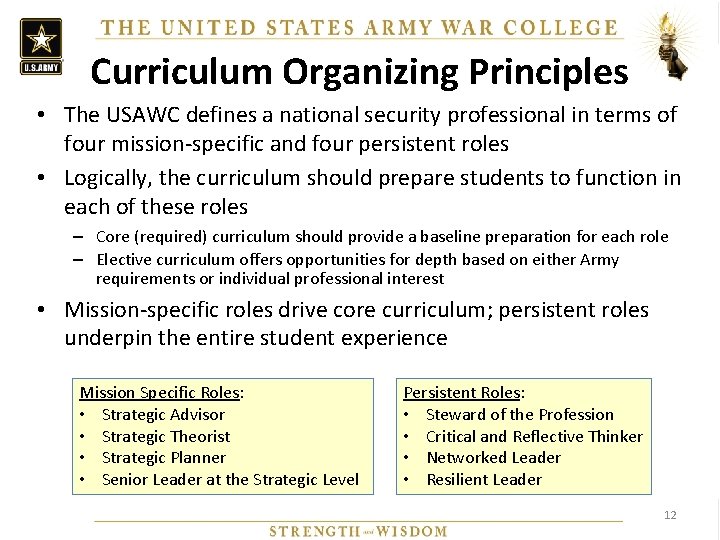
Curriculum Organizing Principles • The USAWC defines a national security professional in terms of four mission-specific and four persistent roles • Logically, the curriculum should prepare students to function in each of these roles – Core (required) curriculum should provide a baseline preparation for each role – Elective curriculum offers opportunities for depth based on either Army requirements or individual professional interest • Mission-specific roles drive core curriculum; persistent roles underpin the entire student experience Mission Specific Roles: • Strategic Advisor • Strategic Theorist • Strategic Planner • Senior Leader at the Strategic Level Persistent Roles: • Steward of the Profession • Critical and Reflective Thinker • Networked Leader • Resilient Leader 12
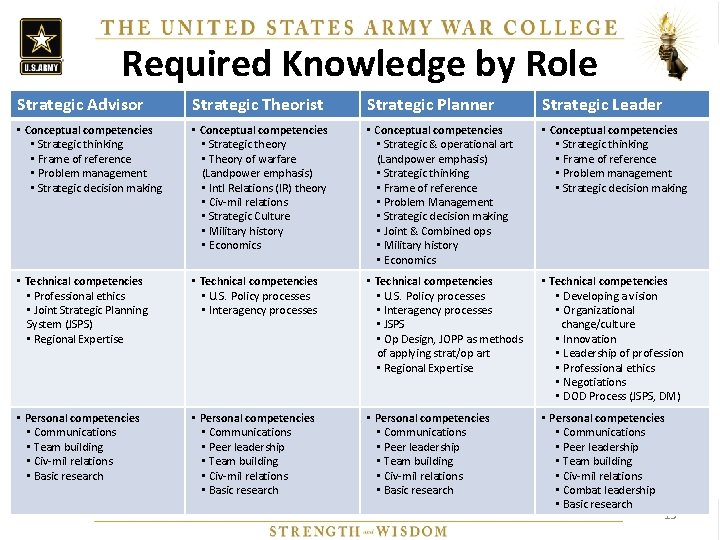
Required Knowledge by Role Strategic Advisor Strategic Theorist Strategic Planner Strategic Leader • Conceptual competencies • Strategic thinking • Frame of reference • Problem management • Strategic decision making • Conceptual competencies • Strategic theory • Theory of warfare (Landpower emphasis) • Intl Relations (IR) theory • Civ-mil relations • Strategic Culture • Military history • Economics • Conceptual competencies • Strategic & operational art (Landpower emphasis) • Strategic thinking • Frame of reference • Problem Management • Strategic decision making • Joint & Combined ops • Military history • Economics • Conceptual competencies • Strategic thinking • Frame of reference • Problem management • Strategic decision making • Technical competencies • Professional ethics • Joint Strategic Planning System (JSPS) • Regional Expertise • Technical competencies • U. S. Policy processes • Interagency processes • JSPS • Op Design, JOPP as methods of applying strat/op art • Regional Expertise • Technical competencies • Developing a vision • Organizational change/culture • Innovation • Leadership of profession • Professional ethics • Negotiations • DOD Process (JSPS, DM) • Personal competencies • Communications • Team building • Civ-mil relations • Basic research • Personal competencies • Communications • Peer leadership • Team building • Civ-mil relations • Combat leadership • Basic research 13
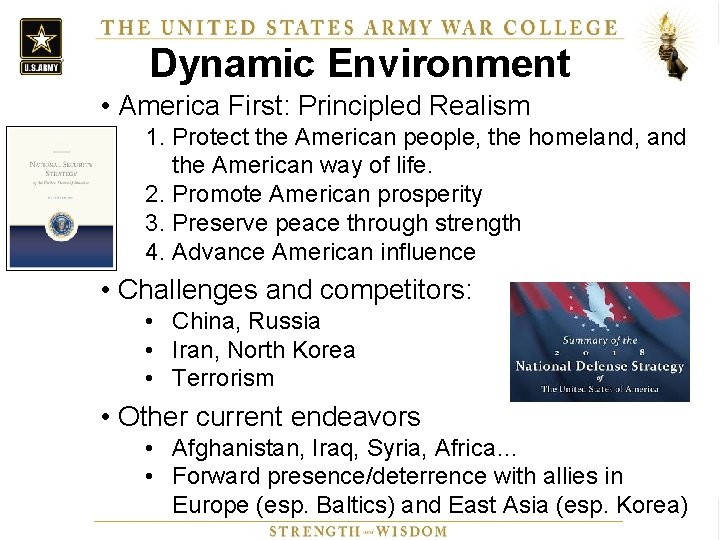
Dynamic Environment • America First: Principled Realism 1. Protect the American people, the homeland, and the American way of life. 2. Promote American prosperity 3. Preserve peace through strength 4. Advance American influence • Challenges and competitors: • China, Russia • Iran, North Korea • Terrorism • Other current endeavors • Afghanistan, Iraq, Syria, Africa… • Forward presence/deterrence with allies in Europe (esp. Baltics) and East Asia (esp. Korea)
Insights and Challenges • Relevant expertise at various levels of leadership is not necessarily the same • Leadership needs of a profession whose highest practitioners must be generalists…but whose career paths favor tactical combat expertise or other specialization • System of competing national security related professions (service, joint, intelligence, foreign service, development, and…) • National security—most acutely war—as complex, integrated and interdisciplinary by nature: requires leaders’ familiarization with many aspects of society and a daunting demand for discretionary judgment as to how they should be connected
Discussion/Questions
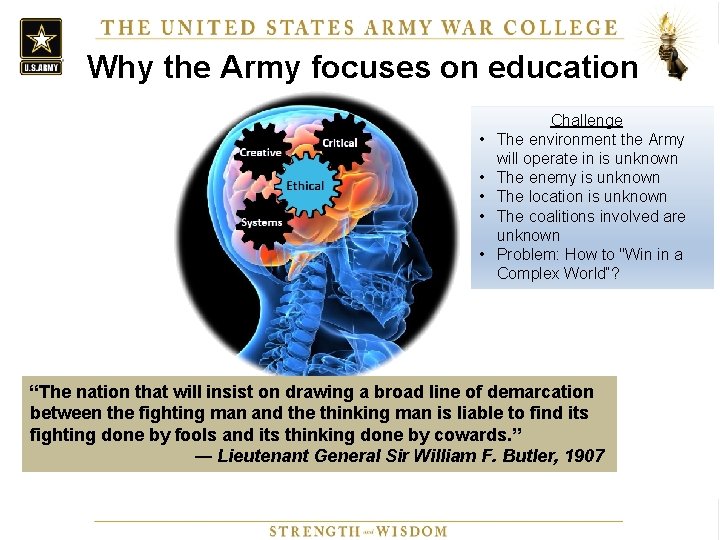
Why the Army focuses on education • • • Challenge The environment the Army will operate in is unknown The enemy is unknown The location is unknown The coalitions involved are unknown Problem: How to "Win in a Complex World“? “The nation that will insist on drawing a broad line of demarcation between the fighting man and the thinking man is liable to find its fighting done by fools and its thinking done by cowards. ” ― Lieutenant General Sir William F. Butler, 1907
Strategic Leader Attributes US National Military Strategy, June 2015 Military leaders of tomorrow require six key attributes: – Strive to understand the environment in which they operate and the effect of applying all instruments of national power – Anticipate and adapt to surprise, uncertainty, and chaos – Operate on intent through trust, empowerment, and understanding – Work to recognize change and lead transitions – Make ethical decisions based on the shared values of the Profession of Arms – Think critically and strategically in applying joint warfighting principles and concepts to joint operations
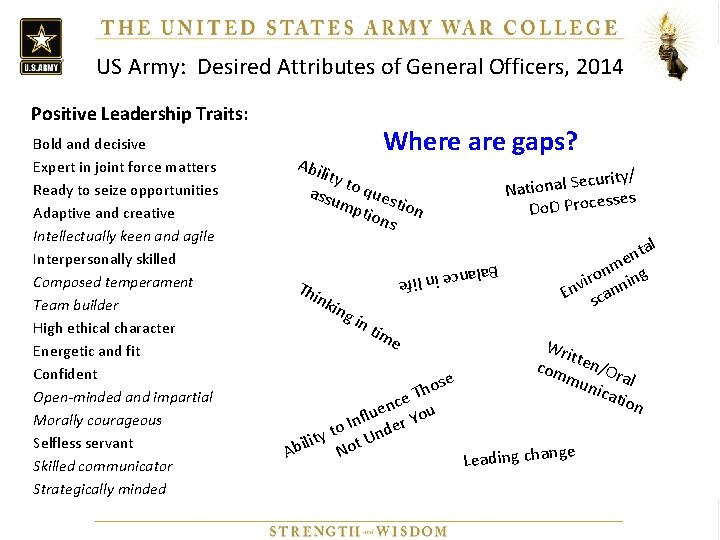
US Army: Desired Attributes of General Officers, 2014 Positive Leadership Traits: Where are gaps? Abil ity t assu o ques ti mpt ions on ink ing l in life Th curity/ e S l a n io t a N sses Do. D Proce Balance Bold and decisive Expert in joint force matters Ready to seize opportunities Adaptive and creative Intellectually keen and agile Interpersonally skilled Composed temperament Team builder High ethical character Energetic and fit Confident Open-minded and impartial Morally courageous Selfless servant Skilled communicator Strategically minded in t im e se o h T nce u nfl er Yo I o y t t Und t i l i Ab No nta e m g n o ir in Env scann Wri t com ten/O ra mu nica l tion e Leading chang

Army War College Concept Developing Leaders and Ideas Transformation to strategic leadership Innovative, respected, impactful scholarship and testing of strategic concepts Providing value to the Army, Joint Force, and Nation
Our efforts are designed to strengthen our professional community to serve American society. Our students and their program here represent an important investment by society. Key outcomes sought include: • Deepened professional development • Broadened experience • Strengthened leadership skills, particularly in transformation from tactical/operational to strategic leadership (at a minimum to advise; for many, to lead) • Mastery of appropriate civil-military relations • Increased contributions to the work of the national security profession 21
Academic Environment: What are we trying to produce? • Our product (desired outcome) is a national security professional well suited for appropriate missionspecific and persistent roles: – Prepared for service at the strategic level – Able to apply discretionary judgment with respect to the body of military professional knowledge – Well-versed in the application of Landpower • Our product is not a highly skilled bureaucrat or a narrowly focused expert in a single discipline 22
Guiding Philosophies (1 of 2) • We are a professional military school focusing on education and leadership • The Masters Degree is a recognition of the quality of our: – Faculty – Students – Curriculum • Everything we do is about developing strategic leaders and contributing relevant ideas to society 23
Guiding Philosophies (2 of 2) • Collaborative learning, seminar-based • Adult learning focus. Adults are… …internally motivated, self-directed, goal-oriented, relevancy-oriented, and practical …bring life experience and knowledge …like to be respected • How to think • Inquiry driven – Focus less on the “what” or “how” and more on the “why? ” and “so what? ” – It’s as much about asking the right questions as it is about knowing the right answers 24
“Not to promote war, but to preserve peace by intelligent and adequate preparation to repel aggression. . To study and confer on the great problems of national defense, of military science, and of responsible command. ” --Elihu Root, 1903
- Slides: 25