
Not Bohring Any More Quantum Mechanics Electron Configurations
Not Bohr-ing Any More Quantum Mechanics & Electron Configurations Chapter 5
TEK • 6(E) express the arrangement of electrons in atoms through electron configurations and Lewis valence electron dot structures

Electron Models All Models agree: – Electrons move around the nucleus – There are energy levels that electrons must be in and NEVER in between (quanta) – Higher energy levels are farther from the nucleus
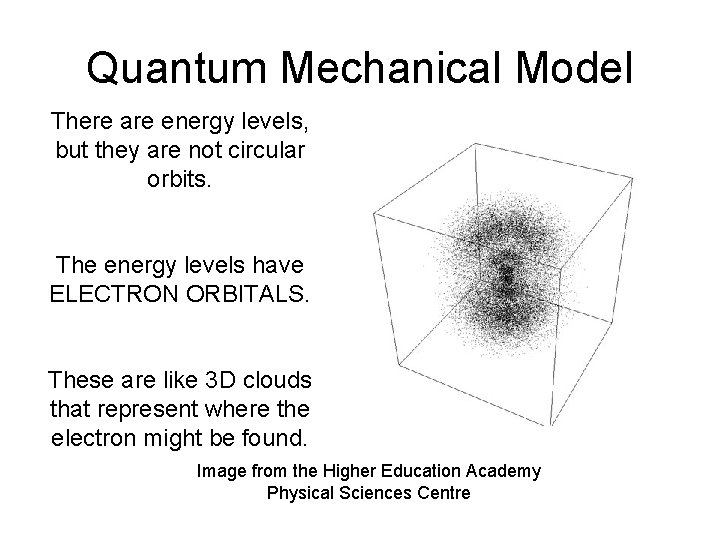
Quantum Mechanical Model There are energy levels, but they are not circular orbits. The energy levels have ELECTRON ORBITALS. These are like 3 D clouds that represent where the electron might be found. Image from the Higher Education Academy Physical Sciences Centre
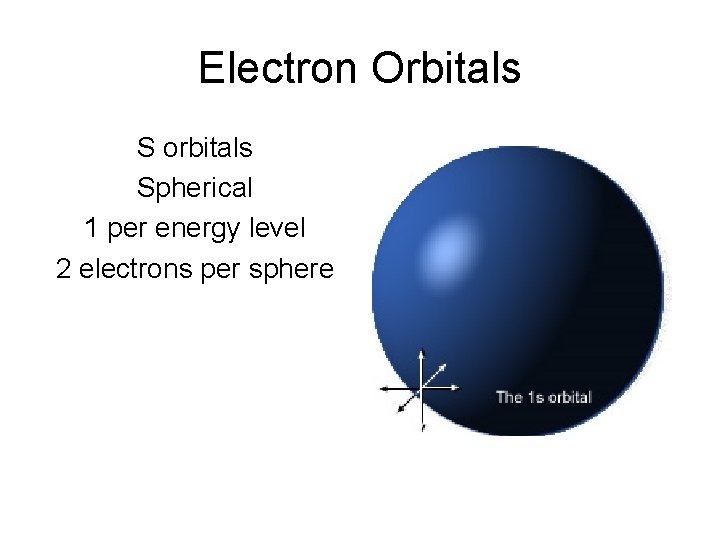
Electron Orbitals S orbitals Spherical 1 per energy level 2 electrons per sphere

Electron Orbitals P orbitals dumb bell shaped 3 per energy level 2 electrons per “dumb bell” www. geo. arizona. edu/xtal/geos 306/fall 07 -2. htm
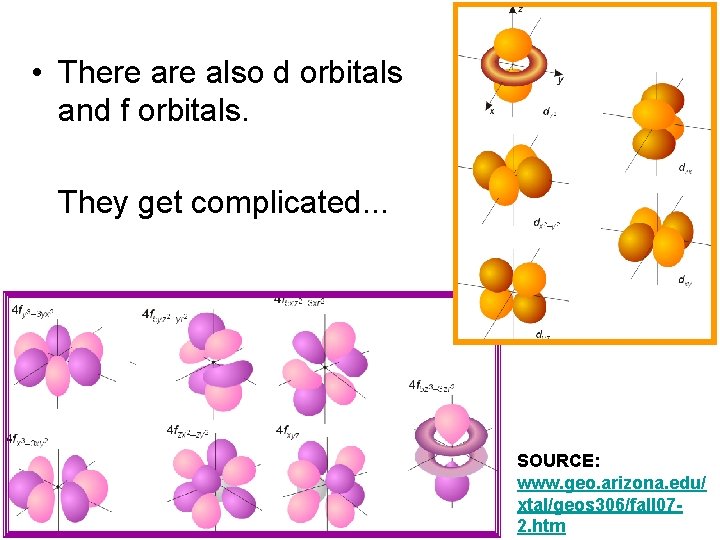
• There also d orbitals and f orbitals. They get complicated. . . SOURCE: www. geo. arizona. edu/ xtal/geos 306/fall 072. htm
Electron Orbitals • The periods on the periodic table are the energy levels of the atom. – The higher the period number, the more elctrons the atom has and the higher the energy level of the valence electrons. • The periodic table is split up into regions, called blocks. – The block where an element “lives” indicates the type of orbital that contains its valence electrons.
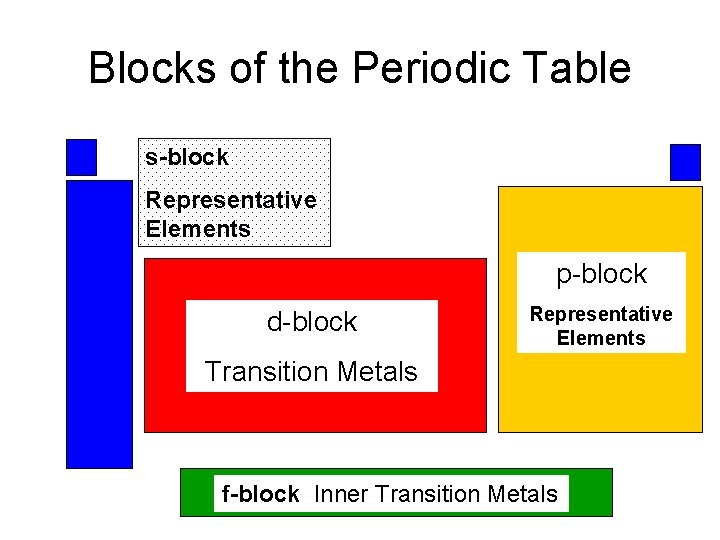
Blocks of the Periodic Table s-block Representative Elements p-block d-block Representative Elements Transition Metals f-block Inner Transition Metals
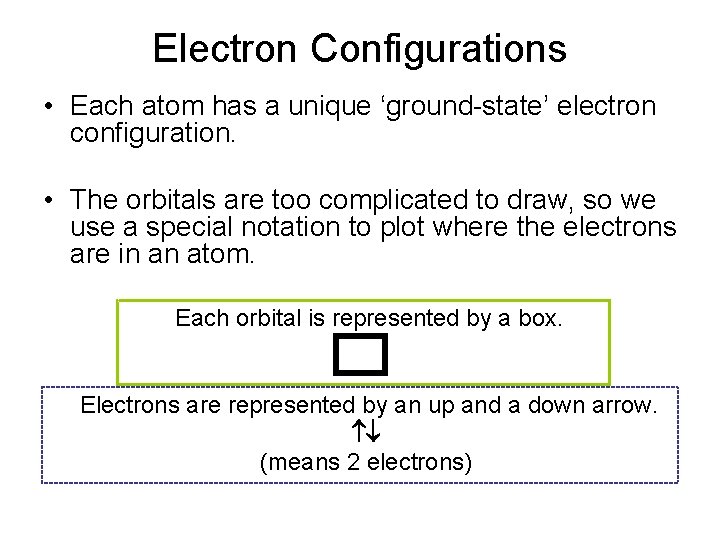
Electron Configurations • Each atom has a unique ‘ground-state’ electron configuration. • The orbitals are too complicated to draw, so we use a special notation to plot where the electrons are in an atom. Each orbital is represented by a box. Electrons are represented by an up and a down arrow. (means 2 electrons)
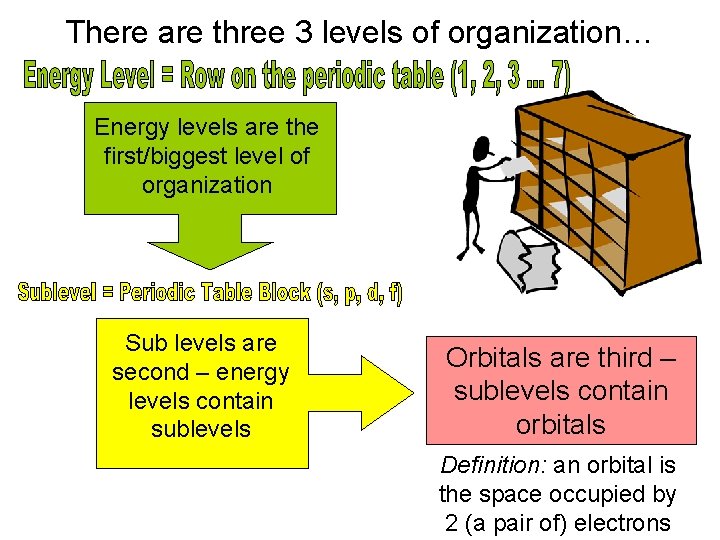
There are three 3 levels of organization… Energy levels are the first/biggest level of organization Sub levels are second – energy levels contain sublevels Orbitals are third – sublevels contain orbitals Definition: an orbital is the space occupied by 2 (a pair of) electrons
An electron configuration for an atom is like a map, telling you where the electrons can be found. There are rules that govern why an electron will be in one sub-level rather than another.
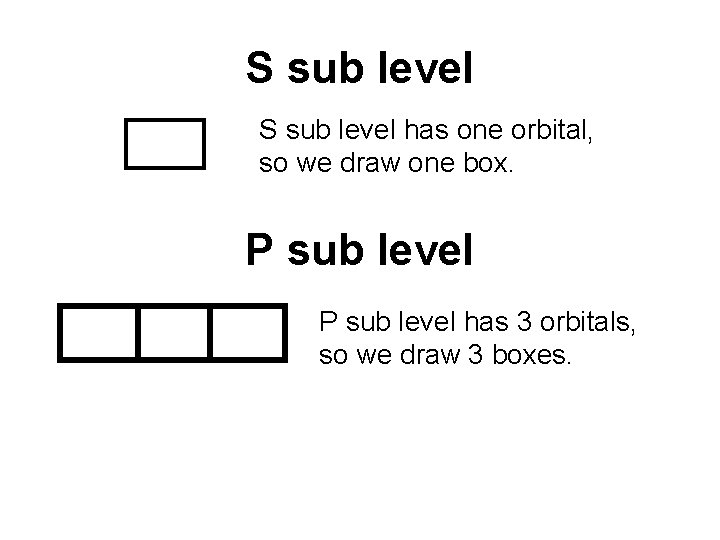
S sub level has one orbital, so we draw one box. P sub level has 3 orbitals, so we draw 3 boxes.
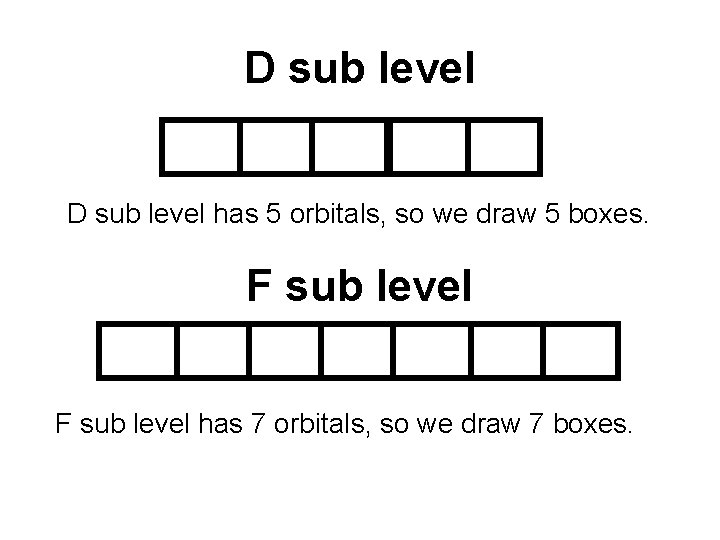
D sub level has 5 orbitals, so we draw 5 boxes. F sub level has 7 orbitals, so we draw 7 boxes.
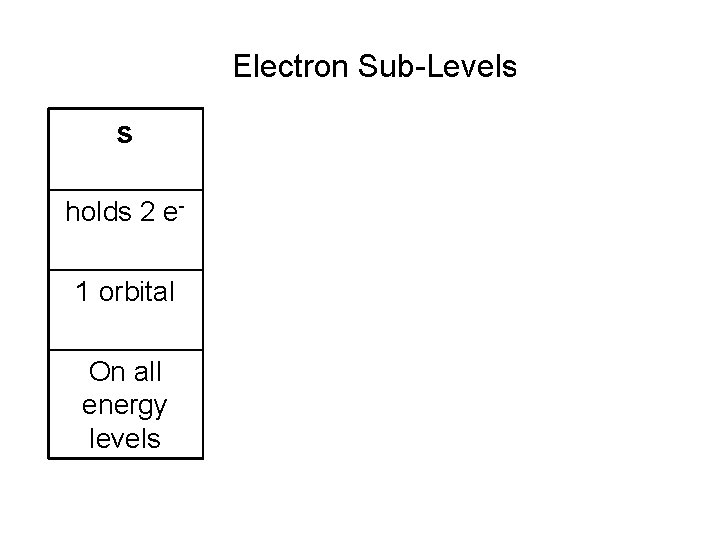
Electron Sub-Levels s holds 2 e 1 orbital On all energy levels p d f holds 6 e- holds 10 e- holds 14 e 3 orbitals 5 orbitals 7 orbitals On energy levels 2 levels 3 -6 levels 4 -5 and up
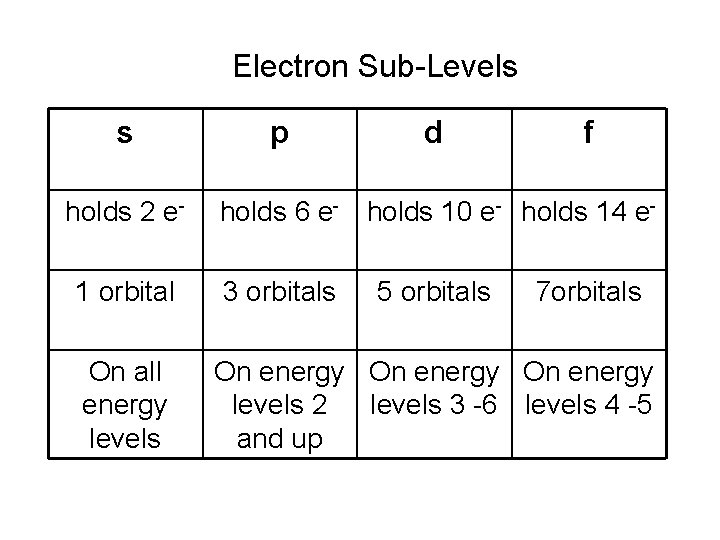
Electron Sub-Levels s holds 2 e 1 orbital On all energy levels p d f holds 6 e- holds 10 e- holds 14 e 3 orbitals 5 orbitals 7 orbitals On energy levels 2 levels 3 -6 levels 4 -5 and up
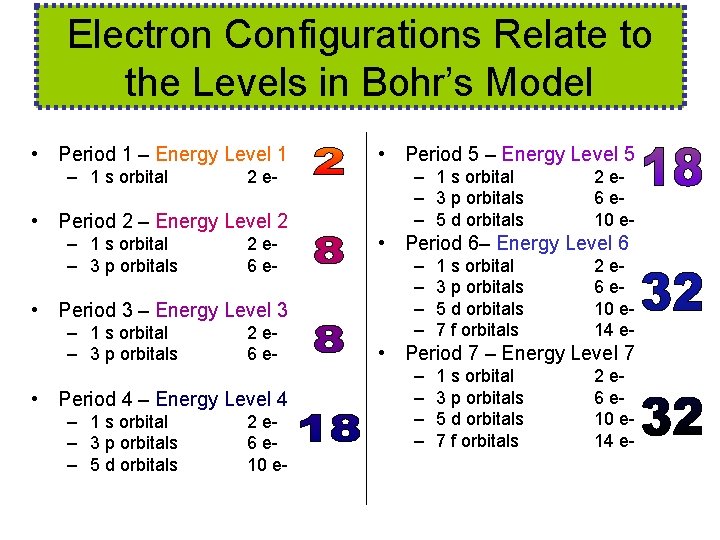
Electron Configurations Relate to the Levels in Bohr’s Model • Period 1 – Energy Level 1 – 1 s orbital 2 e- • Period 2 – Energy Level 2 – 1 s orbital – 3 p orbitals 2 e 6 e- • Period 3 – Energy Level 3 – 1 s orbital – 3 p orbitals 2 e 6 e- • Period 4 – Energy Level 4 – 1 s orbital – 3 p orbitals – 5 d orbitals 2 e 6 e 10 e- • Period 5 – Energy Level 5 – 1 s orbital – 3 p orbitals – 5 d orbitals 2 e 6 e 10 e- • Period 6– Energy Level 6 – – 1 s orbital 3 p orbitals 5 d orbitals 7 f orbitals 2 e 6 e 10 e 14 e- • Period 7 – Energy Level 7 – – 1 s orbital 3 p orbitals 5 d orbitals 7 f orbitals 2 e 6 e 10 e 14 e-
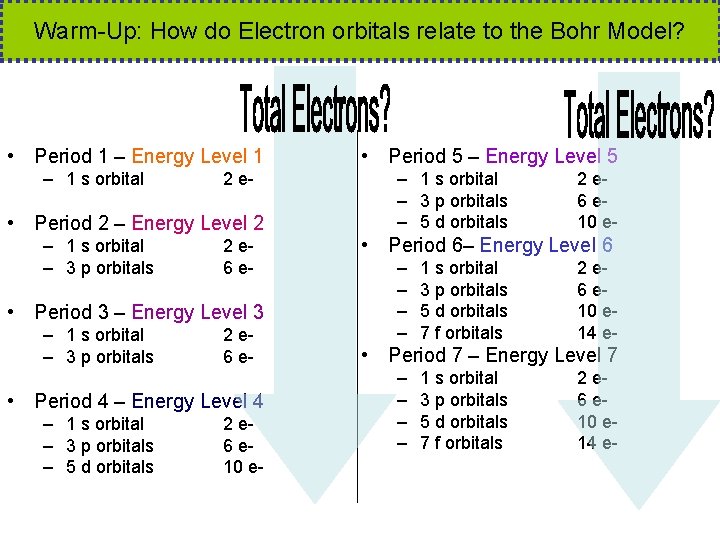
Warm-Up: How do Electron orbitals relate to the Bohr Model? • Period 1 – Energy Level 1 – 1 s orbital 2 e- • Period 2 – Energy Level 2 – 1 s orbital – 3 p orbitals 2 e 6 e- • Period 3 – Energy Level 3 – 1 s orbital – 3 p orbitals 2 e 6 e- • Period 4 – Energy Level 4 – 1 s orbital – 3 p orbitals – 5 d orbitals 2 e 6 e 10 e- • Period 5 – Energy Level 5 – 1 s orbital – 3 p orbitals – 5 d orbitals 2 e 6 e 10 e- • Period 6– Energy Level 6 – – 1 s orbital 3 p orbitals 5 d orbitals 7 f orbitals 2 e 6 e 10 e 14 e- • Period 7 – Energy Level 7 – – 1 s orbital 3 p orbitals 5 d orbitals 7 f orbitals 2 e 6 e 10 e 14 e-
Electron Configurations Rules for filling orbitals with electrons: • The Aufbau Principle – Build up from the lowest energy to the highest • The Pauli Exclusion Principle – The electrons in an orbital must be a “spin up” and “spin down” pair • Hund’s Rule – Electrons will occupy orbitals one by one before they pair up
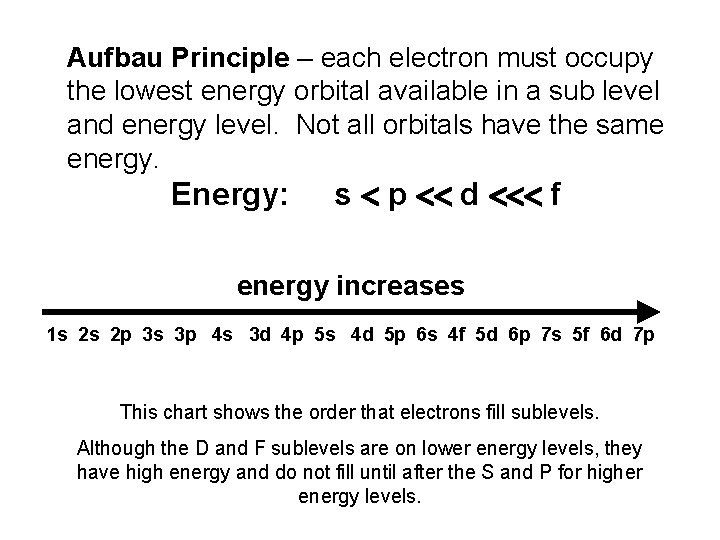
Aufbau Principle – each electron must occupy the lowest energy orbital available in a sub level and energy level. Not all orbitals have the same energy. Energy: s p d f energy increases 1 s 2 s 2 p 3 s 3 p 4 s 3 d 4 p 5 s 4 d 5 p 6 s 4 f 5 d 6 p 7 s 5 f 6 d 7 p This chart shows the order that electrons fill sublevels. Although the D and F sublevels are on lower energy levels, they have high energy and do not fill until after the S and P for higher energy levels.
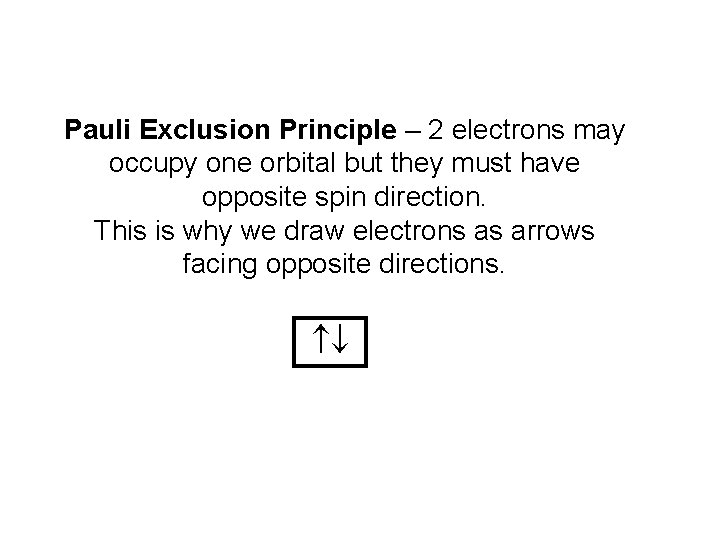
Pauli Exclusion Principle – 2 electrons may occupy one orbital but they must have opposite spin direction. This is why we draw electrons as arrows facing opposite directions.
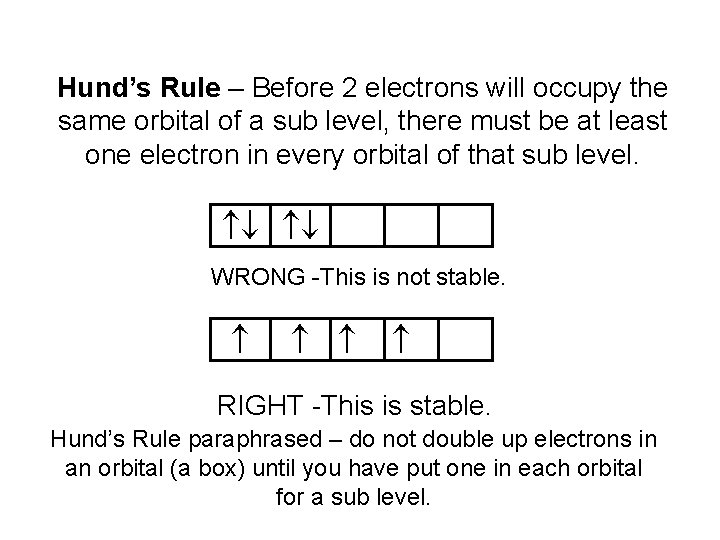
Hund’s Rule – Before 2 electrons will occupy the same orbital of a sub level, there must be at least one electron in every orbital of that sub level. WRONG -This is not stable. RIGHT -This is stable. Hund’s Rule paraphrased – do not double up electrons in an orbital (a box) until you have put one in each orbital for a sub level.
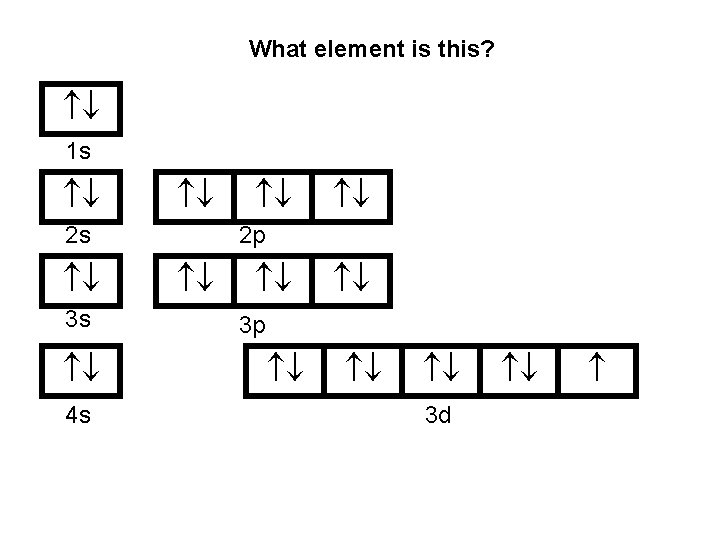
What element is this? 1 s 2 s 3 s 4 s 2 p 3 p 3 d
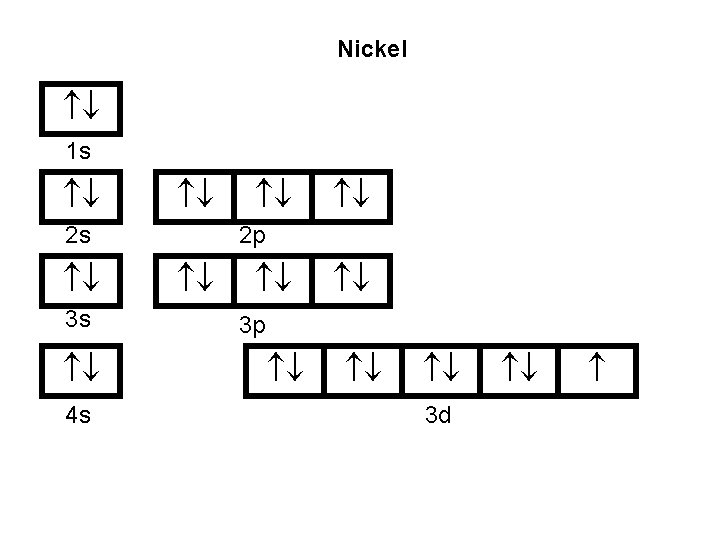
Nickel 1 s 2 s 3 s 4 s 2 p 3 p 3 d
The Periodic Table & Electron Configurations David's Whizzy Periodic Table
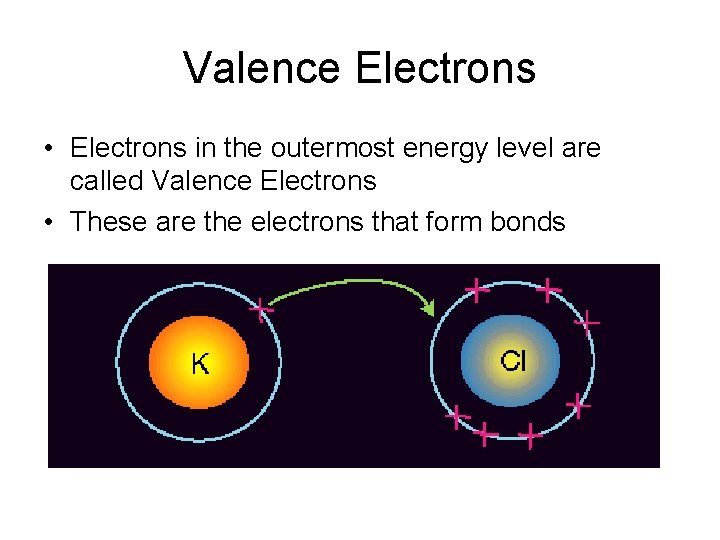
Valence Electrons • Electrons in the outermost energy level are called Valence Electrons • These are the electrons that form bonds
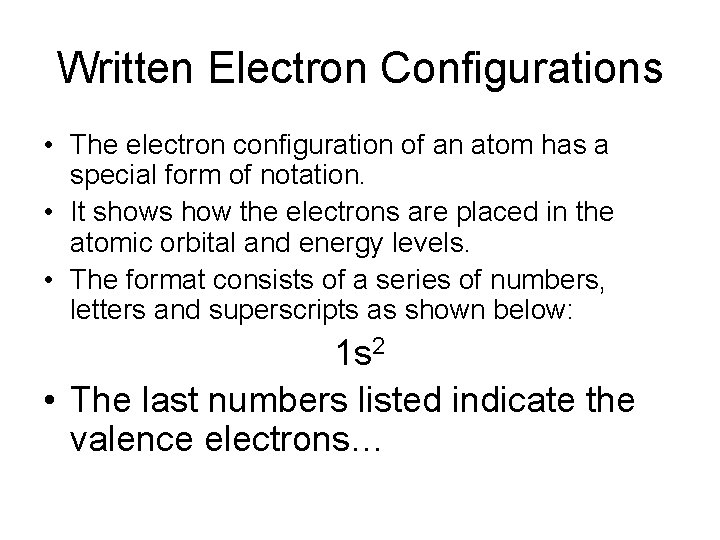
Written Electron Configurations • The electron configuration of an atom has a special form of notation. • It shows how the electrons are placed in the atomic orbital and energy levels. • The format consists of a series of numbers, letters and superscripts as shown below: 1 s 2 • The last numbers listed indicate the valence electrons…
Remember what I said about electron configurations being like a map? Let’s find some elements!
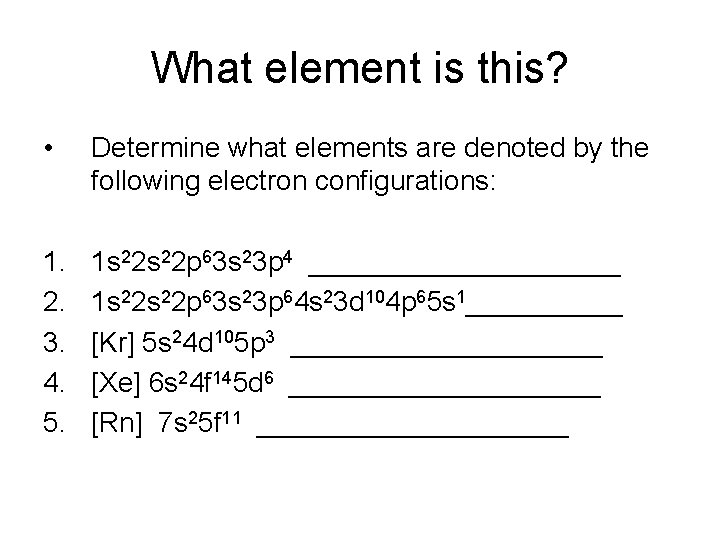
What element is this? • Determine what elements are denoted by the following electron configurations: 1. 2. 3. 4. 5. 1 s 22 p 63 s 23 p 4 __________ 1 s 22 p 63 s 23 p 64 s 23 d 104 p 65 s 1_____ [Kr] 5 s 24 d 105 p 3 __________ [Xe] 6 s 24 f 145 d 6 __________ [Rn] 7 s 25 f 11 __________
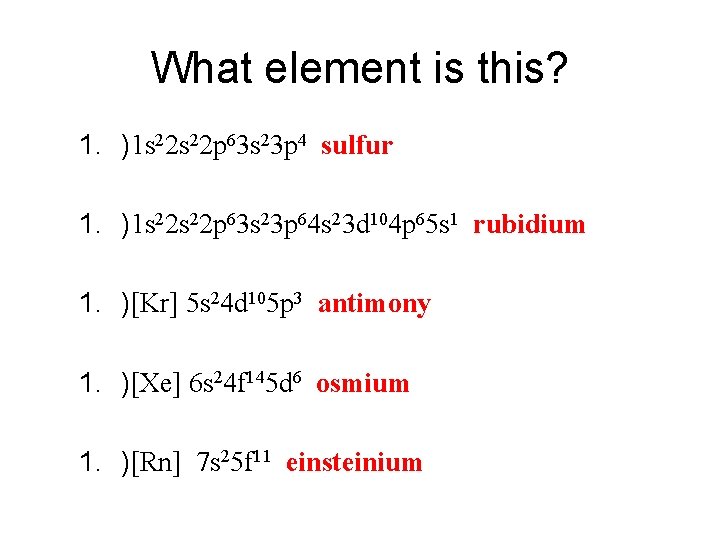
What element is this? 1. )1 s 22 p 63 s 23 p 4 sulfur 1. )1 s 22 p 63 s 23 p 64 s 23 d 104 p 65 s 1 rubidium 1. )[Kr] 5 s 24 d 105 p 3 antimony 1. )[Xe] 6 s 24 f 145 d 6 osmium 1. )[Rn] 7 s 25 f 11 einsteinium
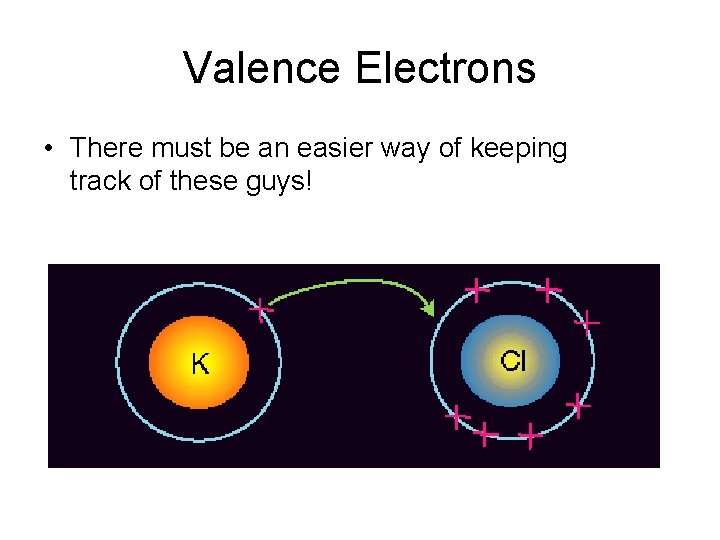
Valence Electrons • There must be an easier way of keeping track of these guys!
Electron Dot Structures • G. N. Lewis (1875 -1946), an American chemist and university professor, devised and easy way to represent valence electrons. • Here are the rules: – Write the element symbol down – Find it’s group on the periodic table and decide how many valence electrons it has – Put a dot around the symbol for every electron – Start on the right…the next one goes on the left…then top…then bottom…lather, rise, repeat…
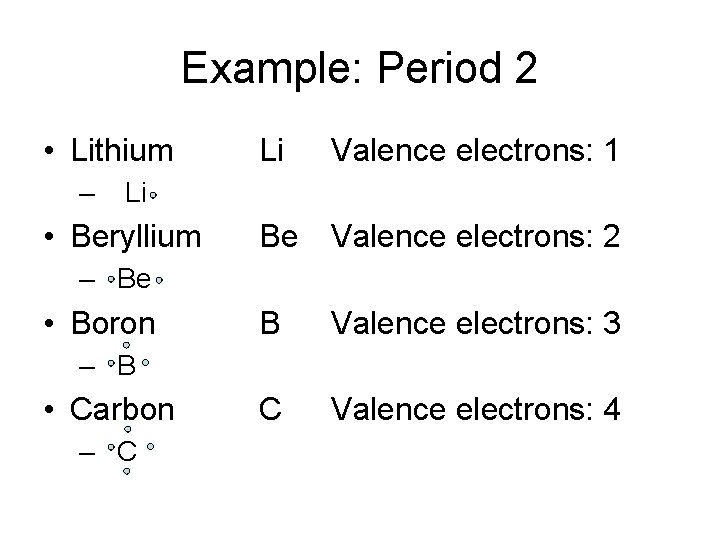
Example: Period 2 • Lithium – Li Valence electrons: 1 Be Valence electrons: 2 B Valence electrons: 3 C Valence electrons: 4 Li • Beryllium – Be • Boron – B • Carbon – C
You Try It! Period 2 • Nitrogen N Valence electrons: 5 • Oxygen O Valence electrons: 6 • Fluorine F Valence electrons: 7 • Neon Ne Valence electrons: 8
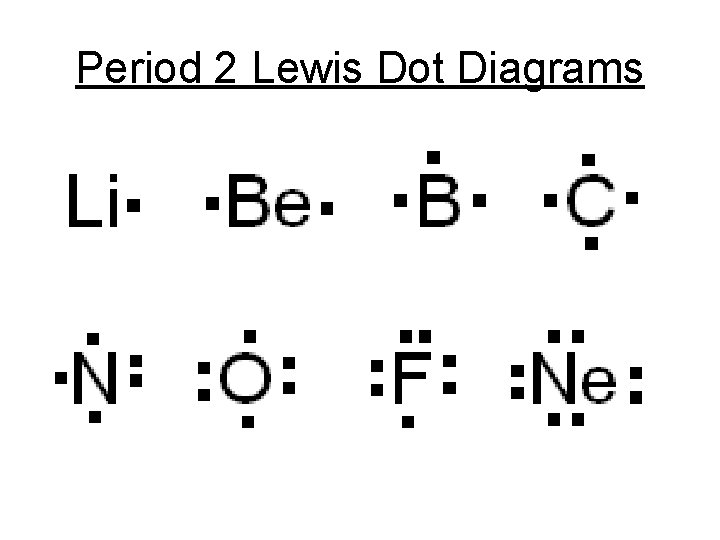
Period 2 Lewis Dot Diagrams
- Slides: 35