
NOSE PARANASAL SINUSES frontal process of the maxilla

- Slides: 29
NOSE & PARANASAL SINUSES
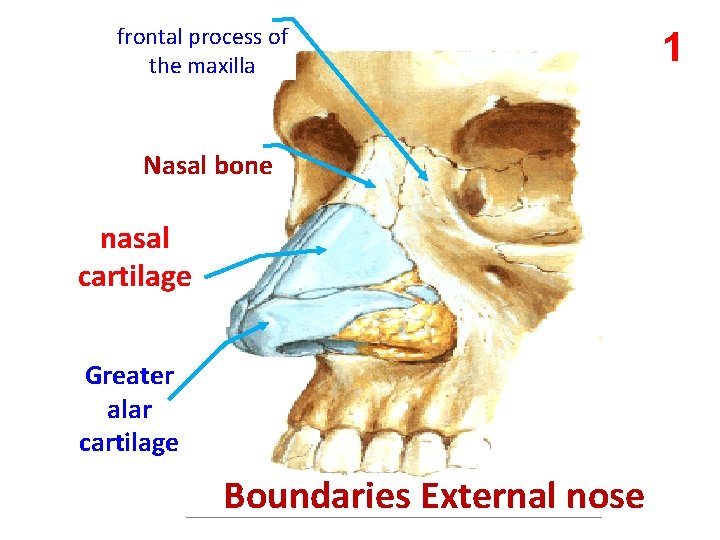
frontal process of the maxilla Nasal bone nasal cartilage Greater alar cartilage Boundaries External nose 1
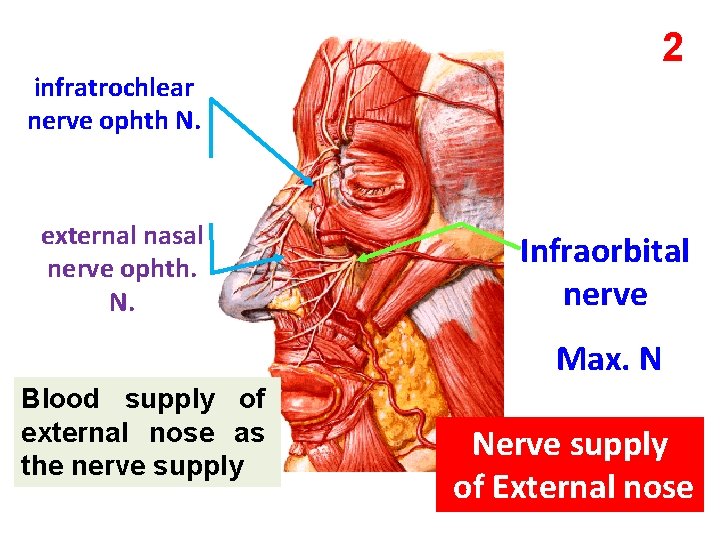
2 infratrochlear nerve ophth N. external nasal nerve ophth. N. Infraorbital nerve Max. N Blood supply of external nose as the nerve supply Nerve supply of External nose
3 Nasal Cavity
- The cavity of the nose is dividing 4 into right and left halves by the nasal septum. - Each cavity opens A- Anteriorly on the face by the anterior nasal aperture (nostril) B- Posteriorly into the nasopharynx by the posterior nasal aperture.
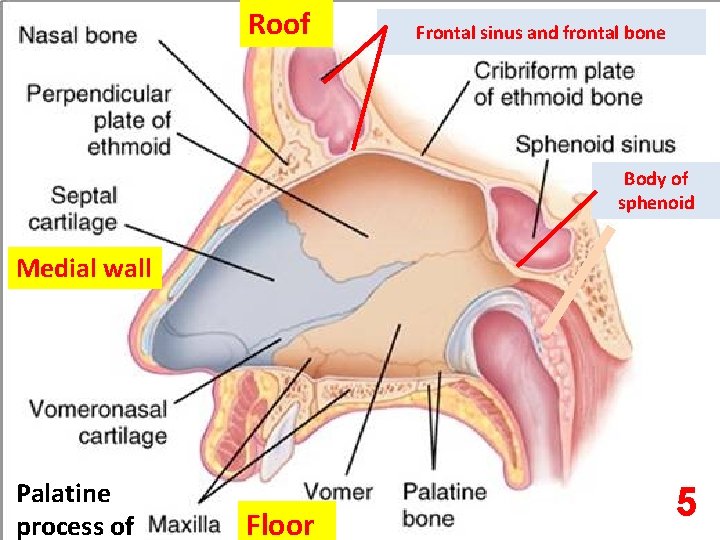
Roof Frontal sinus and frontal bone Body of sphenoid Medial wall Palatine process of Floor 5
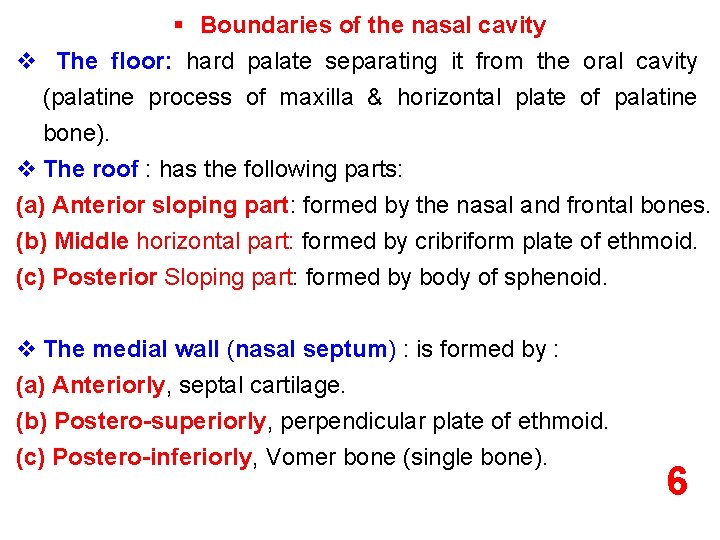
Boundaries of the nasal cavity v The floor: hard palate separating it from the oral cavity (palatine process of maxilla & horizontal plate of palatine bone). v The roof : has the following parts: (a) Anterior sloping part: formed by the nasal and frontal bones. (b) Middle horizontal part: formed by cribriform plate of ethmoid. (c) Posterior Sloping part: formed by body of sphenoid. v The medial wall (nasal septum) : is formed by : (a) Anteriorly, septal cartilage. (b) Postero-superiorly, perpendicular plate of ethmoid. (c) Postero-inferiorly, Vomer bone (single bone). 6
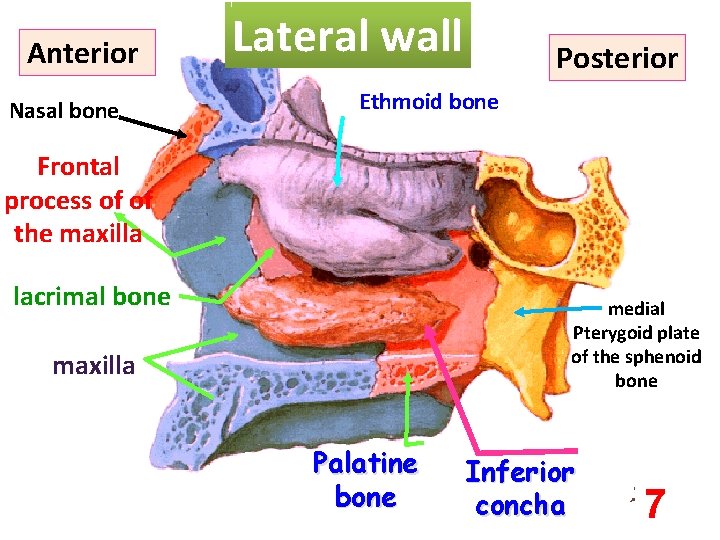
Anterior Nasal bone Lateral wall Posterior Ethmoid bone Frontal process of of the maxilla lacrimal bone medial Pterygoid plate of the sphenoid bone maxilla Palatine bone Inferior concha 7
v Lateral wall of the nasal cavity 8 A- Anteriorly, cartilage, nasal bone and frontal process of maxilla. B- Posteriorly - Upper part, ethmoid bone, lacrimal bone. - Lower part, inferior concha, maxilla, palatine bone, and medial pterygoid plate, .
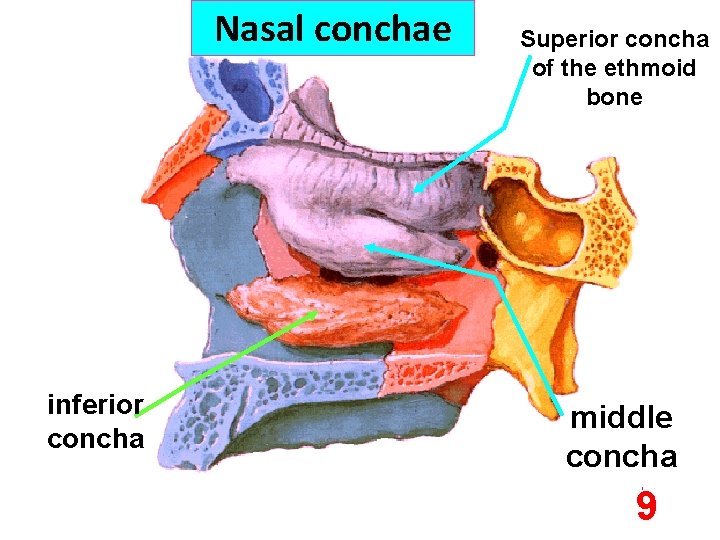
Nasal conchae inferior concha Superior concha of the ethmoid bone middle concha 9
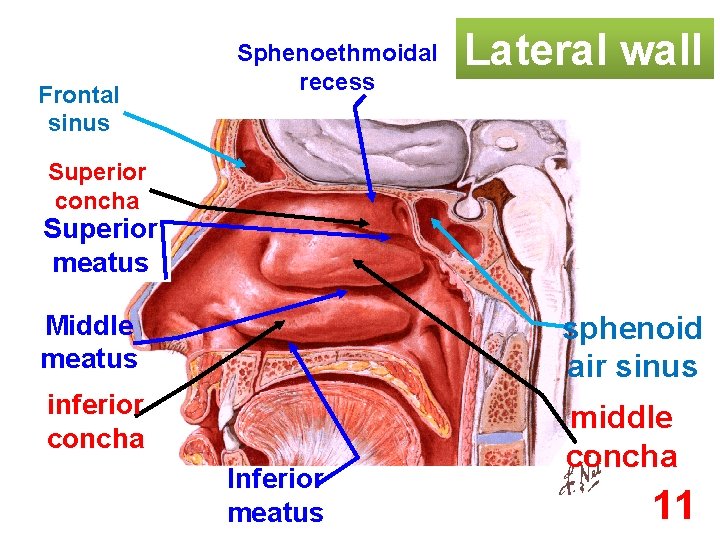
10 Features of the lateral wall, - It is irregular and shows the following: (a) Vestibule; a small dilatation above the anterior nasal aperture. (b) Atrium: a shallow depression above and behind the vestibule. (c) Nasal conchae: 3 shelves-like elevations separated by spaces called meatuses. 1) Superior Concha: is the smallest one and is part of the ethmoid bone (superior meatus below it). 2) Middle Concha: is medium sized and also part of the ethmoid bone (middle meatus below it). 3) Inferior Concha: is the largest one and is a separate bone (inferior meatus below it).
Frontal sinus Sphenoethmoidal recess Lateral wall Superior concha Superior meatus Middle meatus sphenoid air sinus inferior concha middle concha Inferior meatus 11
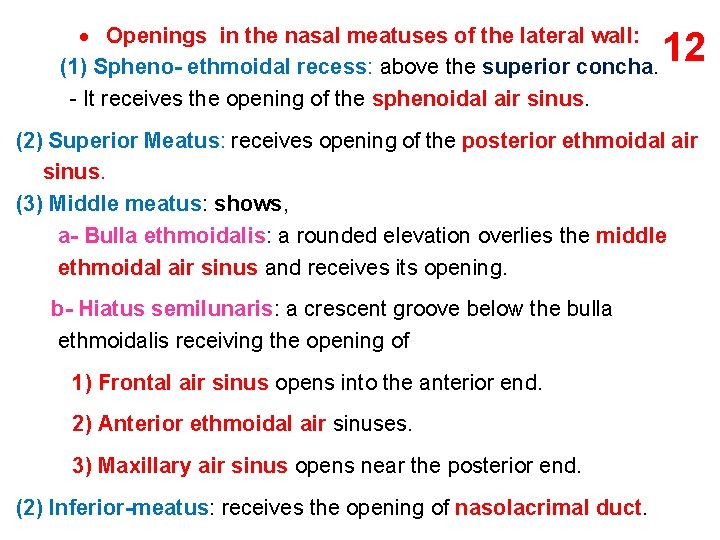
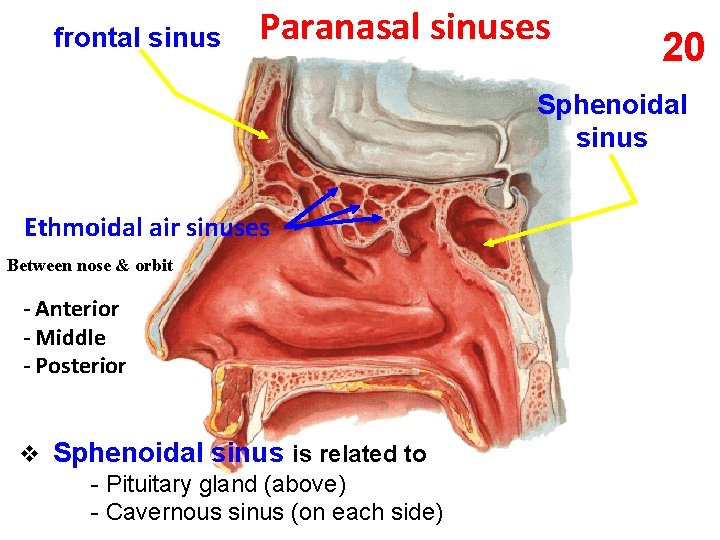
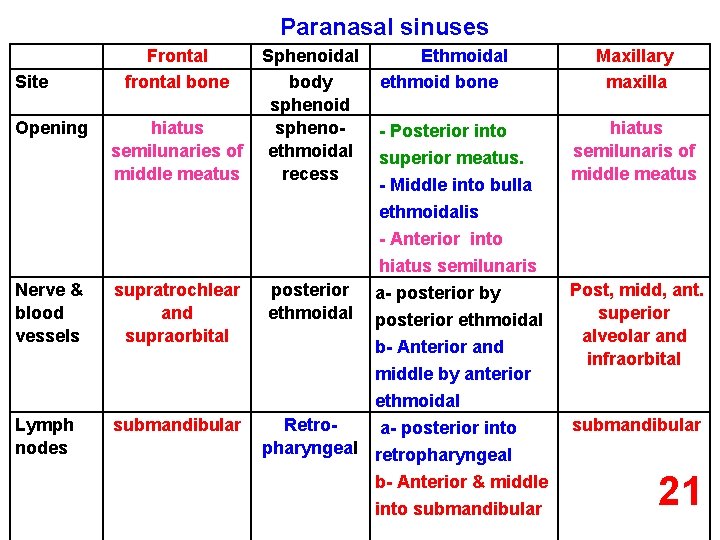
Openings in the nasal meatuses of the lateral wall: (1) Spheno- ethmoidal recess: above the superior concha. - It receives the opening of the sphenoidal air sinus. 12 (2) Superior Meatus: receives opening of the posterior ethmoidal air sinus. (3) Middle meatus: shows, a- Bulla ethmoidalis: a rounded elevation overlies the middle ethmoidal air sinus and receives its opening. b- Hiatus semilunaris: a crescent groove below the bulla ethmoidalis receiving the opening of 1) Frontal air sinus opens into the anterior end. 2) Anterior ethmoidal air sinuses. 3) Maxillary air sinus opens near the posterior end. (2) Inferior-meatus: receives the opening of nasolacrimal duct.
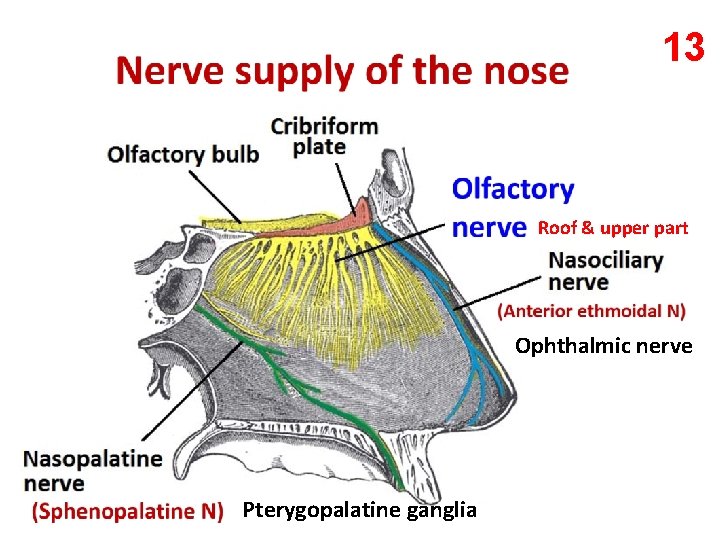
13 Roof & upper part Ophthalmic nerve Pterygopalatine ganglia
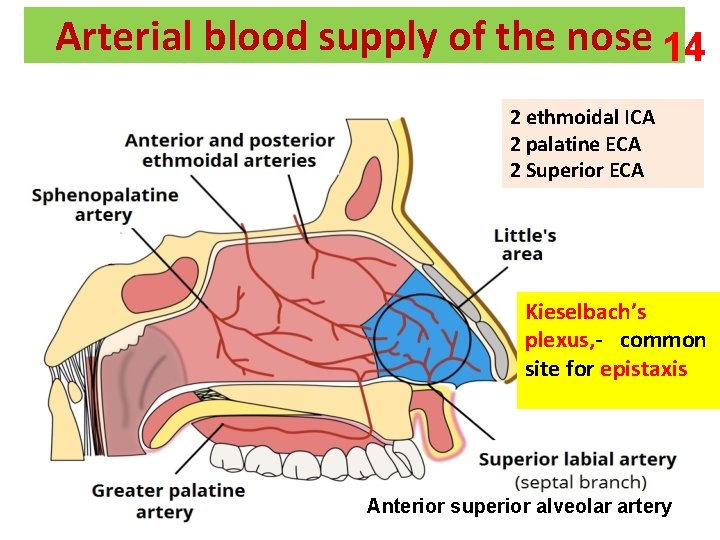
Arterial blood supply of the nose 14 2 ethmoidal ICA 2 palatine ECA 2 Superior ECA Kieselbach’s plexus, - common site for epistaxis Anterior superior alveolar artery
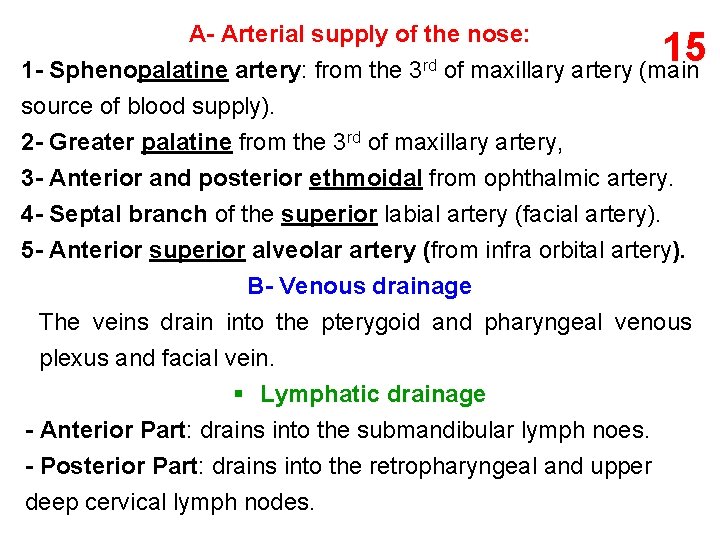
A- Arterial supply of the nose: 1 - Sphenopalatine artery: from the 3 rd of maxillary artery (main source of blood supply). 2 - Greater palatine from the 3 rd of maxillary artery, 3 - Anterior and posterior ethmoidal from ophthalmic artery. 4 - Septal branch of the superior labial artery (facial artery). 15 5 - Anterior superior alveolar artery (from infra orbital artery). B- Venous drainage The veins drain into the pterygoid and pharyngeal venous plexus and facial vein. Lymphatic drainage - Anterior Part: drains into the submandibular lymph noes. - Posterior Part: drains into the retropharyngeal and upper deep cervical lymph nodes.
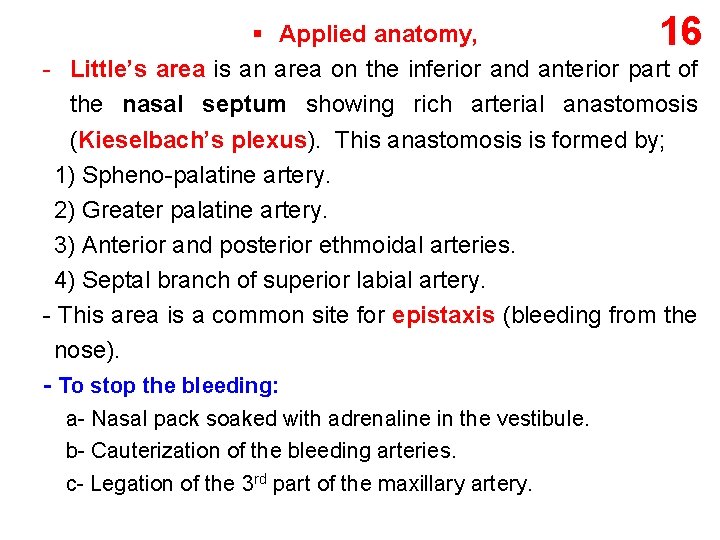
16 Applied anatomy, - Little’s area is an area on the inferior and anterior part of the nasal septum showing rich arterial anastomosis (Kieselbach’s plexus). This anastomosis is formed by; 1) Spheno-palatine artery. 2) Greater palatine artery. 3) Anterior and posterior ethmoidal arteries. 4) Septal branch of superior labial artery. - This area is a common site for epistaxis (bleeding from the nose). - To stop the bleeding: a- Nasal pack soaked with adrenaline in the vestibule. b- Cauterization of the bleeding arteries. c- Legation of the 3 rd part of the maxillary artery.
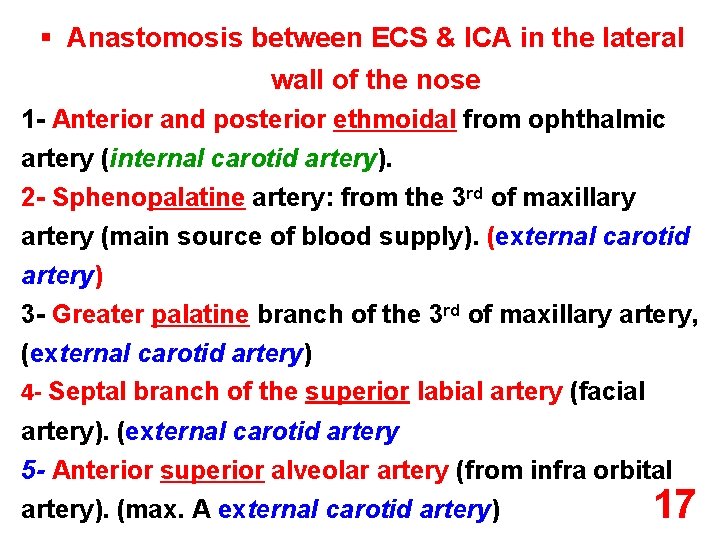
Anastomosis between ECS & ICA in the lateral wall of the nose 1 - Anterior and posterior ethmoidal from ophthalmic artery (internal carotid artery). 2 - Sphenopalatine artery: from the 3 rd of maxillary artery (main source of blood supply). (external carotid artery) 3 - Greater palatine branch of the 3 rd of maxillary artery, (external carotid artery) 4 - Septal branch of the superior labial artery (facial artery). (external carotid artery 5 - Anterior superior alveolar artery (from infra orbital 17 artery). (max. A external carotid artery)
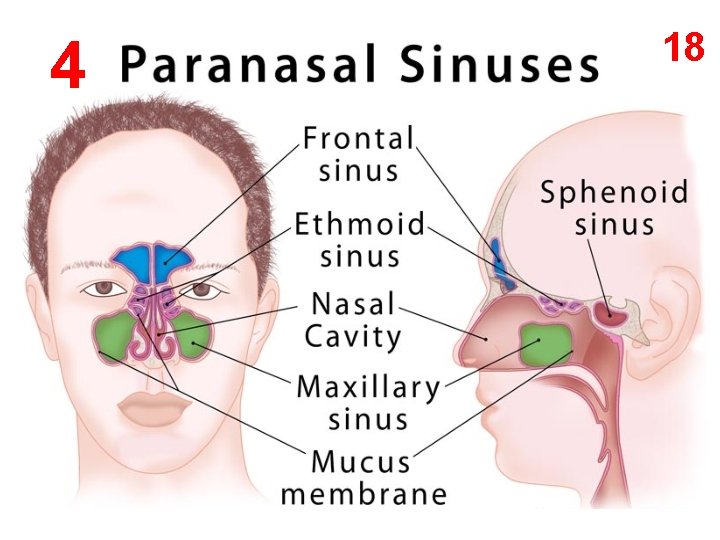
4 18
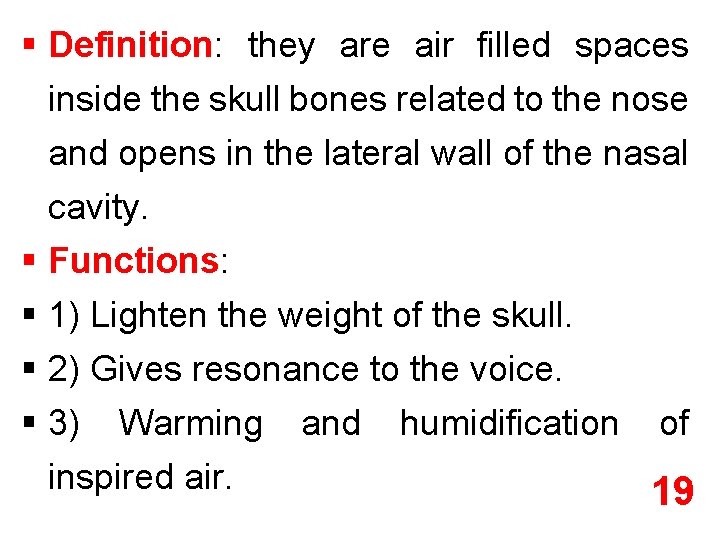
Definition: they are air filled spaces inside the skull bones related to the nose and opens in the lateral wall of the nasal cavity. Functions: 1) Lighten the weight of the skull. 2) Gives resonance to the voice. 3) Warming and humidification of inspired air. 19
frontal sinus Paranasal sinuses 20 Sphenoidal sinus Ethmoidal air sinuses Between nose & orbit - Anterior - Middle - Posterior v Sphenoidal sinus is related to - Pituitary gland (above) - Cavernous sinus (on each side)
Paranasal sinuses Site Opening Nerve & blood vessels Frontal frontal bone hiatus semilunaries of middle meatus supratrochlear and supraorbital Sphenoidal body sphenoid sphenoethmoidal recess posterior ethmoidal Ethmoidal ethmoid bone Maxillary maxilla - Posterior into hiatus semilunaris of middle meatus superior meatus. - Middle into bulla ethmoidalis - Anterior into hiatus semilunaris a- posterior by posterior ethmoidal b- Anterior and middle by anterior ethmoidal Lymph nodes submandibular Retroa- posterior into pharyngeal retropharyngeal b- Anterior & middle into submandibular Post, midd, ant. superior alveolar and infraorbital submandibular 21
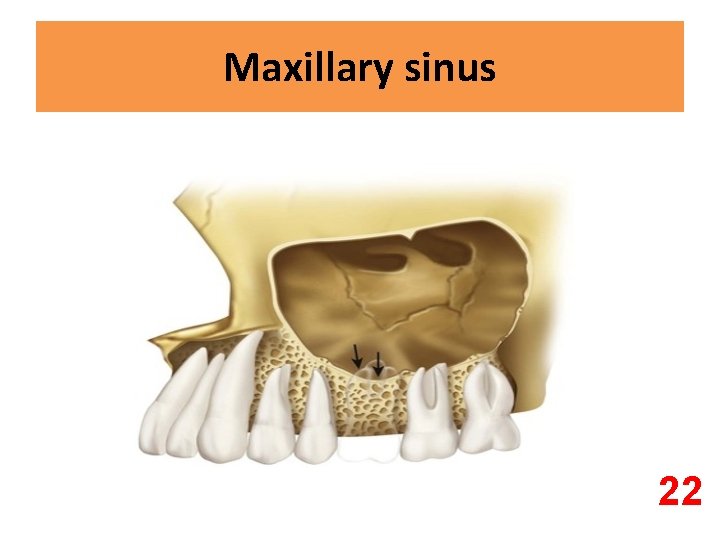
Maxillary sinus 22
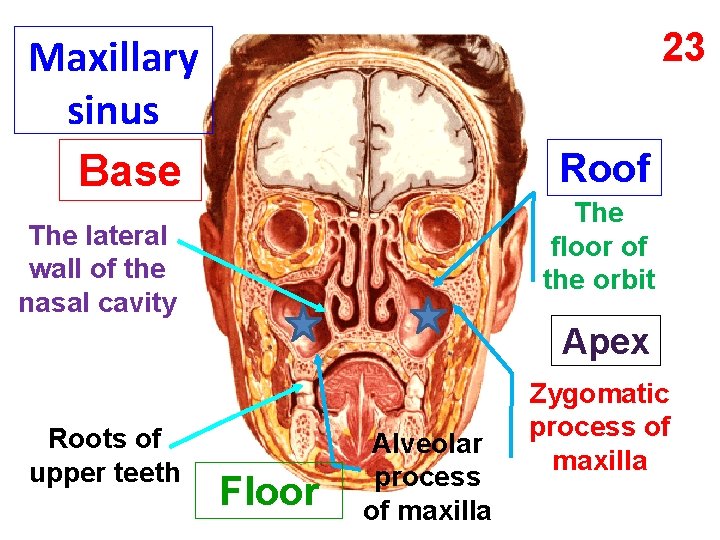
23 Maxillary sinus Base Roof The floor of the orbit The lateral wall of the nasal cavity Apex Roots of upper teeth Floor Alveolar process of maxilla Zygomatic process of maxilla
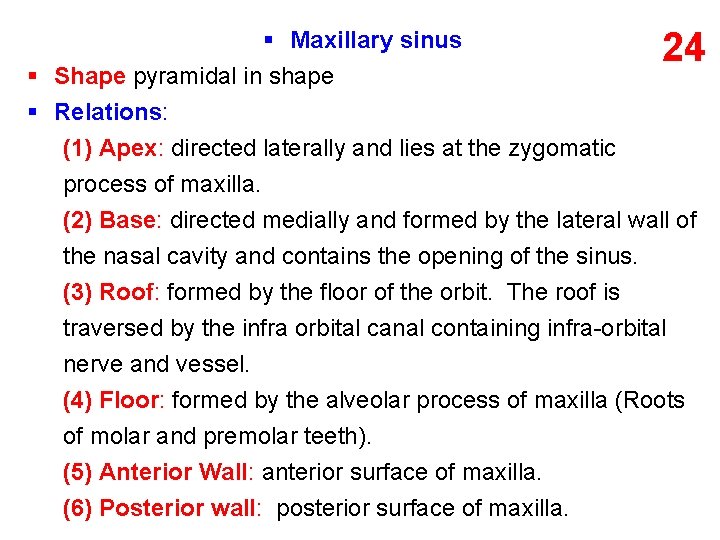
24 Maxillary sinus Shape pyramidal in shape Relations: (1) Apex: directed laterally and lies at the zygomatic process of maxilla. (2) Base: directed medially and formed by the lateral wall of the nasal cavity and contains the opening of the sinus. (3) Roof: formed by the floor of the orbit. The roof is traversed by the infra orbital canal containing infra-orbital nerve and vessel. (4) Floor: formed by the alveolar process of maxilla (Roots of molar and premolar teeth). (5) Anterior Wall: anterior surface of maxilla. (6) Posterior wall: posterior surface of maxilla.
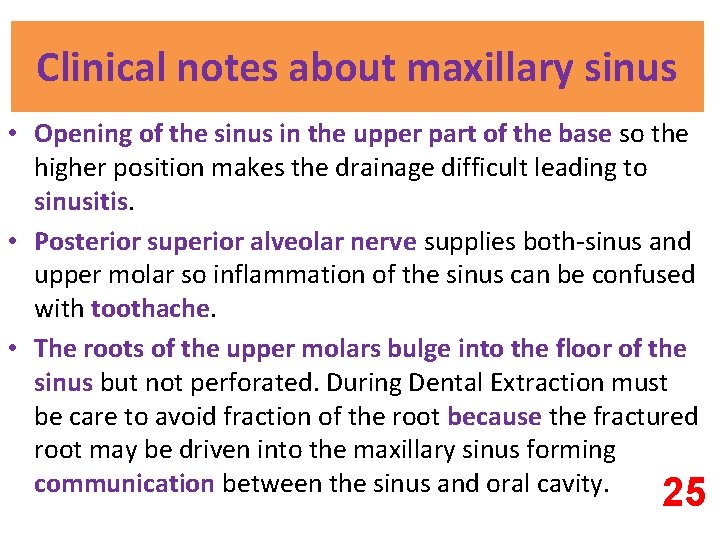
Clinical notes about maxillary sinus • Opening of the sinus in the upper part of the base so the higher position makes the drainage difficult leading to sinusitis. • Posterior superior alveolar nerve supplies both-sinus and upper molar so inflammation of the sinus can be confused with toothache. • The roots of the upper molars bulge into the floor of the sinus but not perforated. During Dental Extraction must be care to avoid fraction of the root because the fractured root may be driven into the maxillary sinus forming communication between the sinus and oral cavity. 25
26
Th ank Qu you est ion s