
Nose Nasal cavity Paranasal Sinuses Pharynx Dr Zeenat

- Slides: 18
Nose, Nasal cavity, Paranasal Sinuses & Pharynx Dr. Zeenat Zaidi Dr. Essam Eldin Salama Anatomy Department
Objectives At the end of the lecture, the students should be able to: § Describe the boundaries of the nasal cavity. § Describe the nasal conchae and meati. § Demonstrate the openings in each meatus. § Describe the paranasal sinuses and their functions § Describe the pharynx and its parts
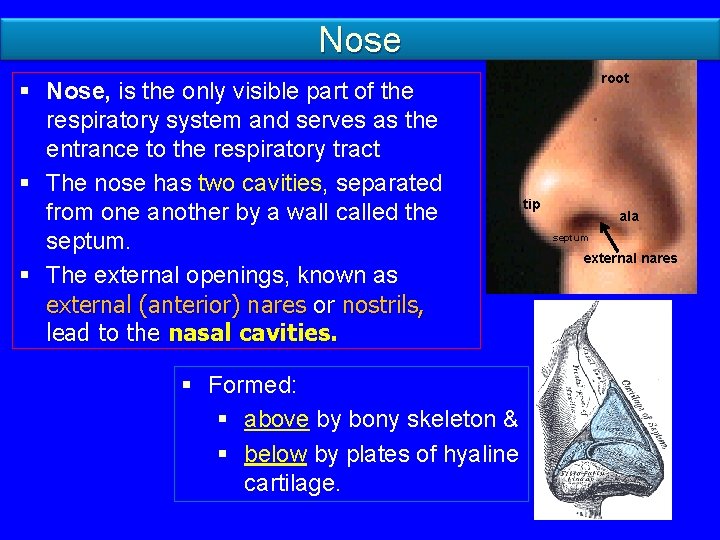
Nose § Nose, is the only visible part of the respiratory system and serves as the entrance to the respiratory tract § The nose has two cavities, separated from one another by a wall called the septum. § The external openings, known as external (anterior) nares or nostrils, lead to the nasal cavities. root tip § Formed: § above by bony skeleton & § below by plates of hyaline cartilage. ala septum external nares
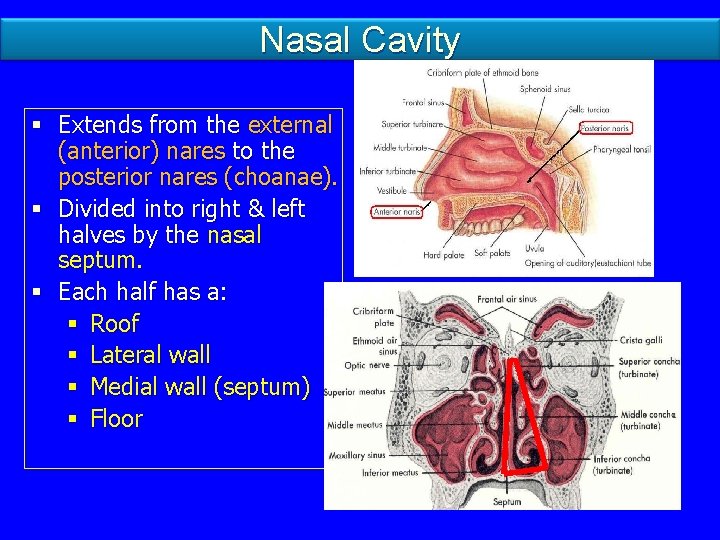
Nasal Cavity § Extends from the external (anterior) nares to the posterior nares (choanae). § Divided into right & left halves by the nasal septum. § Each half has a: § Roof § Lateral wall § Medial wall (septum) § Floor
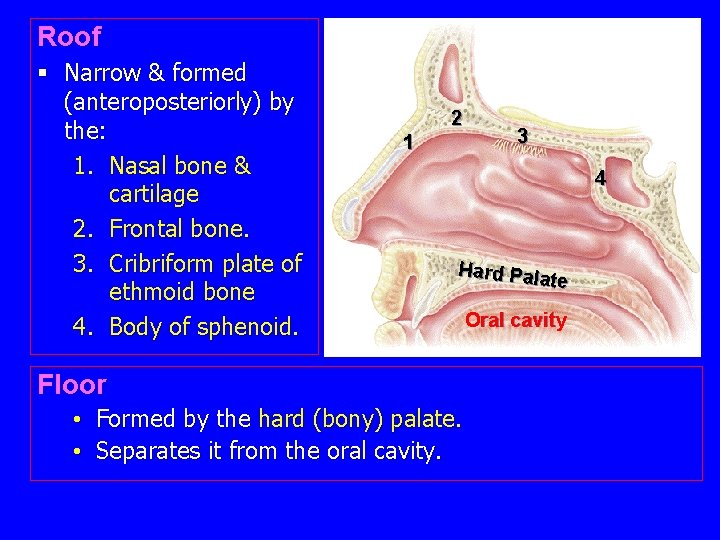
Roof § Narrow & formed (anteroposteriorly) by the: 1. Nasal bone & cartilage 2. Frontal bone. 3. Cribriform plate of ethmoid bone 4. Body of sphenoid. 2 1 3 4 Hard Pala te Floor • Formed by the hard (bony) palate. • Separates it from the oral cavity. Oral cavity
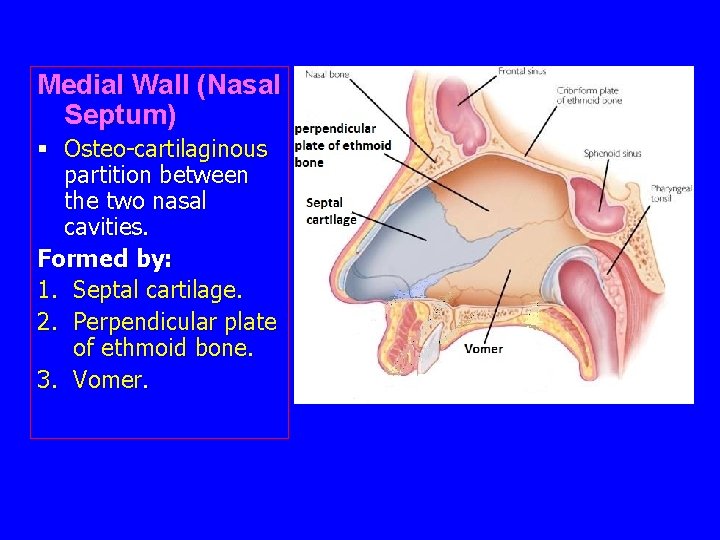
Medial Wall (Nasal Septum) § Osteo-cartilaginous partition between the two nasal cavities. Formed by: 1. Septal cartilage. 2. Perpendicular plate of ethmoid bone. 3. Vomer.
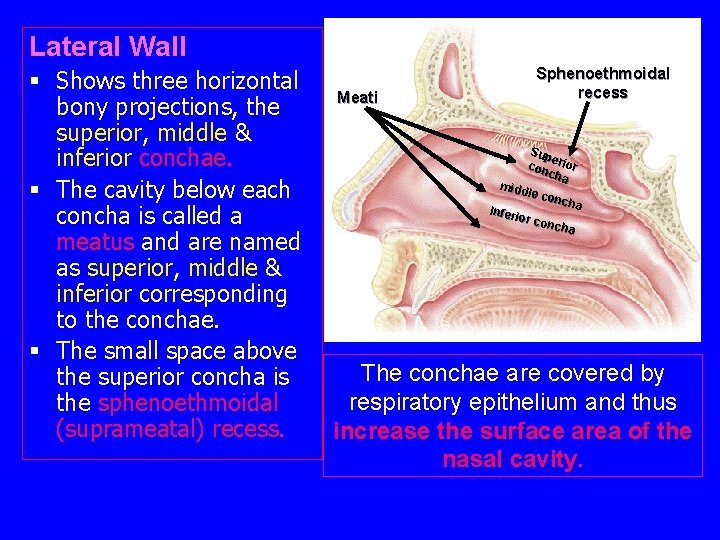
Lateral Wall § Shows three horizontal bony projections, the superior, middle & inferior conchae. § The cavity below each concha is called a meatus and are named as superior, middle & inferior corresponding to the conchae. § The small space above the superior concha is the sphenoethmoidal (suprameatal) recess. Meati Sphenoethmoidal recess Sup e con rior cha midd le co ncha Infer ior co ncha The conchae are covered by respiratory epithelium and thus increase the surface area of the nasal cavity.
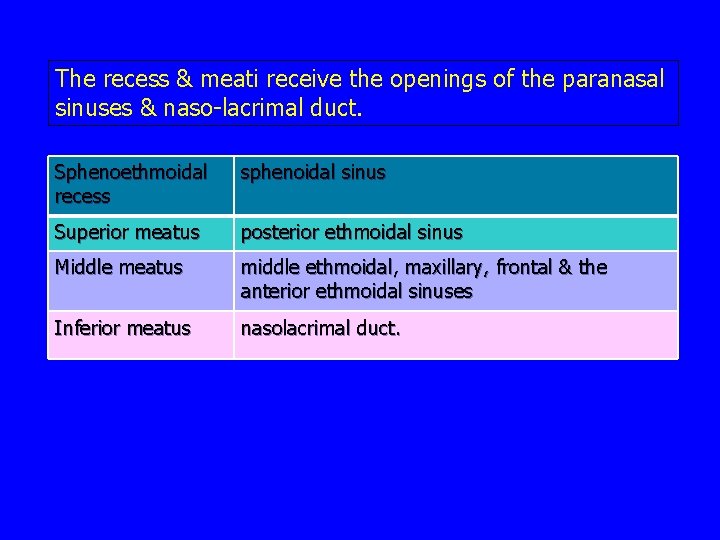
The recess & meati receive the openings of the paranasal sinuses & naso-lacrimal duct. Sphenoethmoidal recess sphenoidal sinus Superior meatus posterior ethmoidal sinus Middle meatus middle ethmoidal, maxillary, frontal & the anterior ethmoidal sinuses Inferior meatus nasolacrimal duct.
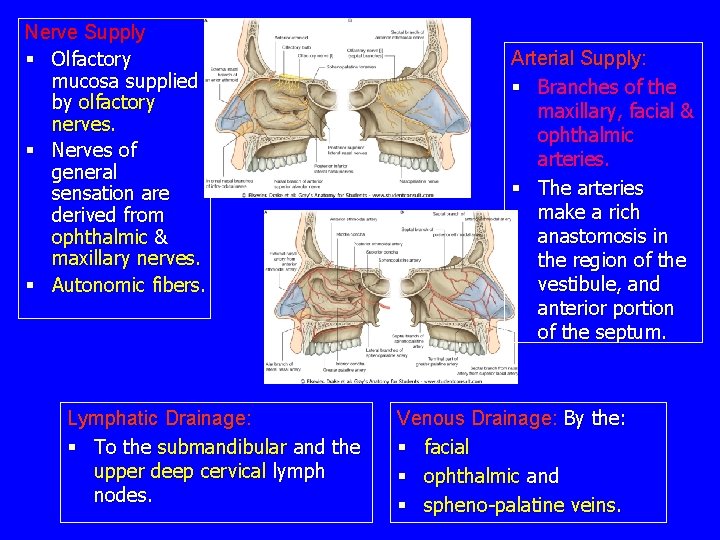
Nerve Supply § Olfactory mucosa supplied by olfactory nerves. § Nerves of general sensation are derived from ophthalmic & maxillary nerves. § Autonomic fibers. Lymphatic Drainage: § To the submandibular and the upper deep cervical lymph nodes. Arterial Supply: § Branches of the maxillary, facial & ophthalmic arteries. § The arteries make a rich anastomosis in the region of the vestibule, and anterior portion of the septum. Venous Drainage: By the: § facial § ophthalmic and § spheno-palatine veins.
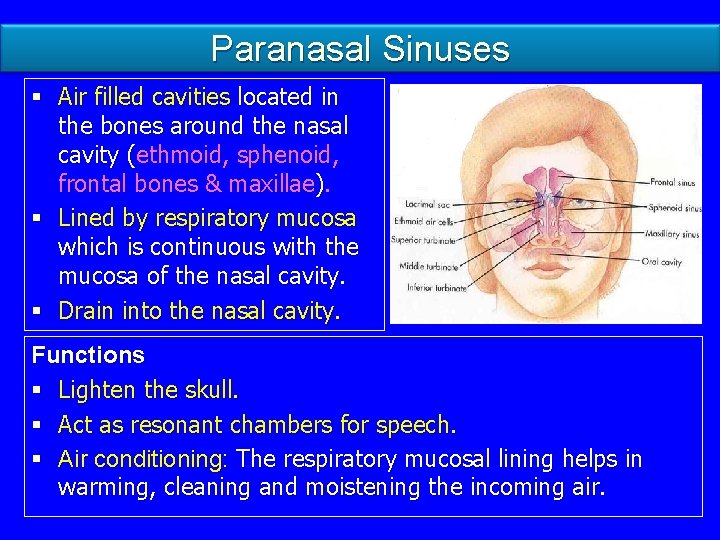
Paranasal Sinuses § Air filled cavities located in the bones around the nasal cavity (ethmoid, sphenoid, frontal bones & maxillae). § Lined by respiratory mucosa which is continuous with the mucosa of the nasal cavity. § Drain into the nasal cavity. Functions § Lighten the skull. § Act as resonant chambers for speech. § Air conditioning: The respiratory mucosal lining helps in warming, cleaning and moistening the incoming air.
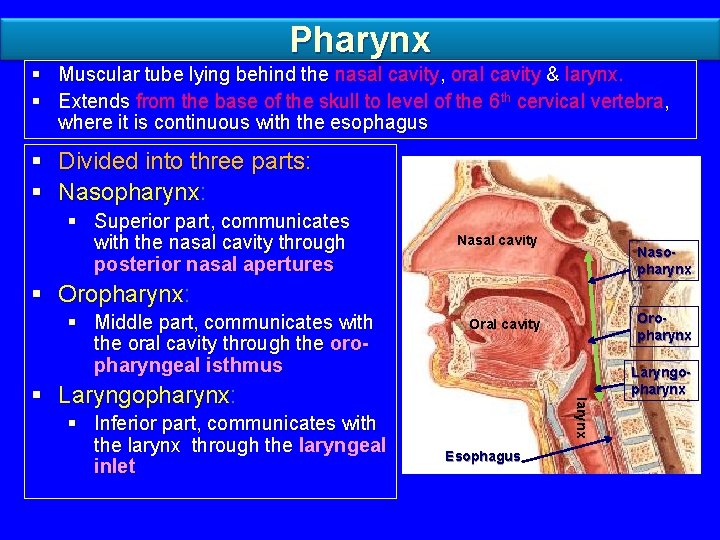
Pharynx § Muscular tube lying behind the nasal cavity, oral cavity & larynx. § Extends from the base of the skull to level of the 6 th cervical vertebra, where it is continuous with the esophagus § Divided into three parts: § Nasopharynx: § Superior part, communicates with the nasal cavity through posterior nasal apertures Nasal cavity Nasopharynx § Oropharynx: § Middle part, communicates with the oral cavity through the oropharyngeal isthmus larynx § Laryngopharynx: § Inferior part, communicates with the larynx through the laryngeal inlet Oropharynx Oral cavity Esophagus Laryngopharynx
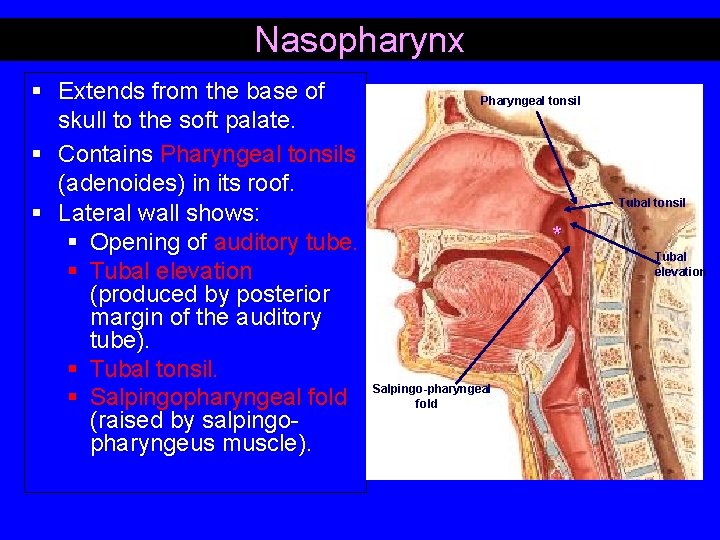
Nasopharynx § Extends from the base of skull to the soft palate. § Contains Pharyngeal tonsils (adenoides) in its roof. § Lateral wall shows: § Opening of auditory tube. § Tubal elevation (produced by posterior margin of the auditory tube). § Tubal tonsil. § Salpingopharyngeal fold (raised by salpingopharyngeus muscle). Pharyngeal tonsil Tubal tonsil * Tubal elevation Salpingo-pharyngeal fold
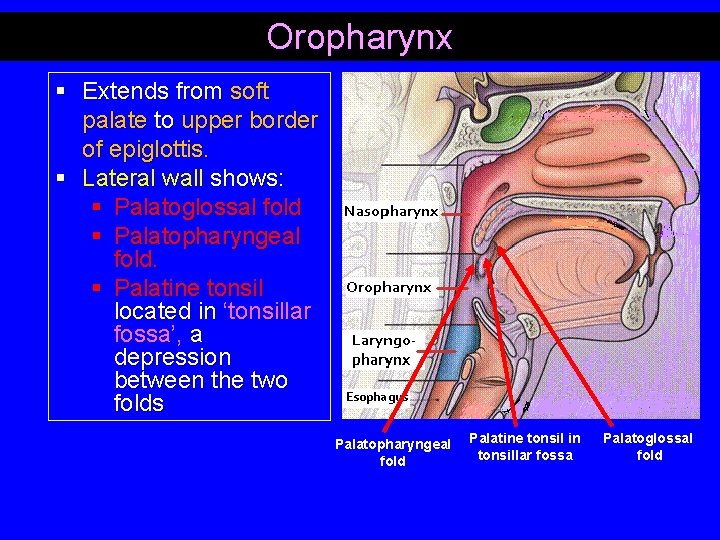
Oropharynx § Extends from soft palate to upper border of epiglottis. § Lateral wall shows: § Palatoglossal fold § Palatopharyngeal fold. § Palatine tonsil located in ‘tonsillar fossa’, a depression between the two folds Palatopharyngeal fold Palatine tonsil in tonsillar fossa Palatoglossal fold
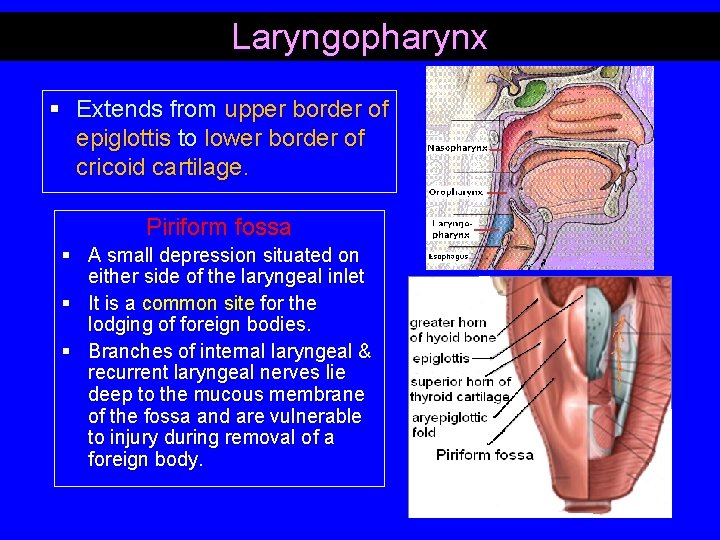
Laryngopharynx § Extends from upper border of epiglottis to lower border of cricoid cartilage. Piriform fossa § A small depression situated on either side of the laryngeal inlet § It is a common site for the lodging of foreign bodies. § Branches of internal laryngeal & recurrent laryngeal nerves lie deep to the mucous membrane of the fossa and are vulnerable to injury during removal of a foreign body.
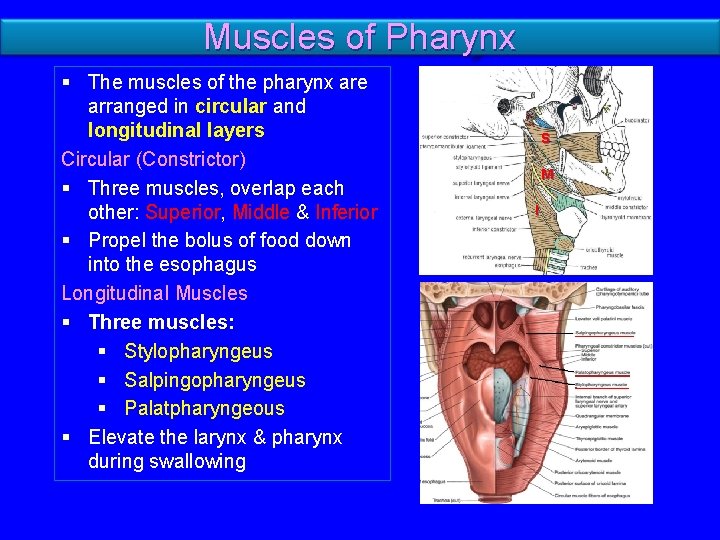
Muscles of Pharynx § The muscles of the pharynx are arranged in circular and longitudinal layers Circular (Constrictor) § Three muscles, overlap each other: Superior, Middle & Inferior § Propel the bolus of food down into the esophagus Longitudinal Muscles § Three muscles: § Stylopharyngeus § Salpingopharyngeus § Palatpharyngeous § Elevate the larynx & pharynx during swallowing S M I
§ Sensory Nerve Supply • Nasopharynx: Maxillary nerve • Oropharynx: Glossopharyngeal nerve • Laryngopharynx: Vagus nerve § Motor Nerve Supply : • All the muscles of pharynx, except the stylopharyngeus, are supplied by the pharyngeal plexus. • Stylopharyngeus is supplied by the glossopharyngeal nerve Pharyngeal plexus A network of nerves (sensory, motor & sympathetic) located on the surface of the middle pharyngeal constrictor muscle, is formed by the: • Pharyngeal branches of glossopharyngeal nerve (sensory) • Pharyngeal branch of vagus nerve (motor) • Sympathetic fibers from superior cervical ganglion (vasomotor)
Arterial supply: From branches of: § Ascending pharyngeal artery § Ascending palatine artery § Facial artery § Maxillary artery § Lingual artery § The Veins drain into pharyngeal venous plexus, which drains into the internal jugular vein § § The Lymphatics drain into the: Deep cervical Retropharyngeal & Paratracheal lymph nodes
Thank You & Good Luck