
Norwegian Life and Society THE NORWEGIAN LEGAL SYSTEM


- Slides: 13
Norwegian Life and Society THE NORWEGIAN LEGAL SYSTEM Michael Reiertsen Research fellow, Dept. of Public and International Law, Ui. O 5 November 2012
1. Some questions for reflection: Legal systems: The Norwegian legal system: • What is a legal system? • Similar or different from other legal systems? • Why do we need a legal system? • Institutions different? • Way of thinking different? • Material (substantive rights) rights different? • • Which institutions do the legal system consist of? Need for “checks and balances”?
2. Foundation: The Constitution of 1814 • Historic situation 1814 • Inspiration: USA, France and right to self determination • Radical content • Constitutional Monarchy - Sovereignty of the People • Division of powers • Judicial review? Constitution legally binding? • Yes (confirmed Supreme Court mid 19 th century) • Judicial review in other European countries
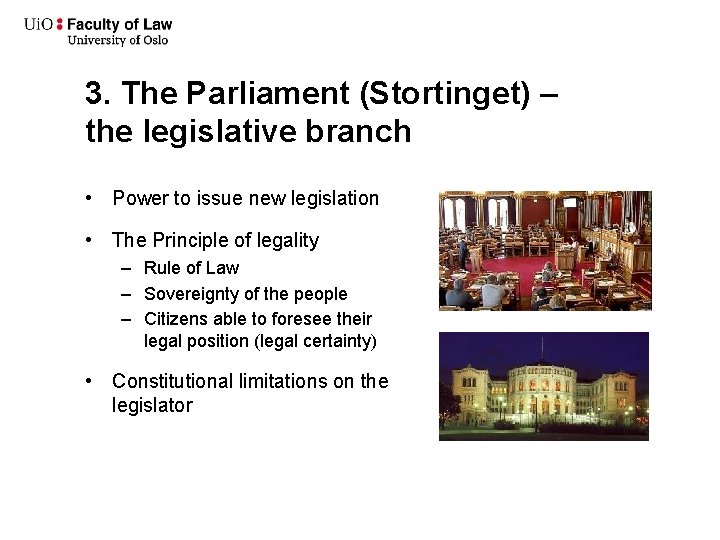
3. The Parliament (Stortinget) – the legislative branch • Power to issue new legislation • The Principle of legality – Rule of Law – Sovereignty of the people – Citizens able to foresee their legal position (legal certainty) • Constitutional limitations on the legislator
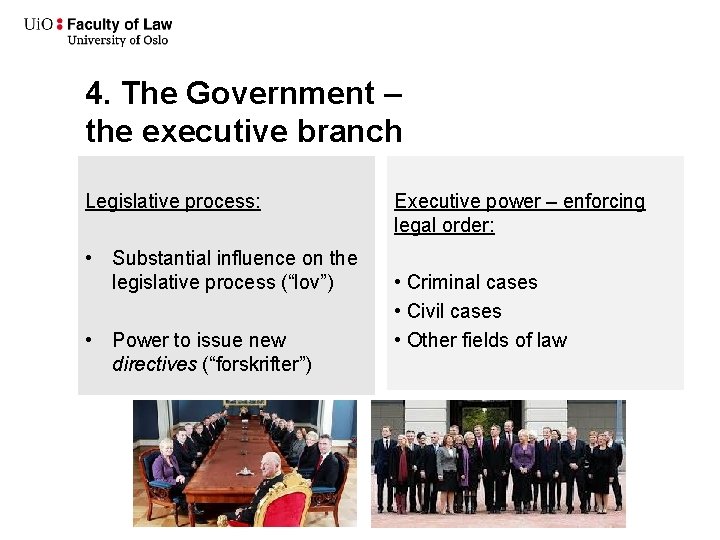
4. The Government – the executive branch Legislative process: • Substantial influence on the legislative process (“lov”) • Power to issue new directives (“forskrifter”) Executive power – enforcing legal order: • Criminal cases • Civil cases • Other fields of law
5. The Court System - the judicial branch • The independence of Courts • Tasks of the Courts – Criminal cases • No investigative courts – Civil cases • Not all disputes settled in courts of law • Conciliation proceedings – Administrative cases • Courts only rule in legal matters
Court system (Hierarchy) Supreme Court “Høyesterett” Appeal Courts ”Lagmannsretten” District Courts ”Tingretten”
District Courts • 70 District Courts • Jurisdiction in all matters – No division of ordinary courts and administrative courts – No division of criminal courts and civil courts – No separate constitutional court Appeal Courts • Only 6 Appeal Courts • Right to appeal – Civil cases – Criminal cases
Supreme Court • Right to appeal heavily restricted • Purpose – – – Not to ensure right outcome in each and every case Ensure uniformity of legal process Resolve matters where the law is unclear Develop the law Decide in matters of principle
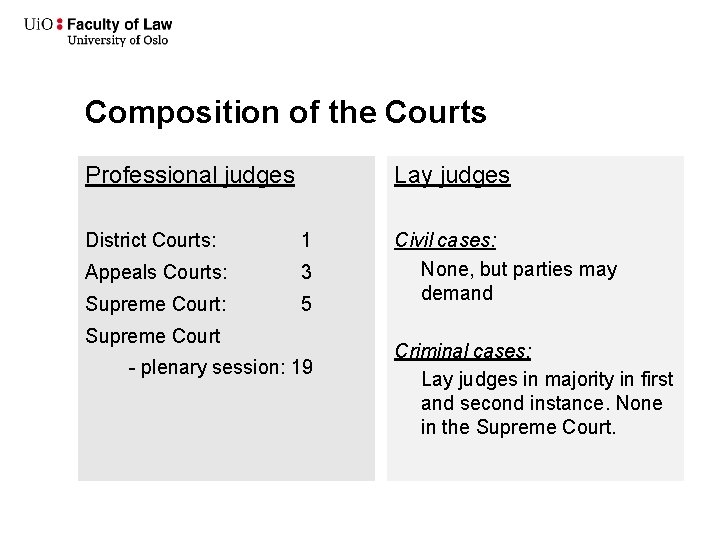
Composition of the Courts Professional judges Lay judges District Courts: 1 Appeals Courts: 3 Supreme Court: 5 Supreme Court - plenary session: 19 Civil cases: None, but parties may demand Criminal cases: Lay judges in majority in first and second instance. None in the Supreme Court.
Court proceedings and hearings Civil cases Criminal cases Strong oral tradition Oral tradition even stronger • Witnesses, documentary evidence and legal arguments presented directly before the court during “main hearing” • • Judges as "tabula rasa” Presumption of innocence Evaluation of evidence Principle of contradiction Principle of transparency
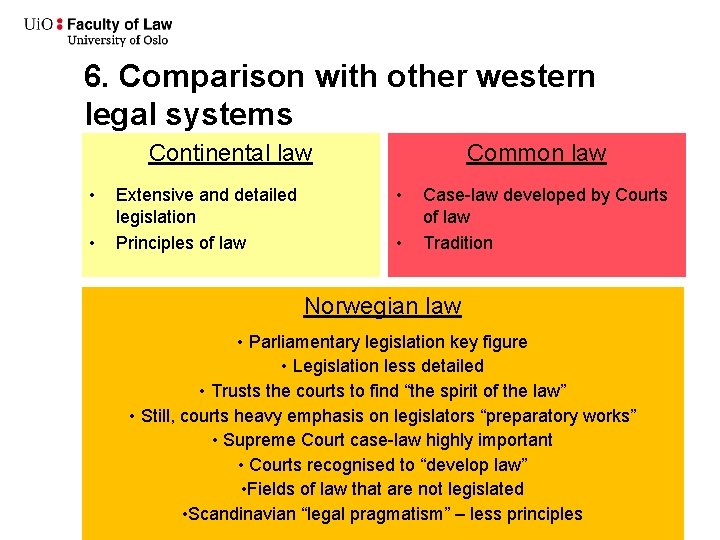
6. Comparison with other western legal systems Continental law • • Extensive and detailed legislation Principles of law Common law • • Case-law developed by Courts of law Tradition Norwegian law • Parliamentary legislation key figure • Legislation less detailed • Trusts the courts to find “the spirit of the law” • Still, courts heavy emphasis on legislators “preparatory works” • Supreme Court case-law highly important • Courts recognised to “develop law” • Fields of law that are not legislated • Scandinavian “legal pragmatism” – less principles
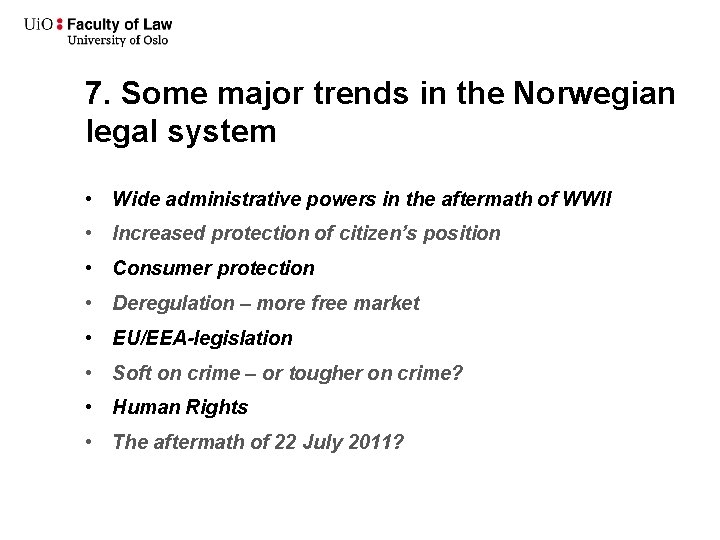
7. Some major trends in the Norwegian legal system • Wide administrative powers in the aftermath of WWII • Increased protection of citizen’s position • Consumer protection • Deregulation – more free market • EU/EEA-legislation • Soft on crime – or tougher on crime? • Human Rights • The aftermath of 22 July 2011?