
Northern Ireland Hear the sounds of Northern Ireland
- Slides: 17
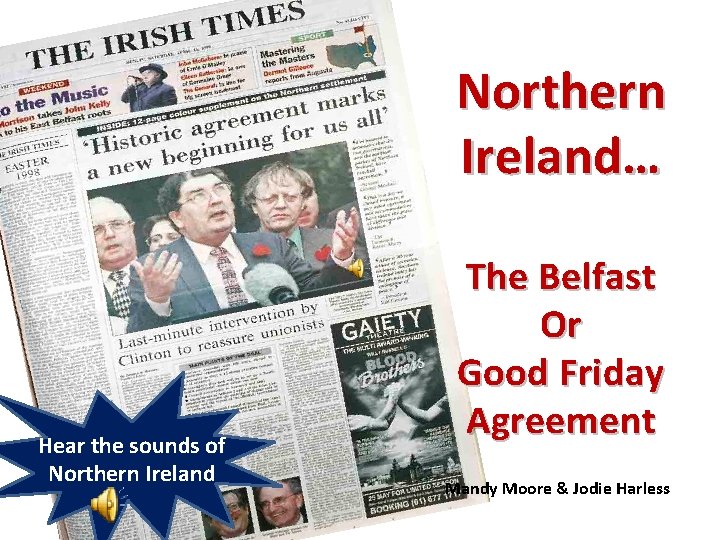
Northern Ireland… Hear the sounds of Northern Ireland The Belfast Or Good Friday Agreement Mandy Moore & Jodie Harless
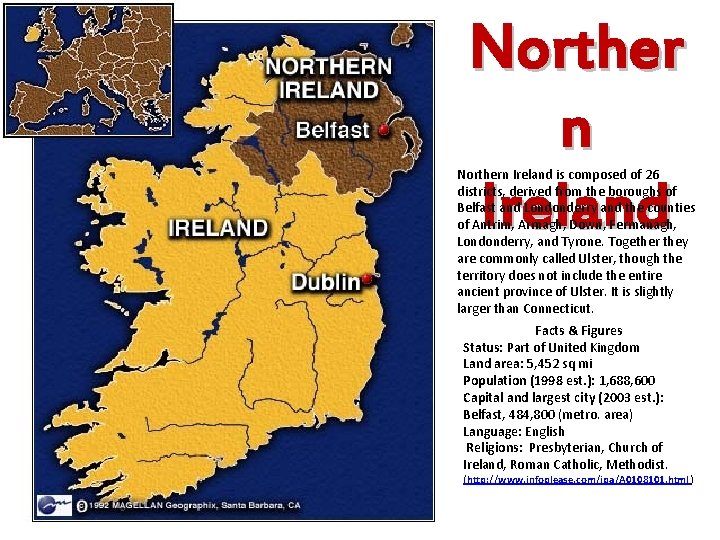
Norther n Ireland Northern Ireland is composed of 26 districts, derived from the boroughs of Belfast and Londonderry and the counties of Antrim, Armagh, Down, Fermanagh, Londonderry, and Tyrone. Together they are commonly called Ulster, though the territory does not include the entire ancient province of Ulster. It is slightly larger than Connecticut. Facts & Figures Status: Part of United Kingdom Land area: 5, 452 sq mi Population (1998 est. ): 1, 688, 600 Capital and largest city (2003 est. ): Belfast, 484, 800 (metro. area) Language: English Religions: Presbyterian, Church of Ireland, Roman Catholic, Methodist. (http: //www. infoplease. com/ipa/A 0108101. html)
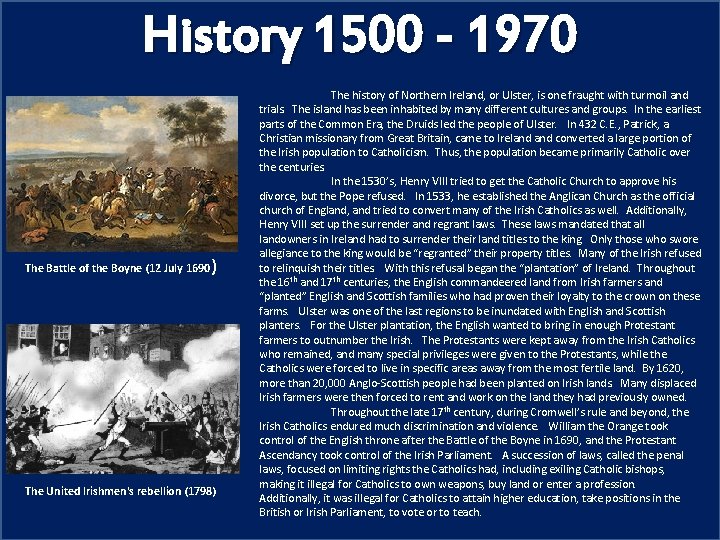
History 1500 - 1970 The Battle of the Boyne (12 July 1690 ) The United Irishmen's rebellion (1798) The history of Northern Ireland, or Ulster, is one fraught with turmoil and trials. The island has been inhabited by many different cultures and groups. In the earliest parts of the Common Era, the Druids led the people of Ulster. In 432 C. E. , Patrick, a Christian missionary from Great Britain, came to Ireland converted a large portion of the Irish population to Catholicism. Thus, the population became primarily Catholic over the centuries. In the 1530’s, Henry VIII tried to get the Catholic Church to approve his divorce, but the Pope refused. In 1533, he established the Anglican Church as the official church of England, and tried to convert many of the Irish Catholics as well. Additionally, Henry VIII set up the surrender and regrant laws. These laws mandated that all landowners in Ireland had to surrender their land titles to the king. Only those who swore allegiance to the king would be “regranted” their property titles. Many of the Irish refused to relinquish their titles. With this refusal began the “plantation” of Ireland. Throughout the 16 th and 17 th centuries, the English commandeered land from Irish farmers and “planted” English and Scottish families who had proven their loyalty to the crown on these farms. Ulster was one of the last regions to be inundated with English and Scottish planters. For the Ulster plantation, the English wanted to bring in enough Protestant farmers to outnumber the Irish. The Protestants were kept away from the Irish Catholics who remained, and many special privileges were given to the Protestants, while the Catholics were forced to live in specific areas away from the most fertile land. By 1620, more than 20, 000 Anglo-Scottish people had been planted on Irish lands. Many displaced Irish farmers were then forced to rent and work on the land they had previously owned. Throughout the late 17 th century, during Cromwell’s rule and beyond, the Irish Catholics endured much discrimination and violence. William the Orange took control of the English throne after the Battle of the Boyne in 1690, and the Protestant Ascendancy took control of the Irish Parliament. A succession of laws, called the penal laws, focused on limiting rights the Catholics had, including exiling Catholic bishops, making it illegal for Catholics to own weapons, buy land or enter a profession. Additionally, it was illegal for Catholics to attain higher education, take positions in the British or Irish Parliament, to vote or to teach.
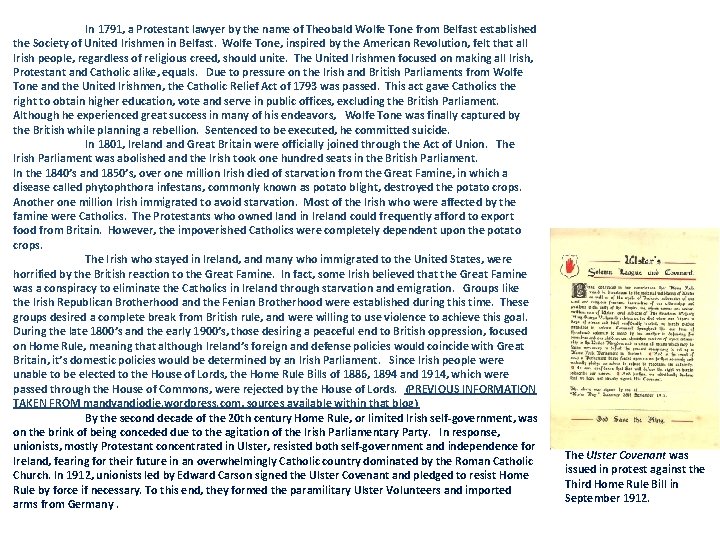
In 1791, a Protestant lawyer by the name of Theobald Wolfe Tone from Belfast established the Society of United Irishmen in Belfast. Wolfe Tone, inspired by the American Revolution, felt that all Irish people, regardless of religious creed, should unite. The United Irishmen focused on making all Irish, Protestant and Catholic alike, equals. Due to pressure on the Irish and British Parliaments from Wolfe Tone and the United Irishmen, the Catholic Relief Act of 1793 was passed. This act gave Catholics the right to obtain higher education, vote and serve in public offices, excluding the British Parliament. Although he experienced great success in many of his endeavors, Wolfe Tone was finally captured by the British while planning a rebellion. Sentenced to be executed, he committed suicide. In 1801, Ireland Great Britain were officially joined through the Act of Union. The Irish Parliament was abolished and the Irish took one hundred seats in the British Parliament. In the 1840’s and 1850’s, over one million Irish died of starvation from the Great Famine, in which a disease called phytophthora infestans, commonly known as potato blight, destroyed the potato crops. Another one million Irish immigrated to avoid starvation. Most of the Irish who were affected by the famine were Catholics. The Protestants who owned land in Ireland could frequently afford to export food from Britain. However, the impoverished Catholics were completely dependent upon the potato crops. The Irish who stayed in Ireland, and many who immigrated to the United States, were horrified by the British reaction to the Great Famine. In fact, some Irish believed that the Great Famine was a conspiracy to eliminate the Catholics in Ireland through starvation and emigration. Groups like the Irish Republican Brotherhood and the Fenian Brotherhood were established during this time. These groups desired a complete break from British rule, and were willing to use violence to achieve this goal. During the late 1800’s and the early 1900’s, those desiring a peaceful end to British oppression, focused on Home Rule, meaning that although Ireland’s foreign and defense policies would coincide with Great Britain, it’s domestic policies would be determined by an Irish Parliament. Since Irish people were unable to be elected to the House of Lords, the Home Rule Bills of 1886, 1894 and 1914, which were passed through the House of Commons, were rejected by the House of Lords. (PREVIOUS INFORMATION TAKEN FROM mandyandjodie. wordpress. com, sources available within that blog) By the second decade of the 20 th century Home Rule, or limited Irish self-government, was on the brink of being conceded due to the agitation of the Irish Parliamentary Party. In response, unionists, mostly Protestant concentrated in Ulster, resisted both self-government and independence for Ireland, fearing for their future in an overwhelmingly Catholic country dominated by the Roman Catholic Church. In 1912, unionists led by Edward Carson signed the Ulster Covenant and pledged to resist Home Rule by force if necessary. To this end, they formed the paramilitary Ulster Volunteers and imported arms from Germany. The Ulster Covenant was issued in protest against the Third Home Rule Bill in September 1912.
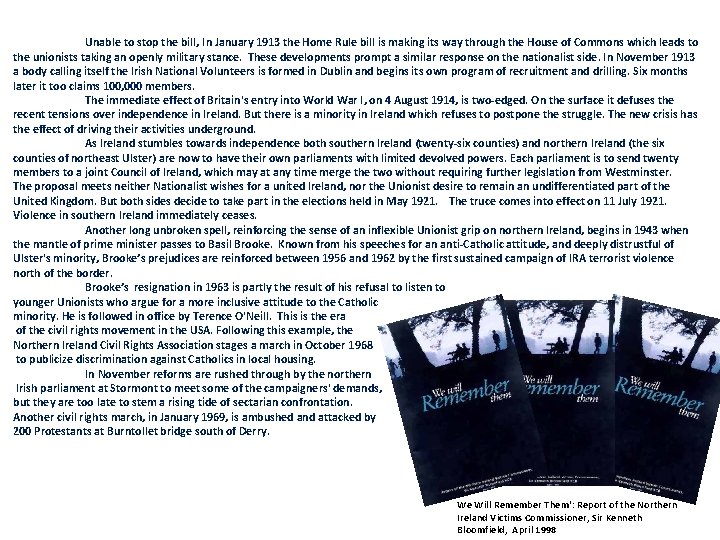
Unable to stop the bill, In January 1913 the Home Rule bill is making its way through the House of Commons which leads to the unionists taking an openly military stance. These developments prompt a similar response on the nationalist side. In November 1913 a body calling itself the Irish National Volunteers is formed in Dublin and begins its own program of recruitment and drilling. Six months later it too claims 100, 000 members. The immediate effect of Britain's entry into World War I, on 4 August 1914, is two-edged. On the surface it defuses the recent tensions over independence in Ireland. But there is a minority in Ireland which refuses to postpone the struggle. The new crisis has the effect of driving their activities underground. As Ireland stumbles towards independence both southern Ireland (twenty-six counties) and northern Ireland (the six counties of northeast Ulster) are now to have their own parliaments with limited devolved powers. Each parliament is to send twenty members to a joint Council of Ireland, which may at any time merge the two without requiring further legislation from Westminster. The proposal meets neither Nationalist wishes for a united Ireland, nor the Unionist desire to remain an undifferentiated part of the United Kingdom. But both sides decide to take part in the elections held in May 1921. The truce comes into effect on 11 July 1921. Violence in southern Ireland immediately ceases. Another long unbroken spell, reinforcing the sense of an inflexible Unionist grip on northern Ireland, begins in 1943 when the mantle of prime minister passes to Basil Brooke. Known from his speeches for an anti-Catholic attitude, and deeply distrustful of Ulster's minority, Brooke’s prejudices are reinforced between 1956 and 1962 by the first sustained campaign of IRA terrorist violence north of the border. Brooke’s resignation in 1963 is partly the result of his refusal to listen to younger Unionists who argue for a more inclusive attitude to the Catholic minority. He is followed in office by Terence O'Neill. This is the era of the civil rights movement in the USA. Following this example, the Northern Ireland Civil Rights Association stages a march in October 1968 to publicize discrimination against Catholics in local housing. In November reforms are rushed through by the northern Irish parliament at Stormont to meet some of the campaigners' demands, but they are too late to stem a rising tide of sectarian confrontation. Another civil rights march, in January 1969, is ambushed and attacked by 200 Protestants at Burntollet bridge south of Derry. We Will Remember Them': Report of the Northern Ireland Victims Commissioner, Sir Kenneth Bloomfield, April 1998
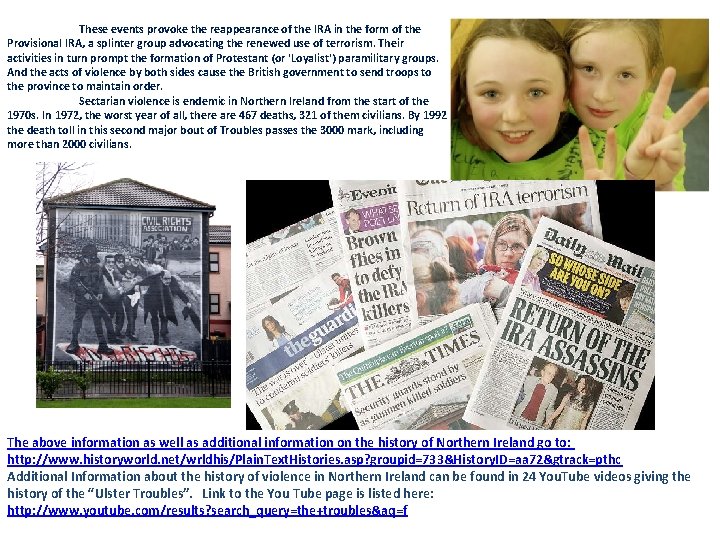
These events provoke the reappearance of the IRA in the form of the Provisional IRA, a splinter group advocating the renewed use of terrorism. Their activities in turn prompt the formation of Protestant (or 'Loyalist') paramilitary groups. And the acts of violence by both sides cause the British government to send troops to the province to maintain order. Sectarian violence is endemic in Northern Ireland from the start of the 1970 s. In 1972, the worst year of all, there are 467 deaths, 321 of them civilians. By 1992 the death toll in this second major bout of Troubles passes the 3000 mark, including more than 2000 civilians. The above information as well as additional information on the history of Northern Ireland go to: http: //www. historyworld. net/wrldhis/Plain. Text. Histories. asp? groupid=733&History. ID=aa 72>rack=pthc Additional Information about the history of violence in Northern Ireland can be found in 24 You. Tube videos giving the history of the “Ulster Troubles”. Link to the You Tube page is listed here: http: //www. youtube. com/results? search_query=the+troubles&aq=f
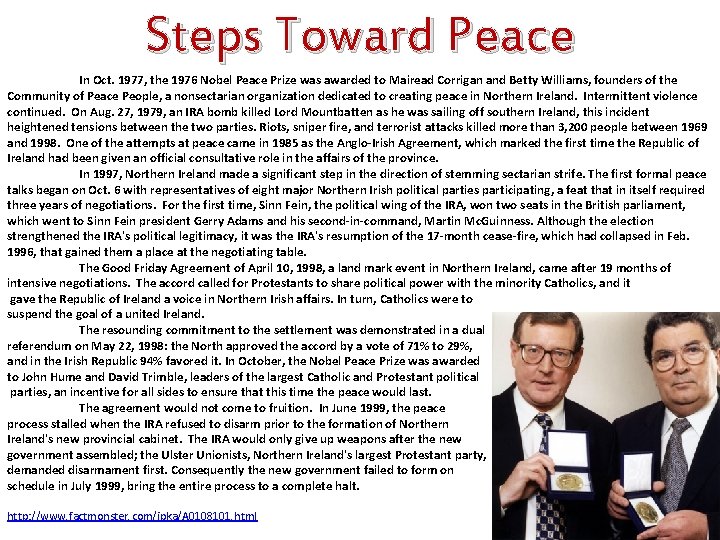
Steps Toward Peace In Oct. 1977, the 1976 Nobel Peace Prize was awarded to Mairead Corrigan and Betty Williams, founders of the Community of Peace People, a nonsectarian organization dedicated to creating peace in Northern Ireland. Intermittent violence continued. On Aug. 27, 1979, an IRA bomb killed Lord Mountbatten as he was sailing off southern Ireland, this incident heightened tensions between the two parties. Riots, sniper fire, and terrorist attacks killed more than 3, 200 people between 1969 and 1998. One of the attempts at peace came in 1985 as the Anglo-Irish Agreement, which marked the first time the Republic of Ireland had been given an official consultative role in the affairs of the province. In 1997, Northern Ireland made a significant step in the direction of stemming sectarian strife. The first formal peace talks began on Oct. 6 with representatives of eight major Northern Irish political parties participating, a feat that in itself required three years of negotiations. For the first time, Sinn Fein, the political wing of the IRA, won two seats in the British parliament, which went to Sinn Fein president Gerry Adams and his second-in-command, Martin Mc. Guinness. Although the election strengthened the IRA's political legitimacy, it was the IRA's resumption of the 17 -month cease-fire, which had collapsed in Feb. 1996, that gained them a place at the negotiating table. The Good Friday Agreement of April 10, 1998, a land mark event in Northern Ireland, came after 19 months of intensive negotiations. The accord called for Protestants to share political power with the minority Catholics, and it gave the Republic of Ireland a voice in Northern Irish affairs. In turn, Catholics were to suspend the goal of a united Ireland. The resounding commitment to the settlement was demonstrated in a dual referendum on May 22, 1998: the North approved the accord by a vote of 71% to 29%, and in the Irish Republic 94% favored it. In October, the Nobel Peace Prize was awarded to John Hume and David Trimble, leaders of the largest Catholic and Protestant political parties, an incentive for all sides to ensure that this time the peace would last. The agreement would not come to fruition. In June 1999, the peace process stalled when the IRA refused to disarm prior to the formation of Northern Ireland's new provincial cabinet. The IRA would only give up weapons after the new government assembled; the Ulster Unionists, Northern Ireland's largest Protestant party, demanded disarmament first. Consequently the new government failed to form on schedule in July 1999, bring the entire process to a complete halt. http: //www. factmonster. com/ipka/A 0108101. html
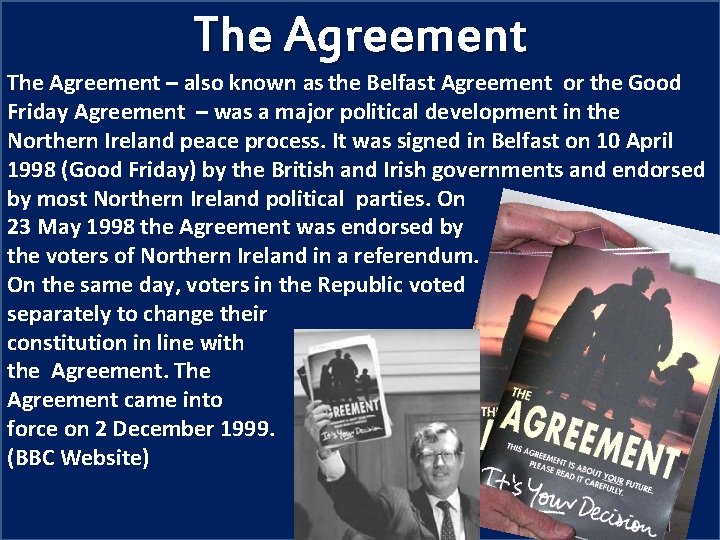
The Agreement – also known as the Belfast Agreement or the Good Friday Agreement – was a major political development in the Northern Ireland peace process. It was signed in Belfast on 10 April 1998 (Good Friday) by the British and Irish governments and endorsed by most Northern Ireland political parties. On 23 May 1998 the Agreement was endorsed by the voters of Northern Ireland in a referendum. On the same day, voters in the Republic voted separately to change their constitution in line with the Agreement. The Agreement came into force on 2 December 1999. (BBC Website)
Strand One -- Democratic OVERVIEW: The section called Strand One dealt with the Institutions establishment and operation of a democratically elected power- sharing assembly in Northern Ireland. It included safeguards for crosscommunity participation, such as the allocation of Committee Chairs, Ministers and Committee membership in proportion to party strengths. 1. This agreement provides for a democratically elected Assembly in Northern Ireland which is inclusive in its membership, capable of exercising executive and legislative authority, and subject to safeguards to protect the rights and interests of all sides of the community. The Assembly 2. A 108 -member Assembly will be elected by PR(STV) from existing Westminster constituencies. 3. The Assembly will exercise full legislative and executive authority in respect of those matters currently within the responsibility of the six Northern Ireland Government Departments, with the possibility of taking on responsibility for other matters as detailed elsewhere in this agreement. … (SEE NOTES) (Conciliation Resources)
Strand Two -- North/south Ministerial Under Strand Two a North/ South Ministerial Council was to bring Council together those with executive responsibilities in Northern Ireland the Irish government "on matters of mutual interest". 1. Under a new British/Irish Agreement dealing with the totality of relationships, and related legislation at Westminster and in the Oireachtas, a North/South Ministerial Council to be established to bring together those with executive responsibilities in Northern Ireland the Irish Government, to develop consultation, cooperation and action within the island of Ireland – including through implementation on an all-island cross-border basis – on matters of mutual interest within the competence of the Administrations, North and South. 2. All Council decisions to be by agreement between the two sides. Northern Ireland to be represented by the First Minister, Deputy First Minister and any relevant Ministers, the Irish Government by the Taoiseach and relevant Ministers, all operating in accordance with the rules for democratic authority and accountability in force in the Northern Ireland Assembly and the Oireachtas respectively. Participation in the Council to be one of the essential responsibilities attaching to relevant posts in the two Administrations. If a holder of a relevant post will not participate normally in the Council, the Taoiseach in the case of the Irish Government and the First and Deputy First Minister in the case of the Northern Ireland Administration to be able to make alternative arrangements. (SEE NOTES) (Conciliation Resources)
Strand Three -- British–Irish A British-Irish Council was set up under Strand Three "to promote the Council harmonious and mutually beneficial development of the totality of relationships among the peoples of these islands". In practice that means a body with representatives of the British and Irish governments and devolved institutions in Northern Ireland, Scotland Wales and, if appropriate, elsewhere in the United Kingdom, together with representatives of the Isle of Man and the Channel Islands. 1. A British–Irish Council (BIC) will be established under a new British–Irish Agreement to promote the harmonious and mutually beneficial development of the totality of relationships among the peoples of these islands. 2. Membership of the BIC will comprise representatives of the British and Irish Governments, devolved institutions in Northern Ireland, Scotland Wales, when established, and, if appropriate, elsewhere in the United Kingdom, together with representatives of the Isle of Man and the Channel Islands. (SEE NOTES) (Conciliation Resources)
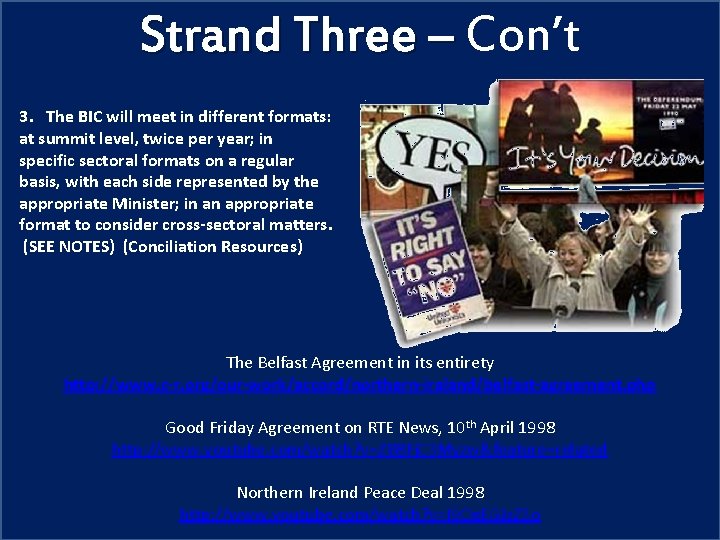
Strand Three – Con’t 3. The BIC will meet in different formats: at summit level, twice per year; in specific sectoral formats on a regular basis, with each side represented by the appropriate Minister; in an appropriate format to consider cross-sectoral matters. (SEE NOTES) (Conciliation Resources) The Belfast Agreement in its entirety http: //www. c-r. org/our-work/accord/northern-ireland/belfast-agreement. php Good Friday Agreement on RTE News, 10 th April 1998 http: //www. youtube. com/watch? v=ZB 8 Fj. C 3 Myzw&feature=related Northern Ireland Peace Deal 1998 http: //www. youtube. com/watch? v=I 9 Og. EGJz. Z 3 o
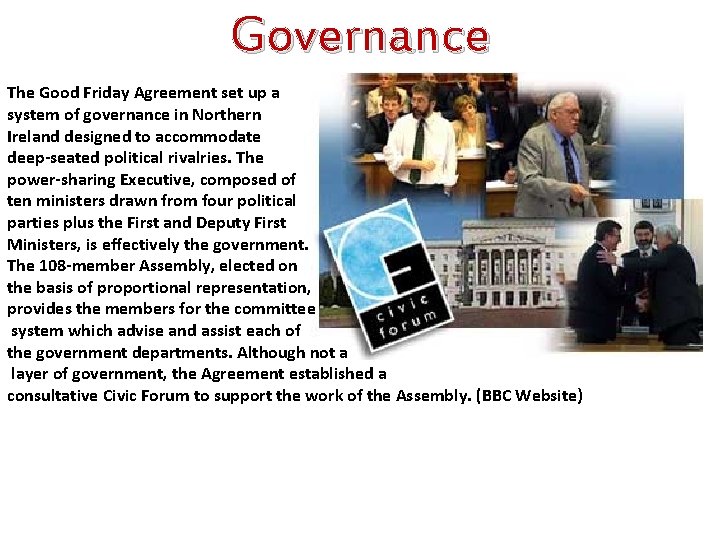
Governance The Good Friday Agreement set up a system of governance in Northern Ireland designed to accommodate deep-seated political rivalries. The power-sharing Executive, composed of ten ministers drawn from four political parties plus the First and Deputy First Ministers, is effectively the government. The 108 -member Assembly, elected on the basis of proportional representation, provides the members for the committee system which advise and assist each of the government departments. Although not a layer of government, the Agreement established a consultative Civic Forum to support the work of the Assembly. (BBC Website)
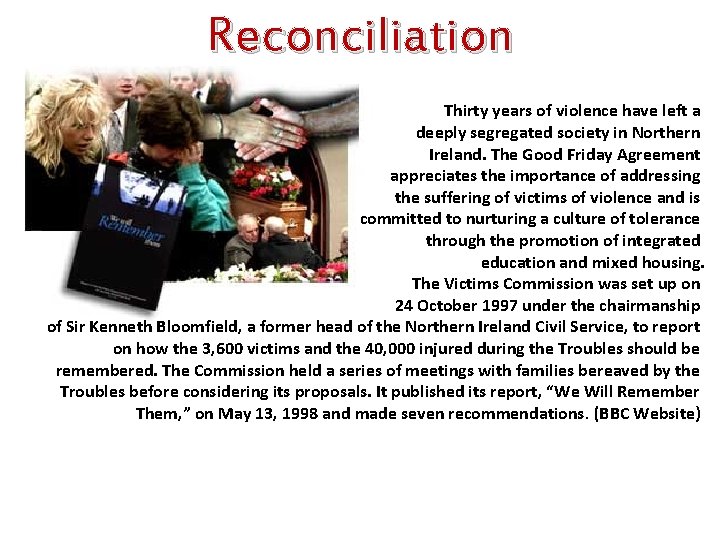
Reconciliation Thirty years of violence have left a deeply segregated society in Northern Ireland. The Good Friday Agreement appreciates the importance of addressing the suffering of victims of violence and is committed to nurturing a culture of tolerance through the promotion of integrated education and mixed housing. The Victims Commission was set up on 24 October 1997 under the chairmanship of Sir Kenneth Bloomfield, a former head of the Northern Ireland Civil Service, to report on how the 3, 600 victims and the 40, 000 injured during the Troubles should be remembered. The Commission held a series of meetings with families bereaved by the Troubles before considering its proposals. It published its report, “We Will Remember Them, ” on May 13, 1998 and made seven recommendations. (BBC Website)
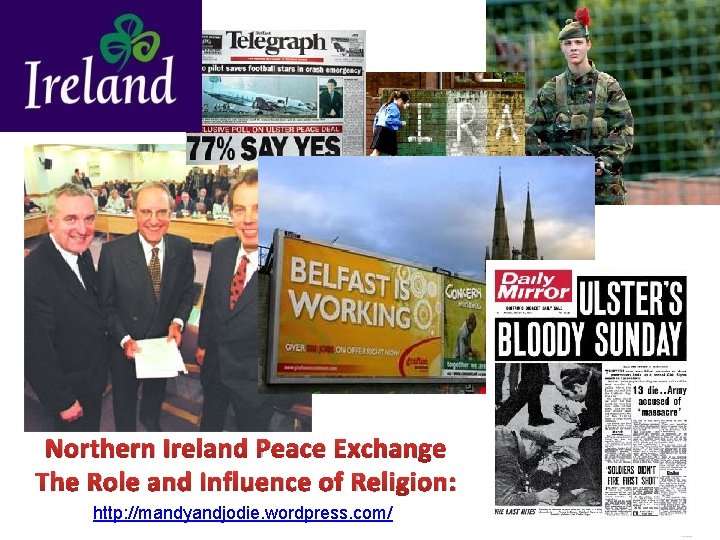
Northern Ireland Peace Exchange The Role and Influence of Religion: http: //mandyandjodie. wordpress. com/
Bibliography Slide 2: Pearson, Part of the Family Education Network; 1938; http: //www. infoplease. com/ipa/A 0108101. html Slide 3 & 4: Sources found in the attached blog mandyandjodie. wordpress. com Slide 5 & 6: Gascoigne, Bamber. History. World. From 2001, ongoing. http: //www. historyworld. net/wrldhis/Plain. Text. Histories. asp? groupid=733&History. ID=a a 72>rack=pthc Slide 7: “Northern Ireland, Steps Toward Peace, ” Fact Monster. © 2000– 2006 Pearson Education, publishing as Fact Monster. 08 May. 2010 http: //www. factmonster. com/ipka/A 0108101. html Slide 8: BBC, Information about Northern Ireland; The Agreement. http: //www. bbc. co. uk/northernireland/schools/agreement/ Slide 9 & 10 & 11 -12: Conciliation Resources, The Belfast Agreement, Northern Ireland. http: //www. c-r. org/our-work/accord/northern-ireland/belfast-agreement. php Slide 13 & 14: BBC, Information about Northern Ireland; governance and reconciliation. http: //www. bbc. co. uk/northernireland/schools/agreement/governance/
Image Sources Slide 1: http: //www. askaboutireland. ie/aai-files/assets/libraries/dublin-city-public-libraries/reading-room/pages-inhistory/1998 -Irish-Times-11 th-April. jpg Slide 2: http: //www. cnn. com/WORLD/europe/9812/31/n. ireland. yearender/ireland. dublin. belfast. jpg Slide 3: (both photos) http: //en. wikipedia. org/wiki/The_troubles Slide 4: http: //en. wikipedia. org/wiki/The_troubles Slide 5: http: //cain. ulst. ac. uk/issues/violence/victims. jpg Slide 6: http: //funpresident. com/wp-content/uploads/2009/03/violence_in_northern_ireland_03. jpg http: //peaceplayersintl. files. wordpress. com/2009/10/girlcloseup_0905091. jpg http: //livingstoneswv. files. wordpress. com/2008/06/bloody_sunday_mural_bogside_2004_smc. jpg Slide 7: http: //www. achievement. org/achievers/hum 0/large/hum 0 -004. jpg Slide 8: http: //oconallstreet. com/wp-content/uploads/2009/04/agreement_29396 a. jpg http: //www. c-r. org/our-work/accord/northern-ireland/images/assess. jpg Slide 12: http: //www. bbc. co. uk/northernireland/schools/agreement/ Slide 13: http: //www. bbc. co. uk/northernireland/schools/agreement/governance/ Slide 14: http: //www. bbc. co. uk/northernireland/schools/agreement/reconciliation/ Slide 15: http: //www. peacepolls. org/images/peacepolls/ni_poll_5. jpg http: //profile. ak. fbcdn. net/object 3/1757/55/n 129882931741_8694. jpg http: //www. irishabroad. com/CMS/Articles/Storage/3246_Images/_summary. Image/good-friday-agreement. jpg http: //www. radiopopolare. it/uploads/RTEmagic. C_Belfast 2. JPG. jpg http: //www. cbc. ca/news/background/northernireland/gfx/kid_irasign. jpg http: //imagecache 5. art. com/p/LRG/20/2094/M 5 O 2 D 00 Z/mirrorpix-ulsters-bloody-sunday-13 -die--army-accused-of-massacre. jpg http: //img. radio. cz/pictures/networkeurope/070803 -northern-ireland-army. jpg