
Northern Illinois University Optical Stochastic Cooling with Lasers

- Slides: 15
Northern Illinois University Optical Stochastic Cooling with Lasers M. Andorf Northern Illinois University
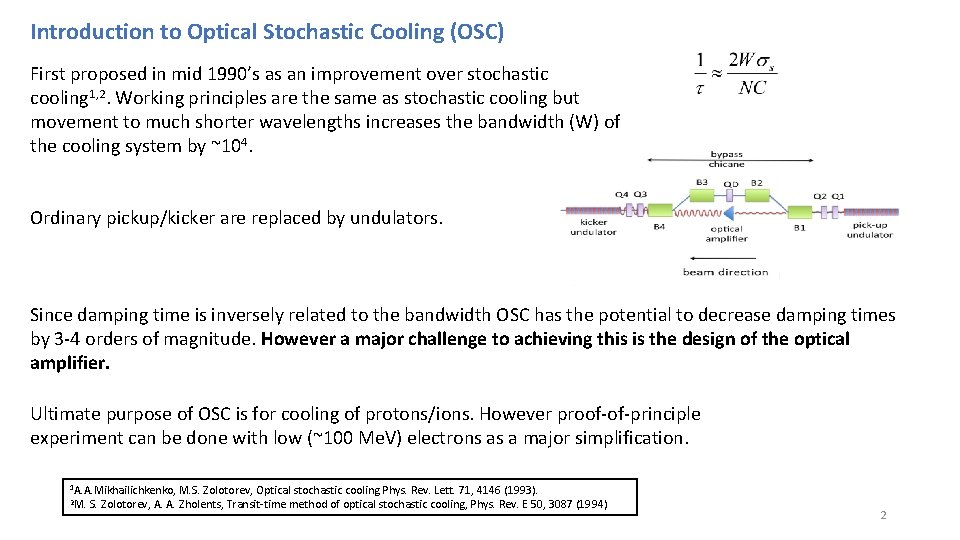
Introduction to Optical Stochastic Cooling (OSC) First proposed in mid 1990’s as an improvement over stochastic cooling 1, 2. Working principles are the same as stochastic cooling but movement to much shorter wavelengths increases the bandwidth (W) of the cooling system by ~104. Ordinary pickup/kicker are replaced by undulators. Since damping time is inversely related to the bandwidth OSC has the potential to decrease damping times by 3 -4 orders of magnitude. However a major challenge to achieving this is the design of the optical amplifier. Ultimate purpose of OSC is for cooling of protons/ions. However proof-of-principle experiment can be done with low (~100 Me. V) electrons as a major simplification. 1 A. A. Mikhailichkenko, 2 M. M. S. Zolotorev, Optical stochastic cooling Phys. Rev. Lett. 71, 4146 (1993). S. Zolotorev, A. A. Zholents, Transit-time method of optical stochastic cooling, Phys. Rev. E 50, 3087 (1994) 2
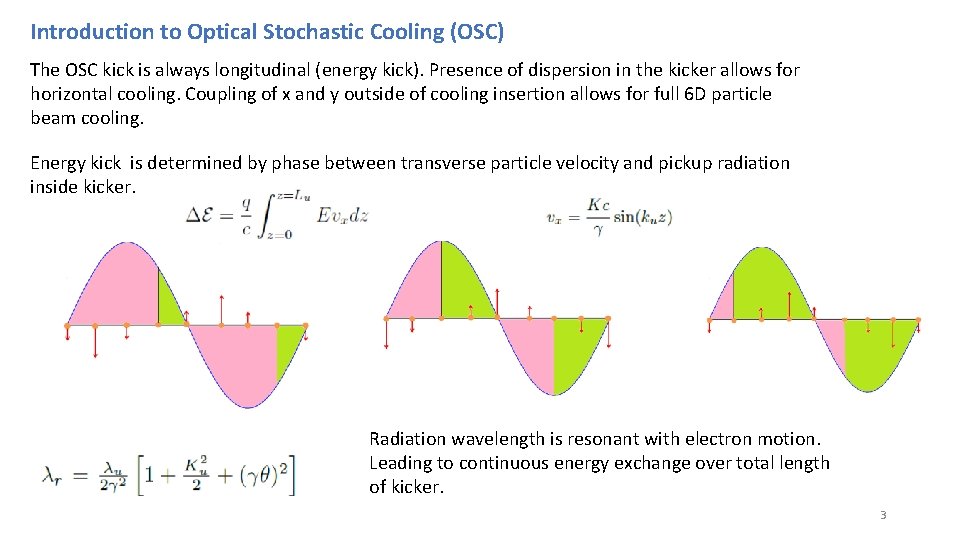
Introduction to Optical Stochastic Cooling (OSC) The OSC kick is always longitudinal (energy kick). Presence of dispersion in the kicker allows for horizontal cooling. Coupling of x and y outside of cooling insertion allows for full 6 D particle beam cooling. Energy kick is determined by phase between transverse particle velocity and pickup radiation inside kicker. Radiation wavelength is resonant with electron motion. Leading to continuous energy exchange over total length of kicker. 3
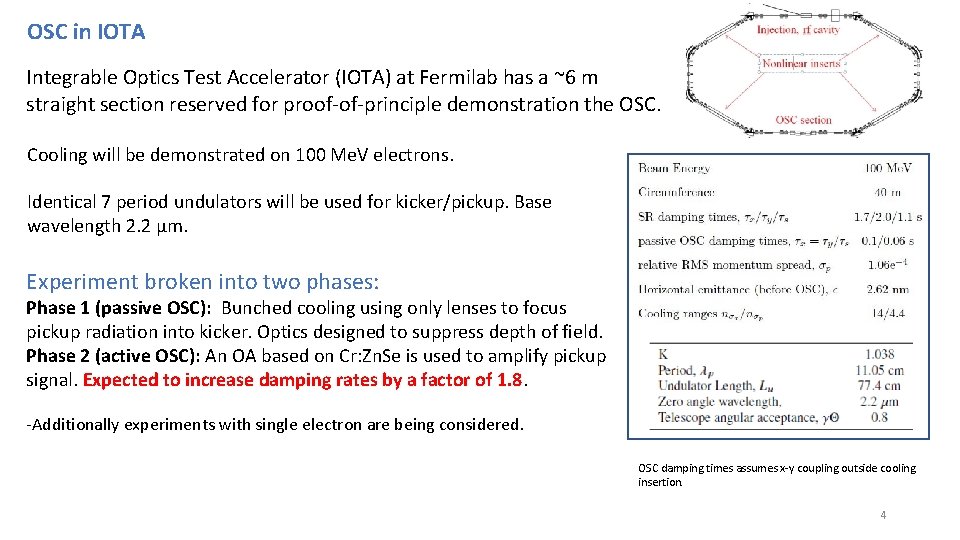
OSC in IOTA Integrable Optics Test Accelerator (IOTA) at Fermilab has a ~6 m straight section reserved for proof-of-principle demonstration the OSC. Cooling will be demonstrated on 100 Me. V electrons. Identical 7 period undulators will be used for kicker/pickup. Base wavelength 2. 2 μm. Experiment broken into two phases: Phase 1 (passive OSC): Bunched cooling using only lenses to focus pickup radiation into kicker. Optics designed to suppress depth of field. Phase 2 (active OSC): An OA based on Cr: Zn. Se is used to amplify pickup signal. Expected to increase damping rates by a factor of 1. 8. -Additionally experiments with single electron are being considered. OSC damping times assumes x-y coupling outside cooling insertion. 4
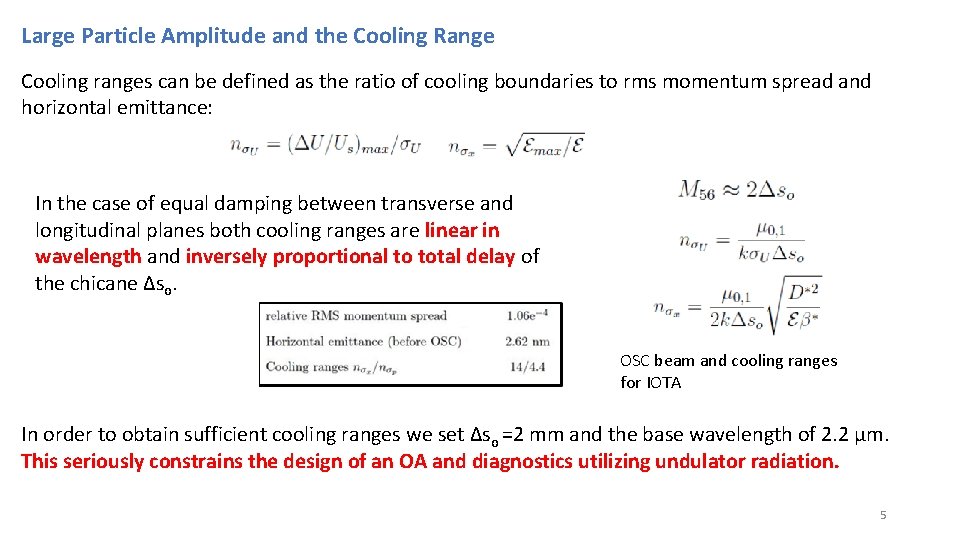
Large Particle Amplitude and the Cooling Range Cooling ranges can be defined as the ratio of cooling boundaries to rms momentum spread and horizontal emittance: In the case of equal damping between transverse and longitudinal planes both cooling ranges are linear in wavelength and inversely proportional to total delay of the chicane Δso. OSC beam and cooling ranges for IOTA In order to obtain sufficient cooling ranges we set Δso =2 mm and the base wavelength of 2. 2 μm. This seriously constrains the design of an OA and diagnostics utilizing undulator radiation. 5
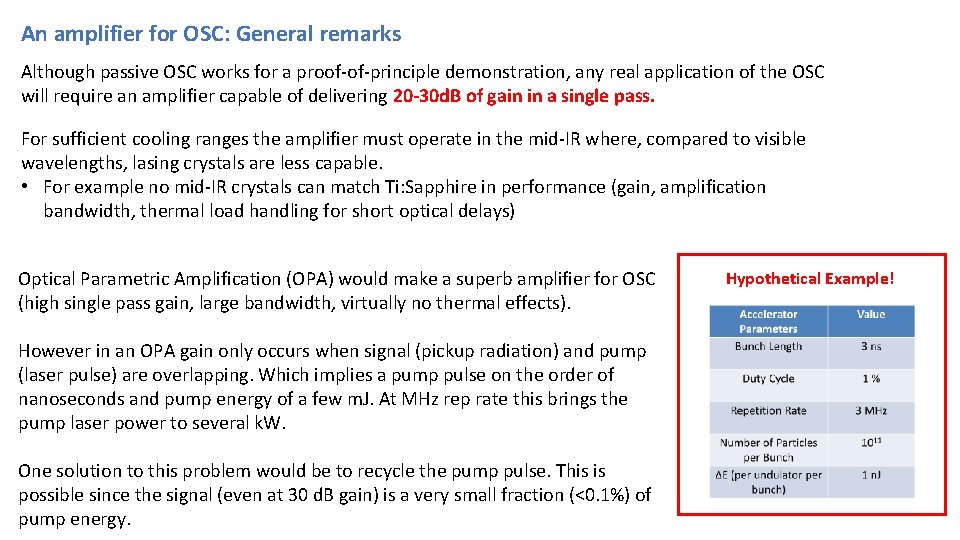
An amplifier for OSC: General remarks Although passive OSC works for a proof-of-principle demonstration, any real application of the OSC will require an amplifier capable of delivering 20 -30 d. B of gain in a single pass. For sufficient cooling ranges the amplifier must operate in the mid-IR where, compared to visible wavelengths, lasing crystals are less capable. • For example no mid-IR crystals can match Ti: Sapphire in performance (gain, amplification bandwidth, thermal load handling for short optical delays) Optical Parametric Amplification (OPA) would make a superb amplifier for OSC (high single pass gain, large bandwidth, virtually no thermal effects). However in an OPA gain only occurs when signal (pickup radiation) and pump (laser pulse) are overlapping. Which implies a pump pulse on the order of nanoseconds and pump energy of a few m. J. At MHz rep rate this brings the pump laser power to several k. W. One solution to this problem would be to recycle the pump pulse. This is possible since the signal (even at 30 d. B gain) is a very small fraction (<0. 1%) of pump energy. Hypothetical Example!
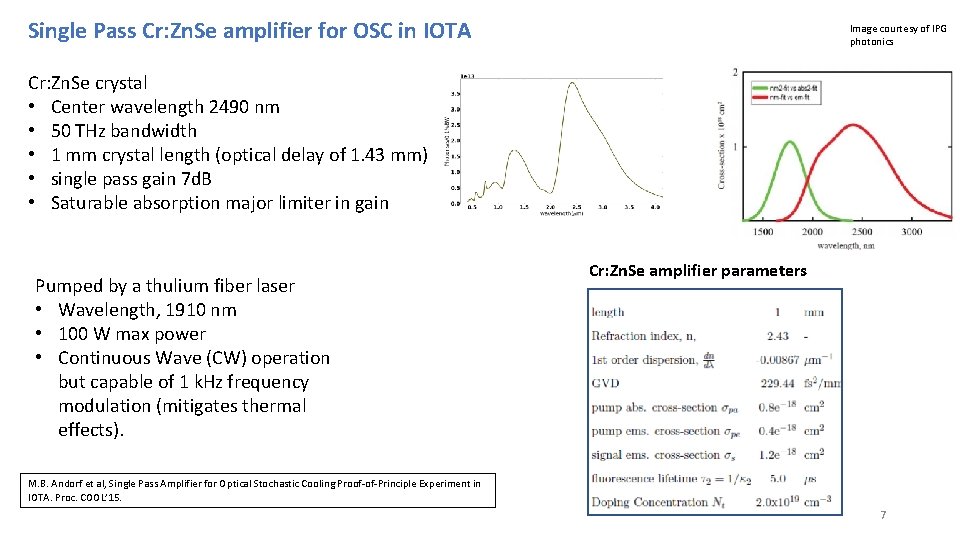
Single Pass Cr: Zn. Se amplifier for OSC in IOTA Image courtesy of IPG photonics Cr: Zn. Se crystal • Center wavelength 2490 nm • 50 THz bandwidth • 1 mm crystal length (optical delay of 1. 43 mm) • single pass gain 7 d. B • Saturable absorption major limiter in gain Pumped by a thulium fiber laser • Wavelength, 1910 nm • 100 W max power • Continuous Wave (CW) operation but capable of 1 k. Hz frequency modulation (mitigates thermal effects). Cr: Zn. Se amplifier parameters M. B. Andorf et al, Single Pass Amplifier for Optical Stochastic Cooling Proof-of-Principle Experiment in IOTA. Proc. COOL’ 15. 7
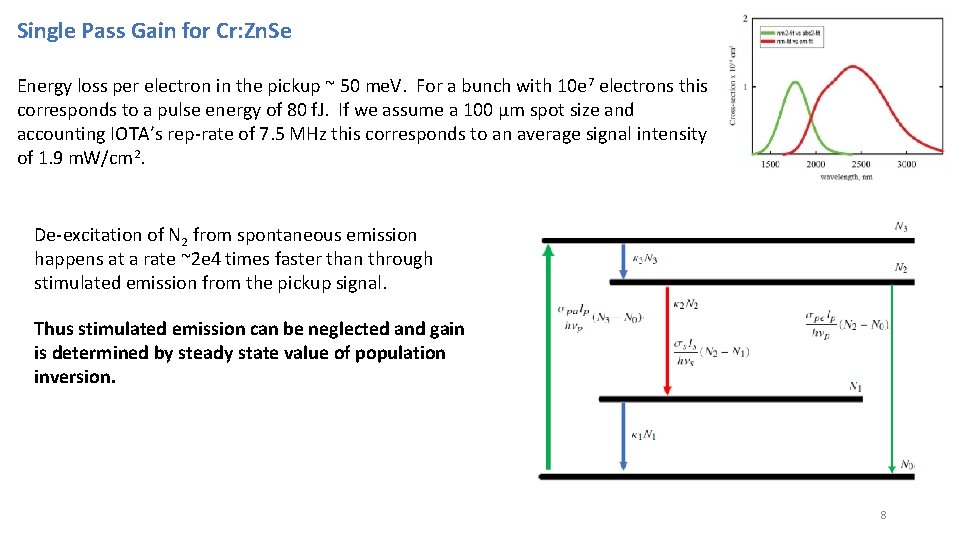
Single Pass Gain for Cr: Zn. Se Energy loss per electron in the pickup ~ 50 me. V. For a bunch with 10 e 7 electrons this corresponds to a pulse energy of 80 f. J. If we assume a 100 μm spot size and accounting IOTA’s rep-rate of 7. 5 MHz this corresponds to an average signal intensity of 1. 9 m. W/cm 2. De-excitation of N 2 from spontaneous emission happens at a rate ~2 e 4 times faster than through stimulated emission from the pickup signal. Thus stimulated emission can be neglected and gain is determined by steady state value of population inversion. 8
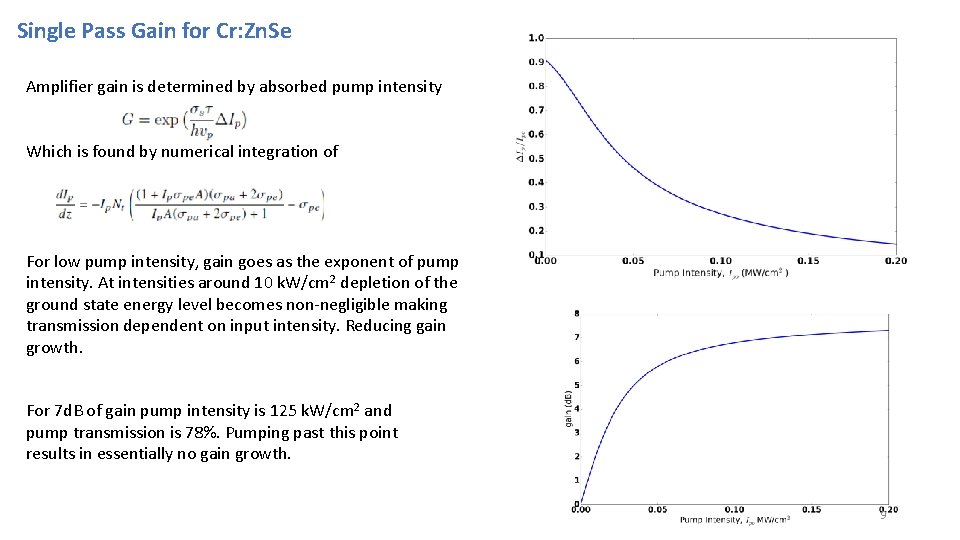
Single Pass Gain for Cr: Zn. Se Amplifier gain is determined by absorbed pump intensity Which is found by numerical integration of For low pump intensity, gain goes as the exponent of pump intensity. At intensities around 10 k. W/cm 2 depletion of the ground state energy level becomes non-negligible making transmission dependent on input intensity. Reducing gain growth. For 7 d. B of gain pump intensity is 125 k. W/cm 2 and pump transmission is 78%. Pumping past this point results in essentially no gain growth. 9
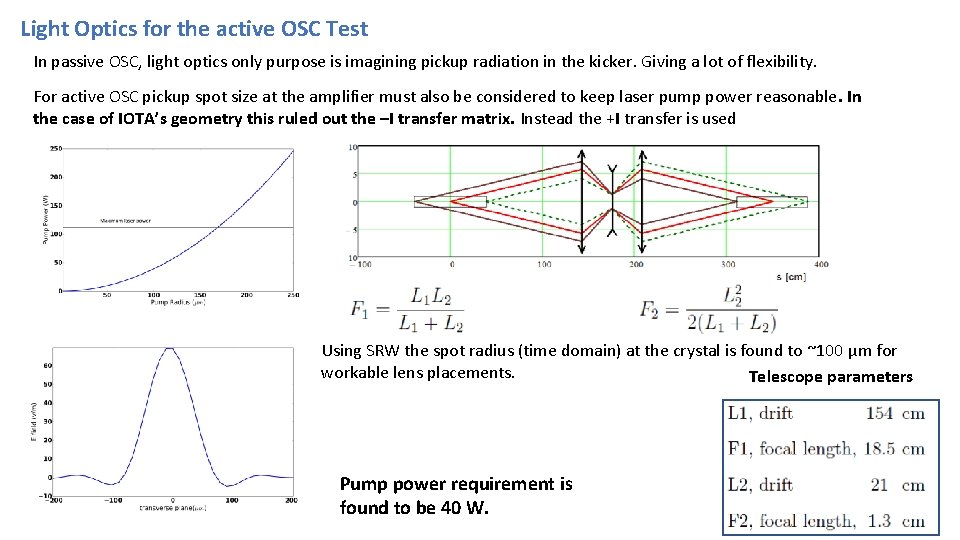
Light Optics for the active OSC Test In passive OSC, light optics only purpose is imagining pickup radiation in the kicker. Giving a lot of flexibility. For active OSC pickup spot size at the amplifier must also be considered to keep laser pump power reasonable. In the case of IOTA’s geometry this ruled out the –I transfer matrix. Instead the +I transfer is used Using SRW the spot radius (time domain) at the crystal is found to ~100 μm for workable lens placements. Telescope parameters Pump power requirement is found to be 40 W. 10
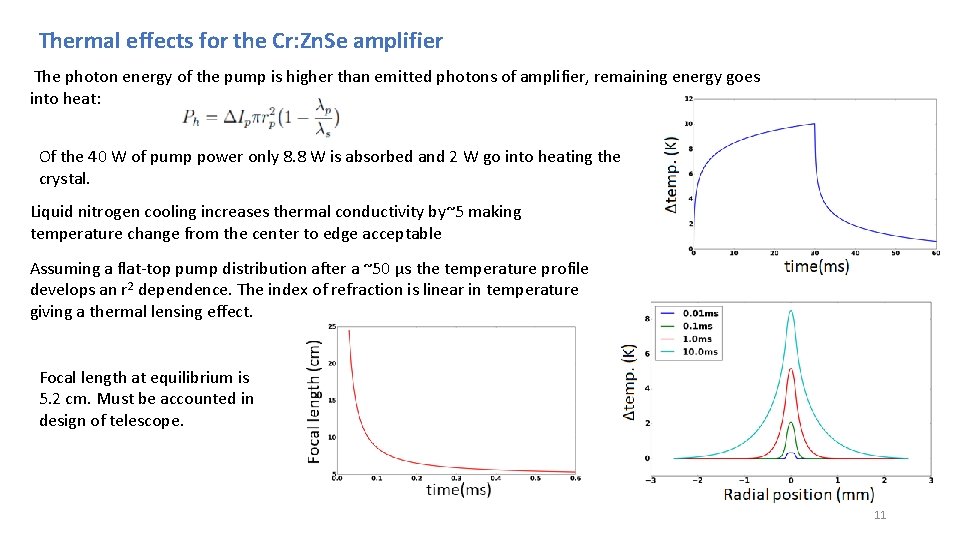
Thermal effects for the Cr: Zn. Se amplifier The photon energy of the pump is higher than emitted photons of amplifier, remaining energy goes into heat: Of the 40 W of pump power only 8. 8 W is absorbed and 2 W go into heating the crystal. Liquid nitrogen cooling increases thermal conductivity by~5 making temperature change from the center to edge acceptable Assuming a flat-top pump distribution after a ~50 μs the temperature profile develops an r 2 dependence. The index of refraction is linear in temperature giving a thermal lensing effect. Focal length at equilibrium is 5. 2 cm. Must be accounted in design of telescope. 11
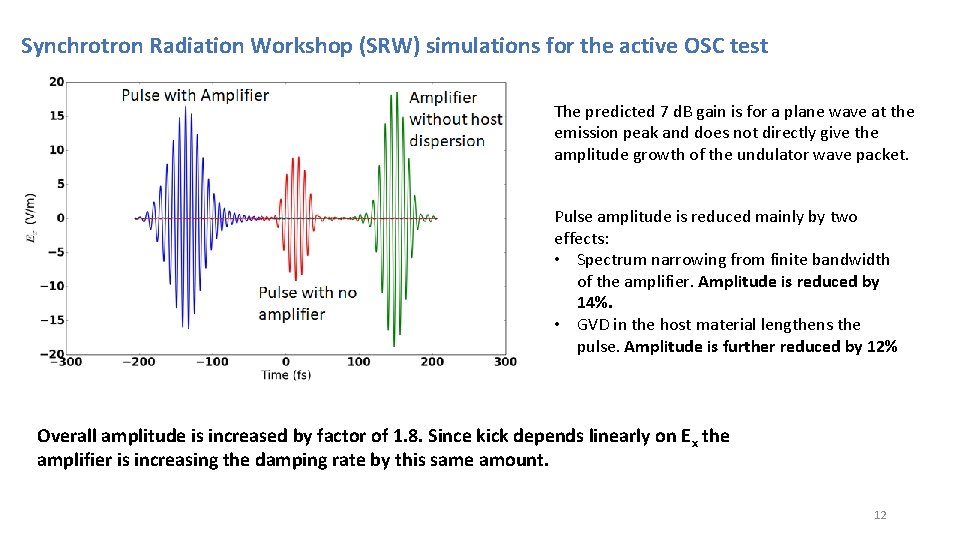
Synchrotron Radiation Workshop (SRW) simulations for the active OSC test The predicted 7 d. B gain is for a plane wave at the emission peak and does not directly give the amplitude growth of the undulator wave packet. Pulse amplitude is reduced mainly by two effects: • Spectrum narrowing from finite bandwidth of the amplifier. Amplitude is reduced by 14%. • GVD in the host material lengthens the pulse. Amplitude is further reduced by 12% Overall amplitude is increased by factor of 1. 8. Since kick depends linearly on E x the amplifier is increasing the damping rate by this same amount. 12
BACK UP SLIDES
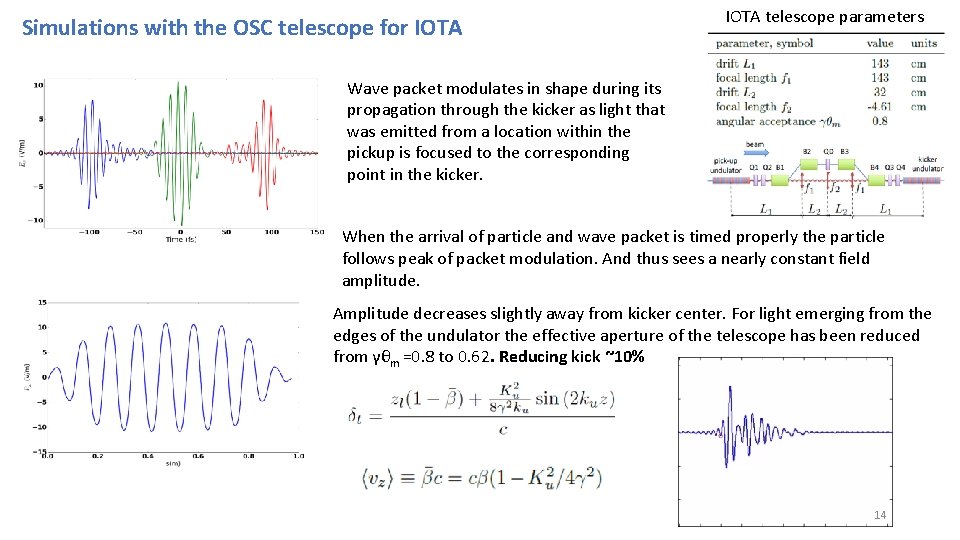
Simulations with the OSC telescope for IOTA telescope parameters Wave packet modulates in shape during its propagation through the kicker as light that was emitted from a location within the pickup is focused to the corresponding point in the kicker. When the arrival of particle and wave packet is timed properly the particle follows peak of packet modulation. And thus sees a nearly constant field amplitude. Amplitude decreases slightly away from kicker center. For light emerging from the edges of the undulator the effective aperture of the telescope has been reduced from γθm =0. 8 to 0. 62. Reducing kick ~10% 14
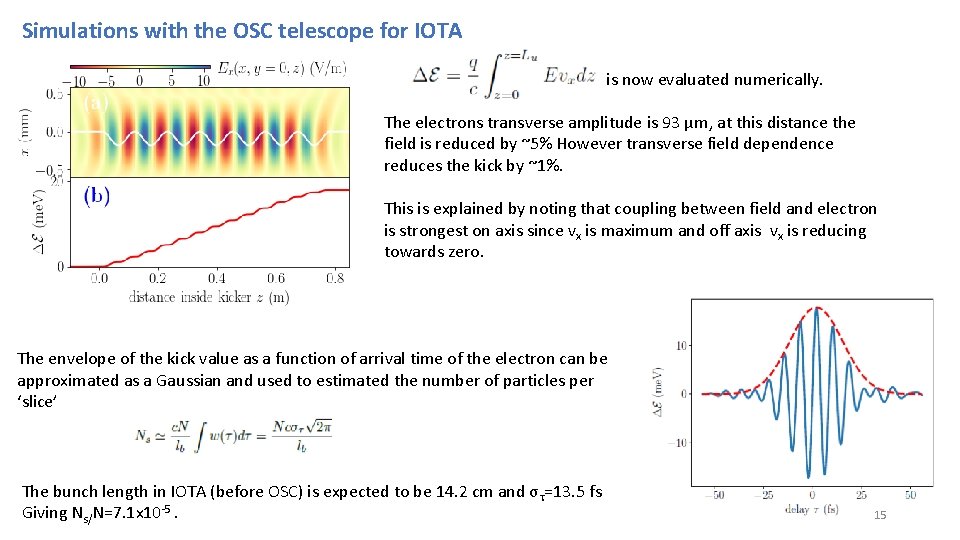
Simulations with the OSC telescope for IOTA is now evaluated numerically. The electrons transverse amplitude is 93 μm, at this distance the field is reduced by ~5% However transverse field dependence reduces the kick by ~1%. This is explained by noting that coupling between field and electron is strongest on axis since vx is maximum and off axis vx is reducing towards zero. The envelope of the kick value as a function of arrival time of the electron can be approximated as a Gaussian and used to estimated the number of particles per ‘slice’ The bunch length in IOTA (before OSC) is expected to be 14. 2 cm and στ=13. 5 fs Giving Ns/N=7. 1 x 10 -5. 15