
Northern Area Local Workforce Development Board Winter Training

Northern Area Local Workforce Development Board Winter Training: New Policies and Updates Dr. Le. Anne Salazar-Montoya Executive Director Deborah Wildenstein Program Monitor

Northern Area Local Workforce Development Board Updates • Staff • Brief Overview of Sector Strategy Initiative IT Convening-– April 1, 2020 (NNMCEspanola, NM) Healthcare Convening—May (TBD) • Policies • Location Changes Upcoming
NALWDB Staff Miranda Harris Executive Secretary Amber Gomez Communications Elena Maestas Program Specialist Deborah Wildenstein Program Monitor Lisa Ortiz Financial Specialist Barney Trujillo Operations Manager Dr. Le. Anne Salazar-Montoya Executive Director Joseph Weathers Henry Roybal Local Board Chair CEO Board Chair
Sector Strategies What is a sector strategy? “Goals, plans of action, policies, and service delivery strategies developed and continuously re-examined by sector partnerships to meet the ongoing and changing needs of employers within that sector. ” (Maher & Maher, 2020) The NALWDB identified sector strategies: q. Information Technology q. Healthcare q. Hospitality q. Education
Sector Strategies cont. . The goal of Sector Strategies goes beyond immediately placing workers in jobs; rather, the goal is to build regional talent pipelines, address skill shortages, and create meaningful “Career Pathways” for a range of workers in specific industry sectors. Career Pathways are: “A clear sequence of educational coursework, work experience and/or training credentials that help a worker enter or advance within a specific sector or occupational field, regardless of skills at the point of entry, with on and off ramps along the way. ”
Purpose The purpose of this guidance is to provide instruction on the policy and procedures required under the Workforce Innovation and Opportunity Act (WIOA) regarding grievances and complaints from participants and other interested parties, including one-on-one assistance for individuals with disabilities when necessary.

Background WIOA mandates that each Local Workforce Development Area (LWDA) or a Local Workforce Development Board (LWDB) receiving an allotment under WIOA to establish and maintain a procedure for WIOA grievances or complaints. Complaints, other than discrimination complaints, will originate at the local level. If a resolution is not obtained at the local level within sixty (60) days of the filing of the complaint, or either party is dissatisfied with the local hearing decision, a state-level appeal may be filed. The state level decision may be appealed to the Secretary in the event that a decision has not been reached within sixty (60) days, or a decision has been reached and the party wishes to appeal to the Secretary.
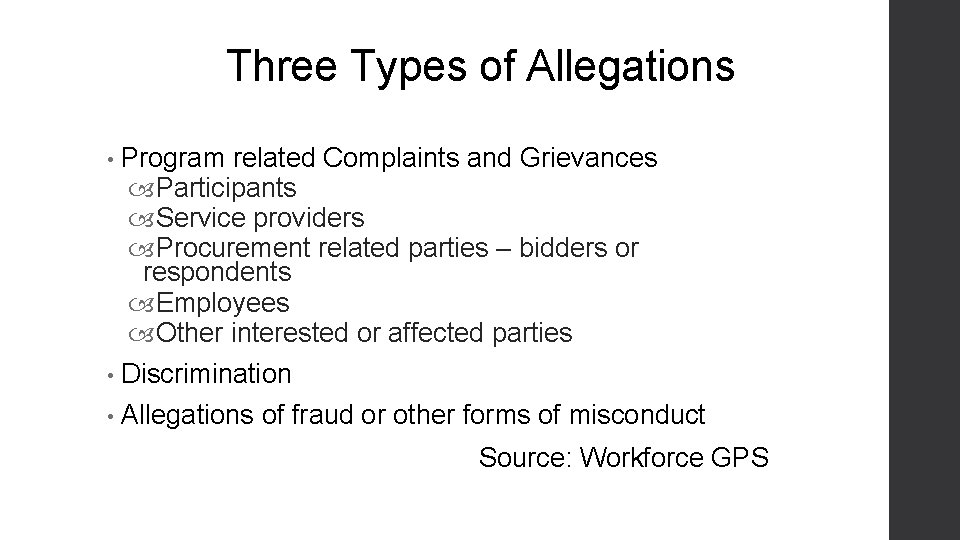
Three Types of Allegations • Program related Complaints and Grievances Participants Service providers Procurement related parties – bidders or respondents Employees Other interested or affected parties Discrimination • Allegations of fraud or other forms of misconduct • Source: Workforce GPS
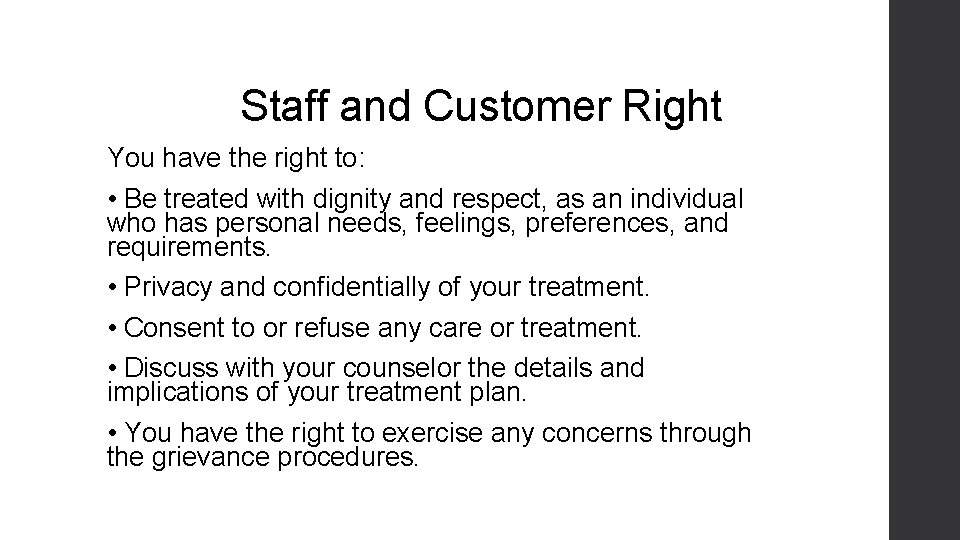
Staff and Customer Right You have the right to: • Be treated with dignity and respect, as an individual who has personal needs, feelings, preferences, and requirements. • Privacy and confidentially of your treatment. • Consent to or refuse any care or treatment. • Discuss with your counselor the details and implications of your treatment plan. • You have the right to exercise any concerns through the grievance procedures.
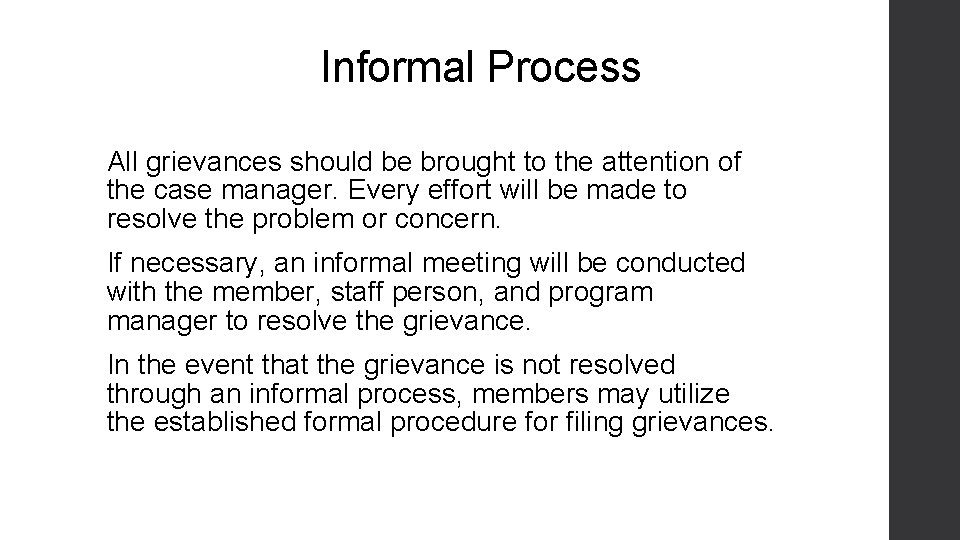
Informal Process All grievances should be brought to the attention of the case manager. Every effort will be made to resolve the problem or concern. If necessary, an informal meeting will be conducted with the member, staff person, and program manager to resolve the grievance. In the event that the grievance is not resolved through an informal process, members may utilize the established formal procedure for filing grievances.
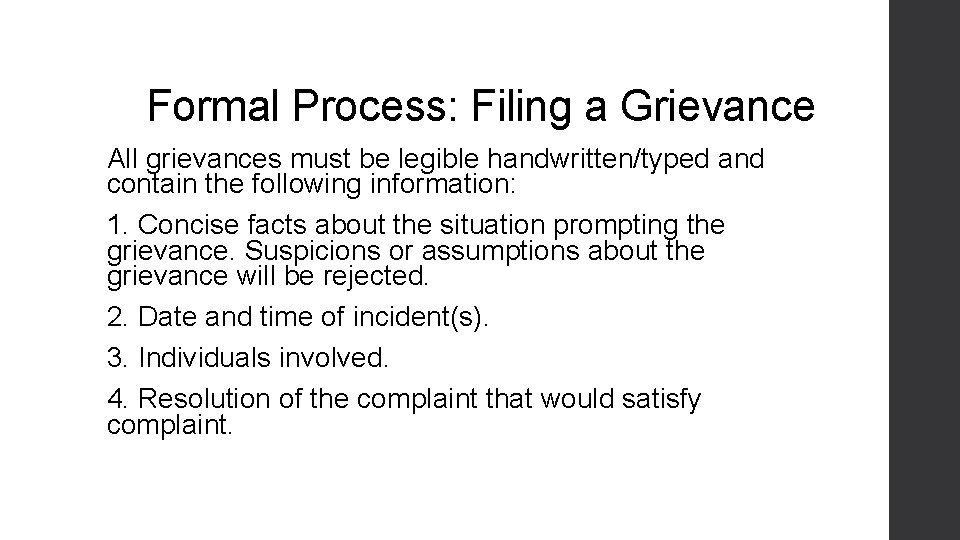
Formal Process: Filing a Grievance All grievances must be legible handwritten/typed and contain the following information: 1. Concise facts about the situation prompting the grievance. Suspicions or assumptions about the grievance will be rejected. 2. Date and time of incident(s). 3. Individuals involved. 4. Resolution of the complaint that would satisfy complaint.
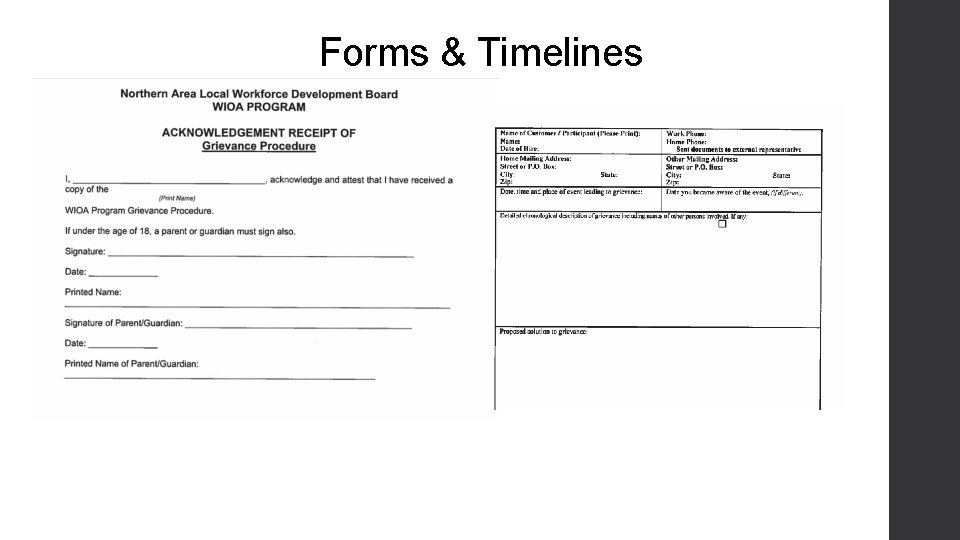
Forms & Timelines
Grievance Policy As stated in section 683. 600 of the Code of Federal Regulations, the purpose of this policy is to “establish and maintain a procedure for participants and other interested parties to file grievances and complaints alleging violations of the requirements of Title I of WIOA, according to the requirements of this section”. 20 CFR 683. 600(a)&(b) • Each state, local area and direct grant recipient must: Establish and maintain a procedure for grievances or complaints alleging violations of the Act. Provide information on these procedures to participants and other interested or affected parties, including one-stop partners and service providers. Require every entity receiving Title I funds to provide this information to their participants. Assure that the information is understood by affected individuals, including youth and limited-English speaking individuals.

Grievance Policy and Procedure What is a grievance? Applicants and participants of the WIOA program, including applicants for employment, and employees, have the right to enter into the grievance process to resolve disputes. Complaints and grievances from participants and other interested parties affected by the local Workforce Innovation System, including One -Stop partners and service providers may file a complaint/grievance. Complaint/grievances must be filed in writing within one year after the alleged WIOA violation took place. Individuals in grievance investigations are protected from retaliation and are permitted to have translators, interpreters, readers and/or a representative of their choice during the grievance process.
The Process (20 CFR Part 683 Subpart F-Grievance Procedures, Complaints and State Appeals; 29 CFR Part 38, WIOA Section 188 Non-Discrimination and Equal Opportunity Regulations) • STEP 1—Initial Review • STEP 2—Informal Resolution • STEP 3—Formal Resolution • STEP 4—Hearing • STEP 5—Final Decision • STEP 6—APPEAL The grievance procedures related to discrimination and equal opportunity are outlined in 20 CFR (§) 683. 600. (1) The provisions of this section on grievance procedures do not apply to discrimination complaints brought under WIOA sec. 188 and/or 29 CFR part 38. Such complaints must be handled in accordance with the procedures set forth in that regulatory part. (2) Questions about or complaints alleging a violation of the nondiscrimination provisions of WIOA sec. 188 may be directed or mailed to the Director, Civil Rights Center, U. S. Department of Labor, Room N 4123, 200 Constitution Avenue NW. , Washington, DC 20210, for processing.
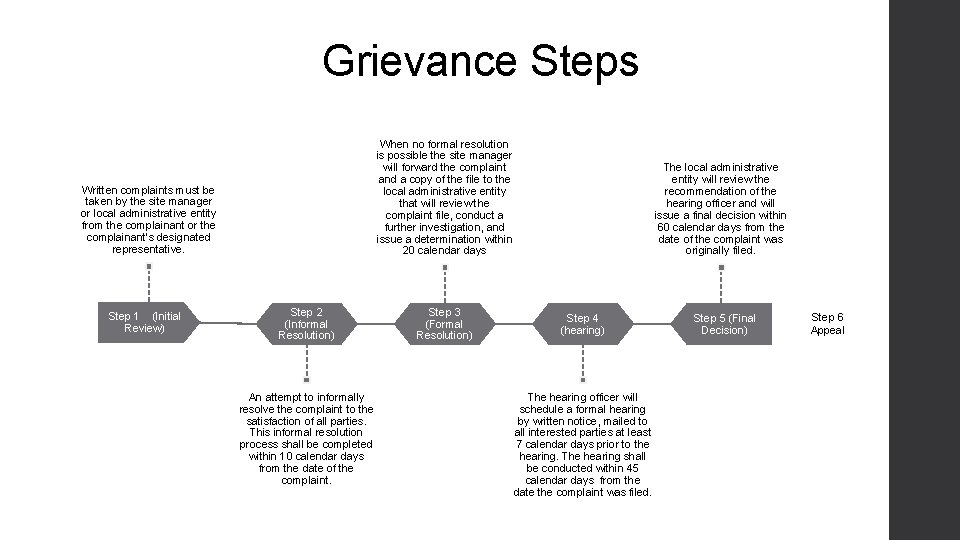
Grievance Steps When no formal resolution is possible the site manager will forward the complaint and a copy of the file to the local administrative entity that will review the complaint file, conduct a further investigation, and issue a determination within 20 calendar days Written complaints must be taken by the site manager or local administrative entity from the complainant or the complainant’s designated representative. Step 1 (Initial Review) Step 2 (Informal Resolution) An attempt to informally resolve the complaint to the satisfaction of all parties. This informal resolution process shall be completed within 10 calendar days from the date of the complaint. Step 3 (Formal Resolution) The local administrative entity will review the recommendation of the hearing officer and will issue a final decision within 60 calendar days from the date of the complaint was originally filed. Step 4 (hearing) The hearing officer will schedule a formal hearing by written notice, mailed to all interested parties at least 7 calendar days prior to the hearing. The hearing shall be conducted within 45 calendar days from the date the complaint was filed. Step 5 (Final Decision) Step 6 Appeal
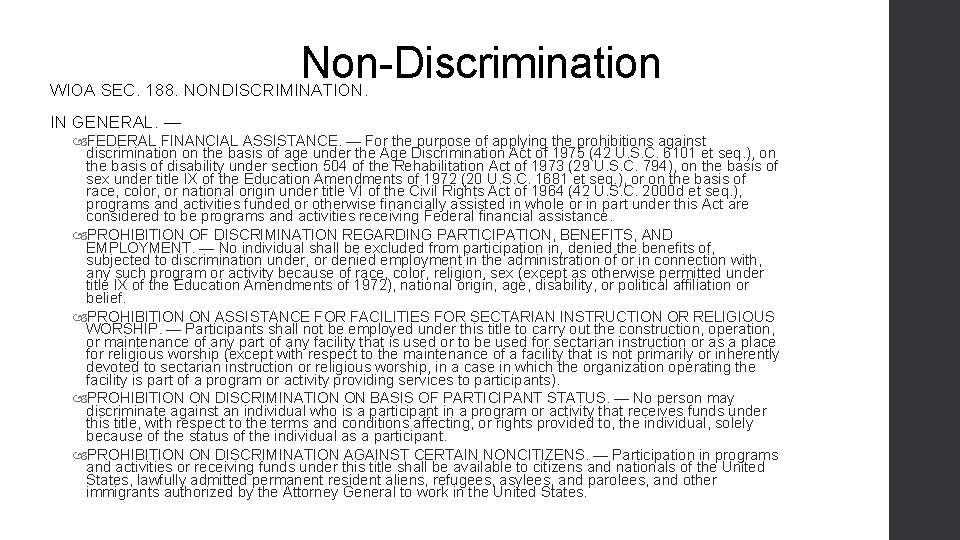
Non-Discrimination WIOA SEC. 188. NONDISCRIMINATION. IN GENERAL. — FEDERAL FINANCIAL ASSISTANCE. — For the purpose of applying the prohibitions against discrimination on the basis of age under the Age Discrimination Act of 1975 (42 U. S. C. 6101 et seq. ), on the basis of disability under section 504 of the Rehabilitation Act of 1973 (29 U. S. C. 794), on the basis of sex under title IX of the Education Amendments of 1972 (20 U. S. C. 1681 et seq. ), or on the basis of race, color, or national origin under title VI of the Civil Rights Act of 1964 (42 U. S. C. 2000 d et seq. ), programs and activities funded or otherwise financially assisted in whole or in part under this Act are considered to be programs and activities receiving Federal financial assistance. PROHIBITION OF DISCRIMINATION REGARDING PARTICIPATION, BENEFITS, AND EMPLOYMENT. — No individual shall be excluded from participation in, denied the benefits of, subjected to discrimination under, or denied employment in the administration of or in connection with, any such program or activity because of race, color, religion, sex (except as otherwise permitted under title IX of the Education Amendments of 1972), national origin, age, disability, or political affiliation or belief. PROHIBITION ON ASSISTANCE FOR FACILITIES FOR SECTARIAN INSTRUCTION OR RELIGIOUS WORSHIP. — Participants shall not be employed under this title to carry out the construction, operation, or maintenance of any part of any facility that is used or to be used for sectarian instruction or as a place for religious worship (except with respect to the maintenance of a facility that is not primarily or inherently devoted to sectarian instruction or religious worship, in a case in which the organization operating the facility is part of a program or activity providing services to participants). PROHIBITION ON DISCRIMINATION ON BASIS OF PARTICIPANT STATUS. — No person may discriminate against an individual who is a participant in a program or activity that receives funds under this title, with respect to the terms and conditions affecting, or rights provided to, the individual, solely because of the status of the individual as a participant. PROHIBITION ON DISCRIMINATION AGAINST CERTAIN NONCITIZENS. — Participation in programs and activities or receiving funds under this title shall be available to citizens and nationals of the United States, lawfully admitted permanent resident aliens, refugees, asylees, and parolees, and other immigrants authorized by the Attorney General to work in the United States.
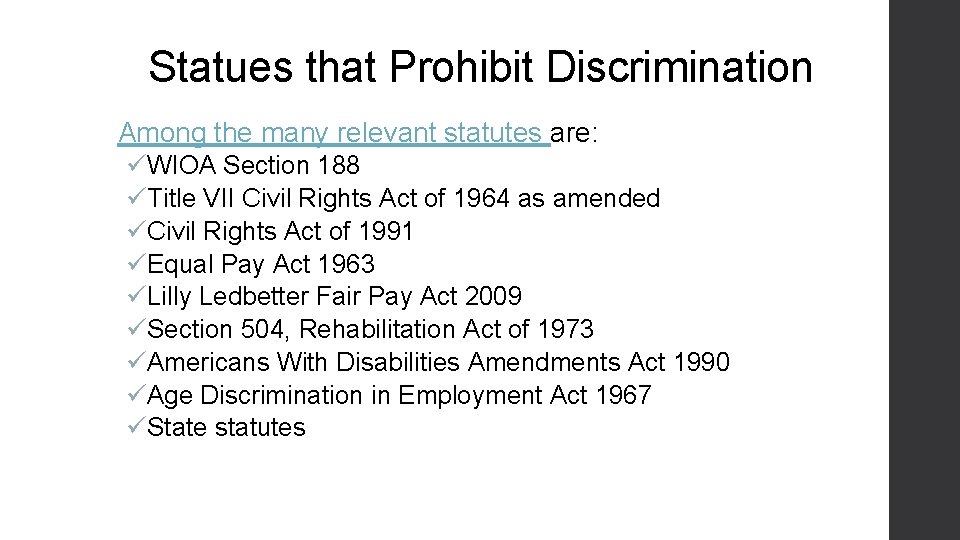
Statues that Prohibit Discrimination Among the many relevant statutes are: üWIOA Section 188 üTitle VII Civil Rights Act of 1964 as amended üCivil Rights Act of 1991 üEqual Pay Act 1963 üLilly Ledbetter Fair Pay Act 2009 üSection 504, Rehabilitation Act of 1973 üAmericans With Disabilities Amendments Act 1990 üAge Discrimination in Employment Act 1967 üState statutes
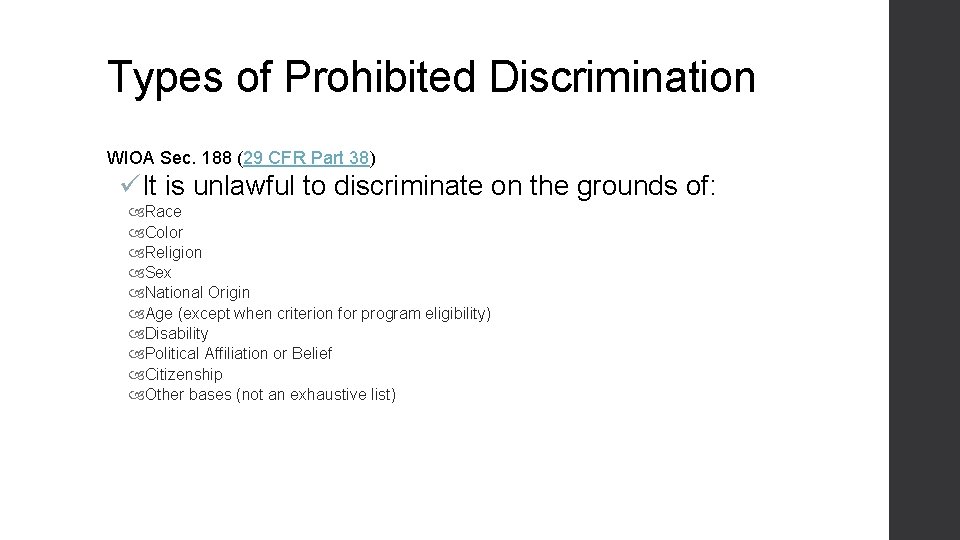
Types of Prohibited Discrimination WIOA Sec. 188 (29 CFR Part 38) üIt is unlawful to discriminate on the grounds of: Race Color Religion Sex National Origin Age (except when criterion for program eligibility) Disability Political Affiliation or Belief Citizenship Other bases (not an exhaustive list)
Allegations of Fraud 20 CFR § 683. 620 (a) Information and complaints involving criminal fraud, waste, abuse or other criminal activity must be reported immediately through the Department's Incident Reporting System to the Department of Labor Office of Inspector General, Office of Investigations, Room S 5514, 200 Constitution Avenue NW. , Washington, DC 20210, or to the corresponding Regional Inspector General for Investigations, with a copy simultaneously provided to the Employment and Training Administration. The Hotline number is 1 -800 -347 -3756. The Web site is http: //www. oig. dol. gov/contact. htm. (b) Complaints of a non-criminal nature may be handled under the procedures set forth in § 683. 600 or through the Department's Incident Reporting System.
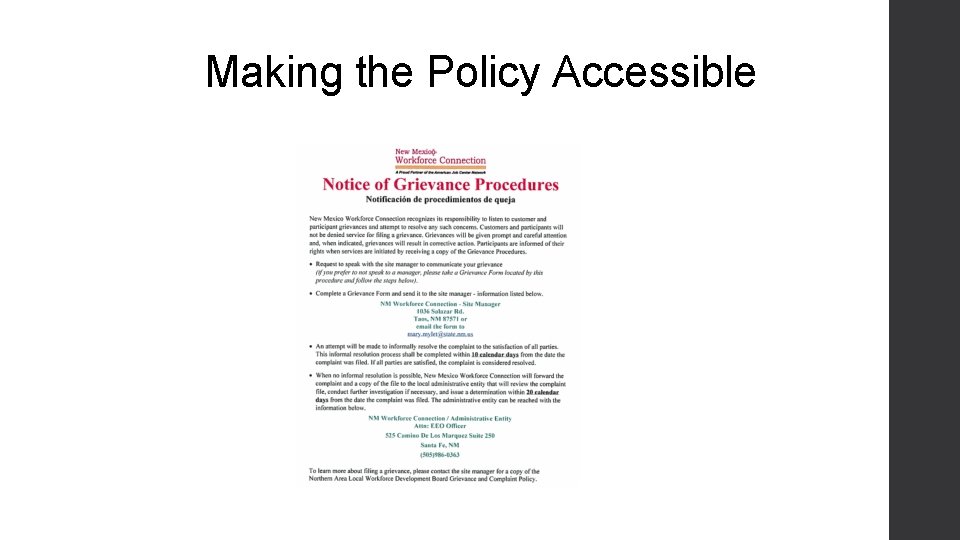
Making the Policy Accessible
Resources Filing a charge of discrimination: https: //www. dws. state. nm. us/Filing-a-Charge-of-Discrimination Additional Training: Complaints, Grievances & Incident Reporting https: //www. workforcegps. org/events/2019/08/14/17/30/~/link. aspx? _id=E 5 CCE 15 FA 68 D 4 A 658707 B 07 F 310988 FE&_z=zn
Questions The Northern Area Local Workforce Development Board 525 Camino de Los Marquez Santa Fe, New Mexico 87505 (505) 986 -0363 www. northernboard. org info@nalwdb. org
- Slides: 24