
Northeast Georgia Council KK 4 BSA Radio Merit
Northeast Georgia Council KK 4 BSA Radio Merit Badge 1
Northeast Georgia Council KK 4 BSA Counselor Information • • Mr. Steve Back Amateur Radio Extra Class Operator Call sign: WB 2 OGY Authorized Volunteer Examiner (VE) with W 5 YI and ARRL • Committee Chairman for Venture Crew 73, chartered by the Gwinnett Amateur Radio Society • Email: sb@sback. org • Phone: 770 712 9069 2
Northeast Georgia Council KK 4 BSA What is Radio • Radio is a way to electronically communicate from one place to another without wires • Radio is used in broadcasting, two way radios, television, mobile telephones, wireless LANs, garage door openers, car locks, EZpass, satellites, pagers, radar, microwave ovens, etc. 3 Radio M. B Req. 1
Northeast Georgia Council KK 4 BSA The differences between Broadcast & Hobby Radio • Broadcast radio sends information to many people at the same time. Examples: talk radio, music, or television. • Hobby Radio is used by amateur radio & citizens band operators and people that engage in activities where radio is helpful Examples: controlling models or tracking balloons or Family Radio Service (FRS) radios when camping 4 Radio M. B Req. 1 a
Northeast Georgia Council KK 4 BSA Differences between Broadcast & Two-Way Communication • Broadcasting is one-way communication from a transmitter to many receivers. It is usually planned programming and may be commercial with music, news, sports and advertising or non-commercial from schools, community radio stations, or National Public Radio (NPR). • Two-way radio uses both a transmitter and receiver at both ends. Examples are walkietalkies, amateur radio, mobile telephones, fire and police, taxis, aviation, ships, military, etc. 5 Radio M. B Req. 1 b
Northeast Georgia Council KK 4 BSA Radio Station Call Signs • Call signs are a unique identification for a licensed radio station. • Broadcast radio station call signs are three or four letters. • WABC, WLS, KNBC, KCMO • U. S. Amateur radio station call signs are letters and a number beginning with • W, K, A, or N. • W 1 AW, K 9 BR, KB 3 BOY, WW 9 Y, N 3 YVH, K 2 BSA • Create Your Imaginary Call Sign • Pick K, N, or W, a number, and add your initials 6 Radio M. B Req. 1. c.
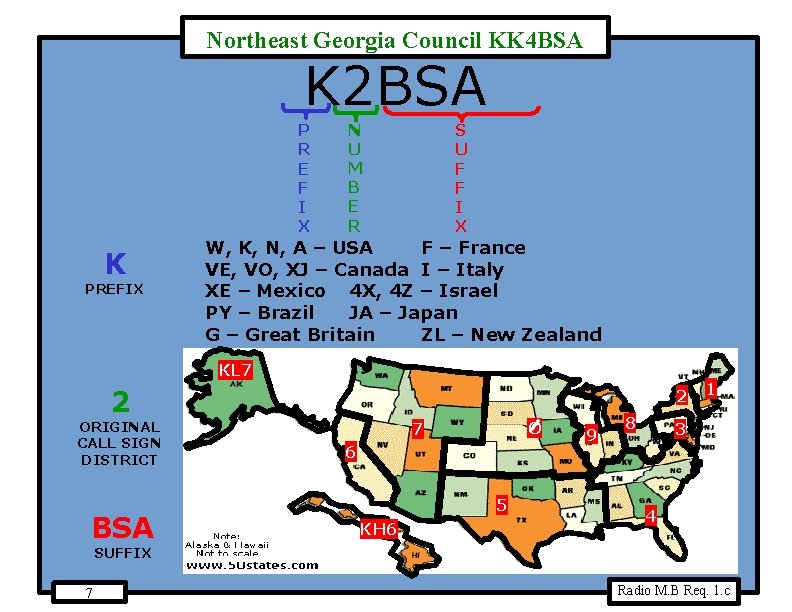
Northeast Georgia Council KK 4 BSA K 2 BSA P R E F I X K PREFIX N U M B E R S U F F I X W, K, N, A – USA F – France VE, VO, XJ – Canada I – Italy XE – Mexico 4 X, 4 Z – Israel PY – Brazil JA – Japan G – Great Britain ZL – New Zealand KL 7 2 ORIGINAL CALL SIGN DISTRICT BSA 2 O 7 6 5 KH 6 9 8 1 3 4 SUFFIX 7 Radio M. B Req. 1. c
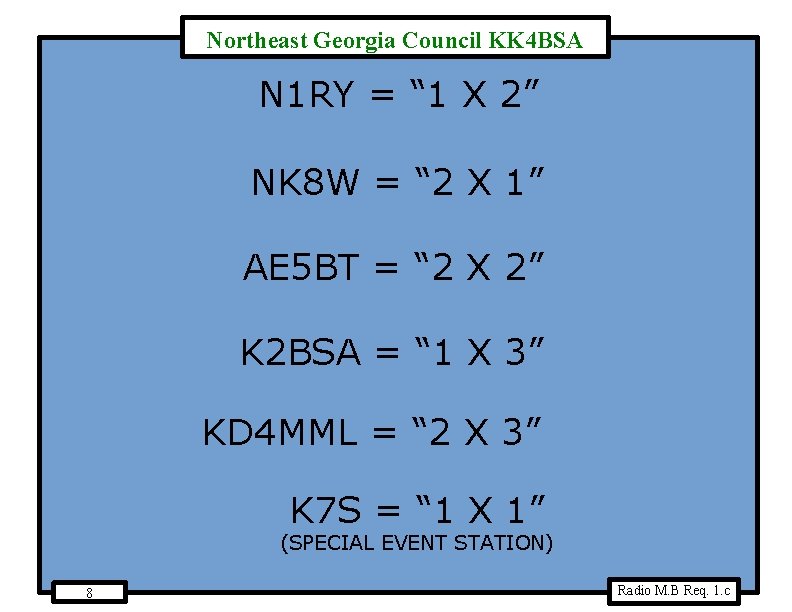
Northeast Georgia Council KK 4 BSA N 1 RY = “ 1 X 2” NK 8 W = “ 2 X 1” AE 5 BT = “ 2 X 2” K 2 BSA = “ 1 X 3” KD 4 MML = “ 2 X 3” K 7 S = “ 1 X 1” (SPECIAL EVENT STATION) 8 Radio M. B Req. 1. c
Northeast Georgia Council KK 4 BSA Phonetic Alphabet • Many letters sound similar. • Over the radio, the letter C, E, V or Z might sound the same. • Weak radio signals and noise might make it difficult to hear voices. • An operator for whom English is not a native language may alter letter pronunciation. • Radio operators use a phonetic alphabet to improve understanding and avoid communication errors. 9 Radio M. B Req. 1. d.
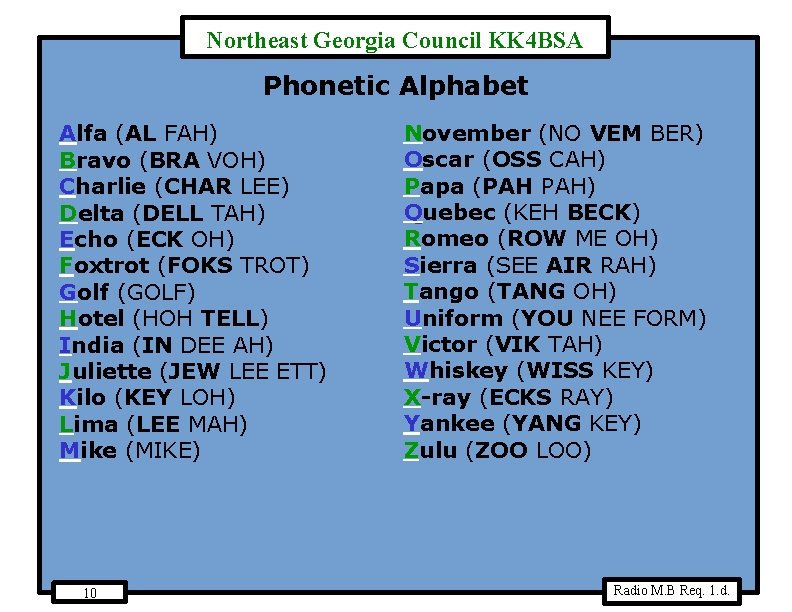
Northeast Georgia Council KK 4 BSA Phonetic Alphabet Alfa (AL FAH) Bravo (BRA VOH) Charlie (CHAR LEE) Delta (DELL TAH) Echo (ECK OH) Foxtrot (FOKS TROT) Golf (GOLF) Hotel (HOH TELL) India (IN DEE AH) Juliette (JEW LEE ETT) Kilo (KEY LOH) Lima (LEE MAH) Mike (MIKE) 10 November (NO VEM BER) Oscar (OSS CAH) Papa (PAH PAH) Quebec (KEH BECK) Romeo (ROW ME OH) Sierra (SEE AIR RAH) Tango (TANG OH) Uniform (YOU NEE FORM) Victor (VIK TAH) Whiskey (WISS KEY) X-ray (ECKS RAY) Yankee (YANG KEY) Zulu (ZOO LOO) Radio M. B Req. 1. d.
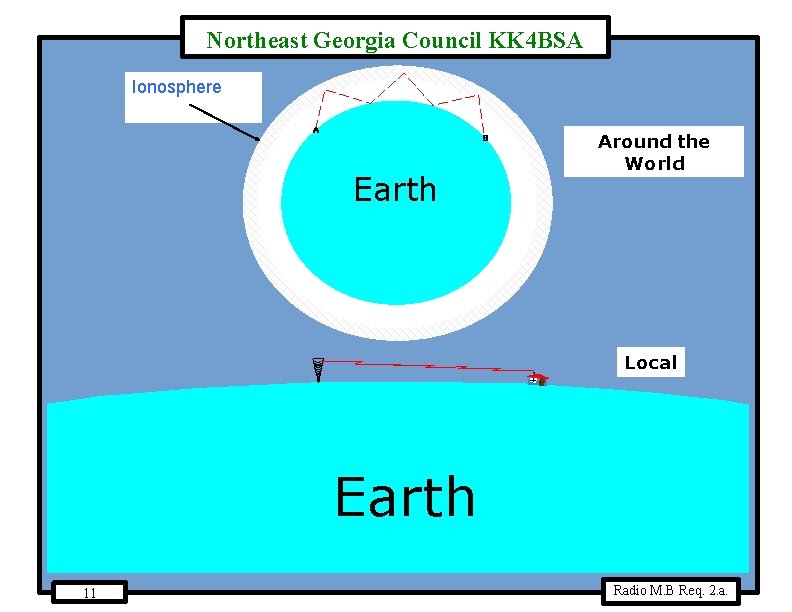
Northeast Georgia Council KK 4 BSA Ionosphere A B Earth Around the World Local Earth 11 Radio M. B Req. 2. a.
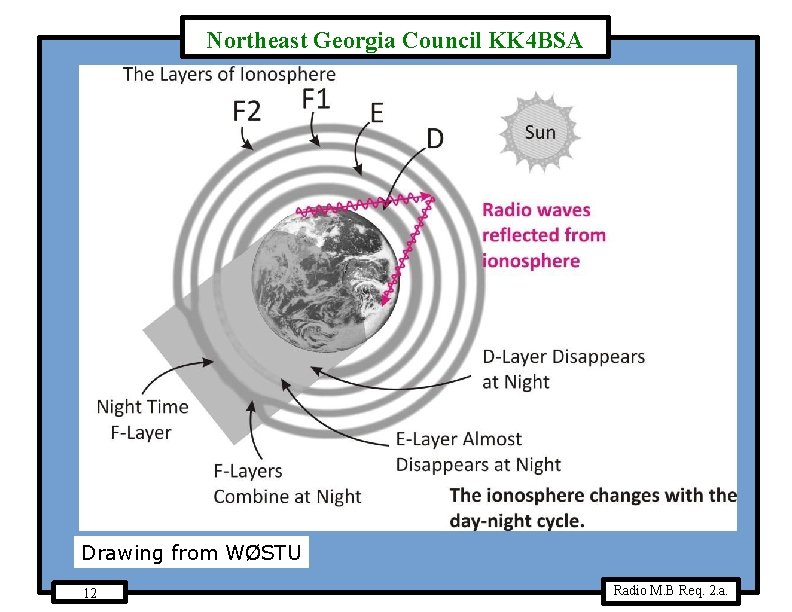
Northeast Georgia Council KK 4 BSA Drawing from WØSTU 12 Radio M. B Req. 2. a.
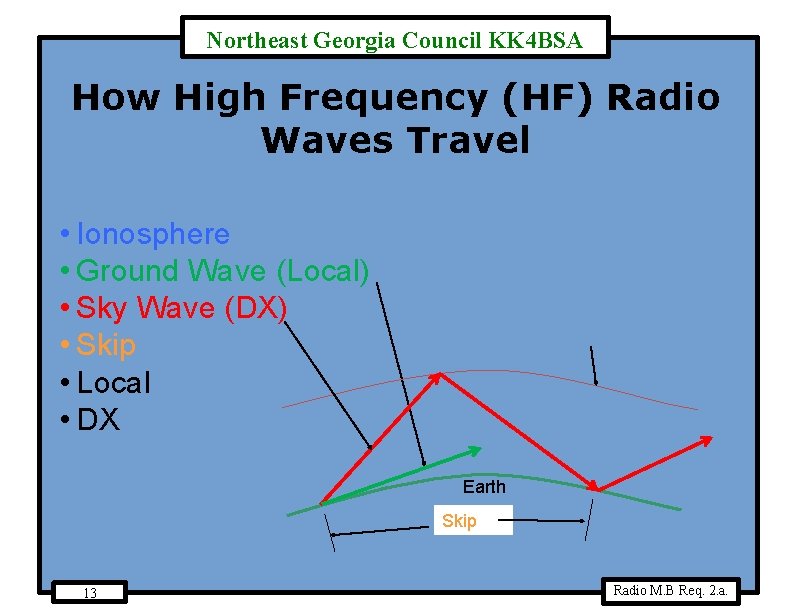
Northeast Georgia Council KK 4 BSA How High Frequency (HF) Radio Waves Travel • Ionosphere • Ground Wave (Local) • Sky Wave (DX) • Skip • Local • DX Earth Skip 13 Radio M. B Req. 2. a.
Northeast Georgia Council KK 4 BSA WWV and WWVH • National Institute of Standards & Technology radio stations that provide accurate frequency, time, and HF propagation forecasts. • WWV & WWVH transmit on 2. 5, 5, 10, 15 and 20 MHz. • WWV is in Ft Collins, Colorado and WWVH is in Kauai, Hawaii. • Listening to WWV or WWVH provides an indication of the radio frequencies that are being reflected from the ionosphere and the locations from which you may hear radio stations for each frequency. 14 Radio M. B Req. 2. b
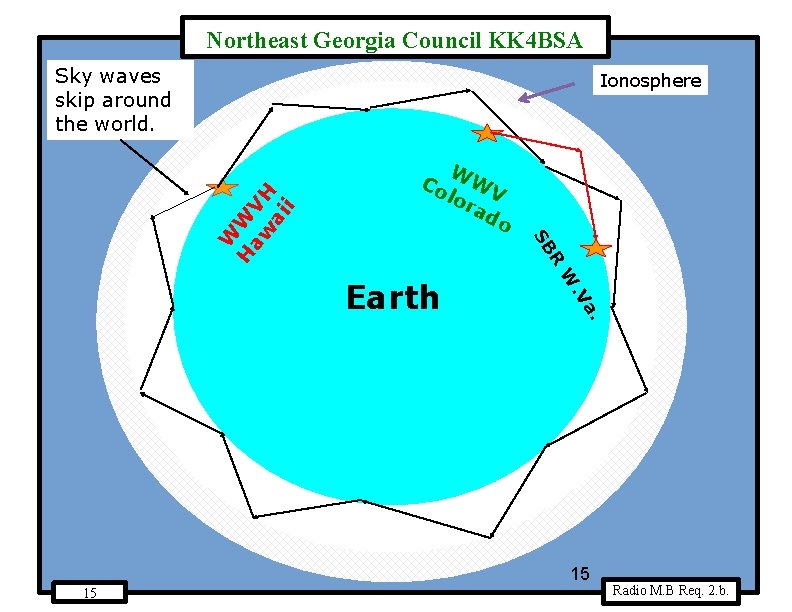
Northeast Georgia Council KK 4 BSA Sky waves skip around the world. W Co WV lor ad o R SB W H W aw VH ai i Ionosphere a. . V W Earth 15 15 Radio M. B Req. 2. b.
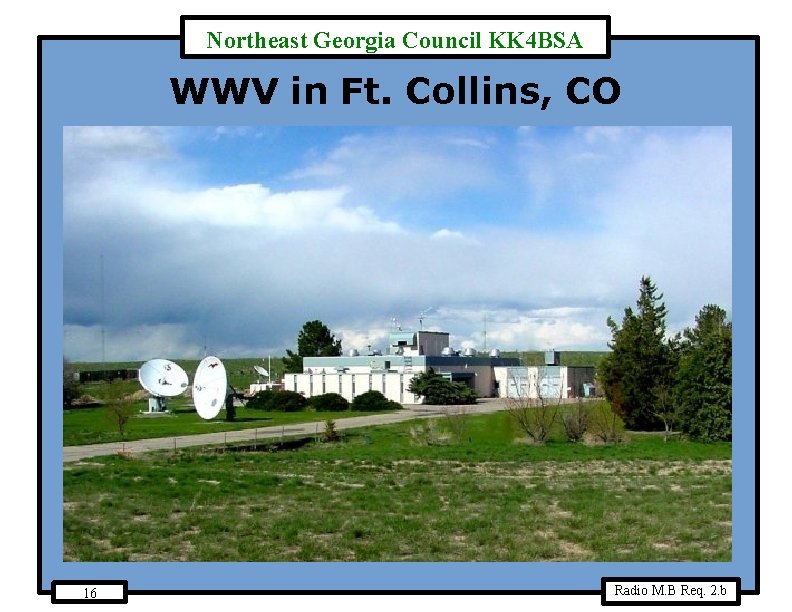
Northeast Georgia Council KK 4 BSA WWV in Ft. Collins, CO 16 Radio M. B Req. 2. b
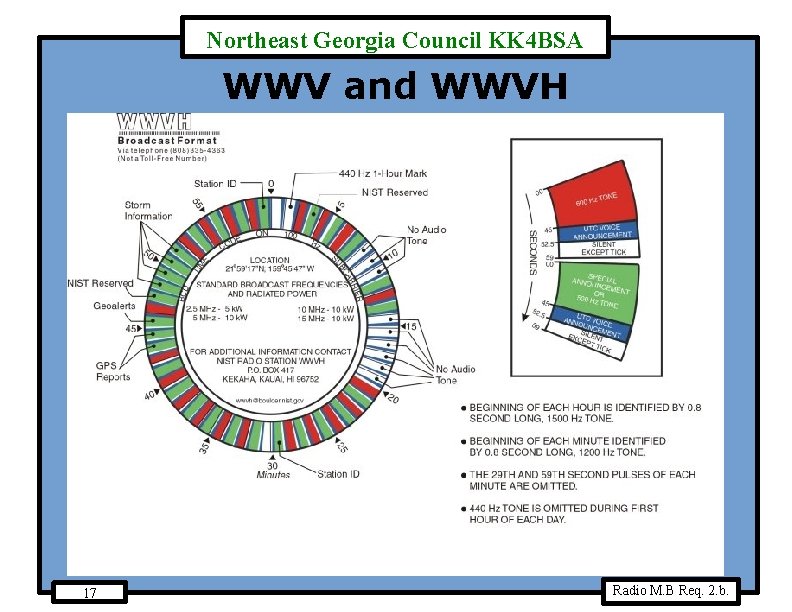
Northeast Georgia Council KK 4 BSA WWV and WWVH 17 Radio M. B Req. 2. b.
Northeast Georgia Council KK 4 BSA DX and Local Stations • A DX station is a distant station usually located in another country. • DX is the old Morse code abbreviation for distance. It refers to hearing or communicating with a radio station that is far away. • A local radio station is located in the nearby community or region. 18 Radio M. B Req. 2. c.
Northeast Georgia Council KK 4 BSA FCC – Federal Communications Commission • The FCC sets and enforces technical standards for devices that produce radio frequencies and issues licenses for radio stations, transmitters and operators. • The FCC does not have any authority outside of the United States. 19 Radio M. B Req. 2. d.
Northeast Georgia Council KK 4 BSA ITU – International Telecommunications Union • The ITU coordinates global telecommunications networks and services including management of radio frequency spectrum and satellite orbits. • The ITU tries to prevent harmful interference between radio stations but it depends upon cooperation among countries as it does not have the ability to enforce actions. 20 Radio M. B Req. 2. d
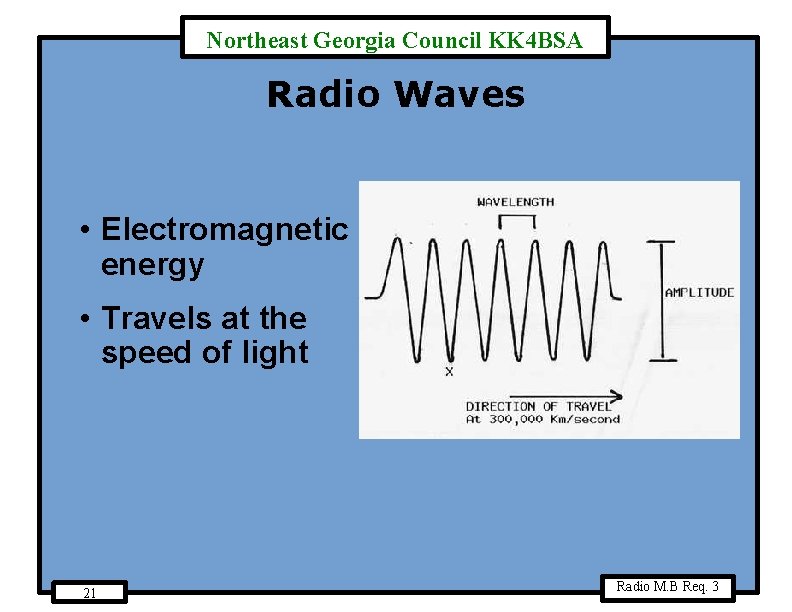
Northeast Georgia Council KK 4 BSA Radio Waves • Electromagnetic energy • Travels at the speed of light 21 Radio M. B Req. 3
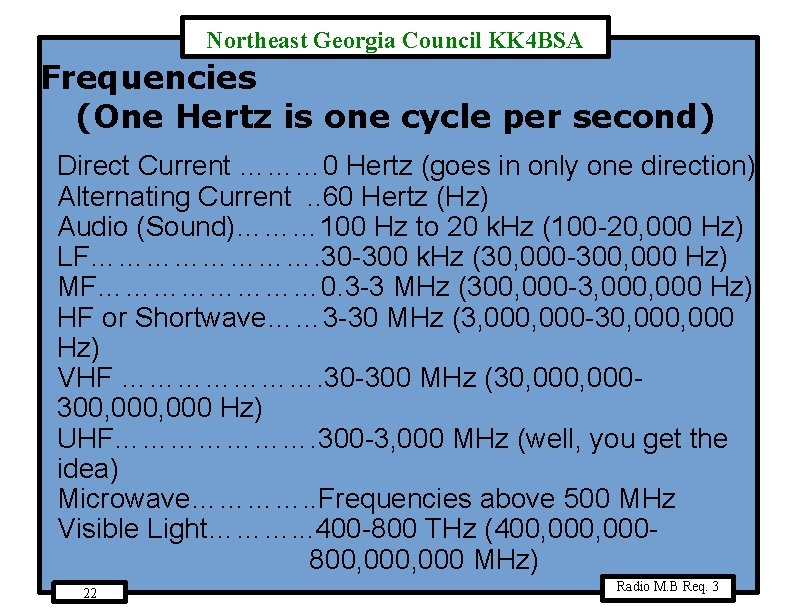
Northeast Georgia Council KK 4 BSA Frequencies (One Hertz is one cycle per second) Direct Current ……… 0 Hertz (goes in only one direction) Alternating Current. . 60 Hertz (Hz) Audio (Sound)……… 100 Hz to 20 k. Hz (100 -20, 000 Hz) LF…………. 30 -300 k. Hz (30, 000 -300, 000 Hz) MF………… 0. 3 -3 MHz (300, 000 -3, 000 Hz) HF or Shortwave…… 3 -30 MHz (3, 000 -30, 000 Hz) VHF …………………. 30 -300 MHz (30, 000300, 000 Hz) UHF…………………. 300 -3, 000 MHz (well, you get the idea) Microwave…………. . Frequencies above 500 MHz Visible Light………. . . 400 -800 THz (400, 000800, 000 MHz) 22 Radio M. B Req. 3
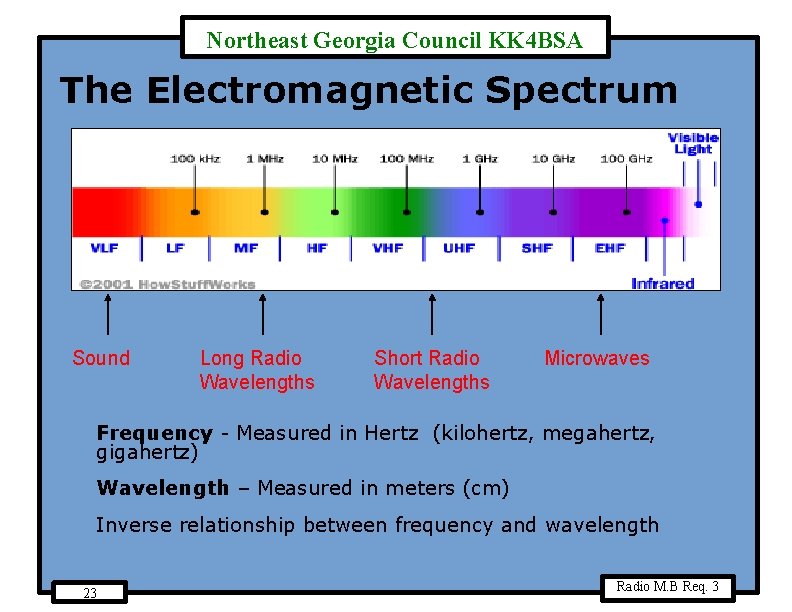
Northeast Georgia Council KK 4 BSA The Electromagnetic Spectrum Sound Long Radio Wavelengths Short Radio Wavelengths Microwaves Frequency - Measured in Hertz (kilohertz, megahertz, gigahertz) Wavelength – Measured in meters (cm) Inverse relationship between frequency and wavelength 23 Radio M. B Req. 3
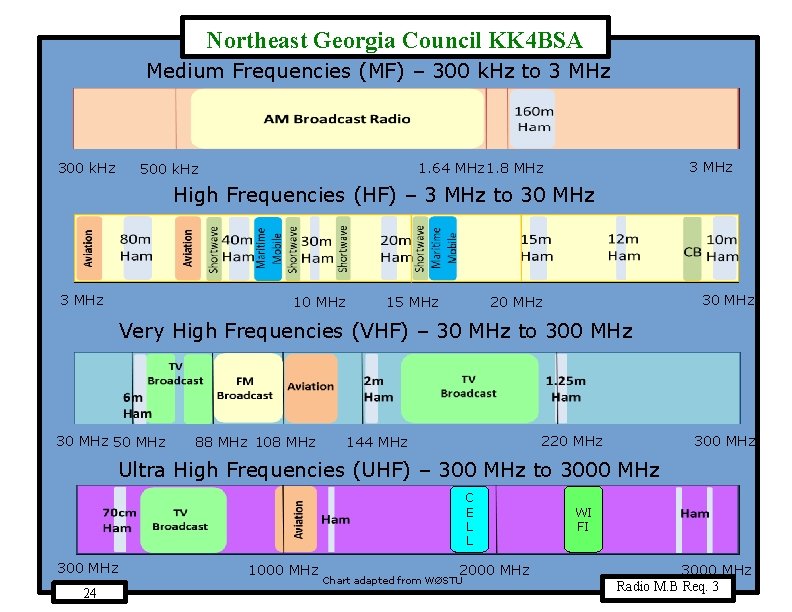
Northeast Georgia Council KK 4 BSA Medium Frequencies (MF) – 300 k. Hz to 3 MHz 300 k. Hz 3 MHz 1. 64 MHz 1. 8 MHz 500 k. Hz High Frequencies (HF) – 3 MHz to 30 MHz 3 MHz 10 MHz 15 MHz 30 MHz 20 MHz Very High Frequencies (VHF) – 30 MHz to 300 MHz 30 MHz 50 MHz 88 MHz 108 MHz 220 MHz 144 MHz 300 MHz Ultra High Frequencies (UHF) – 300 MHz to 3000 MHz C E L L 300 MHz 24 1000 MHz 2000 MHz Chart adapted from WØSTU WI FI 3000 MHz Radio M. B Req. 3
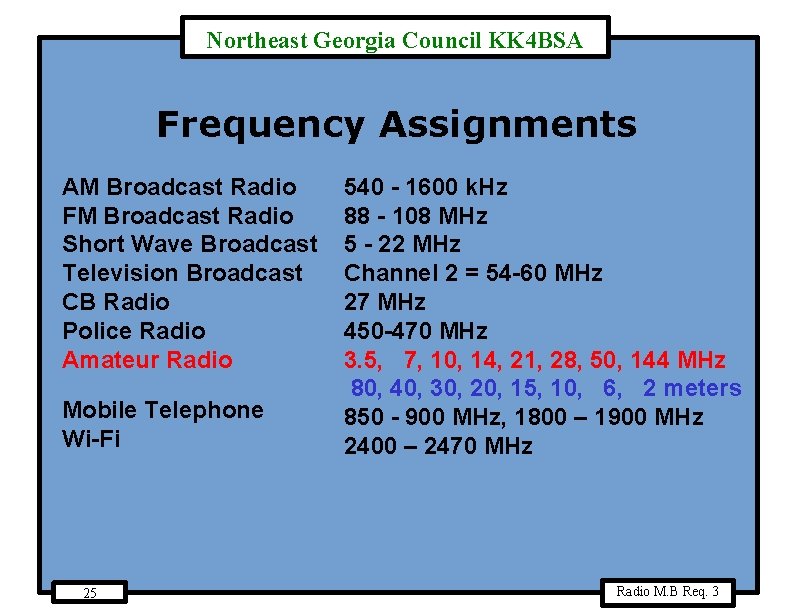
Northeast Georgia Council KK 4 BSA Frequency Assignments AM Broadcast Radio FM Broadcast Radio Short Wave Broadcast Television Broadcast CB Radio Police Radio Amateur Radio Mobile Telephone Wi-Fi 25 540 - 1600 k. Hz 88 - 108 MHz 5 - 22 MHz Channel 2 = 54 -60 MHz 27 MHz 450 -470 MHz 3. 5, 7, 10, 14, 21, 28, 50, 144 MHz 80, 40, 30, 20, 15, 10, 6, 2 meters 850 - 900 MHz, 1800 – 1900 MHz 2400 – 2470 MHz Radio M. B Req. 3
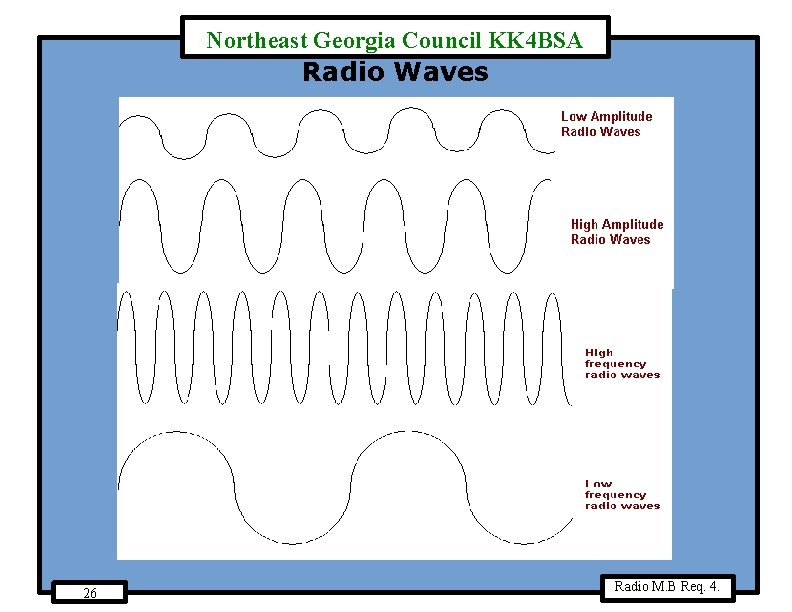
Northeast Georgia Council KK 4 BSA Radio Waves 26 Radio M. B Req. 4.
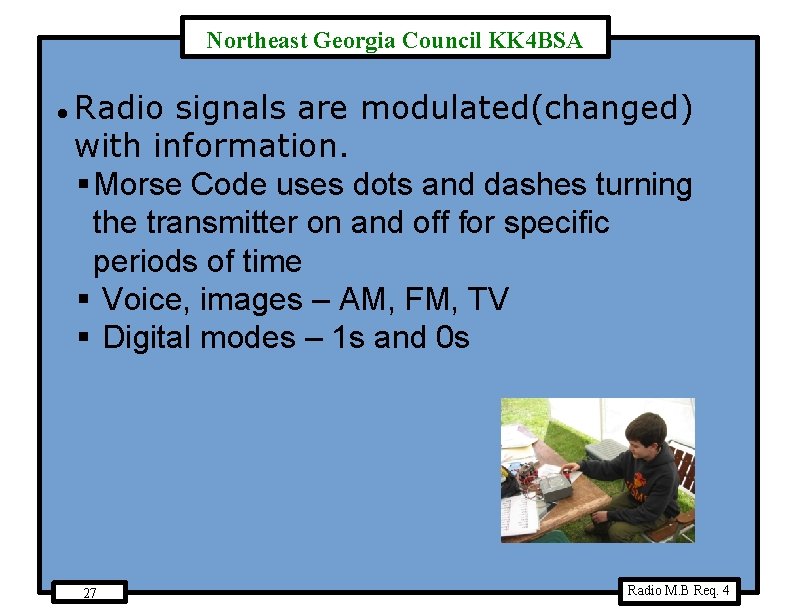
Northeast Georgia Council KK 4 BSA Radio signals are modulated(changed) with information. Morse Code uses dots and dashes turning the transmitter on and off for specific periods of time Voice, images – AM, FM, TV Digital modes – 1 s and 0 s 27 Radio M. B Req. 4
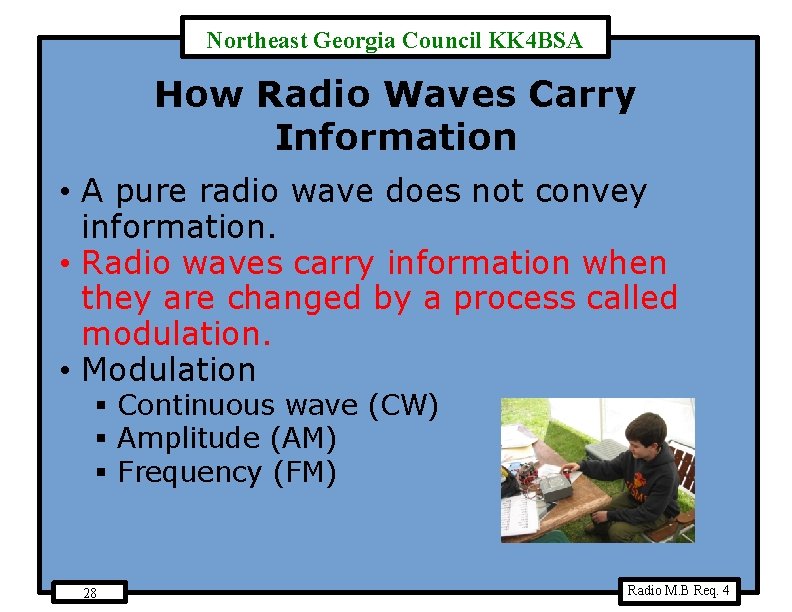
Northeast Georgia Council KK 4 BSA How Radio Waves Carry Information • A pure radio wave does not convey information. • Radio waves carry information when they are changed by a process called modulation. • Modulation Continuous wave (CW) Amplitude (AM) Frequency (FM) 28 Radio M. B Req. 4
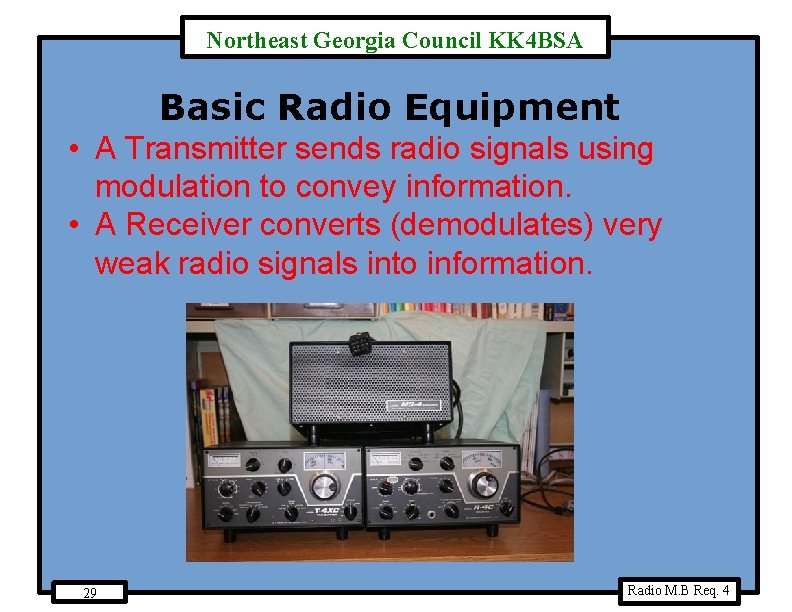
Northeast Georgia Council KK 4 BSA Basic Radio Equipment • A Transmitter sends radio signals using modulation to convey information. • A Receiver converts (demodulates) very weak radio signals into information. 29 Radio M. B Req. 4
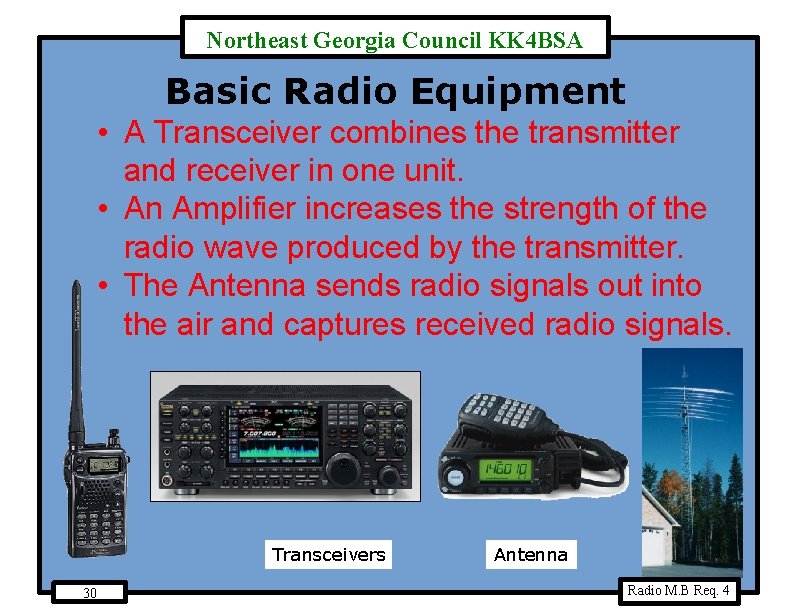
Northeast Georgia Council KK 4 BSA Basic Radio Equipment • A Transceiver combines the transmitter and receiver in one unit. • An Amplifier increases the strength of the radio wave produced by the transmitter. • The Antenna sends radio signals out into the air and captures received radio signals. Transceivers 30 Antenna Radio M. B Req. 4
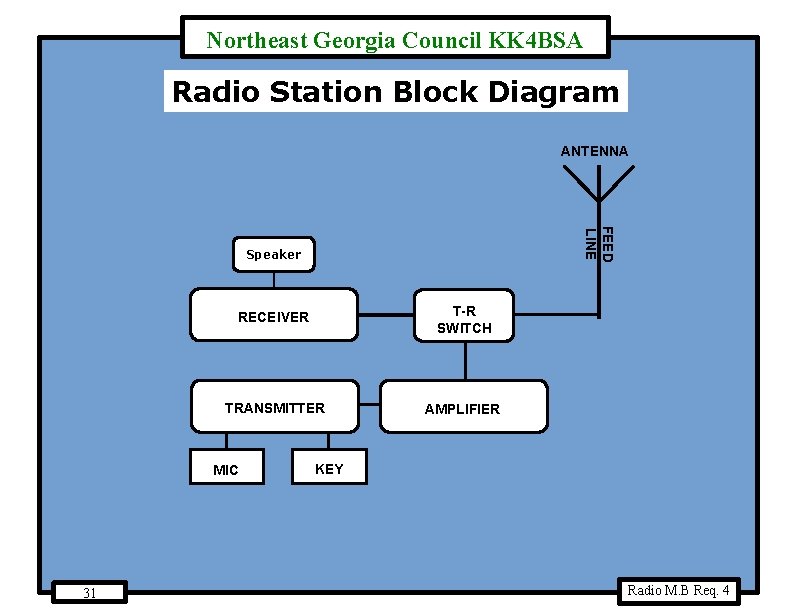
Northeast Georgia Council KK 4 BSA Radio Station Block Diagram ANTENNA FEED LINE Speaker RECEIVER T-R SWITCH TRANSMITTER AMPLIFIER MIC 31 KEY Radio M. B Req. 4
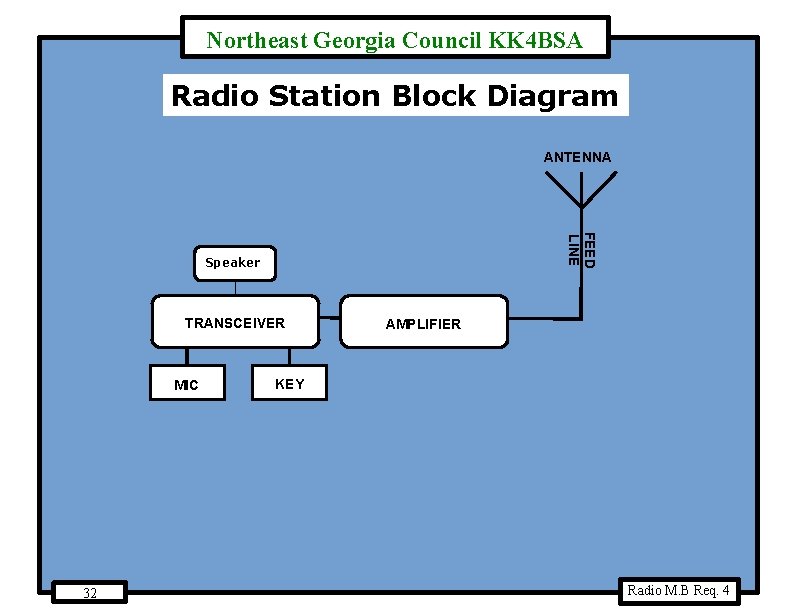
Northeast Georgia Council KK 4 BSA Radio Station Block Diagram ANTENNA FEED LINE Speaker TRANSCEIVER MIC 32 AMPLIFIER KEY Radio M. B Req. 4
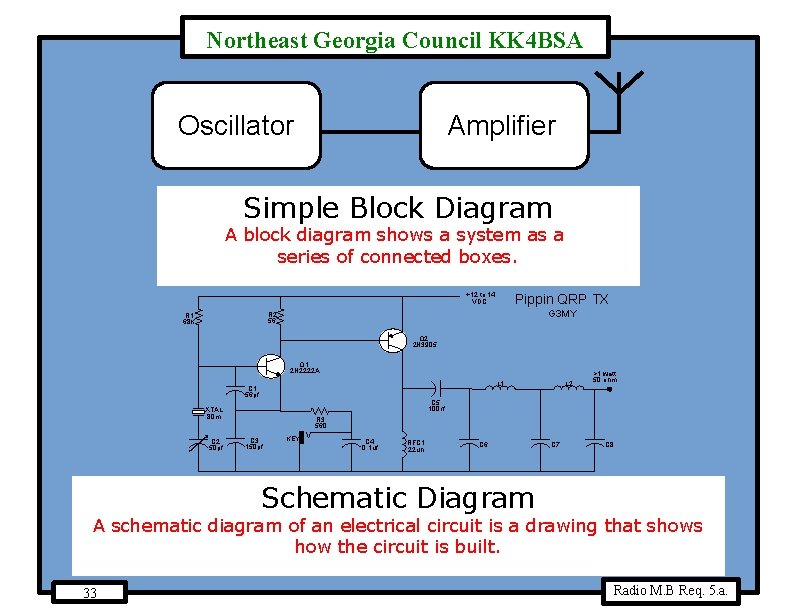
Northeast Georgia Council KK 4 BSA Oscillator Amplifier Simple Block Diagram A block diagram shows a system as a series of connected boxes. +12 to 14 VDC Pippin QRP TX G 3 MY R 2 56 R 1 68 K Q 2 2 N 3905 Q 1 2 N 2222 A L 1 C 1 56 pf >1 watt 50 ohm C 5 100 nf XTAL 80 m C 2 50 pf L 2 R 3 560 C 3 150 pf KEY C 4 0. 1 uf RFC 1 22 uh C 6 C 7 C 8 Schematic Diagram A schematic diagram of an electrical circuit is a drawing that shows how the circuit is built. 33 Radio M. B Req. 5. a.
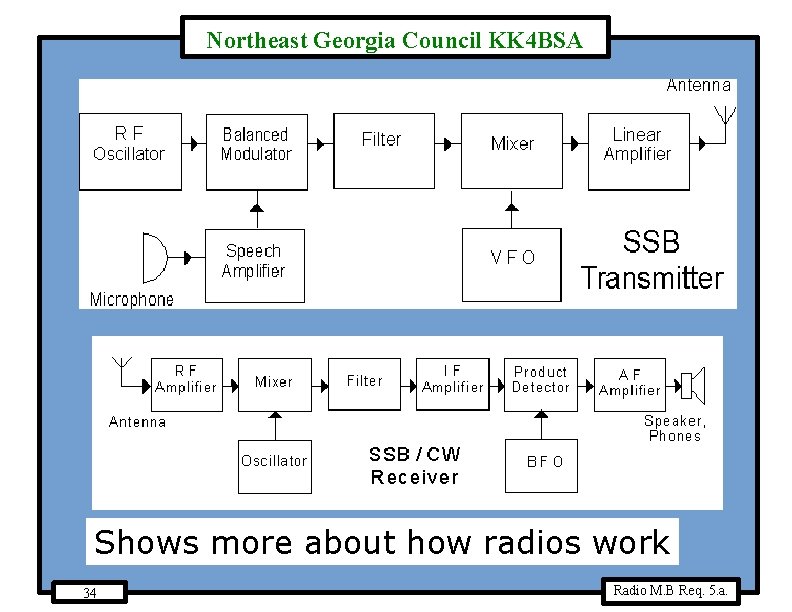
Northeast Georgia Council KK 4 BSA Shows more about how radios work 34 Radio M. B Req. 5. a.
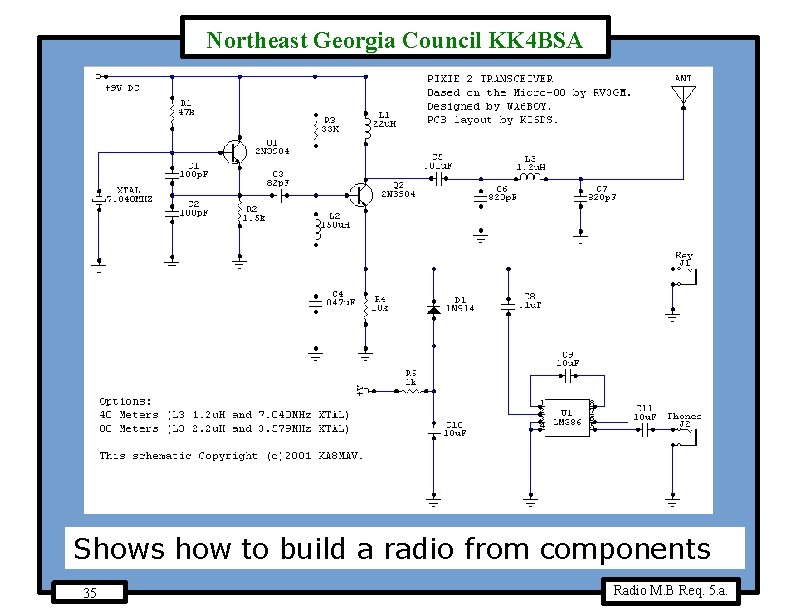
Northeast Georgia Council KK 4 BSA Shows how to build a radio from components 35 Radio M. B Req. 5. a.
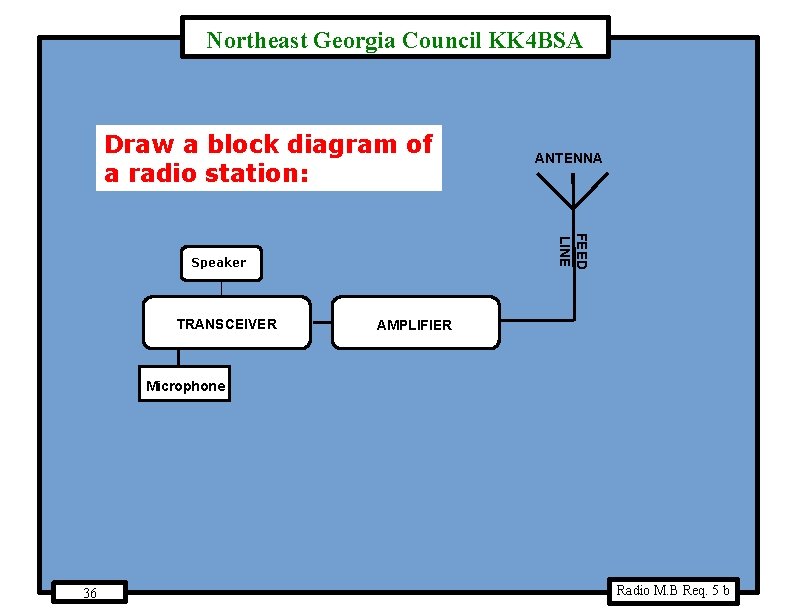
Northeast Georgia Council KK 4 BSA Draw a block diagram of a radio station: FEED LINE Speaker TRANSCEIVER ANTENNA AMPLIFIER Microphone 36 Radio M. B Req. 5 b
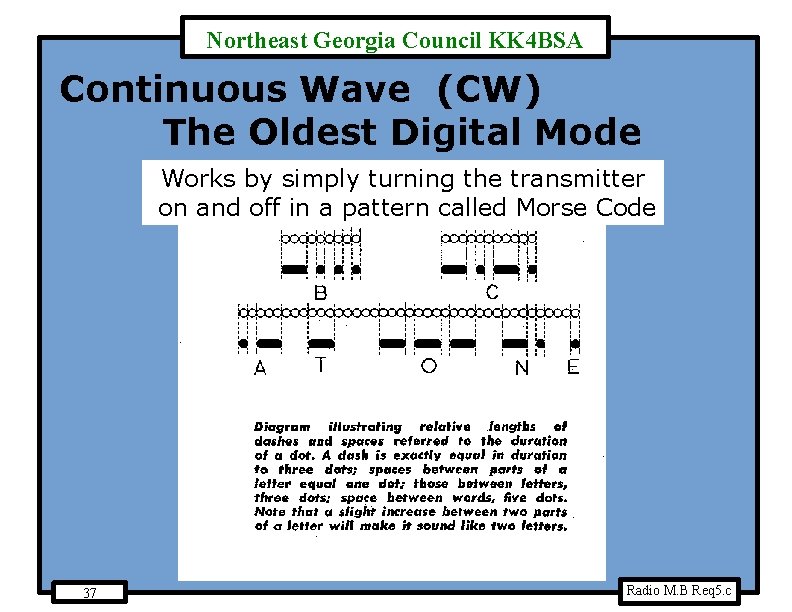
Northeast Georgia Council KK 4 BSA Continuous Wave (CW) The Oldest Digital Mode Works by simply turning the transmitter on and off in a pattern called Morse Code 37 Radio M. B Req 5. c
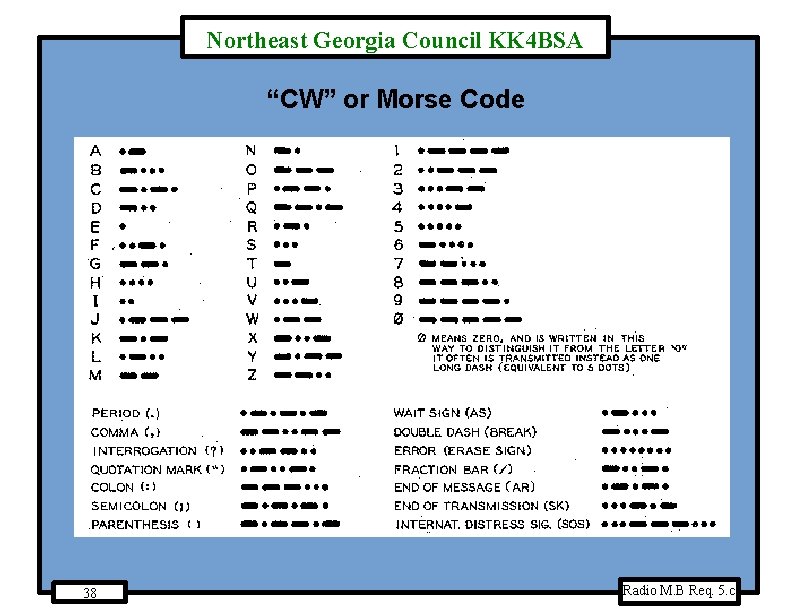
Northeast Georgia Council KK 4 BSA “CW” or Morse Code 38 Radio M. B Req. 5. c
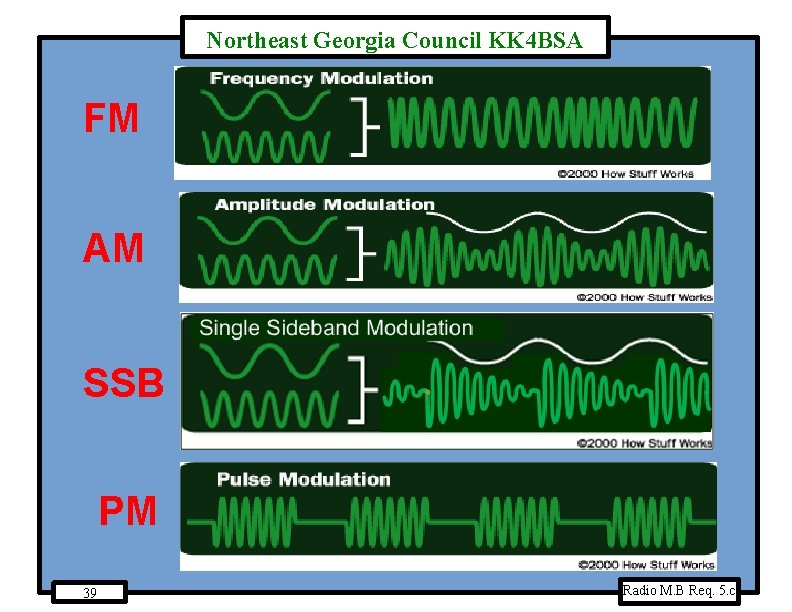
Northeast Georgia Council KK 4 BSA FM AM SSB PM 39 Radio M. B Req. 5. c
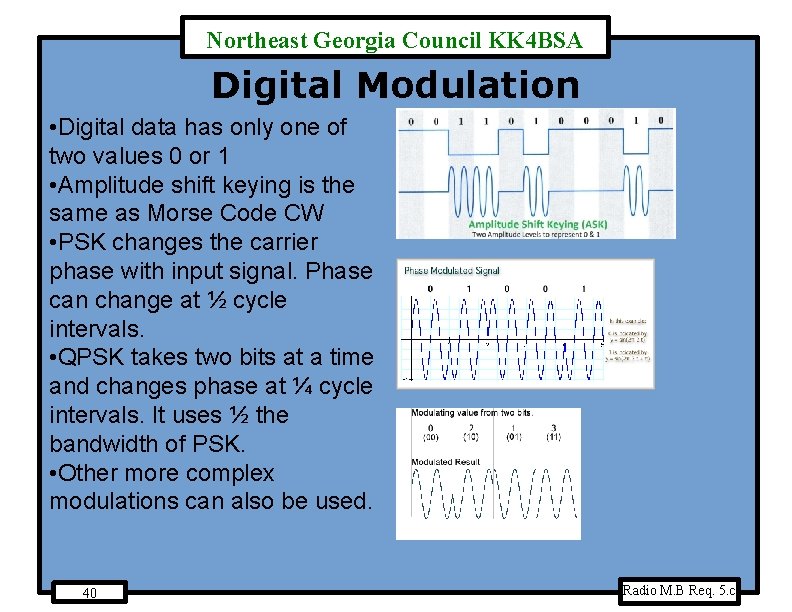
Northeast Georgia Council KK 4 BSA Digital Modulation • Digital data has only one of two values 0 or 1 • Amplitude shift keying is the same as Morse Code CW • PSK changes the carrier phase with input signal. Phase can change at ½ cycle intervals. • QPSK takes two bits at a time and changes phase at ¼ cycle intervals. It uses ½ the bandwidth of PSK. • Other more complex modulations can also be used. 40 Radio M. B Req. 5. c
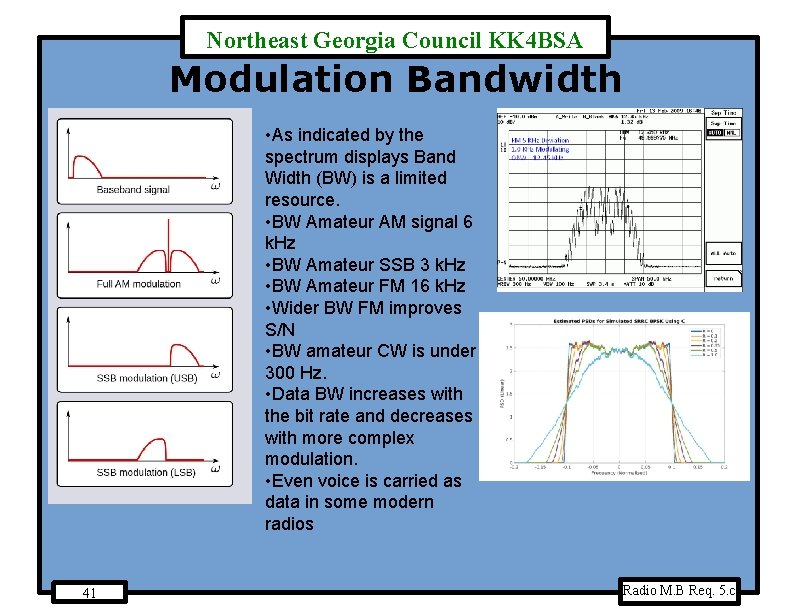
Northeast Georgia Council KK 4 BSA Modulation Bandwidth • As indicated by the spectrum displays Band Width (BW) is a limited resource. • BW Amateur AM signal 6 k. Hz • BW Amateur SSB 3 k. Hz • BW Amateur FM 16 k. Hz • Wider BW FM improves S/N • BW amateur CW is under 300 Hz. • Data BW increases with the bit rate and decreases with more complex modulation. • Even voice is carried as data in some modern radios 41 Radio M. B Req. 5. c
Northeast Georgia Council KK 4 BSA NOAA Weather Radio • NOAA transmits weather and emergency information from 1025 transmitters using seven VHF frequencies from 162. 400 MHz to 162. 550 MHz. • Alerts are transmitted for specific weather and emergency events covering specific areas. • Specific Alert Message Encoding allows you to specify the particular area for which you wish to receive alerts. • Weather radios should be part of any Scouting event especially campouts 42 Radio M. B Req. 5. d
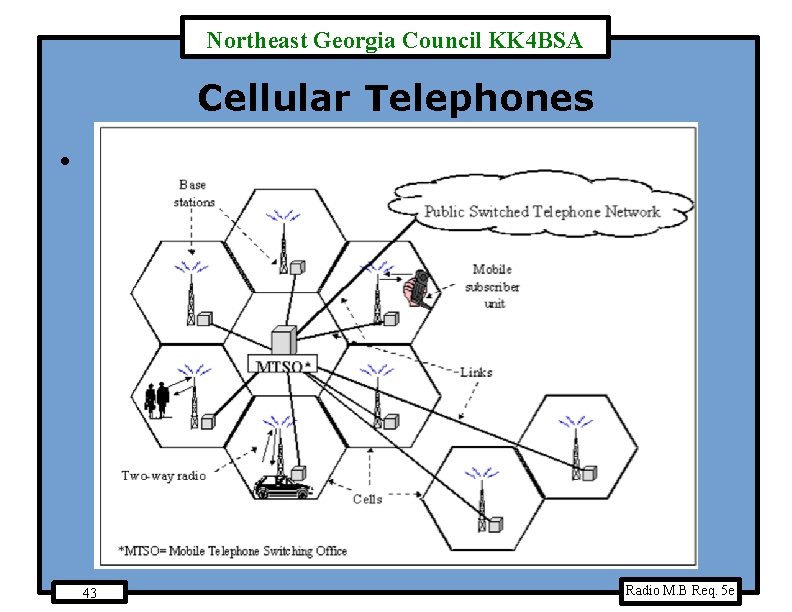
Northeast Georgia Council KK 4 BSA Cellular Telephones • 43 Radio M. B Req. 5 e
Northeast Georgia Council KK 4 BSA • Cellular Benefits Cell systems reuse the same frequency. More frequency reuse allows more users and more data. A failure at one cell can be recovered by an adjacent cell. Allows freedom of movement. • Cellular Limitations Frequency reuse causes interference which needs to be controlled. Needs complex handover procedure when user moves from one cell to another. System requires complex infrastructure and may not survive a disaster. 44 Radio M. B Req. 5. e
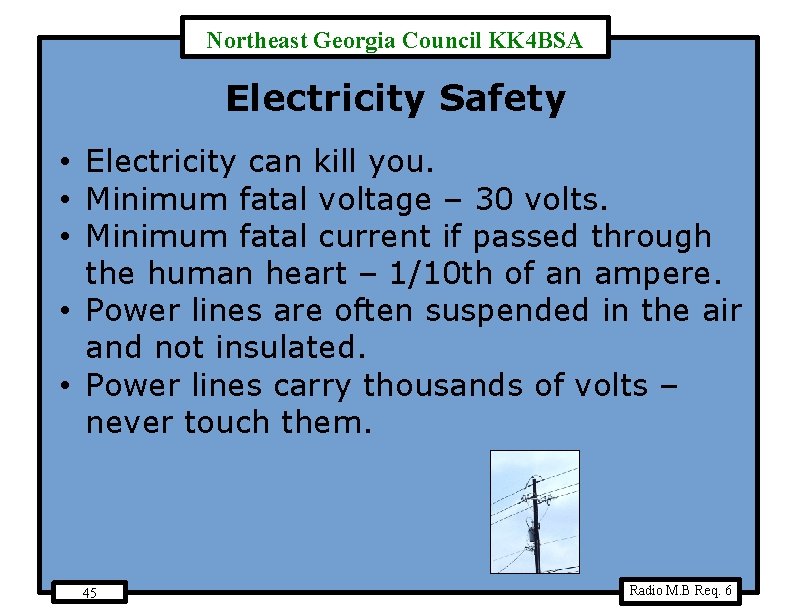
Northeast Georgia Council KK 4 BSA Electricity Safety • Electricity can kill you. • Minimum fatal voltage – 30 volts. • Minimum fatal current if passed through the human heart – 1/10 th of an ampere. • Power lines are often suspended in the air and not insulated. • Power lines carry thousands of volts – never touch them. 45 Radio M. B Req. 6
Northeast Georgia Council KK 4 BSA Radio Safety Precautions • Unplug equipment before working on it. • Never let anyone turn the power on and off for you. • Don’t work on a radio when you are tired. • Don’t use your bare hands to adjust components. • Don’t let your body be a ground path by touching grounded metal or standing in water. • Never wear headphones while working on a radio. • “Keep one hand in your pocket” so electricity can’t travel through your chest. • Tell your family how to turn off the power. • Be careful; death is permanent. 46 Radio M. B Req. 6.
Northeast Georgia Council KK 4 BSA Radio Frequency (RF) Energy • Exposure to high levels of radio frequency (RF) energy can be unhealthy. Direct contact can cause burns; human eyes are sensitive to RF energy. • Don't use a radio when it is not completely assembled as the cabinet shields the RF radiation. • Keep antennas out of reach. 47 Radio M. B Req. 6
Northeast Georgia Council KK 4 BSA Direct Current Circuit Grounding • “Grounding” means establishing an electrical connection to an “electrically neutral” object that is at “ 0” Volts electric potential. A “ground” is often a long metal rod driven into the earth. Grounding is a safety measure to prevent electric shock and equipment damage. • Direct Current Circuits in radio equipment are grounded to prevent electric shock. The circuit is connected to the metal cabinet or “chassis” and the chassis is connected to a ground. 48 Radio M. B Req. 6
Northeast Georgia Council KK 4 BSA Power Outlet Grounding • Electric power enters a house through a box of circuit breakers. A metal ground rod is driven into the earth near where power enters the house to establish a Ground. • Power Outlets are connected to the circuit breaker box with three wire cable and one of the wires is connected to Ground. • Equipment is connected to Power Outlets with three prong plugs and one prong is connected to the Ground. • The equipment case is then grounded to prevent electric shock. 49 Radio M. B Req. 6
Northeast Georgia Council KK 4 BSA Antenna System Grounding • Antenna systems often include tall towers or objects that might be struck by lightning. • Antenna systems include transmission lines connecting the antenna to radio equipment. • Lightning arrestors are devices inserted into transmission line with a spark gap or gaseous discharge to ground. • Antenna system grounding should include both a ground connection for the antenna tower and a lightning arrestor in the transmission line where it enters the house. • The lightning arrestor may discharge static electricity but likely offers little protection from a direct strike. 50 Radio M. B Req. 6
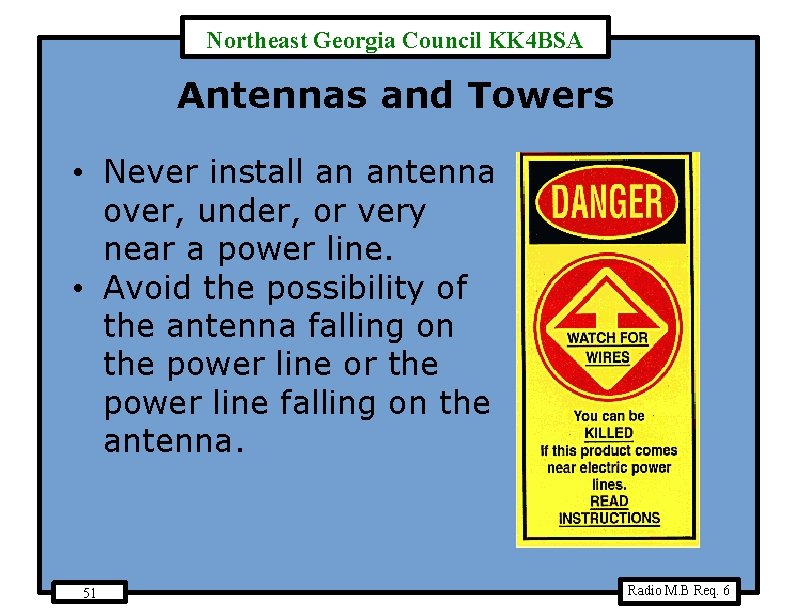
Northeast Georgia Council KK 4 BSA Antennas and Towers • Never install an antenna over, under, or very near a power line. • Avoid the possibility of the antenna falling on the power line or the power line falling on the antenna. 51 Radio M. B Req. 6
Northeast Georgia Council KK 4 BSA Antennas and Towers • Never install an antenna where a person could touch the antenna. • Be careful working on towers and roofs. • Protect yourself from falling. • Protect people below you from falling objects. • Use safety harnesses, belts, tethers, and hard-hats. 52 Radio M. B Req. 6
Northeast Georgia Council KK 4 BSA Lightning Protection • Antenna support poles and towers should be connected to a ground rod. • Disconnect radios if lightning is in the area. • Lightning could strike your antenna and travel down the transmission line to the radio. • Make sure your antenna and radio are grounded to a good earth ground. • Never operate your radio in thunderstorms. 53 53 Radio M. B Req. 6
Northeast Georgia Council KK 4 BSA Requirement 7 is completed When doing requirement 9 a Radio M. B Req. 7
Northeast Georgia Council KK 4 BSA Radio Careers • Technical Careers • Broadcasting Careers • Operator Careers 55 Radio M. B Req. 8
Northeast Georgia Council KK 4 BSA Technical Radio Careers • A Design Engineer develops the block diagrams and schematics to create a radio. • A Design Technician selects the actual parts and determines the physical arrangement of those parts on the printed circuit board. • A Manufacturing Engineer determines how to purchase the parts and assemble the radio. • A Radio Station Engineer operates and maintains the radio station equipment. • An Electronics Technician repairs radio equipment. 56 Radio M. B Req. 8
Northeast Georgia Council KK 4 BSA Broadcasting Careers • Announcers and Radio/TV Personalities perform the on-the-air communication at a radio or TV station. • The Station Manager is responsible for the overall operation of the radio or TV station. • The Program Director or Music Director will be responsible for the content of the broadcast material. • A Program Writer will be responsible for producing for some programs the actual text read by the Announcers or Personalities. 57 Radio M. B Req. 8
Northeast Georgia Council KK 4 BSA Radio Operator Careers • Radio communication systems are everywhere in our culture. • Many careers include radio operation incidental to the main career role. For example, radio communication is essential for policemen to function effectively. • All public safety functions like fire and ambulance services require radio communication operations. • Aviation traffic management relies on very extensive radio communication networks. • Military operations rely upon radio networks. 58 Radio M. B Req. 8
Northeast Georgia Council KK 4 BSA Education for Radio Careers • Most jobs require high school diploma. • Radio engineers generally study electrical engineering at college. • Colleges offer courses in broadcasting and communications. • Gain broadcasting experience at college radio stations. • Radio technicians attend trade schools or community colleges. • Many organizations offer radio license training courses and certifications. 59 Radio M. B Req. 8
Northeast Georgia Council KK 4 BSA Amateur Radio 60
Northeast Georgia Council KK 4 BSA What is Amateur Radio? • A type of two-way radio. A place to learn about radio. • Called the “Amateur Radio Service” because it can’t be used for profit. • Also known as “Ham Radio”. • An important part of disaster response. • A lot of fun! 61 Radio M. B Req. 9. a(1)
Northeast Georgia Council KK 4 BSA Why does the FCC have an Amateur Radio Service? • Public service - community service and disaster help (A Scout does a good turn daily – here is another way). • International goodwill - A great way to talk to people in other countries. • Experimentation - Hams have made inventions like FM, SSB, Packet Radio, Automatic Position Reporting Systems. • Communication skills - Many people trained to communicate. 62 Radio M. B Req. 9. a(1)
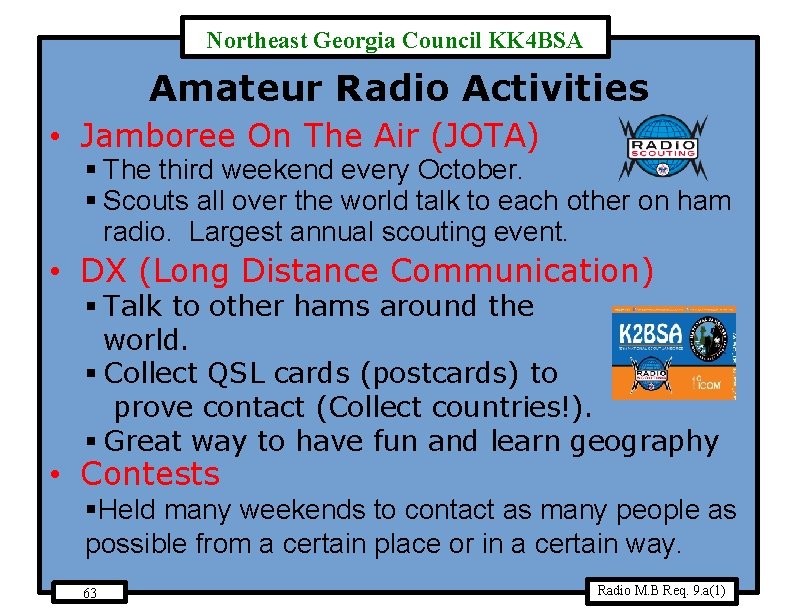
Northeast Georgia Council KK 4 BSA Amateur Radio Activities • Jamboree On The Air (JOTA) The third weekend every October. Scouts all over the world talk to each other on ham radio. Largest annual scouting event. • DX (Long Distance Communication) Talk to other hams around the world. Collect QSL cards (postcards) to prove contact (Collect countries!). Great way to have fun and learn geography • Contests Held many weekends to contact as many people as possible from a certain place or in a certain way. 63 Radio M. B Req. 9. a(1)
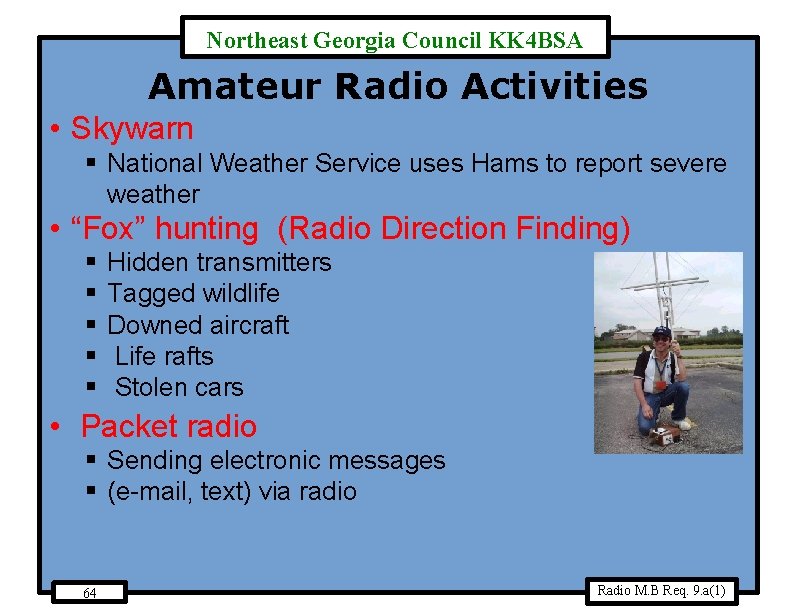
Northeast Georgia Council KK 4 BSA Amateur Radio Activities • Skywarn National Weather Service uses Hams to report severe weather • “Fox” hunting (Radio Direction Finding) Hidden transmitters Tagged wildlife Downed aircraft Life rafts Stolen cars • Packet radio Sending electronic messages (e-mail, text) via radio 64 Radio M. B Req. 9. a(1)
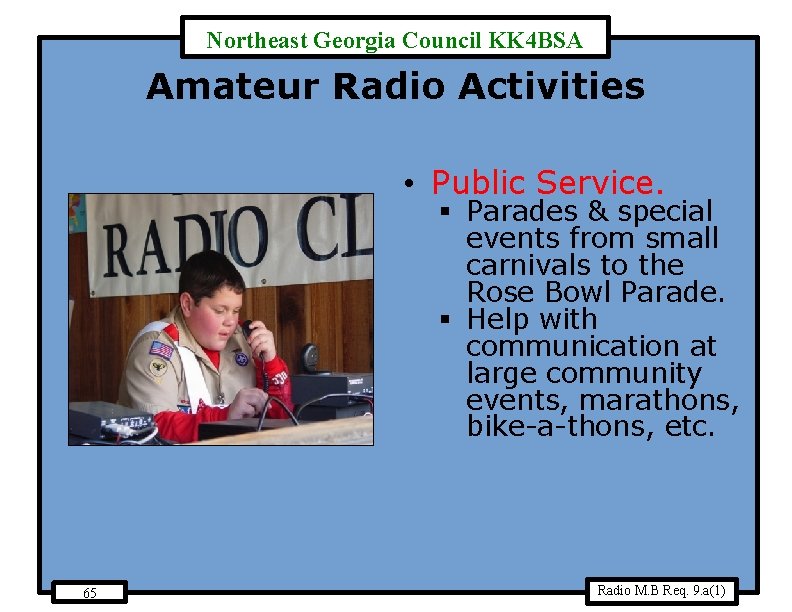
Northeast Georgia Council KK 4 BSA Amateur Radio Activities • Public Service. Parades & special events from small carnivals to the Rose Bowl Parade. Help with communication at large community events, marathons, bike-a-thons, etc. 65 Radio M. B Req. 9. a(1)
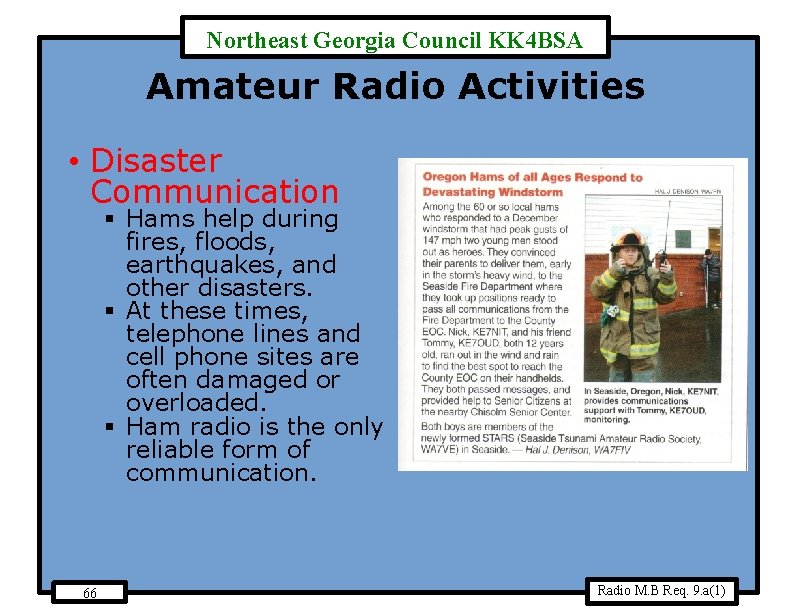
Northeast Georgia Council KK 4 BSA Amateur Radio Activities • Disaster Communication Hams help during fires, floods, earthquakes, and other disasters. At these times, telephone lines and cell phone sites are often damaged or overloaded. Ham radio is the only reliable form of communication. 66 Radio M. B Req. 9. a(1)
Northeast Georgia Council KK 4 BSA Amateur Radio Licenses • Technician Class Elementary operating procedures. Radio regulations. Beginning electronics. Emphasis on VHF and UHF. • General Class Intermediate practices, regulations, theory. Operating privileges in all amateur bands with some limits on frequencies. Emphasis on HF. • Amateur Extra Class 67 Advanced theory and practices. All operating privileges in all bands. Administer license exams. Radio M. B Req. 9. a. (2)
Northeast Georgia Council KK 4 BSA Technician Class License No age restriction Elementary operating procedures Radio regulations Beginning electronics Emphasis on VHF and UHF 35 -question, multiple-choice written examination • Minimum passing score is 26 correct answers – 74% • • • 68 Radio M. B Req. 9. a. (2)
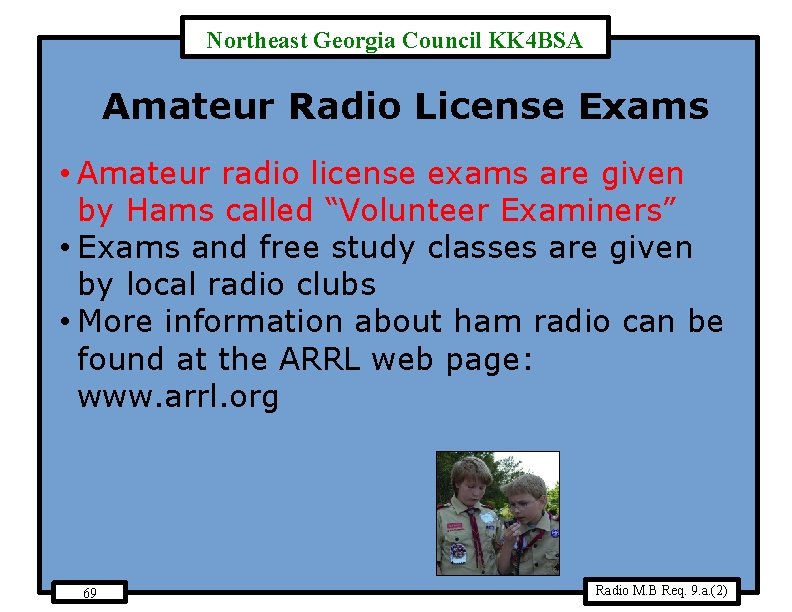
Northeast Georgia Council KK 4 BSA Amateur Radio License Exams • Amateur radio license exams are given by Hams called “Volunteer Examiners” • Exams and free study classes are given by local radio clubs • More information about ham radio can be found at the ARRL web page: www. arrl. org 69 Radio M. B Req. 9. a. (2)
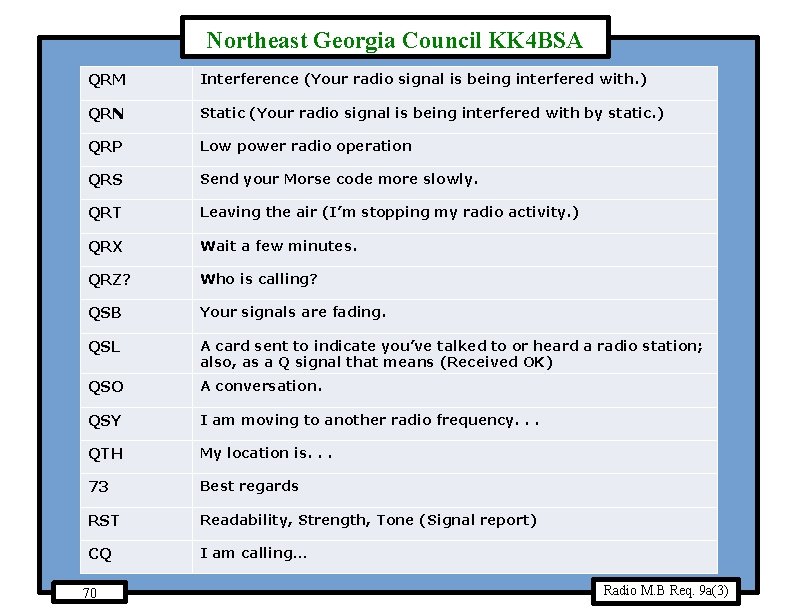
Northeast Georgia Council KK 4 BSA QRM Interference (Your radio signal is being interfered with. ) QRN Static (Your radio signal is being interfered with by static. ) QRP Low power radio operation QRS Send your Morse code more slowly. QRT Leaving the air (I’m stopping my radio activity. ) QRX Wait a few minutes. QRZ? Who is calling? QSB Your signals are fading. QSL A card sent to indicate you’ve talked to or heard a radio station; also, as a Q signal that means (Received OK) QSO A conversation. QSY I am moving to another radio frequency. . . QTH My location is. . . 73 Best regards RST Readability, Strength, Tone (Signal report) CQ I am calling… 70 Radio M. B Req. 9 a(3)
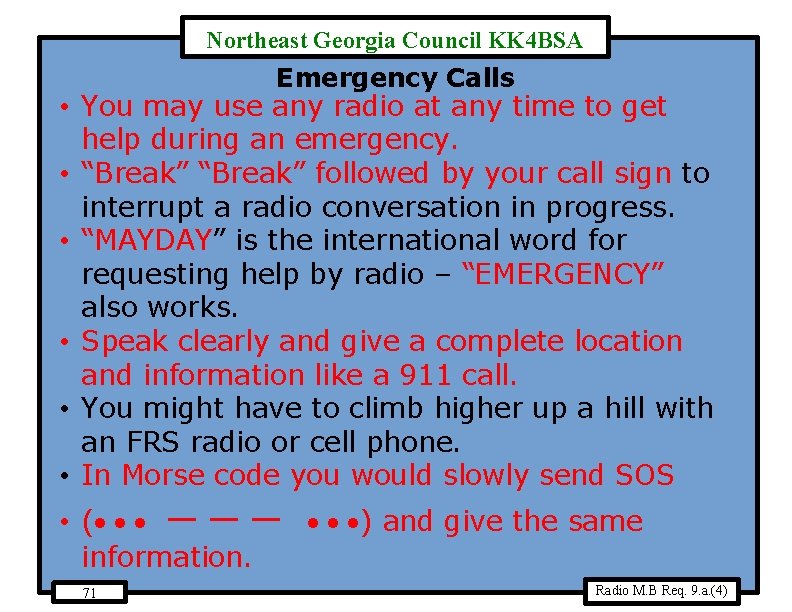
Northeast Georgia Council KK 4 BSA Emergency Calls • You may use any radio at any time to get help during an emergency. • “Break” followed by your call sign to interrupt a radio conversation in progress. • “MAYDAY” is the international word for requesting help by radio – “EMERGENCY” also works. • Speak clearly and give a complete location and information like a 911 call. • You might have to climb higher up a hill with an FRS radio or cell phone. • In Morse code you would slowly send SOS • ( ─ ─ ─ ) and give the same information. 71 Radio M. B Req. 9. a. (4)
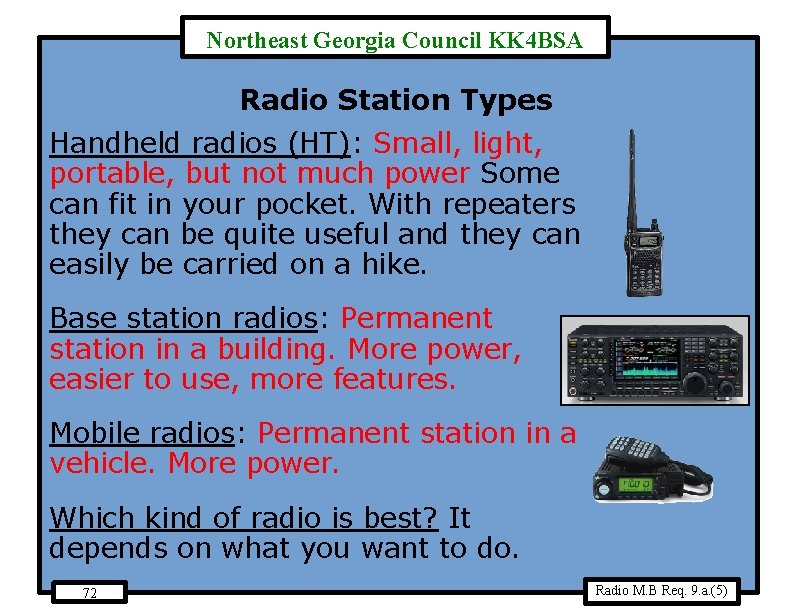
Northeast Georgia Council KK 4 BSA Radio Station Types Handheld radios (HT): Small, light, portable, but not much power Some can fit in your pocket. With repeaters they can be quite useful and they can easily be carried on a hike. Base station radios: Permanent station in a building. More power, easier to use, more features. Mobile radios: Permanent station in a vehicle. More power. Which kind of radio is best? It depends on what you want to do. 72 Radio M. B Req. 9. a. (5)
Northeast Georgia Council KK 4 BSA Repeaters • Repeaters are transceivers located on high points (Mountains, tall buildings, satellites) to automatically relay radio signals. Some have connections to the telephone system. • A repeater receive on one frequency and re-transmits on another. • A repeater extends the range of a handheld transceiver. 73 Radio M. B Req. 9. a. (5)
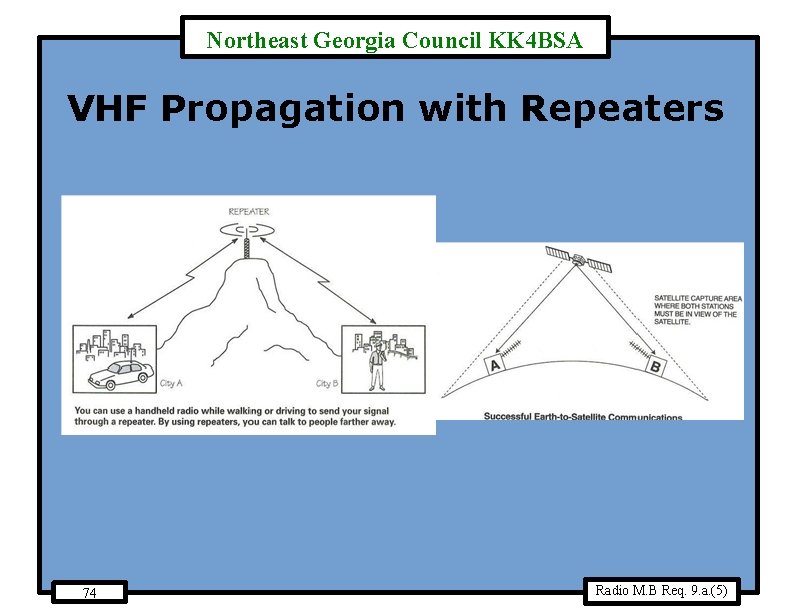
Northeast Georgia Council KK 4 BSA VHF Propagation with Repeaters 74 Radio M. B Req. 9. a. (5)
Northeast Georgia Council KK 4 BSA Radio Merit Badge Amateur radio operating experience 75 Radio M. B Req. 7 & 9. a. (6)
Northeast Georgia Council KK 4 BSA Make a Ham Radio Contact • Listen and call another ham radio station • Talk with the other Radio Station Operator. Relax and have fun Tell your name Tell Where you live Describe your school Talk about Scout camp Use Q-signals • Log your contact 76 Radio M. B Req. 9. a. (6)
Northeast Georgia Council KK 4 BSA Log Your Contact His Name His Call His QTH (location) Frequency Mode His RST (signal report) My RST (signal report) Comments 77 ________________ ________________ Radio M. B Req. 9. a. (6)
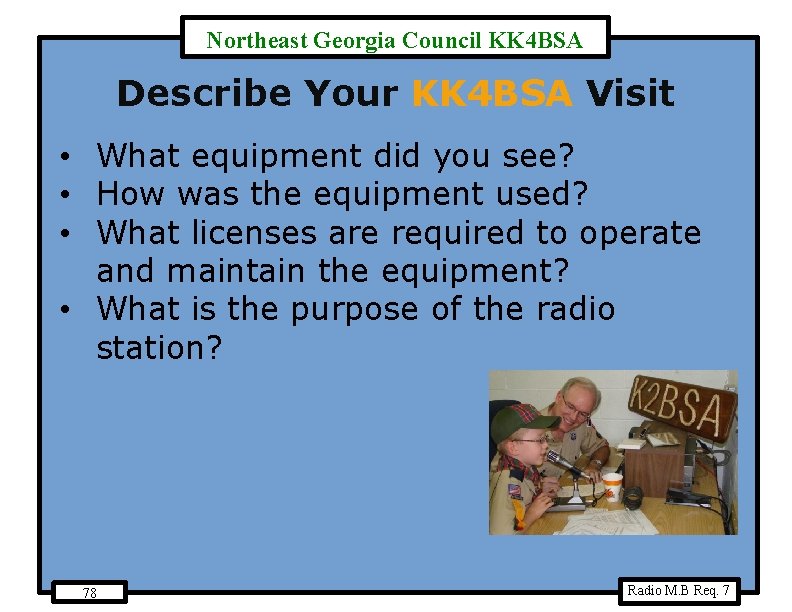
Northeast Georgia Council KK 4 BSA Describe Your KK 4 BSA Visit • What equipment did you see? • How was the equipment used? • What licenses are required to operate and maintain the equipment? • What is the purpose of the radio station? 78 Radio M. B Req. 7
Northeast Georgia Council KK 4 BSA Further Information • Amateur Radio Relay League (ARRL) – Governing organization for amateur radio – www. arrl. org • QRZ. COM – Ham call sign database – Practice exams – www. qrz. com • Gwinnett Amateur Radio Society (GARS) – www. gars. org • Venture Crew 73 – www. venturecrew 73. org 79
Northeast Georgia Council KK 4 BSA Radio Merit Badge 80
- Slides: 80