
Northamptonshire Safeguarding Children Board Annual Conference Introduction and
Northamptonshire Safeguarding Children Board Annual Conference
Introduction and Welcome Mr Keith Makin Independent Chair NSCB

NSCB Update. Activity & Progress 2013 -2015 Mr Keith Makin Independent Chair NSCB
Strategic Priorities for the Board. . . • Child Sexual Exploitation • Domestic Abuse • Neglect • Homelessness • Privately Fostered Children • LADO support and engagement Delivered by: • Listening to the views of children and young people • Improved information sharing • Solid, strong communications • Full engagement at an operational and strategic level 4
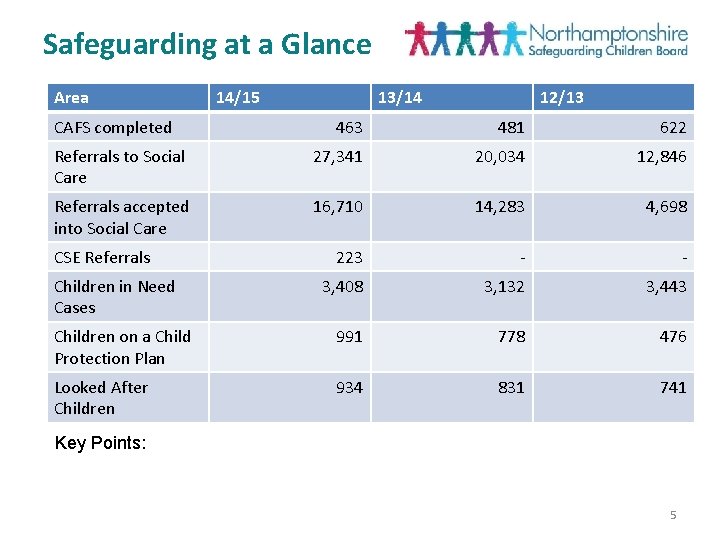
Safeguarding at a Glance Area CAFS completed 14/15 13/14 12/13 463 481 622 Referrals to Social Care 27, 341 20, 034 12, 846 Referrals accepted into Social Care 16, 710 14, 283 4, 698 223 - - 3, 408 3, 132 3, 443 Children on a Child Protection Plan 991 778 476 Looked After Children 934 831 741 CSE Referrals Children in Need Cases Key Points: 5
Get Involved with the Board • Sub Groups – Child Sexual Exploitation – Quality Assurance – Policies and Procedures – Learning and Development – Young Peoples NSCB – Serious Case Review – Child Death Review • Use the website, policies and procedures e-bulletin • Send articles of interest for wider partners • Tell me when things go well or when they could be better! 6
Child Sexual Exploitation Ivan Balhatchet Assistant Chief Constable 7
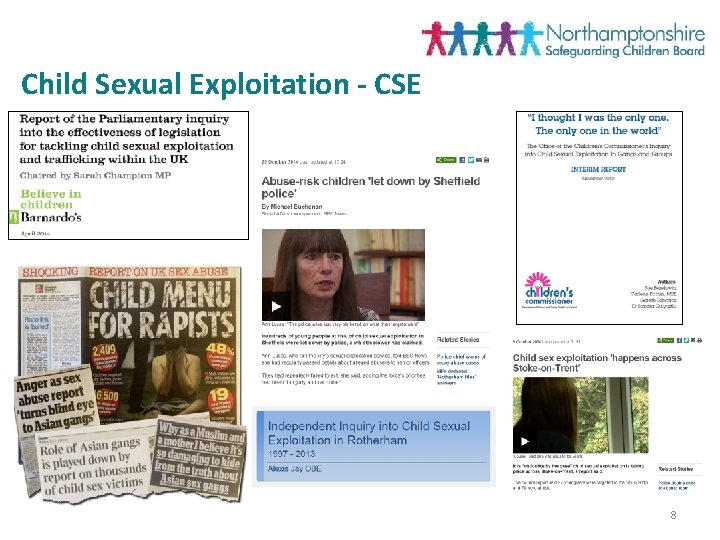
Child Sexual Exploitation - CSE 8
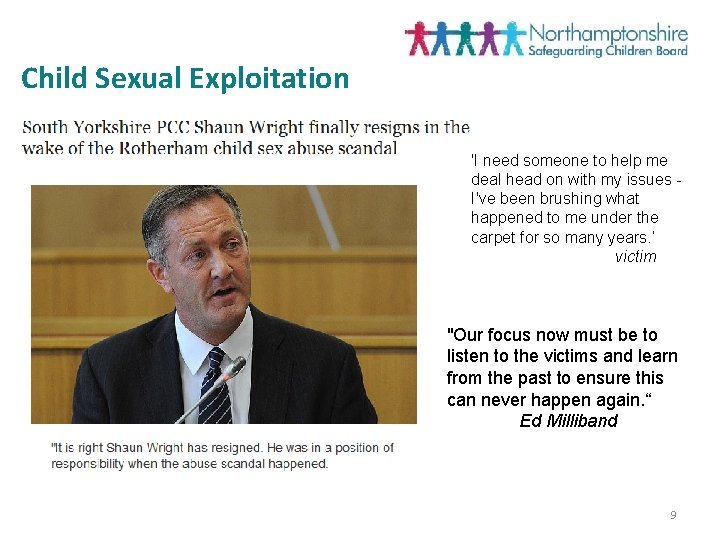
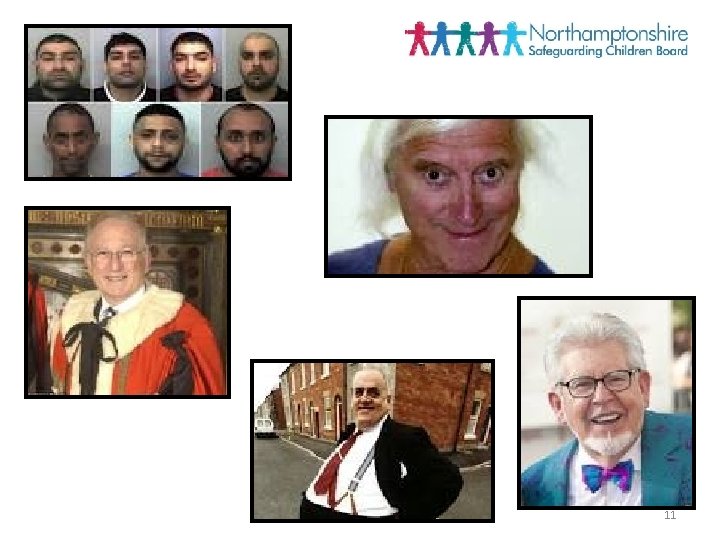
Child Sexual Exploitation 'I need someone to help me deal head on with my issues I've been brushing what happened to me under the carpet for so many years. ‘ victim "Our focus now must be to listen to the victims and learn from the past to ensure this can never happen again. “ Ed Milliband 9
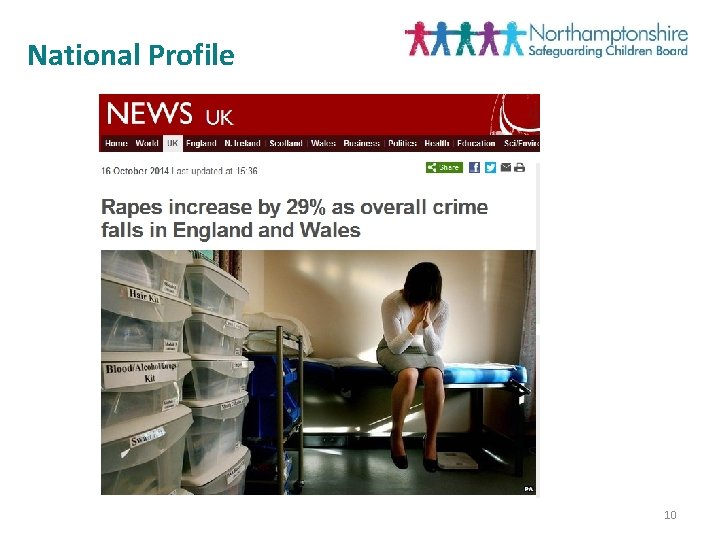
National Profile 10
11
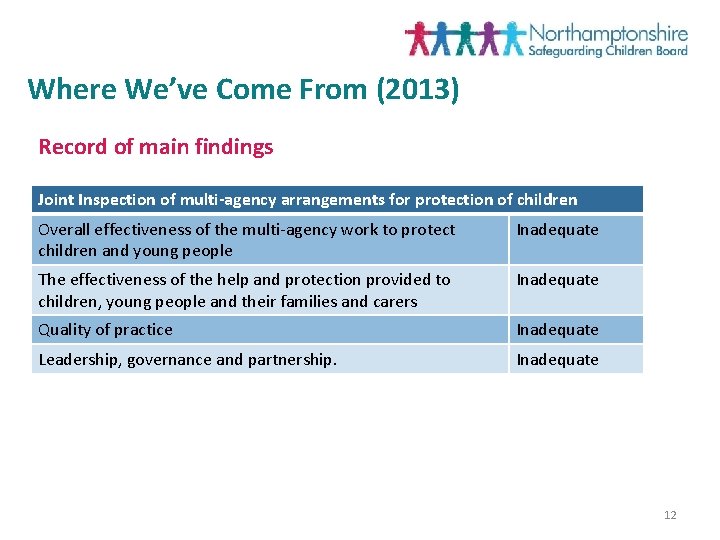
Where We’ve Come From (2013) Record of main findings Joint Inspection of multi-agency arrangements for protection of children Overall effectiveness of the multi-agency work to protect children and young people Inadequate The effectiveness of the help and protection provided to children, young people and their families and carers Inadequate Quality of practice Inadequate Leadership, governance and partnership. Inadequate 12

MASH - Multi-Agency Safeguarding Hub? 13
• Children are now made safer • There have been material improvements in child protection arrangements since January 2013 • The main findings are that significant investment in response to child protection by working with partners to develop a true multi-agency child protection approach for Northamptonshire; – deploying additional specialist resources; – providing development time for senior leadership within the Protecting Vulnerable People Unit; and – providing training for specialist and frontline officers and changing working practices. 14

Northamptonshire - Response People • Leadership – NIB, NSCB and CSE & Missing sub-group • New Strategy, TOR and Action Plan – best practice and learning • OPCC Pledge • Resources – growth within public protection related teams / RISE • Learning and development ‘ambitious’ yet delivered • Training needs analysis across partnership • Significant programme for schools • Best use of estate – nearly 80 partners in CJC safeguarding • Peer inspections / OFSTED / CQC / HMIC / Audit Process • Multi Agency Safeguarding Hub – right people doing the right things • Streamline referrals – effective triage • Crime investigation – worked with HMIC on developing our investigation model • CSE Problem Profile Investment • Over £xx million extra invested in safeguarding work between the OFSTED inspection and May 2015 15
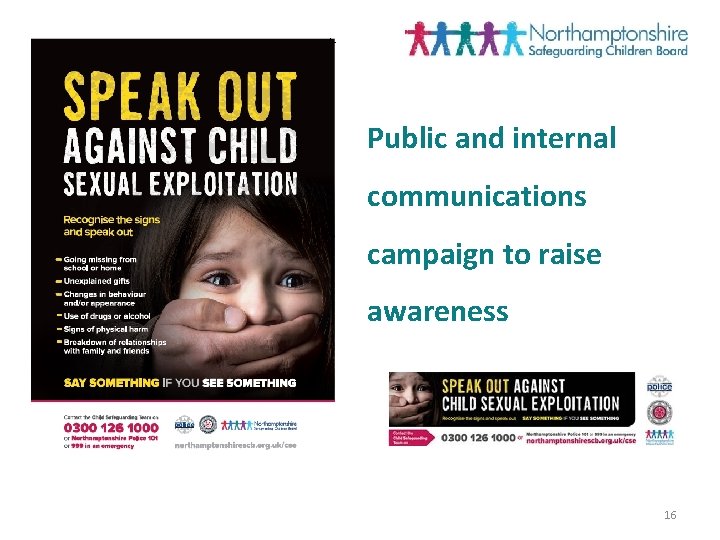
Public and internal communications campaign to raise awareness 16
Young People’s LSCB Presentation Lisa Walsh Interim Snr. Project Officer NSCB
Child Sexual Exploitation “We may think it’s cool to be dating an older man or woman because we don’t understand the possible consequences” 18
Radicalisation “Northants is not London so radicalisation is not an issue here like in London where the school girls travelled to Syria” 19
Female Genital Mutilation (FGM) “Why do we allow cultures to believe it’s acceptable? ” 20
Domestic Abuse “Parents going through Domestic Abuse begin thinking that arguing is more important than caring for your child” 21
Neglect “As a child or young person we need to know we are loved no matter what” 22
Questions 1. 2. 3. 4. 5. How will you educate us in what CSE is and prove people will act quickly if we report it? How will you prove that radicalisation is an issue in Northants? How can we understand why different cultures do it? How will you encourage us to speak out about Domestic Abuse? How will you help us understand what Neglect is and how we can speak to people who have experienced Neglect? 23
Have We Been Neglecting Neglect? Towards strategic thinking and good practice Malcolm Ward Independent Child Protection Consultant

Background/Key References • Nationally not clear that LSCBs / Partner Agencies implemented lessons from the Research Overview: Safeguarding children across services, 2011 • In the child’s time: professional responses to neglect OFSTED March 2014 • Missed opportunities: indicators of neglect – what is ignored, why and what can be done? Df. E Nov 2014 (Not just for social work) Is there a gap locally? Are the findings true for Northamptonshire? 25
Safeguarding Children Across Services: Messages from Research - Davies & Ward, 2011 • Summary / analysis of wide-ranging research on safeguarding children from neglect &abuse England/Wales. • 15 new research projects plus literature reviews / evidence based • Highlighted main implications for all professionals & policymakers involved in safeguarding Change of Gov & Munro Review at time of publication – so in many places the importance of the research was lost 26
Safeguarding Children Across Services 2011 Key Themes 1 • Long term corrosive impact of abuse/neglect not recognised & leads to drift • Adolescent neglect hidden – evidence of some effective (yp & parenting) programmes • Some good evidence-based programmes – but short term & neglect often needs continuing support • Few researched programmes in DV, inc victims/children 27
Safeguarding Children Across Services 2011 Key themes 2 • Proactive social work (relationship work) can be very effective – needs proactive planning • Need for better training in child development for professionals • Majority of maltreated children who are LAC do better than those at home • Insufficient agreement over thresholds & poor feedback on gatekeeping – creates problems for multi-disciplinary work • Need closer working with GPs, adult mental health and DV services where children have been maltreated 28
Child and Family Practitioners’ Understanding of Child Development Df. E published a report based on a small sample of SCRs raising concerns about practitioners’ knowledge of child development and its impact on the cases and outcomes for the children. Df. E - RR 110 Govt Publications What is the quality of knowledge of developmental ages and stages in Northamptonshire? 29
Children’s Needs and Parenting Capacity 2011 Prof Hedy Cleaver updated her research (from 1999) on the impact of parental substance misuse, mental health, learning disability and domestic abuse on children and young people - across the life-stages ~~~~~~ Childhood Neglect Df. E Resources 2012 Online learning and training resources – see end slides 30
OFSTED Thematic Inspection March 2014 In the child’s time: professional responses to neglect Small sample of cases (124) • • • Assessment of cases of neglect Case monitoring and reviewing Timely responses to neglect Support for the workforce Learning from SCRs 31
In the Child’s Time: Findings - Case Practice • Mixed quality of professional responses to neglect • Some children left in neglect for too long • Third of long term cases – drift, delay & poor planning • Range of assessment methods – too variable • Poor use of family history to understand chronicity • Did not consider the impact of neglect on child • Challenges of parental engagement led to poor progress 32
In the Child’s Time: Findings - Strategic • Neglect Training not evaluated / ineffective • Practitioners mostly unaware of recent research or not using it in the work (QA systems & supervision) • LSCBs/Strategic planners unaware of incidence of local neglect – underestimations of the true problem – only seeing those identified already through CP figures • Best results were from LAs/LSCBs where there was a clear local neglect strategy 33
Missed opportunities: Indicators of Neglect Df. E Nov 14 • Neglect is most common form of maltreatment & one of the most damaging long-term • Yet it is difficult for practitioners to identify indicators and assess their severity and if action is required • The report draws on research to help practitioners understand indicators of actual neglect in cases and to assess likelihood and possible interventions from evidence based research An LSCB needs to work towards a capable workforce 34
Missed opportunities: Indicators of Neglect • What is neglect? • The harm of neglect • Impact on children’s development Indicators of neglect Perceptions • Observable social and environmental factors • Observable risk factors in parents and children • Observable harmful-parent child interactions • Observable concerns about the child’s functioning • Observable harmful parent behaviour • Tiers or levels of concern • What to do next • Assessment & Planning 35
Neglect: Working Together - 2015 Neglect is the persistent failure to meet a child’s basic physical and/or psychological needs, likely to result in the serious impairment of the child’s health or development. Neglect may occur during pregnancy as a result of maternal substance abuse. Once a child is born, neglect may involve a parent or carer failing to: • provide adequate food, clothing and shelter (including exclusion from home or abandonment); • protect a child from physical and emotional harm or danger; • ensure adequate supervision (including the use of inadequate care-givers); or • ensure access to appropriate medical care or treatment. It may also include neglect of, or unresponsiveness to, a child’s basic emotional needs. 36
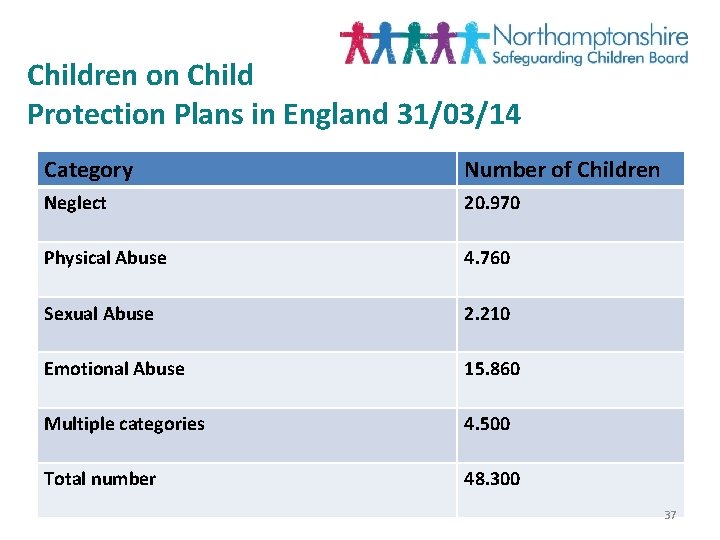
Children on Child Protection Plans in England 31/03/14 Category Number of Children Neglect 20. 970 Physical Abuse 4. 760 Sexual Abuse 2. 210 Emotional Abuse 15. 860 Multiple categories 4. 500 Total number 48. 300 37
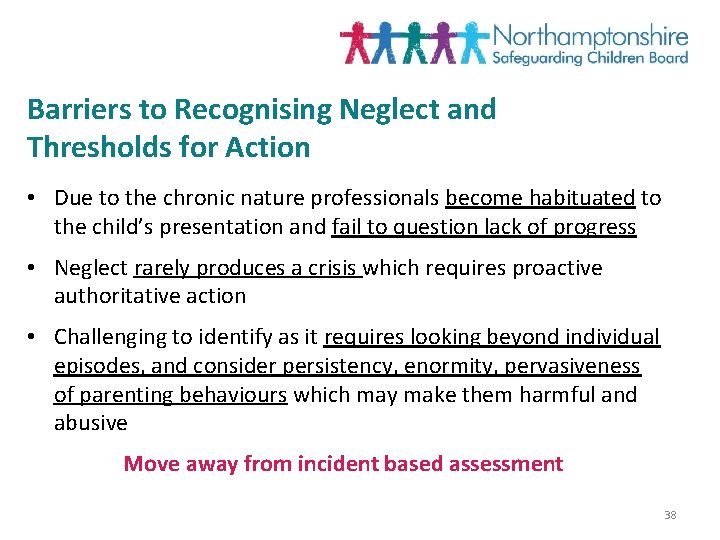
Barriers to Recognising Neglect and Thresholds for Action • Due to the chronic nature professionals become habituated to the child’s presentation and fail to question lack of progress • Neglect rarely produces a crisis which requires proactive authoritative action • Challenging to identify as it requires looking beyond individual episodes, and consider persistency, enormity, pervasiveness of parenting behaviours which may make them harmful and abusive Move away from incident based assessment 38
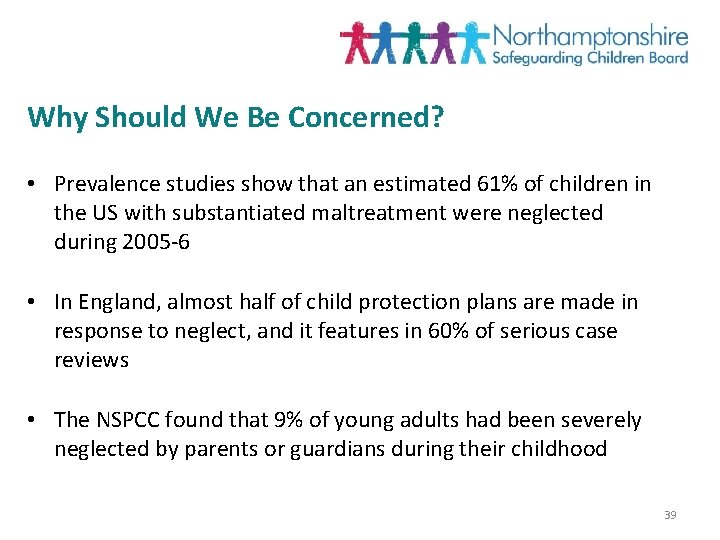
Why Should We Be Concerned? • Prevalence studies show that an estimated 61% of children in the US with substantiated maltreatment were neglected during 2005 -6 • In England, almost half of child protection plans are made in response to neglect, and it features in 60% of serious case reviews • The NSPCC found that 9% of young adults had been severely neglected by parents or guardians during their childhood 39
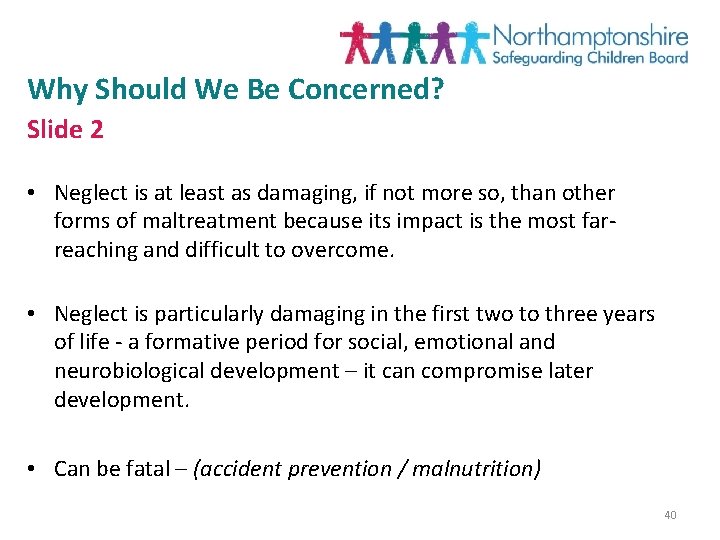
Why Should We Be Concerned? Slide 2 • Neglect is at least as damaging, if not more so, than other forms of maltreatment because its impact is the most farreaching and difficult to overcome. • Neglect is particularly damaging in the first two to three years of life - a formative period for social, emotional and neurobiological development – it can compromise later development. • Can be fatal – (accident prevention / malnutrition) 40
Why Should We Be Concerned? Slide 3 • The impact of neglect is not only widespread, affecting a wide range of developmental domains, it is also cumulative. • Neglected infants and toddlers show a dramatic decline in overall developmental scores between the ages of 9 and 24 months • They also show a progressive decline in their cognitive function throughout the pre-school years Does this make neglect a public health issue? Is it in NSCB’s JSNA? 41
Missed Opportunities Obstacles to effective action: • Lack of knowledge of the potential extent of the impact of neglect • Resource constraints influence professional behaviour and what practitioners perceive can be achieved when they have concerns about neglect. • A number of additional ‘mind-sets’ hamper professional confidence and action (see next slide) 42
Mind-Sets • Fears about being considered judgemental • A focus on parent rather than the child • Failure to consider/understand child’s lived experience • A fixed view of the family • Parents’ superficial or false compliance • “Not my area of expertise” • Reluctance to refer 43
Overcoming the Barriers It is important for practitioners to be able to distinguish between a general risk of neglect occurring • i. e. it might happen – likelihood/probability and indicators of actual neglect. • i. e. it is happening 44

Overcoming the Barriers • General Risk factors do aid understanding of the child’s experience, and do help agencies determine priorities for offering support, however, they should be used and interpreted with care. • Indicators of neglect suggest that the child is experiencing actual neglect. • Behavioural and developmental indicators are particularly helpful and should be taken seriously since both the causes and consequences of such parent/child behaviour may have important implications for the child. 45
Assessment of Neglect Slide 1 There are three aspects / stages to assessment: a) Description of current state and identification of any current indicators of neglect: i. ii. Exploration of persistence of indicator – is this something that happens frequently /all the time/ never been noticed before? (History) Assessment of the current functioning of the child and of the family. 46
Assessment of Neglect Slide 2 b) Review of underlying risk factors incorporating a previous history of: i. The child and of each parent/caregiver. ii. Professional involvement and the family’s (previous) response to this. 47
Assessment of Neglect Slide 2 c) Assessment of the parents’ capacity to change: This can only be tested as part of the parental response to sound, supportive intervention which focuses on social and environmental risk factors and neglectful parent-child interactions. 48
What Does All This Mean for the NSCB? How do the HWB & NSCB measure the local incidence of neglect? Through some of its symptoms – single parents? Poverty? Housing? Employment? But these do not necessarily equate to neglect Research shows we need to understand the incidence and impact of neglect at each of the lifestages and that adolescent neglect has been under-recognised Is that so in Northamptonshire? Your dashboard? Child Protection Plans for neglect are for when a child/family has crossed the threshold but how do we measure for prevention? Iceberg? 49
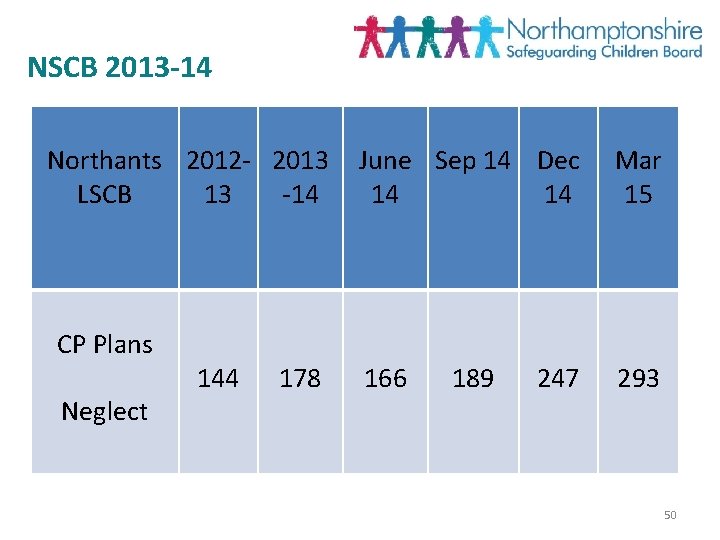
NSCB 2013 -14 Northants 2012 - 2013 LSCB 13 -14 CP Plans Neglect 144 178 June Sep 14 Dec 14 14 Mar 15 166 293 189 247 50
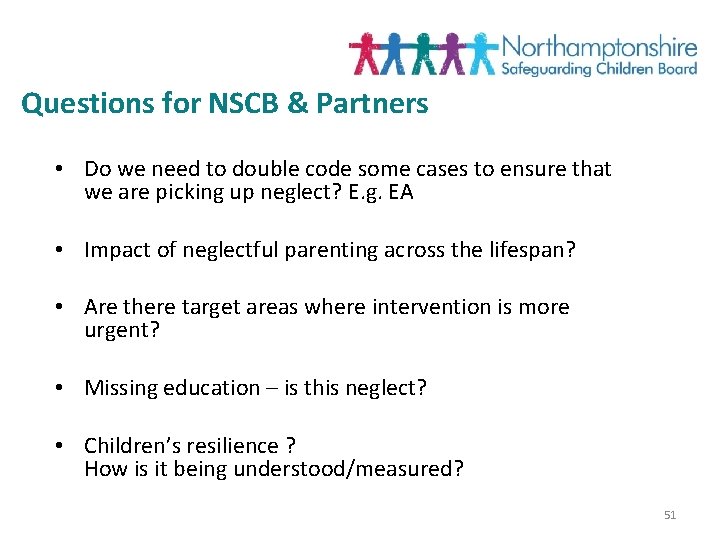
Questions for NSCB & Partners • Do we need to double code some cases to ensure that we are picking up neglect? E. g. EA • Impact of neglectful parenting across the lifespan? • Are there target areas where intervention is more urgent? • Missing education – is this neglect? • Children’s resilience ? How is it being understood/measured? 51
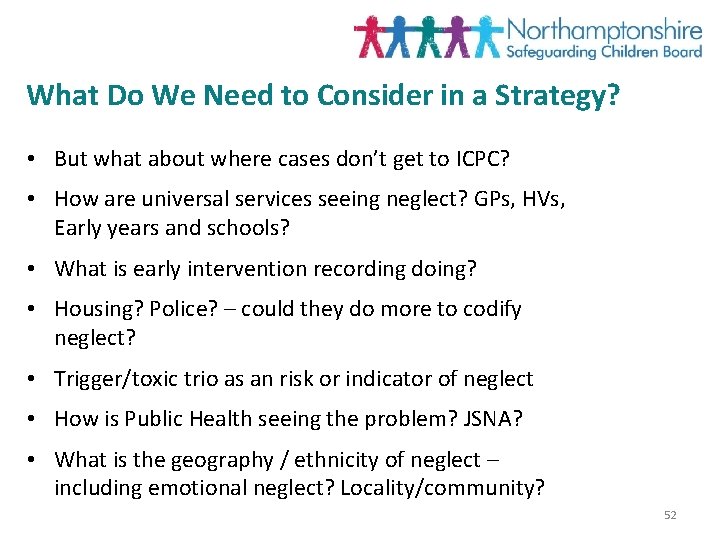
What Do We Need to Consider in a Strategy? • But what about where cases don’t get to ICPC? • How are universal services seeing neglect? GPs, HVs, Early years and schools? • What is early intervention recording doing? • Housing? Police? – could they do more to codify neglect? • Trigger/toxic trio as an risk or indicator of neglect • How is Public Health seeing the problem? JSNA? • What is the geography / ethnicity of neglect – including emotional neglect? Locality/community? 52
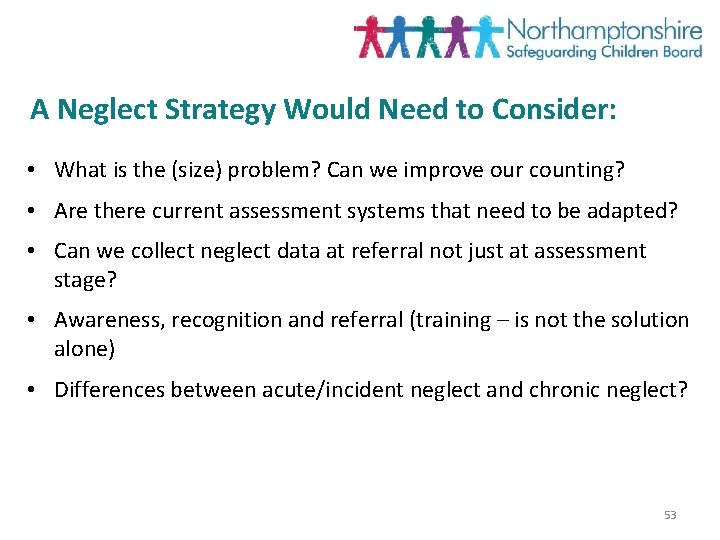
A Neglect Strategy Would Need to Consider: • What is the (size) problem? Can we improve our counting? • Are there current assessment systems that need to be adapted? • Can we collect neglect data at referral not just at assessment stage? • Awareness, recognition and referral (training – is not the solution alone) • Differences between acute/incident neglect and chronic neglect? 53
• Thresholds – how do these deal with the research neglect indicators? • Parenting education? • Benefits take up and employment and/or child care / housing? Food banks? • Local communities and faith groups as gateways to neglect in localities? • What strategies / approaches are already in place to recognise and respond to neglect? • What can we learn from these ? • Are there professional reading and research support groups or briefings in Northamptonshire? (The following slides have references) Thank you Malcolm Ward July 2015 54
Safeguarding Children Across Services: Messages from Research 2011 Recognition of Neglect Recognition of Adolescent Neglected Children Reunification Study Emotional Abuse Recognition Training Evaluation Safeguarding babies and very young children from abuse and neglect • Lessons from SCRs • • • Summaries of key messages of each study in appendices • https: //www. gov. uk/government/publications/safeguardingchildren-across-services-messages-from-research-on-identifyingand-responding-to-child-maltreatment (May 2011) 55
Children’s Needs and Parenting Capacity 2011 Prof Hedy Cleaver updated her research (from 1999) on the impact of parental substance misuse, mental health, learning disability and domestic abuse on children and young people across the life-stages https: //www. gov. uk/government/uploads/system/uploads/atta chment_data/file/182095/DFE-00108 -2011 Childrens_Needs_Parenting_Capacity. pdf 56
Childhood Neglect: Df. E Resources 2012 • https: //www. gov. uk/government/collections/childhood-neglecttraining-resources • Childhood neglect: improving outcomes for children - guidance for trainers • Childhood neglect: improving outcomes for children - the framework • Training resources on childhood neglect: exercises and guidance • Training resources on childhood neglect: presentations and notes • Training resources on childhood neglect: handouts • Training resources on childhood neglect: family case studies 57
Child Abuse Review March – April 2015 Why have we made neglect so complicated? Taking a fresh look at noticing and helping the neglected child Prof Brigid Daniel Paper argues that professionals are not aware of the wealth of research into neglect for recognition and effective assessment and treatment Are there professional reading and research support groups or briefings in Northamptonshire? Malcolm Ward Safeguarding Ltd www. malcolmward. co. uk 58
Have We Made A Difference? Kevin Johnson Project Officer NSCB
BREAK 10. 30 – 10. 50
Breakout Sessions: a. Domestic Abuse b. Neglect c. Radicalisation d. Child Sexual Exploitation e. Female Genital Mutilation
Breakout Session Feedback Recommendations & Actions
Finish Thank you for attending today Have a safe journey
- Slides: 63