
NORTH SEA OFFSHORE GRID INTEGRATION TOWARDS 2050 Assessing


- Slides: 23
NORTH SEA OFFSHORE GRID – INTEGRATION TOWARDS 2050 Assessing the barriers toward an integrated North Sea grid Lise-Lotte Pade Associate Professor llph@dtu. dk @llpade Holmen Fjordhotell, Oslo, Norway April 23 -25, 2018
Background • Paris Agreement from 2015 • Renewable energy target 2030 and 2050 • EU integrated electricity market • With its substantial offshore wind potential, a large share of the renewable energy is expected to take place in the North Sea • The offshore grid in the North Sea has to be expanded over the coming decades • Ambitious development of transmission capacity and interconnections between European countries is necessary – Offshore grids/interconnections potentially reduce the overall socio-economic costs – Integrated grids potentially bring economic benefits 2 DTU Management Engineering, Danmarks Tekniske Universitet
Background II • Several studies have found that there are benefits to further integrating the North Sea grid A meshed solution would increase efficiency: • Cost savings – higher initial costs • costs outbalanced by annual savings and benefits • Price convergence • More energy produced from RES. 3 DTU Management Engineering, Danmarks Tekniske Universitet
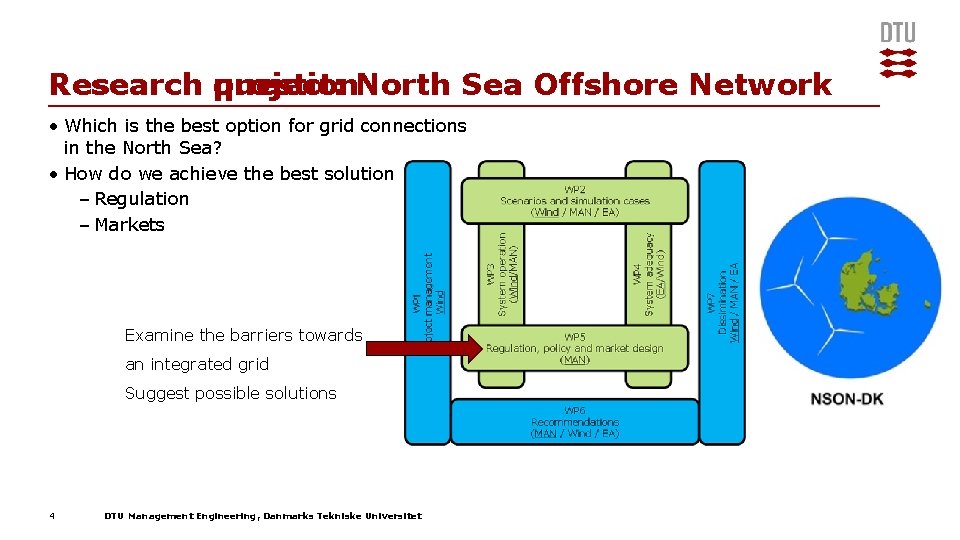
Research project: question. North Sea Offshore Network • Which is the best option for grid connections in the North Sea? • How do we achieve the best solution – Regulation – Markets Examine the barriers towards an integrated grid Suggest possible solutions 4 DTU Management Engineering, Danmarks Tekniske Universitet
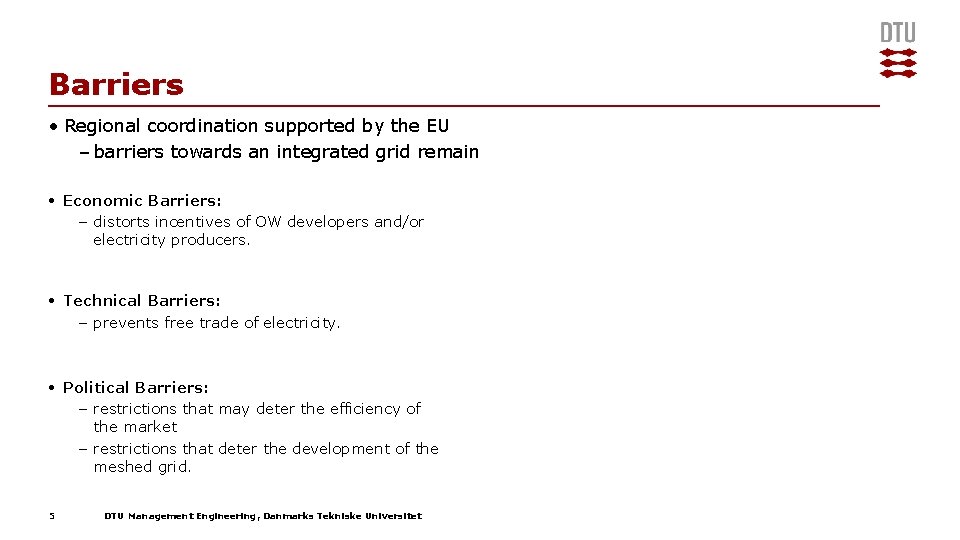
Barriers • Regional coordination supported by the EU – barriers towards an integrated grid remain • Economic Barriers: – distorts incentives of OW developers and/or electricity producers. • Technical Barriers: – prevents free trade of electricity. • Political Barriers: – restrictions that may deter the efficiency of the market – restrictions that deter the development of the meshed grid. 5 DTU Management Engineering, Danmarks Tekniske Universitet
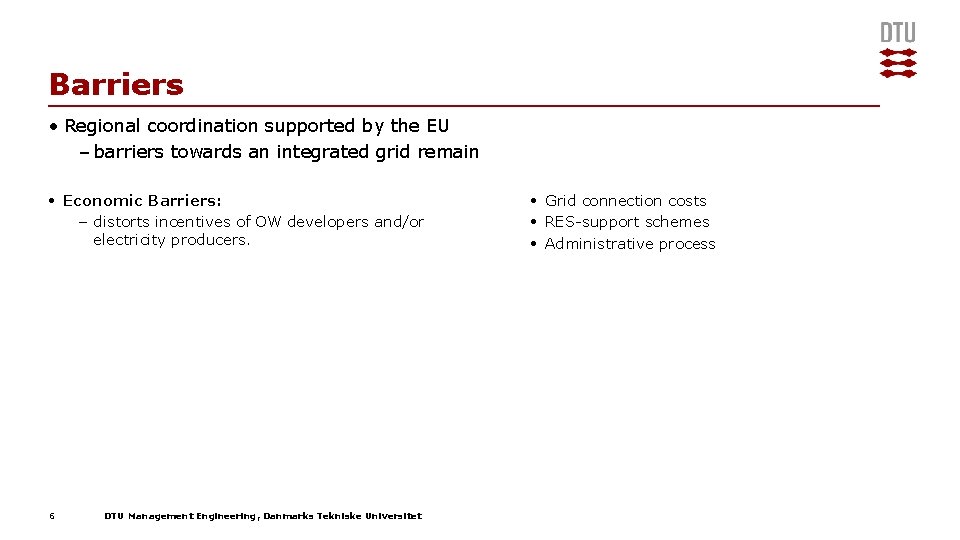
Barriers • Regional coordination supported by the EU – barriers towards an integrated grid remain • Economic Barriers: – distorts incentives of OW developers and/or electricity producers. – Technical Barriers: prevents free trade of electricity. • Political Barriers: – restrictions on electricity producers that may hurt the efficiency of the market or deter the development of the meshed grid. 6 DTU Management Engineering, Danmarks Tekniske Universitet • Grid connection costs • RES-support schemes • Administrative process • • Financing offshore assets Cross border capacity allocation Priority grid Access Onshore connection rules • Balancing responsibilities • Cost-benefit allocation
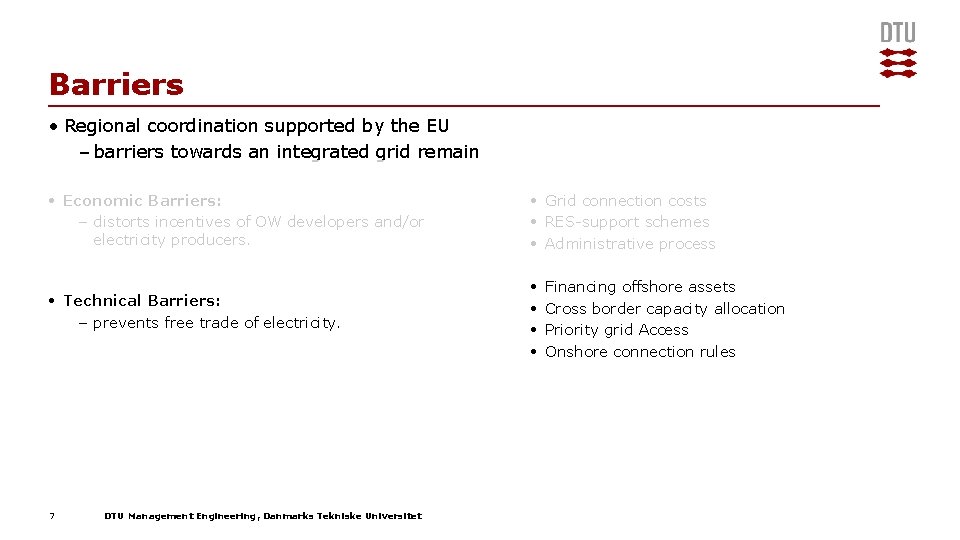
Barriers • Regional coordination supported by the EU – barriers towards an integrated grid remain • Economic Barriers: – distorts incentives of OW developers and/or electricity producers. • Grid connection costs • RES-support schemes • Administrative process • Technical Barriers: – prevents free trade of electricity. • • • Political Barriers: restrictions on electricity producers that may hurt the efficiency of the market or deter the development of the meshed grid. 7 DTU Management Engineering, Danmarks Tekniske Universitet Financing offshore assets Cross border capacity allocation Priority grid Access Onshore connection rules • Balancing responsibilities • Cost-benefit allocation
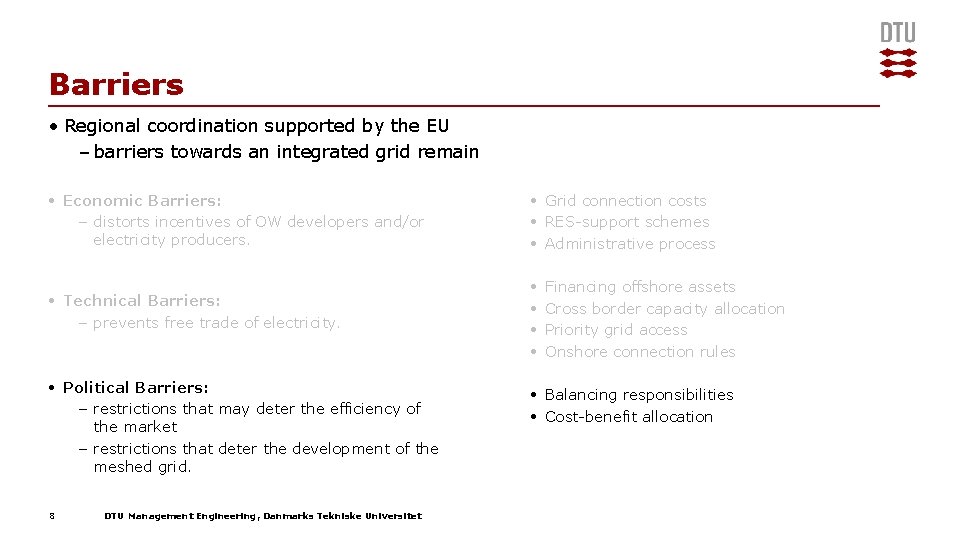
Barriers • Regional coordination supported by the EU – barriers towards an integrated grid remain • Economic Barriers: – distorts incentives of OW developers and/or electricity producers. • Grid connection costs • RES-support schemes • Administrative process • Technical Barriers: – prevents free trade of electricity. • • • Political Barriers: – restrictions that may deter the efficiency of the market – restrictions that deter the development of the meshed grid. 8 DTU Management Engineering, Danmarks Tekniske Universitet Financing offshore assets Cross border capacity allocation Priority grid access Onshore connection rules • Balancing responsibilities • Cost-benefit allocation
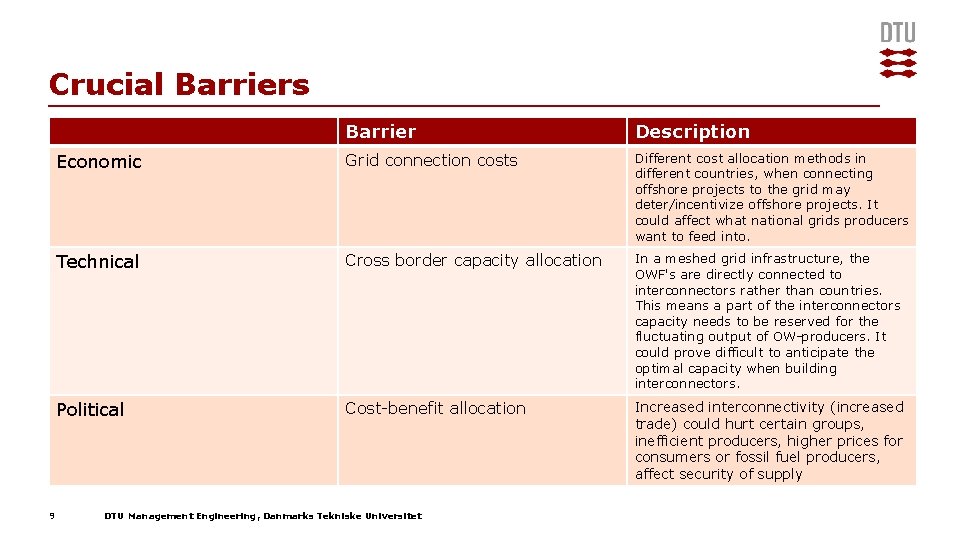
Crucial Barriers 9 Barrier Description Economic Grid connection costs Different cost allocation methods in different countries, when connecting offshore projects to the grid may deter/incentivize offshore projects. It could affect what national grids producers want to feed into. Technical Cross border capacity allocation In a meshed grid infrastructure, the OWF's are directly connected to interconnectors rather than countries. This means a part of the interconnectors capacity needs to be reserved for the fluctuating output of OW-producers. It could prove difficult to anticipate the optimal capacity when building interconnectors. Political Cost-benefit allocation Increased interconnectivity (increased trade) could hurt certain groups, inefficient producers, higher prices for consumers or fossil fuel producers, affect security of supply DTU Management Engineering, Danmarks Tekniske Universitet
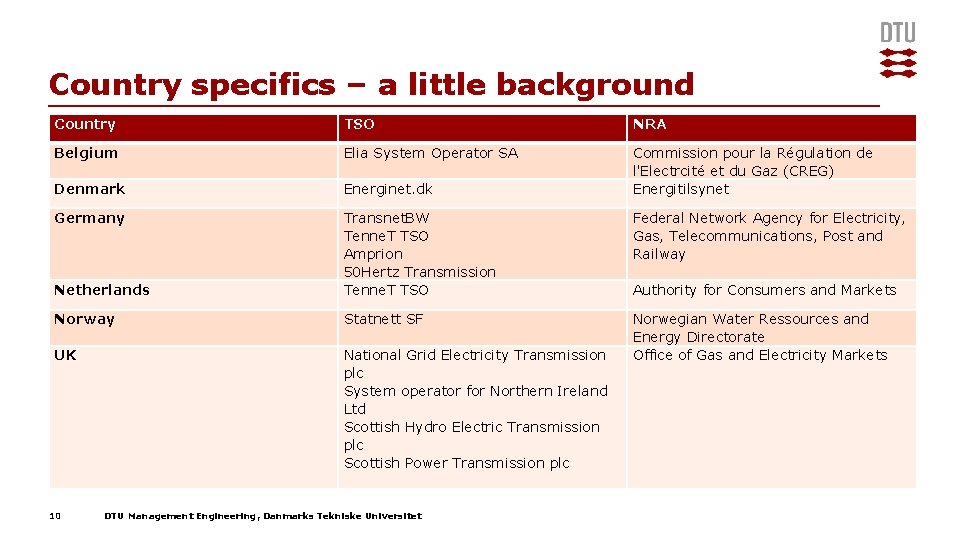
Country specifics – a little background Country TSO NRA Belgium Elia System Operator SA Denmark Energinet. dk Commission pour la Régulation de l'Electrcité et du Gaz (CREG) Energitilsynet Germany Federal Network Agency for Electricity, Gas, Telecommunications, Post and Railway Netherlands Transnet. BW Tenne. T TSO Amprion 50 Hertz Transmission Tenne. T TSO Norway Statnett SF UK National Grid Electricity Transmission plc System operator for Northern Ireland Ltd Scottish Hydro Electric Transmission plc Scottish Power Transmission plc Norwegian Water Ressources and Energy Directorate Office of Gas and Electricity Markets 10 DTU Management Engineering, Danmarks Tekniske Universitet Authority for Consumers and Markets
Country specifics – a little background II Country RES target 2020 RES target 2030* RES support schemes EU 20% 27% - Belgium 13% 23% Denmark 30% 42% Germany 18% 29% Feed-in premium Netherlands 14% 25% Feed-in premium Norway 67, 5% - UK 15% 27% *Calculated based on the methodology for effort sharing in RES Directive 2009/28/EC. 11 DTU Management Engineering, Danmarks Tekniske Universitet Quota system and tradable certificates Feed-in premium/auctions Quota system and tradable certificates/Cf. D
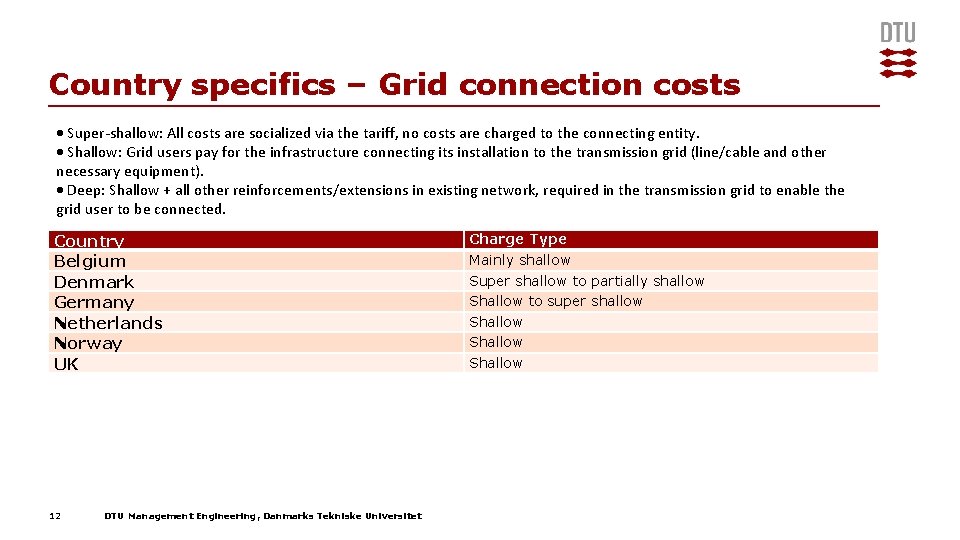
Country specifics – Grid connection costs Super-shallow: All costs are socialized via the tariff, no costs are charged to the connecting entity. Shallow: Grid users pay for the infrastructure connecting its installation to the transmission grid (line/cable and other necessary equipment). Deep: Shallow + all other reinforcements/extensions in existing network, required in the transmission grid to enable the grid user to be connected. Country Belgium Denmark Germany Netherlands Norway UK 12 DTU Management Engineering, Danmarks Tekniske Universitet Charge Type Mainly shallow Super shallow to partially shallow Shallow to super shallow Shallow
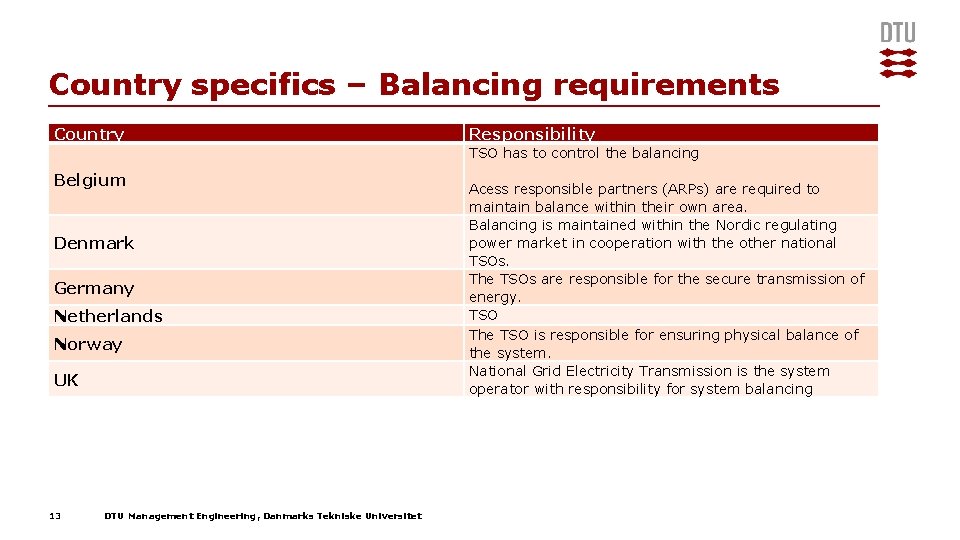
Country specifics – Balancing requirements Country Belgium Denmark Germany Netherlands Norway UK 13 DTU Management Engineering, Danmarks Tekniske Universitet Responsibility TSO has to control the balancing Acess responsible partners (ARPs) are required to maintain balance within their own area. Balancing is maintained within the Nordic regulating power market in cooperation with the other national TSOs. The TSOs are responsible for the secure transmission of energy. TSO The TSO is responsible for ensuring physical balance of the system. National Grid Electricity Transmission is the system operator with responsibility for system balancing
Political Technical Economic Possible solution (work in progress…) 14 Barriers Solution Grid connection costs A harmonization of grid connection costs would remove the distorting incentives RES-support schemes A harmonization of RES-support schemes would remove the distorting incentives Administrative process Creating standard documentation for potential offshore developers could ease the administrative burden. Financing offshore assets Making sure that there is a stable regulatory framework in place in necessary in order to attract investors. Cross border capacity allocation Adjustment of EU regulation 2009/714 regarding the principle of discriminationfree allocation of interconnector capacity Priority grid access A set of rules that determine how to allocate capacity between RES projects is necessary. Onshore connection rules In order to achieve a well functioning grid, that ensures a well functioning trade of electricity throughout the EU a centralized planning TSO could be a solution. Balancing responsibilities A clear framework for what markets a offshore wind farm is balancing responsible in is necessary. Cost-benefit allocation Since there are benefits to increasing interconnectivity a cost-benefit allocation mechanism that compensates potential losers, should be developed. DTU Management Engineering, Danmarks Tekniske Universitet
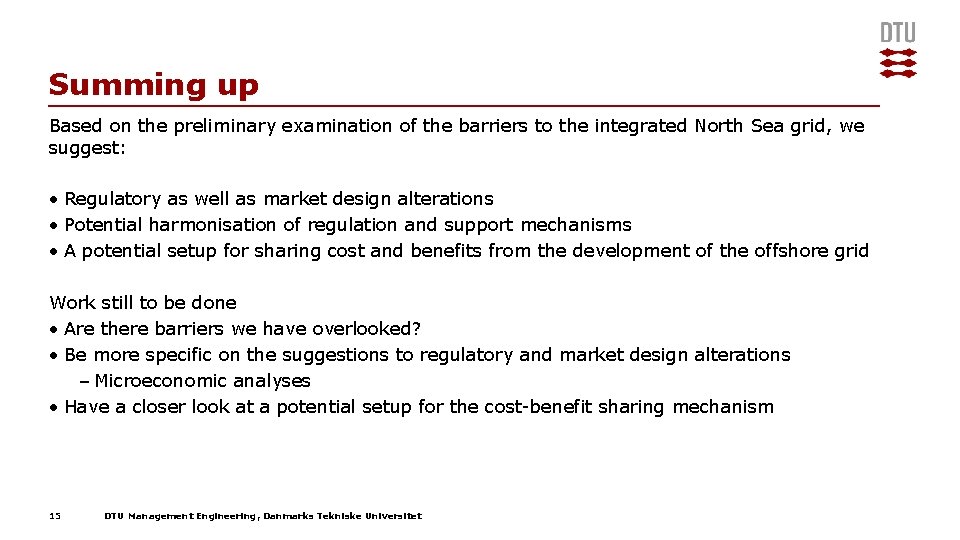
Summing up Based on the preliminary examination of the barriers to the integrated North Sea grid, we suggest: • Regulatory as well as market design alterations • Potential harmonisation of regulation and support mechanisms • A potential setup for sharing cost and benefits from the development of the offshore grid Work still to be done • Are there barriers we have overlooked? • Be more specific on the suggestions to regulatory and market design alterations – Microeconomic analyses • Have a closer look at a potential setup for the cost-benefit sharing mechanism 15 DTU Management Engineering, Danmarks Tekniske Universitet
Thank you for your attention! DTU MAN NSON-team: Lise-Lotte Pade (llph@dtu. dk) Lauge Truels Larsen Athanasios Papakonstantinou Juan Gea Bermudez
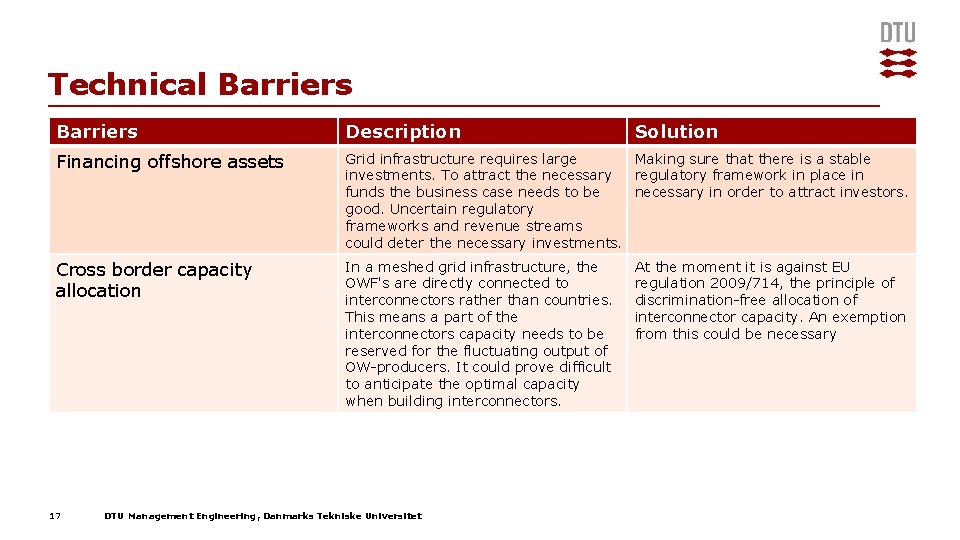
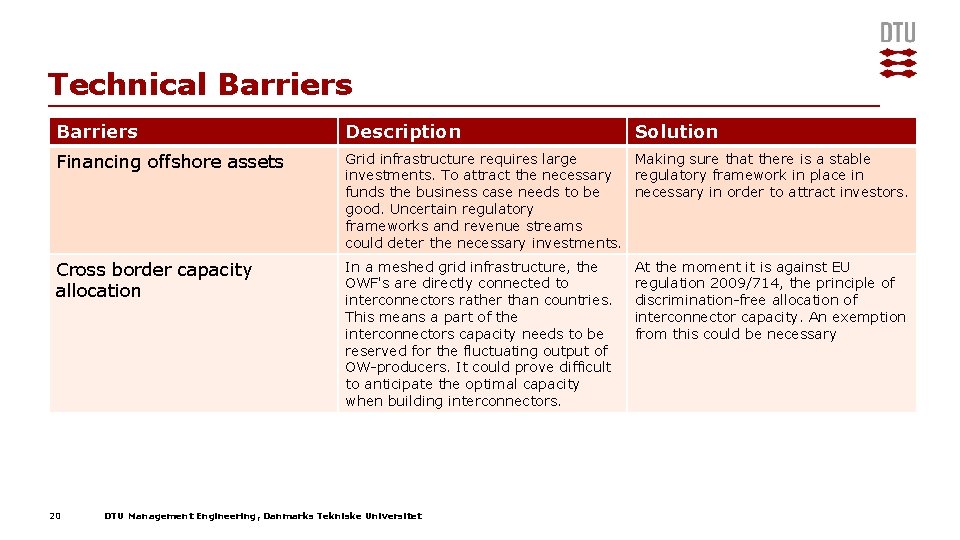
Technical Barriers Description Financing offshore assets Grid infrastructure requires large Making sure that there is a stable investments. To attract the necessary regulatory framework in place in funds the business case needs to be necessary in order to attract investors. good. Uncertain regulatory frameworks and revenue streams could deter the necessary investments. Cross border capacity allocation In a meshed grid infrastructure, the OWF's are directly connected to interconnectors rather than countries. This means a part of the interconnectors capacity needs to be reserved for the fluctuating output of OW-producers. It could prove difficult to anticipate the optimal capacity when building interconnectors. 17 DTU Management Engineering, Danmarks Tekniske Universitet Solution At the moment it is against EU regulation 2009/714, the principle of discrimination-free allocation of interconnector capacity. An exemption from this could be necessary
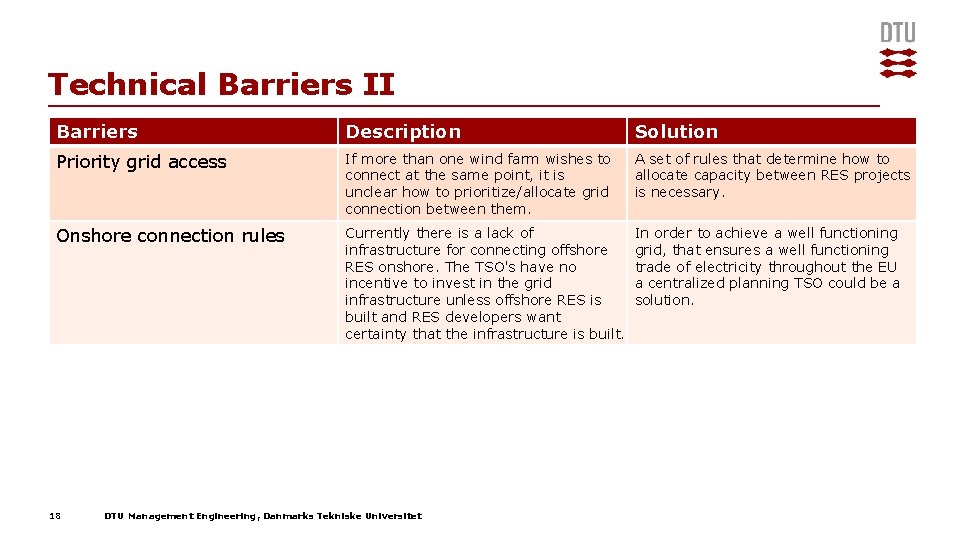
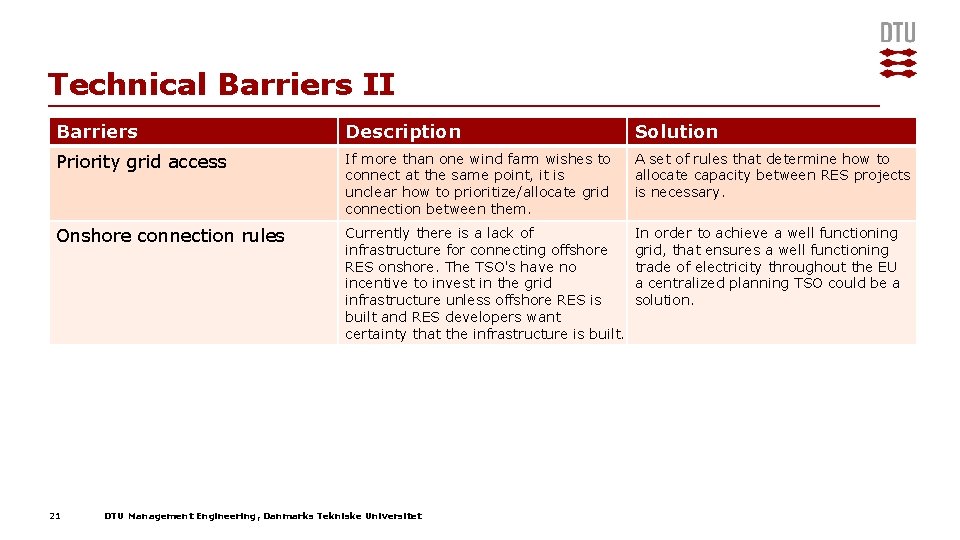
Technical Barriers II Barriers Description Solution Priority grid access If more than one wind farm wishes to connect at the same point, it is unclear how to prioritize/allocate grid connection between them. A set of rules that determine how to allocate capacity between RES projects is necessary. Onshore connection rules Currently there is a lack of infrastructure for connecting offshore RES onshore. The TSO's have no incentive to invest in the grid infrastructure unless offshore RES is built and RES developers want certainty that the infrastructure is built. In order to achieve a well functioning grid, that ensures a well functioning trade of electricity throughout the EU a centralized planning TSO could be a solution. 18 DTU Management Engineering, Danmarks Tekniske Universitet
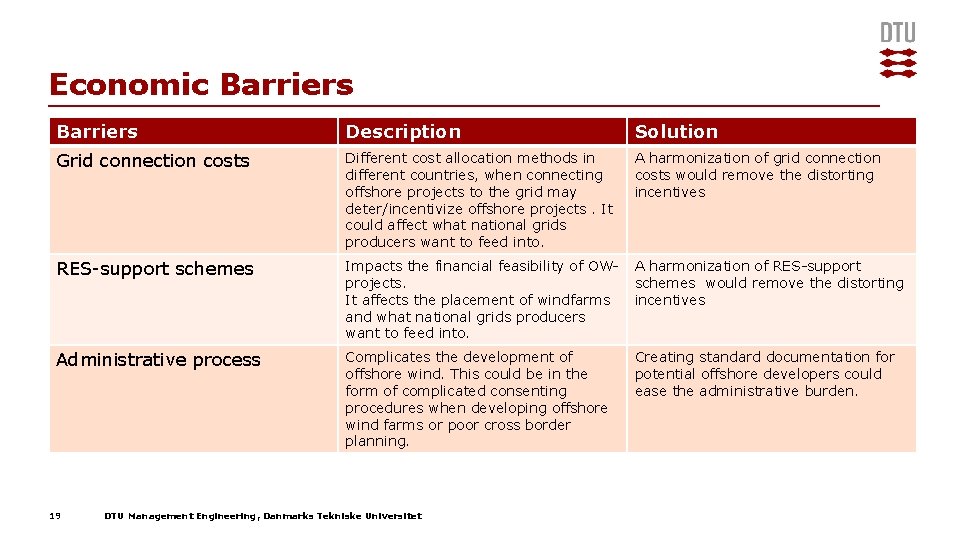
Economic Barriers Description Solution Grid connection costs Different cost allocation methods in different countries, when connecting offshore projects to the grid may deter/incentivize offshore projects. It could affect what national grids producers want to feed into. A harmonization of grid connection costs would remove the distorting incentives RES-support schemes Impacts the financial feasibility of OWprojects. It affects the placement of windfarms and what national grids producers want to feed into. A harmonization of RES-support schemes would remove the distorting incentives Administrative process Complicates the development of offshore wind. This could be in the form of complicated consenting procedures when developing offshore wind farms or poor cross border planning. Creating standard documentation for potential offshore developers could ease the administrative burden. 19 DTU Management Engineering, Danmarks Tekniske Universitet
Technical Barriers Description Financing offshore assets Grid infrastructure requires large Making sure that there is a stable investments. To attract the necessary regulatory framework in place in funds the business case needs to be necessary in order to attract investors. good. Uncertain regulatory frameworks and revenue streams could deter the necessary investments. Cross border capacity allocation In a meshed grid infrastructure, the OWF's are directly connected to interconnectors rather than countries. This means a part of the interconnectors capacity needs to be reserved for the fluctuating output of OW-producers. It could prove difficult to anticipate the optimal capacity when building interconnectors. 20 DTU Management Engineering, Danmarks Tekniske Universitet Solution At the moment it is against EU regulation 2009/714, the principle of discrimination-free allocation of interconnector capacity. An exemption from this could be necessary
Technical Barriers II Barriers Description Solution Priority grid access If more than one wind farm wishes to connect at the same point, it is unclear how to prioritize/allocate grid connection between them. A set of rules that determine how to allocate capacity between RES projects is necessary. Onshore connection rules Currently there is a lack of infrastructure for connecting offshore RES onshore. The TSO's have no incentive to invest in the grid infrastructure unless offshore RES is built and RES developers want certainty that the infrastructure is built. In order to achieve a well functioning grid, that ensures a well functioning trade of electricity throughout the EU a centralized planning TSO could be a solution. 21 DTU Management Engineering, Danmarks Tekniske Universitet
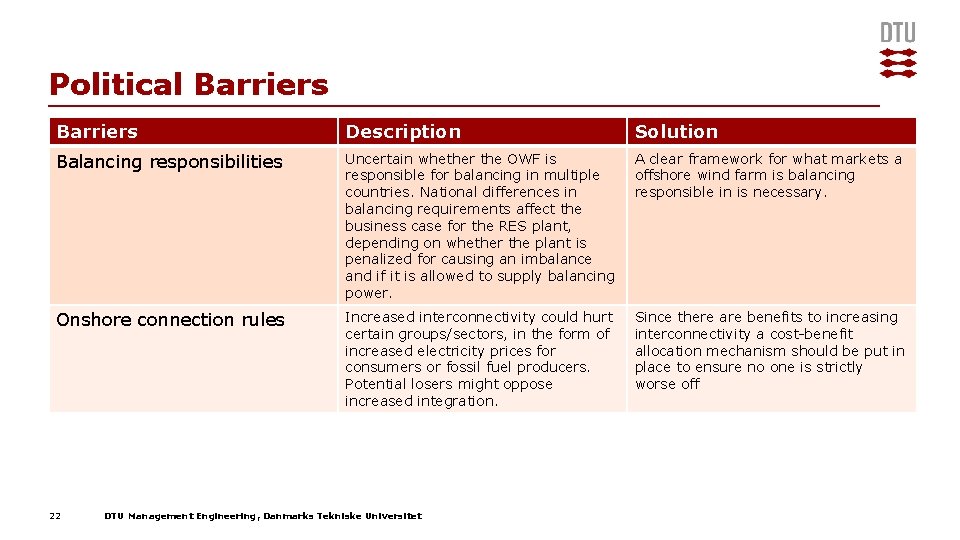
Political Barriers Description Solution Balancing responsibilities Uncertain whether the OWF is responsible for balancing in multiple countries. National differences in balancing requirements affect the business case for the RES plant, depending on whether the plant is penalized for causing an imbalance and if it is allowed to supply balancing power. A clear framework for what markets a offshore wind farm is balancing responsible in is necessary. Onshore connection rules Increased interconnectivity could hurt certain groups/sectors, in the form of increased electricity prices for consumers or fossil fuel producers. Potential losers might oppose increased integration. Since there are benefits to increasing interconnectivity a cost-benefit allocation mechanism should be put in place to ensure no one is strictly worse off 22 DTU Management Engineering, Danmarks Tekniske Universitet
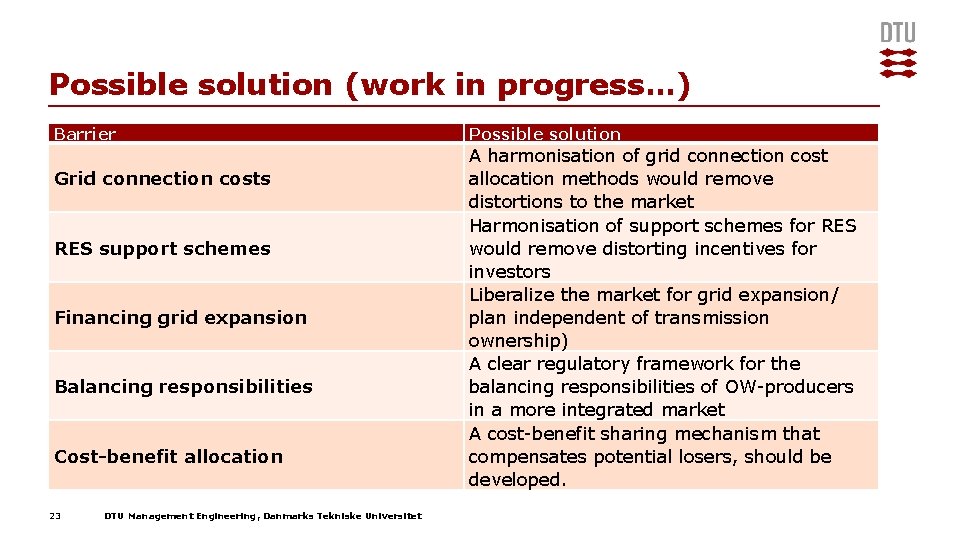
Possible solution (work in progress…) Barrier Grid connection costs RES support schemes Financing grid expansion Balancing responsibilities Cost-benefit allocation 23 DTU Management Engineering, Danmarks Tekniske Universitet Possible solution A harmonisation of grid connection cost allocation methods would remove distortions to the market Harmonisation of support schemes for RES would remove distorting incentives for investors Liberalize the market for grid expansion/ plan independent of transmission ownership) A clear regulatory framework for the balancing responsibilities of OW-producers in a more integrated market A cost-benefit sharing mechanism that compensates potential losers, should be developed.