
North Carolina Workers Compensation e Billing Overview Are

North Carolina Workers’ Compensation e. Billing Overview Are you ready? June 19, 2014 Conor Brockett – Associate General Counsel, North Carolina Medical Society Don St. Jacques – SVP - Business Development, Jopari Solutions, Inc.
North Carolina e. Bill and EFT - Agenda • North Carolina e. Billing Overview and Terminology • Industry Approach • Regulations recap • How to get started • References
Announcement Regarding Electronic Medical Billing and Payment Pursuant to N. C. Gen. Stat. § 97 -26(g 1), the Industrial Commission was directed to adopt rules requiring electronic medical billing and payment processes. The Industrial Commission subsequently adopted Electronic Billing Rules 101 -109 in 2012. These rules were then held in abeyance in conjunction with other rule making efforts and to allow the Commission to develop an implementation guide. The Electronic Billing and Payment Companion Guide is now in final form and ready for publication. Click here for access to the guide. This guide can also be accessed on the Commission’s webpages for Carriers and for Medical Providers. . The date for implementation of electronic medical billing in the adopted rules referenced above is March 1, 2014. The Commission received and considered feedback and multiple requests for extensions of the March 1, 2014 deadline from employers, carriers, third-party administrators, and medical billing companies. In order to allow these stakeholders additional time for preparation, the Commission will not require compliance with the Electronic Billing Rules until July 1, 2014, with regard to electronic medical billing processes. The rules and portions of the companion guide that govern and require electronic medical payment processes will not be mandatory until January 1, 2015. No additional extensions will be granted. . http: //www. ic. nc. gov/medproviders. html
Terminology • e. Billing – the process of submitting Workers’ Compensation medical billing and related documentation electronically to payers, as well as receiving acknowledgements and remittance information. • EFT (electronic funds transfer) – the ability of a payer to directly deposit payments for medical bills into a provider’s designated bank account. Requires enrolling with a payer to supply banking information. • e. Billing agent – a specialized clearinghouse partner that assists providers and payers with their Workers’ Compensation connectivity, along with providing EFT enrollment capabilities for multiple payers.
Terminology - continued • “ Complete Claim” (Clean Bill) – be submitted in the correct billing format, with the correct billing code sets, – be transmitted in compliance with all necessary format requirements – include in legible text all medical reports and records, including, but not limited to, evaluation reports, narrative reports, assessment reports, progress report/notes, clinical notes, hospital records and diagnostic test results that are necessary for adjudication including any other jurisdictional requirements found in its regulations or North Carolina e. Bill companion guide • Payer ID - the routing number that e. Bill agents use to direct the transaction to the correct payer destination
Terminology - continued • Remittance Advice (835) – an electronic feed of information from the payer to providers to advise whether a bill has been paid or denied, by what method, how much, and reasons on a line-by-line basis for paid/denied. It contains much of what is on a typical Explanation of Reimbursement (EOR), but often not some of the specific messaging. The 835 is designed to allow automatic posting into the PMS/RCS or Clearinghouse, provided it has been enabled with the capabilities to import them. • Companion Guide – the details of how e. Billing is to work, including formats; timelines; responsibilities of provider, payers, and agents. The NC Companion Guide is available on the Industrial Commission website at http: //www. ic. nc. gov/ncic/pages/EBPCguide. pdf
Terminology - continued • Trading Partners – are entities that have established EDI relationships and that exchange information electronically either in standard or mutually agreed-upon formats. Trading Partners can be both Senders and Receivers, depending on the electronic process involved (i. e. Billing or Acknowledgment). • Trading Partner Agreement – a written agreement that defines the methods, formats, and responsibilities of each party exchanging data, including Claims Submission, Attachment Formats, Acknowledgements, delivery of Electronic Remittance Advices, Payment Methodology, access to Portal Services, Transmission Methods, and Processing rules.
Workers’ Compensation Industry approach to e. Billing • Utilize the same technology platform(s) and workflow(s) that a provider uses today to process all other lines of insurance • Utilize the same HIPAA transaction sets as group/commercial claims to enable connectivity solutions to move WC transactions: • ASC X 12 Standards for Electronic Data Interchange Technical Report Type 3, Health Care Claim (837 - Professional, Institutional and Dental • ASCX 12 Acknowledgments ( 999, TA 1, 277 CA) • ASC X 12 Standards for Electronic Data Interchange Technical Report Type 3, Health Care Claim Payment/Advice (835), ASCX 12 N Health Care Claim Remittance Advice ( 835)- NCPDP D. 0 EFT/ERA utilization • Establish consistent, clear ground rules for providers and payers
Workers’ Compensation Industry approach to e. Billing • Overall, streamline the process and eliminate unnecessary steps and paper • Clean data on the front end results in “straight through” processing on the back end – reduces Accounts Receivables, need for follow-up calls, improves coordination with the claims adjuster
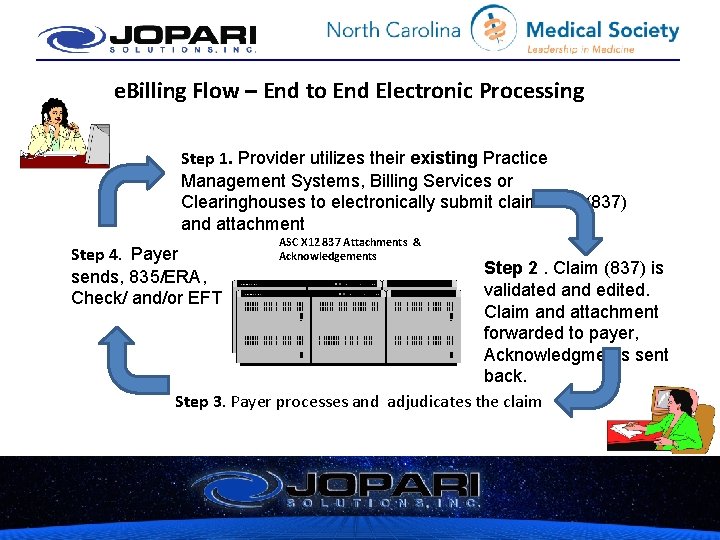
e. Billing Flow – End to End Electronic Processing Step 1. Provider utilizes their existing Practice Management Systems, Billing Services or Clearinghouses to electronically submit claim data (837) and attachment Step 4. Payer sends, 835/ERA, Check/ and/or EFT ASC X 12 837 Attachments & Acknowledgements Step 2. Claim (837) is validated and edited. Claim and attachment forwarded to payer, Acknowledgments sent back. Step 3. Payer processes and adjudicates the claim

North Carolina regulations • North Carolina is the latest state to join a growing number of jurisdictions that requires Workers’ compensation providers and payers to exchange medical billing/payment information electronically. • The North Carolina rules are based on a nationally adopted framework using standard transactions created by the IAIABC, which is the trade association of Workers’ Compensation jurisdictional authorities. (In NC, this the Industrial Commission) • The rules were prepared by a consensus group with input from the medical and payer communities. • The rules layout both the formats, responsibilities of each party, as well as operating timelines.
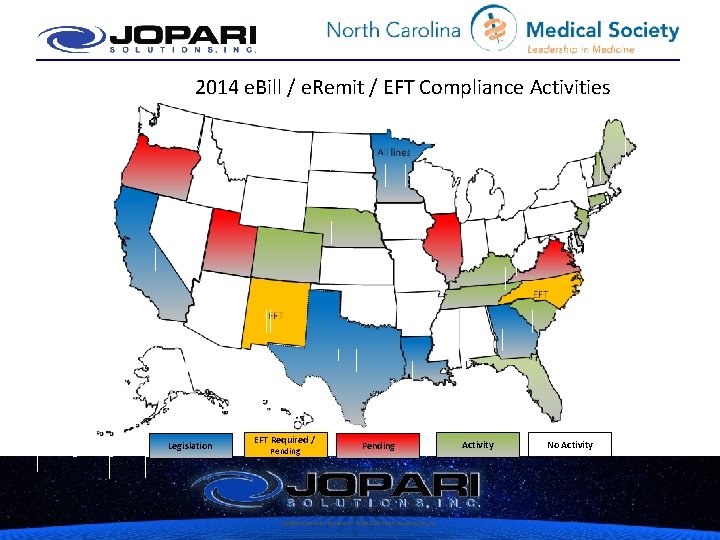
2014 e. Bill / e. Remit / EFT Compliance Activities Legislation EFT Required / Pending Confidential and Proprietary. © 2011 Mitchell International, Inc. Activity No Activity
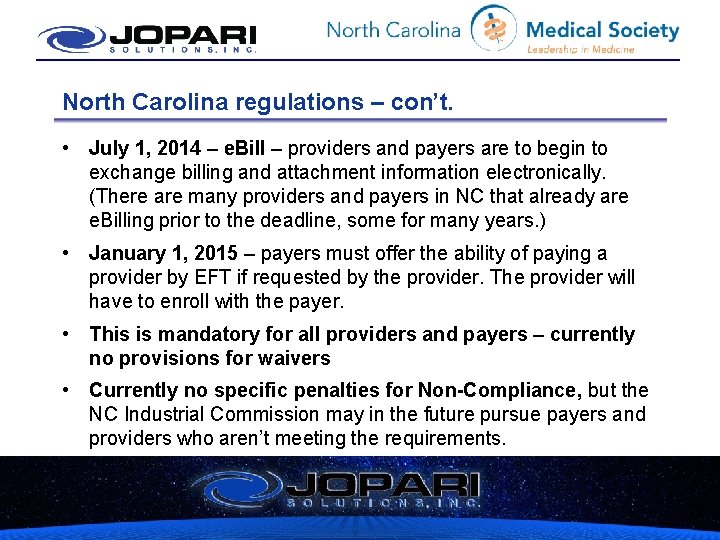
North Carolina regulations – con’t. • July 1, 2014 – e. Bill – providers and payers are to begin to exchange billing and attachment information electronically. (There are many providers and payers in NC that already are e. Billing prior to the deadline, some for many years. ) • January 1, 2015 – payers must offer the ability of paying a provider by EFT if requested by the provider. The provider will have to enroll with the payer. • This is mandatory for all providers and payers – currently no provisions for waivers • Currently no specific penalties for Non-Compliance, but the NC Industrial Commission may in the future pursue payers and providers who aren’t meeting the requirements.
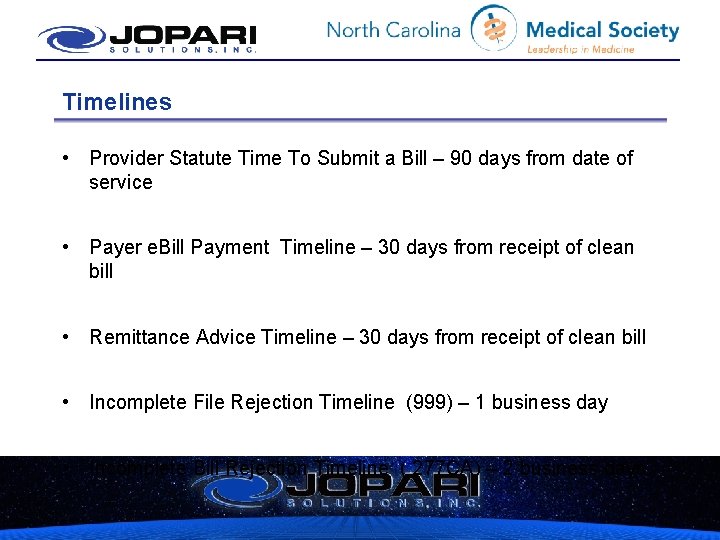
Timelines • Provider Statute Time To Submit a Bill – 90 days from date of service • Payer e. Bill Payment Timeline – 30 days from receipt of clean bill • Remittance Advice Timeline – 30 days from receipt of clean bill • Incomplete File Rejection Timeline (999) – 1 business day • Incomplete Bill Rejection Timeline ( 277 CA) – 2 business days
Timelines • Complete Bill Missing Claim Number Pending Timeline Rules – 5 days • Complete Bill Missing Attachment Pending Timeline Rules – 5 days • Duplicate Bill Submission Timeline from date of ERA notification - 60 days • Reconsideration/ Appeal Timeline date of ERA/Payer final decision – 30 days
Benefits of e. Billing • Eliminates paper distribution processes • Establishes electronic audit trail • Edits ensure that a complete bill package is delivered to the payer, reducing rejects for incomplete or missing data/attachments • If your practice can accept an 835, it should assist in posting and reconciliation processes • Typically providers see big improvements in their A/R metrics, fewer follow-up calls, and reduced need to resubmit bills* *This may not be the case for all payers
Most common methods available to utilize e. Billing • Direct e. Bill Portal – an option for providers that may not readily have access to be able to generate or send transactions via their system, or are low volume WC. Allows for entry of billing data and use of an upload of PDF or TIF images or fax server for attachments. These Portals allow for online correction, viewing error messages or rejects from payers, and viewing of Remittance Advice (835) information. • Online Portal Uploads – allows practices that can create billing files on their system to upload 837 or other formats to a portal when they cannot establish a link to a payer or e. Bill agent. Attachments can also be uploaded, either individually or in batches, or also use a fax server. Portal is used for viewing errors and retrieving Remittance Advice (835) information.
Most common methods available to utilize e. Billing • EDI interfaces - billing and attachment files are sent securely between the PMS/RCS or Clearinghouse and the payer or e. Bill agent. Acknowledgments, error messages, and Remittance Advice (835) information is exchanged electronically. This method requires some effort to get set-up and test, but for volume users this is the most efficient model. (Similar to the process for Group and Commercial payers. ) • Attachment Solutions – Flexibility for Trading Partner Agreements to include such methods as secure electronic fax, secure encrypted email, or electronic transmission using the prescribed format ASC X 12 N/005010 X 210 Additional Information to Support Health Care Claim (275), using mutually agreed upon formats such as PDFs, TIFFs, C-CDA, or Objects to accommodate PMS, EMR or other administrative systems
EFT – coming 1/1/2015 • Traditionally, payments for medically-related services by WC payers is to issue paper checks and Explanations of Reimbursement (EOR) via the USPS. Providers often manually post the information in their systems. • As of 1 -1 -2014, the Centers for Medicare/Medicaid Services (CMS) required Group/Commercial payers must offer providers the ability to enroll for and be paid via EFT. A set of Operating Rules for EFT and ERA have been issued by CAQH/CORE which further define how providers and payers interact. • The Workers’ Compensation industry is also now adopting the use of EFT.
EFT – coming 1/1/2015 • What to expect? – Just like in the Group market, you will likely have to enroll with each payer. – There will be some e. Bill solutions that will offer EFT enrollment across multiple payers
How to get started • Like any business problem, you need to have some basic information to find the right solution for your practice – How much WC do you handle? Number of bills per month, $$ billed, A/R and DSO attributed to WC, major payers you bill, and specific practice needs • Contact your Practice or Revenue Cycle Management System supplier, billing service, or Clearinghouse – Ask them if they have WC e. Billing capabilities, and who they are connected to as far as e. Bill agents. Be sure that they can get you to the majority of your key payers • Be sure you understand any contracting, upgrades, or costs associated with getting started
How to get started - more • Despite the mandate, you need to be ready that not all employers/payers will be ready on 7/1, and even for sometime after that – You may still need to send some bills via paper. Many WC solutions and e. Bill agents do offer Print & Mail capabilities so that you can make the workflow changes once, but you need to assess any costs to be sure it is the right strategy for your practice. • Decide on the solution and get implemented – For some solutions it may be a matter of days, for others there could be significant lead time, contracting, and/or add-on modules to buy. • Train your staff, monitor your results – This is a change of process, so you need to stay focused to ensure the right results
Some examples of e. Bill ready Provider Systems o o o o o Athena. Health Availity Capario Emdeon Passport Practice Insight SSI Systoc Zir. Med Payers ü ü ü Gallagher-Bassett Hartford Travelers Key Risk Liberty Mutual Zenith …. . and many, many more Systems and Payers
References • North Carolina Industrial Commission http: //www. ic. nc. gov/medproviders. html – NC Workers’ Comp E-bill Companion Guide www. ic. nc. gov/ncic/pages/EBPCguide. pdf • North Carolina Medical Society http: //www. ncmedsoc. org • American Medical Association – Property & Casualty Toolkit http: //www. ama-assn. org/ama/pub/advocacy/topics/administrativesimplification-initiatives/electronic-transactions-toolkit/workerscompensation. page • WEDI Property & Casualty Workgroup – e. Bill Educational Resource Tools http: //www. wedi. org/workgroups/transactions-codesets/property-casualty-electronic-medical-bill-(ebill) • Jopari Solutions, Inc. www. jopari. com

Questions ? The North Carolina Medical Society always welcomes questions about the e. Billing transition or about finding an e. Billing solution. Please contact Conor Brockett at (919) 833 -3836 or CBrockett@ncmedsoc. org.
- Slides: 25