
North Carolina MSW Management Tonnage and Trends Debra
North Carolina MSW Management: Tonnage and Trends Debra L. Kantner Bryan Staley, Ph. D PE Data & Policy Program Manager President and CEO
EREF Programs 1. Research Grants 2. Scholarships 3. Education 4. Data & Policy Analysis (Internal Research)
Talk Overview Waste Generation and Management in the U. S. • Study Premise & Methodology • National Results Facilities and Tonnage N. C. Waste Management by End Point • • • Landfilling Recycling Waste-to-Energy (incineration w/ energy recovery) Composting Anaerobic Digestion Summary

Study Premise & Methodology
Existing Waste Data • U. S. EPA Solid Waste Facts & Figures – materials flow analysis based on production, import/export – makes various assumptions (e. g. time before discard) – minimal reliance on actual waste management facility data • Biocycle State of Garbage Report – last published in 2010 (using 2008 data) but discontinued • 2011 data available in Master’s thesis – primarily based on state agency data • recycling & composting data held by states is incomplete
Study Objectives Goal: Create a national inventory of U. S. MSW generation 1) Evaluate relative fractions of materials going to: • • • Landfills Recycling Facilities Waste-to-energy Facilities Composting Operations Anaerobic Digestion 2) Understand materials flow dynamics related to: • Recycling • Composting • Anaerobic digestion
Methodology Overview • Facility based, ‘bottom up’ approach • Facility lists generated first • Key data (e. g. tonnage) acquired via: – State agencies and other databases where data deemed reliable (e. g. landfills) – Direct contact with facility • Data adjusted to account for potential sources of error – Facilities only handling non-MSW materials – Non-MSW materials/organics (e. g. agricultural biomass) – Front-of-gate vs. processed tonnage
Waste Management National Picture
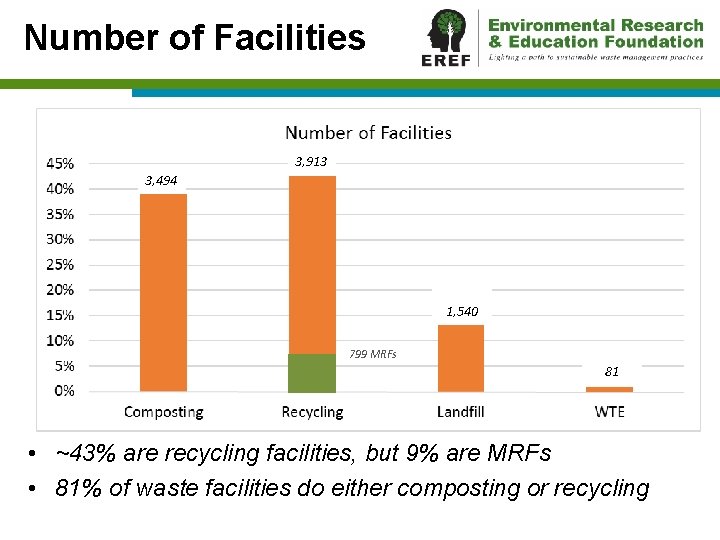
Number of Facilities 3, 913 3, 494 1, 540 799 MRFs 81 • ~43% are recycling facilities, but 9% are MRFs • 81% of waste facilities do either composting or recycling
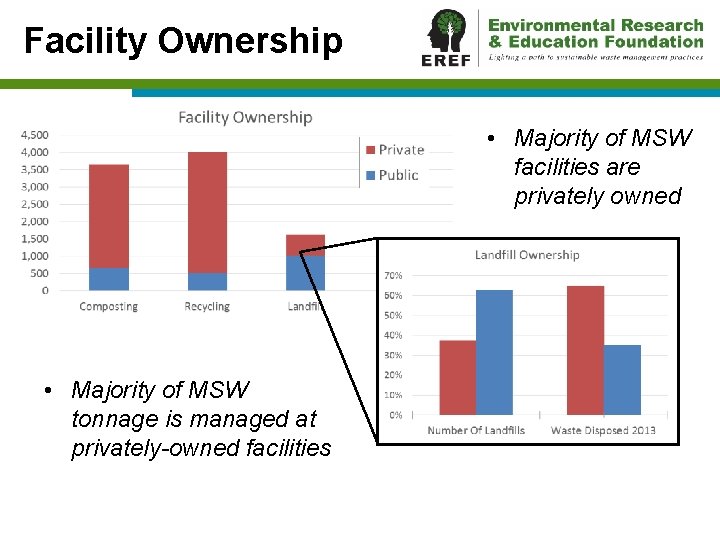
Facility Ownership • Majority of MSW facilities are privately owned • Majority of MSW tonnage is managed at privately-owned facilities
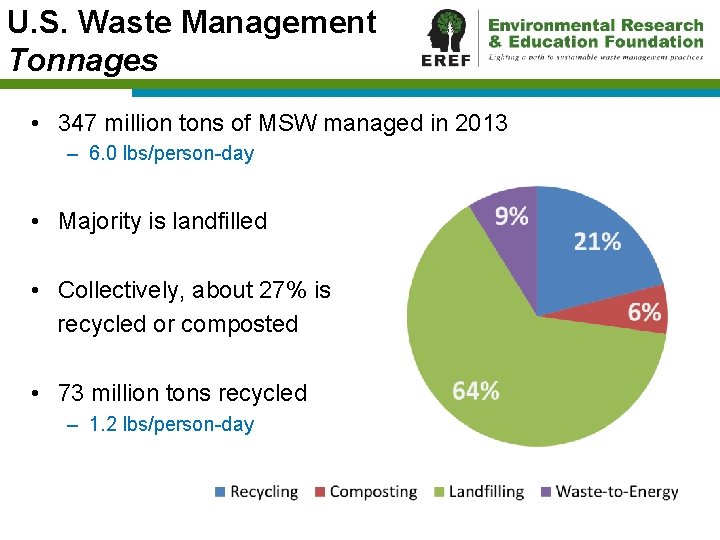
U. S. Waste Management Tonnages • 347 million tons of MSW managed in 2013 – 6. 0 lbs/person-day • Majority is landfilled • Collectively, about 27% is recycled or composted • 73 million tons recycled – 1. 2 lbs/person-day
North Carolina MSW Management
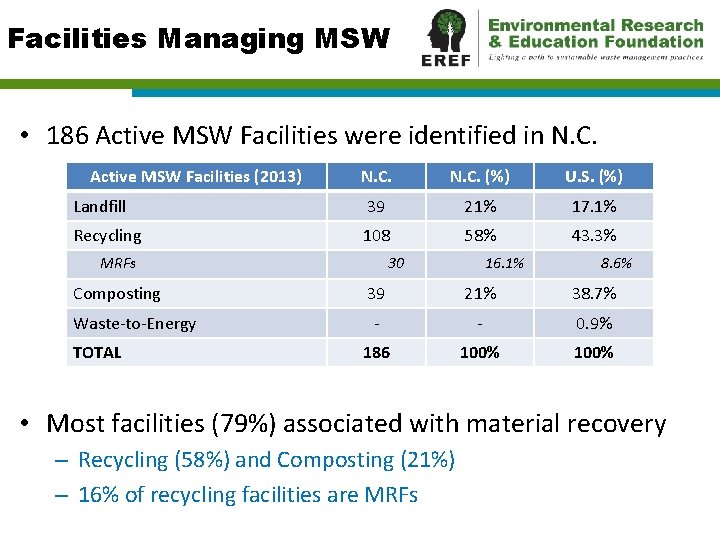
Facilities Managing MSW • 186 Active MSW Facilities were identified in N. C. Active MSW Facilities (2013) N. C. (%) U. S. (%) Landfill 39 21% 17. 1% Recycling 108 58% 43. 3% MRFs Composting Waste-to-Energy TOTAL 30 16. 1% 8. 6% 39 21% 38. 7% - - 0. 9% 186 100% • Most facilities (79%) associated with material recovery – Recycling (58%) and Composting (21%) – 16% of recycling facilities are MRFs
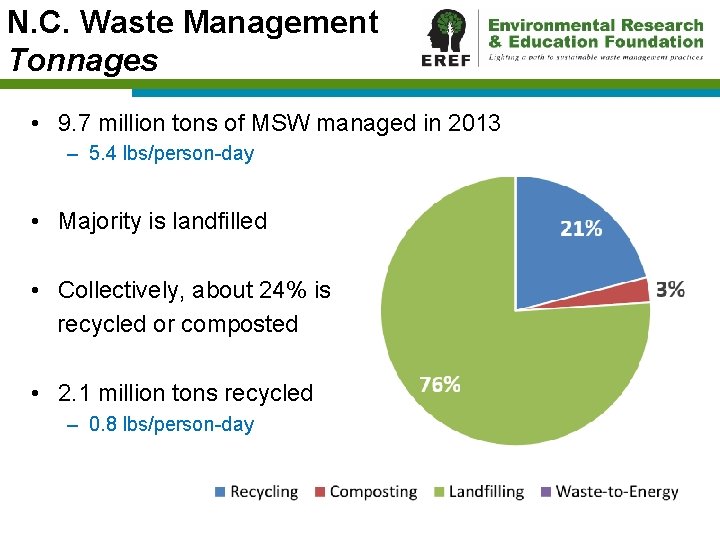
N. C. Waste Management Tonnages • 9. 7 million tons of MSW managed in 2013 – 5. 4 lbs/person-day • Majority is landfilled • Collectively, about 24% is recycled or composted • 2. 1 million tons recycled – 0. 8 lbs/person-day
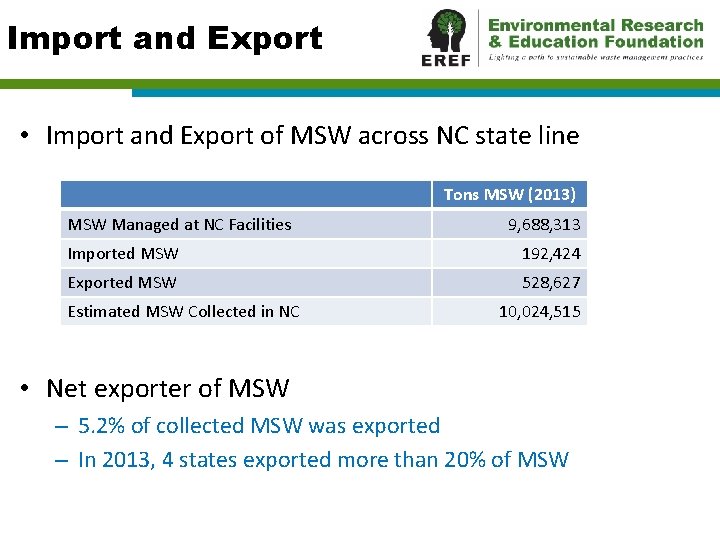
Import and Export • Import and Export of MSW across NC state line Tons MSW (2013) MSW Managed at NC Facilities 9, 688, 313 Imported MSW 192, 424 Exported MSW 528, 627 Estimated MSW Collected in NC 10, 024, 515 • Net exporter of MSW – 5. 2% of collected MSW was exported – In 2013, 4 states exported more than 20% of MSW

Landfilling
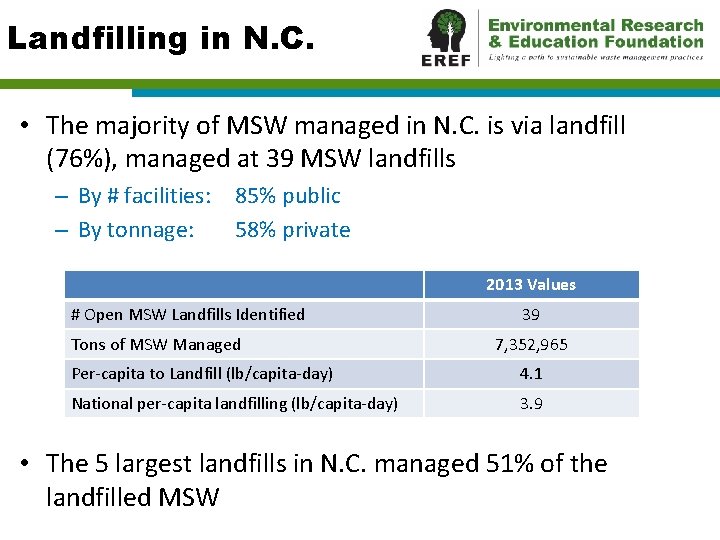
Landfilling in N. C. • The majority of MSW managed in N. C. is via landfill (76%), managed at 39 MSW landfills – By # facilities: 85% public – By tonnage: 58% private 2013 Values # Open MSW Landfills Identified Tons of MSW Managed 39 7, 352, 965 Per-capita to Landfill (lb/capita-day) 4. 1 National per-capita landfilling (lb/capita-day) 3. 9 • The 5 largest landfills in N. C. managed 51% of the landfilled MSW
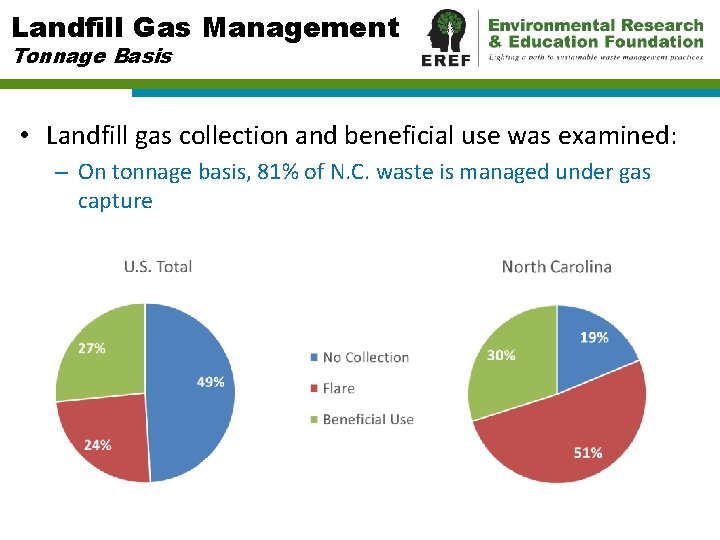
Landfill Gas Management Tonnage Basis • Landfill gas collection and beneficial use was examined: – On tonnage basis, 81% of N. C. waste is managed under gas capture

Recycling
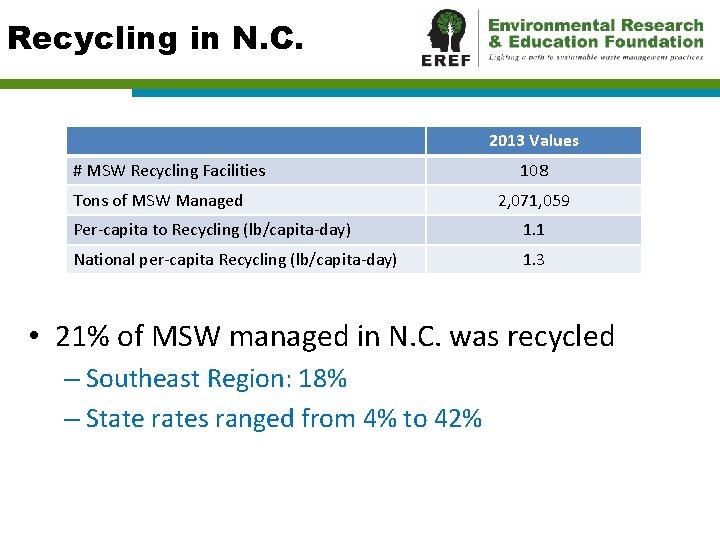
Recycling in N. C. 2013 Values # MSW Recycling Facilities Tons of MSW Managed 108 2, 071, 059 Per-capita to Recycling (lb/capita-day) 1. 1 National per-capita Recycling (lb/capita-day) 1. 3 • 21% of MSW managed in N. C. was recycled – Southeast Region: 18% – State rates ranged from 4% to 42%
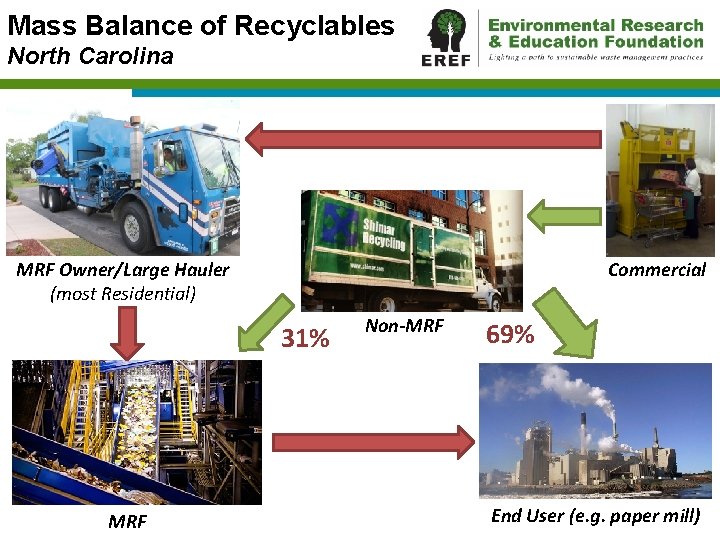
Mass Balance of Recyclables North Carolina MRF Owner/Large Hauler (most Residential) Commercial 31% MRF Non-MRF 69% End User (e. g. paper mill)
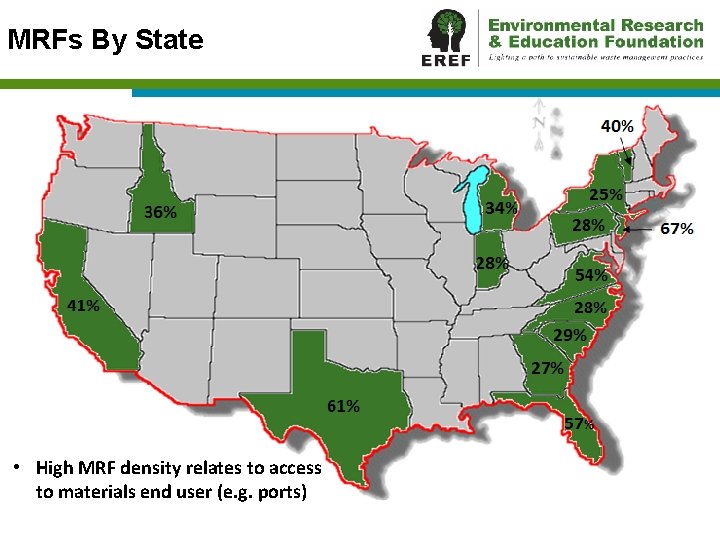
MRFs By State • High MRF density relates to access to materials end user (e. g. ports)
Recycling Facility Residual Generation • Current rate (EREF, 2013) = 12% – Range: 3% to 51% • Previous rate (Berenyi, 2007) = 7% – Range: 3% to 11% (source separated) (single stream) • Residual rate nearly doubled in last 7 yrs – Variability appears to be much higher – Likely to due increase in single stream, acceptance of more materials, etc.
Waste-to-Energy (Incineration w/ energy recovery)
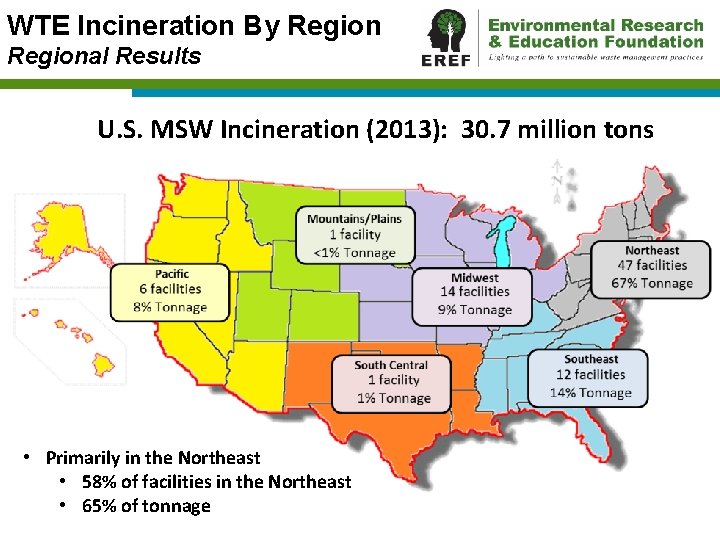
WTE Incineration By Regional Results U. S. MSW Incineration (2013): 30. 7 million tons • Primarily in the Northeast • 58% of facilities in the Northeast • 65% of tonnage

Composting
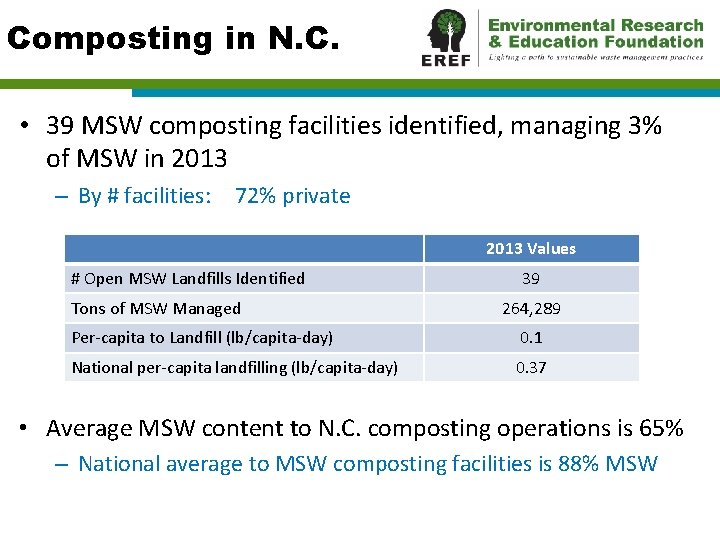
Composting in N. C. • 39 MSW composting facilities identified, managing 3% of MSW in 2013 – By # facilities: 72% private 2013 Values # Open MSW Landfills Identified Tons of MSW Managed 39 264, 289 Per-capita to Landfill (lb/capita-day) 0. 1 National per-capita landfilling (lb/capita-day) 0. 37 • Average MSW content to N. C. composting operations is 65% – National average to MSW composting facilities is 88% MSW
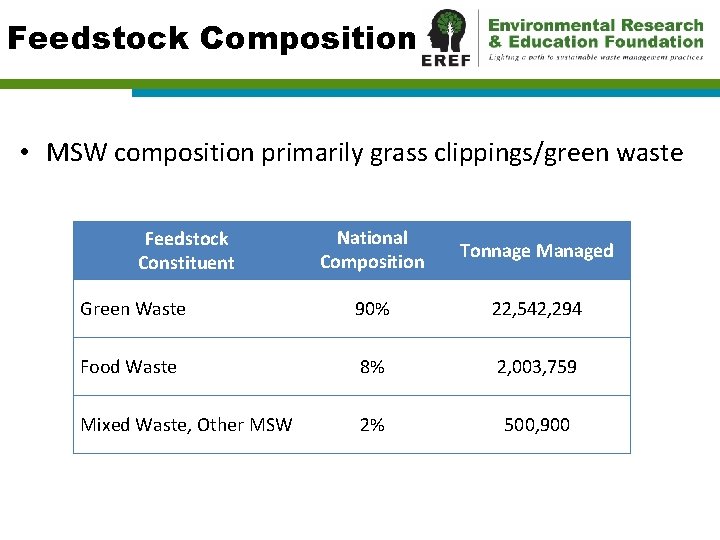
Feedstock Composition • MSW composition primarily grass clippings/green waste National Composition Tonnage Managed Green Waste 90% 22, 542, 294 Food Waste 8% 2, 003, 759 Mixed Waste, Other MSW 2% 500, 900 Feedstock Constituent
Anaerobic Digestion
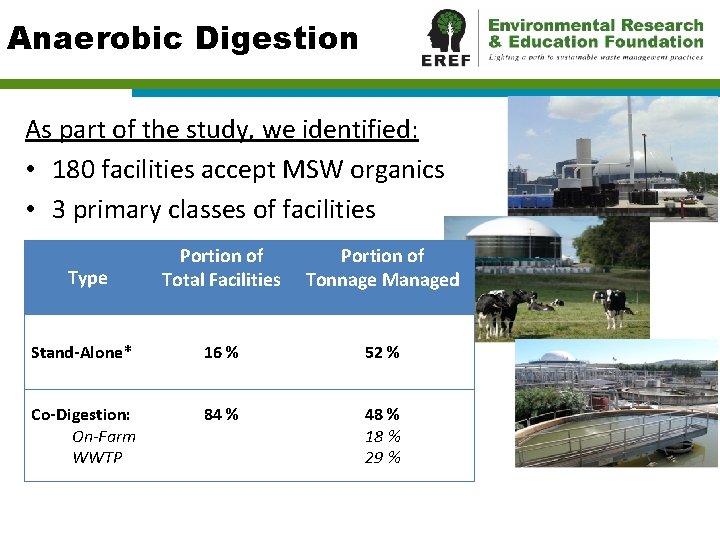
Anaerobic Digestion As part of the study, we identified: • 180 facilities accept MSW organics • 3 primary classes of facilities Portion of Total Facilities Portion of Tonnage Managed Stand-Alone* 16 % 52 % Co-Digestion: On-Farm WWTP 84 % 48 % 18 % 29 % Type
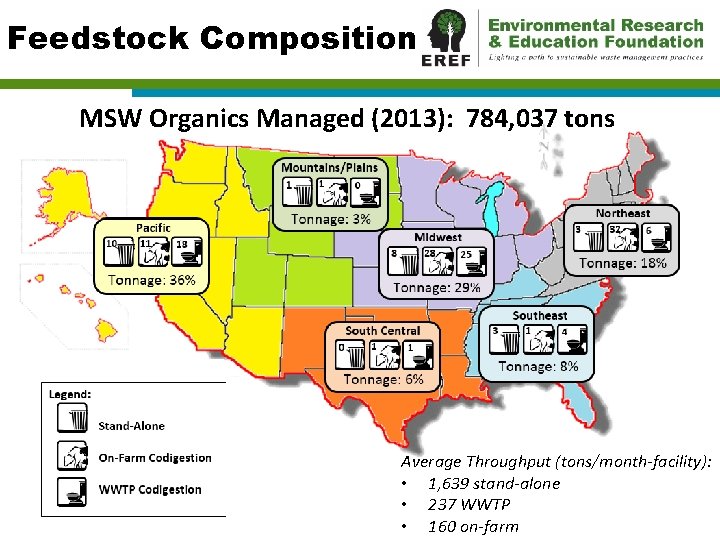
Feedstock Composition MSW Organics Managed (2013): 784, 037 tons Average Throughput (tons/month-facility): • 1, 639 stand-alone • 237 WWTP • 160 on-farm
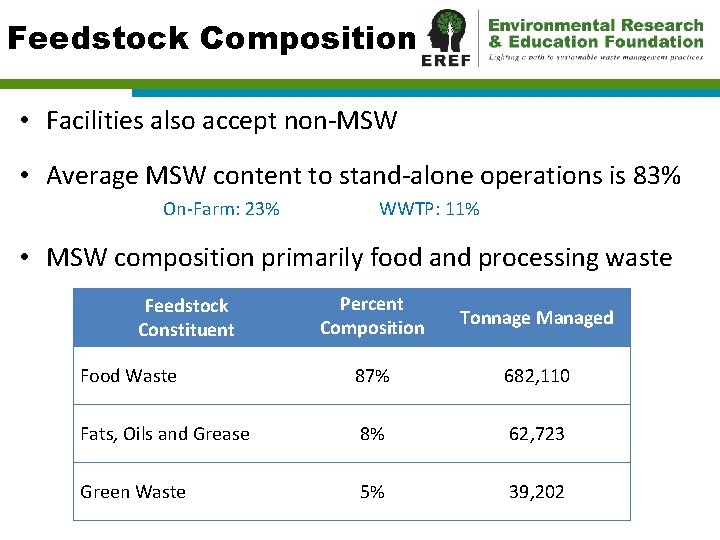
Feedstock Composition • Facilities also accept non-MSW • Average MSW content to stand-alone operations is 83% On-Farm: 23% WWTP: 11% • MSW composition primarily food and processing waste Percent Composition Tonnage Managed Food Waste 87% 682, 110 Fats, Oils and Grease 8% 62, 723 Green Waste 5% 39, 202 Feedstock Constituent
Summary
Key Take Aways • Landfilling continues to be the primary way MSW is managed • Recycling infrastructure includes variety of facilities in addition to traditional MRFs • Organics management is a focus: – Composting increasing, primarily managing yard waste – Anaerobic Digestion growing, handle food waste
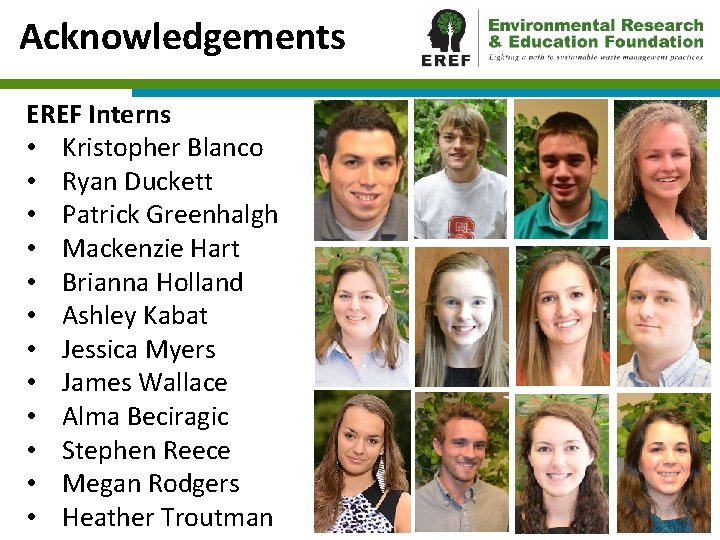
Acknowledgements EREF Interns • Kristopher Blanco • Ryan Duckett • Patrick Greenhalgh • Mackenzie Hart • Brianna Holland • Ashley Kabat • Jessica Myers • James Wallace • Alma Beciragic • Stephen Reece • Megan Rodgers • Heather Troutman

Thank you! Debra Kantner dkantner@erefdn. org www. erefdn. org From the EREF Data & Policy Report: MSW Management in the U. S. : 2010 & 2013 Proceeds are used to provide college internships!
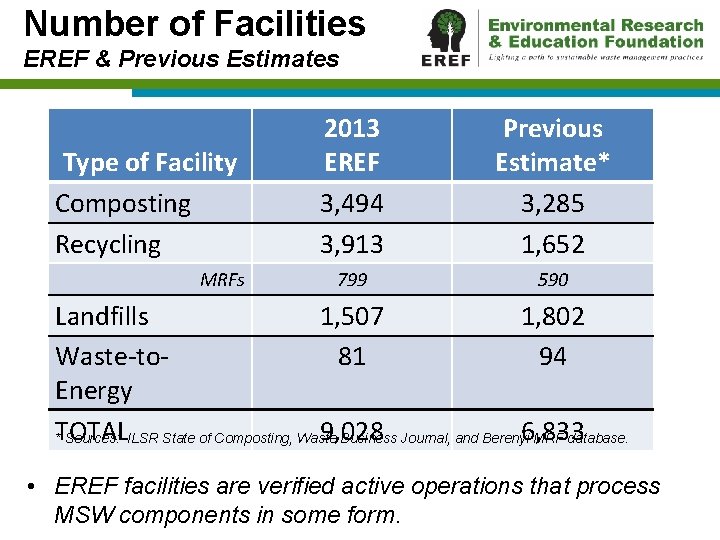
Number of Facilities EREF & Previous Estimates Type of Facility Composting Recycling MRFs 2013 EREF 3, 494 3, 913 Previous Estimate* 3, 285 1, 652 799 590 Landfills 1, 507 1, 802 Waste-to 81 94 Energy TOTAL 9, 028 6, 833 * Sources: ILSR State of Composting, Waste Business Journal, and Berenyi MRF database. • EREF facilities are verified active operations that process MSW components in some form.
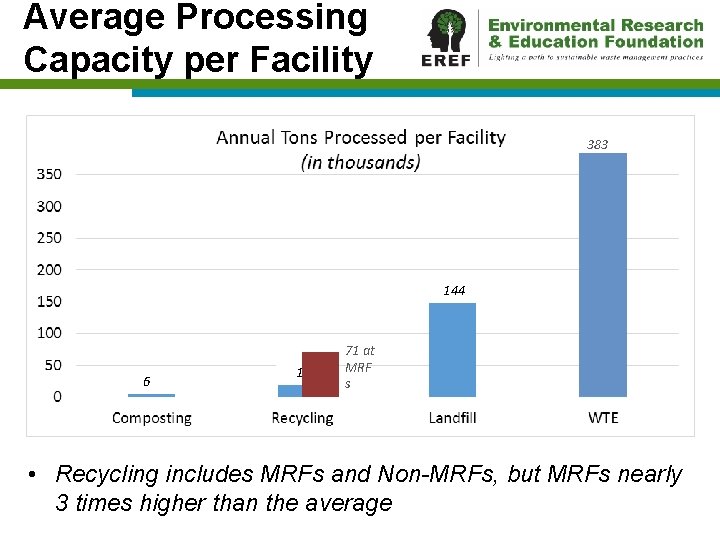
Average Processing Capacity per Facility 383 144 6 18 71 at MRF s • Recycling includes MRFs and Non-MRFs, but MRFs nearly 3 times higher than the average
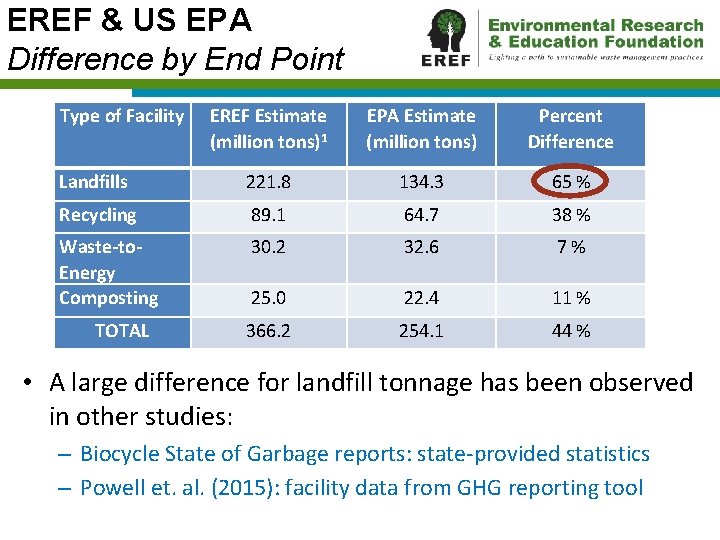
EREF & US EPA Difference by End Point Type of Facility EREF Estimate (million tons)1 EPA Estimate (million tons) Percent Difference Landfills 221. 8 134. 3 65 % Recycling 89. 1 64. 7 38 % Waste-to. Energy Composting 30. 2 32. 6 7% 25. 0 22. 4 11 % 366. 2 254. 1 44 % TOTAL • A large difference for landfill tonnage has been observed in other studies: – Biocycle State of Garbage reports: state-provided statistics – Powell et. al. (2015): facility data from GHG reporting tool
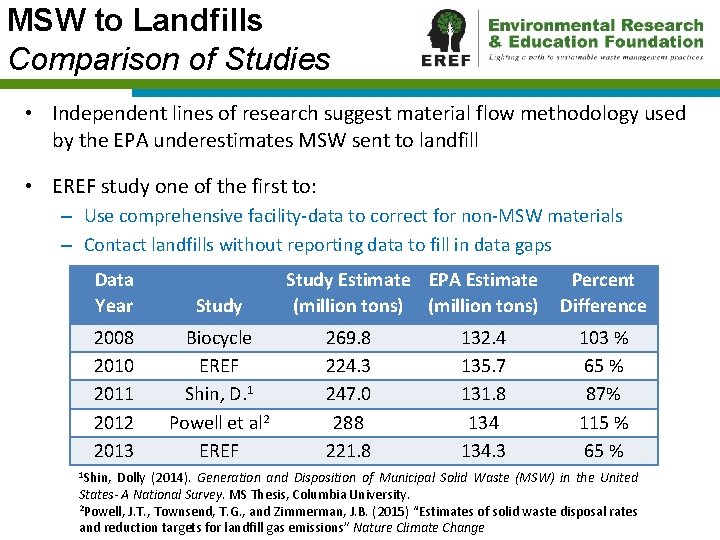
MSW to Landfills Comparison of Studies • Independent lines of research suggest material flow methodology used by the EPA underestimates MSW sent to landfill • EREF study one of the first to: – Use comprehensive facility-data to correct for non-MSW materials – Contact landfills without reporting data to fill in data gaps Data Year Study 2008 2010 2011 2012 2013 Biocycle EREF Shin, D. 1 Powell et al 2 EREF 1 Shin, Study Estimate EPA Estimate (million tons) 269. 8 224. 3 247. 0 288 221. 8 132. 4 135. 7 131. 8 134. 3 Percent Difference 103 % 65 % 87% 115 % 65 % Dolly (2014). Generation and Disposition of Municipal Solid Waste (MSW) in the United States- A National Survey. MS Thesis, Columbia University. 2 Powell, J. T. , Townsend, T. G. , and Zimmerman, J. B. (2015) “Estimates of solid waste disposal rates and reduction targets for landfill gas emissions” Nature Climate Change
- Slides: 41