
North Carolina History Timeline Wax Museum Educating students
- Slides: 24
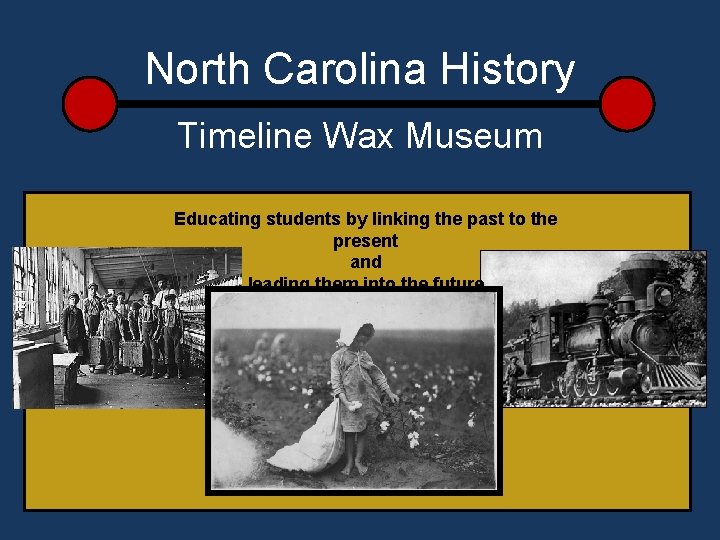
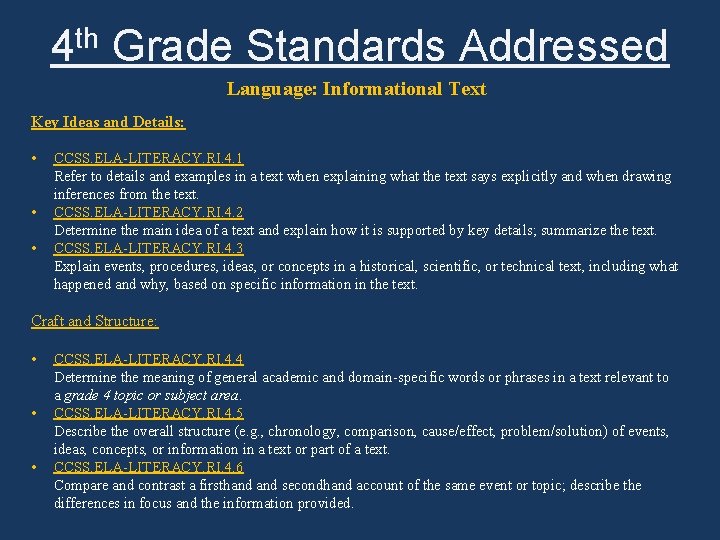
North Carolina History Timeline Wax Museum Educating students by linking the past to the present and leading them into the future
Purpose For students to gain knowledge about history, ranging from Pre-Colonial times to the present, addressing the following areas: • People • Major Events • Major Conflicts • Inventions/Technology • Agriculture/Industries • Change/Growth • Transportation • Government
4 th Grade Standards Addressed Language: Informational Text Key Ideas and Details: • • • CCSS. ELA-LITERACY. RI. 4. 1 Refer to details and examples in a text when explaining what the text says explicitly and when drawing inferences from the text. CCSS. ELA-LITERACY. RI. 4. 2 Determine the main idea of a text and explain how it is supported by key details; summarize the text. CCSS. ELA-LITERACY. RI. 4. 3 Explain events, procedures, ideas, or concepts in a historical, scientific, or technical text, including what happened and why, based on specific information in the text. Craft and Structure: • • • CCSS. ELA-LITERACY. RI. 4. 4 Determine the meaning of general academic and domain-specific words or phrases in a text relevant to a grade 4 topic or subject area. CCSS. ELA-LITERACY. RI. 4. 5 Describe the overall structure (e. g. , chronology, comparison, cause/effect, problem/solution) of events, ideas, concepts, or information in a text or part of a text. CCSS. ELA-LITERACY. RI. 4. 6 Compare and contrast a firsthand secondhand account of the same event or topic; describe the differences in focus and the information provided.
Integration of Knowledge and Ideas: • • • CCSS. ELA-LITERACY. RI. 4. 7 Interpret information presented visually, or quantitatively (e. g. , in charts, graphs, diagrams, time lines, animations, or interactive elements on Web pages) and explain how the information contributes to an understanding of the text in which it appears. CCSS. ELA-LITERACY. RI. 4. 8 Explain how an author uses reasons and evidence to support particular points in a text. CCSS. ELA-LITERACY. RI. 4. 9 Integrate information from two texts on the same topic in order to write or speak about the subject knowledgeably. Range of Reading and Level of Text Complexity: • CCSS. ELA-LITERACY. RI. 4. 10 By the end of year, read and comprehend informational texts, including history/social studies, science, and technical texts, in the grades 4 -5 text complexity band proficiently, with scaffolding as needed at the high end of the range. Fluency: • • • CCSS. ELA-LITERACY. RF. 4. 4 Read with sufficient accuracy and fluency to support comprehension. CCSS. ELA-LITERACY. RF. 4. 4. A Read grade-level text with purpose and understanding. CCSS. ELA-LITERACY. RF. 4. 4. C Use context to confirm or self-correct word recognition and understanding, rereading as necessary
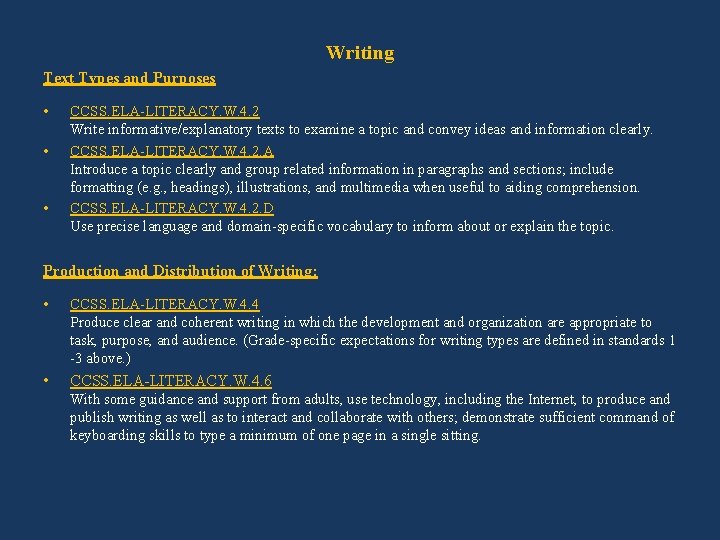
Writing Text Types and Purposes • • • CCSS. ELA-LITERACY. W. 4. 2 Write informative/explanatory texts to examine a topic and convey ideas and information clearly. CCSS. ELA-LITERACY. W. 4. 2. A Introduce a topic clearly and group related information in paragraphs and sections; include formatting (e. g. , headings), illustrations, and multimedia when useful to aiding comprehension. CCSS. ELA-LITERACY. W. 4. 2. D Use precise language and domain-specific vocabulary to inform about or explain the topic. Production and Distribution of Writing: • CCSS. ELA-LITERACY. W. 4. 4 Produce clear and coherent writing in which the development and organization are appropriate to task, purpose, and audience. (Grade-specific expectations for writing types are defined in standards 1 -3 above. ) • CCSS. ELA-LITERACY. W. 4. 6 With some guidance and support from adults, use technology, including the Internet, to produce and publish writing as well as to interact and collaborate with others; demonstrate sufficient command of keyboarding skills to type a minimum of one page in a single sitting.
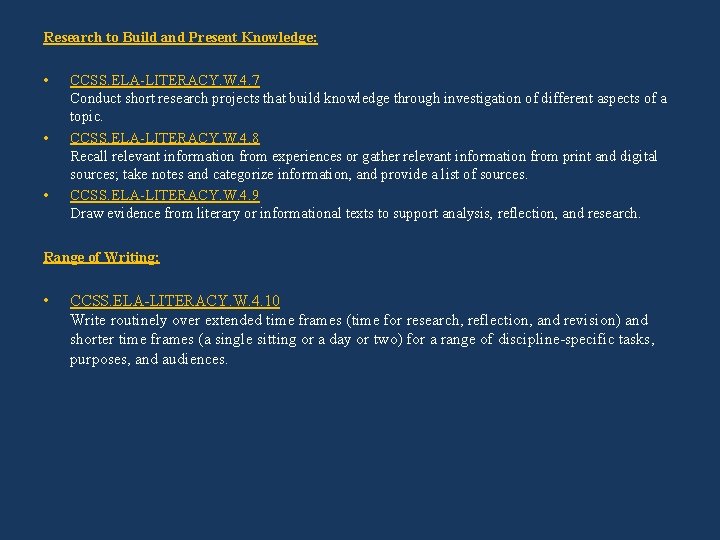
Research to Build and Present Knowledge: • • • CCSS. ELA-LITERACY. W. 4. 7 Conduct short research projects that build knowledge through investigation of different aspects of a topic. CCSS. ELA-LITERACY. W. 4. 8 Recall relevant information from experiences or gather relevant information from print and digital sources; take notes and categorize information, and provide a list of sources. CCSS. ELA-LITERACY. W. 4. 9 Draw evidence from literary or informational texts to support analysis, reflection, and research. Range of Writing: • CCSS. ELA-LITERACY. W. 4. 10 Write routinely over extended time frames (time for research, reflection, and revision) and shorter time frames (a single sitting or a day or two) for a range of discipline-specific tasks, purposes, and audiences.
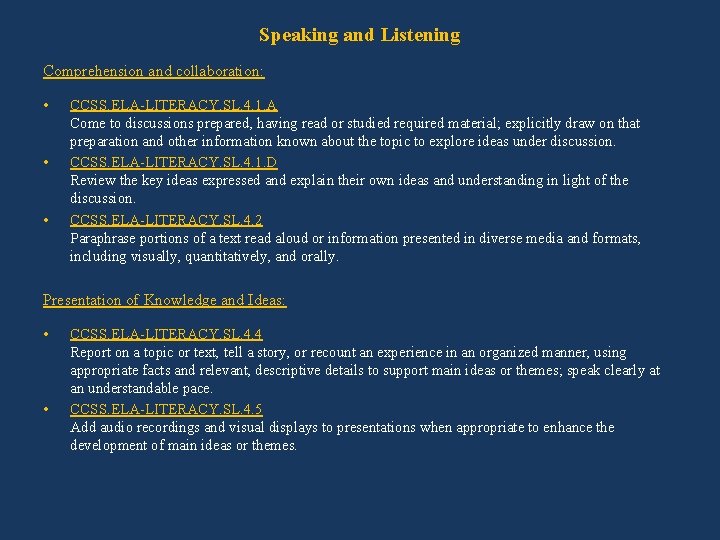
Speaking and Listening Comprehension and collaboration: • • • CCSS. ELA-LITERACY. SL. 4. 1. A Come to discussions prepared, having read or studied required material; explicitly draw on that preparation and other information known about the topic to explore ideas under discussion. CCSS. ELA-LITERACY. SL. 4. 1. D Review the key ideas expressed and explain their own ideas and understanding in light of the discussion. CCSS. ELA-LITERACY. SL. 4. 2 Paraphrase portions of a text read aloud or information presented in diverse media and formats, including visually, quantitatively, and orally. Presentation of Knowledge and Ideas: • • CCSS. ELA-LITERACY. SL. 4. 4 Report on a topic or text, tell a story, or recount an experience in an organized manner, using appropriate facts and relevant, descriptive details to support main ideas or themes; speak clearly at an understandable pace. CCSS. ELA-LITERACY. SL. 4. 5 Add audio recordings and visual displays to presentations when appropriate to enhance the development of main ideas or themes.
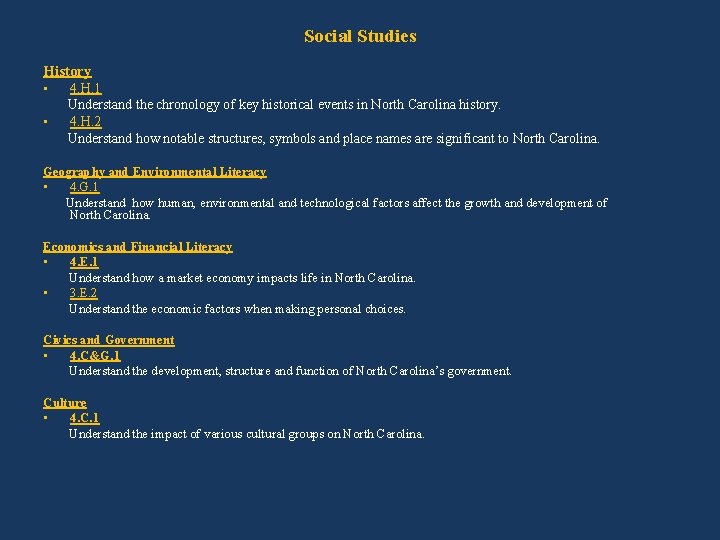
Social Studies History • 4. H. 1 • Understand the chronology of key historical events in North Carolina history. 4. H. 2 Understand how notable structures, symbols and place names are significant to North Carolina. Geography and Environmental Literacy • 4. G. 1 Understand how human, environmental and technological factors affect the growth and development of North Carolina. Economics and Financial Literacy • 4. E. 1 Understand how a market economy impacts life in North Carolina. • 3. E. 2 Understand the economic factors when making personal choices. Civics and Government • 4. C&G. 1 Understand the development, structure and function of North Carolina’s government. Culture • 4. C. 1 Understand the impact of various cultural groups on North Carolina.
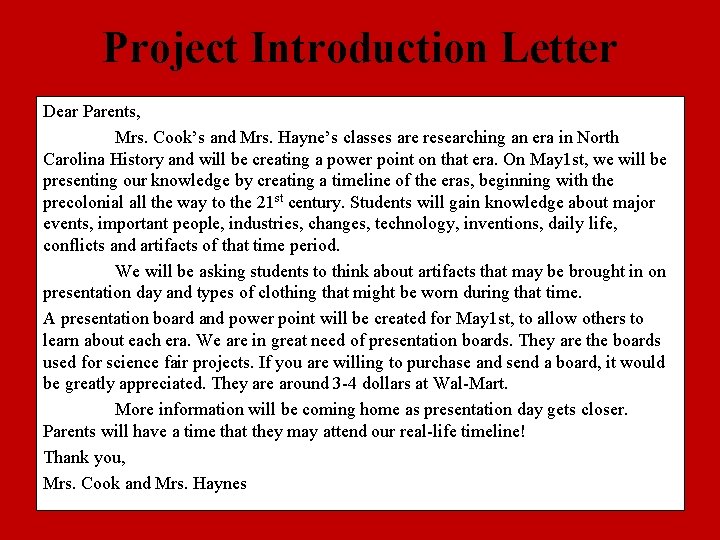
Project Introduction Letter Dear Parents, Mrs. Cook’s and Mrs. Hayne’s classes are researching an era in North Carolina History and will be creating a power point on that era. On May 1 st, we will be presenting our knowledge by creating a timeline of the eras, beginning with the precolonial all the way to the 21 st century. Students will gain knowledge about major events, important people, industries, changes, technology, inventions, daily life, conflicts and artifacts of that time period. We will be asking students to think about artifacts that may be brought in on presentation day and types of clothing that might be worn during that time. A presentation board and power point will be created for May 1 st, to allow others to learn about each era. We are in great need of presentation boards. They are the boards used for science fair projects. If you are willing to purchase and send a board, it would be greatly appreciated. They are around 3 -4 dollars at Wal-Mart. More information will be coming home as presentation day gets closer. Parents will have a time that they may attend our real-life timeline! Thank you, Mrs. Cook and Mrs. Haynes
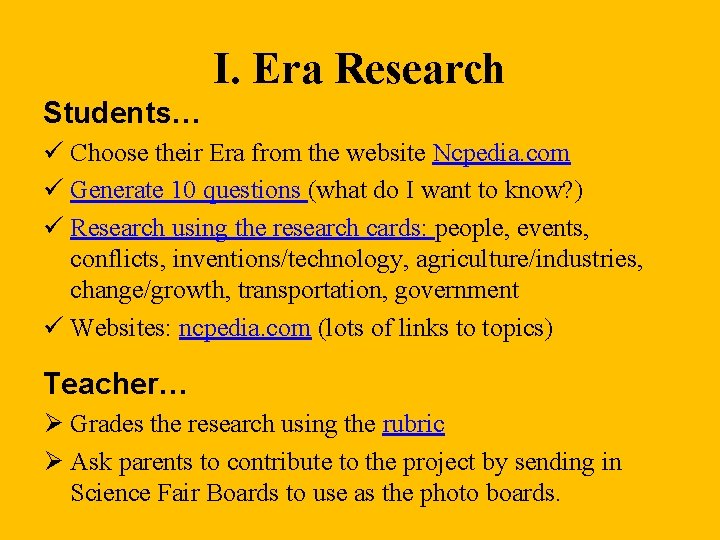
I. Era Research Students… ü Choose their Era from the website Ncpedia. com ü Generate 10 questions (what do I want to know? ) ü Research using the research cards: people, events, conflicts, inventions/technology, agriculture/industries, change/growth, transportation, government ü Websites: ncpedia. com (lots of links to topics) Teacher… Ø Grades the research using the rubric Ø Ask parents to contribute to the project by sending in Science Fair Boards to use as the photo boards.
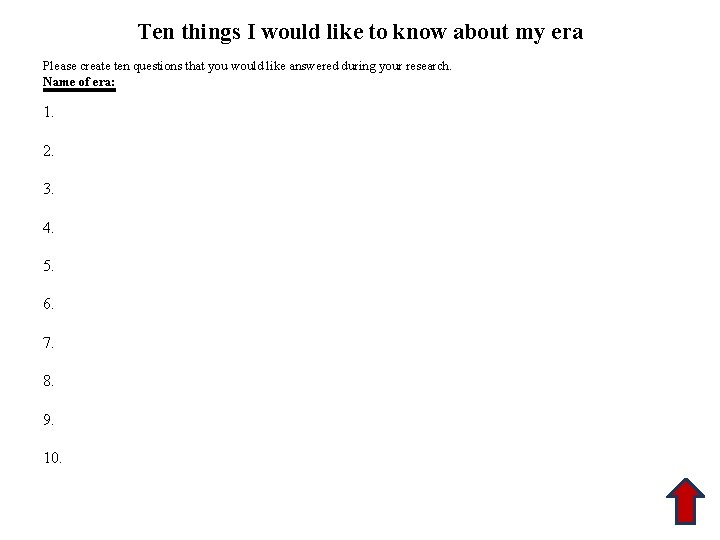
Ten things I would like to know about my era Please create ten questions that you would like answered during your research. Name of era: 1. 2. 3. 4. 5. 6. 7. 8. 9. 10.
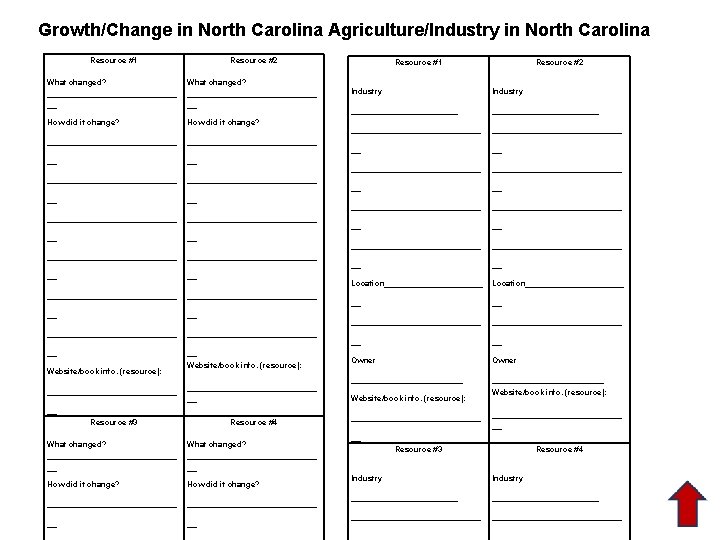
Growth/Change in North Carolina Agriculture/Industry in North Carolina Resource #1 Resource #2 What changed? _____________________________ __ How did it change? _____________________________ _____________________________ __ __ _____________________________ __ __ Website/book info. (resource): _____________________________ __ __ Resource #3 Resource #4 What changed? _____________________________ __ How did it change? _____________________________ __ __ Resource #1 Resource #2 Industry _____________________________________________________ _______________________________ __ __ Location______________________ _____________________________ __ __ Owner _________________________ Website/book info. (resource): _____________________________ __ __ Resource #3 Resource #4 Industry _____________________________ __ __
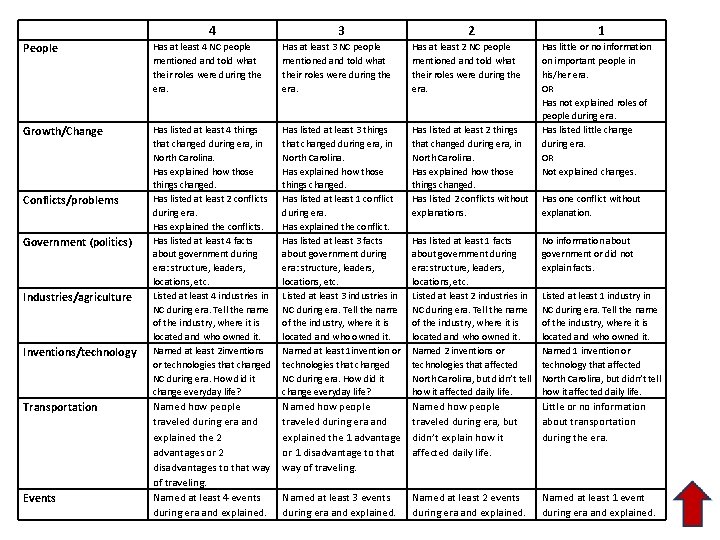
4 3 2 1 People Has at least 4 NC people mentioned and told what their roles were during the era. Has at least 3 NC people mentioned and told what their roles were during the era. Has at least 2 NC people mentioned and told what their roles were during the era. Growth/Change Has listed at least 4 things that changed during era, in North Carolina. Has explained how those things changed. Has listed at least 2 conflicts during era. Has explained the conflicts. Has listed at least 4 facts about government during era: structure, leaders, locations, etc. Listed at least 4 industries in NC during era. Tell the name of the industry, where it is located and who owned it. Named at least 2 inventions or technologies that changed NC during era. How did it change everyday life? Has listed at least 3 things that changed during era, in North Carolina. Has explained how those things changed. Has listed at least 1 conflict during era. Has explained the conflict. Has listed at least 3 facts about government during era: structure, leaders, locations, etc. Listed at least 3 industries in NC during era. Tell the name of the industry, where it is located and who owned it. Named at least 1 invention or technologies that changed NC during era. How did it change everyday life? Has listed at least 2 things that changed during era, in North Carolina. Has explained how those things changed. Has listed 2 conflicts without explanations. Has listed at least 1 facts about government during era: structure, leaders, locations, etc. Listed at least 2 industries in NC during era. Tell the name of the industry, where it is located and who owned it. Named 2 inventions or technologies that affected North Carolina, but didn’t tell how it affected daily life. No information about government or did not explain facts. Named how people traveled during era and explained the 2 advantages or 2 disadvantages to that way of traveling. Named at least 4 events during era and explained. Named how people traveled during era and explained the 1 advantage or 1 disadvantage to that way of traveling. Named how people traveled during era, but didn’t explain how it affected daily life. Little or no information about transportation during the era. Named at least 3 events during era and explained. Named at least 2 events during era and explained. Named at least 1 event during era and explained. Conflicts/problems Government (politics) Industries/agriculture Inventions/technology Transportation Events Has little or no information on important people in his/her era. OR Has not explained roles of people during era. Has listed little change during era. OR Not explained changes. Has one conflict without explanation. Listed at least 1 industry in NC during era. Tell the name of the industry, where it is located and who owned it. Named 1 invention or technology that affected North Carolina, but didn’t tell how it affected daily life.
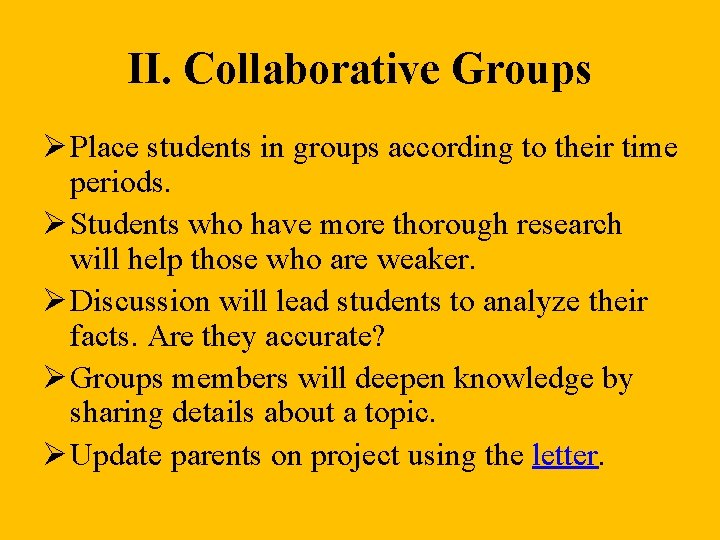
II. Collaborative Groups Ø Place students in groups according to their time periods. Ø Students who have more thorough research will help those who are weaker. Ø Discussion will lead students to analyze their facts. Are they accurate? Ø Groups members will deepen knowledge by sharing details about a topic. Ø Update parents on project using the letter.
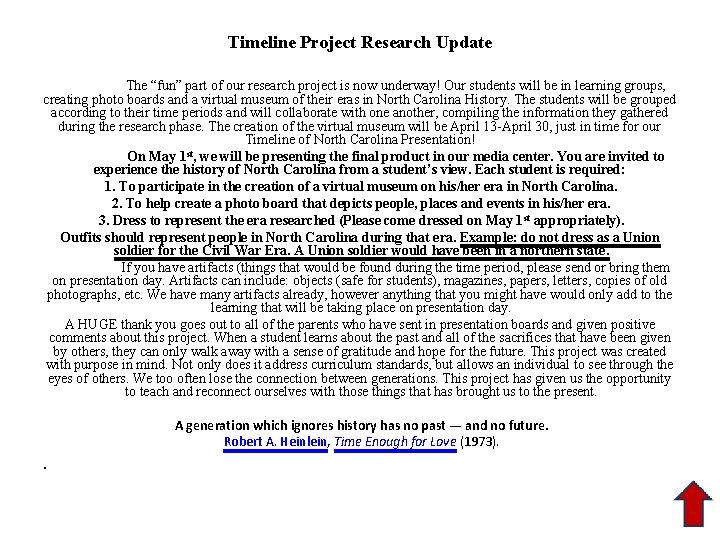
Timeline Project Research Update The “fun” part of our research project is now underway! Our students will be in learning groups, creating photo boards and a virtual museum of their eras in North Carolina History. The students will be grouped according to their time periods and will collaborate with one another, compiling the information they gathered during the research phase. The creation of the virtual museum will be April 13 -April 30, just in time for our Timeline of North Carolina Presentation! st On May 1 , we will be presenting the final product in our media center. You are invited to experience the history of North Carolina from a student’s view. Each student is required: 1. To participate in the creation of a virtual museum on his/her era in North Carolina. 2. To help create a photo board that depicts people, places and events in his/her era. 3. Dress to represent the era researched (Please come dressed on May 1 st appropriately). Outfits should represent people in North Carolina during that era. Example: do not dress as a Union soldier for the Civil War Era. A Union soldier would have been in a northern state. If you have artifacts (things that would be found during the time period, please send or bring them on presentation day. Artifacts can include: objects (safe for students), magazines, papers, letters, copies of old photographs, etc. We have many artifacts already, however anything that you might have would only add to the learning that will be taking place on presentation day. A HUGE thank you goes out to all of the parents who have sent in presentation boards and given positive comments about this project. When a student learns about the past and all of the sacrifices that have been given by others, they can only walk away with a sense of gratitude and hope for the future. This project was created with purpose in mind. Not only does it address curriculum standards, but allows an individual to see through the eyes of others. We too often lose the connection between generations. This project has given us the opportunity to teach and reconnect ourselves with those things that has brought us to the present. A generation which ignores history has no past — and no future. Robert A. Heinlein, Time Enough for Love (1973). •
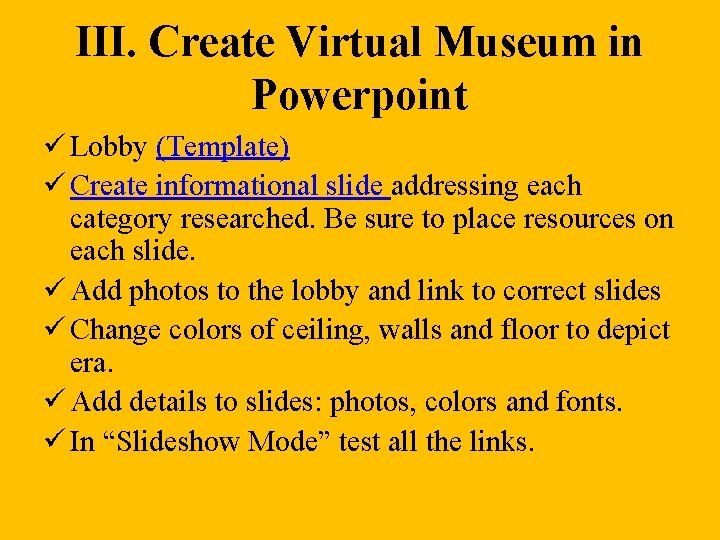
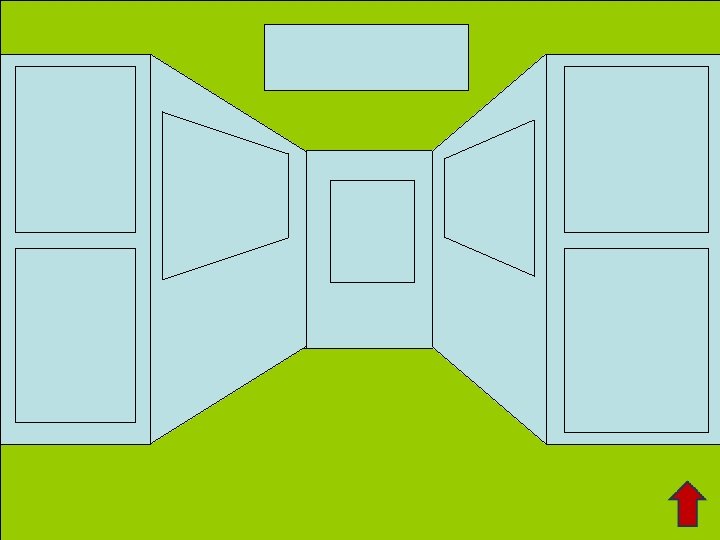
III. Create Virtual Museum in Powerpoint ü Lobby (Template) ü Create informational slide addressing each category researched. Be sure to place resources on each slide. ü Add photos to the lobby and link to correct slides ü Change colors of ceiling, walls and floor to depict era. ü Add details to slides: photos, colors and fonts. ü In “Slideshow Mode” test all the links.
Click to Add Title • Click to add text
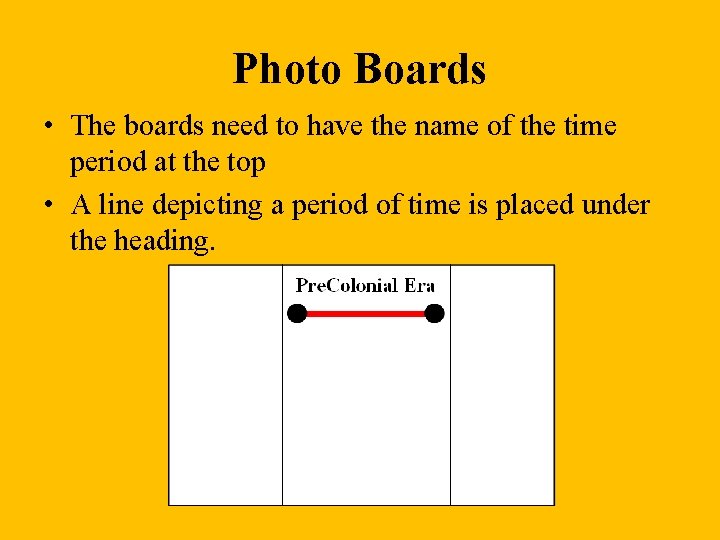
Photo Boards • The boards need to have the name of the time period at the top • A line depicting a period of time is placed under the heading.
IV. Presentation of Virtual Museum in Class Students… ü In chronological order, present era by using the smartboard and their powerpoint museum ü Sample virtual museum Teachers… ü Grade the presentation as students present, using the presentation rubric. ü Grade the virtual museum using rubric.
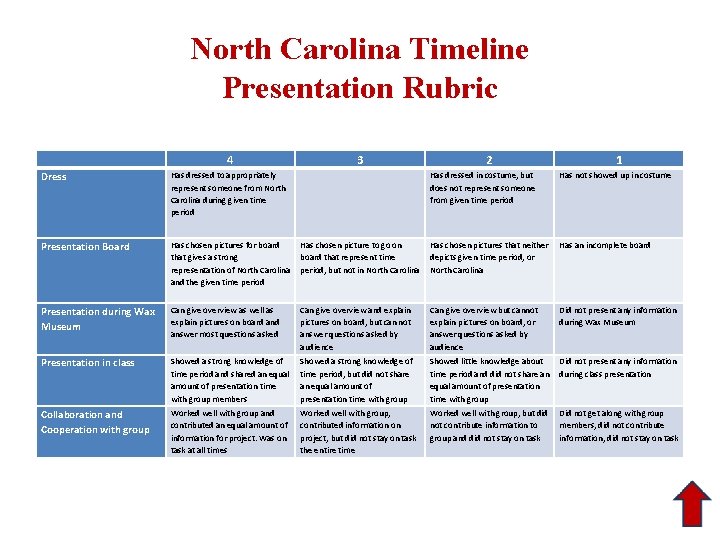
North Carolina Timeline Presentation Rubric 4 3 2 1 Dress Has dressed to appropriately represent someone from North Carolina during given time period Has dressed in costume, but does not represent someone from given time period Has not showed up in costume Presentation Board Has chosen pictures for board that gives a strong representation of North Carolina and the given time period Has chosen picture to go on board that represent time period, but not in North Carolina Has chosen pictures that neither depicts given time period, or North Carolina Has an incomplete board Presentation during Wax Museum Can give overview as well as explain pictures on board answer most questions asked Can give overview and explain pictures on board, but can not answer questions asked by audience Can give overview but cannot explain pictures on board, or answer questions asked by audience Did not present any information during Wax Museum Presentation in class Showed a strong knowledge of time period and shared an equal amount of presentation time with group members Showed a strong knowledge of time period, but did not share an equal amount of presentation time with group Showed little knowledge about time period and did not share an equal amount of presentation time with group Did not present any information during class presentation Collaboration and Cooperation with group Worked well with group and contributed an equal amount of information for project. Was on task at all times Worked well with group, contributed information on project, but did not stay on task the entire time Worked well with group, but did not contribute information to group and did not stay on task Did not get along with group members, did not contribute information, did not stay on task
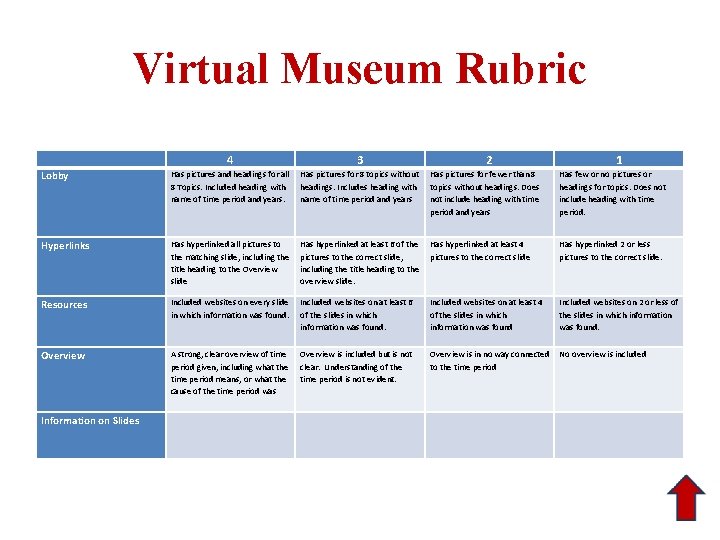
Virtual Museum Rubric 4 3 Lobby Has pictures and headings for all 8 Topics. Included heading with name of time period and years. Has pictures for 8 topics without headings. Includes heading with name of time period and years Has pictures for fewer than 8 topics without headings. Does not include heading with time period and years Has few or no pictures or headings for topics. Does not include heading with time period. Hyperlinks Has hyperlinked all pictures to the matching slide, including the title heading to the Overview slide Has hyperlinked at least 6 of the pictures to the correct slide, including the title heading to the overview slide. Has hyperlinked at least 4 pictures to the correct slide Has hyperlinked 2 or less pictures to the correct slide. Resources Included websites on every slide in which information was found. Included websites on at least 6 of the slides in which information was found. Included websites on at least 4 of the slides in which information was found Included websites on 2 or less of the slides in which information was found. Overview A strong, clear overview of time period given, including what the time period means, or what the cause of the time period was Overview is included but is not clear. Understanding of the time period is not evident. Overview is in no way connected to the time period No overview is included Information on Slides 2 1
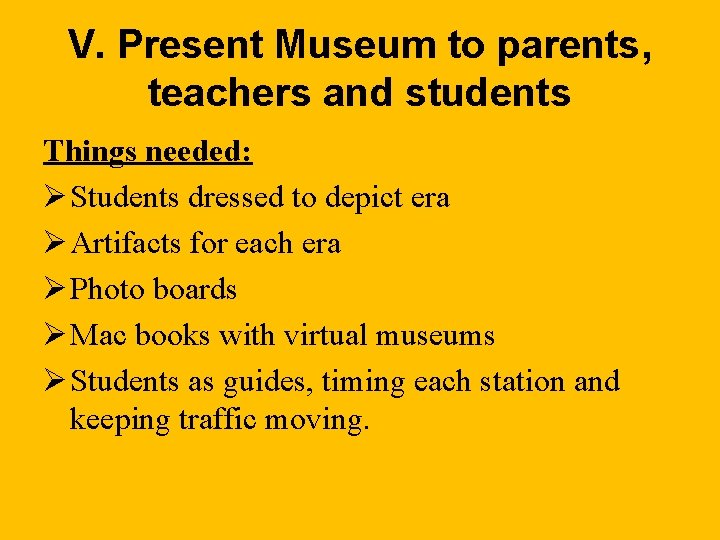
V. Present Museum to parents, teachers and students Things needed: Ø Students dressed to depict era Ø Artifacts for each era Ø Photo boards Ø Mac books with virtual museums Ø Students as guides, timing each station and keeping traffic moving.
Resources • • http: //unceduc 415. pbworks. com/w/page/24768953/I%3 A%20 The%20 Running%20 of%20 the%20 Railroads%20 and%20 Their %20 Impact%20 on%20 Society http: //www. tarheelpress. com/ET 1. html http: //www. corestandards. org/ELA-Literacy/SL/4/ http: //seriouslyepicstuff. com/20 -seriously-epic-historical-bw-photographs-of-americans/