
North Carolina History First in Freedom First Provincial
- Slides: 21
North Carolina History ● “First in Freedom” ● First Provincial Congress (August 1774) – elected people to the Continental Congress ● Mecklenburg Declaration (May 1775) – citizens of Mecklenburg County stated that the only lawful government was the provincial government, not the British. ● Halifax Resolves (April 12, 1776) – NC was the first state to call for complete independence from Britain. ● NC sent 3 delegates to the 2 nd Continental Congress. ● NC did not ratify the U. S. Constitution until 1789 when the Bill of Rights was added.
North Carolina History cont. ● Three Constitutions in NC’s history ● Very small number compared to other states ● 1 st – Constitution of 1776 ● Very similar to the US Constitution ● 1835 Changes ● ● Voters now allowed to elect governor, approve or reject constitutional amendments Took away rights of free men of African and Indian decent ● 2 nd – Constitution of 1868 ● All Confederate states had to create new Constitution after Civil War ● Slavery abolished, all men over 21 could vote ● 3 rd – Constitution of 1971 ● All elections free, freedom of speech, equal protection of laws
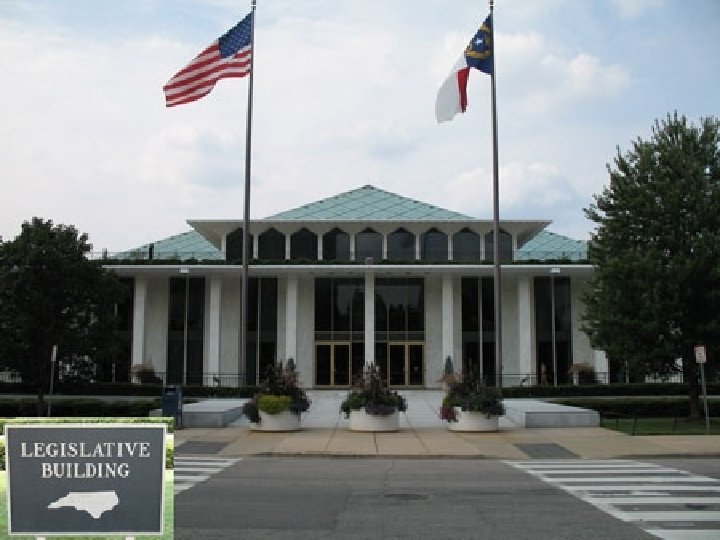
NC Legislative Branch ● The Legislative Branch of North Carolina’s state government is called the General Assembly ● Makes two types of laws: ● Statutes – apply to everyone in the state ● Local or Specific laws – just to certain areas in the state ● Major power deals with finances. How much to spend and how much to tax? ● Other powers: ex. Legislative Oversight – review of government operations
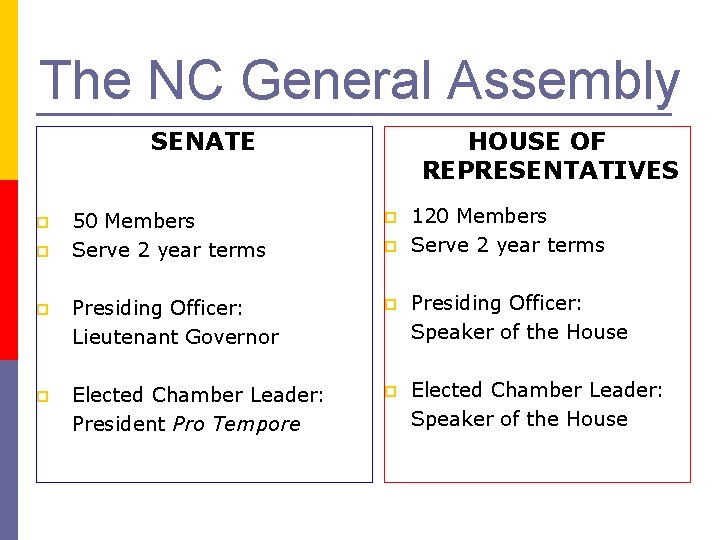
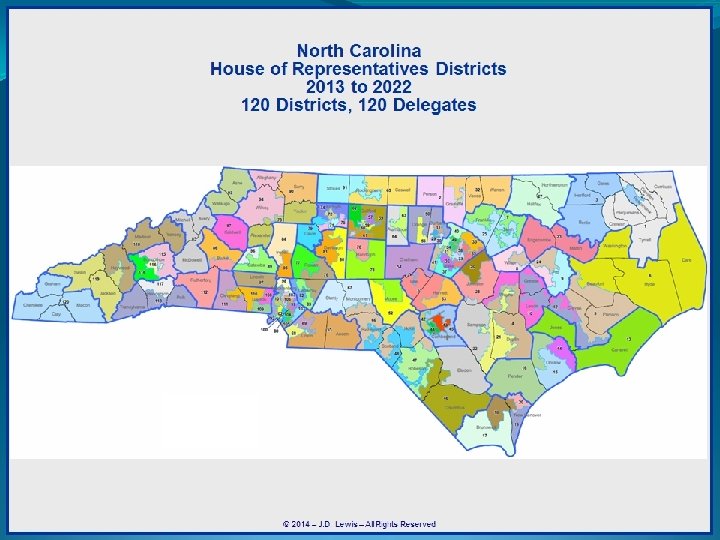
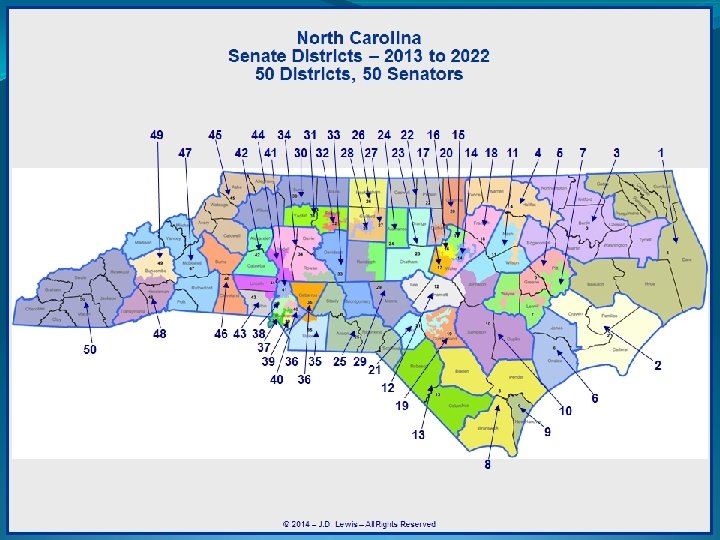
The NC General Assembly SENATE HOUSE OF REPRESENTATIVES 120 Members Serve 2 year terms 50 Members Serve 2 year terms p p Presiding Officer: Lieutenant Governor p Presiding Officer: Speaker of the House p Elected Chamber Leader: President Pro Tempore p Elected Chamber Leader: Speaker of the House p p p
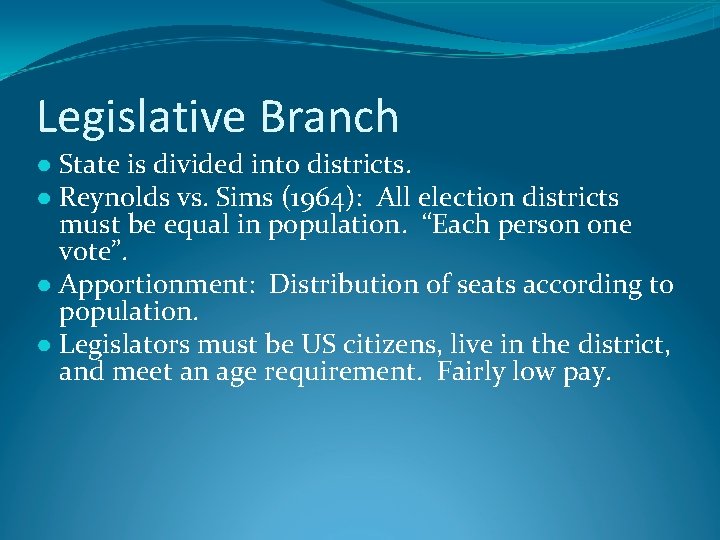
Legislative Branch ● State is divided into districts. ● Reynolds vs. Sims (1964): All election districts must be equal in population. “Each person one vote”. ● Apportionment: Distribution of seats according to population. ● Legislators must be US citizens, live in the district, and meet an age requirement. Fairly low pay.
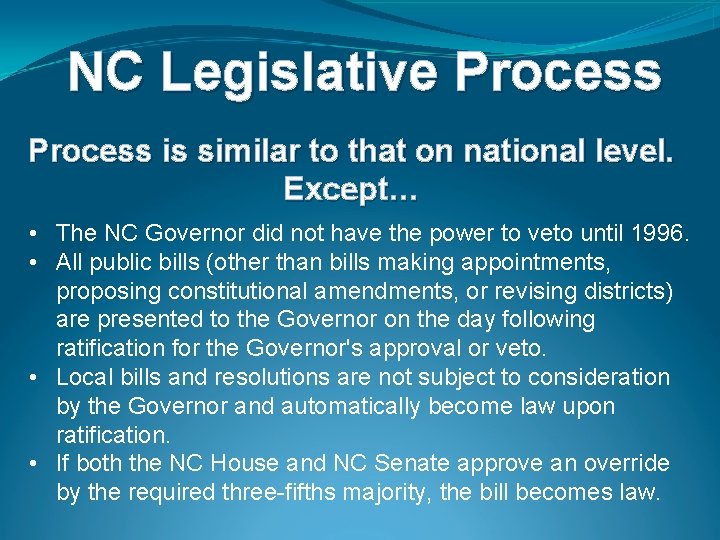
NC Legislative Process is similar to that on national level. Except… • The NC Governor did not have the power to veto until 1996. • All public bills (other than bills making appointments, proposing constitutional amendments, or revising districts) are presented to the Governor on the day following ratification for the Governor's approval or veto. • Local bills and resolutions are not subject to consideration by the Governor and automatically become law upon ratification. • If both the NC House and NC Senate approve an override by the required three-fifths majority, the bill becomes law.
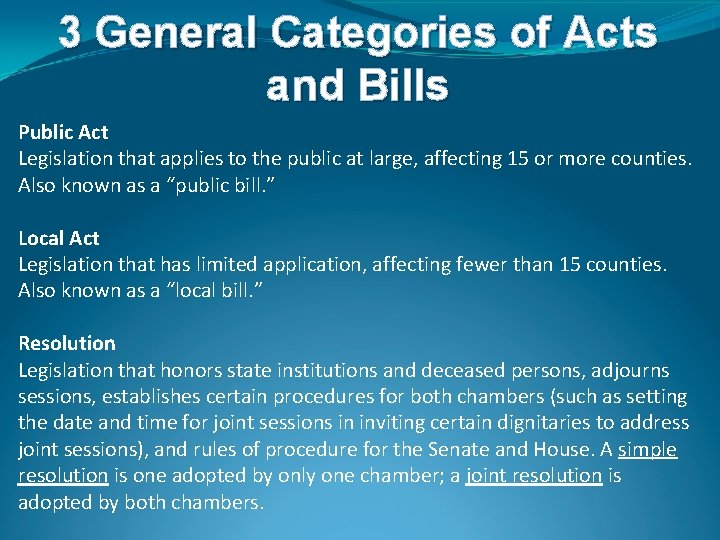
3 General Categories of Acts and Bills Public Act Legislation that applies to the public at large, affecting 15 or more counties. Also known as a “public bill. ” Local Act Legislation that has limited application, affecting fewer than 15 counties. Also known as a “local bill. ” Resolution Legislation that honors state institutions and deceased persons, adjourns sessions, establishes certain procedures for both chambers (such as setting the date and time for joint sessions in inviting certain dignitaries to address joint sessions), and rules of procedure for the Senate and House. A simple resolution is one adopted by only one chamber; a joint resolution is adopted by both chambers.
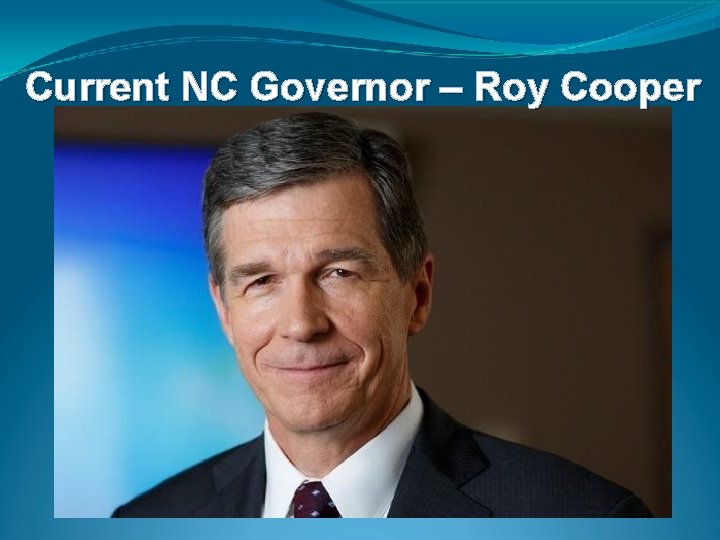
Current NC Governor – Roy Cooper
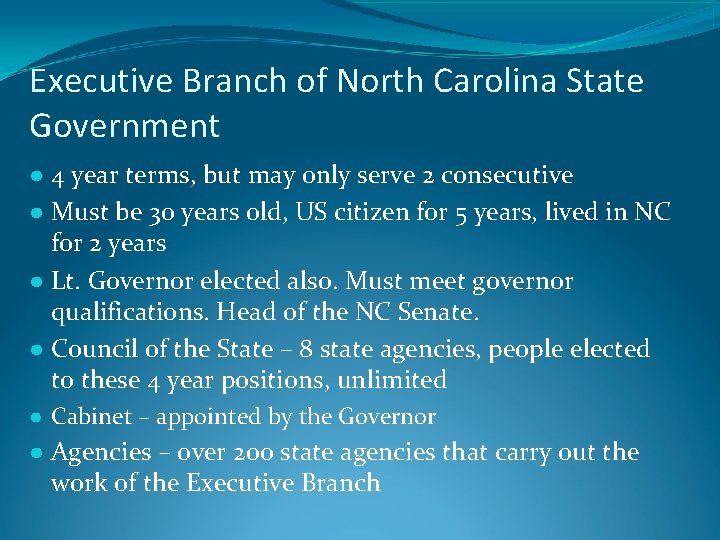
Executive Branch of North Carolina State Government ● 4 year terms, but may only serve 2 consecutive ● Must be 30 years old, US citizen for 5 years, lived in NC for 2 years ● Lt. Governor elected also. Must meet governor qualifications. Head of the NC Senate. ● Council of the State – 8 state agencies, people elected to these 4 year positions, unlimited ● Cabinet – appointed by the Governor ● Agencies – over 200 state agencies that carry out the work of the Executive Branch
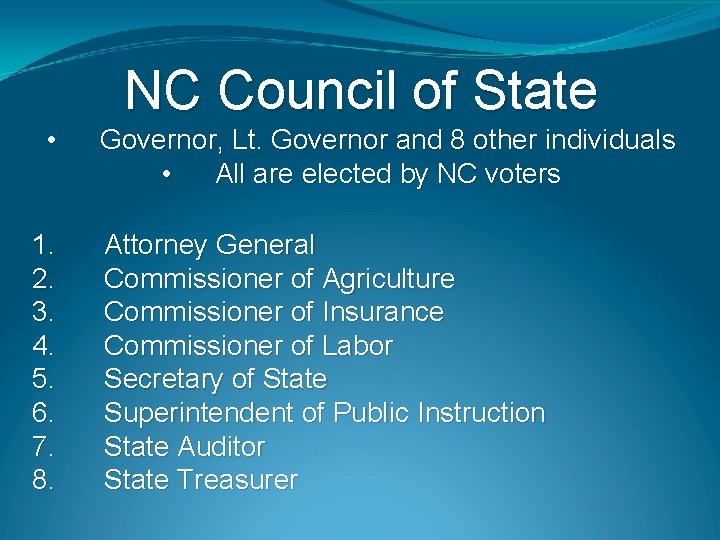
NC Council of State • 1. 2. 3. 4. 5. 6. 7. 8. Governor, Lt. Governor and 8 other individuals • All are elected by NC voters Attorney General Commissioner of Agriculture Commissioner of Insurance Commissioner of Labor Secretary of State Superintendent of Public Instruction State Auditor State Treasurer
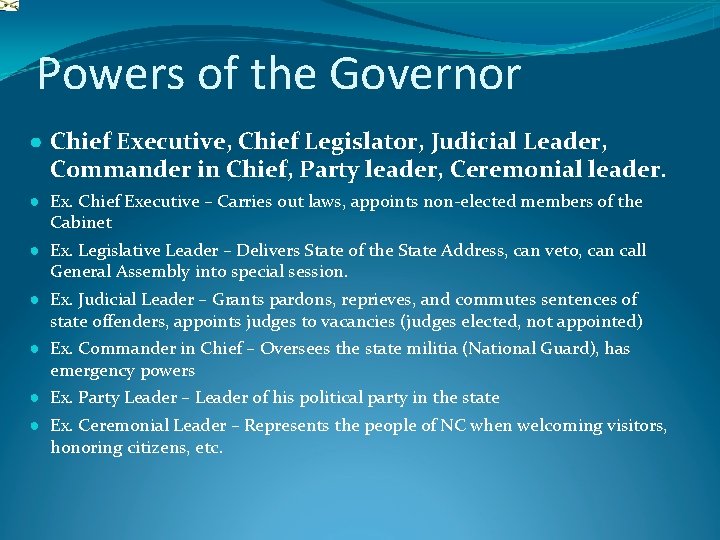
Powers of the Governor ● Chief Executive, Chief Legislator, Judicial Leader, Commander in Chief, Party leader, Ceremonial leader. ● Ex. Chief Executive – Carries out laws, appoints non-elected members of the Cabinet ● Ex. Legislative Leader – Delivers State of the State Address, can veto, can call General Assembly into special session. ● Ex. Judicial Leader – Grants pardons, reprieves, and commutes sentences of state offenders, appoints judges to vacancies (judges elected, not appointed) ● Ex. Commander in Chief – Oversees the state militia (National Guard), has emergency powers ● Ex. Party Leader – Leader of his political party in the state ● Ex. Ceremonial Leader – Represents the people of NC when welcoming visitors, honoring citizens, etc.
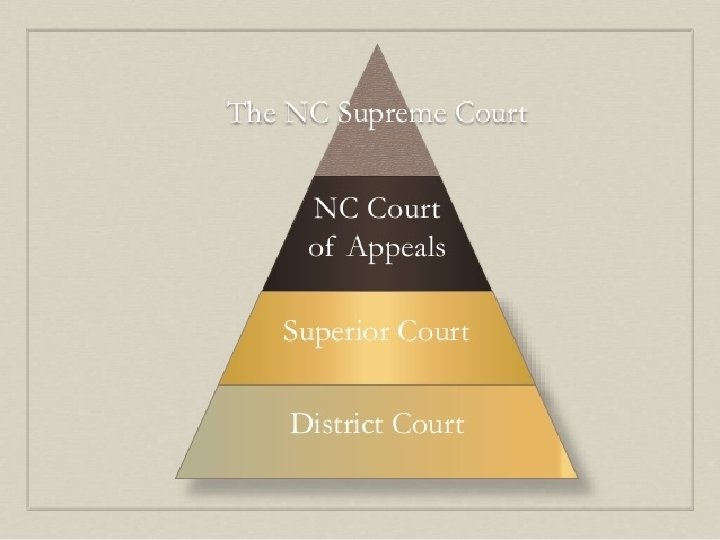
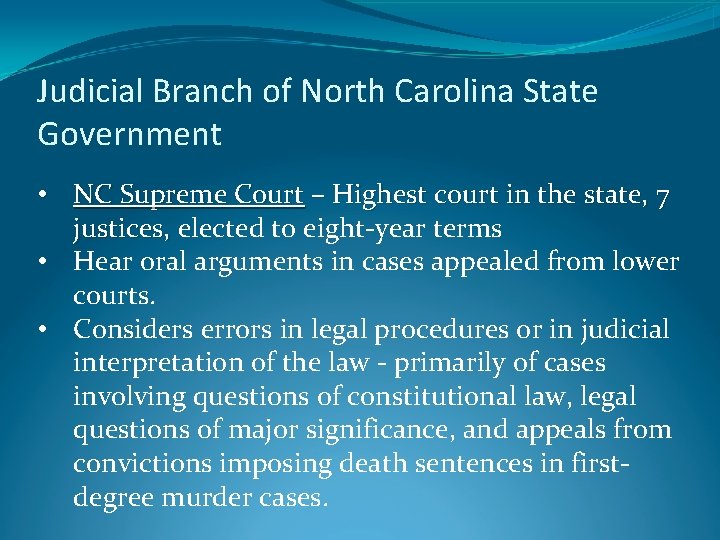
Judicial Branch of North Carolina State Government • NC Supreme Court – Highest court in the state, 7 justices, elected to eight-year terms • Hear oral arguments in cases appealed from lower courts. • Considers errors in legal procedures or in judicial interpretation of the law - primarily of cases involving questions of constitutional law, legal questions of major significance, and appeals from convictions imposing death sentences in firstdegree murder cases.
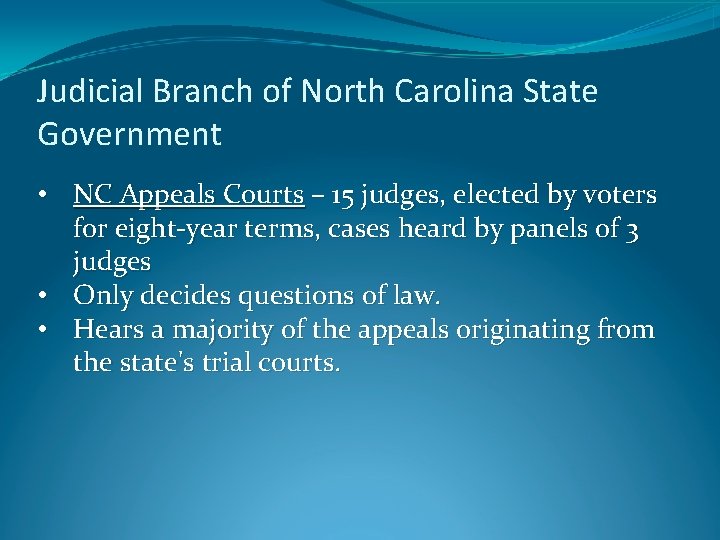
Judicial Branch of North Carolina State Government • NC Appeals Courts – 15 judges, elected by voters for eight-year terms, cases heard by panels of 3 judges • Only decides questions of law. • Hears a majority of the appeals originating from the state's trial courts.
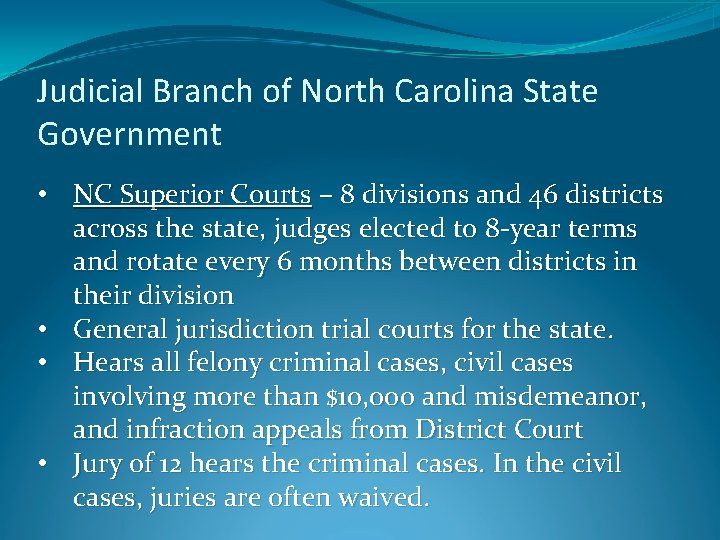
Judicial Branch of North Carolina State Government • NC Superior Courts – 8 divisions and 46 districts across the state, judges elected to 8 -year terms and rotate every 6 months between districts in their division • General jurisdiction trial courts for the state. • Hears all felony criminal cases, civil cases involving more than $10, 000 and misdemeanor, and infraction appeals from District Court • Jury of 12 hears the criminal cases. In the civil cases, juries are often waived.
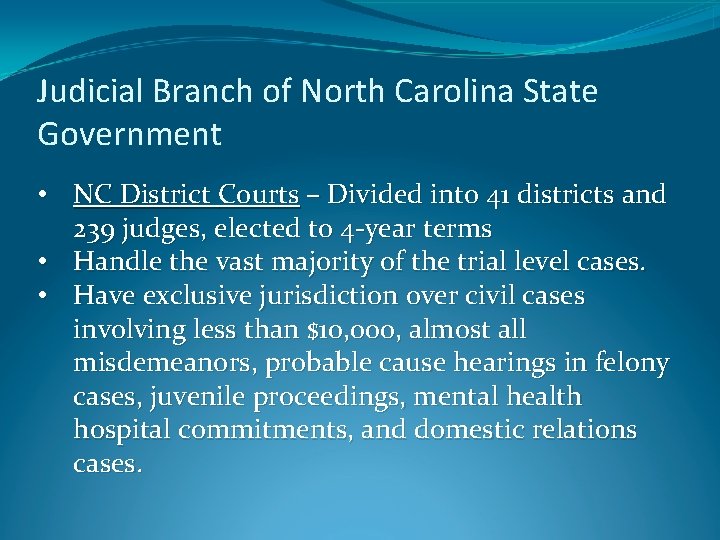
Judicial Branch of North Carolina State Government • NC District Courts – Divided into 41 districts and 239 judges, elected to 4 -year terms • Handle the vast majority of the trial level cases. • Have exclusive jurisdiction over civil cases involving less than $10, 000, almost all misdemeanors, probable cause hearings in felony cases, juvenile proceedings, mental health hospital commitments, and domestic relations cases.
Judicial Branch cont. ● Misdemeanors: Minor crimes handled by lower courts. ● Felonies: Serious crimes handled by higher courts. ● Trial courts: Use juries. Judge decides punishment. ● Appellate courts: Panel of judges. Appellate jurisdiction. ● Magistrates: a civil officer or lay judge who administers the law, especially one who conducts a court that deals with minor offenses and holds preliminary hearings for more serious ones.