
North Carolina ABC Board Association 2021 General Managers

North Carolina ABC Board Association 2021 General Managers Virtual Meeting March 30, 2021 A Discussion about COVID-19 Presented by James P. Mahoney CPCU, CBIA, AIA HPB Insurance Group jmahoney@hpbinsurance. com 336 -881 -3928
What is COVID-19 (Coronavirus)? It is highly contagious virus, easily spread from person to person. In just a short year, it has infected millions of people worldwide. It is spread from person to person, mainly through respiratory droplets from someone who is infected. It can spread to others from coughing, sneezing, singing, yelling or from just talking. It can also spread from contact with contaminated surfaces. Incubation period is 2 -14 days after exposure. Wide range of symptoms reported ranging from mild to severe illness: Common symptoms-fever, cough, shortness of breath, chills, muscle pains, headache, sore throat, loss of taste and smell. It can be transferred by asymptomatic carriers. Can cause serious, sometimes fatal complications. www. cdc. gov
What to do if you feel sick? Stay Home! Seek medical attention, contact and stay in touch with doctor. Get tested if advised to do so by doctor Advise your employer ASAP (employer is required to maintain confidentially) What Happens if I test positive? Follow health providers instructions Inform your employer Follow producers from your employer/human resources when ready to return to work What happens if I feel sick? Follow health providers instructions Inform your employer Follow producers from your employer/human resources when ready to return to work www. cdc. gov

Center for Disease Control (CDC): www. cdc. gov/coronavirus/2019 Occupational Safety and Health Administration (OSHA): www. osha. . gov Environmental Protection Agency (EPA): www. epa. gov Resources North Carolina Department of Labor (NCDOL): www. labor. nc. gov The State of North Carolina: www. nc. gov/covid 19 North Carolina Department of Health and Human Services (NCDHHS): www. ncdhhs. gov National Institute for Occupational Safety and Health (NIOSH): www. cdc. gov/niosh
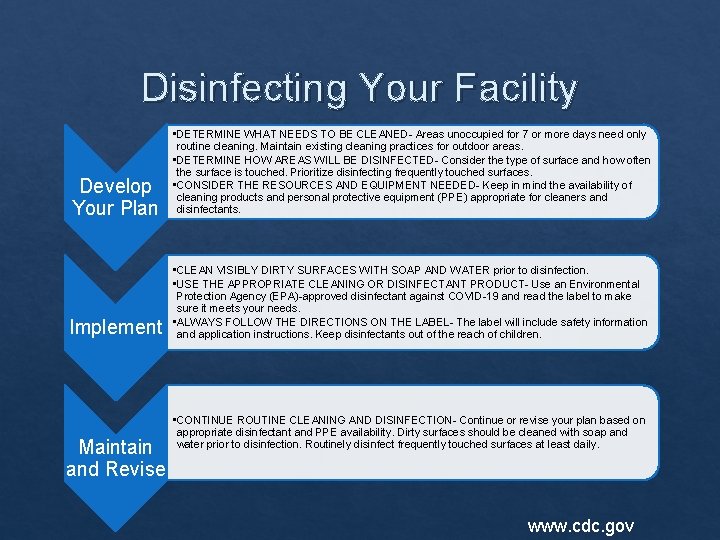
Disinfecting Your Facility Develop Your Plan • DETERMINE WHAT NEEDS TO BE CLEANED- Areas unoccupied for 7 or more days need only routine cleaning. Maintain existing cleaning practices for outdoor areas. • DETERMINE HOW AREAS WILL BE DISINFECTED- Consider the type of surface and how often the surface is touched. Prioritize disinfecting frequently touched surfaces. • CONSIDER THE RESOURCES AND EQUIPMENT NEEDED- Keep in mind the availability of cleaning products and personal protective equipment (PPE) appropriate for cleaners and disinfectants. Implement • CLEAN VISIBLY DIRTY SURFACES WITH SOAP AND WATER prior to disinfection. • USE THE APPROPRIATE CLEANING OR DISINFECTANT PRODUCT- Use an Environmental Protection Agency (EPA)-approved disinfectant against COVID-19 and read the label to make sure it meets your needs. • ALWAYS FOLLOW THE DIRECTIONS ON THE LABEL- The label will include safety information and application instructions. Keep disinfectants out of the reach of children. Maintain and Revise • CONTINUE ROUTINE CLEANING AND DISINFECTION- Continue or revise your plan based on appropriate disinfectant and PPE availability. Dirty surfaces should be cleaned with soap and water prior to disinfection. Routinely disinfect frequently touched surfaces at least daily. www. cdc. gov
Disinfecting Your Vehicles When transporting a known confirmed positive passenger, it is recommended that: • Drivers wear an N 95 respirator or facemask (if a respirator is not available) and eye protection such as a face shield or goggles (as long as they do not create a driving hazard) • Passenger should wear a facemask or cloth face covering • Occupants of these vehicles should avoid or limit close contact (within 6 feet) with others. • The use of larger vehicles such as vans is recommended when feasible to allow greater social (physical) distance between vehicle occupants. • Additionally, drivers should practice regular hand hygiene, avoid touching their nose, mouth, or eyes, and avoid picking up multiple passengers who would not otherwise be riding together on the same route. • CDC recommends that individuals wear cloth face coverings in settings where other social distancing measures are difficult to maintain, especially in areas with significant community transmission. Cloth face coverings may prevent people who don’t know they have the virus from transmitting it to others; these face coverings are not surgical masks, respirators, or personal protective equipment (PPE). Cloth face coverings should not be placed on young children under age 2, anyone who has trouble breathing, or is unconscious, incapacitated or otherwise unable to remove the mask without assistance. www. cdc. gov
Suspected or Confirmed Cases of COVID-19 in the Workplace What should I do if an employee comes to work with COVID-19 symptoms? • Employees who have symptoms when they arrive at work or become sick during the day should immediately be separated from other employees, customers, and visitors and sent home. Employees who develop symptoms outside of work should notify their supervisor and stay home. • Sick employees should follow CDCrecommended steps to help prevent the spread of COVID-19. Employees should not return to work until they have met the criteria to discontinue home isolation and have consulted with a healthcare provider. • Employers should not require sick employees to provide a COVID-19 test result or healthcare provider's note to validate their illness, qualify for sick leave, or return to work. Healthcare provider offices and medical facilities may be extremely busy and not able to What should I do if an employee is suspected or confirmed to have COVID -19? • In most cases, you do not need to shut down your facility. But do close off any areas used for prolonged periods of time by the sick person: • Wait 24 hours before cleaning and disinfecting to minimize potential for other employees being exposed to respiratory droplets. If waiting 24 hours is not feasible, wait as long as possible. www. cdc. gov
Limiting Workplace Violence Offer customers options to minimize their contact with others and promote social distancing. These options can include curbside pick-up; personal shoppers; home delivery for groceries, food, and other services ; and alternative shopping hours. Advertise COVID-19 related policies on the business website. Put in place steps to assess and respond to workplace violence. Response will depend on severity of the violence on the size and structure of the business. Possible responses may include reporting to a manager or supervisor on-duty, calling security, or calling 911. Assign two workers to work as a team to encourage COVID-19 prevention policies be followed, if staffing permits. Identify a safe area for employees to go if they feel they are in danger (e. g. , a room that locks from the inside, has a second exit route, and has a phone or silent alarm. Post signs that let customers know about policies for wearing masks, social distancing, and the maximum number of people allowed in a business facility. Provide employee training on threat recognition, conflict resolution, nonviolent response, and on any other relevant topics related to workplace violence response. Remain aware of and support employees and customers if a threatening or violent situation occurs. Install security systems (e. g. , panic buttons, cameras, alarms) and train employees how to use them. www. cdc. gov
Basic Do’s and Don’ts of Workplace Violence Do Attend all employer-provided training on how to recognize, avoid, and response to potentially violent situations. Report perceived threats or acts of violence to your manager or supervisor, following any existing policies that may be in place. Remain aware of and support coworkers and customers if Don’t Argue with a customer if they make threats or become violent. If needed, go to a safe are (ideally, a room that locks from the inside, has a second exit route, and has a phone or silent alarm). Attempt to force anyone who appears upset or violent to follow COVID-19 prevention policies or other policies or practices related to COVID-19 (e. g. , limits on number of household or food products). cdc. gov/coronavirus
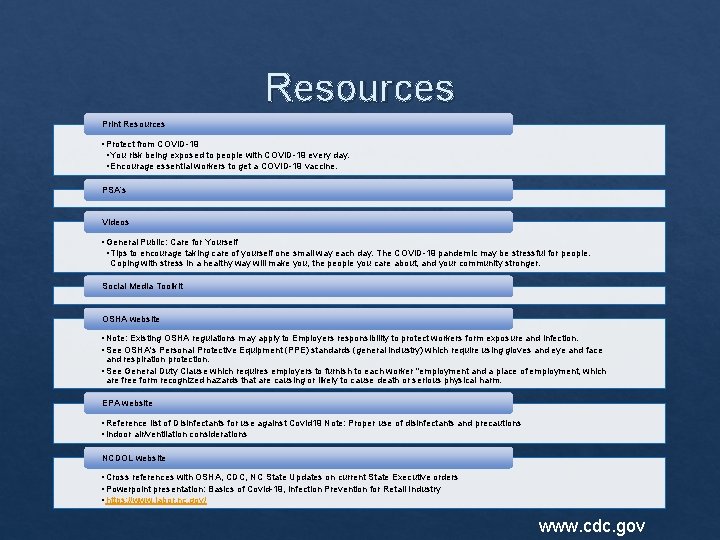
Resources Print Resources • Protect from COVID-19 • You risk being exposed to people with COVID-19 every day. • Encourage essential workers to get a COVID-19 vaccine. PSA’s Videos • General Public: Care for Yourself • Tips to encourage taking care of yourself one small way each day. The COVID-19 pandemic may be stressful for people. Coping with stress in a healthy way will make you, the people you care about, and your community stronger. Social Media Toolkit OSHA website • Note: Existing OSHA regulations may apply to Employers responsibility to protect workers form exposure and infection. • See OSHA's Personal Protective Equipment (PPE) standards (general industry) which require using gloves and eye and face and respiration protection. • See General Duty Clause which requires employers to furnish to each worker "employment and a place of employment, which are free form recognized hazards that are causing or likely to cause death or serious physical harm. EPA website • Reference list of Disinfectants for use against Covid 19 Note: Proper use of disinfectants and precautions • Indoor air/ventilation considerations NCDOL website • Cross references with OSHA, CDC, NC State Updates on current State Executive orders • Powerpoint presentation: Basics of Covid-19, Infection Prevention for Retail Industry • https: //www. labor. nc. gov/ www. cdc. gov
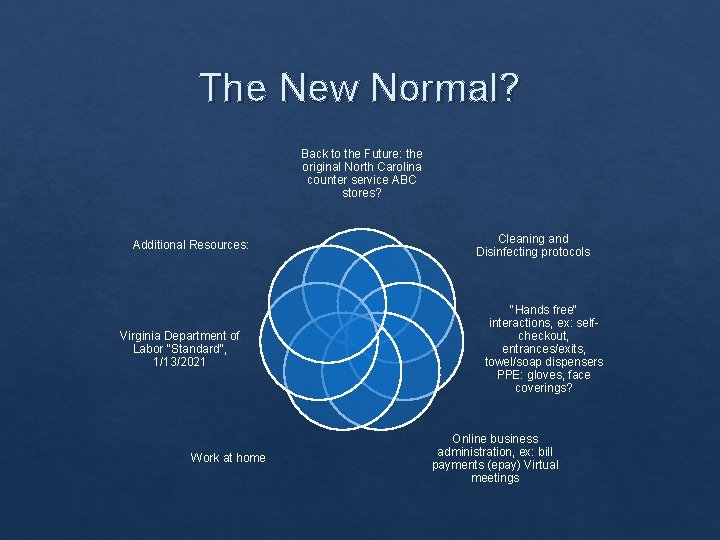
The New Normal? Back to the Future: the original North Carolina counter service ABC stores? Additional Resources: Virginia Department of Labor "Standard", 1/13/2021 Work at home Cleaning and Disinfecting protocols "Hands free" interactions, ex: selfcheckout, entrances/exits, towel/soap dispensers PPE: gloves, face coverings? Online business administration, ex: bill payments (epay) Virtual meetings
Questions? Would you like a copy of this presentation? Email: jmahoney@hpbinsurance. com 336 -881 -3928
- Slides: 15