
North American Land Data Assimilation System NLDAS Research
- Slides: 4
North American Land Data Assimilation System (NLDAS) Research at the NASA Goddard Space Flight Center Brian A. Cosgrove, Paul R. Houser, and Greg Quina NASA Goddard Space Flight Center Kenneth Mitchell, Eric Wood, John Schaake, Alan Robock, Dag Lohmann, Justin Sheffield, Qingyun Duan, Lifeng Luo, Dennis Lettenmaier, Wayne Higgins, Rachel Pinker, Dan Tarpley, Jesse Meng
Background Biases in energy and water stores can develop in coupled modeling systems due to forcing errors, and errors in model physics and parameters, and continue to grow in such self contained systems Uncoupled Land Data Assimilation Systems (LDAS) driven by observations and constrained by data assimilation have potential to more accurately depict land surface conditions Output benefits flood prediction, determination of observation needs and error criteria, improvement of land data assimilation and land surface models Numerical weather prediction (NWP) models should benefit from initialization with LDAS land surface states
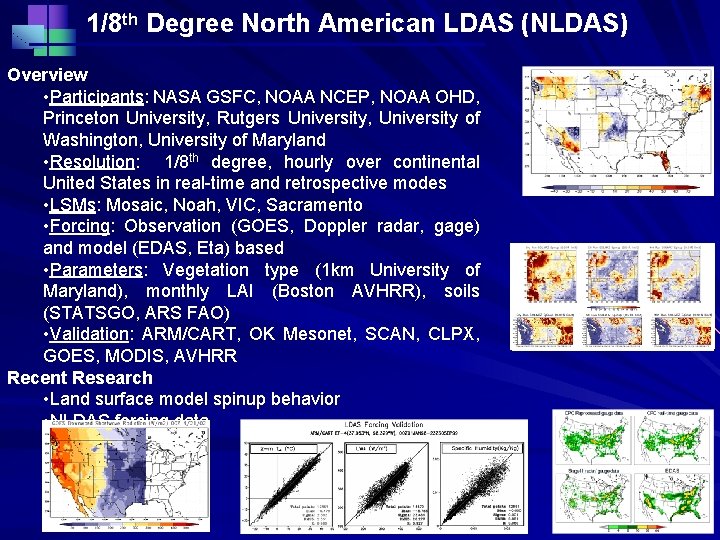
1/8 th Degree North American LDAS (NLDAS) Overview • Participants: NASA GSFC, NOAA NCEP, NOAA OHD, Princeton University, Rutgers University, University of Washington, University of Maryland • Resolution: 1/8 th degree, hourly over continental United States in real-time and retrospective modes • LSMs: Mosaic, Noah, VIC, Sacramento • Forcing: Observation (GOES, Doppler radar, gage) and model (EDAS, Eta) based • Parameters: Vegetation type (1 km University of Maryland), monthly LAI (Boston AVHRR), soils (STATSGO, ARS FAO) • Validation: ARM/CART, OK Mesonet, SCAN, CLPX, GOES, MODIS, AVHRR Recent Research • Land surface model spinup behavior • NLDAS forcing data
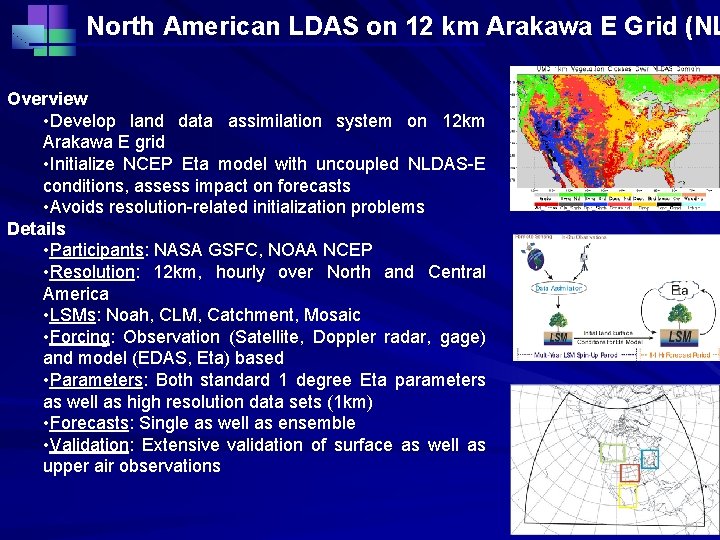
North American LDAS on 12 km Arakawa E Grid (NL Overview • Develop land data assimilation system on 12 km Arakawa E grid • Initialize NCEP Eta model with uncoupled NLDAS-E conditions, assess impact on forecasts • Avoids resolution-related initialization problems Details • Participants: NASA GSFC, NOAA NCEP • Resolution: 12 km, hourly over North and Central America • LSMs: Noah, CLM, Catchment, Mosaic • Forcing: Observation (Satellite, Doppler radar, gage) and model (EDAS, Eta) based • Parameters: Both standard 1 degree Eta parameters as well as high resolution data sets (1 km) • Forecasts: Single as well as ensemble • Validation: Extensive validation of surface as well as upper air observations