
NormReferenced Tests and Test Scores What does it



- Slides: 50
Norm-Referenced Tests and Test Scores: What does it all mean? Steven M. Koch, Ph. D. Riley Child Development Center IU School of Medicine - Department of Pediatrics
Presentation Goals • • Recognize areas of assessment Understandardized test scores Learn about the new SSA Test List Identify resources on specific tests
Questions asked answered today • • • Why do we assess children? How do we assess children? Why do I need to know about the tests? What are all those scores? – And what do they mean? • Where can I find information on tests?
Why do we assess children? • Guide diagnosis • Determine eligibility – SSI – Medicaid waiver – Special education • Monitor progress • Determine treatment approach • Research
How do we assess children? • Four Pillars of Assessment (Sattler, 2001) – Norm-referenced tests (standardized tests) – Interviews – Observations – Informal assessment procedures • Testing should be fair and culture-free
Norm-referenced tests • Provide a degree of quantification of the child’s functioning in a given area – Describes the child’s present functioning in reference to peer group – Identifies strengths and weaknesses in area – Provides a baseline for later testing
Interviews • Structured interviews • Semi-structured interviews • Free flowing interviews
Observations • Systematic observations / data collection – Frequency counts – Incident logs • Informal observations – Approach towards more difficult tasks – Generate hypotheses
Informal Assessment • Non-standardized assessment approaches that test an examiner’s hypothesis • Can further identify particular strengths and weaknesses • Examples of informal assessment procedures – Reading passages – Play-based assessment
Fair testing • Fair testing does not mean the same test is administered to all individuals. • The tests selected for each child should address the questions asked, and the areas of concern. • The impact of other skills on performance should be minimized
Why do I need to know about all these tests?
Why do I need to know about tests? • Provides an understanding of the tests which are a part of the claimant’s file • Can provide guidance when requesting a CE – How can the CE obtain the needed information to help with the eligibility determination? – What instruments or areas of assessment would be most helpful as part of the CE?
In what areas do we assess children?
Areas assessed by norm-referenced instruments • • Intelligence / cognition Social / emotional Adaptive functioning Speech Oral language Academic Gross & fine motor Early childhood / global development
Intelligence / Cognition • Definitions (Sattler, 2001) – Higher-level components, which include abstract reasoning, representation, problem solving, and decision making – Overt behavioral manifestations represented by effective or successful responses – Elementary processes, such as perception, sensation and attention – Executive processes – Memory – Ability to learn
Intelligence / Cognition • Assessment approaches – Wechsler Intelligence Scale for Children: 4 – Wechsler Adult Intelligence Scale: 3 – Wide Range Assessment of Memory and Learning: 2 – Stanford-Binet Intelligence Scales: 5 – Differential Abilities Scale – Bayley Scales of Infant Development: 3 – Universal Nonverbal Intelligence Test
Social / Emotional • Definitions – Assessment of emotional status, impact of mental disorders on functioning, and social interactions and relationships with others – Often viewed as internalizing and externalizing behaviors.
Social / Emotional • Internalizing – Anxiousness, depressed mood, somatic complaints • Externalizing – Hyperactivity, verbal aggression, physical aggression • Other areas – Social problems, inattention, thought disturbance
Social / Emotional • Assessment approaches – Mental Status Examination – Child Behavior Checklist – Behavior Assessment System for Children: 2 – Behavior Rating Inventory of Executive Function – Revised Children’s Manifest Anxiety Scale – Roberts Apperception Test for Children: 2 – Children’s Depression Inventory – Functional Behavior Assessment
Adaptive Functioning • Definitions – The effectiveness with which individuals meet the standards of personal independence and social responsibility expected of individuals of their age and cultural group (Sattler, 2002). – Multifactorial • Independent functioning, physical development, economic activity, language development, numbers & time, (pre)vocational, self-direction, responsibility, socialization (AAMR)
Adaptive Functioning • Assessment approaches – Vineland Adaptive Behavior Scales: 2 – Scales of Independent Behavior: Revised – Adaptive Behavior Assessment System: 2 – Semi-structured interview
Speech • Definitions – Involves the production of sounds which form words • Areas of speech disorders – Oral-Motor – Apraxia – Articulation – Stuttering / Dysfluency – Phonological disorder
Speech • Assessment approaches – Goldman-Fristoe Test of Articulation: 2 – Khan-Lewis Phonological Analysis: 2 – Photo Articulation Test: 3 – Stuttering Severity Inventory: 3
Oral Language • The use of words and sentences to convey meaning to others. Oral language examines both the production of messages (expressive) and their receipt (receptive). • Basic components – Semantics – Syntax – Morphology – Phonology – Pragmatics
Oral Language • Assessment approaches – Preschool Language Scale: 4 – Clinical Evaluation of Language Fundamentals: 4 – Receptive-Expressive Emergent Language Scale: 3 – Test of Language Development: 3 – Peabody Picture Vocabulary Test: 3 – Rosetti Infant-Toddler Language Scale – Test of Pragmatic Language – Hawaii Early Learning Profile
Academic • Definitions – The skills children learn through direct intervention or instruction (Sattler, 2001) – Commonly assessed skills include • • • Reading individual words Reading comprehension Mathematics Spelling Written expression
Academic • Assessment approaches – Wechsler Individual Achievement Test: 2 – Woodcock-Johnson Tests of Achievement: 3 – Kaufman Test of Educational Achievement: 2 – Woodcock Reading Mastery Test: 2 – Key. Math: 2 – Diagnostic Achievement Battery: 3
Gross & Fine Motor • Definitions – Gross motor refers to tasks involving the larger muscles of the body, such as the legs and trunk – Fine motor refers to tasks involving the hands and wrists – Visual-motor refers to the integration of visual and fine motor, such as handwriting – Sensory integration refers to the ability to regulate sensory input (auditory, visual, tactile, kinesthetic)
Gross & Fine Motor • Assessment approaches – Peabody Developmental Motor Scales: 2 – Bruininks Oseretsky Test of Motor Proficiency – Beery-Buktenica Test of Visual-Motor Integration: 5 – Gross Motor Function Test – The Sensory Profile
Early Childhood / Global • Many instruments assessing youth in early childhood examine multiple areas of development, such as cognitive, speech, language, motor, school readiness, etc. • Norm-referenced tests are not always appropriate for this age, and more curriculum-based approaches are utilized
Early Childhood / Global • Assessment approaches – Bayley Scales of Infant Development: 3 – Assessment, Evaluation & Programming System – Kaufman Survey of Early Academic and Language Skills – Bracken Basic Concept Scale: 2 – Hawaii Early Learning Profile – Infant Toddler Social Emotional Assessment – Carolina Curriculum for Infants / Toddlers
What scores are provided by tests?
Types of scores • Raw scores – Number of correct responses for a test – May be useful when measuring progress • Standard and Scaled Scores – Normal distribution of raw scores (established mean and standard deviation) – IQ scores – T-Scores
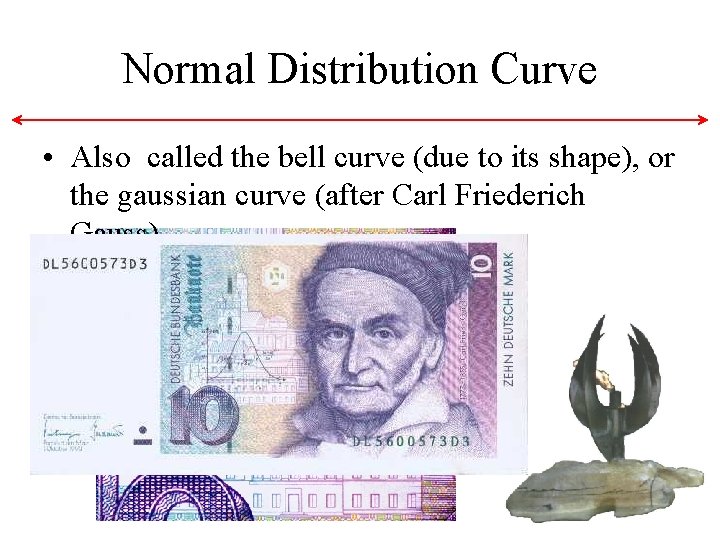
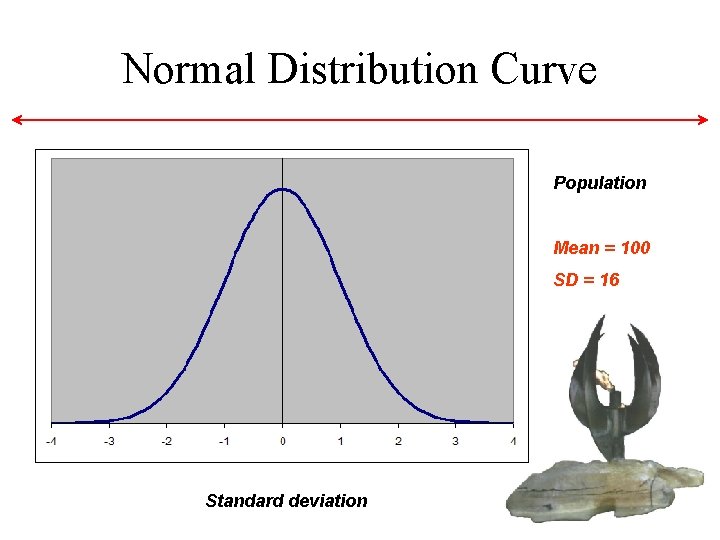
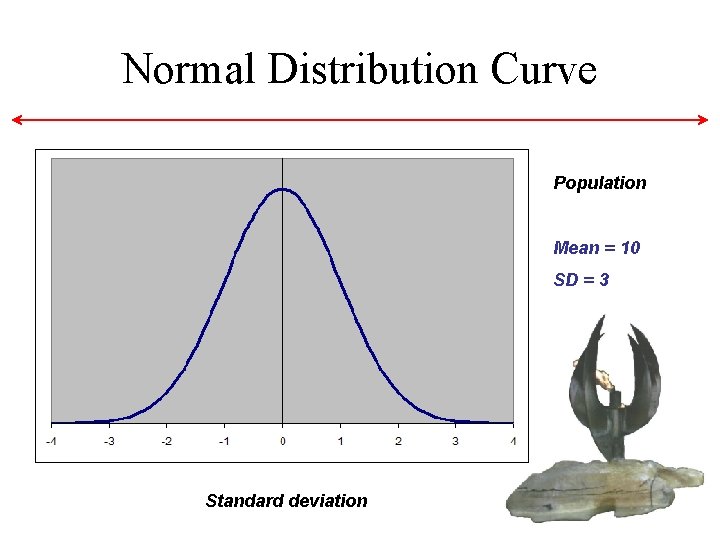
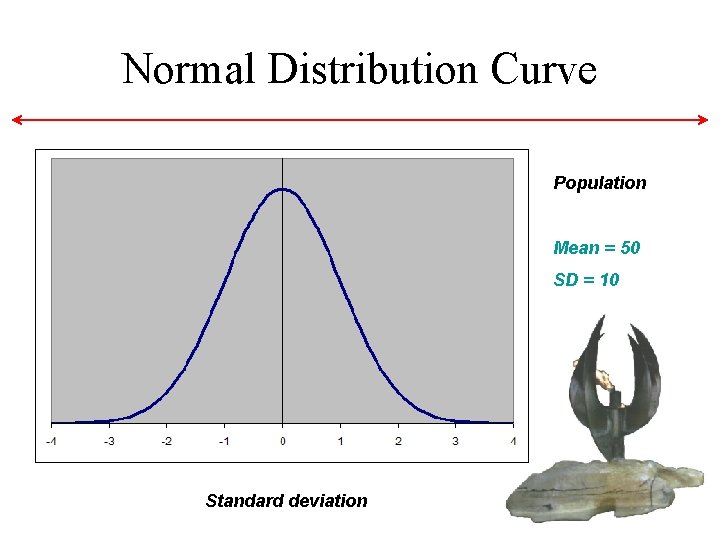
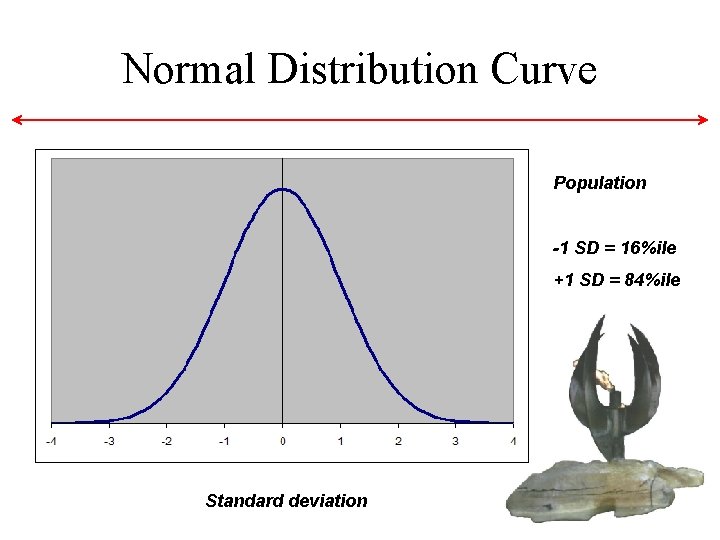
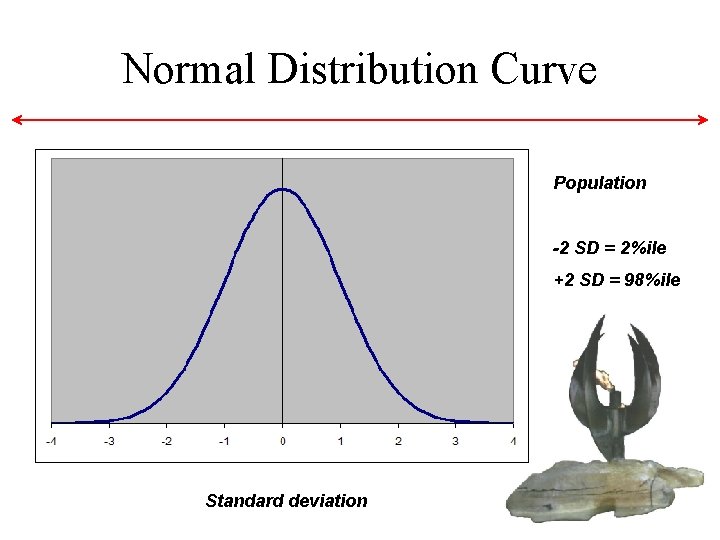
Normal Distribution Curve • Also called the bell curve (due to its shape), or the gaussian curve (after Carl Friederich Gauss)
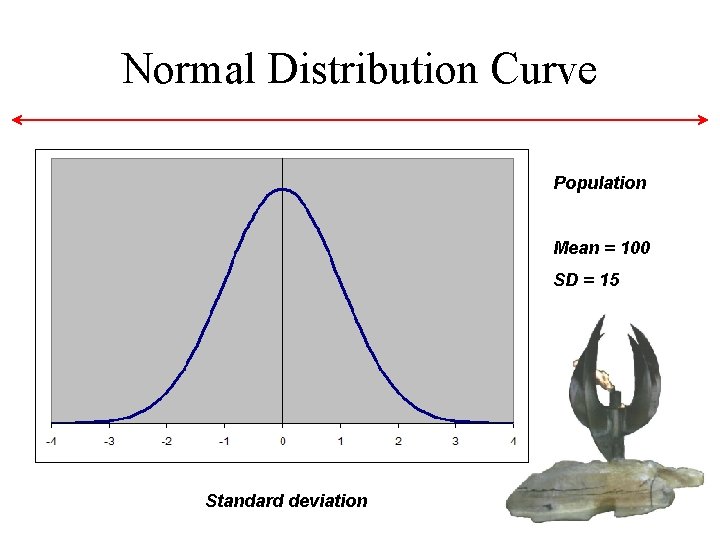
Normal Distribution Curve • Mean ( ) – average score • Standard deviation ( ) – spread of scores
Normal Distribution Curve Population Mean = 100 SD = 15 Standard deviation
Normal Distribution Curve Population Mean = 100 SD = 16 Standard deviation
Normal Distribution Curve Population Mean = 10 SD = 3 Standard deviation
Normal Distribution Curve Population Mean = 50 SD = 10 Standard deviation
Types of scores • Age / grade equivalents – Child’s raw score in relation to average score for a given age – Often used with young children, and individuals with developmental delays – Often interpreted incorrectly
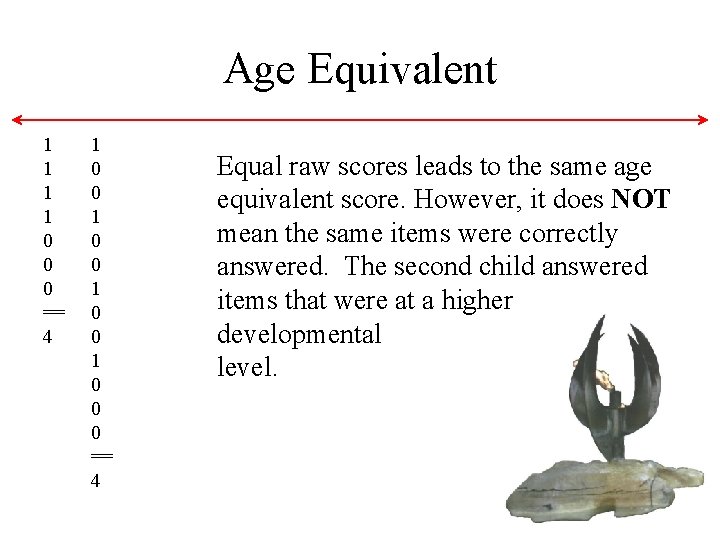
Age Equivalent 1 1 0 0 0 == 4 1 0 0 0 == 4 Equal raw scores leads to the same age equivalent score. However, it does NOT mean the same items were correctly answered. The second child answered items that were at a higher developmental level.
Types of scores • Percentiles – Different than percentages – Provides comparison to peer group – Perform equal to or better than X% of children
Normal Distribution Curve Population -1 SD = 16%ile +1 SD = 84%ile Standard deviation
Normal Distribution Curve Population -2 SD = 2%ile +2 SD = 98%ile Standard deviation
When is a score significant? • Generally, when a score is greater than 2 SD (either above or below the mean, the score is significantly different (e. g. , an IQ of 70 or lower). • The score can be significant if it is 2 SD below OR 2 SD above the mean (e. g. , T-Scores on behavior checklists greater than 2 SD above the mean generally indicate an area of concern.
Where can I find information on tests?
Where to get information • Your medical consultants (e. g. , psychologists, SLPs) • Sattler, J. M. (2001). Assessment of Children: Cognitive Applications (4 th Ed. ). La Mesa, CA: Sattler Publisher. • Sattler, J. M. (2002). Assessment of Children: Behavioral and Clinical Applications (4 th Ed. ). La Mesa, CA: Sattler Publisher. • Buros Institute – Mental Measurements Yearbook – Tests in Print • University libraries (e. g. , IUPUI) • SSA Test List
SSA Test List • Updated list of tests (earlier list developed ca. 1991) • Recently placed on SSA’s intranet • Provides the following information: – List of tests by area • Comprehensive, screening, subarea, special population – – – Publisher, publication date Description / Purpose Standard administration time Scores (names, types) How information is obtained • Is currently being updated
Where to get information • Test Publishers – Achenbach System of Empirically Based Assessment – American Guidance Service – Psychological Assessment Resources – Psychological Corporation – Riverside Publishing – Western Psychological Services
For more information…. Steven M. Koch, Ph. D. , HSPP Psychologist, Interdisciplinary Training Director Riley Child Development Center IU School of Medicine – Dept. of Pediatrics Riley Hospital for Children 317. 274. 8167 smkoch@iupui. edu