
Norman England 1066 c 1100 Whole Unit Knowledge
- Slides: 17
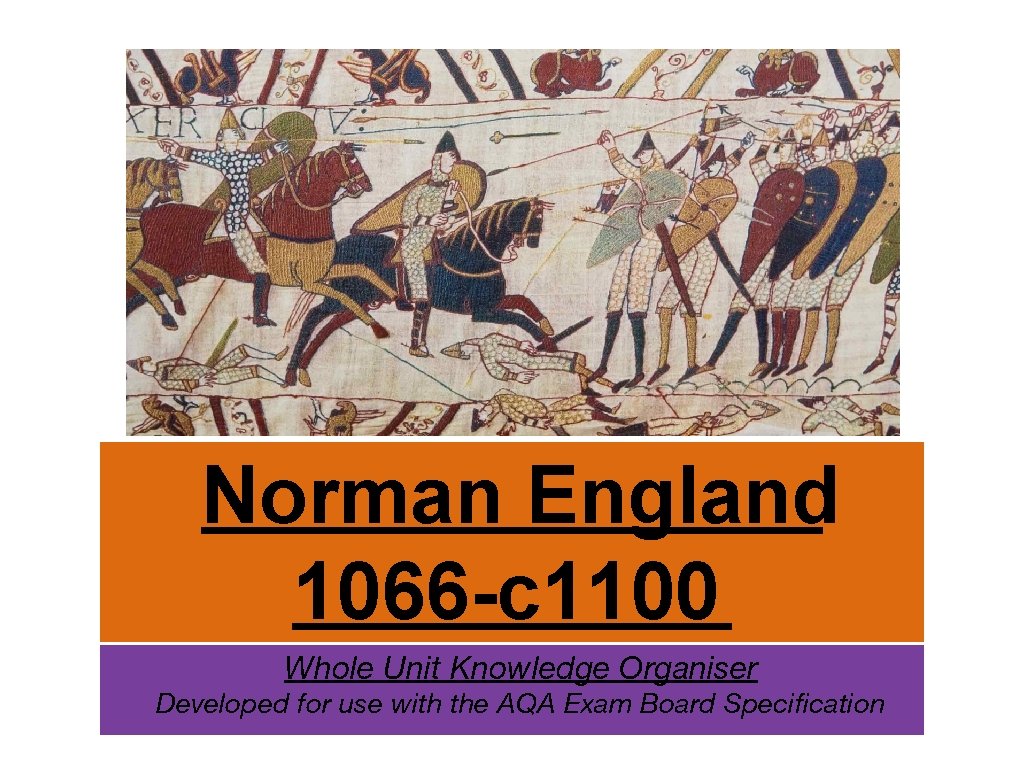
Norman England 1066 -c 1100 Whole Unit Knowledge Organiser Developed for use with the AQA Exam Board Specification
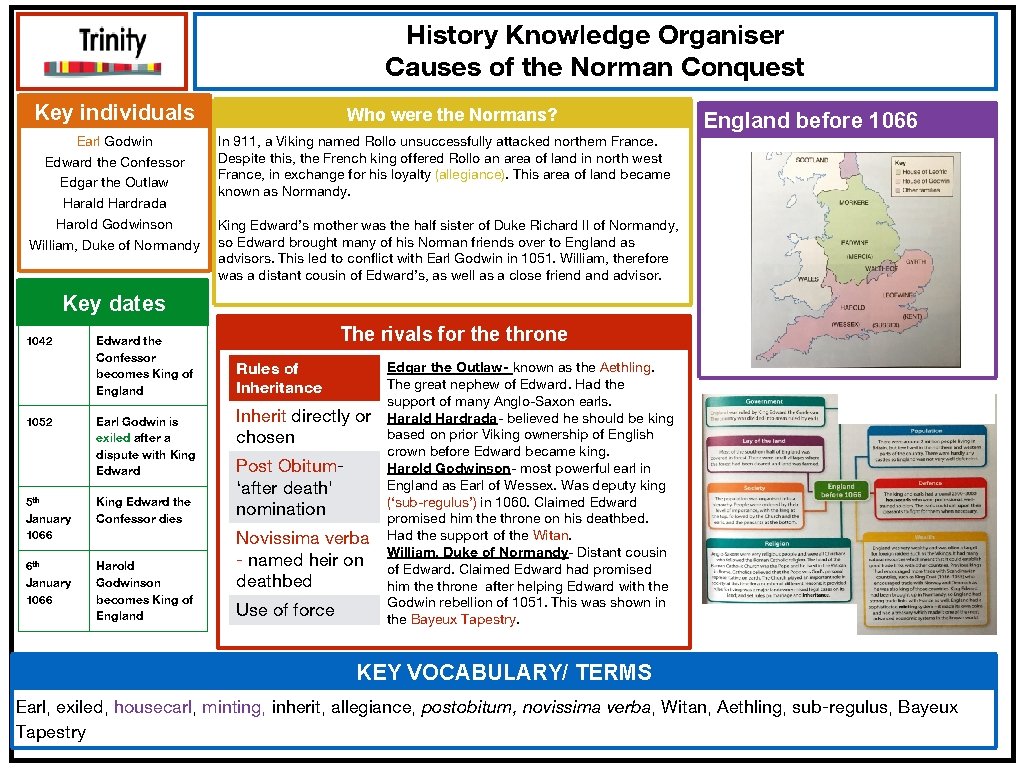
History Knowledge Organiser Causes of the Norman Conquest Key individuals Earl Godwin Edward the Confessor Edgar the Outlaw Harald Hardrada Harold Godwinson William, Duke of Normandy Who were the Normans? In 911, a Viking named Rollo unsuccessfully attacked northern France. Despite this, the French king offered Rollo an area of land in north west France, in exchange for his loyalty (allegiance). This area of land became known as Normandy. England before 1066 King Edward’s mother was the half sister of Duke Richard II of Normandy, so Edward brought many of his Norman friends over to England as advisors. This led to conflict with Earl Godwin in 1051. William, therefore was a distant cousin of Edward’s, as well as a close friend advisor. Key dates 1042 1052 Edward the Confessor becomes King of England Earl Godwin is exiled after a dispute with King Edward 5 th January 1066 King Edward the Confessor dies 6 th January 1066 Harold Godwinson becomes King of England The rivals for the throne Rules of Inheritance Inherit directly or chosen Post Obitum‘after death’ nomination Novissima verba - named heir on deathbed Use of force Edgar the Outlaw- known as the Aethling. The great nephew of Edward. Had the support of many Anglo-Saxon earls. Harald Hardrada- believed he should be king based on prior Viking ownership of English crown before Edward became king. Harold Godwinson- most powerful earl in England as Earl of Wessex. Was deputy king (‘sub-regulus’) in 1060. Claimed Edward promised him the throne on his deathbed. Had the support of the Witan. William, Duke of Normandy- Distant cousin of Edward. Claimed Edward had promised him the throne after helping Edward with the Godwin rebellion of 1051. This was shown in the Bayeux Tapestry. KEY VOCABULARY/ TERMS Earl, exiled, housecarl, minting, inherit, allegiance, postobitum, novissima verba, Witan, Aethling, sub-regulus, Bayeux Tapestry
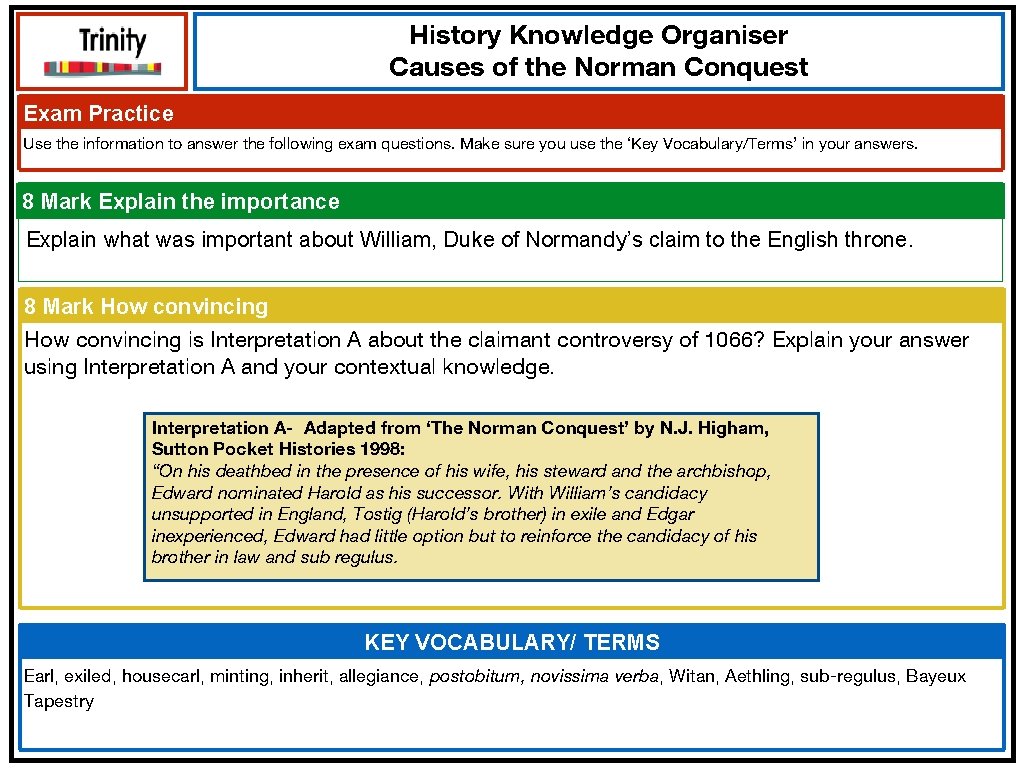
History Knowledge Organiser Causes of the Norman Conquest Exam Practice Use the information to answer the following exam questions. Make sure you use the ‘Key Vocabulary/Terms’ in your answers. 8 Mark Explain the importance Explain what was important about William, Duke of Normandy’s claim to the English throne. 8 Mark How convincing is Interpretation A about the claimant controversy of 1066? Explain your answer using Interpretation A and your contextual knowledge. Interpretation A- Adapted from ‘The Norman Conquest’ by N. J. Higham, Sutton Pocket Histories 1998: “On his deathbed in the presence of his wife, his steward and the archbishop, Edward nominated Harold as his successor. With William’s candidacy unsupported in England, Tostig (Harold’s brother) in exile and Edgar inexperienced, Edward had little option but to reinforce the candidacy of his brother in law and sub regulus. KEY VOCABULARY/ TERMS Earl, exiled, housecarl, minting, inherit, allegiance, postobitum, novissima verba, Witan, Aethling, sub-regulus, Bayeux Tapestry
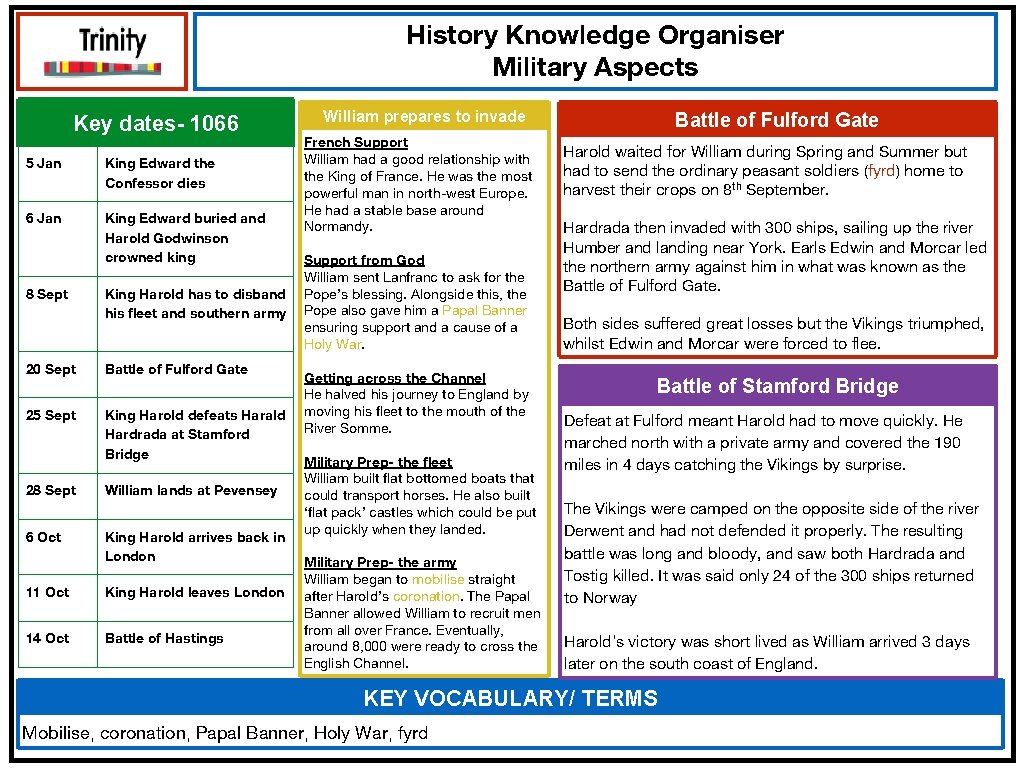
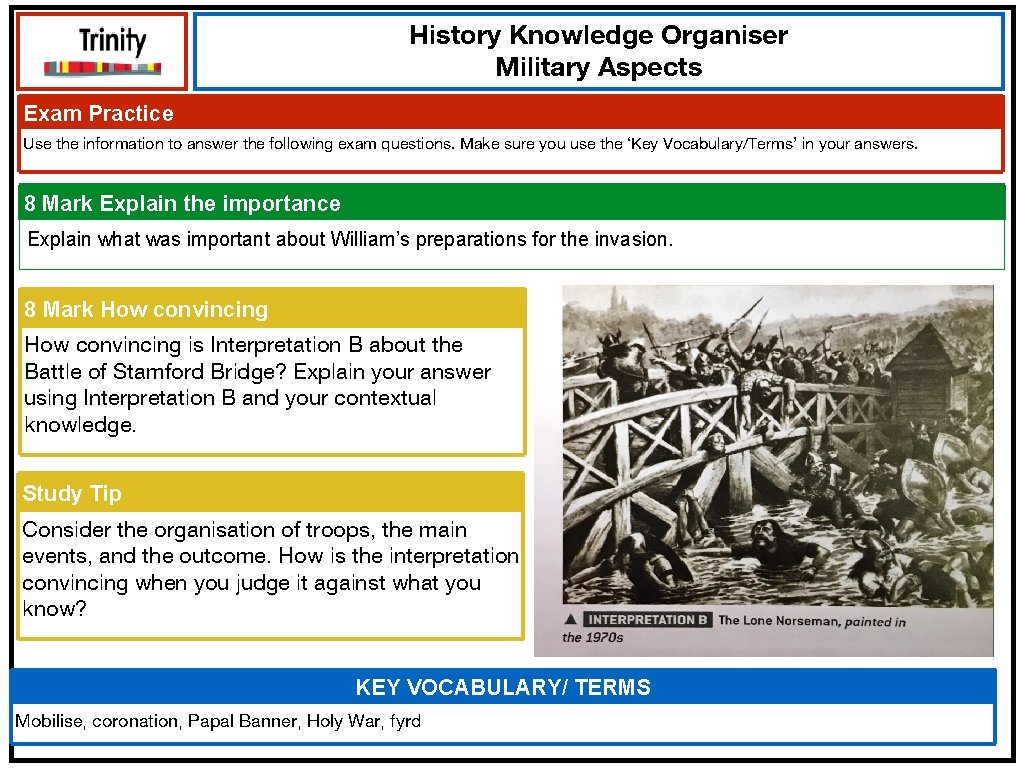
History Knowledge Organiser Military Aspects Key dates- 1066 5 Jan King Edward the Confessor dies 6 Jan King Edward buried and Harold Godwinson crowned king 8 Sept King Harold has to disband his fleet and southern army 20 Sept Battle of Fulford Gate 25 Sept King Harold defeats Harald Hardrada at Stamford Bridge 28 Sept William lands at Pevensey 6 Oct King Harold arrives back in London 11 Oct King Harold leaves London 14 Oct Battle of Hastings William prepares to invade French Support William had a good relationship with the King of France. He was the most powerful man in north-west Europe. He had a stable base around Normandy. Support from God William sent Lanfranc to ask for the Pope’s blessing. Alongside this, the Pope also gave him a Papal Banner ensuring support and a cause of a Holy War. Getting across the Channel He halved his journey to England by moving his fleet to the mouth of the River Somme. Military Prep- the fleet William built flat bottomed boats that could transport horses. He also built ‘flat pack’ castles which could be put up quickly when they landed. Military Prep- the army William began to mobilise straight after Harold’s coronation. The Papal Banner allowed William to recruit men from all over France. Eventually, around 8, 000 were ready to cross the English Channel. Battle of Fulford Gate Harold waited for William during Spring and Summer but had to send the ordinary peasant soldiers (fyrd) home to harvest their crops on 8 th September. Hardrada then invaded with 300 ships, sailing up the river Humber and landing near York. Earls Edwin and Morcar led the northern army against him in what was known as the Battle of Fulford Gate. Both sides suffered great losses but the Vikings triumphed, whilst Edwin and Morcar were forced to flee. Battle of Stamford Bridge Defeat at Fulford meant Harold had to move quickly. He marched north with a private army and covered the 190 miles in 4 days catching the Vikings by surprise. The Vikings were camped on the opposite side of the river Derwent and had not defended it properly. The resulting battle was long and bloody, and saw both Hardrada and Tostig killed. It was said only 24 of the 300 ships returned to Norway Harold's victory was short lived as William arrived 3 days later on the south coast of England. KEY VOCABULARY/ TERMS Mobilise, coronation, Papal Banner, Holy War, fyrd
History Knowledge Organiser Military Aspects Exam Practice Use the information to answer the following exam questions. Make sure you use the ‘Key Vocabulary/Terms’ in your answers. 8 Mark Explain the importance Explain what was important about William’s preparations for the invasion. 8 Mark How convincing is Interpretation B about the Battle of Stamford Bridge? Explain your answer using Interpretation B and your contextual knowledge. Study Tip Consider the organisation of troops, the main events, and the outcome. How is the interpretation convincing when you judge it against what you know? KEY VOCABULARY/ TERMS Mobilise, coronation, Papal Banner, Holy War, fyrd
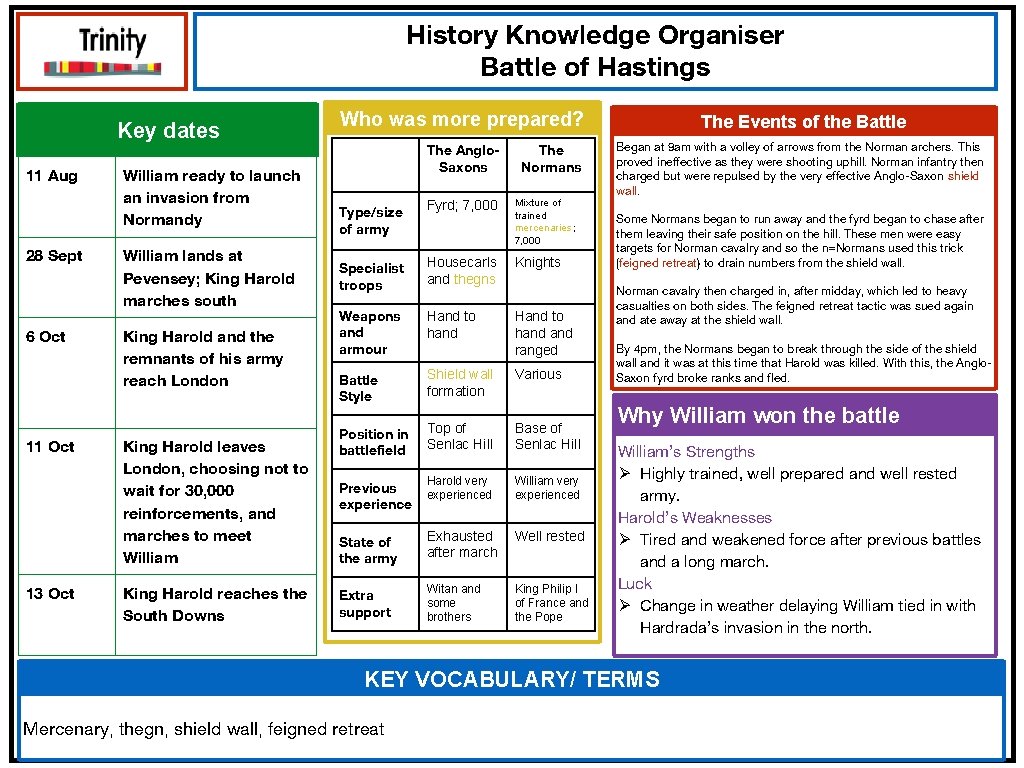
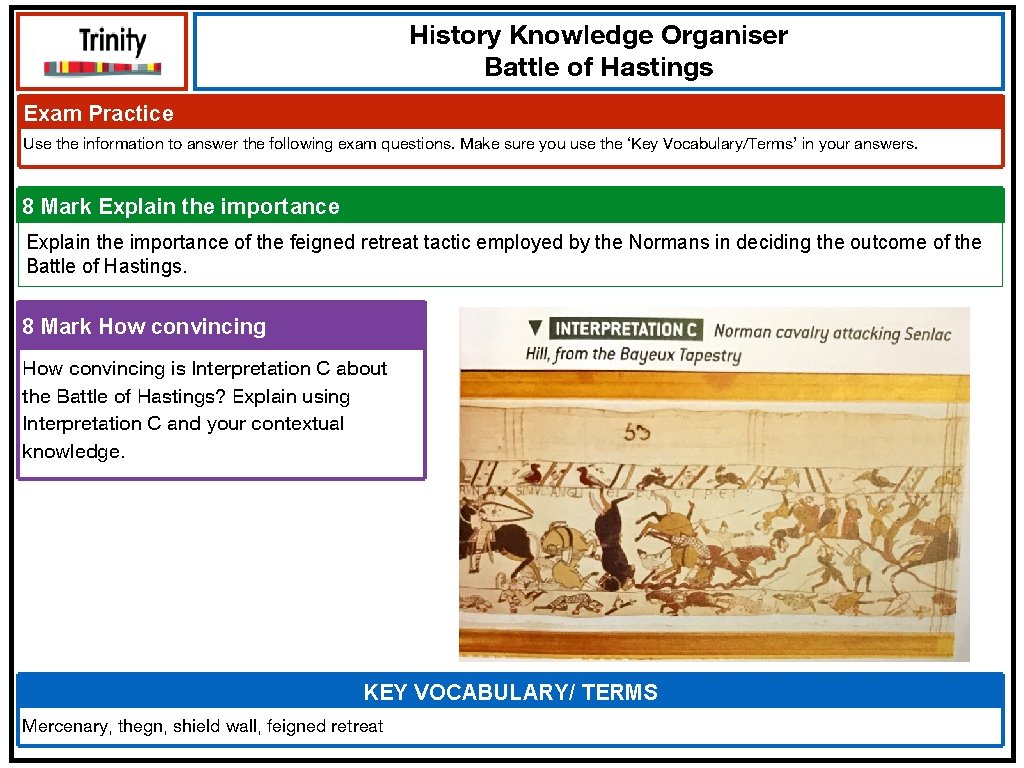
History Knowledge Organiser Battle of Hastings Key dates 11 Aug 28 Sept 6 Oct 11 Oct 13 Oct William ready to launch an invasion from Normandy William lands at Pevensey; King Harold marches south King Harold and the remnants of his army reach London King Harold leaves London, choosing not to wait for 30, 000 reinforcements, and marches to meet William King Harold reaches the South Downs Who was more prepared? The Anglo. Saxons The Normans Type/size of army Fyrd; 7, 000 Mixture of trained mercenaries; 7, 000 Specialist troops Housecarls and thegns Knights Weapons and armour Hand to hand and ranged Battle Style Shield wall formation Various Position in battlefield Top of Senlac Hill Base of Senlac Hill Previous experience Harold very experienced William very experienced State of the army Exhausted after march Well rested Extra support Witan and some brothers King Philip I of France and the Pope The Events of the Battle Began at 9 am with a volley of arrows from the Norman archers. This proved ineffective as they were shooting uphill. Norman infantry then charged but were repulsed by the very effective Anglo-Saxon shield wall. Some Normans began to run away and the fyrd began to chase after them leaving their safe position on the hill. These men were easy targets for Norman cavalry and so the n=Normans used this trick (feigned retreat) to drain numbers from the shield wall. Norman cavalry then charged in, after midday, which led to heavy casualties on both sides. The feigned retreat tactic was sued again and ate away at the shield wall. By 4 pm, the Normans began to break through the side of the shield wall and it was at this time that Harold was killed. With this, the Anglo. Saxon fyrd broke ranks and fled. Why William won the battle William’s Strengths Ø Highly trained, well prepared and well rested army. Harold’s Weaknesses Ø Tired and weakened force after previous battles and a long march. Luck Ø Change in weather delaying William tied in with Hardrada’s invasion in the north. KEY VOCABULARY/ TERMS Mercenary, thegn, shield wall, feigned retreat
History Knowledge Organiser Battle of Hastings Exam Practice Use the information to answer the following exam questions. Make sure you use the ‘Key Vocabulary/Terms’ in your answers. 8 Mark Explain the importance of the feigned retreat tactic employed by the Normans in deciding the outcome of the Battle of Hastings. 8 Mark How convincing is Interpretation C about the Battle of Hastings? Explain using Interpretation C and your contextual knowledge. KEY VOCABULARY/ TERMS Mercenary, thegn, shield wall, feigned retreat
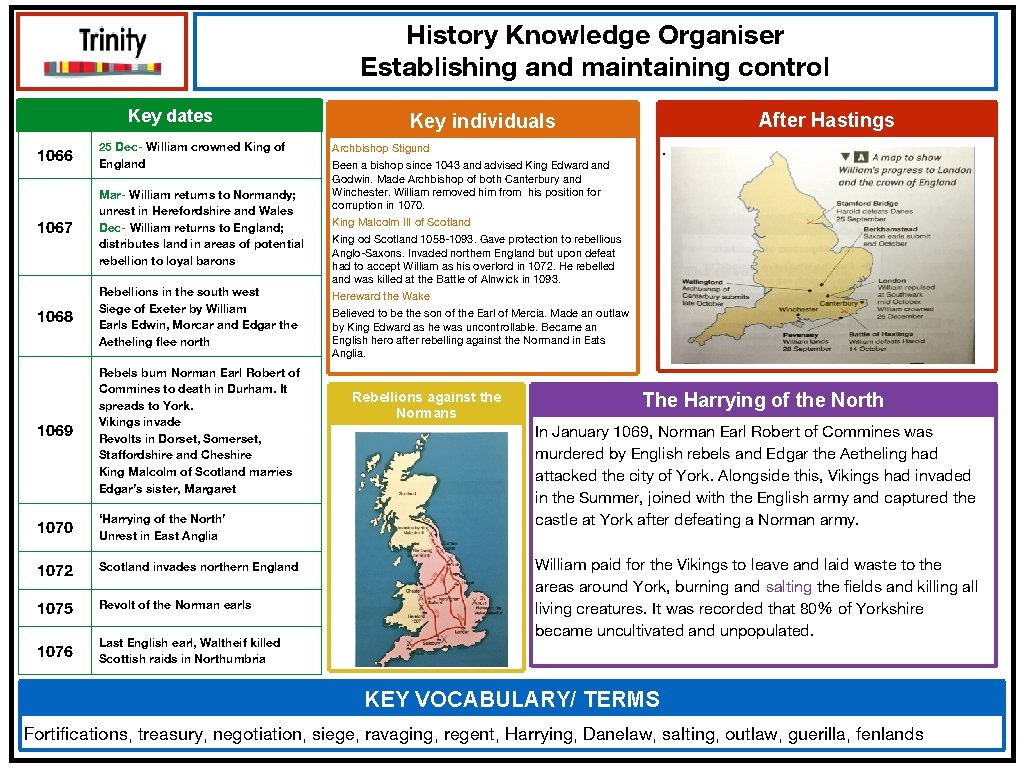
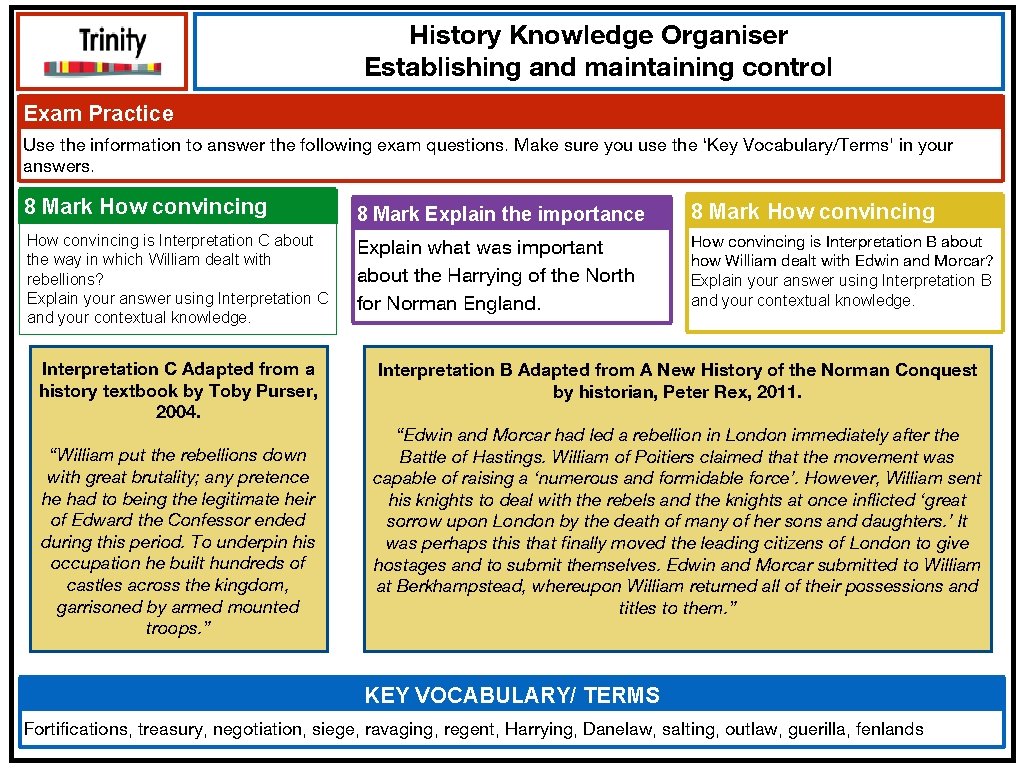
History Knowledge Organiser Establishing and maintaining control Key dates 1066 25 Dec- William crowned King of England 1067 Mar- William returns to Normandy; unrest in Herefordshire and Wales Dec- William returns to England; distributes land in areas of potential rebellion to loyal barons 1068 Rebellions in the south west Siege of Exeter by William Earls Edwin, Morcar and Edgar the Aetheling flee north 1069 Rebels burn Norman Earl Robert of Commines to death in Durham. It spreads to York. Vikings invade Revolts in Dorset, Somerset, Staffordshire and Cheshire King Malcolm of Scotland marries Edgar’s sister, Margaret 1070 ‘Harrying of the North’ Unrest in East Anglia 1072 Scotland invades northern England 1075 Revolt of the Norman earls 1076 Last English earl, Waltheif killed Scottish raids in Northumbria After Hastings Key individuals. Archbishop Stigund Been a bishop since 1043 and advised King Edward and Godwin. Made Archbishop of both Canterbury and Winchester. William removed him from his position for corruption in 1070. King Malcolm III of Scotland King od Scotland 1058 -1093. Gave protection to rebellious Anglo-Saxons. Invaded northern England but upon defeat had to accept William as his overlord in 1072. He rebelled and was killed at the Battle of Alnwick in 1093. Hereward the Wake Believed to be the son of the Earl of Mercia. Made an outlaw by King Edward as he was uncontrollable. Became an English hero after rebelling against the Normand in Eats Anglia. Rebellions against the Normans The Harrying of the North In January 1069, Norman Earl Robert of Commines was murdered by English rebels and Edgar the Aetheling had attacked the city of York. Alongside this, Vikings had invaded in the Summer, joined with the English army and captured the castle at York after defeating a Norman army. William paid for the Vikings to leave and laid waste to the areas around York, burning and salting the fields and killing all living creatures. It was recorded that 80% of Yorkshire became uncultivated and unpopulated. KEY VOCABULARY/ TERMS Fortifications, treasury, negotiation, siege, ravaging, regent, Harrying, Danelaw, salting, outlaw, guerilla, fenlands
History Knowledge Organiser Establishing and maintaining control Exam Practice Use the information to answer the following exam questions. Make sure you use the ‘Key Vocabulary/Terms’ in your answers. 8 Mark How convincing 8 Mark Explain the importance 8 Mark How convincing is Interpretation C about the way in which William dealt with rebellions? Explain your answer using Interpretation C and your contextual knowledge. Explain what was important about the Harrying of the North for Norman England. How convincing is Interpretation B about how William dealt with Edwin and Morcar? Explain your answer using Interpretation B and your contextual knowledge. Interpretation C Adapted from a history textbook by Toby Purser, 2004. “William put the rebellions down with great brutality; any pretence he had to being the legitimate heir of Edward the Confessor ended during this period. To underpin his occupation he built hundreds of castles across the kingdom, garrisoned by armed mounted troops. ” Interpretation B Adapted from A New History of the Norman Conquest by historian, Peter Rex, 2011. “Edwin and Morcar had led a rebellion in London immediately after the Battle of Hastings. William of Poitiers claimed that the movement was capable of raising a ‘numerous and formidable force’. However, William sent his knights to deal with the rebels and the knights at once inflicted ‘great sorrow upon London by the death of many of her sons and daughters. ’ It was perhaps this that finally moved the leading citizens of London to give hostages and to submit themselves. Edwin and Morcar submitted to William at Berkhampstead, whereupon William returned all of their possessions and titles to them. ” KEY VOCABULARY/ TERMS Fortifications, treasury, negotiation, siege, ravaging, regent, Harrying, Danelaw, salting, outlaw, guerilla, fenlands
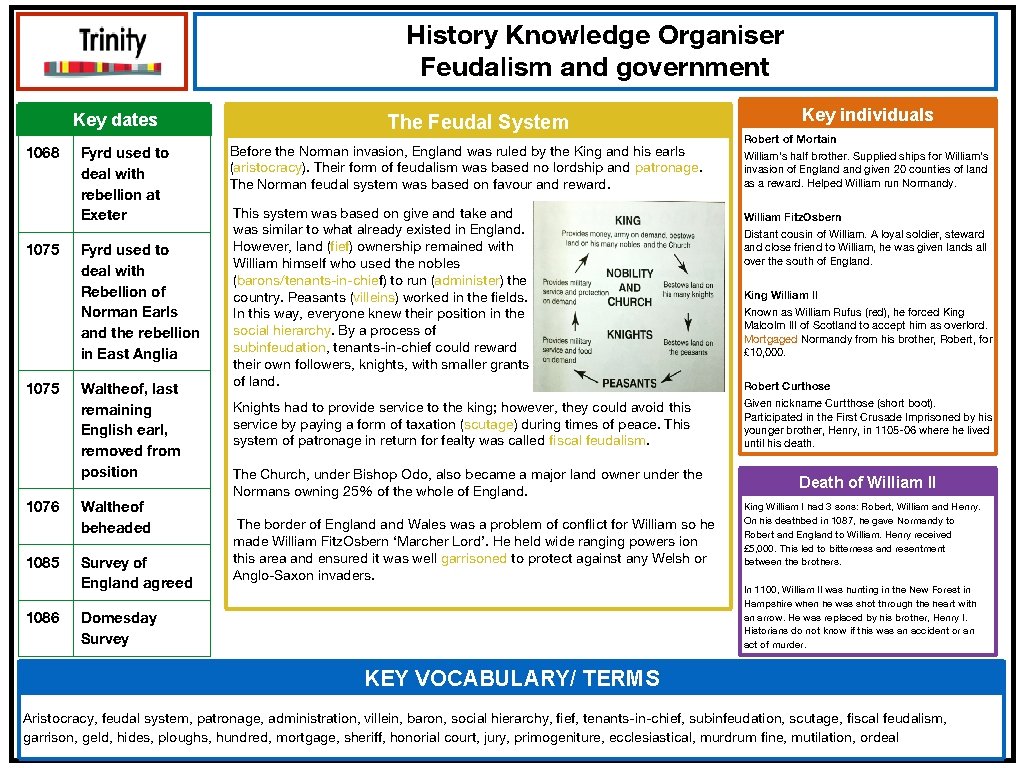
History Knowledge Organiser Feudalism and government Key dates 1068 1075 Fyrd used to deal with rebellion at Exeter Fyrd used to deal with Rebellion of Norman Earls and the rebellion in East Anglia Waltheof, last remaining English earl, removed from position 1076 Waltheof beheaded 1085 Survey of England agreed 1086 The Feudal System Before the Norman invasion, England was ruled by the King and his earls (aristocracy). Their form of feudalism was based no lordship and patronage. The Norman feudal system was based on favour and reward. This system was based on give and take and was similar to what already existed in England. However, land (fief) ownership remained with William himself who used the nobles (barons/tenants-in-chief) to run (administer) the country. Peasants (villeins) worked in the fields. In this way, everyone knew their position in the social hierarchy. By a process of subinfeudation, tenants-in-chief could reward their own followers, knights, with smaller grants of land. Knights had to provide service to the king; however, they could avoid this service by paying a form of taxation (scutage) during times of peace. This system of patronage in return for fealty was called fiscal feudalism. The Church, under Bishop Odo, also became a major land owner under the Normans owning 25% of the whole of England. The border of England Wales was a problem of conflict for William so he made William Fitz. Osbern ‘Marcher Lord’. He held wide ranging powers ion this area and ensured it was well garrisoned to protect against any Welsh or Anglo-Saxon invaders. Domesday Survey Key individuals Robert of Mortain William’s half brother. Supplied ships for William’s invasion of England given 20 counties of land as a reward. Helped William run Normandy. William Fitz. Osbern Distant cousin of William. A loyal soldier, steward and close friend to William, he was given lands all over the south of England. King William II Known as William Rufus (red), he forced King Malcolm III of Scotland to accept him as overlord. Mortgaged Normandy from his brother, Robert, for £ 10, 000. Robert Curthose Given nickname Curtthose (short boot). Participated in the First Crusade Imprisoned by his younger brother, Henry, in 1105 -06 where he lived until his death. Death of William II King William I had 3 sons: Robert, William and Henry. On his deathbed in 1087, he gave Normandy to Robert and England to William. Henry received £ 5, 000. This led to bitterness and resentment between the brothers. In 1100, William II was hunting in the New Forest in Hampshire when he was shot through the heart with an arrow. He was replaced by his brother, Henry I. Historians do not know if this was an accident or an act of murder. KEY VOCABULARY/ TERMS Aristocracy, feudal system, patronage, administration, villein, baron, social hierarchy, fief, tenants-in-chief, subinfeudation, scutage, fiscal feudalism, garrison, geld, hides, ploughs, hundred, mortgage, sheriff, honorial court, jury, primogeniture, ecclesiastical, murdrum fine, mutilation, ordeal
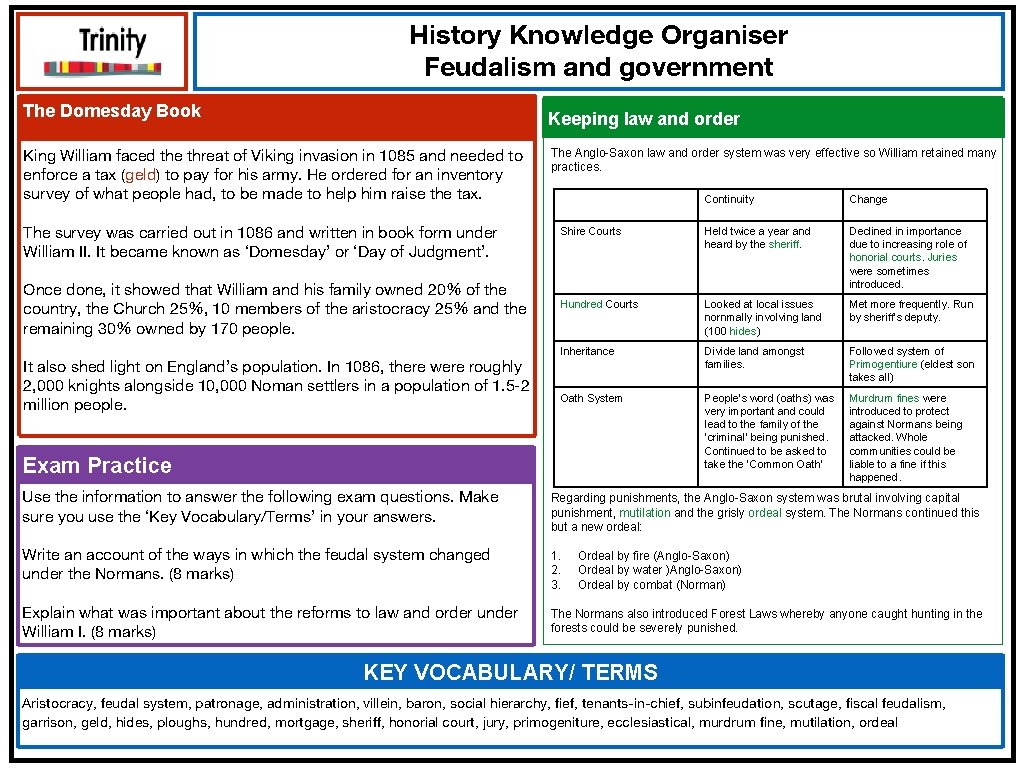
History Knowledge Organiser Feudalism and government The Domesday Book Keeping law and order King William faced the threat of Viking invasion in 1085 and needed to enforce a tax (geld) to pay for his army. He ordered for an inventory survey of what people had, to be made to help him raise the tax. The survey was carried out in 1086 and written in book form under William II. It became known as ‘Domesday’ or ‘Day of Judgment’. Once done, it showed that William and his family owned 20% of the country, the Church 25%, 10 members of the aristocracy 25% and the remaining 30% owned by 170 people. It also shed light on England’s population. In 1086, there were roughly 2, 000 knights alongside 10, 000 Noman settlers in a population of 1. 5 -2 million people. The Anglo-Saxon law and order system was very effective so William retained many practices. Continuity Change Shire Courts Held twice a year and heard by the sheriff. Declined in importance due to increasing role of honorial courts. Juries were sometimes introduced. Hundred Courts Looked at local issues nornmally involving land (100 hides) Met more frequently. Run by sheriff’s deputy. Inheritance Divide land amongst families. Followed system of Primogentiure (eldest son takes all) Oath System People’s word (oaths) was very important and could lead to the family of the ‘criminal’ being punished. Continued to be asked to take the ‘Common Oath’ Murdrum fines were introduced to protect against Normans being attacked. Whole communities could be liable to a fine if this happened. Exam Practice Use the information to answer the following exam questions. Make sure you use the ‘Key Vocabulary/Terms’ in your answers. Regarding punishments, the Anglo-Saxon system was brutal involving capital punishment, mutilation and the grisly ordeal system. The Normans continued this but a new ordeal: Write an account of the ways in which the feudal system changed under the Normans. (8 marks) 1. 2. 3. Explain what was important about the reforms to law and order under William I. (8 marks) The Normans also introduced Forest Laws whereby anyone caught hunting in the forests could be severely punished. Ordeal by fire (Anglo-Saxon) Ordeal by water )Anglo-Saxon) Ordeal by combat (Norman) KEY VOCABULARY/ TERMS Aristocracy, feudal system, patronage, administration, villein, baron, social hierarchy, fief, tenants-in-chief, subinfeudation, scutage, fiscal feudalism, garrison, geld, hides, ploughs, hundred, mortgage, sheriff, honorial court, jury, primogeniture, ecclesiastical, murdrum fine, mutilation, ordeal
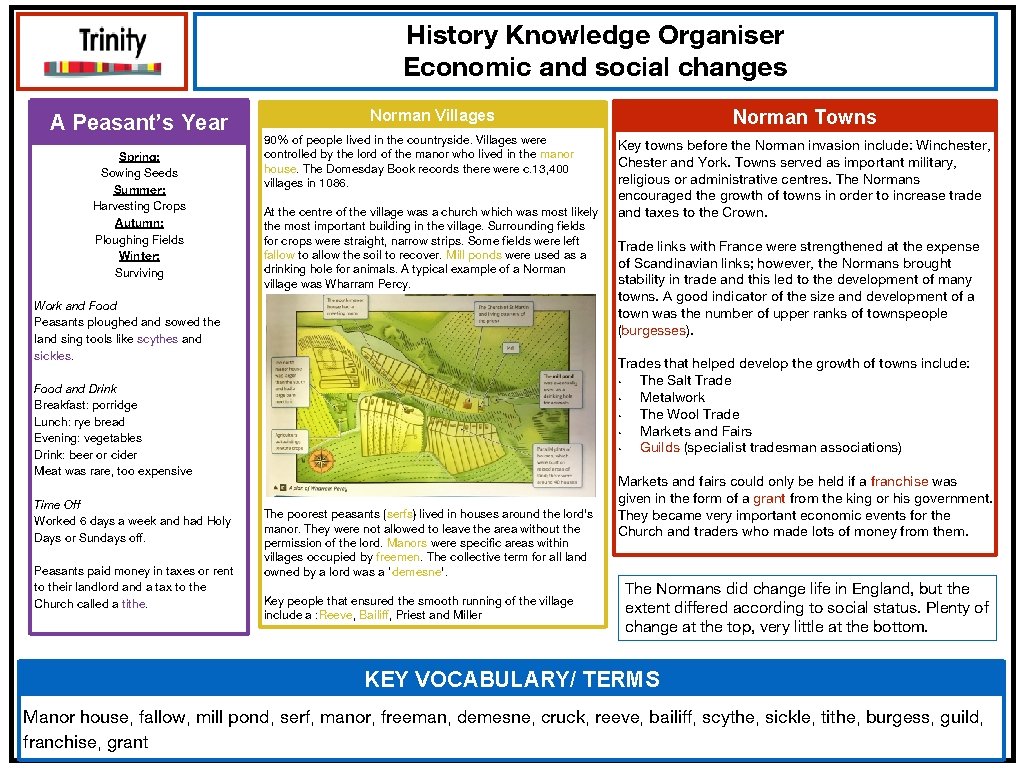
History Knowledge Organiser Economic and social changes A Peasant’s Year Spring: Sowing Seeds Summer: Harvesting Crops Autumn: Ploughing Fields Winter: Surviving 90% of people lived in the countryside. Villages were controlled by the lord of the manor who lived in the manor house. The Domesday Book records there were c. 13, 400 villages in 1086. At the centre of the village was a church which was most likely the most important building in the village. Surrounding fields for crops were straight, narrow strips. Some fields were left fallow to allow the soil to recover. Mill ponds were used as a drinking hole for animals. A typical example of a Norman village was Wharram Percy. Work and Food Peasants ploughed and sowed the land sing tools like scythes and sickles. Peasants paid money in taxes or rent to their landlord and a tax to the Church called a tithe. Key towns before the Norman invasion include: Winchester, Chester and York. Towns served as important military, religious or administrative centres. The Normans encouraged the growth of towns in order to increase trade and taxes to the Crown. Trade links with France were strengthened at the expense of Scandinavian links; however, the Normans brought stability in trade and this led to the development of many towns. A good indicator of the size and development of a town was the number of upper ranks of townspeople (burgesses). Trades that helped develop the growth of towns include: • The Salt Trade • Metalwork • The Wool Trade • Markets and Fairs • Guilds (specialist tradesman associations) Food and Drink Breakfast: porridge Lunch: rye bread Evening: vegetables Drink: beer or cider Meat was rare, too expensive Time Off Worked 6 days a week and had Holy Days or Sundays off. Norman Towns Norman Villages The poorest peasants (serfs) lived in houses around the lord’s manor. They were not allowed to leave the area without the permission of the lord. Manors were specific areas within villages occupied by freemen. The collective term for all land owned by a lord was a ‘demesne’. Key people that ensured the smooth running of the village include a : Reeve, Bailiff, Priest and Miller Markets and fairs could only be held if a franchise was given in the form of a grant from the king or his government. They became very important economic events for the Church and traders who made lots of money from them. The Normans did change life in England, but the extent differed according to social status. Plenty of change at the top, very little at the bottom. KEY VOCABULARY/ TERMS Manor house, fallow, mill pond, serf, manor, freeman, demesne, cruck, reeve, bailiff, scythe, sickle, tithe, burgess, guild, franchise, grant
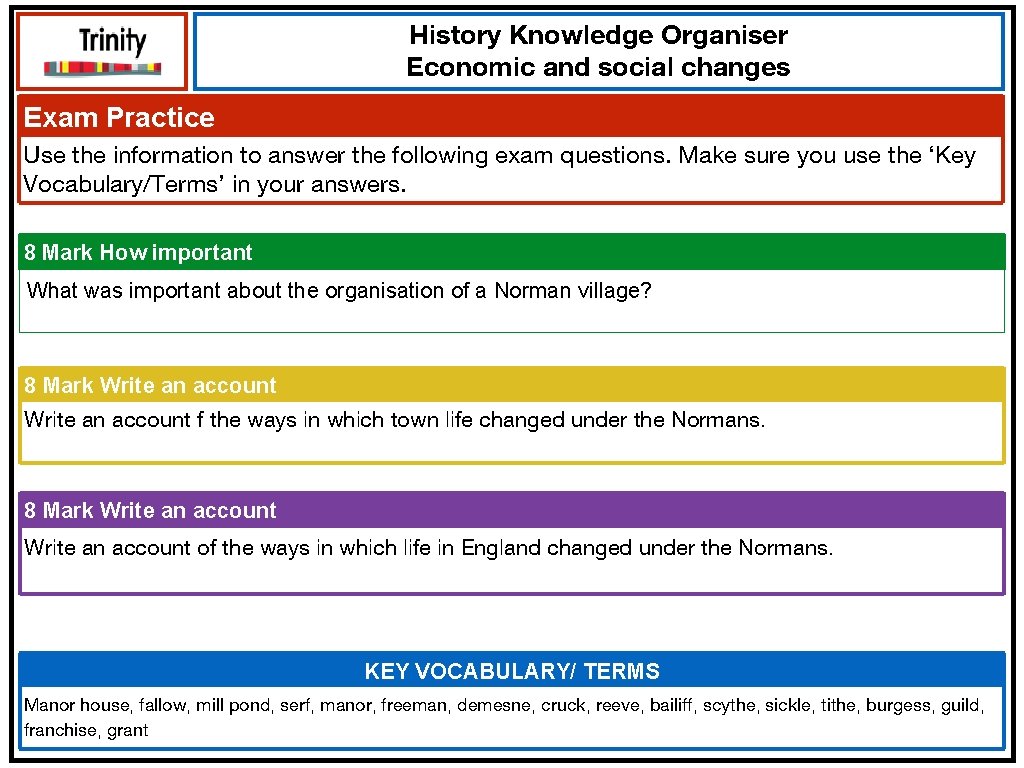
History Knowledge Organiser Economic and social changes Exam Practice Use the information to answer the following exam questions. Make sure you use the ‘Key Vocabulary/Terms’ in your answers. 8 Mark How important What was important about the organisation of a Norman village? 8 Mark Write an account f the ways in which town life changed under the Normans. 8 Mark Write an account of the ways in which life in England changed under the Normans. KEY VOCABULARY/ TERMS Manor house, fallow, mill pond, serf, manor, freeman, demesne, cruck, reeve, bailiff, scythe, sickle, tithe, burgess, guild, franchise, grant
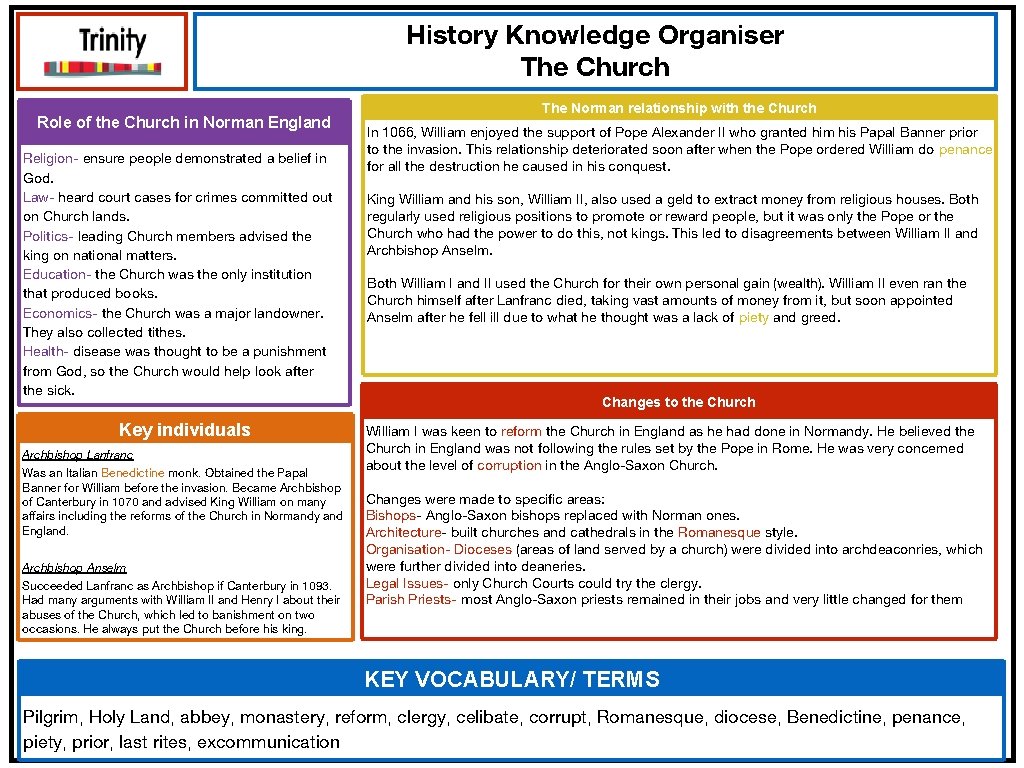
History Knowledge Organiser The Church Role of the Church in Norman England Religion- ensure people demonstrated a belief in God. Law- heard court cases for crimes committed out on Church lands. Politics- leading Church members advised the king on national matters. Education- the Church was the only institution that produced books. Economics- the Church was a major landowner. They also collected tithes. Health- disease was thought to be a punishment from God, so the Church would help look after the sick. Key individuals Archbishop Lanfranc Was an Italian Benedictine monk. Obtained the Papal Banner for William before the invasion. Became Archbishop of Canterbury in 1070 and advised King William on many affairs including the reforms of the Church in Normandy and England. Archbishop Anselm Succeeded Lanfranc as Archbishop if Canterbury in 1093. Had many arguments with William II and Henry I about their abuses of the Church, which led to banishment on two occasions. He always put the Church before his king. The Norman relationship with the Church In 1066, William enjoyed the support of Pope Alexander II who granted him his Papal Banner prior to the invasion. This relationship deteriorated soon after when the Pope ordered William do penance for all the destruction he caused in his conquest. King William and his son, William II, also used a geld to extract money from religious houses. Both regularly used religious positions to promote or reward people, but it was only the Pope or the Church who had the power to do this, not kings. This led to disagreements between William II and Archbishop Anselm. Both William I and II used the Church for their own personal gain (wealth). William II even ran the Church himself after Lanfranc died, taking vast amounts of money from it, but soon appointed Anselm after he fell ill due to what he thought was a lack of piety and greed. Changes to the Church William I was keen to reform the Church in England as he had done in Normandy. He believed the Church in England was not following the rules set by the Pope in Rome. He was very concerned about the level of corruption in the Anglo-Saxon Church. Changes were made to specific areas: Bishops- Anglo-Saxon bishops replaced with Norman ones. Architecture- built churches and cathedrals in the Romanesque style. Organisation- Dioceses (areas of land served by a church) were divided into archdeaconries, which were further divided into deaneries. Legal Issues- only Church Courts could try the clergy. Parish Priests- most Anglo-Saxon priests remained in their jobs and very little changed for them KEY VOCABULARY/ TERMS Pilgrim, Holy Land, abbey, monastery, reform, clergy, celibate, corrupt, Romanesque, diocese, Benedictine, penance, piety, prior, last rites, excommunication
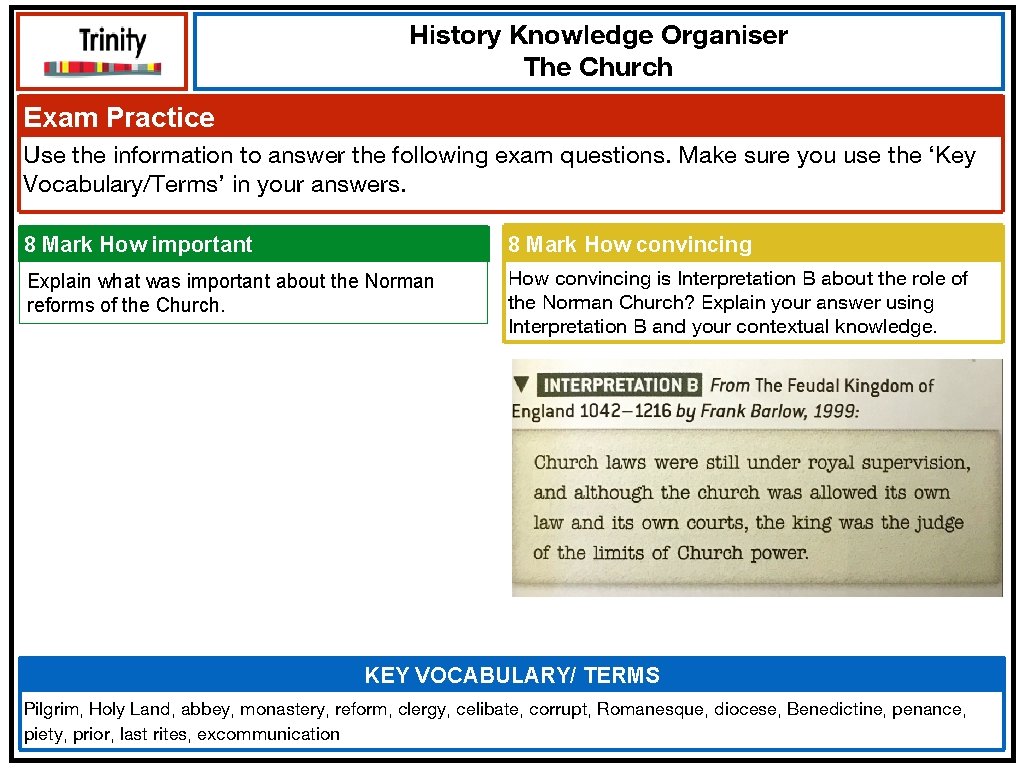
History Knowledge Organiser The Church Exam Practice Use the information to answer the following exam questions. Make sure you use the ‘Key Vocabulary/Terms’ in your answers. 8 Mark How important 8 Mark How convincing Explain what was important about the Norman reforms of the Church. How convincing is Interpretation B about the role of the Norman Church? Explain your answer using Interpretation B and your contextual knowledge. KEY VOCABULARY/ TERMS Pilgrim, Holy Land, abbey, monastery, reform, clergy, celibate, corrupt, Romanesque, diocese, Benedictine, penance, piety, prior, last rites, excommunication
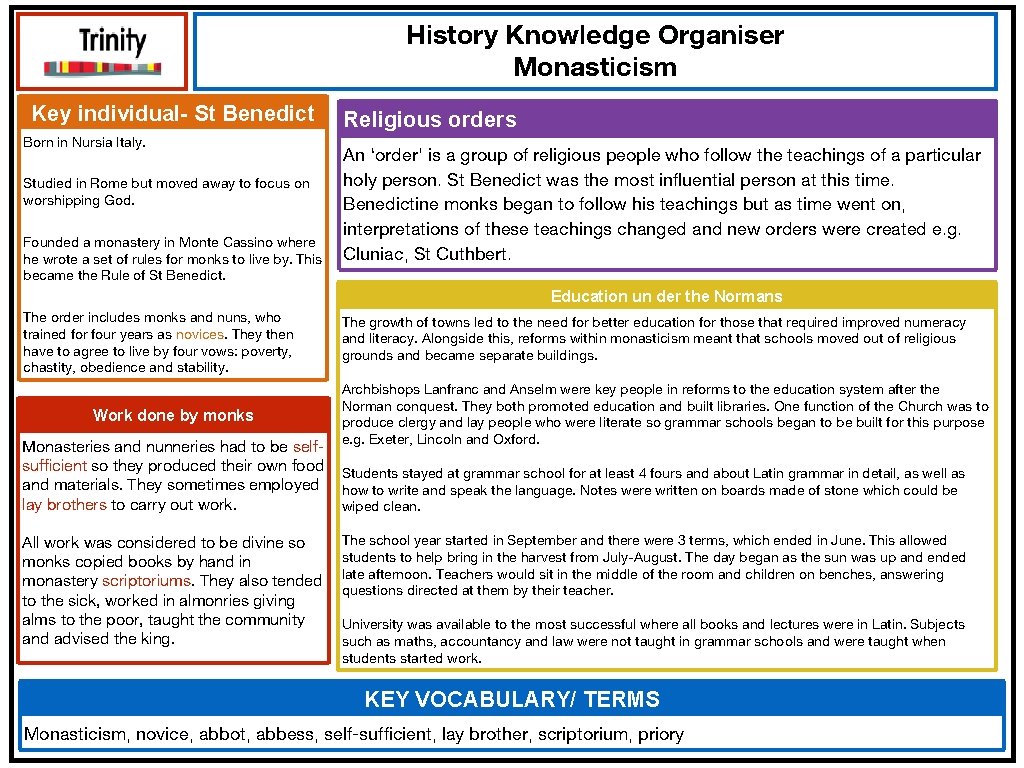
History Knowledge Organiser Monasticism Key individual- St Benedict Born in Nursia Italy. Studied in Rome but moved away to focus on worshipping God. Founded a monastery in Monte Cassino where he wrote a set of rules for monks to live by. This became the Rule of St Benedict. Religious orders An ‘order’ is a group of religious people who follow the teachings of a particular holy person. St Benedict was the most influential person at this time. Benedictine monks began to follow his teachings but as time went on, interpretations of these teachings changed and new orders were created e. g. Cluniac, St Cuthbert. Education un der the Normans The order includes monks and nuns, who trained for four years as novices. They then have to agree to live by four vows: poverty, chastity, obedience and stability. Work done by monks Monasteries and nunneries had to be selfsufficient so they produced their own food and materials. They sometimes employed lay brothers to carry out work. All work was considered to be divine so monks copied books by hand in monastery scriptoriums. They also tended to the sick, worked in almonries giving alms to the poor, taught the community and advised the king. The growth of towns led to the need for better education for those that required improved numeracy and literacy. Alongside this, reforms within monasticism meant that schools moved out of religious grounds and became separate buildings. Archbishops Lanfranc and Anselm were key people in reforms to the education system after the Norman conquest. They both promoted education and built libraries. One function of the Church was to produce clergy and lay people who were literate so grammar schools began to be built for this purpose e. g. Exeter, Lincoln and Oxford. Students stayed at grammar school for at least 4 fours and about Latin grammar in detail, as well as how to write and speak the language. Notes were written on boards made of stone which could be wiped clean. The school year started in September and there were 3 terms, which ended in June. This allowed students to help bring in the harvest from July-August. The day began as the sun was up and ended late afternoon. Teachers would sit in the middle of the room and children on benches, answering questions directed at them by their teacher. University was available to the most successful where all books and lectures were in Latin. Subjects such as maths, accountancy and law were not taught in grammar schools and were taught when students started work. KEY VOCABULARY/ TERMS Monasticism, novice, abbot, abbess, self-sufficient, lay brother, scriptorium, priory
History Knowledge Organiser Monasticism Exam Practice Use the information to answer the following exam questions. Make sure you use the ‘Key Vocabulary/Terms’ in your answers. 8 Mark Write an account of the ways in which education changed under the Normans. KEY VOCABULARY/ TERMS Monasticism, novice, abbot, abbess, self-sufficient, lay brother, scriptorium, priory