
Normalization Presented By Md Zahid Hasan Zahid csediu

Normalization Presented By Md. Zahid Hasan Zahid. cse@diu. edu. bd
Definition • Normalization is the process of organizing the data in the database. • Normalization is used to minimize the redundancy from a relation or set of relations. It is also used to eliminate the undesirable characteristics like Insertion, Update and Deletion Anomalies. • Normalization divides the larger table into the smaller table and links them using relationship. • The normal form is used to reduce redundancy from the database table
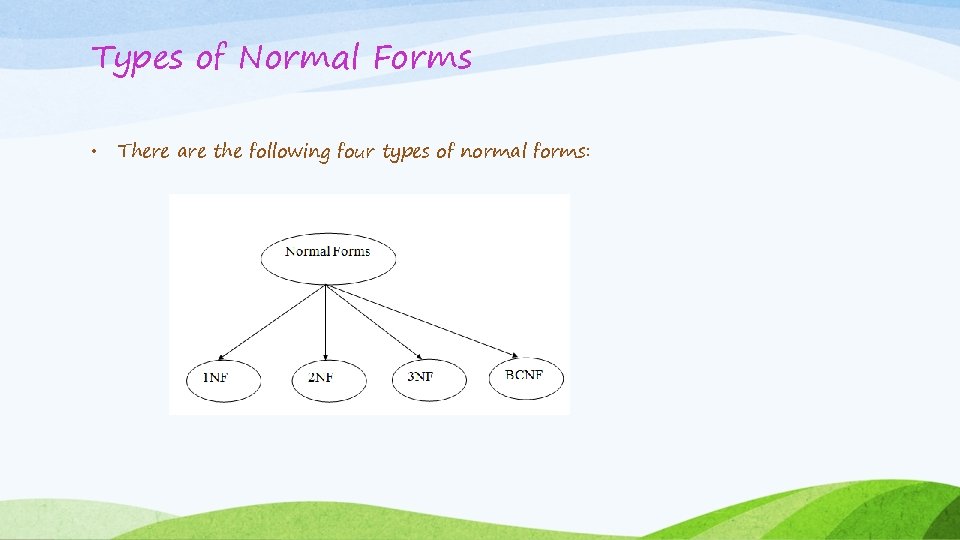
Types of Normal Forms • There are the following four types of normal forms:
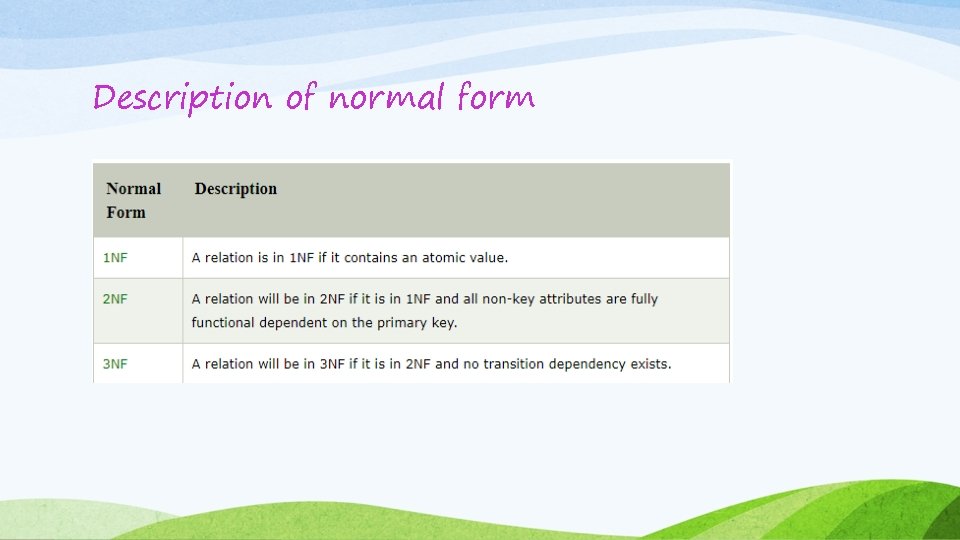
Description of normal form
First Normal Form (1 NF) • A relation will be 1 NF if it contains an atomic value. • It states that an attribute of a table cannot hold multiple values. It must hold only single-valued attribute. • First normal form disallows the multi-valued attribute, composite attribute, and their combinations.
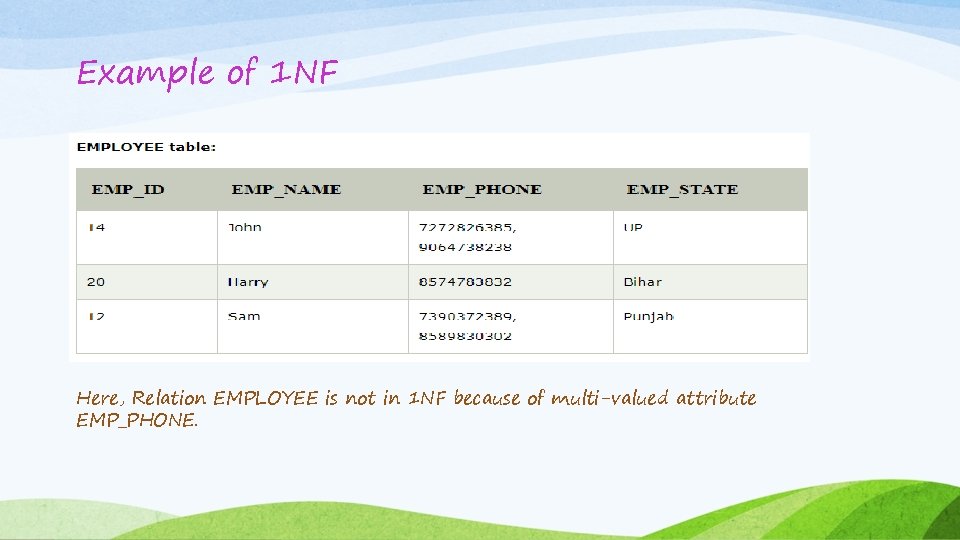
Example of 1 NF Here, Relation EMPLOYEE is not in 1 NF because of multi-valued attribute EMP_PHONE.
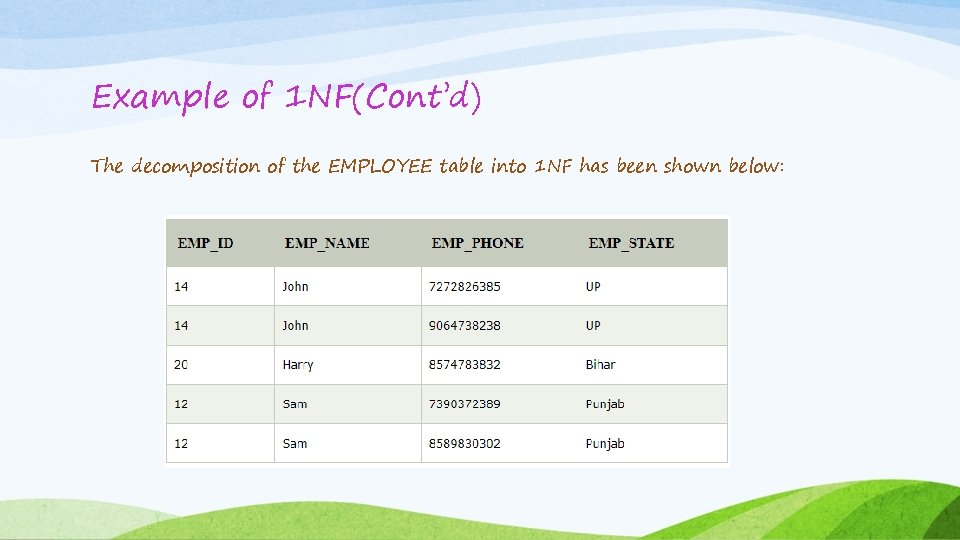
Example of 1 NF(Cont’d) The decomposition of the EMPLOYEE table into 1 NF has been shown below:
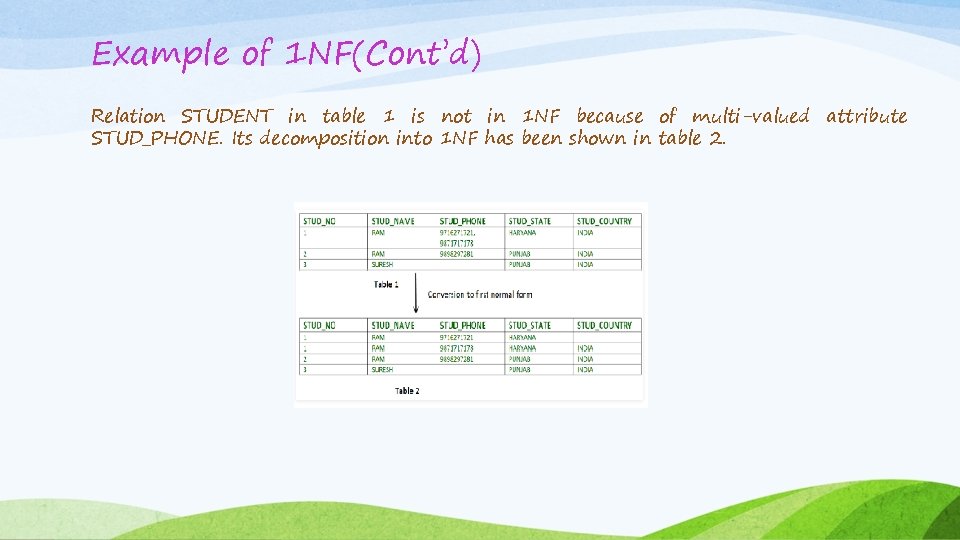
Example of 1 NF(Cont’d) Relation STUDENT in table 1 is not in 1 NF because of multi-valued attribute STUD_PHONE. Its decomposition into 1 NF has been shown in table 2.
Second Normal Form (2 NF) • In the 2 NF, relational must be in 1 NF. • In the second normal form, this full functional dependency means that it meets the requirements of First Normal Form (1 NF), and all non-key attributes are fully functionally dependent on the primary key. • A relation is in 2 NF if it has No Partial Dependency • If the proper subset of candidate key determines non-prime attribute, it is called partial dependency. • 2 NF tries to reduce the redundant data getting stored in memory.
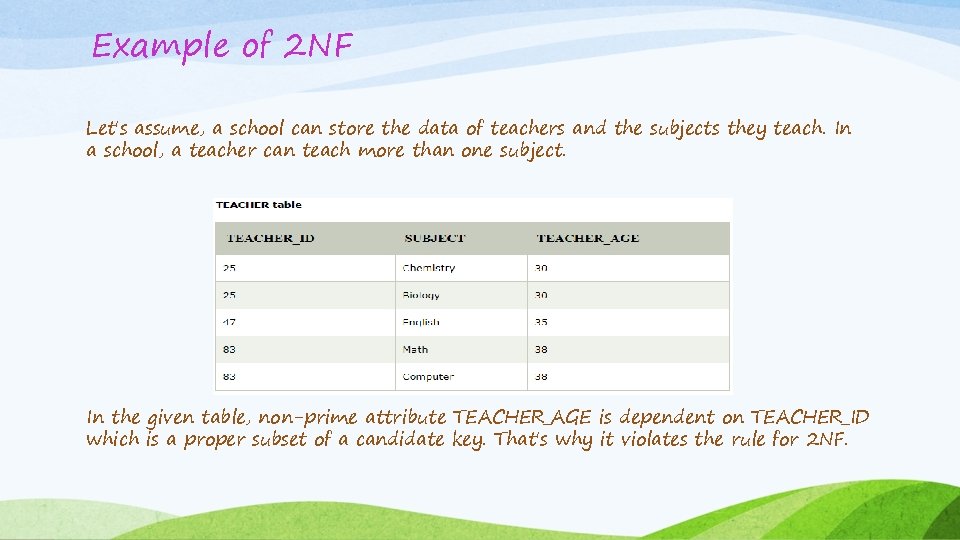
Example of 2 NF Let's assume, a school can store the data of teachers and the subjects they teach. In a school, a teacher can teach more than one subject. In the given table, non-prime attribute TEACHER_AGE is dependent on TEACHER_ID which is a proper subset of a candidate key. That's why it violates the rule for 2 NF.
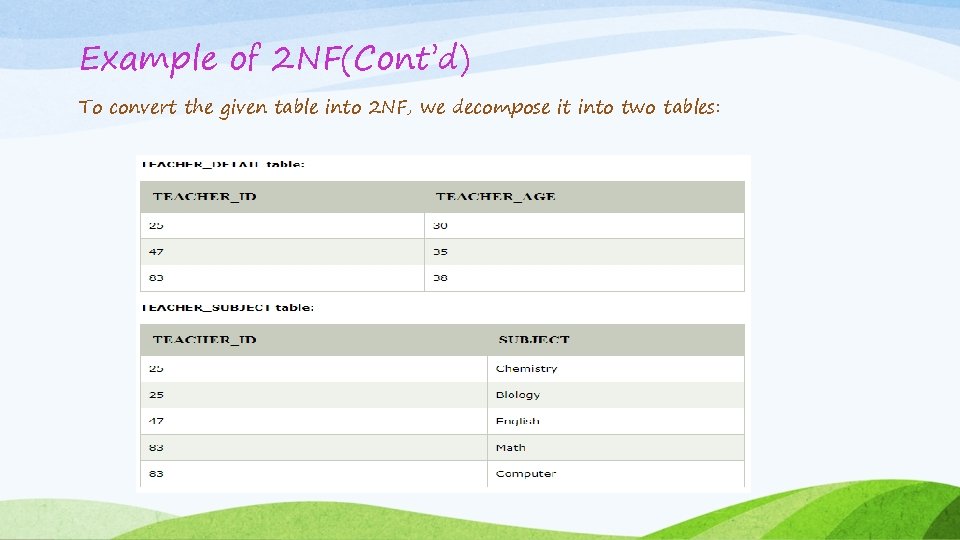
Example of 2 NF(Cont’d) To convert the given table into 2 NF, we decompose it into two tables:
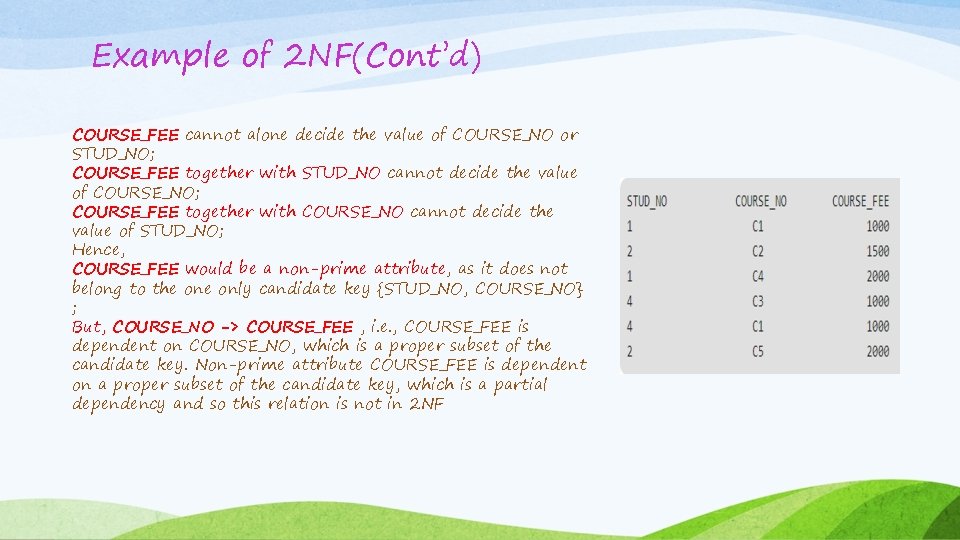
Example of 2 NF(Cont’d) COURSE_FEE cannot alone decide the value of COURSE_NO or STUD_NO; COURSE_FEE together with STUD_NO cannot decide the value of COURSE_NO; COURSE_FEE together with COURSE_NO cannot decide the value of STUD_NO; Hence, COURSE_FEE would be a non-prime attribute, as it does not belong to the only candidate key {STUD_NO, COURSE_NO} ; But, COURSE_NO -> COURSE_FEE , i. e. , COURSE_FEE is dependent on COURSE_NO, which is a proper subset of the candidate key. Non-prime attribute COURSE_FEE is dependent on a proper subset of the candidate key, which is a partial dependency and so this relation is not in 2 NF
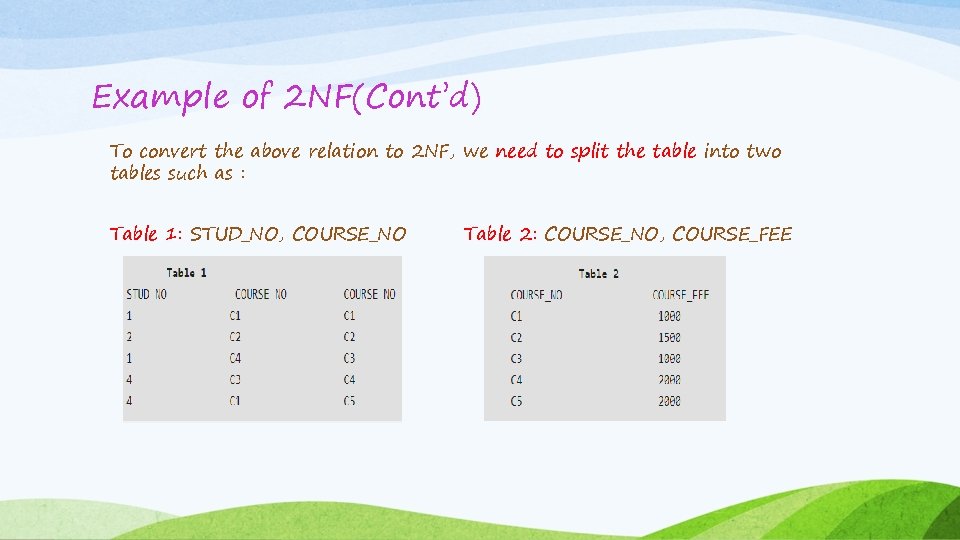
Example of 2 NF(Cont’d) To convert the above relation to 2 NF, we need to split the table into two tables such as : Table 1: STUD_NO, COURSE_NO Table 2: COURSE_NO, COURSE_FEE
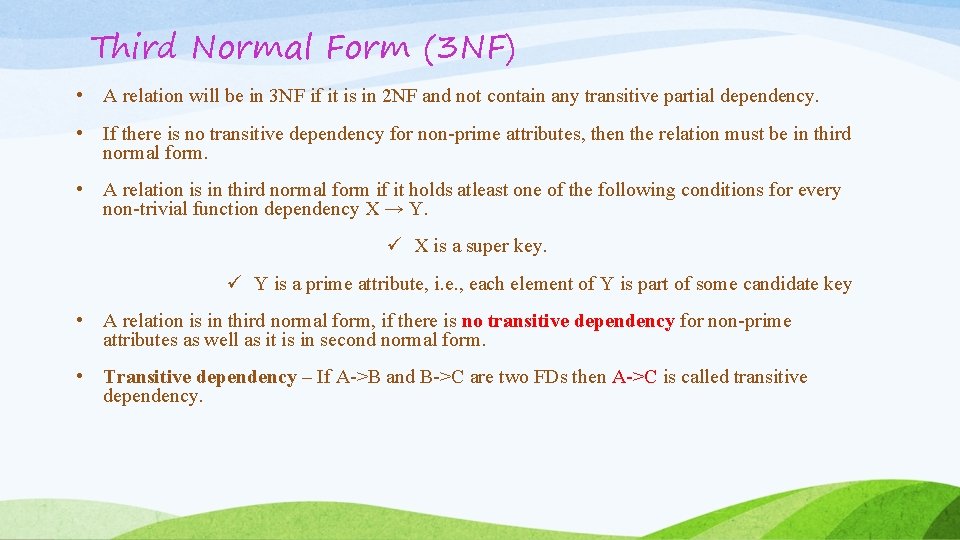
Third Normal Form (3 NF) • A relation will be in 3 NF if it is in 2 NF and not contain any transitive partial dependency. • If there is no transitive dependency for non-prime attributes, then the relation must be in third normal form. • A relation is in third normal form if it holds atleast one of the following conditions for every non-trivial function dependency X → Y. ü X is a super key. ü Y is a prime attribute, i. e. , each element of Y is part of some candidate key • A relation is in third normal form, if there is no transitive dependency for non-prime attributes as well as it is in second normal form. • Transitive dependency – If A->B and B->C are two FDs then A->C is called transitive dependency.
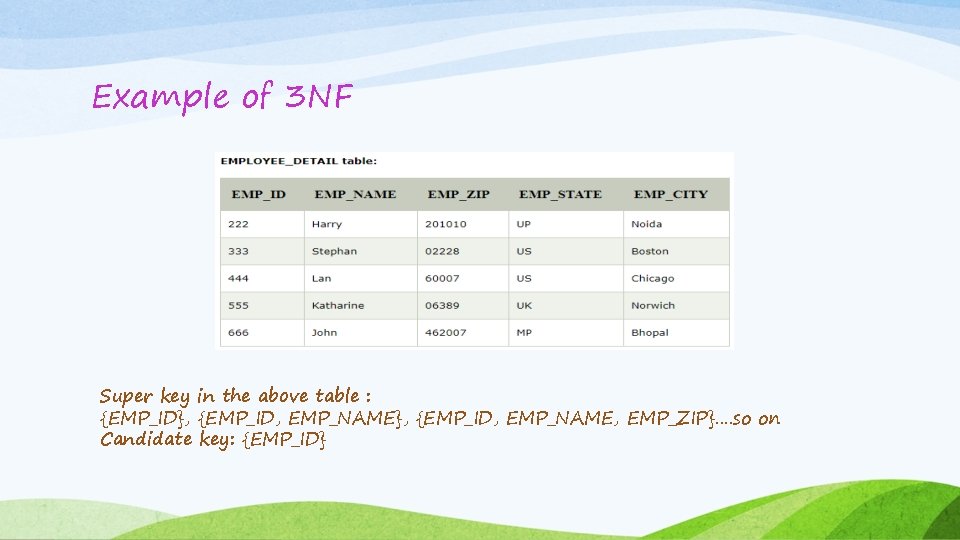
Example of 3 NF Super key in the above table : {EMP_ID}, {EMP_ID, EMP_NAME, EMP_ZIP}. . so on Candidate key: {EMP_ID}
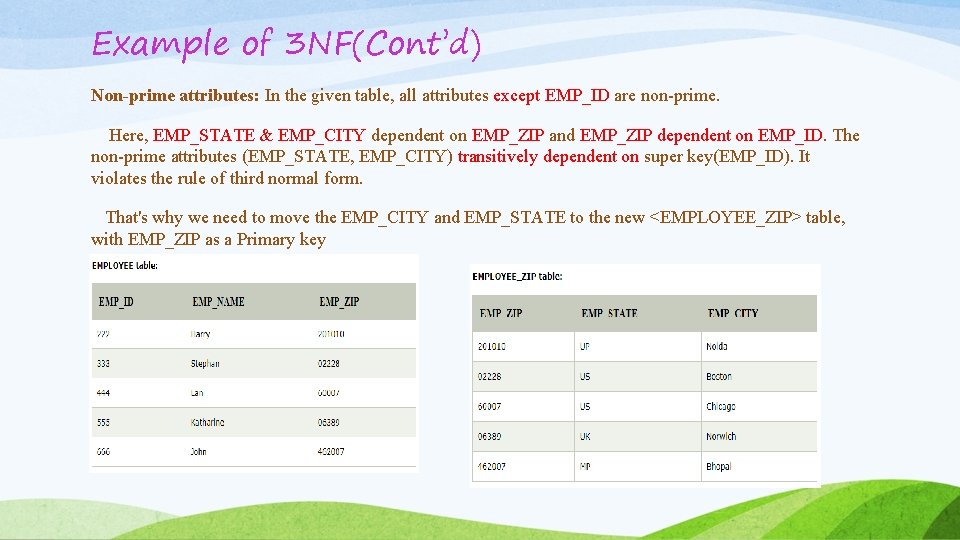
Example of 3 NF(Cont’d) Non-prime attributes: In the given table, all attributes except EMP_ID are non-prime. Here, EMP_STATE & EMP_CITY dependent on EMP_ZIP and EMP_ZIP dependent on EMP_ID. The non-prime attributes (EMP_STATE, EMP_CITY) transitively dependent on super key(EMP_ID). It violates the rule of third normal form. That's why we need to move the EMP_CITY and EMP_STATE to the new <EMPLOYEE_ZIP> table, with EMP_ZIP as a Primary key
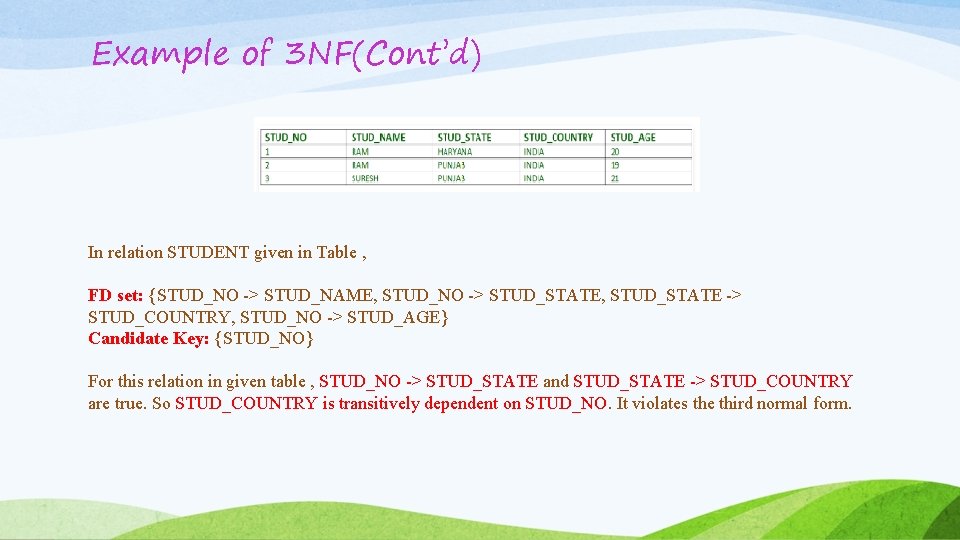
Example of 3 NF(Cont’d) In relation STUDENT given in Table , FD set: {STUD_NO -> STUD_NAME, STUD_NO -> STUD_STATE, STUD_STATE -> STUD_COUNTRY, STUD_NO -> STUD_AGE} Candidate Key: {STUD_NO} For this relation in given table , STUD_NO -> STUD_STATE and STUD_STATE -> STUD_COUNTRY are true. So STUD_COUNTRY is transitively dependent on STUD_NO. It violates the third normal form.
Example of 3 NF(Cont’d) To convert it in third normal form, we will decompose the relation STUDENT (STUD_NO, STUD_NAME, STUD_PHONE, STUD_STATE, STUD_COUNTRY_STUD_AGE) as: STUDENT (STUD_NO, STUD_NAME, STUD_PHONE, STUD_STATE, STUD_AGE) STATE_COUNTRY (STATE, COUNTRY)
Boyce-Codd Normal Form (BCNF) It is an advance version of 3 NF that’s why it is also referred as 3. 5 NF. BCNF is stricter than 3 NF. A table complies with BCNF if it is in 3 NF and for every functional dependency X->Y, X should be the super key of the table.
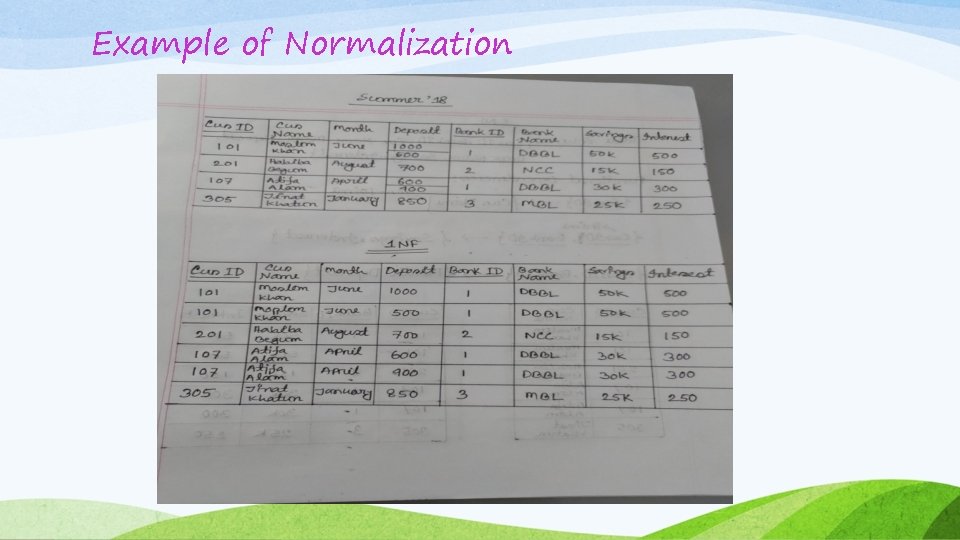
Example of Normalization
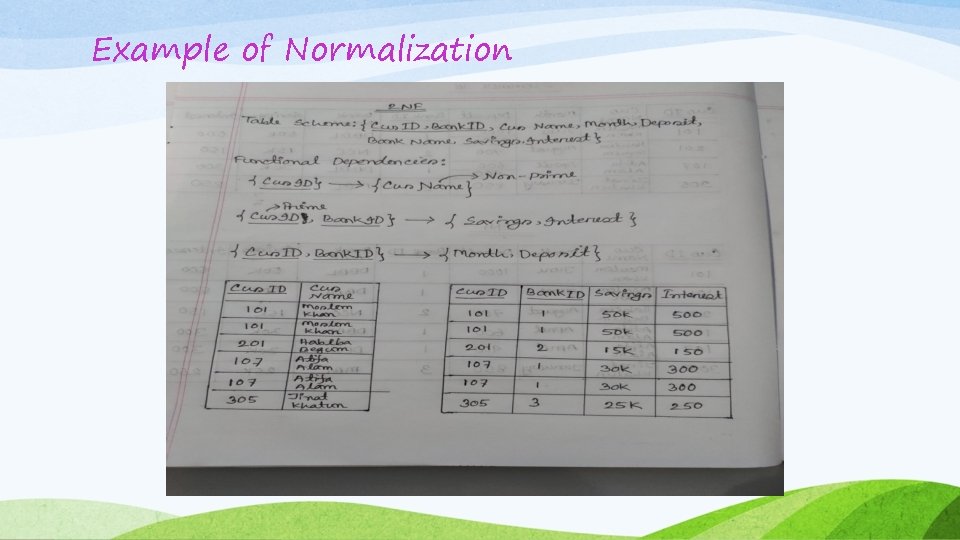
Example of Normalization
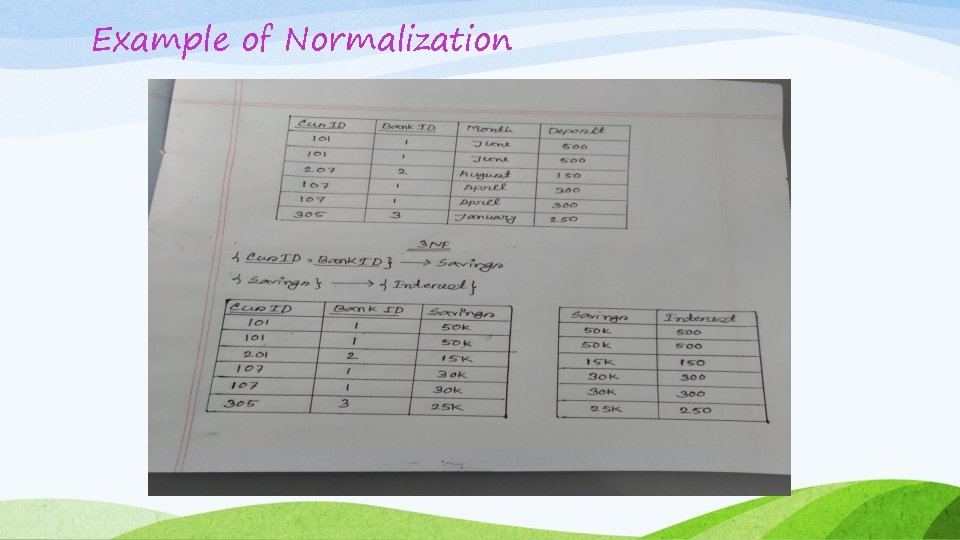
Example of Normalization

“A winner is a dreamer who never gives up” – Nelson Mandela
- Slides: 23