
Normal Radiographic Anatomy Based on Intraoral Films Teeth
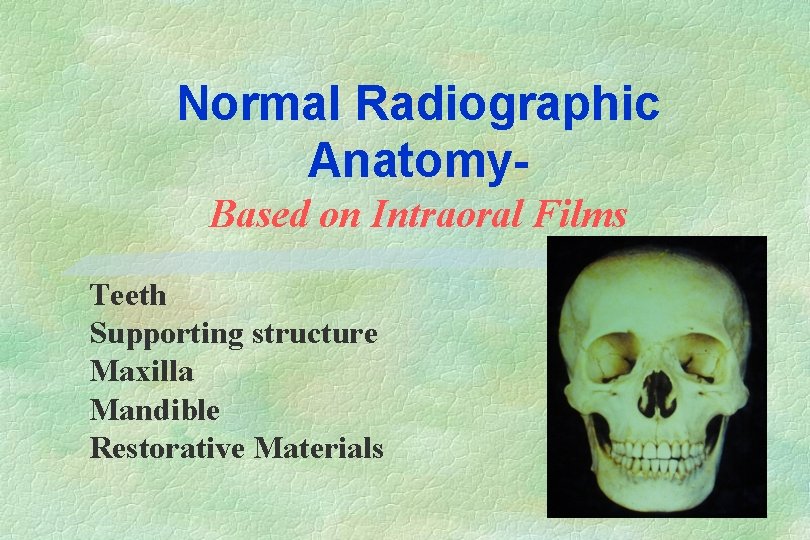
Normal Radiographic Anatomy. Based on Intraoral Films Teeth Supporting structure Maxilla Mandible Restorative Materials
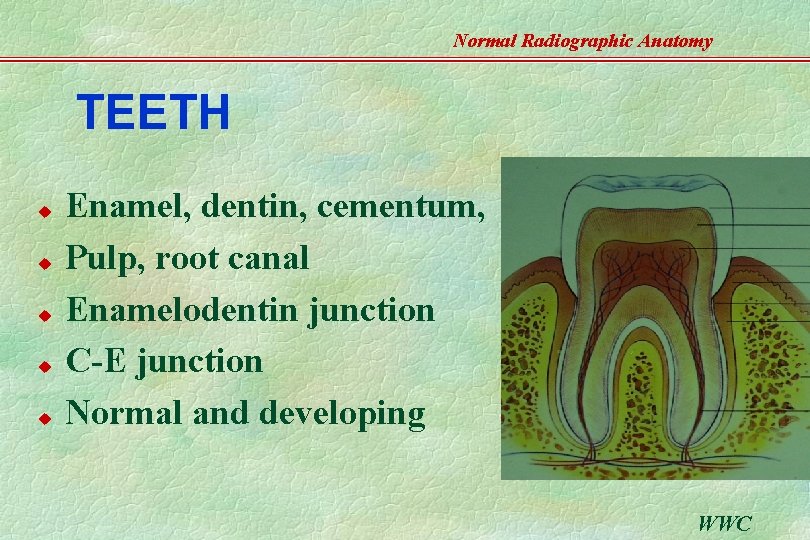
Normal Radiographic Anatomy TEETH u u u Enamel, dentin, cementum, Pulp, root canal Enamelodentin junction C-E junction Normal and developing WWC
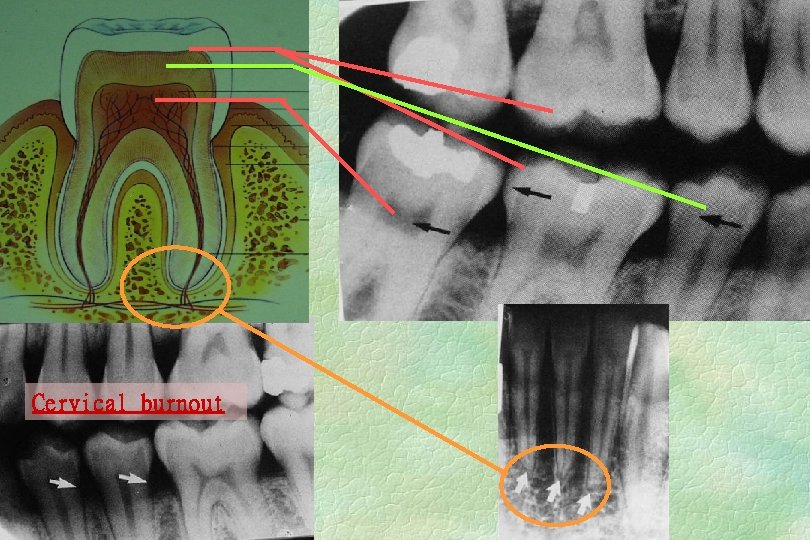
Cervical burnout
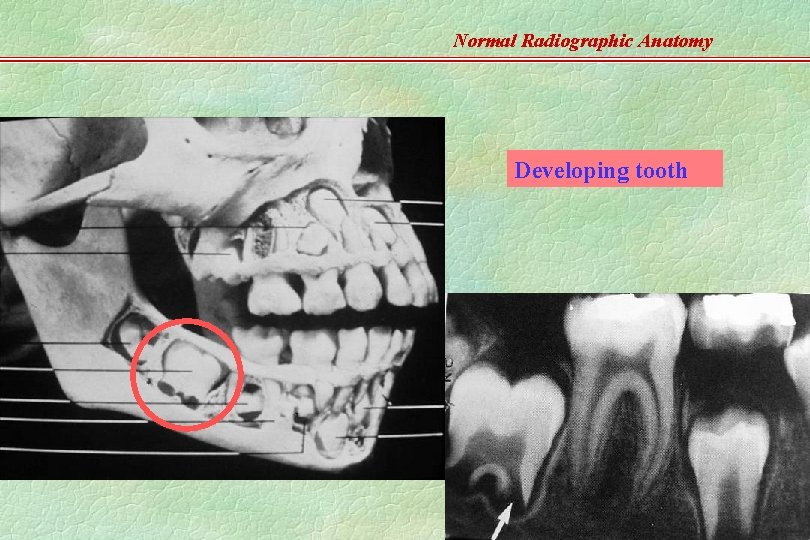
Normal Radiographic Anatomy Developing tooth WWC
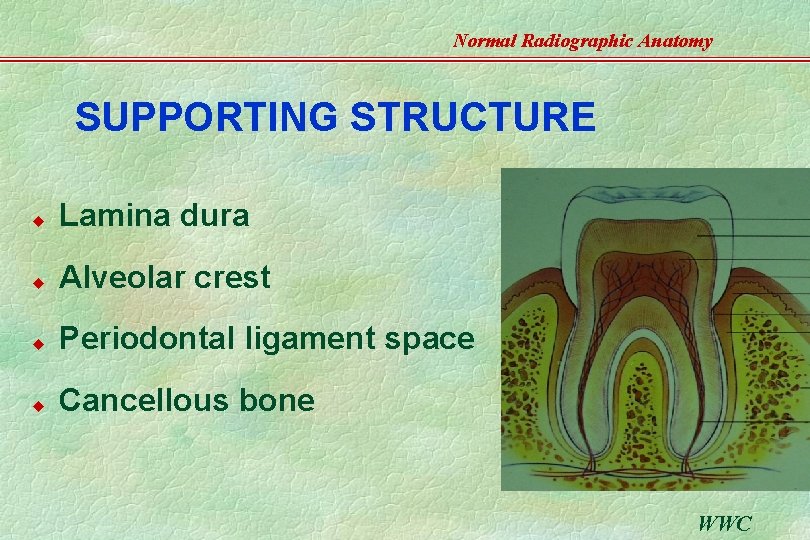
Normal Radiographic Anatomy SUPPORTING STRUCTURE u Lamina dura u Alveolar crest u Periodontal ligament space u Cancellous bone WWC
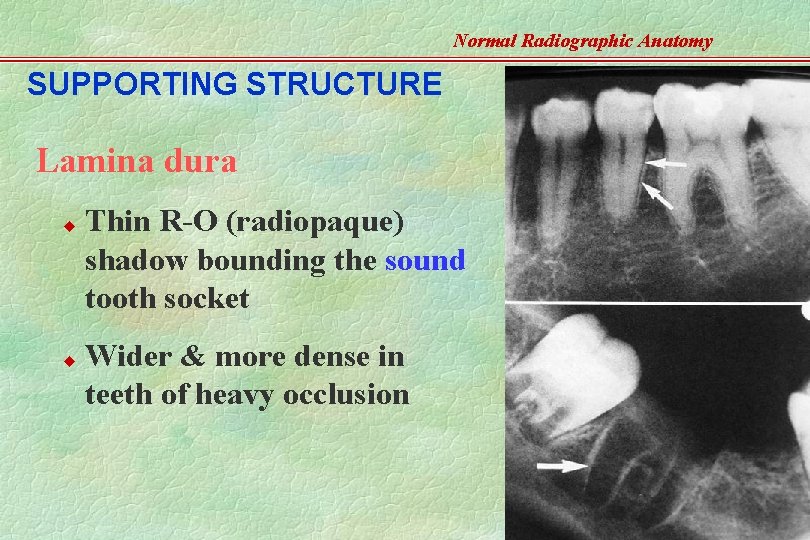
Normal Radiographic Anatomy SUPPORTING STRUCTURE Lamina dura u u Thin R-O (radiopaque) shadow bounding the sound tooth socket Wider & more dense in teeth of heavy occlusion WWC
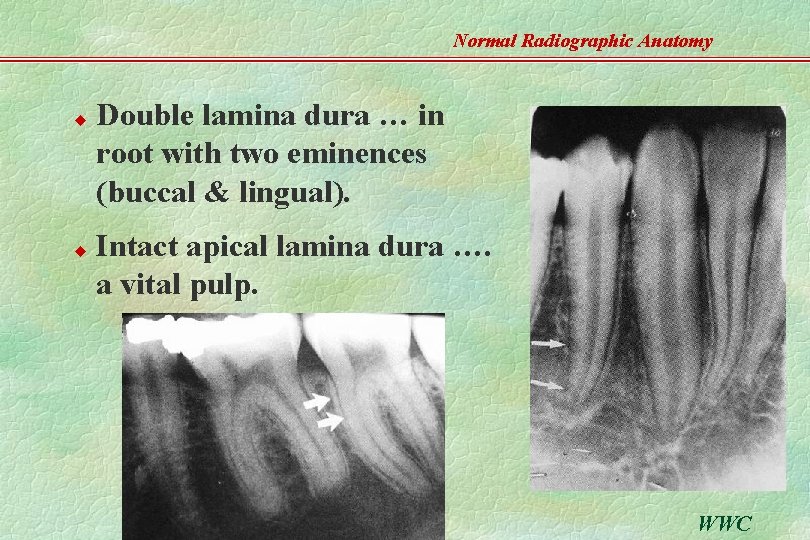
Normal Radiographic Anatomy u u Double lamina dura … in root with two eminences (buccal & lingual). Intact apical lamina dura …. a vital pulp. WWC
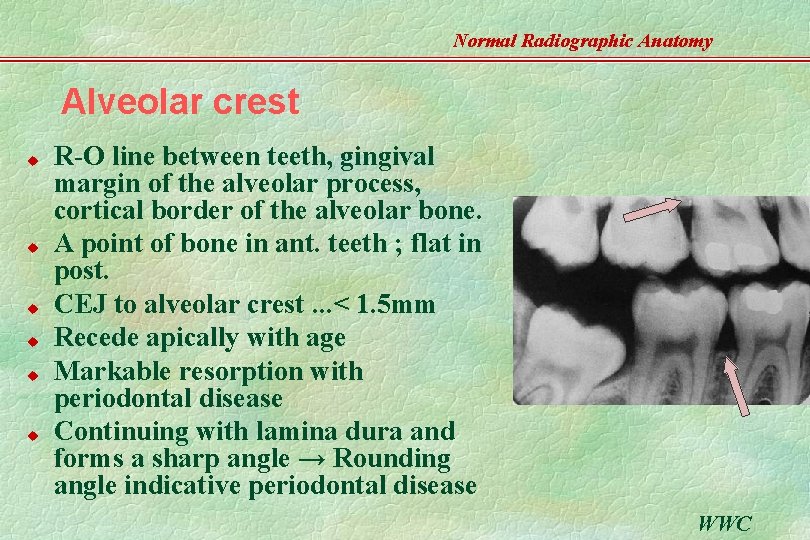
Normal Radiographic Anatomy Alveolar crest u u u R-O line between teeth, gingival margin of the alveolar process, cortical border of the alveolar bone. A point of bone in ant. teeth ; flat in post. CEJ to alveolar crest. . . < 1. 5 mm Recede apically with age Markable resorption with periodontal disease Continuing with lamina dura and forms a sharp angle → Rounding angle indicative periodontal disease WWC
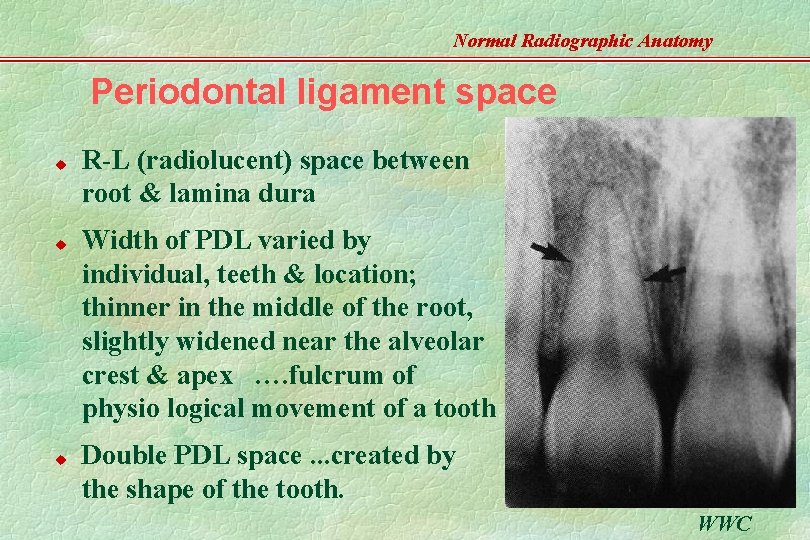
Normal Radiographic Anatomy Periodontal ligament space u u u R-L (radiolucent) space between root & lamina dura Width of PDL varied by individual, teeth & location; thinner in the middle of the root, slightly widened near the alveolar crest & apex …. fulcrum of physio logical movement of a tooth Double PDL space. . . created by the shape of the tooth. WWC
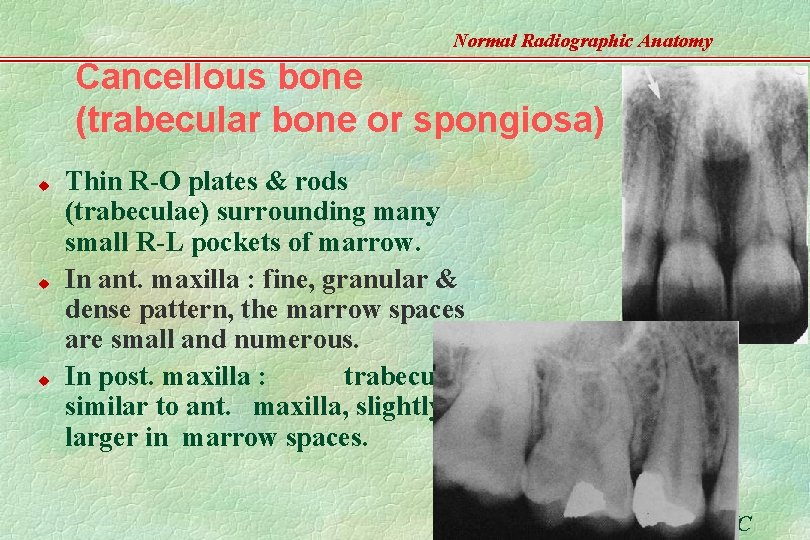
Normal Radiographic Anatomy Cancellous bone (trabecular bone or spongiosa) u u u Thin R-O plates & rods (trabeculae) surrounding many small R-L pockets of marrow. In ant. maxilla : fine, granular & dense pattern, the marrow spaces are small and numerous. In post. maxilla : trabecular similar to ant. maxilla, slightly larger in marrow spaces. WWC
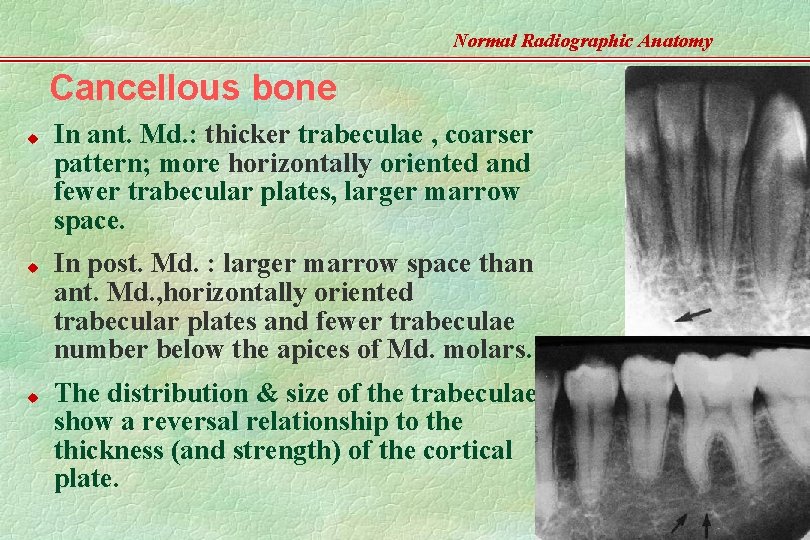
Normal Radiographic Anatomy Cancellous bone u u u In ant. Md. : thicker trabeculae , coarser pattern; more horizontally oriented and fewer trabecular plates, larger marrow space. In post. Md. : larger marrow space than ant. Md. , horizontally oriented trabecular plates and fewer trabeculae number below the apices of Md. molars. The distribution & size of the trabeculae show a reversal relationship to the thickness (and strength) of the cortical plate. WWC
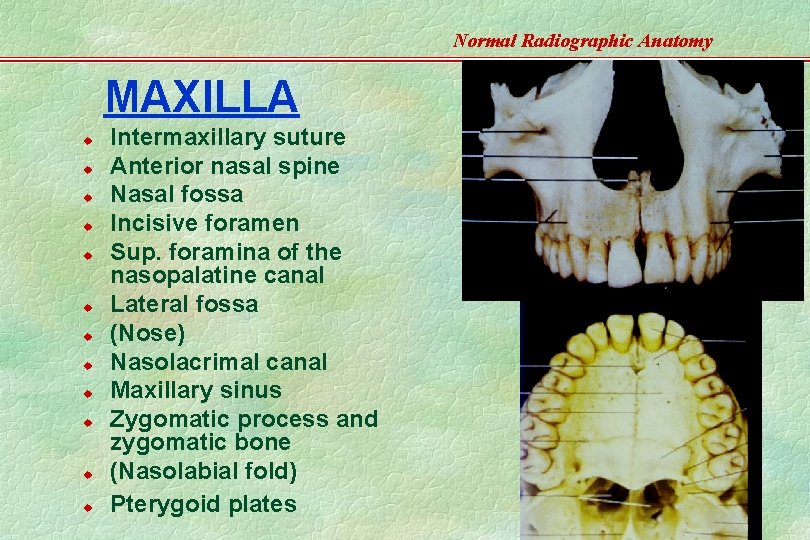
Normal Radiographic Anatomy MAXILLA u u u Intermaxillary suture Anterior nasal spine Nasal fossa Incisive foramen Sup. foramina of the nasopalatine canal Lateral fossa (Nose) Nasolacrimal canal Maxillary sinus Zygomatic process and zygomatic bone (Nasolabial fold) Pterygoid plates WWC
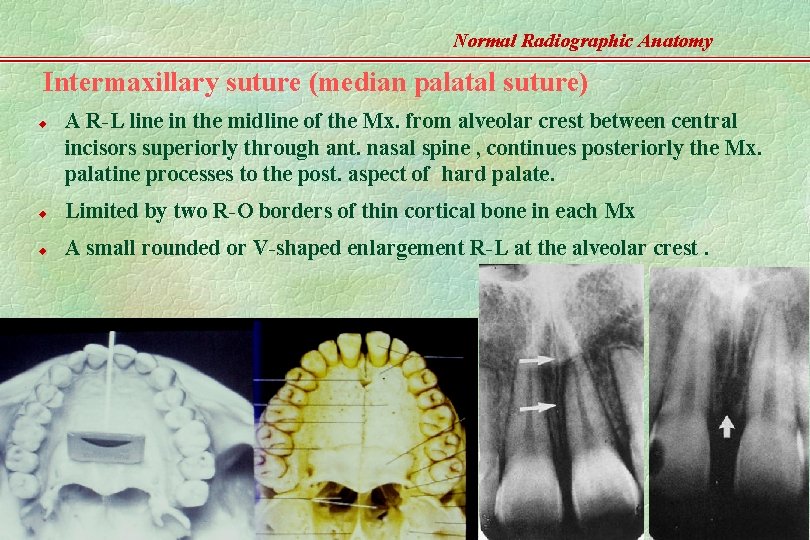
Normal Radiographic Anatomy Intermaxillary suture (median palatal suture) u A R-L line in the midline of the Mx. from alveolar crest between central incisors superiorly through ant. nasal spine , continues posteriorly the Mx. palatine processes to the post. aspect of hard palate. u Limited by two R-O borders of thin cortical bone in each Mx u A small rounded or V-shaped enlargement R-L at the alveolar crest. WWC
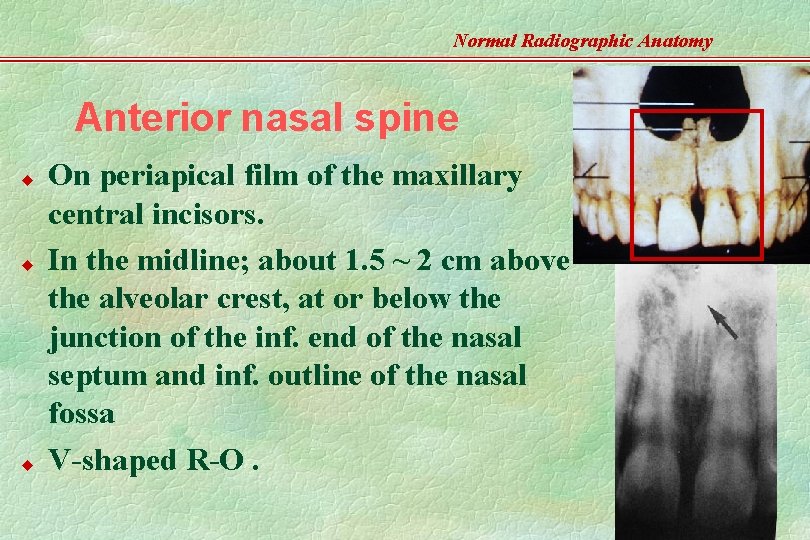
Normal Radiographic Anatomy Anterior nasal spine u u u On periapical film of the maxillary central incisors. In the midline; about 1. 5 ~ 2 cm above the alveolar crest, at or below the junction of the inf. end of the nasal septum and inf. outline of the nasal fossa V-shaped R-O. WWC
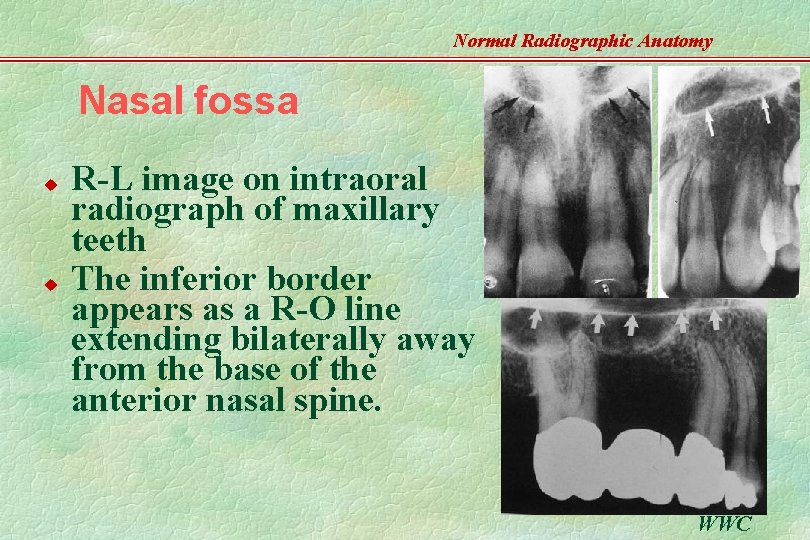
Normal Radiographic Anatomy Nasal fossa u u R-L image on intraoral radiograph of maxillary teeth The inferior border appears as a R-O line extending bilaterally away from the base of the anterior nasal spine. WWC
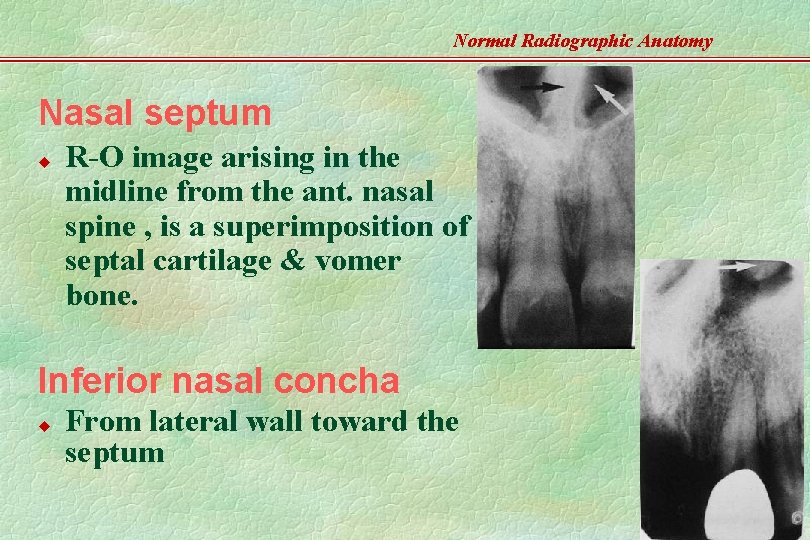
Normal Radiographic Anatomy Nasal septum u R-O image arising in the midline from the ant. nasal spine , is a superimposition of septal cartilage & vomer bone. Inferior nasal concha u From lateral wall toward the septum WWC
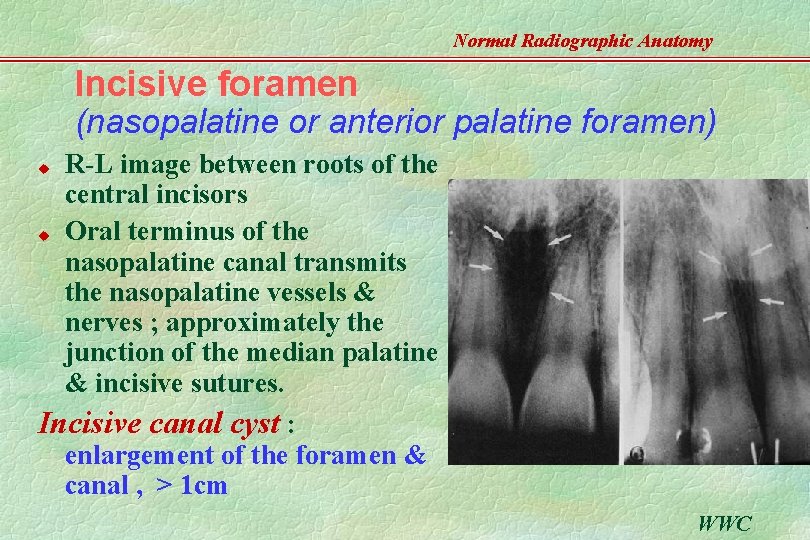
Normal Radiographic Anatomy Incisive foramen (nasopalatine or anterior palatine foramen) R-L image between roots of the central incisors u Oral terminus of the nasopalatine canal transmits the nasopalatine vessels & nerves ; approximately the junction of the median palatine & incisive sutures. Incisive canal cyst : enlargement of the foramen & canal , > 1 cm u WWC
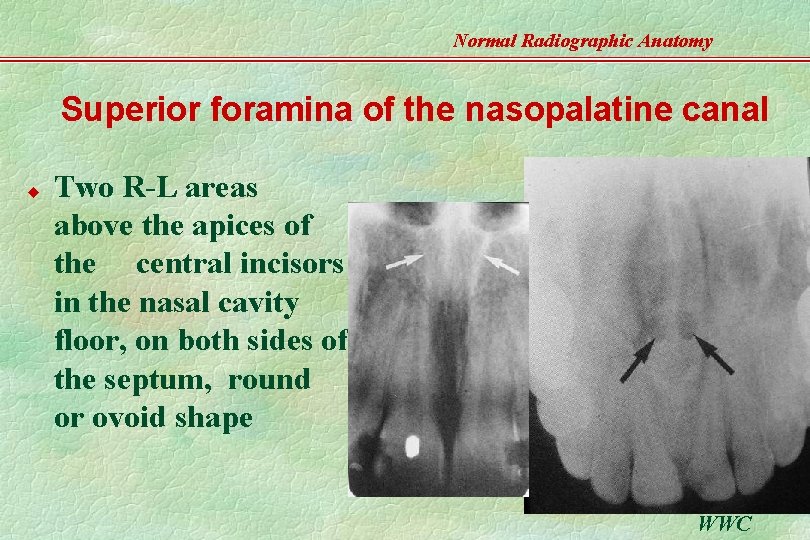
Normal Radiographic Anatomy Superior foramina of the nasopalatine canal u Two R-L areas above the apices of the central incisors in the nasal cavity floor, on both sides of the septum, round or ovoid shape WWC
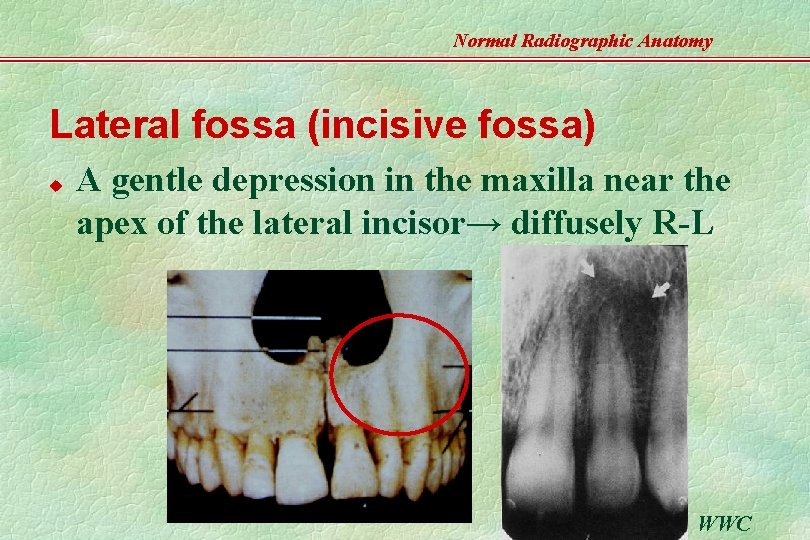
Normal Radiographic Anatomy Lateral fossa (incisive fossa) u A gentle depression in the maxilla near the apex of the lateral incisor→ diffusely R-L WWC
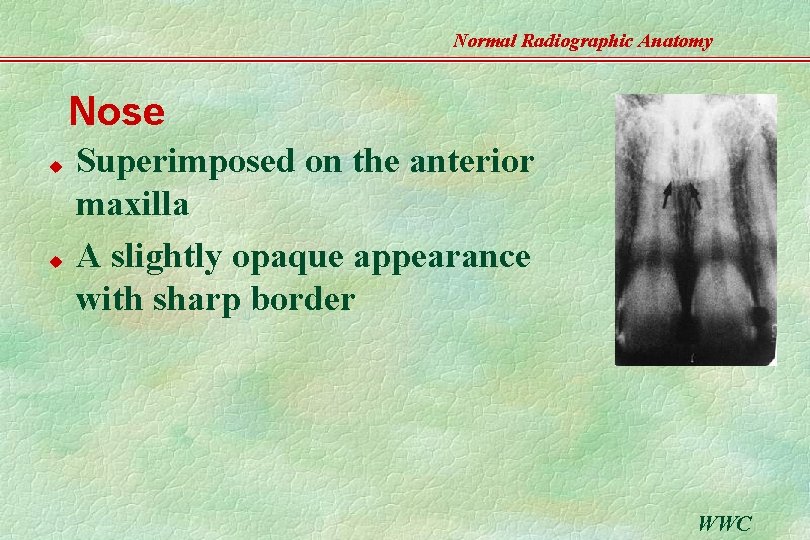
Normal Radiographic Anatomy Nose u u Superimposed on the anterior maxilla A slightly opaque appearance with sharp border WWC
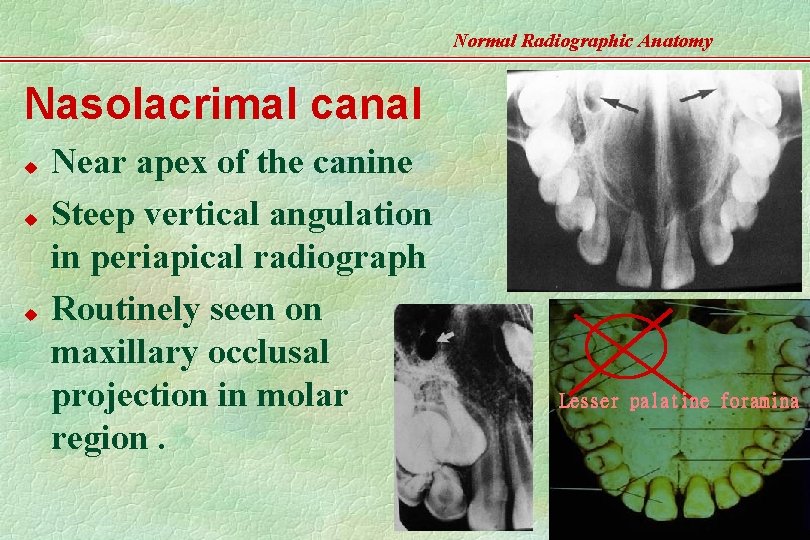
Normal Radiographic Anatomy Nasolacrimal canal u u u Near apex of the canine Steep vertical angulation in periapical radiograph Routinely seen on maxillary occlusal projection in molar region. Lesser palatine foramina WWC
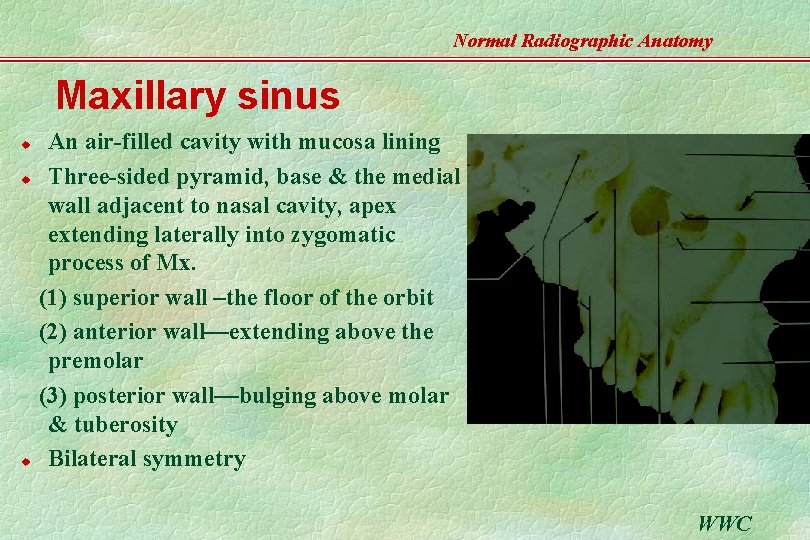
Normal Radiographic Anatomy Maxillary sinus u u u An air-filled cavity with mucosa lining Three-sided pyramid, base & the medial wall adjacent to nasal cavity, apex extending laterally into zygomatic process of Mx. (1) superior wall –the floor of the orbit (2) anterior wall—extending above the premolar (3) posterior wall—bulging above molar & tuberosity Bilateral symmetry WWC
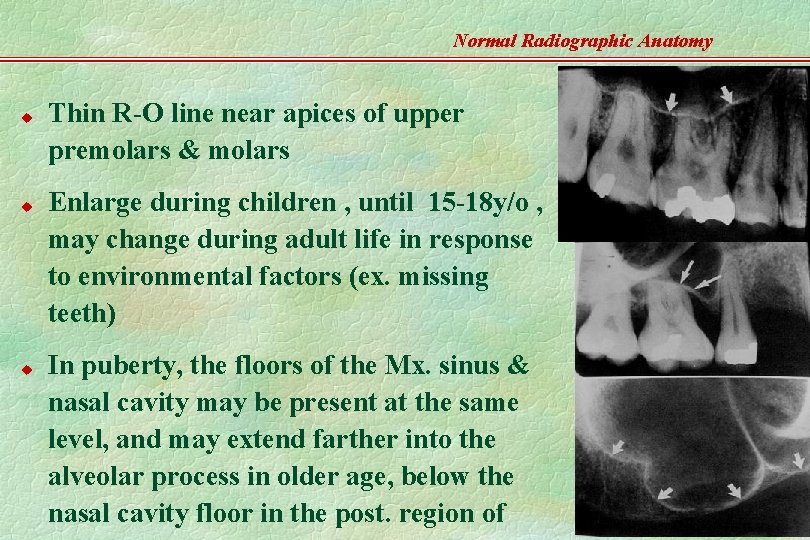
Normal Radiographic Anatomy u u u Thin R-O line near apices of upper premolars & molars Enlarge during children , until 15 -18 y/o , may change during adult life in response to environmental factors (ex. missing teeth) In puberty, the floors of the Mx. sinus & nasal cavity may be present at the same level, and may extend farther into the alveolar process in older age, below the nasal cavity floor in the post. region of WWC
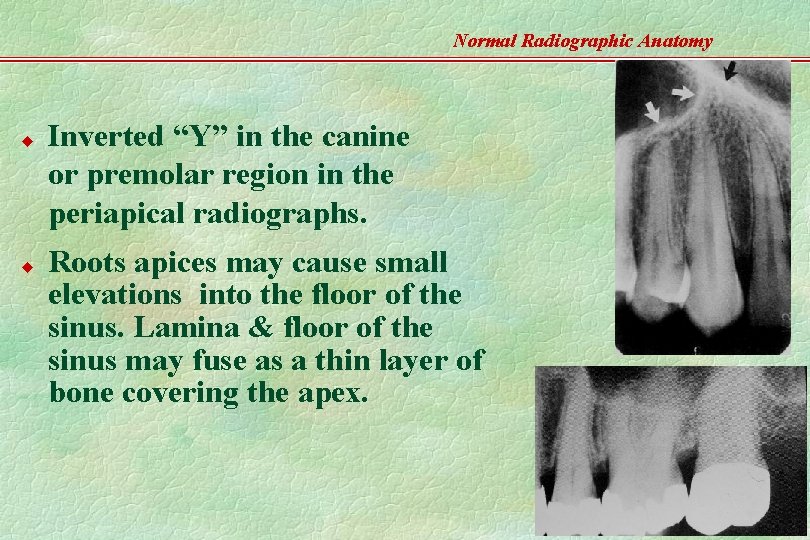
Normal Radiographic Anatomy u u Inverted “Y” in the canine or premolar region in the periapical radiographs. Roots apices may cause small elevations into the floor of the sinus. Lamina & floor of the sinus may fuse as a thin layer of bone covering the apex. WWC
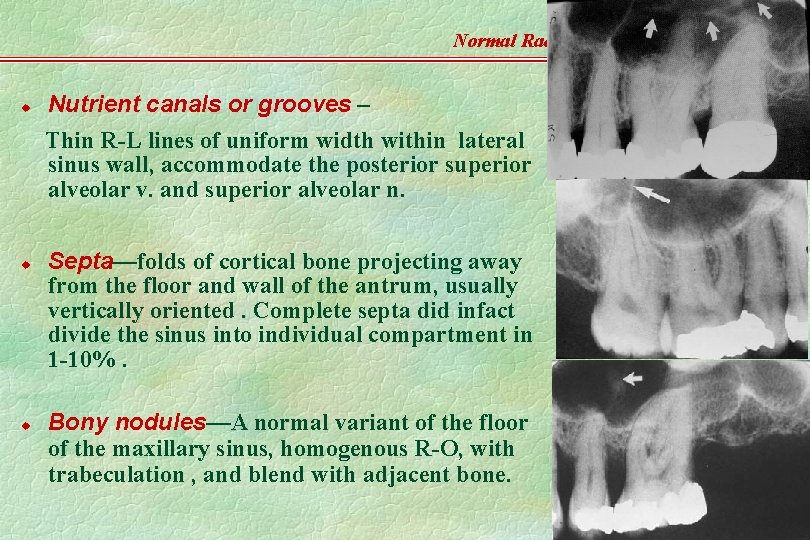
Normal Radiographic Anatomy u u u Nutrient canals or grooves – Thin R-L lines of uniform width within lateral sinus wall, accommodate the posterior superior alveolar v. and superior alveolar n. Septa—folds of cortical bone projecting away from the floor and wall of the antrum, usually vertically oriented. Complete septa did infact divide the sinus into individual compartment in 1 -10%. Bony nodules—A normal variant of the floor of the maxillary sinus, homogenous R-O, with trabeculation , and blend with adjacent bone. WWC
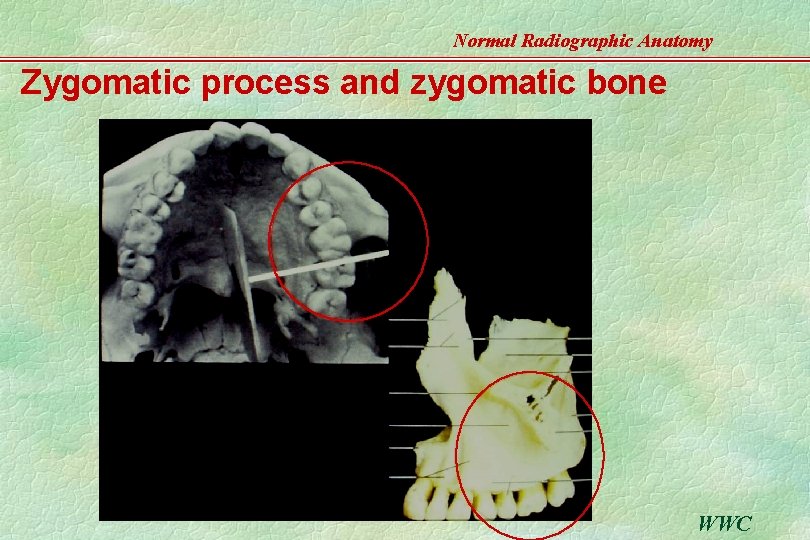
Normal Radiographic Anatomy Zygomatic process and zygomatic bone WWC
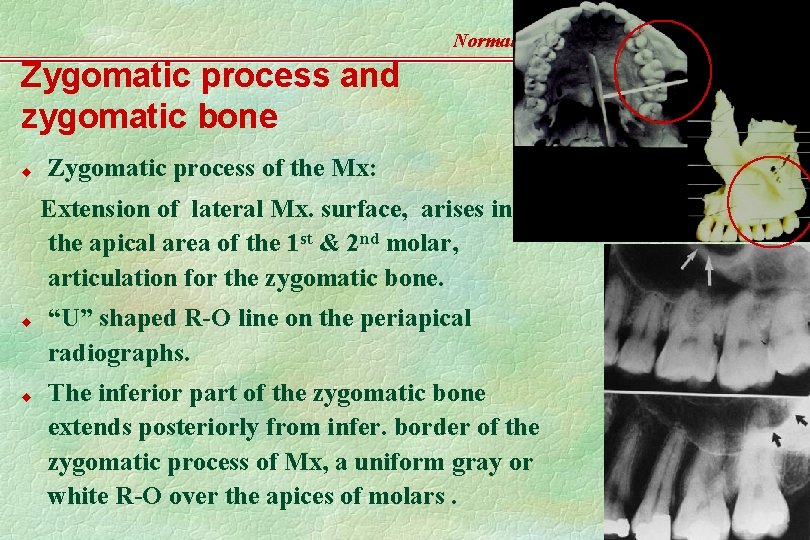
Normal Radiographic Anatomy Zygomatic process and zygomatic bone u Zygomatic process of the Mx: Extension of lateral Mx. surface, arises in the apical area of the 1 st & 2 nd molar, articulation for the zygomatic bone. u u “U” shaped R-O line on the periapical radiographs. The inferior part of the zygomatic bone extends posteriorly from infer. border of the zygomatic process of Mx, a uniform gray or white R-O over the apices of molars. WWC
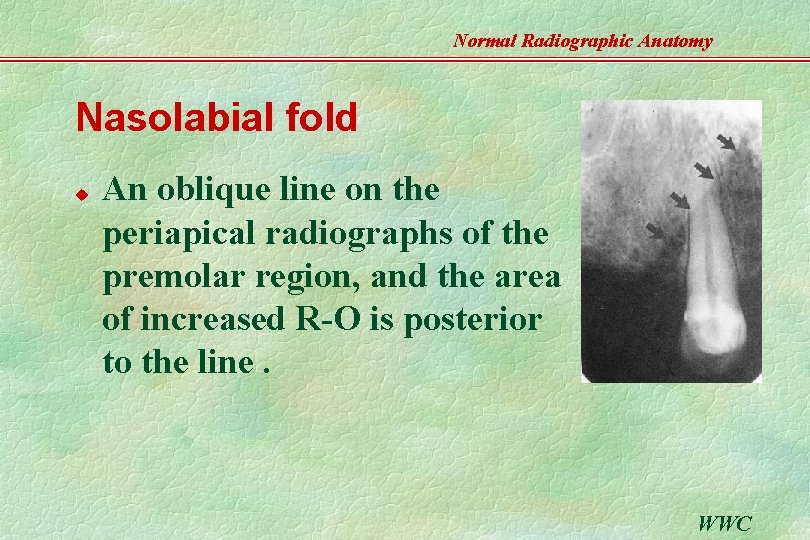
Normal Radiographic Anatomy Nasolabial fold u An oblique line on the periapical radiographs of the premolar region, and the area of increased R-O is posterior to the line. WWC
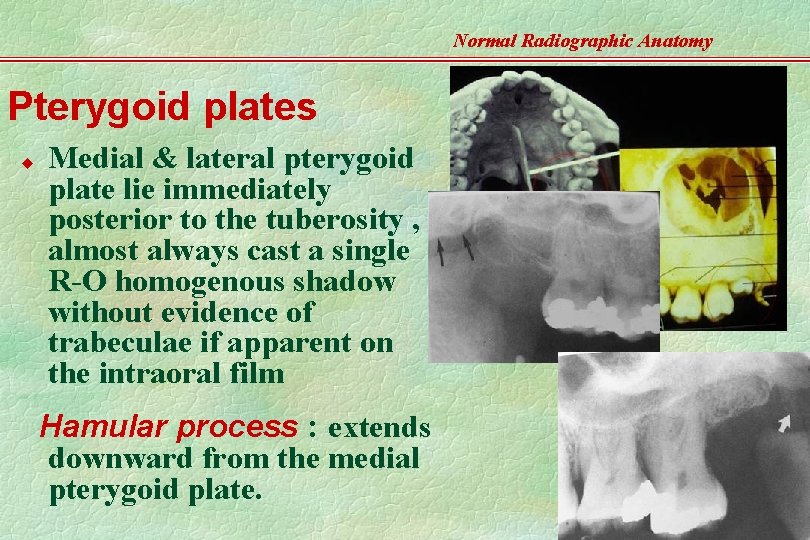
Normal Radiographic Anatomy Pterygoid plates u Medial & lateral pterygoid plate lie immediately posterior to the tuberosity , almost always cast a single R-O homogenous shadow without evidence of trabeculae if apparent on the intraoral film Hamular process : extends downward from the medial pterygoid plate. WWC
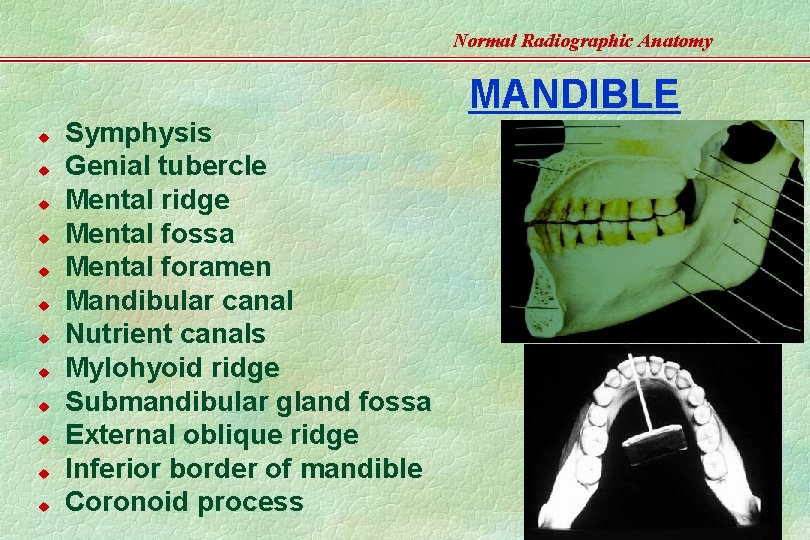
Normal Radiographic Anatomy u u u Symphysis Genial tubercle Mental ridge Mental fossa Mental foramen Mandibular canal Nutrient canals Mylohyoid ridge Submandibular gland fossa External oblique ridge Inferior border of mandible Coronoid process MANDIBLE WWC
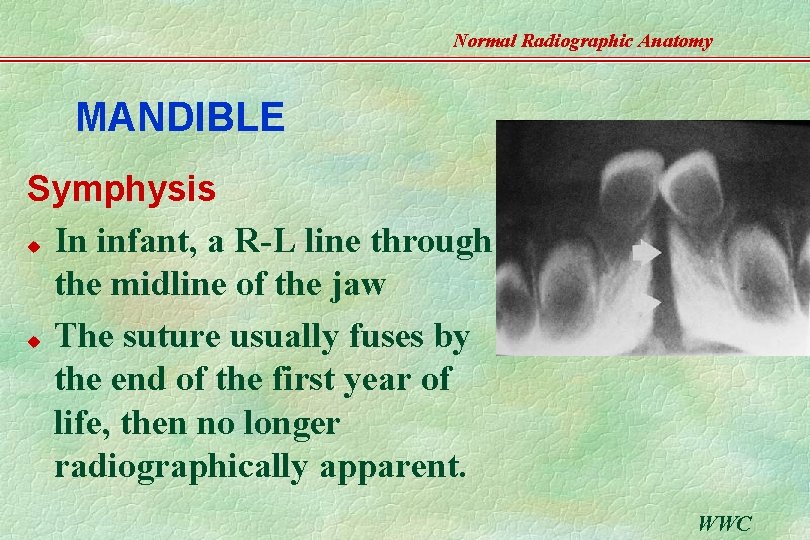
Normal Radiographic Anatomy MANDIBLE Symphysis u In infant, a R-L line through the midline of the jaw u The suture usually fuses by the end of the first year of life, then no longer radiographically apparent. WWC
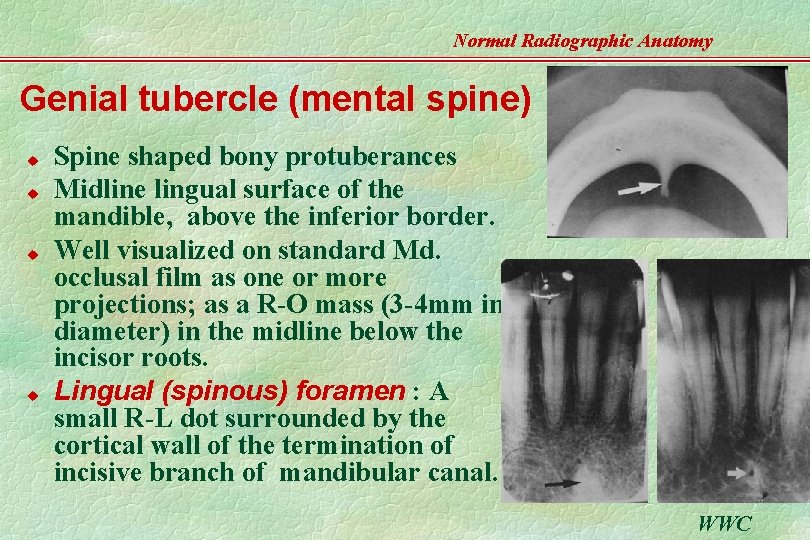
Normal Radiographic Anatomy Genial tubercle (mental spine) u u Spine shaped bony protuberances Midline lingual surface of the mandible, above the inferior border. Well visualized on standard Md. occlusal film as one or more projections; as a R-O mass (3 -4 mm in diameter) in the midline below the incisor roots. Lingual (spinous) foramen : A small R-L dot surrounded by the cortical wall of the termination of incisive branch of mandibular canal. WWC
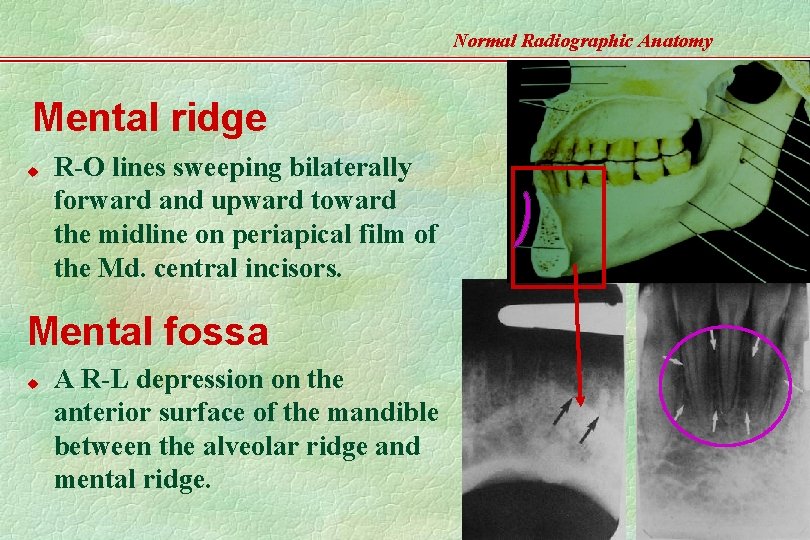
Normal Radiographic Anatomy Mental ridge u R-O lines sweeping bilaterally forward and upward toward the midline on periapical film of the Md. central incisors. Mental fossa u A R-L depression on the anterior surface of the mandible between the alveolar ridge and mental ridge. WWC
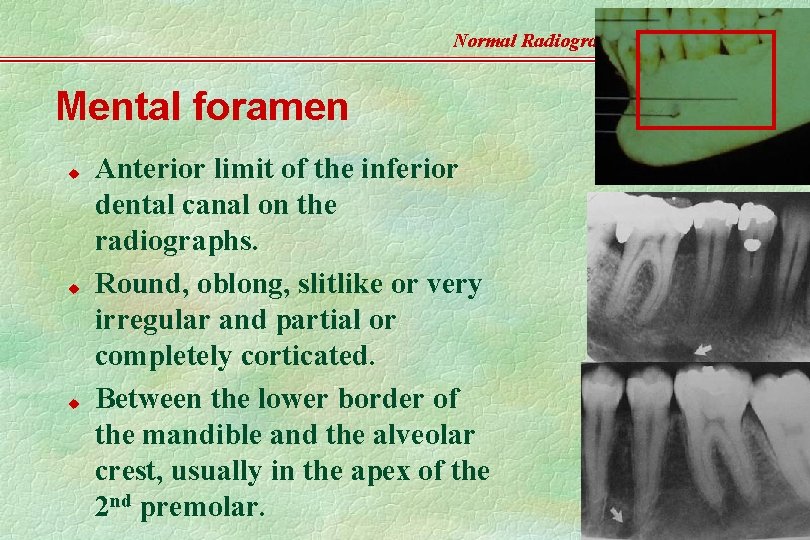
Normal Radiographic Anatomy Mental foramen u u u Anterior limit of the inferior dental canal on the radiographs. Round, oblong, slitlike or very irregular and partial or completely corticated. Between the lower border of the mandible and the alveolar crest, usually in the apex of the 2 nd premolar. WWC
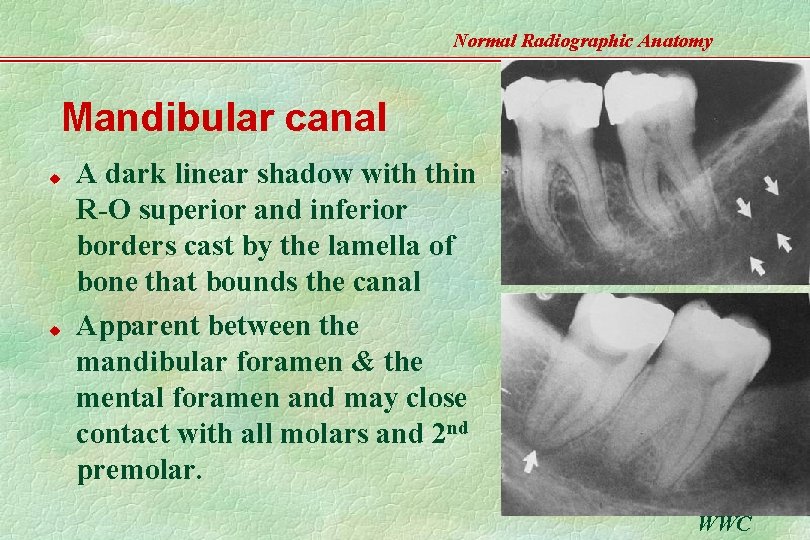
Normal Radiographic Anatomy Mandibular canal u u A dark linear shadow with thin R-O superior and inferior borders cast by the lamella of bone that bounds the canal Apparent between the mandibular foramen & the mental foramen and may close contact with all molars and 2 nd premolar. WWC
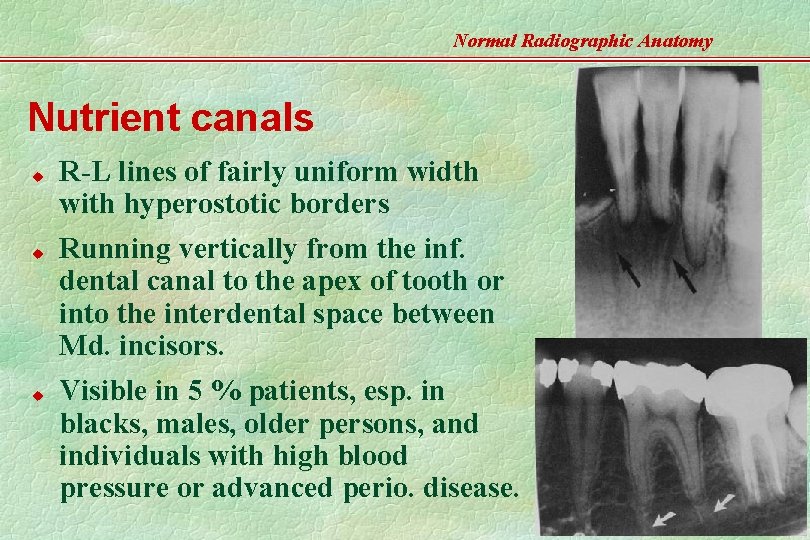
Normal Radiographic Anatomy Nutrient canals u u u R-L lines of fairly uniform width with hyperostotic borders Running vertically from the inf. dental canal to the apex of tooth or into the interdental space between Md. incisors. Visible in 5 % patients, esp. in blacks, males, older persons, and individuals with high blood pressure or advanced perio. disease. WWC
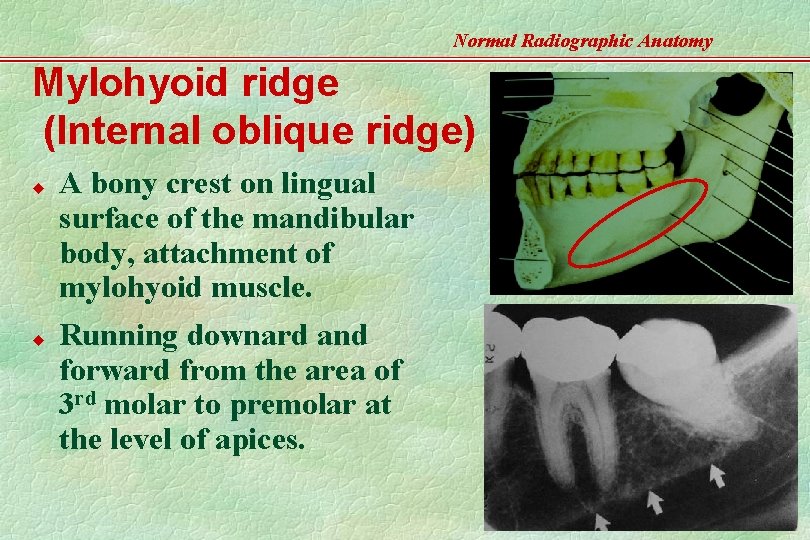
Normal Radiographic Anatomy Mylohyoid ridge (Internal oblique ridge) u u A bony crest on lingual surface of the mandibular body, attachment of mylohyoid muscle. Running downard and forward from the area of 3 rd molar to premolar at the level of apices. WWC
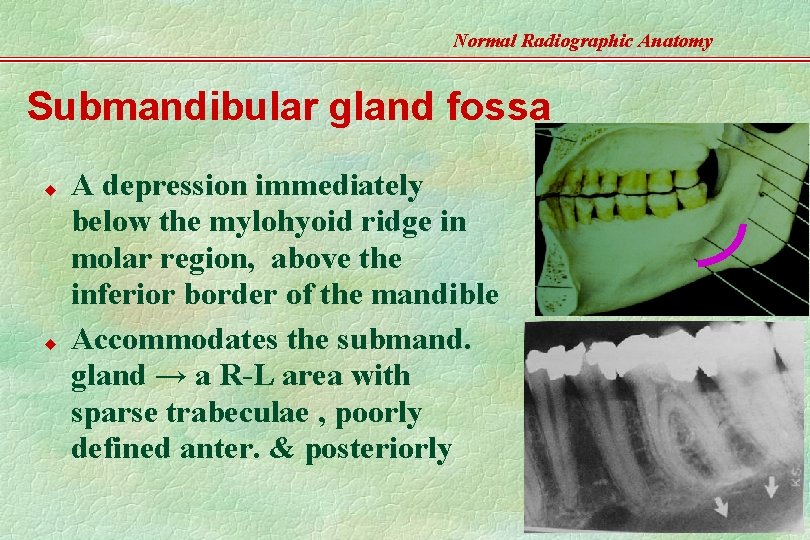
Normal Radiographic Anatomy Submandibular gland fossa u u A depression immediately below the mylohyoid ridge in molar region, above the inferior border of the mandible Accommodates the submand. gland → a R-L area with sparse trabeculae , poorly defined anter. & posteriorly WWC
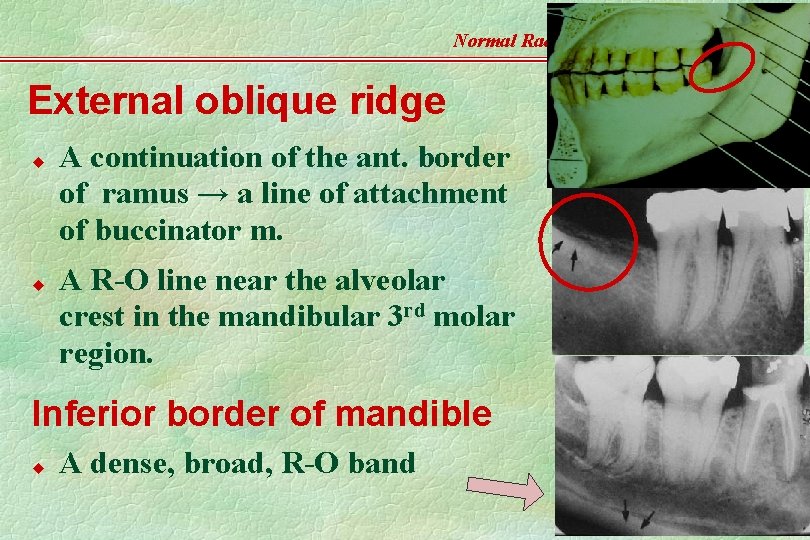
Normal Radiographic Anatomy External oblique ridge u u A continuation of the ant. border of ramus → a line of attachment of buccinator m. A R-O line near the alveolar crest in the mandibular 3 rd molar region. Inferior border of mandible u A dense, broad, R-O band WWC
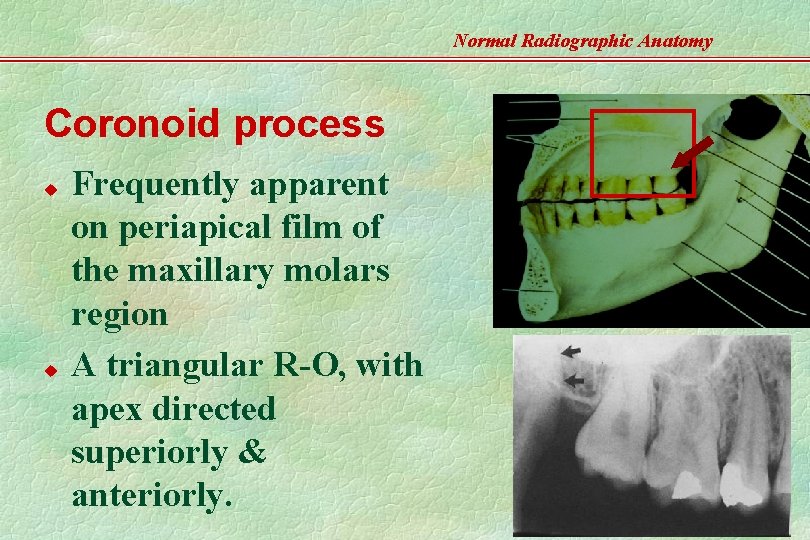
Normal Radiographic Anatomy Coronoid process u u Frequently apparent on periapical film of the maxillary molars region A triangular R-O, with apex directed superiorly & anteriorly. WWC
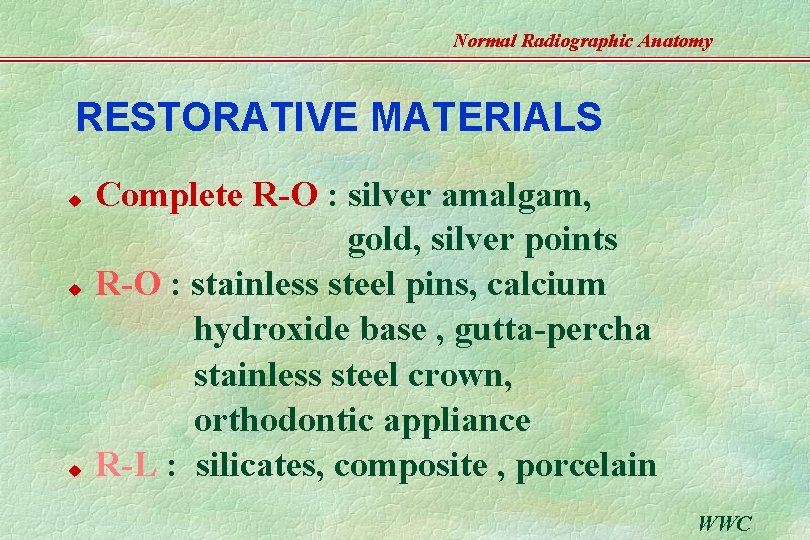
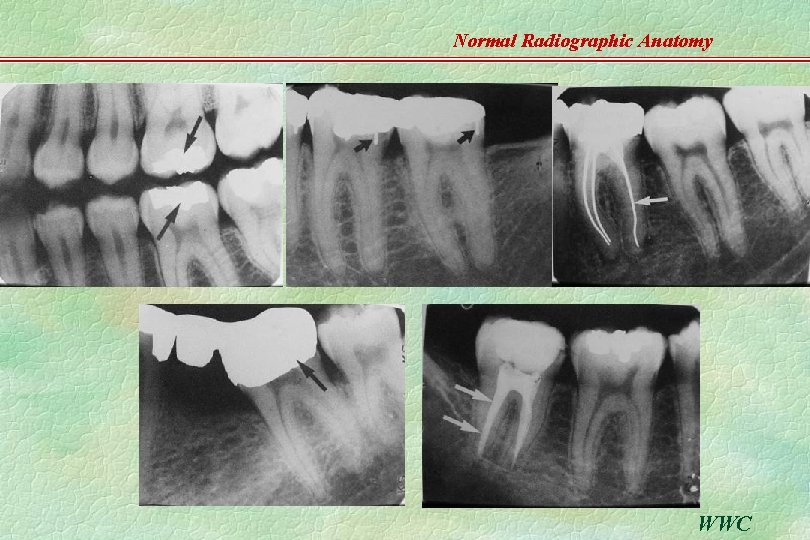
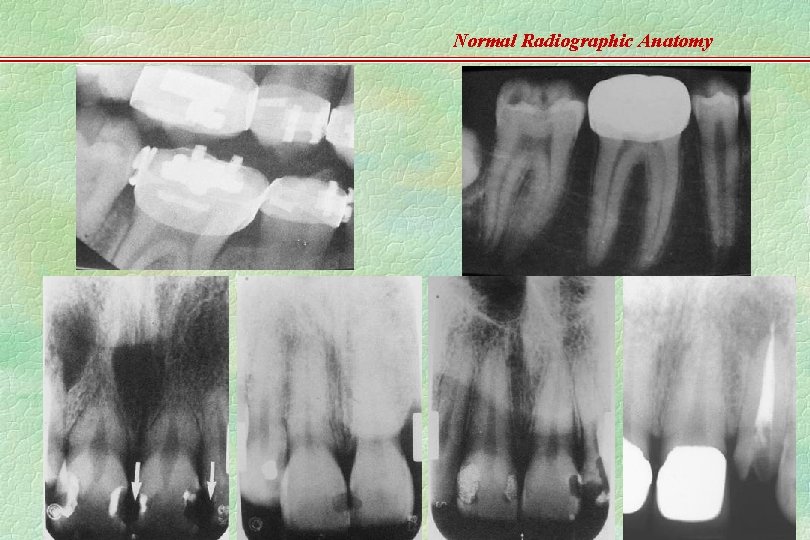
Normal Radiographic Anatomy RESTORATIVE MATERIALS u u u Complete R-O : silver amalgam, gold, silver points R-O : stainless steel pins, calcium hydroxide base , gutta-percha stainless steel crown, orthodontic appliance R-L : silicates, composite , porcelain WWC
Normal Radiographic Anatomy WWC
Normal Radiographic Anatomy WWC

- Slides: 44