
Normal or Canonical Forms Rosen 1 2 exercises
- Slides: 13
Normal or Canonical Forms Rosen 1. 2 (exercises)
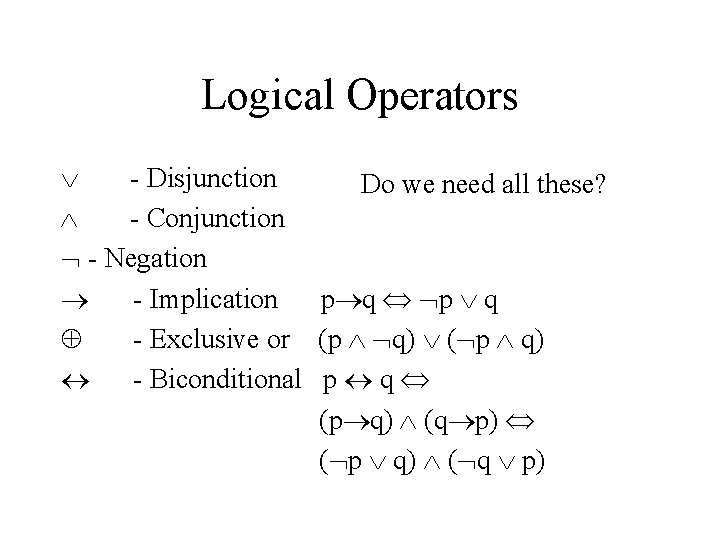
Logical Operators - Disjunction Do we need all these? - Conjunction - Negation - Implication p q p q - Exclusive or (p q) ( p q) - Biconditional p q (p q) (q p) ( p q) ( q p)
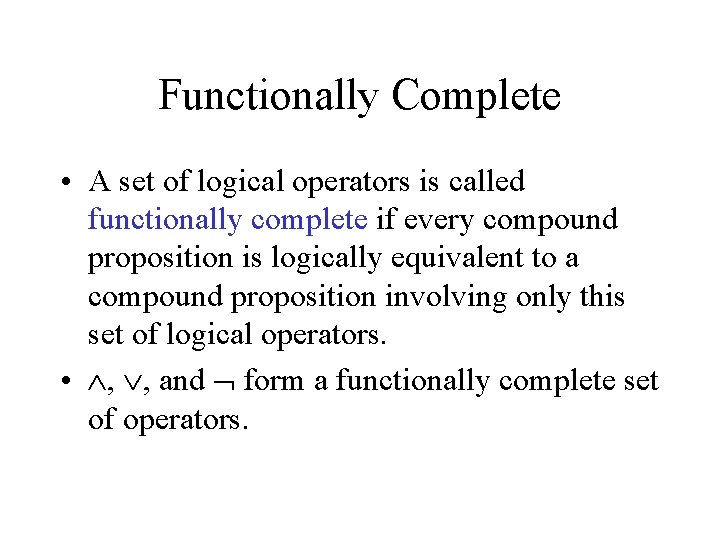
Functionally Complete • A set of logical operators is called functionally complete if every compound proposition is logically equivalent to a compound proposition involving only this set of logical operators. • , , and form a functionally complete set of operators.
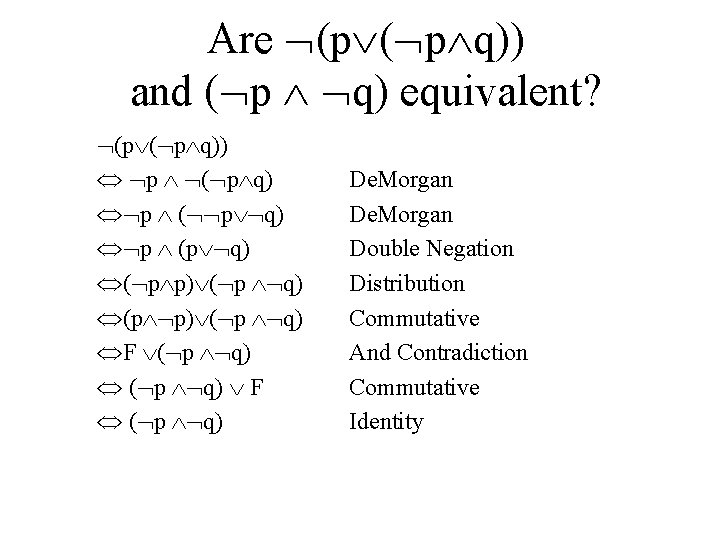
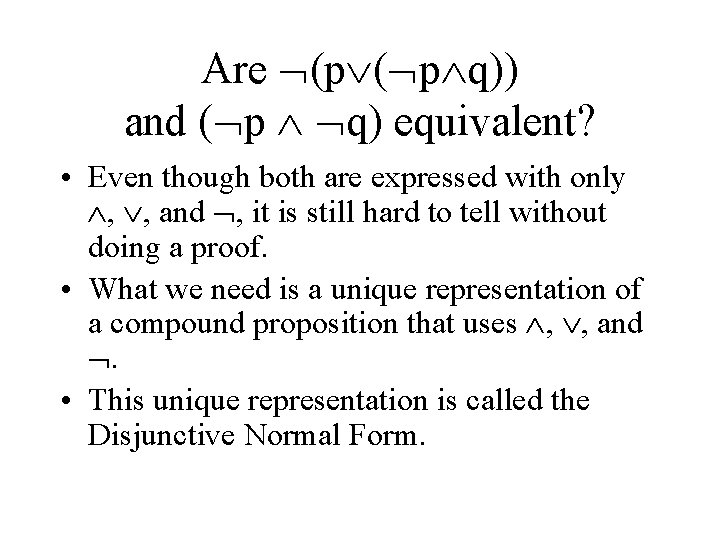
Are (p ( p q)) and ( p q) equivalent? (p ( p q)) p ( p q) p (p q) ( p p) ( p q) (p p) ( p q) F ( p q) F ( p q) De. Morgan Double Negation Distribution Commutative And Contradiction Commutative Identity
Are (p ( p q)) and ( p q) equivalent? • Even though both are expressed with only , , and , it is still hard to tell without doing a proof. • What we need is a unique representation of a compound proposition that uses , , and . • This unique representation is called the Disjunctive Normal Form.
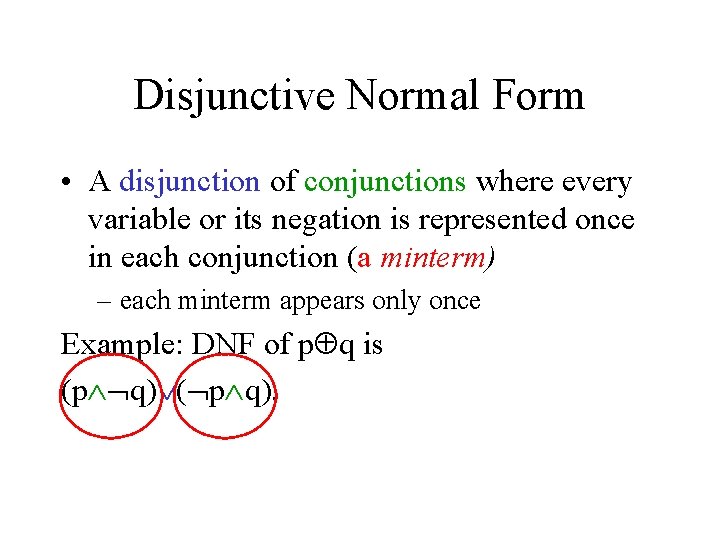
Disjunctive Normal Form • A disjunction of conjunctions where every variable or its negation is represented once in each conjunction (a minterm) – each minterm appears only once Example: DNF of p q is (p q) ( p q).
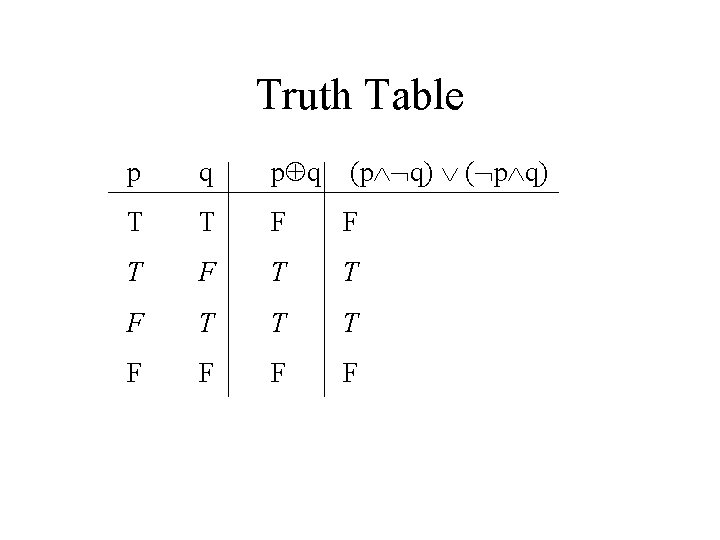
Truth Table p q (p q) ( p q) T T F F T T T F F
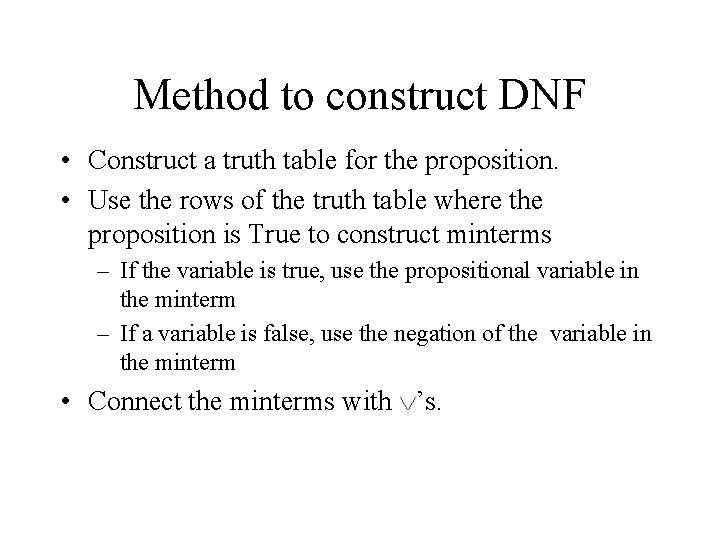
Method to construct DNF • Construct a truth table for the proposition. • Use the rows of the truth table where the proposition is True to construct minterms – If the variable is true, use the propositional variable in the minterm – If a variable is false, use the negation of the variable in the minterm • Connect the minterms with ’s.
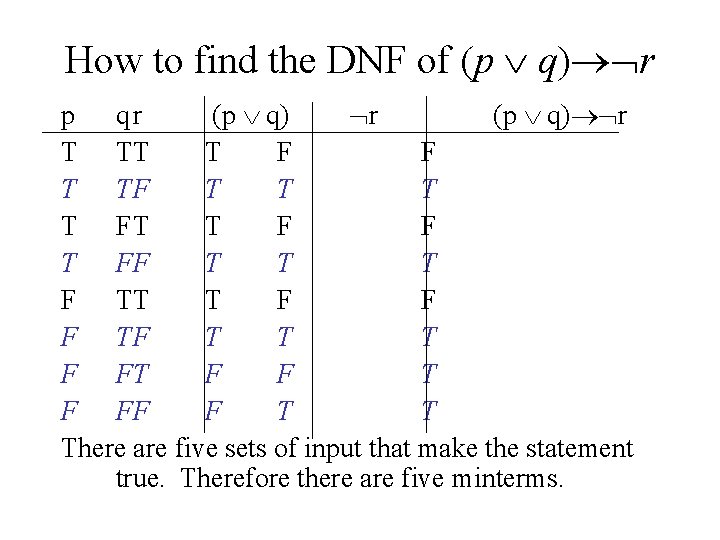
How to find the DNF of (p q) r p qr (p q) r T TT T F F T T T T F F T FF T T T F TT T F F F TF T T T F FF F T T There are five sets of input that make the statement true. Therefore there are five minterms.
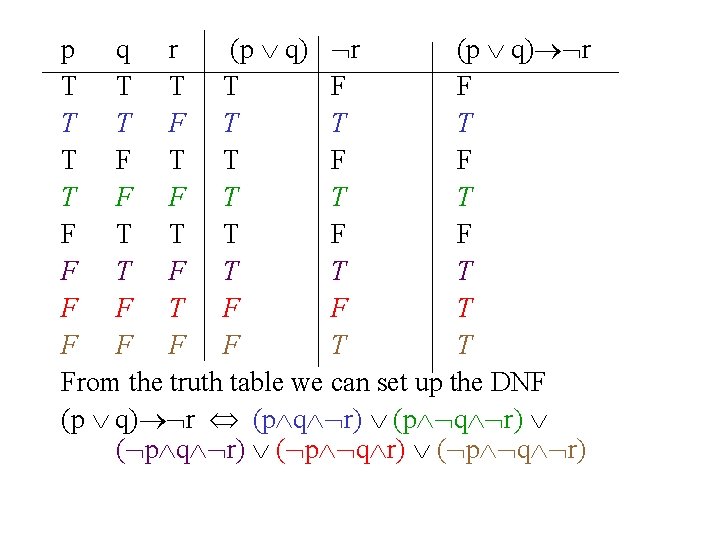
p q r (p q) r T T F F T T T T F F T T T F F F T T T F F T T From the truth table we can set up the DNF (p q) r (p q r) ( p q r)
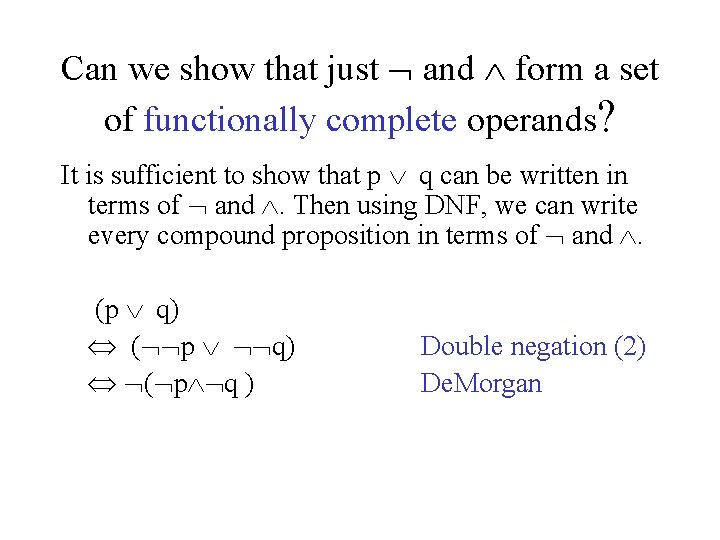
Can we show that just and form a set of functionally complete operands? It is sufficient to show that p q can be written in terms of and . Then using DNF, we can write every compound proposition in terms of and . (p q) ( p q ) Double negation (2) De. Morgan
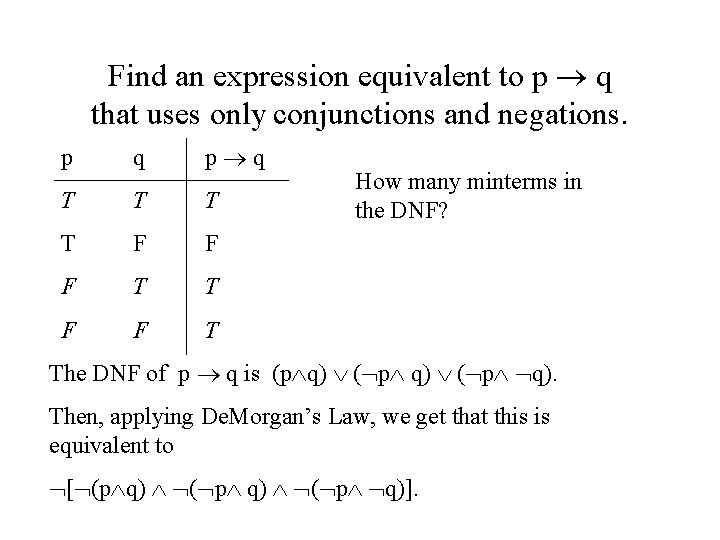
Find an expression equivalent to p q that uses only conjunctions and negations. p q T T F F F T T F F T How many minterms in the DNF? The DNF of p q is (p q) ( p q). Then, applying De. Morgan’s Law, we get that this is equivalent to [ (p q) ( p q)].
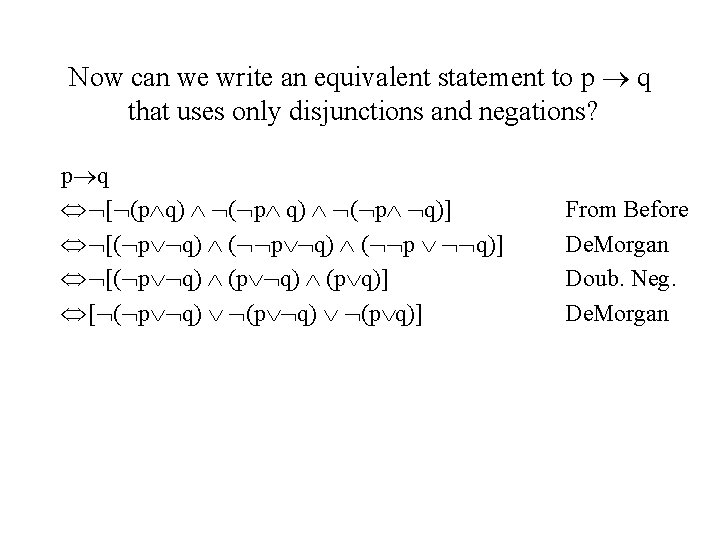
Now can we write an equivalent statement to p q that uses only disjunctions and negations? p q [ (p q) ( p q)] [( p q) ( p q)] [( p q) (p q)] [ ( p q) (p q)] From Before De. Morgan Doub. Neg. De. Morgan