
NORMAL NEWBORN AND THERMAL CARE IAP UG Teaching
NORMAL NEWBORN AND THERMAL CARE IAP UG Teaching slides 2015 -16 1

TERMINOLOGY • Neonatal – perinatal period • Weight related • Gestation related IAP UG Teaching slides 2015 -16 2

DEFINITIONS Neonatal period Refers to the period of less than 28 days after birth. Perinatal period Commences from 22 weeks (154 days) of gestation (the time when the birth weight is 500 g), and ends at 7 completed days after birth. IAP UG Teaching slides 2015 -16 3
Still birth Death of a fetus having birth weight > 500 g (or gestation > 22 weeks or crown - heel length >25 cm) or more. IAP UG Teaching slides 2015 -16 4
WEIGHT Low birth weight (LBW) Birth weight of less than 2500 gm. Very low birth weight (VLBW) Birth weight of less than 1500 gm. Extremely low birth weight (ELBW) Birth weight of less than 1000 gm. IAP UG Teaching slides 2015 -16 5

GESTATION Preterm Gestational age of less than 37 completed weeks (i. e. less than 259 days) Term Gestational age of 37 to less than 42 completed weeks (i. e. 259 to 293 days) Post term Gestational age of 42 completed weeks or more (i. e. 294 days or more) IAP UG Teaching slides 2015 -16 6

AGA Weight 10 -90 th percentile for gestation SGA Weight < 10 th percentile for gestation LGA Weight > 90 th percentile for gestation IAP UG Teaching slides 2015 -16 7
NEWBORN HEALTH IN INDIA • 25 million (2. 5 crores) births per year - Accounts for 20% of global births. • 0. 9 million (9 lakhs) die in neonatal period - Accounts for about 25% of global deaths. India accounts for highest births & neonatal deaths globally IAP UG Teaching slides 2015 -16 8
FACTS • Preterm baby has 9 -20 times more chance of dying compared to term baby. • IUGR baby has 3 times more chance of dying than term baby. • 70 % of neonatal deaths are preventable. IAP UG Teaching slides 2015 -16 9
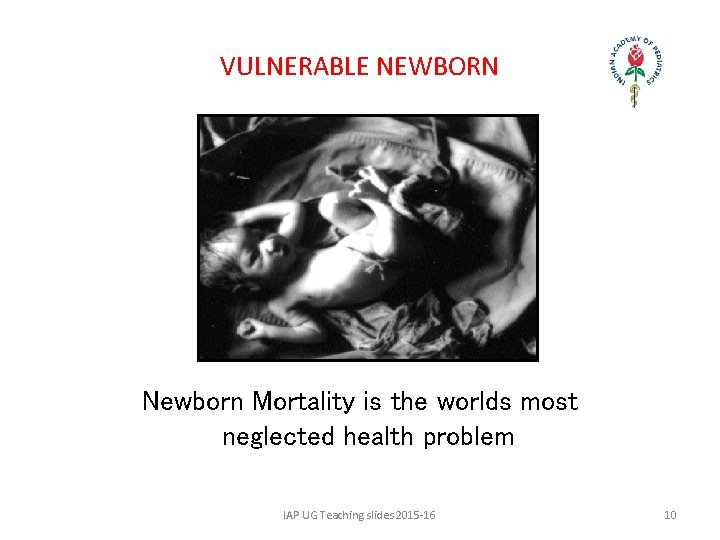
VULNERABLE NEWBORN Newborn Mortality is the worlds most neglected health problem IAP UG Teaching slides 2015 -16 10
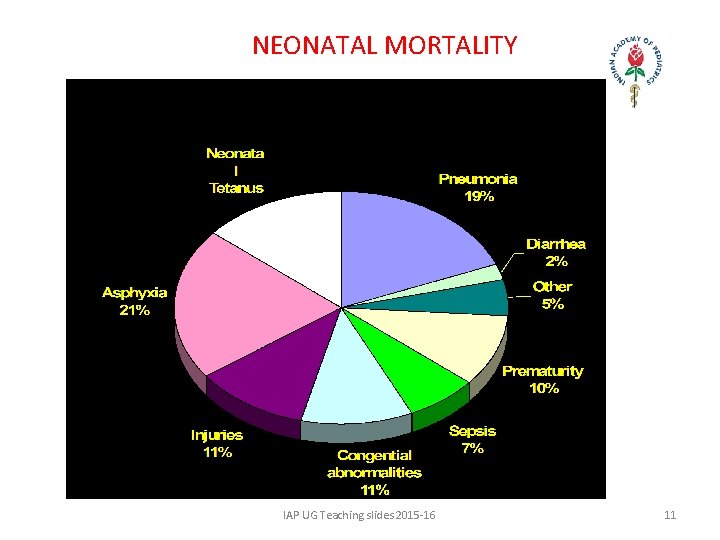
NEONATAL MORTALITY IAP UG Teaching slides 2015 -16 11
THERMAL CARE IAP UG Teaching slides 2015 -16 12
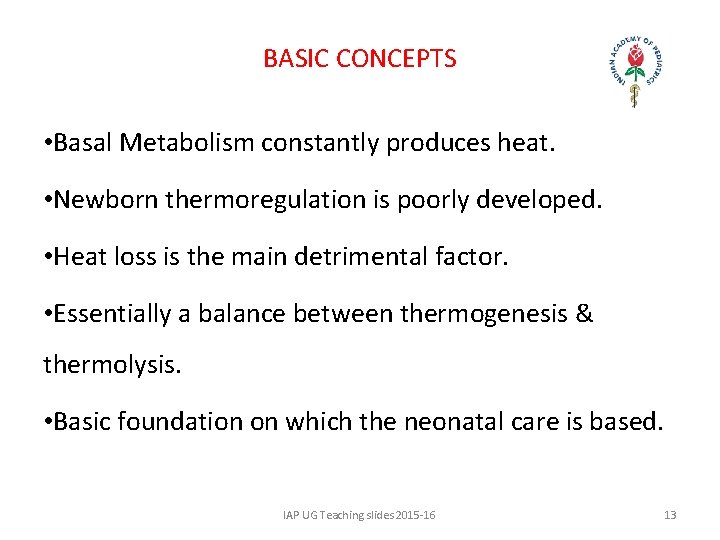
BASIC CONCEPTS • Basal Metabolism constantly produces heat. • Newborn thermoregulation is poorly developed. • Heat loss is the main detrimental factor. • Essentially a balance between thermogenesis & thermolysis. • Basic foundation on which the neonatal care is based. IAP UG Teaching slides 2015 -16 13
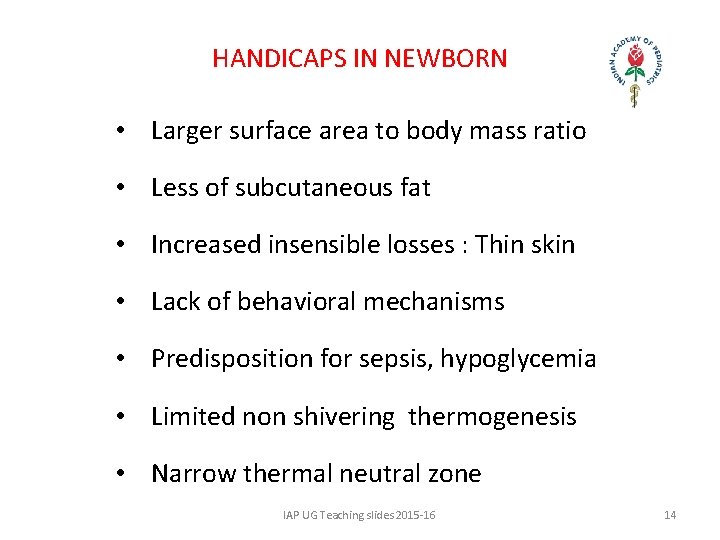
HANDICAPS IN NEWBORN • Larger surface area to body mass ratio • Less of subcutaneous fat • Increased insensible losses : Thin skin • Lack of behavioral mechanisms • Predisposition for sepsis, hypoglycemia • Limited non shivering thermogenesis • Narrow thermal neutral zone IAP UG Teaching slides 2015 -16 14

PRETERM VS. TERM • Less subcutaneous tissue • Thin skin : Evaporative losses • Less brown fat • Lack of sweating • Larger body surface area • No behavioral mechanisms • Behave like poikilothermic • Less oral intake IAP UG Teaching slides 2015 -16 15
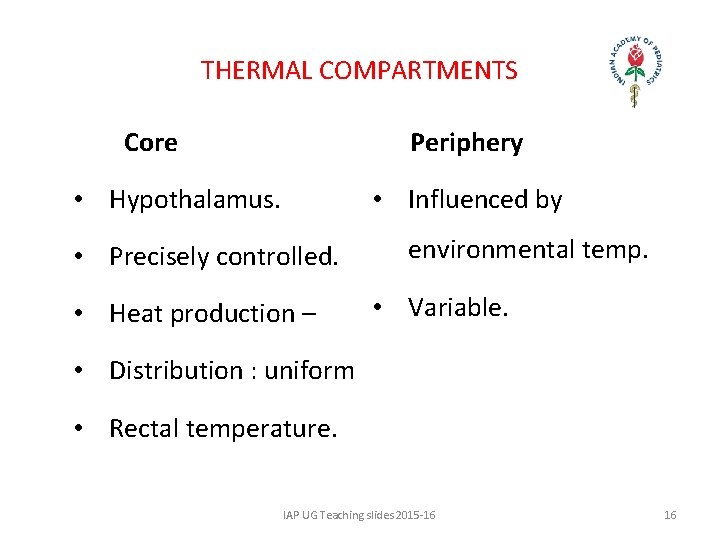
THERMAL COMPARTMENTS Core Periphery • Hypothalamus. • Influenced by • Precisely controlled. • Heat production – environmental temp. • Variable. • Distribution : uniform • Rectal temperature. IAP UG Teaching slides 2015 -16 16

THERMOREGULATION Thermogenesis = Thermolysis Thermogenesis : • Voluntary muscle activity. • Shivering. • Non shivering thermogenesis. Thermolysis : • Core to periphery. • From periphery to environment. IAP UG Teaching slides 2015 -16 17
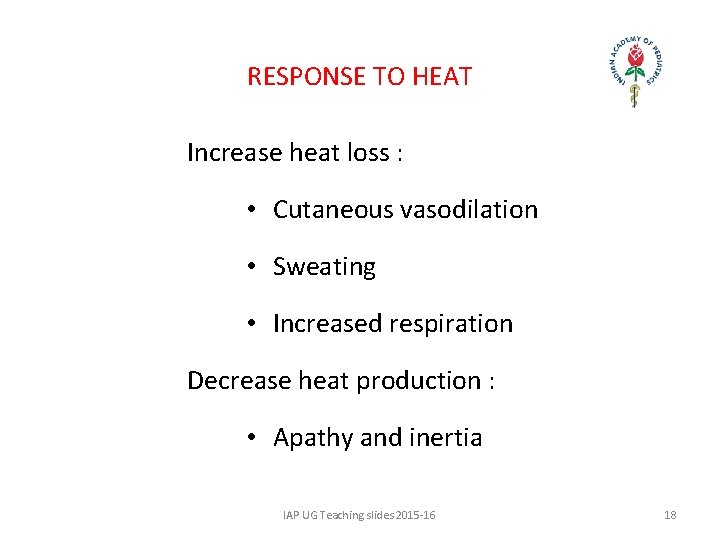
RESPONSE TO HEAT Increase heat loss : • Cutaneous vasodilation • Sweating • Increased respiration Decrease heat production : • Apathy and inertia IAP UG Teaching slides 2015 -16 18

RESPONSE TO COLD Increase heat production : • Shivering • Increased voluntary activity • Increased secretion of sympathomimetics. Decrease heat loss : • Cutaneous vasoconstriction • Curling up • Horripilation IAP UG Teaching slides 2015 -16 19
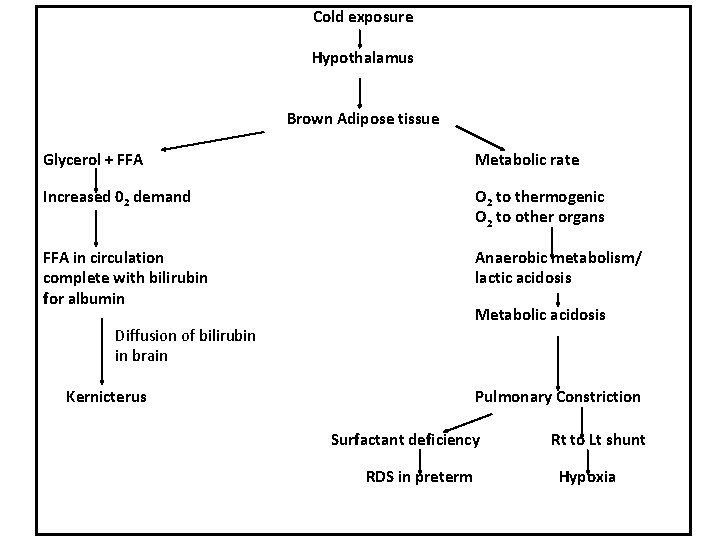
Cold exposure Hypothalamus Brown Adipose tissue Glycerol + FFA Metabolic rate Increased 02 demand O 2 to thermogenic O 2 to other organs FFA in circulation complete with bilirubin for albumin Anaerobic metabolism/ lactic acidosis Metabolic acidosis Diffusion of bilirubin in brain Kernicterus Pulmonary Constriction Surfactant deficiency RDS in preterm IAP UG Teaching slides 2015 -16 Rt to Lt shunt Hypoxia 20
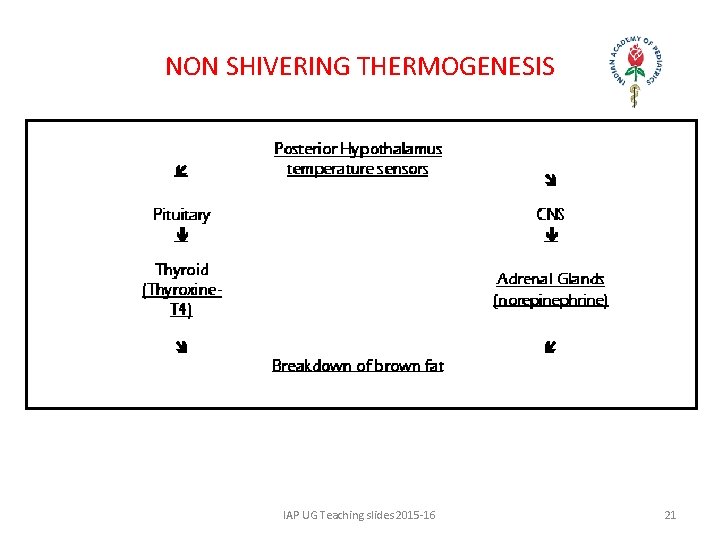
NON SHIVERING THERMOGENESIS IAP UG Teaching slides 2015 -16 21
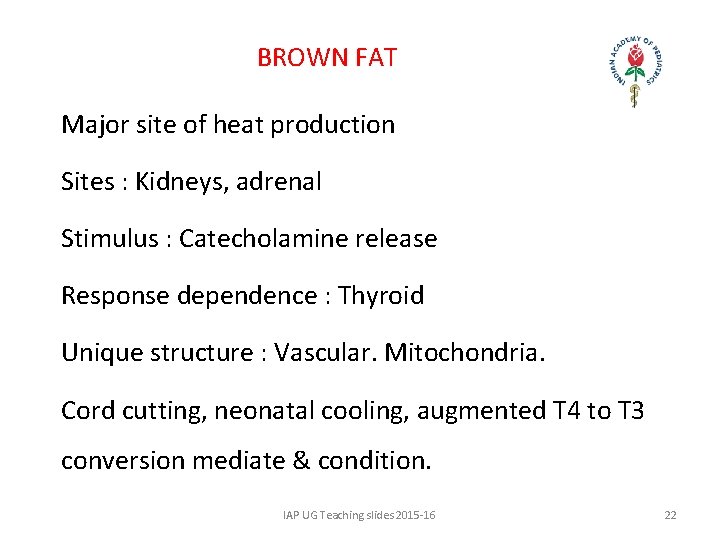
BROWN FAT Major site of heat production Sites : Kidneys, adrenal Stimulus : Catecholamine release Response dependence : Thyroid Unique structure : Vascular. Mitochondria. Cord cutting, neonatal cooling, augmented T 4 to T 3 conversion mediate & condition. IAP UG Teaching slides 2015 -16 22
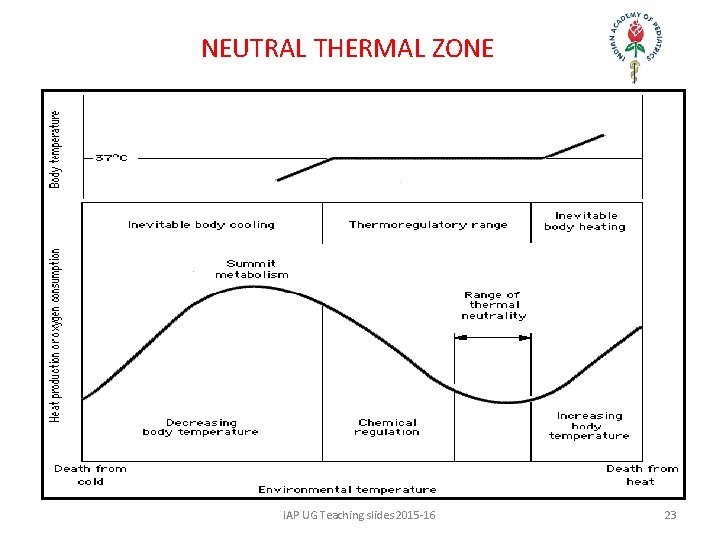
NEUTRAL THERMAL ZONE IAP UG Teaching slides 2015 -16 23
NEUTRAL THERMAL ZONE • Depends upon resting heat production & insulation. Clothing & wrapping widen and lower the NTZ. • Nursing in NTZ optimizes somatic and brain growth. • Clinically body maintains core temperature between 36. 7 – 37. 3 C IAP UG Teaching slides 2015 -16 24

TEMPERATURE RECORDING Axillary temperature recording for 3 minutes is recommended for routine monitoring IAP UG Teaching slides 2015 -16 25
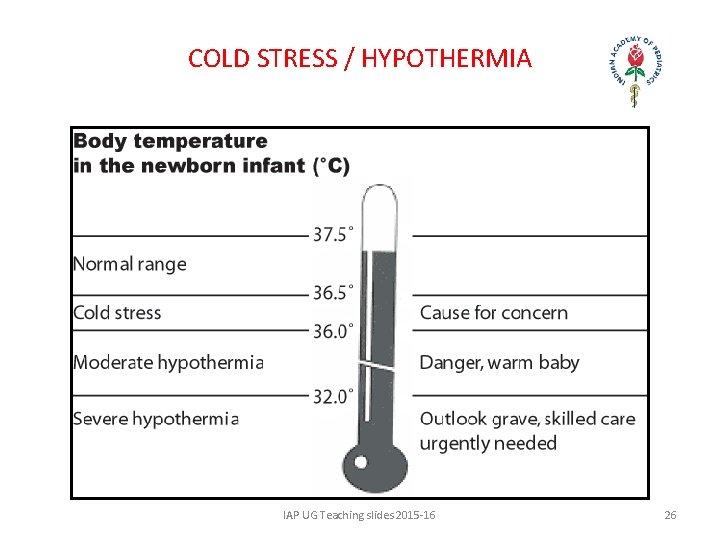
COLD STRESS / HYPOTHERMIA IAP UG Teaching slides 2015 -16 26
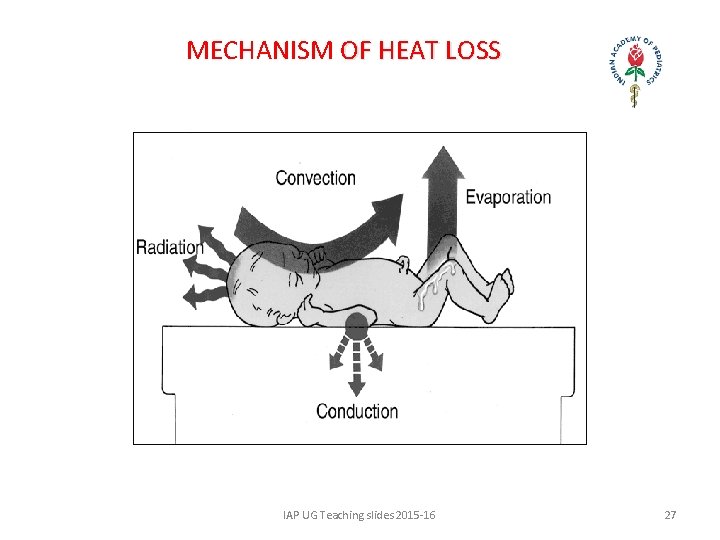
MECHANISM OF HEAT LOSS IAP UG Teaching slides 2015 -16 27
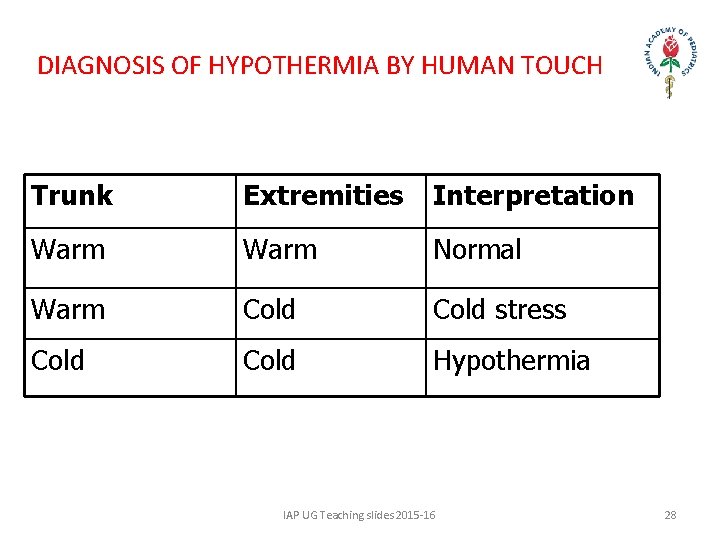
DIAGNOSIS OF HYPOTHERMIA BY HUMAN TOUCH Trunk Extremities Interpretation Warm Normal Warm Cold stress Cold Hypothermia IAP UG Teaching slides 2015 -16 28
MEASURES IN DELIVERY ROOM Thermoregulation • Draft free area • Pre-warmed linen • Heat source • Room temp : 28 -30 degrees C • Remove wet linen • Dry thoroughly & Wrap • Promote skin to skin contact IAP UG Teaching slides 2015 -16 29
THERMAL CARE (PNC WARD) • Ensure warmth • Cover the head • Promote rooming in • Avoid baby bath in hospital • Do not remove vernix caseosa • Early & Exclusive breast feeding IAP UG Teaching slides 2015 -16 30
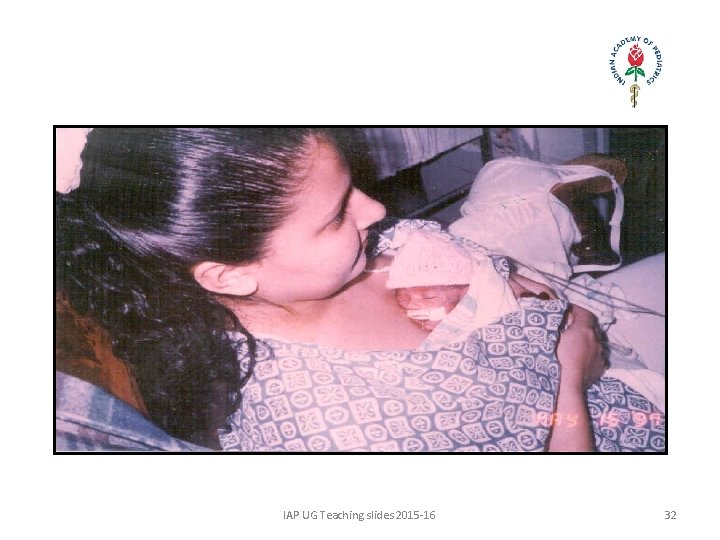
KANGAROO CARE • Assists in maintaining temperature • Facilitates breastfeeding • Increases duration of breastfeeding • Improves mother-baby bonding IAP UG Teaching slides 2015 -16 31
IAP UG Teaching slides 2015 -16 32
TEN COMMANDANT’S WARM CHAIN Warm delivery room Postpone bath Warm resuscitation Appropriate clothing Immediate drying Rooming in Kangaroo Care Warm transportation Breast feeding Awareness IAP UG Teaching slides 2015 -16 33
HYPERTHERMIA Ø Elevated set point • Endogenous / Exogenous pyrogens • Prostaglandin / cytokine mediated • Behavioral mechanism Ø Hyperthermia no change in set point : Ø Overrides the ability to lose heat IAP UG Teaching 2015 -16 Ø Hyperpyrexia : >slides 41. 5 C 34

HYPERTHERMIA OVER HEATED FEBRILE 1. High rectal temp 2. Warm hands / feet. 2. Cold hands / feet. 3. Pink skin. 3. Pale skin. 4. Extended posture. 4. Flexed posture. 5. Healthy. 5. Sick. 6. Core – axillary mismatch < 2 6. Core – axillary mismatch degrees C. > 3 degrees C. IAP UG Teaching slides 2015 -16 35

MANAGEMENT OF HYPERTHERMIA • Place the baby in a normal temperature environment (25 - 28 degrees C), away from any source of heat. • Undress the baby partially or fully, if necessary. • Give frequent breast feeds; give breast milk by cup if unable to suck. • If temperature >39 degrees C, sponge the baby with tap water; DO NOT use cold / ice water for sponge. • Measure the temperature hourly till it becomes normal. IAP UG Teaching slides 2015 -16 36
HYPOTHERMIA • More due to lack of knowledge than to lack of equipment. • No single environmental temperature that is appropriate for all sizes, gestational ages and conditions of newborn babies • Early marker of thermal stress IAP UG Teaching slides 2015 -16 37
MANAGEMENT OF COLD STRESS • Cover adequately - remove cold clothes and replace with warm clothes • Warm room/bed • Take measures to reduce heat loss • Ensure skin-to-skin contact with mother; if not possible, keep next to mother after fully covering the baby • Breast feeding • Monitor axillary temperature every ½ hour until it reaches 36. 50 C, then hourly for next 4 hours, 2 hourly for 12 hours thereafter. IAP UG Teaching slides 2015 -16 38
MANAGEMENT OF MODERATE HYPOTHERMIA • Skin to skin contact • Warm room/bed • Take measures to reduce heat loss • Provide extra heat • Room heater • Radiant warmer, incubator • Apply warm towels IAP UG Teaching slides 2015 -16 39
MANAGEMENT OF SEVERE HYPOTHERMIA • Provide extra heat preferably under radiant warmer or air heated incubator. • rapidly warm till 34 degrees C, then slow re-warming • Take measures to reduce heat loss. • IV fluids: 60 - 80 ml/kg of 10% Dextrose. • Oxygen. • Inj. vitamin K 1 mg in term & 0. 5 mg in preterm • If still hypothermic, consider antibiotics assuming sepsis. • Monitor HR, BP, Glucose (if available). IAP UG Teaching slides 2015 -16 40
CONCLUSIONS • Hypothermia is a major contributory factor in neonatal morbidity / mortality. • It is the most neglected aspect of neonatal management. • Essentially preventable. • Early detection and prompt simple interventions will prevent both hypo & hyperthermia. IAP UG Teaching slides 2015 -16 41

THANK YOU IAP UG Teaching slides 2015 -16 42
- Slides: 42