
Normal Mapping CS 418 Interactive Computer Graphics UNIVERSITY

![Normal Map • Normal vector encoded as rgb • [-1, 1]3 [0, 1]3: rgb](https://slidetodoc.com/presentation_image_h2/447346ed134d9146ef3855b9ab850f94/image-4.jpg "Normal Map • Normal vector encoded as rgb • [-1, 1]3 [0, 1]3: rgb")
- Slides: 13
Normal Mapping CS 418: Interactive Computer Graphics UNIVERSITY OF ILLINOIS AT URBANA-CHAMPAIGN Eric Shaffer
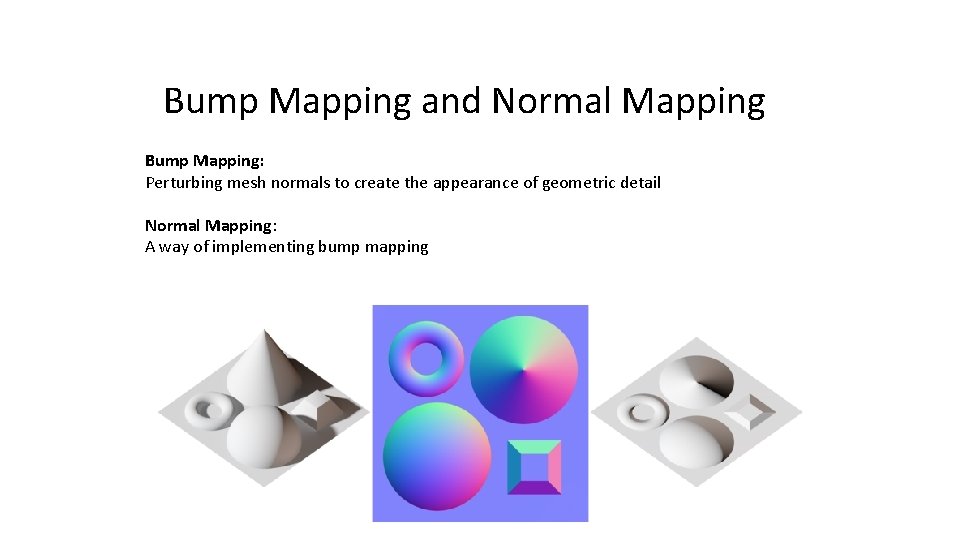
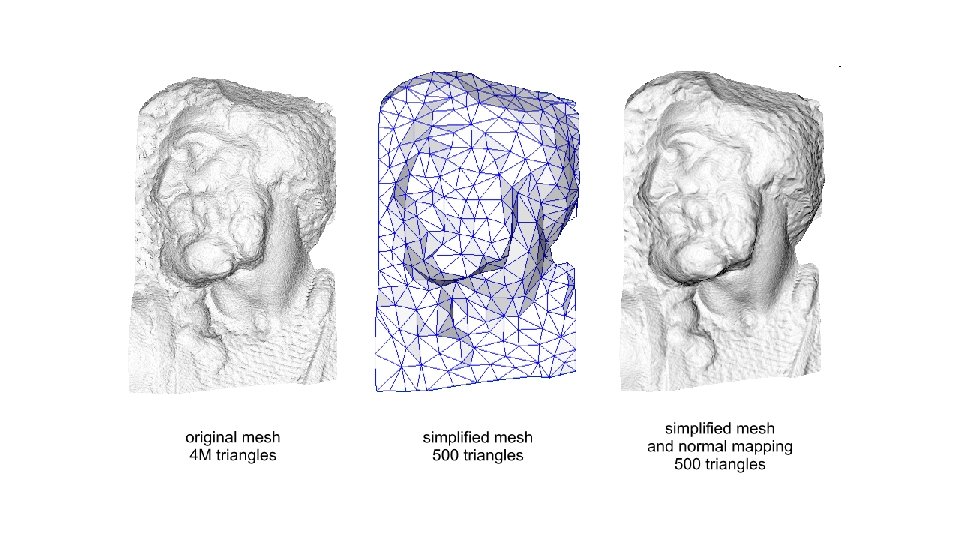
Bump Mapping and Normal Mapping Bump Mapping: Perturbing mesh normals to create the appearance of geometric detail Normal Mapping: A way of implementing bump mapping
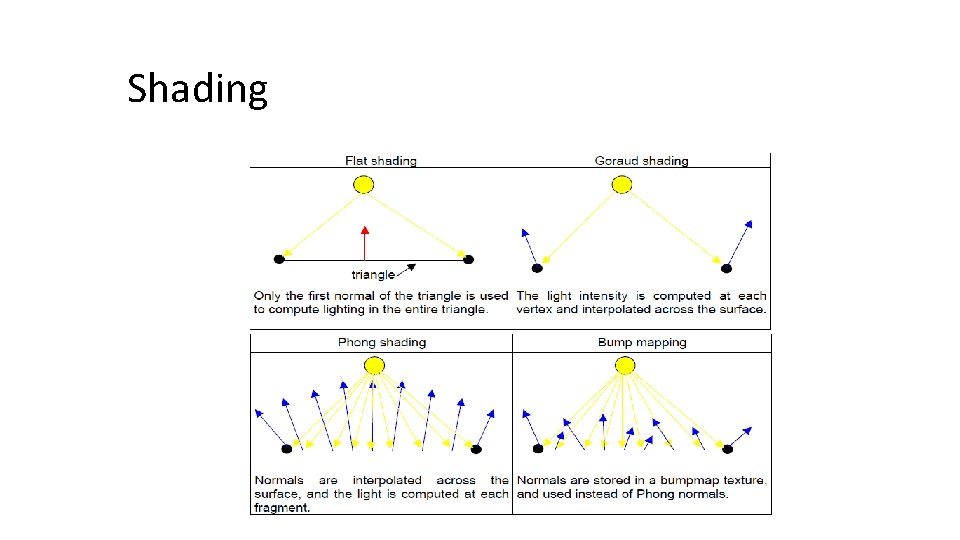
Shading
Normal Map • Normal vector encoded as rgb • [-1, 1]3 [0, 1]3: rgb = n*0. 5 + 0. 5 • RGB decoding in fragment shaders • vec 3 n = texture 2 D(Normal. Map, texcoord. st). xyz * 2. 0 – 1. 0 • Normal maps typically map direction out of image to +z • Hence RGB color for the straight up normal is (0. 5, 1. 0). • This is why normal maps are mostly a light blue color • Normals are then used for shading computation • Diffuse: n • l • Specular: (n • h)shininess • Computations done in tangent space at each fragment
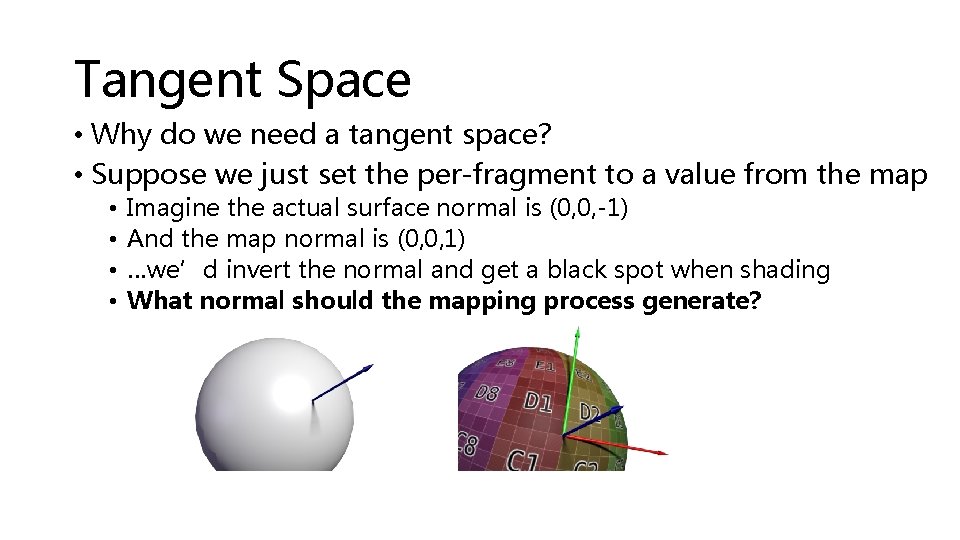
Tangent Space • Why do we need a tangent space? • Suppose we just set the per-fragment to a value from the map • • Imagine the actual surface normal is (0, 0, -1) And the map normal is (0, 0, 1) …we’d invert the normal and get a black spot when shading What normal should the mapping process generate?
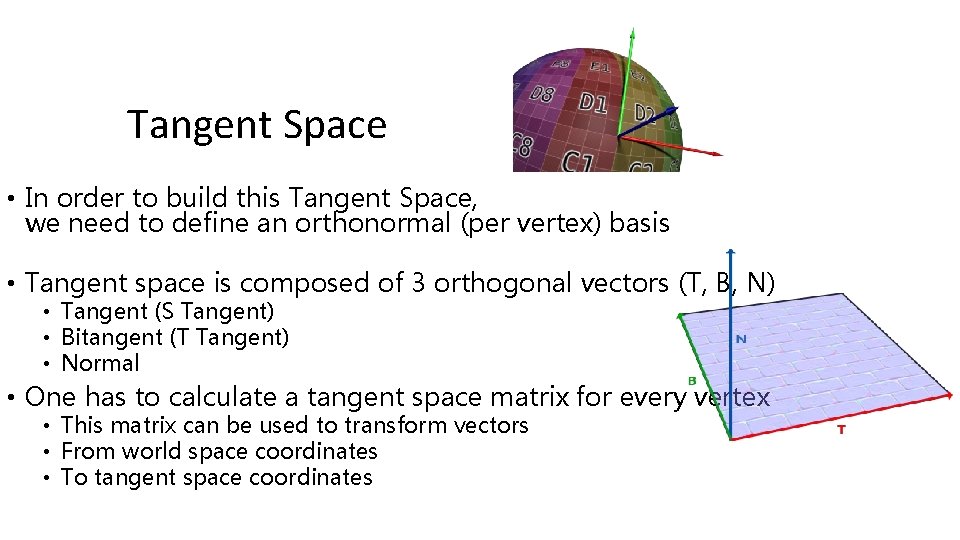
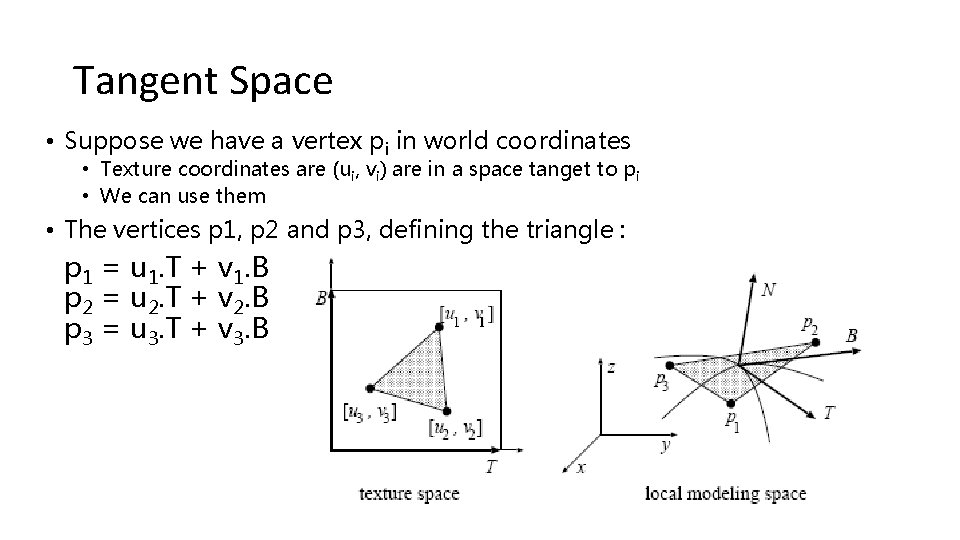
Tangent Space • In order to build this Tangent Space, we need to define an orthonormal (per vertex) basis • Tangent space is composed of 3 orthogonal vectors (T, B, N) • Tangent (S Tangent) • Bitangent (T Tangent) • Normal • One has to calculate a tangent space matrix for every vertex • This matrix can be used to transform vectors • From world space coordinates • To tangent space coordinates
Tangent Space • Suppose we have a vertex pi in world coordinates • Texture coordinates are (ui, vi) are in a space tanget to pi • We can use them • The vertices p 1, p 2 and p 3, defining the triangle : p 1 = u 1. T + v 1. B p 2 = u 2. T + v 2. B p 3 = u 3. T + v 3. B
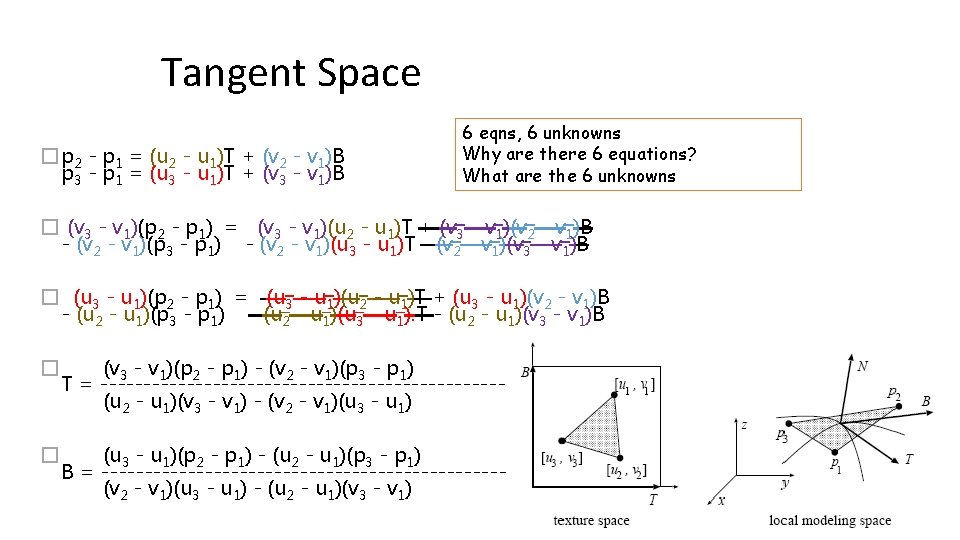
Tangent Space � p 2 - p 1 = (u 2 - u 1)T + (v 2 - v 1)B p 3 - p 1 = (u 3 - u 1)T + (v 3 - v 1)B 6 eqns, 6 unknowns Why are there 6 equations? What are the 6 unknowns � (v 3 - v 1)(p 2 - p 1) = (v 3 - v 1)(u 2 - u 1)T + (v 3 - v 1)(v 2 - v 1)B - (v 2 - v 1)(p 3 - p 1) - (v 2 - v 1)(u 3 - u 1)T - (v 2 - v 1)(v 3 - v 1)B � (u 3 - u 1)(p 2 - p 1) = (u 3 - u 1)(u 2 - u 1)T + (u 3 - u 1)(v 2 - v 1)B - (u 2 - u 1)(p 3 - p 1) - (u 2 - u 1)(u 3 - u 1). T - (u 2 - u 1)(v 3 - v 1)B � (v 3 - v 1)(p 2 - p 1) - (v 2 - v 1)(p 3 - p 1) T = ------------------------(u 2 - u 1)(v 3 - v 1) - (v 2 - v 1)(u 3 - u 1) � (u 3 - u 1)(p 2 - p 1) - (u 2 - u 1)(p 3 - p 1) B = ------------------------(v 2 - v 1)(u 3 - u 1) - (u 2 - u 1)(v 3 - v 1)
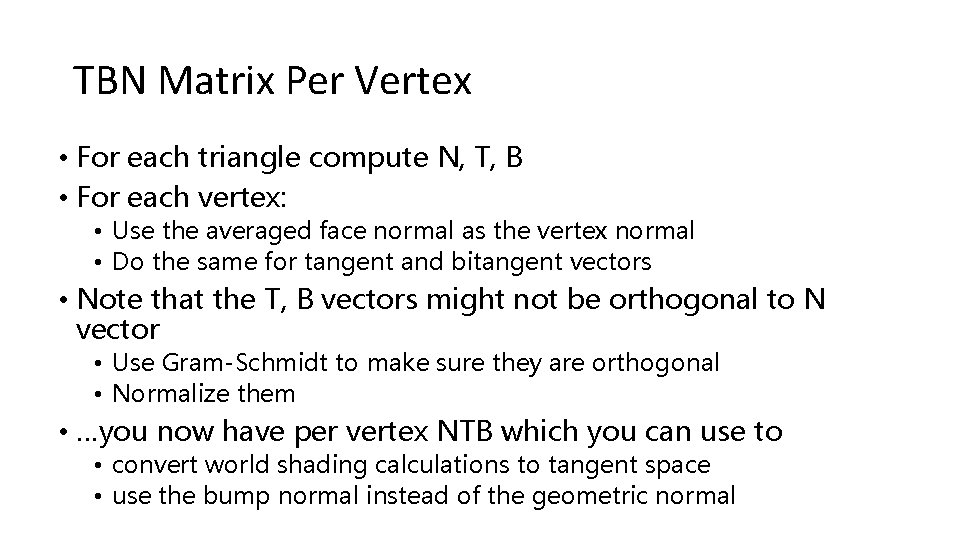
TBN Matrix Per Vertex • For each triangle compute N, T, B • For each vertex: • Use the averaged face normal as the vertex normal • Do the same for tangent and bitangent vectors • Note that the T, B vectors might not be orthogonal to N vector • Use Gram-Schmidt to make sure they are orthogonal • Normalize them • …you now have per vertex NTB which you can use to • convert world shading calculations to tangent space • use the bump normal instead of the geometric normal
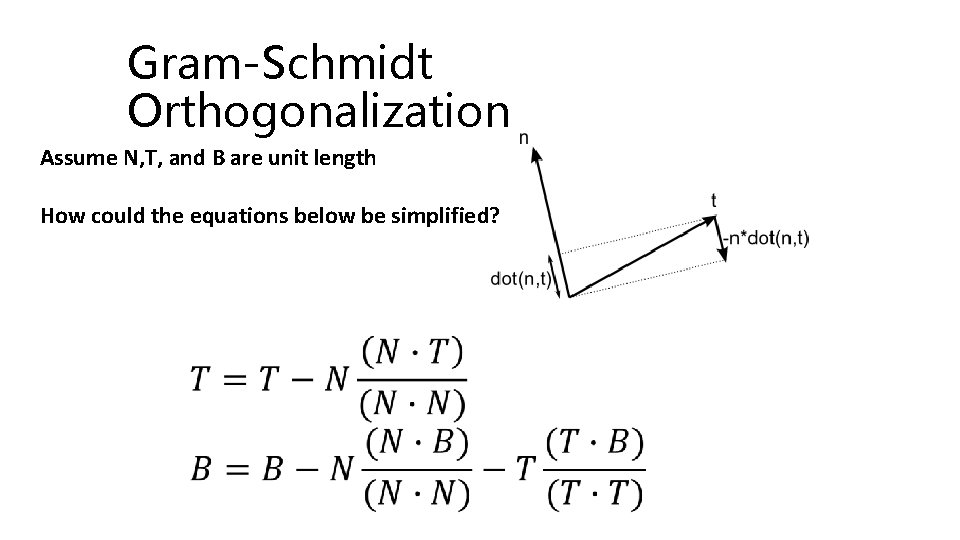
Gram-Schmidt Orthogonalization Assume N, T, and B are unit length How could the equations below be simplified?
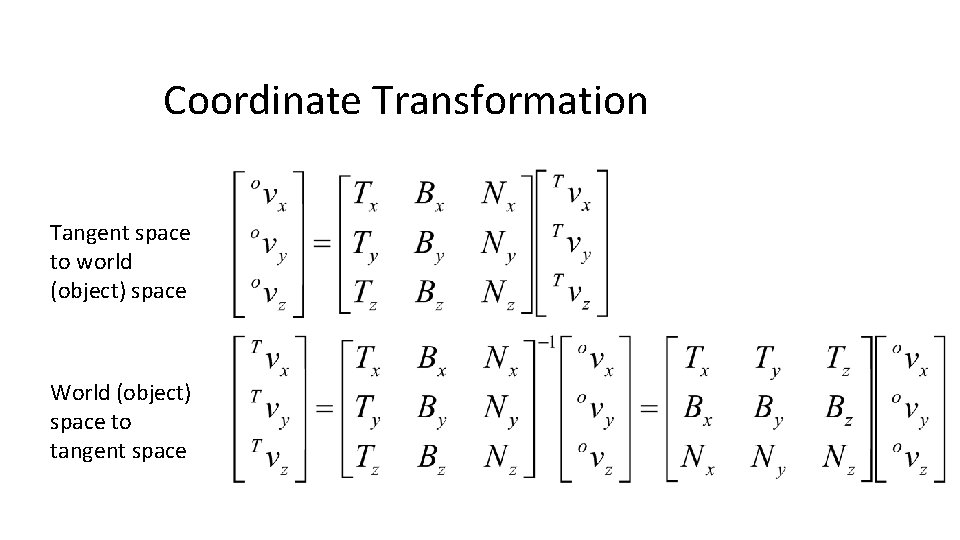
Coordinate Transformation Tangent space to world (object) space World (object) space to tangent space
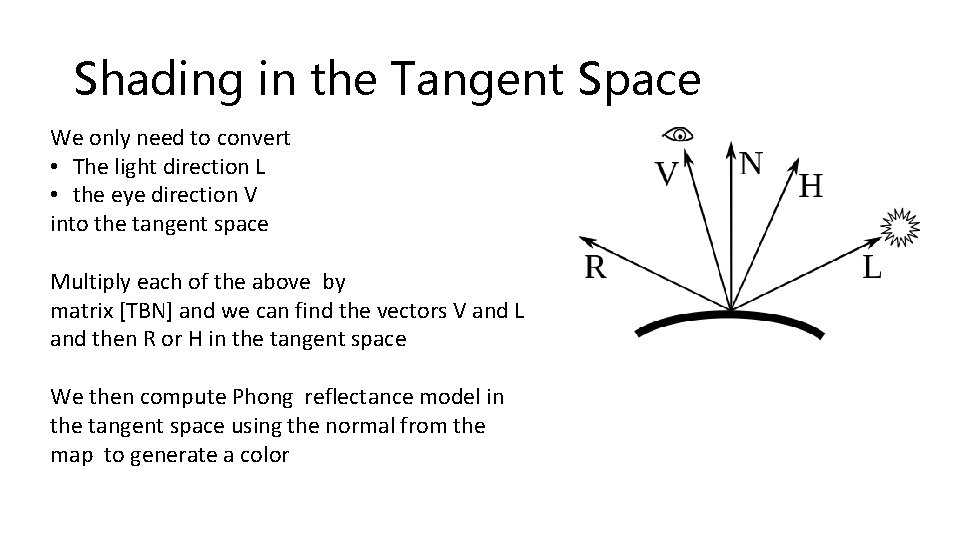
Shading in the Tangent Space We only need to convert • The light direction L • the eye direction V into the tangent space Multiply each of the above by matrix [TBN] and we can find the vectors V and L and then R or H in the tangent space We then compute Phong reflectance model in the tangent space using the normal from the map to generate a color