
NORMAL LAB VALUES Paula Ruedebusch ARNP DNP IMPORTANCE

NORMAL LAB VALUES Paula Ruedebusch, ARNP, DNP
IMPORTANCE • • • Electrolytes become ions Acquire capacity to conduct electricity Present in human body Balance is necessary for NORMAL function of cells and organs Can measure in blood (urine, sweat, etc) Hunt for etiology of disease

NORMS FOR THIS COURSE • • • Text pages 1083 -1084 except for K+ and HCO 3 Many variations of “normal” Lab tests and ranges vary across testing centers Boards will be similar MUST MEMORIZE!!
BASIC METABOLIC PANEL • • Measures electrolytes, chemicals, metabolic end products & substrates Consists of Glucose, Blood Urea Nitrogen (BUN), Creatinine, Na+, K+, Cl-, Bicarbonate (HCO 3 -), Ca 2+
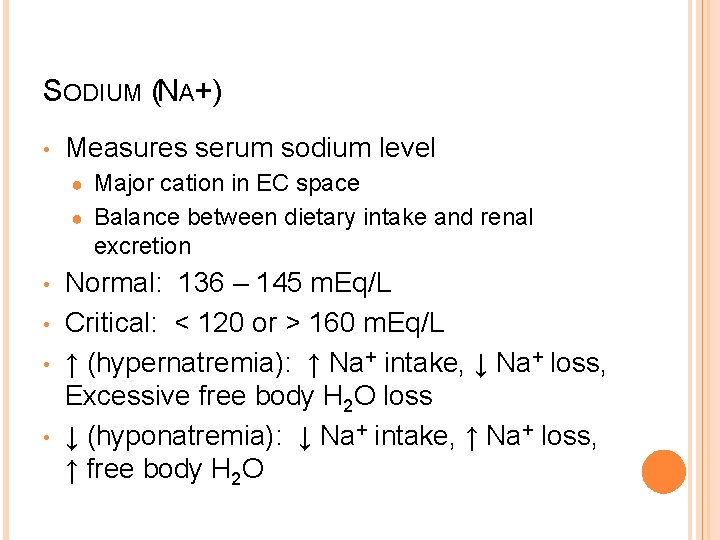
SODIUM (NA+) • Measures serum sodium level Major cation in EC space ● Balance between dietary intake and renal excretion ● • • Normal: 136 – 145 m. Eq/L Critical: < 120 or > 160 m. Eq/L ↑ (hypernatremia): ↑ Na+ intake, ↓ Na+ loss, Excessive free body H 2 O loss ↓ (hyponatremia): ↓ Na+ intake, ↑ Na+ loss, ↑ free body H 2 O
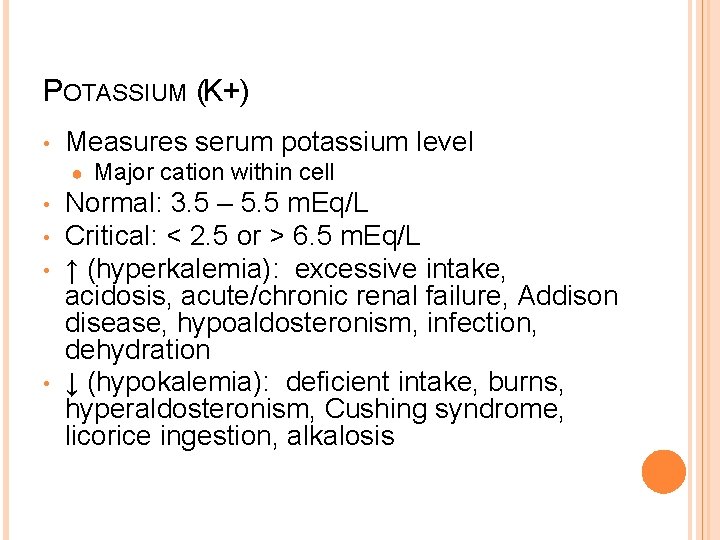
POTASSIUM (K+) • Measures serum potassium level ● • • Major cation within cell Normal: 3. 5 – 5. 5 m. Eq/L Critical: < 2. 5 or > 6. 5 m. Eq/L ↑ (hyperkalemia): excessive intake, acidosis, acute/chronic renal failure, Addison disease, hypoaldosteronism, infection, dehydration ↓ (hypokalemia): deficient intake, burns, hyperaldosteronism, Cushing syndrome, licorice ingestion, alkalosis
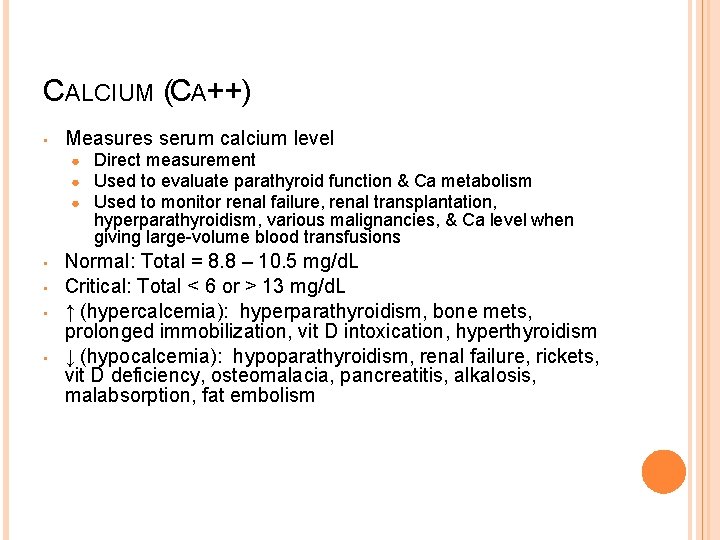
CALCIUM (CA++) • Measures serum calcium level ● ● ● • • Direct measurement Used to evaluate parathyroid function & Ca metabolism Used to monitor renal failure, renal transplantation, hyperparathyroidism, various malignancies, & Ca level when giving large-volume blood transfusions Normal: Total = 8. 8 – 10. 5 mg/d. L Critical: Total < 6 or > 13 mg/d. L ↑ (hypercalcemia): hyperparathyroidism, bone mets, prolonged immobilization, vit D intoxication, hyperthyroidism ↓ (hypocalcemia): hypoparathyroidism, renal failure, rickets, vit D deficiency, osteomalacia, pancreatitis, alkalosis, malabsorption, fat embolism
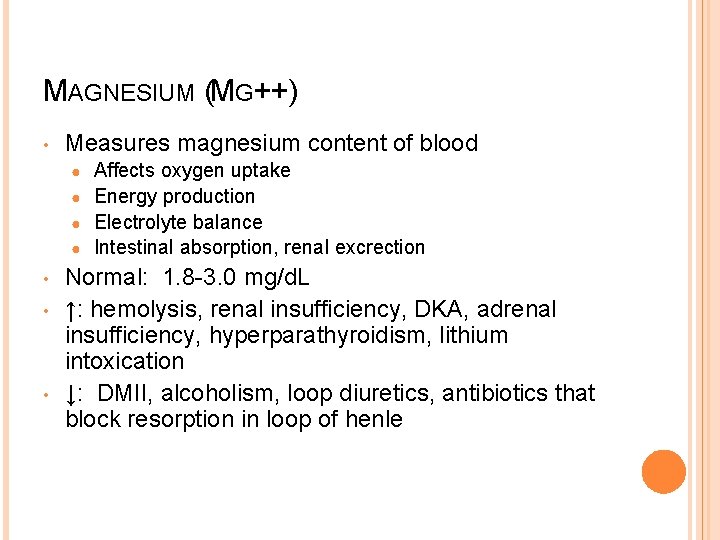
MAGNESIUM (MG++) • Measures magnesium content of blood Affects oxygen uptake ● Energy production ● Electrolyte balance ● Intestinal absorption, renal excrection ● • • • Normal: 1. 8 -3. 0 mg/d. L ↑: hemolysis, renal insufficiency, DKA, adrenal insufficiency, hyperparathyroidism, lithium intoxication ↓: DMII, alcoholism, loop diuretics, antibiotics that block resorption in loop of henle
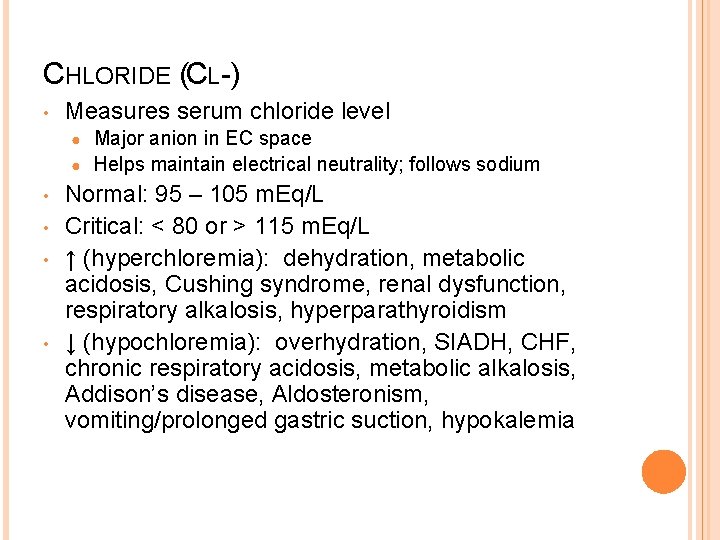
CHLORIDE (CL-) • Measures serum chloride level Major anion in EC space ● Helps maintain electrical neutrality; follows sodium ● • • Normal: 95 – 105 m. Eq/L Critical: < 80 or > 115 m. Eq/L ↑ (hyperchloremia): dehydration, metabolic acidosis, Cushing syndrome, renal dysfunction, respiratory alkalosis, hyperparathyroidism ↓ (hypochloremia): overhydration, SIADH, CHF, chronic respiratory acidosis, metabolic alkalosis, Addison’s disease, Aldosteronism, vomiting/prolonged gastric suction, hypokalemia
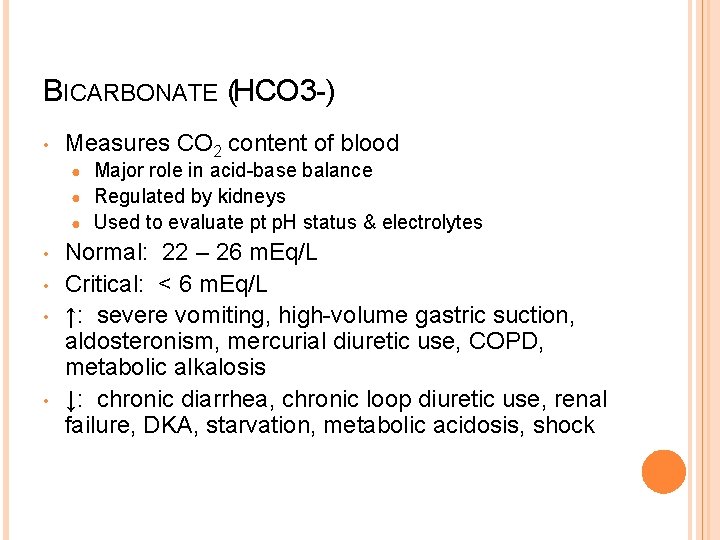
BICARBONATE (HCO 3 -) • Measures CO 2 content of blood Major role in acid-base balance ● Regulated by kidneys ● Used to evaluate pt p. H status & electrolytes ● • • Normal: 22 – 26 m. Eq/L Critical: < 6 m. Eq/L ↑: severe vomiting, high-volume gastric suction, aldosteronism, mercurial diuretic use, COPD, metabolic alkalosis ↓: chronic diarrhea, chronic loop diuretic use, renal failure, DKA, starvation, metabolic acidosis, shock
PHOSPHATE • • 2. 5 – 5. 0 mg/d. L Abnormal in bone, parathyroid and renal disease
GLUCOSE • Direct measure of blood glucose Commonly used to evaluate diabetic pts ● Part of “routine” testing ● • • Normal: 75 - 110 mg/d. L Critical: < 50 and > 400 mg/d. L ↑ (hyperglycemia): DM, acute stress response, Cushing syndrome, pheochromocytoma, chronic renal failure, acute pancreatitis, acromegaly, corticosteroid therapy ↓ (hypoglycemia): insulinoma, hypothyroidism, hypopituitarism, Addison’s disease, extensive liver disease, insulin overdose, starvation
BUN • Measures urea nitrogen in blood End product of protein metabolism (produced in liver) Indirect measure of renal function & glomerular function (excretion) ● Measure of liver metabolic function ● Part of routine labs ● Usually interpreted along with Cr (less accurate than Cr for renal disease) ● ● • • • Normal: 7 -18 mg/d. L ↑: prerenal causes, postrenal azotemia ↓: liver failure, overhydration because of SIADH, neg nitrogen balance, pregnancy, nephrotic syndrome
CREATININE • Measures serum creatinine ● ● ● • • Catabolic product of creatine phosphate (skeletal muscle contraction) Excreted entirely by kidneys → direct measure of renal function Minimally affected by liver function Elevation occurs slower than BUN Doubling ≈ 50% reduction in GFR Normal: 0. 6 – 1. 2 mg/d. L Critical: > 4 mg/d. L ↑: diseases affecting renal function (glomerulonephritis, pyelonephritis, ATN, urinary tract obstruction, reduced renal blood flow, diabetic nephropathy, nephritis), rhabdomyolysis, acromegaly, gigantism ↓: decreased muscle mass
BUN & CREATININE VS. RENAL FUNCTION • • • BUN and Creatinine ↑ = Kidney Function ↓ BUN and Creatinine ↓ = Kidney Function ↑ If kidneys are not working well, they are not clearing BUN and Creatinine, so the values go ↑ ↑ ↑
COMPREHENSIVE METABOLIC PANEL (CMP) • Includes all components of BMP plus Albumin, Total protein, Alkaline phosphatase (ALP), Alanine aminotransferase (ALT), Aspartate aminotransferase (AST) and Bilirubin
RELEVANCE • Patient improvement! ☺ • Patient worsening! ☹ • • • Is therapy effective? Therapy/treatment recommendations? Objective signs of invisible changes Nursing care plan initiation Changes to nursing care plan Criteria for discharge
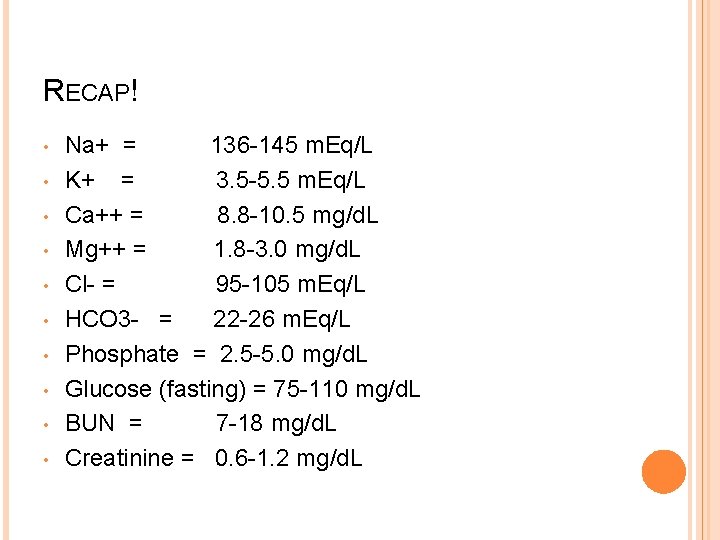
RECAP! • • • Na+ = 136 -145 m. Eq/L K+ = 3. 5 -5. 5 m. Eq/L Ca++ = 8. 8 -10. 5 mg/d. L Mg++ = 1. 8 -3. 0 mg/d. L Cl- = 95 -105 m. Eq/L HCO 3 - = 22 -26 m. Eq/L Phosphate = 2. 5 -5. 0 mg/d. L Glucose (fasting) = 75 -110 mg/d. L BUN = 7 -18 mg/d. L Creatinine = 0. 6 -1. 2 mg/d. L

Important to remember! • Additional items on CMP: Albumin, total protein, ALP, ALT, AST • MEMORIZE the values • Get comfortable recognizing abnormals • Practice, practice!
- Slides: 19