
NORMAL GUT MICROBIOTA Dr Valizadeh toosi Khordad 93
NORMAL GUT MICROBIOTA Dr Valizadeh toosi Khordad 93
DEFINITION OF GUT MICROBIOTA • Microbiota , microflora , commensal bacteria , microbiome are synonyms • The sum of all microorganisms including • • • bacteria protozoans fungi and viruses that reside in the host GIT
DEFINITION OF GUT MICROBIOTA • Bacterias are mean composition of gut microbiota • bacteria in the healthy human GUT contain : • average of 470 phylotypes. • likely exceed 1000 species
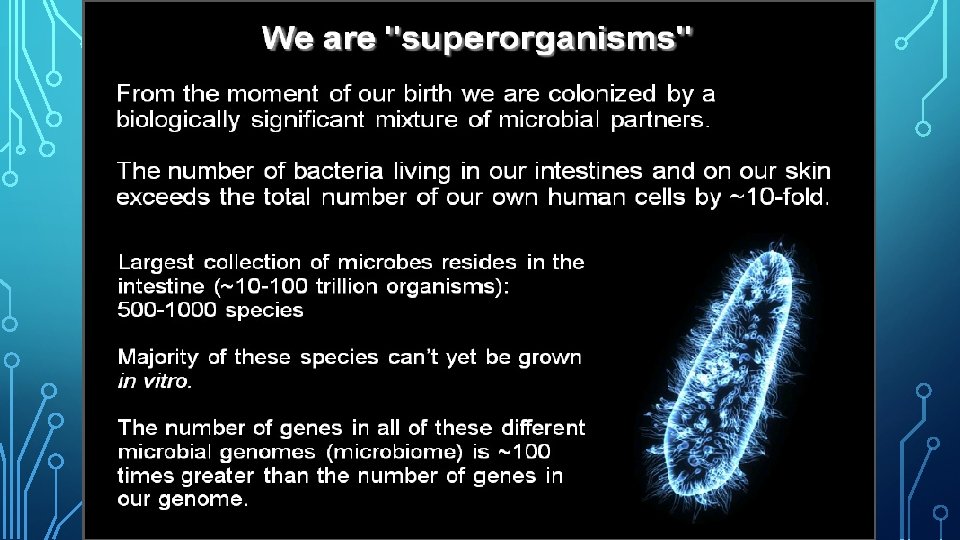
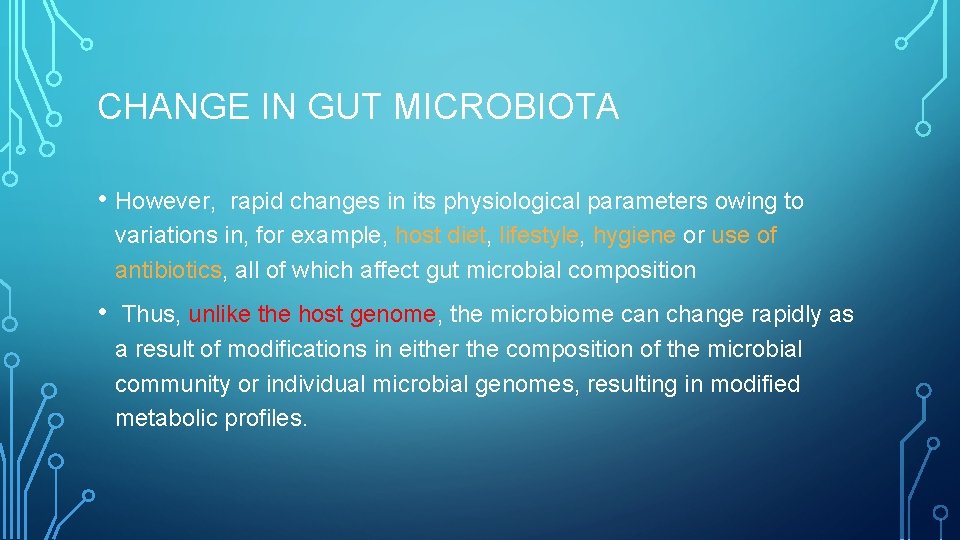
DEFINITION OF GUT MICROBIOTA • Over 99% of the bacteria in the gut are anaerobes. • Our microbiota contains 100 trillions of bacterial cells, 10 times more cells than cells constituting the human body. • Number of genes of our colonic microbiota exceeds the number of genes in the human genome by 150 times.
GUT MICROBIOTA COMPOSITION • the healthy human GI microbiome is dominated by the phyla Firmicutes and Bacteroidetes • other species present are Proteobacteria, Verrumicrobia, Actinobacteria, Fusobacteria and Cyanobacteria. • Lactobacillus, is present to a lesser extent.
GUT MICROBIOTA COMPOSITION • Less than 0. 1% of the human GI microbiota comprises primary overt pathogens such as Campylobacter jejuni, Salmonella enterica, and Vibrio cholerae. • about 70%, of this microbiota in our body is composed of bacteria that cannot be cultured.
GUT MICROBIOTA IN DIFFERENT PERSONS • each of us has a unique microbiota • but there are considerable differences between the compositions of the microbiota of individuals. • the main bacterial populations comprising our microbiota stabilize during the first years of life. (2 -3 years) • and subsequently remains stable throughout our life in terms of the major bacterial populations(but not completely ) • alterations may occur with changes in lifestyle, diet and age
GUT MICROBIOTA AS AN ORGAN • The human body carries about 100 trillion microorganisms in its intestines, • a number ten times greater than the total number of human cells in the body • The metabolic activities performed by these bacteria resemble those of an organ
GI MICROBIOTA AS AN INDICATOR OF HEALTH • Some bacteria are key indicators of GI Microbiome wellness --respect to human health • The relative abundance of commensal taxa (eg, Bacteroides, Prevotella, Ruminococcus) and low proportion of pathogenic bacteria( Proteobacteria)
BASIC ENTEROTYPES IN HEALTHY ADULTS • Three basic enterotypes have been described. • Enterotype 1 contains a high proportion of genera Bacteroides • enterotype 2 contains a high proportion of Prevotella • enterotype 3 contains a high proportion of Ruminococcus
ENTEROTYPES IN HEALTHY METABOLIC ACTIVITY • Each enterotypes have specific metabolic modules. • For example, genes belonging to the biotin and riboflavin biosynthesis pathways were detected with greater frequency in enterotype 1( Bacteroides ) • whereas genes involved in the thiamine and folate biosynthesis pathways were detected with greater frequencies in enterotype 2 ( Prevotella)



GUT MICROBIOTA DEVELOPMENT • The microbial communities that inhabit the human GIT are shaped by multiple environmental influences, including • lifestyle • and importantly, the aging process. • distinct phases of development occur in both the host and its GI microbiome
GUT MICROBIOTA COMPOSITIONS IN DIFERENT AGE • Human babies are colonized during passage through the birth canal by environmental microorganisms (for example, from the mother’s vagina or skin) and during breast feeding by microorganisms present in the milk. • Microbial signatures stabilize and start to resemble the ‘adult state’ when the infant reaches 1– 2 years of age.
GUT MICROBIOTA DEVELOPMENT • After birth, Bifidobacteria, specialized in the metabolism of milk oligosaccharides, are frequent • • As dietary richness and environmental exposures increase ---complexity of the GI microbiome also increase
DIET EFFECTS ON GUT MICROBIOTA • Comparisons of pediatric populations found large differences in bacterial composition, among healthy children who consume • diets dominated by plant carbohydrates vs those who consumed • a typical Western diet
DIET EFFECTS ON GUT MICROBIOTA • high-carbohydrate and high-fiber diets are associated with increased bifidobacteria, whereas a high-fat diet is linked with an increase in Bacteroides species. • Individuals who consume diets rich in plant carbohydrates appear to have larger proportions of Prevotella species
DIET EFFECTS ON GUT MICROBIOTA • Other bacterial populations associated with a healthy intestine include active butyrate-producing microbes. • Butyrate production can regulate the differentiation of colonic Tregulatory cells and influence inflammatory and allergic responses. • The ability to generate acetate was associated with resistance to damage by Shiga toxin–producing E coli.
GUT MICROBIOTA COMPOSITIONS IN DIFFERENT AGES • the microbiota appear distinct in different persons, the composition of each person's microbiota is relatively stable throughout adulthood. • the individuality of human microflora may be genetically controlled, but environmental variables including diet and sanitation appear to have profound effects on early intestinal colonization with bacteria • Microbiomes of healthy individuals vary with sex, race/ethnicity, and age;

GUT MICROBIOTA COMPOSITIONS IN DIFFERENT AGES • The colon flora becomes established after weaning and is thought to remain relatively stable throughout life • Its role in maintaining health is believed to be in establishing ecologic balance by preventing colonization with exogenous organisms. • This protection, known as "colonization resistance, “
GUT MICROBIOTA COMPOSITIONS IN DIFFERENT AGES • As we age, the proportions of bifidobacteria, Faecalibacterium prausnitzii, and multiple members of the Firmicutes typically decrease • whereas proportions of E coli, other members of the Proteobacteria, and Staphylococcus often increase
SHIFTS IN THE POPULATIONS OF GUT MICROBIOTA • Numerous studies have suggested that shifts in the populations of gut microbial communities may be associated with a number of important acute and chronic diseases: • • • inflammatory bowel disease obesity cardiovascular disease eczema and other skin diseases, vaginal infections
GUT MICROBIOTA RELATIONSHIP WITH HOST • Relationship between gut flora and humans is not merely commensal (a non -harmful coexistence), but rather a mutualistic relationship • the microorganisms perform a host of useful functions, such as • training the immune system, • preventing growth of harmful, pathogenic bacteria , • regulating the development of the gut, • Conversion of prodrugs to active metabolites • Breakdown of dietary oxalate
GUT MICROBIOTA RELATIONSHIP WITH HOST • fermentation of undigested carbohydrates and the subsequent absorption of short-chain fatty acids. • The most important of these fatty acids are butyrates, metabolised by the colonic epithelium; propionates by the liver; and acetates by the muscle tissue. • Intestinal bacteria also play a role in synthesizing vitamin B and vitamin K as well as metabolizing bile acids
GUT MICROBIOTA RELATIONSHIP WITH HOST • The production of antimicrobial compounds by commensal microbiome might prevent expansion of enteric pathogens. • The generation of antimicrobial peptides, immune-modulatory compounds, and neurotransmitters by the microbiome therefore could affect the performance of the mucosal immune system and enteric nervous system.
EFFECTS OF GUT MICROBIOTA ON HOST METABOLISM • germ-free mice have reduced adiposity and require a higher caloric intake to achieve the same weight as conventionally raised mice • This has in part been attributed to reduced energy extraction from a carbohydrate-rich diet in germ-free mice • these mice are also resistant to diet-induced obesity when fed a fatand sucrose-rich ‘Western’ diet.

DIET EFFECT ON GUT MICROBIOTA • the normal host-microbiota relationship has nutritional benefit, in contrast with the negative nutritional effect associated with bacterial overgrowth syndromes. • Elegant studies with germ-free mice have shown that upon colonization, body weight increases despite a reduced caloric intake.
CHANGE IN GUT MICROBIOTA • However, rapid changes in its physiological parameters owing to variations in, for example, host diet, lifestyle, hygiene or use of antibiotics, all of which affect gut microbial composition • Thus, unlike the host genome, the microbiome can change rapidly as a result of modifications in either the composition of the microbial community or individual microbial genomes, resulting in modified metabolic profiles.
OBESITY AND GUT MICROBIOTA • there are differences in the gut microbiota composition between obese and non-obese individuals • Compared with the gut microbiome of non-obese mice, that of obese mice is enriched in genes encoding carbohydrate metabolism enzymes and was demonstrated to have a greater capacity to extract energy from the diet and to generate short-chain fatty acids
OBESITY AND GUT MICROBIOTA • germ-free mice were colonized with the microbiota of obese mice and a control slim strain. • Colonization with microbiota from obese mice induced a higher rise in body fat than did colonization with the microbiota from slim mice. • The composition of the intestinal bacteria of the obese mice was found to differ from that of the slim mice, particularly concerning the proportion of the two bacterial groups Firmicutes and Bacteroidetes. • 50% lower frequency of Bacteroidetes and an increased proportion of Firmicutes in obese mice

OBESITY AND GUT MICROBIOTA • obese patients had a lower proportion of Bacteroidetes and, if they lost weight during a year, the proportion of Firmicutes in their intestinal microbiota was comparable with that found in slim persons. • some evidence suggests that the ratio of Firmicutes: Bacteroidetes can be used to determine predisposition to obesity and metabolic syndromes,


- Slides: 38