
Normal Distributions Section 2 1 2 Starter A
Normal Distributions Section 2. 1. 2
Starter • A density curve starts at the origin and follows the line y = 2 x. At some point on the line where x = p, the curve drops vertically to return to the x axis. 1. Draw the curve. 2. What is the value of p? 3. What is the median of the curve? – Show it as a vertical line on the curve.
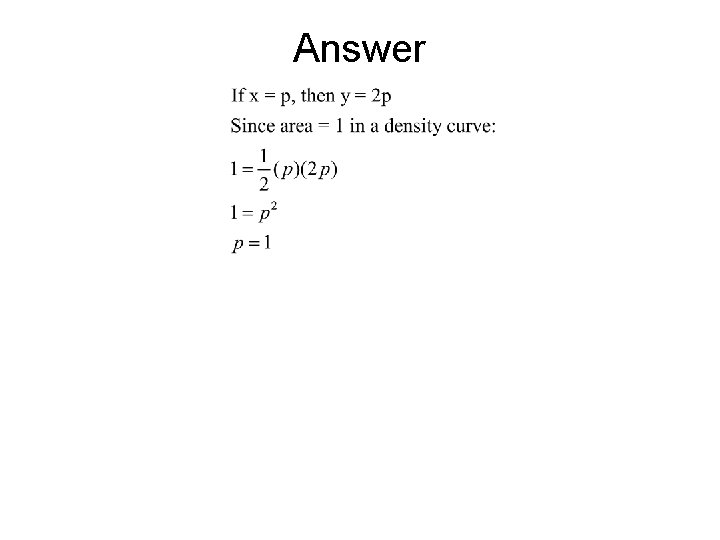
Answer
Today’s Objectives • Draw a normal curve and show μ, µ±σ, µ± 2σ, µ± 3σ on the graph • Use the Empirical Rule (a. k. a. 68 -95 Rule) to answer questions about percents and percentiles

Normal Curves • Draw a bell-shaped curve above an x axis • Draw the vertical line of symmetry – Label the x axis “μ” at this point • Show the two “inflection points” on the curve • The left inflection point is where the curve stops getting more steep and starts getting less steep • The other is symmetric to it about the mean line – Label the x axis “µ+σ” and “µ-σ” below the points • Using the same scale, label the x axis with µ plus and minus 2σ and 3σ
Normal Curves • Normal curves are special case density curves – The area under the curve is 1 • This is true of ALL density curves – The curve is symmetric and “bell-shaped” • So mean = median • We normally speak of the mean rather than median – The inflection points of the curve are one standard deviation (σ) above and below the mean
The Empirical Rule or: 68 -95 Rule • In a normal distribution with mean μ and standard deviation σ: – This is called the N(μ, σ) distribution – About 68% of the observations fall within σ of μ – About 95% fall within 2σ of μ – About 99. 7% fall within 3σ of μ
Example • Suppose the heights of American men are known to be N(69 in, 2. 5 in) – Draw the normal curve and label the axis – What percent of men are between 69 inches and 71. 5 inches tall? • Since 68% are between 66. 5 and 71. 5, and the graph is symmetric, there are 34% between 69 and 71. 5 inches tall.
Example Continued • What percent of men are taller than 74 in? – Since 95% of observations fall within ± 2σ of μ, then 5% fall outside those borders. – By symmetry, 2. 5% fall more than 2σ above the mean. • In this case, that is 69 + 2 x 2. 5 = 74 in • So 2. 5% of men are taller than 74 in
Example Concluded • In what percentile is a man who is 71. 5 in tall? • Recall that “percentile” means the percent of observations equal to or less than the specified value – By definition, 50% fall below 69 inches – 71. 5 inches is one σ above the mean, so 34% must fall between 69 and 71. 5 – Thus 71. 5 inches is the 84 th percentile • 50 + 34 = 84
Exploring Normal Data • 50 Fathoms Demo 3 – What Do Normal Data Look Like?
Today’s Objectives • Draw a normal curve and show μ, µ±σ, µ± 2σ, µ± 3σ on the graph • Use the Empirical Rule (a. k. a. 68 -95 Rule) to answer questions about percents and percentiles
Homework • Read pages 73 – 77 • Do problems 6 – 9
- Slides: 13