
Normal Distribution Normal Distribution also known as Gaussian
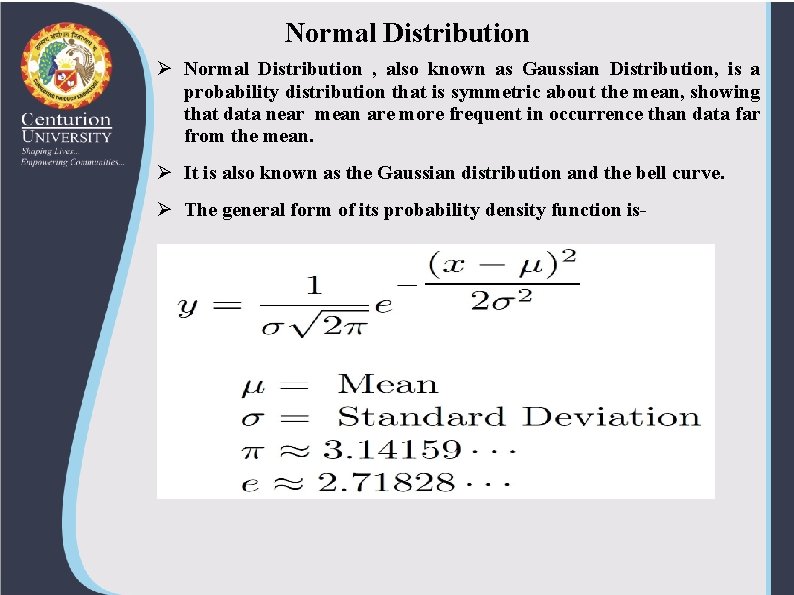
Normal Distribution Ø Normal Distribution , also known as Gaussian Distribution, is a probability distribution that is symmetric about the mean, showing that data near mean are more frequent in occurrence than data far from the mean. Ø It is also known as the Gaussian distribution and the bell curve. Ø The general form of its probability density function is-
Normal Distribution in Statistics ü The normal distribution is the most important probability distribution in statistics because it fits many natural phenomena. ü Many things closely follows normal distributions: § Heights of people § Size of things produced by machines § Errors in measurements § Blood Pressure § Marks on a test
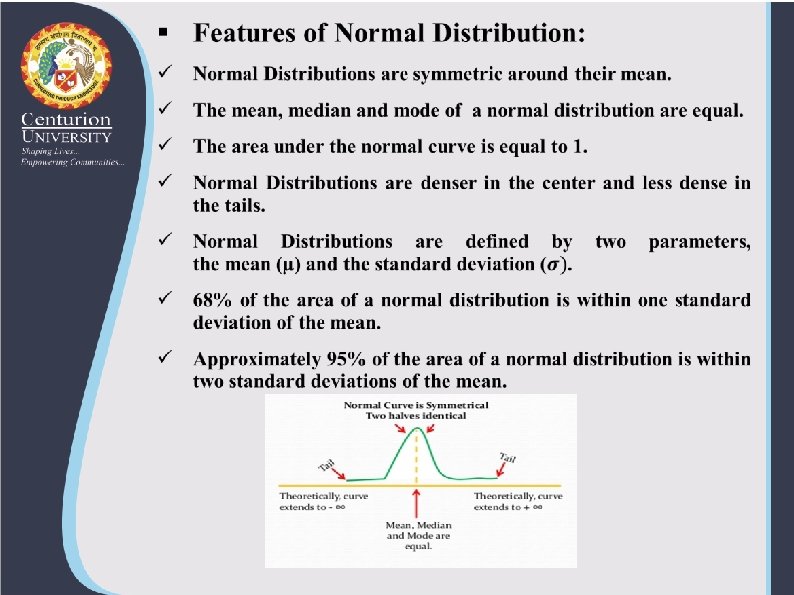
Business Applications v Sales Forecasting: § Normal Distributions are used to predict future levels of sales. § It is essentially impossible to predict the precise value of a future sales level; however, business still need to be able to plan for future events. § Using a scenario analysis bases on probability distribution can help a company frame its possible future values in terms of likely sales level and worst-case and base-case scenario. § By doing so the company can base its business.
v Risk Evaluation: § In addition to predicting future sales levels, probability distribution can also be a useful tool for evaluating risk. § Consider, for example, a company considering entering new business line. § If the company needs to generate $500000 in revenue in order to break and their probability distribution tells them that there is a 10% chance that revenues will be less than $500000, the company knows roughly what level of risk it is facing if it decides to pursue that new business line.
Applications of Central Limit Theorem ü The Central Limit Theorem states that the sampling distribution of the sample means approaches a normal distribution as the sample size gets larger — no matter what the shape of the population distribution. ü The probability distribution for total distance covered in a random walk (biased or unbiased) will tend toward a normal distribution. ü Flipping many coins will result in a normal distribution for the total number of heads (or equivalently total number of tails). ü From another viewpoint, the central limit theorem explains the common appearance of the "bell curve" in density estimates applied to real world data. ü In cases like electronic noise, examination grades, and so on, we can often regard a single measured value as the weighted average of many small effects. ü Using generalisations of the central limit theorem, we can then see that this would often (though not always) produce a final distribution that is approximately normal.
Application Ø It is used to measure the mean or average family income of a family in a particular region. Ø To create a range of values which is likely to include the population mean, we can use the sample mean.

THANK YOU 8
- Slides: 8