
Normal Distribution Dr T VENKATESAN Assistant Professor Department
Normal Distribution Dr. T. VENKATESAN Assistant Professor Department of Statistics St. Joseph’s College, Trichy-2. 28. 2. 2019
Objectives o Learning Objective - To understand the topic on Normal Distribution and its importance in different disciplines. o Performance Objectives At the end of this lecture the student will be able to: o Draw normal distribution curves and calculate the standard score (z score) o Apply the basic knowledge of normal distribution to solve problems. o Interpret the results of the problems.
Types of Distribution o Frequency Distribution o Normal (Gaussian) Distribution o Probability Distribution o Poisson Distribution o Binomial Distribution o Sampling Distribution o t distribution o F distribution
What is Normal (Gaussian) Distribution? o The normal distribution is a descriptive model that describes real world situations. o It is defined as a continuous frequency distribution of infinite range (can take any values not just integers as in the case of binomial and Poisson distribution). o This is the most important probability distribution in statistics and important tool in analysis of epidemiological data and management science.
Characteristics of Normal Distribution o It links frequency distribution to probability distribution o Has a Bell Shape Curve and is Symmetric o It is Symmetric around the mean: Two halves of the curve are the same (mirror images)
Characteristics of Normal Distribution Cont’d o Hence Mean = Median o The total area under the curve is 1 (or 100%) o Normal Distribution has the same shape as Standard Normal Distribution.
Characteristics of Normal Distribution Cont’d o In a Standard Normal Distribution: The mean (μ ) = 0 and Standard deviation (σ) =1 Tripthi M. Mathew, MD, MPH
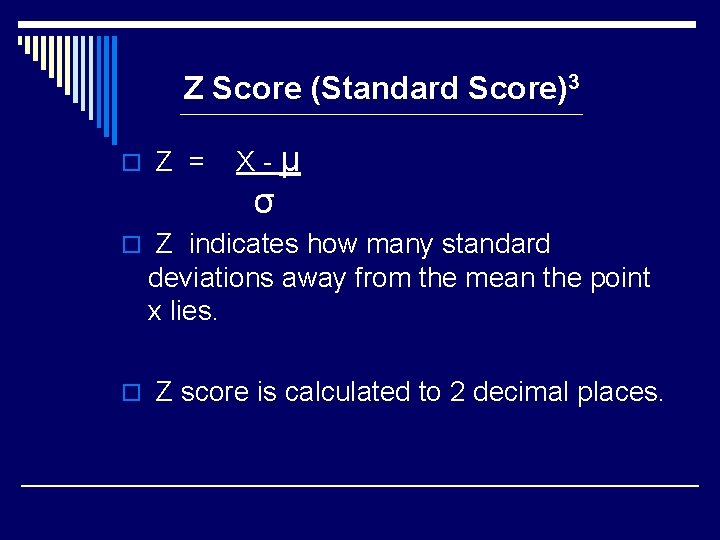
Z Score (Standard Score)3 o Z = X-μ σ o Z indicates how many standard deviations away from the mean the point x lies. o Z score is calculated to 2 decimal places.

Tables o Areas under the standard normal curve (Appendices of the textbook)
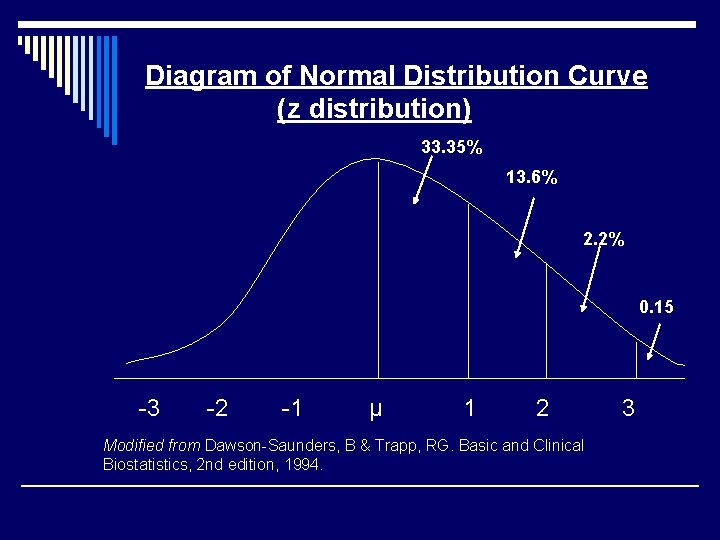
Diagram of Normal Distribution Curve (z distribution) 33. 35% 13. 6% 2. 2% 0. 15 -3 -2 -1 μ 1 2 Modified from Dawson-Saunders, B & Trapp, RG. Basic and Clinical Biostatistics, 2 nd edition, 1994. 3
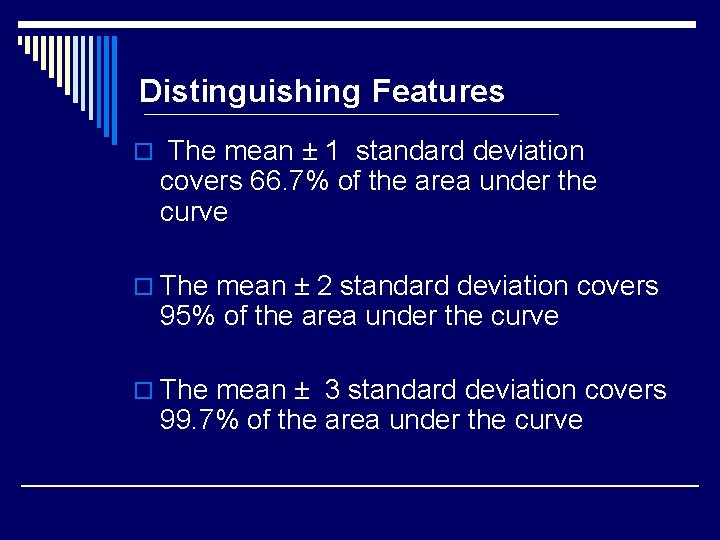
Distinguishing Features o The mean ± 1 standard deviation covers 66. 7% of the area under the curve o The mean ± 2 standard deviation covers 95% of the area under the curve o The mean ± 3 standard deviation covers 99. 7% of the area under the curve
- Slides: 11