
Normal Distribution Chong Ho Alex Yu Standard Normal
Normal Distribution Chong Ho (Alex) Yu

Standard Normal Distribution • • • symmetric continuous unimodal bell-shaped asymptotic the mean, median, and mode are the same.

Normal distribution • Normal curve is a theoretical construct. • Geary (1947) stated that normality could be viewed as a special case of many distributions rather than a universal property. Geary suggested that future editions of all existing textbooks and new textbooks should include this warning: “Normality is a myth; there never was, and never will be, a normal distribution” (p. 241).
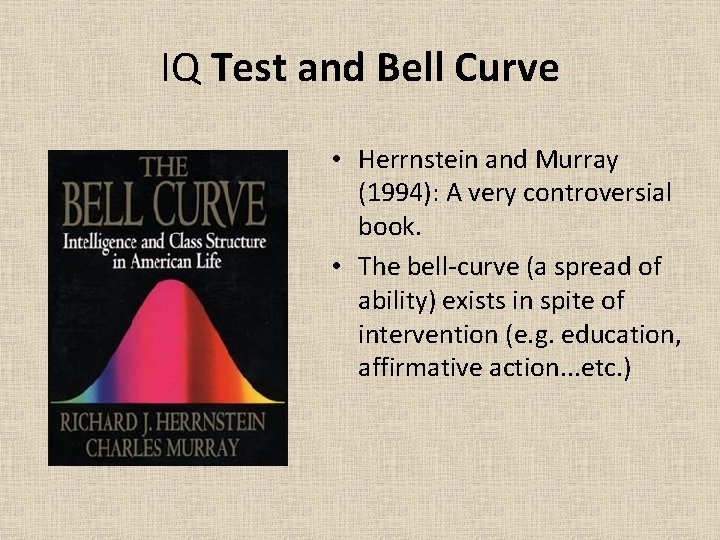
IQ Test and Bell Curve • Herrnstein and Murray (1994): A very controversial book. • The bell-curve (a spread of ability) exists in spite of intervention (e. g. education, affirmative action. . . etc. )
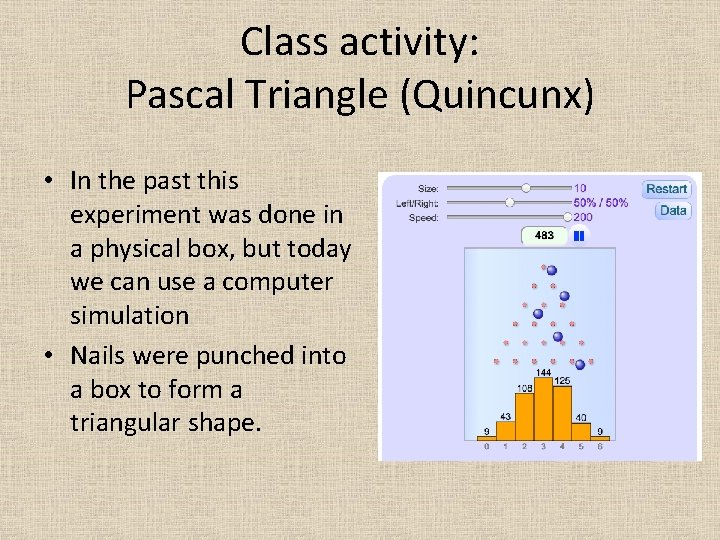
Class activity: Pascal Triangle (Quincunx) • In the past this experiment was done in a physical box, but today we can use a computer simulation • Nails were punched into a box to form a triangular shape.

Pascal Triangle (Quincunx) • On top there is only one nail. The second row has two nails. Each subsequent row has one additional nail. • When a ball is poured into the box from top and lands on the first nail, the probability of going to the left is. 5 and to the right is also. 5.

Pascal Triangle • Subsequently, the probability of going to which direction gets more and more complicated. Nonetheless, the process is random. • But this random process always produces a normal distribution!

Pascal Triangle • Open https: //www. mathsisfun. com/data/quincunx. html • How long does it take to make a normal distribution. • When you think you have a normal curve, please raise your hand.
Skewness and kurtosis • There is no perfectly normal curve. • Skewness refers to the degree of asymmetry in the distribution. The normal distribution is symmetric and hence has zero skewness. • Kurtosis is the relative ratio of the mass of the distribution located in the center versus in the tails. The kurtosis of the normal distribution is 3

Computation • Download the data “Visualization_data” from the Unit 4 folder. • There are two versions: Excel and SPSS. Download all of them. • If you don’t have Excel, you can use either Google Sheet or Open Office, which are free. • I will use SAT to do a demo. Then you will use GPA.
Computation in Excel • Skewness: – In the cell where you want to place the output, type =skew(first cell of the data column: last cell). – For example, if you want to calculate the skewness of SAT, type =skew(I 2: I 91). – Caution: the function “skew” is for the sample, the function “skew. p” is for the population. • Kurtosis: = kurt(first: last)

Computation in SPSS • Analyze Descriptive Statistics Explore • (This screen capture is made in a Mac. It might looks different in Windows)
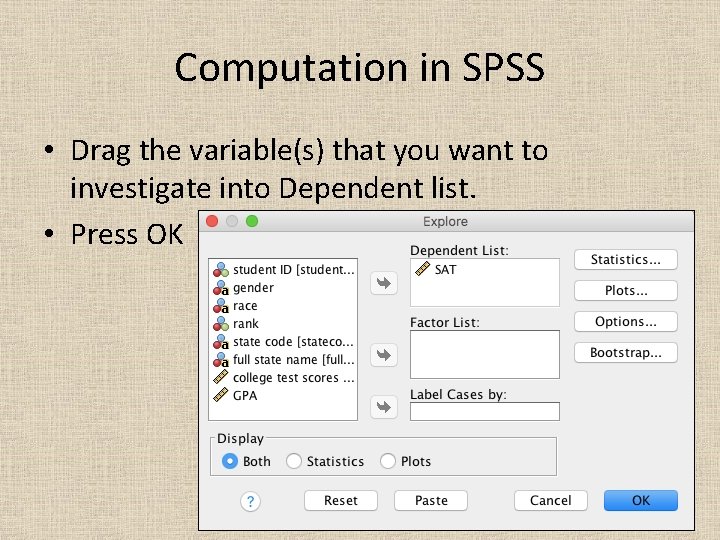
Computation in SPSS • Drag the variable(s) that you want to investigate into Dependent list. • Press OK
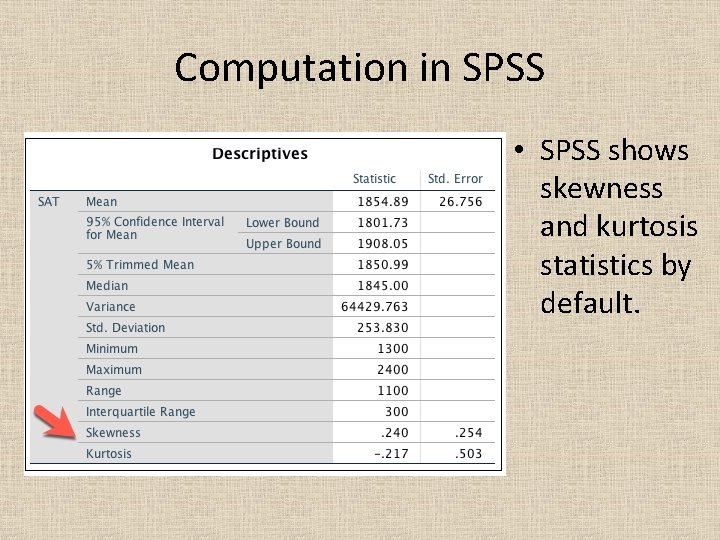
Computation in SPSS • SPSS shows skewness and kurtosis statistics by default.
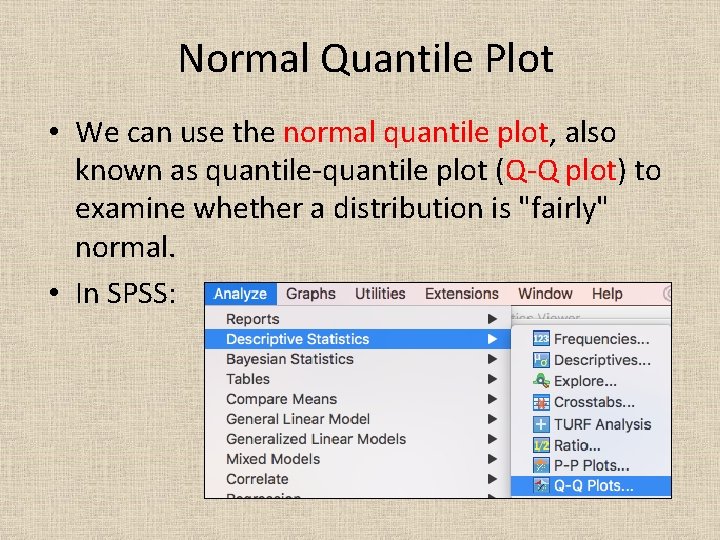
Normal Quantile Plot • We can use the normal quantile plot, also known as quantile-quantile plot (Q-Q plot) to examine whether a distribution is "fairly" normal. • In SPSS:

Normal Quantile Plot • SPSS:
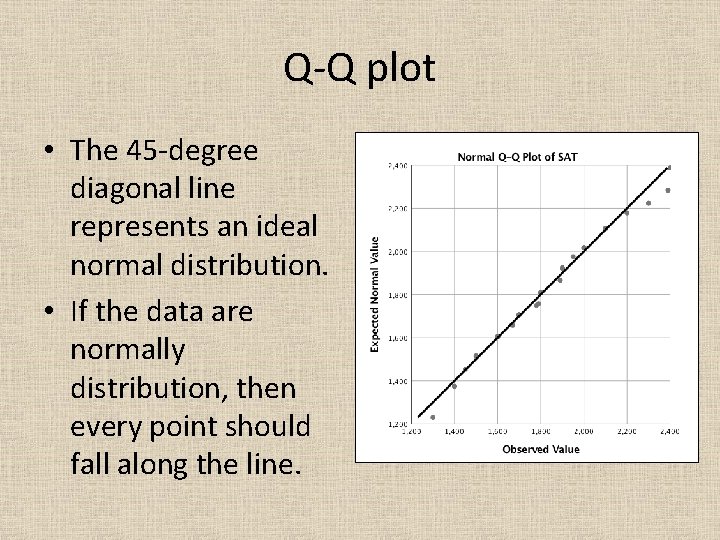
Q-Q plot • The 45 -degree diagonal line represents an ideal normal distribution. • If the data are normally distribution, then every point should fall along the line.
Ungraded Exercise • Use any tool you like (Excel, Google Sheet, Open Office, or SPSS). • Compute the skewness and kurtosis of GPA • Plot a normal quantile plot, also known as Q-Q plot, for GPA.
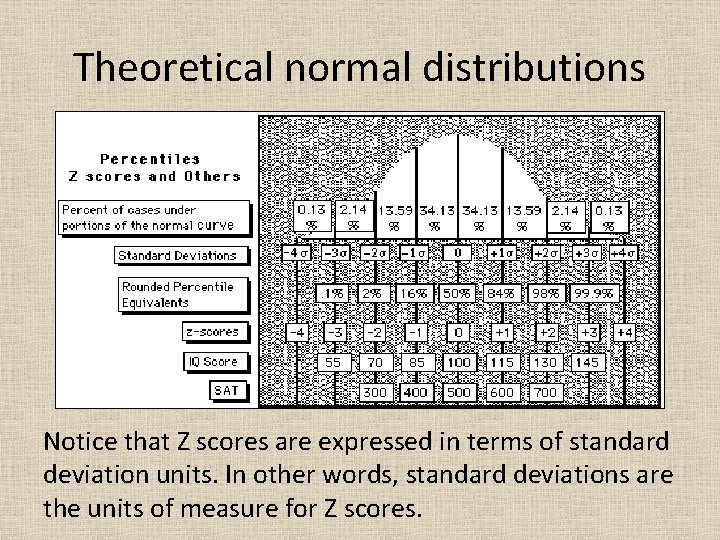
Theoretical normal distributions Notice that Z scores are expressed in terms of standard deviation units. In other words, standard deviations are the units of measure for Z scores.

The real SAT distribution

Theoretical normal distributions For an IQ score with Z=1. 5, the score is 1. 5 standard deviation units above the mean

Theoretical normal distributions Z scores not only give the distance of the score from the mean in standard deviation units, but also the direction of the score from the mean by using the sign of the Z score (+ or -).
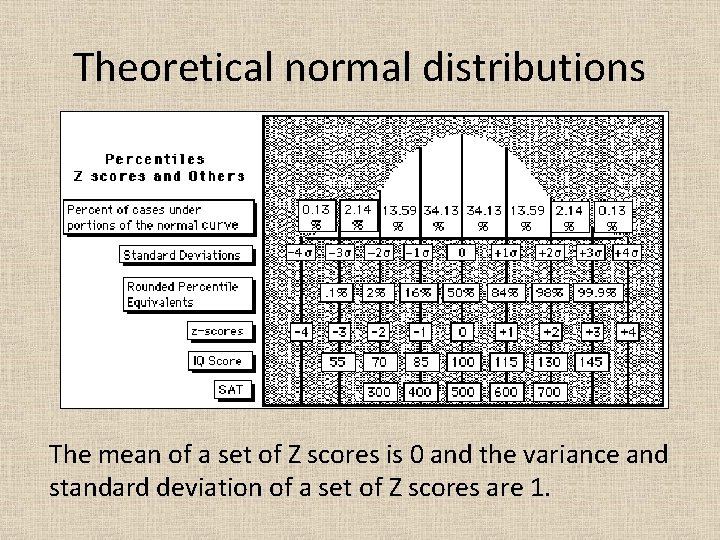
Theoretical normal distributions The mean of a set of Z scores is 0 and the variance and standard deviation of a set of Z scores are 1.
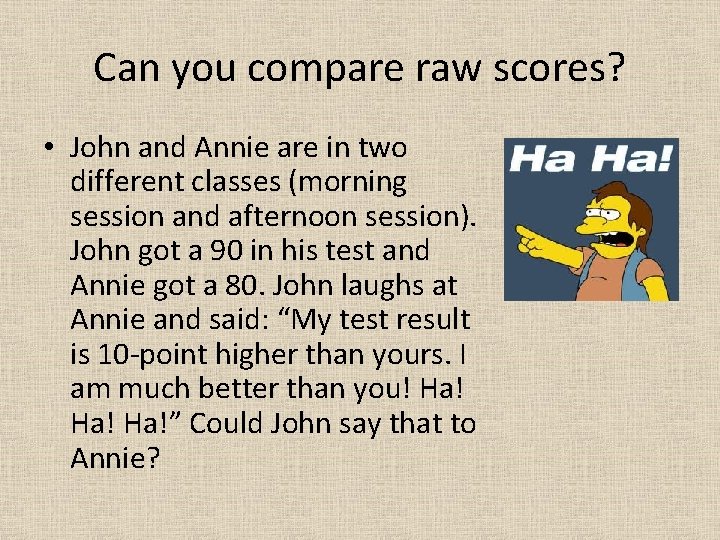
Can you compare raw scores? • John and Annie are in two different classes (morning session and afternoon session). John got a 90 in his test and Annie got a 80. John laughs at Annie and said: “My test result is 10 -point higher than yours. I am much better than you! Ha! Ha!” Could John say that to Annie?
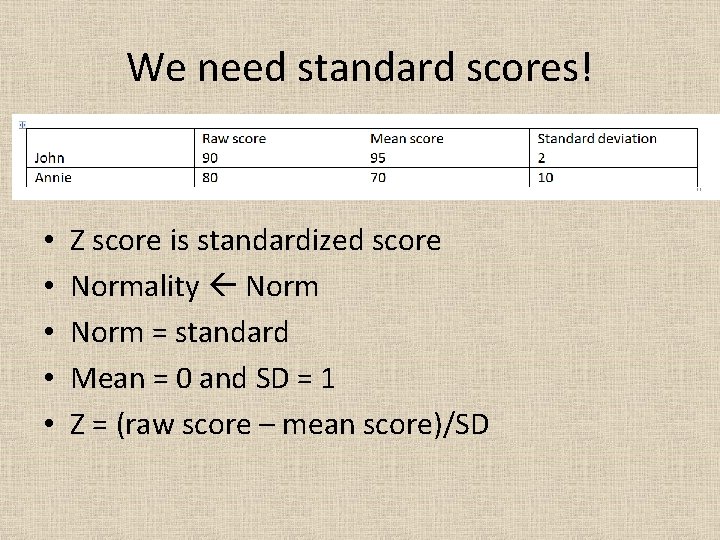
We need standard scores! • • • Z score is standardized score Normality Norm = standard Mean = 0 and SD = 1 Z = (raw score – mean score)/SD
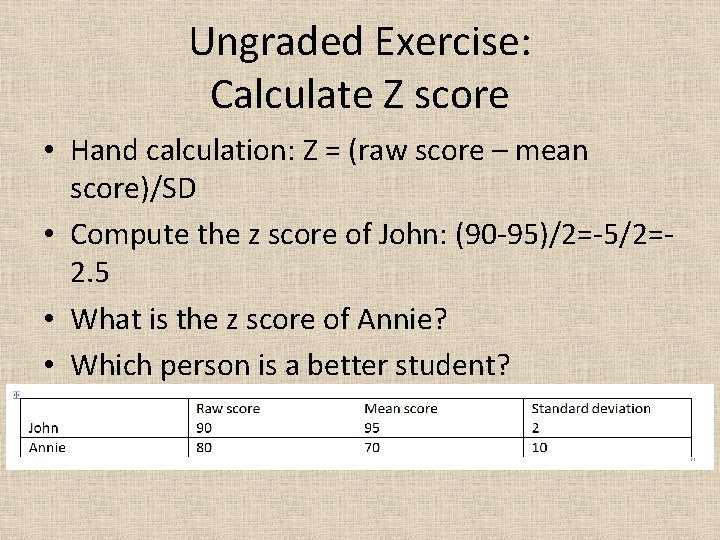
Ungraded Exercise: Calculate Z score • Hand calculation: Z = (raw score – mean score)/SD • Compute the z score of John: (90 -95)/2=-5/2=2. 5 • What is the z score of Annie? • Which person is a better student?
Exercise (Continue) • The mean of GRE score is 500 and the SD is 100. • My GRE score (raw score) is 587. What is my z score? • You can verify your answer at: https: //www. socscistatistics. com/tests/ztest/z scorecalculator. aspx
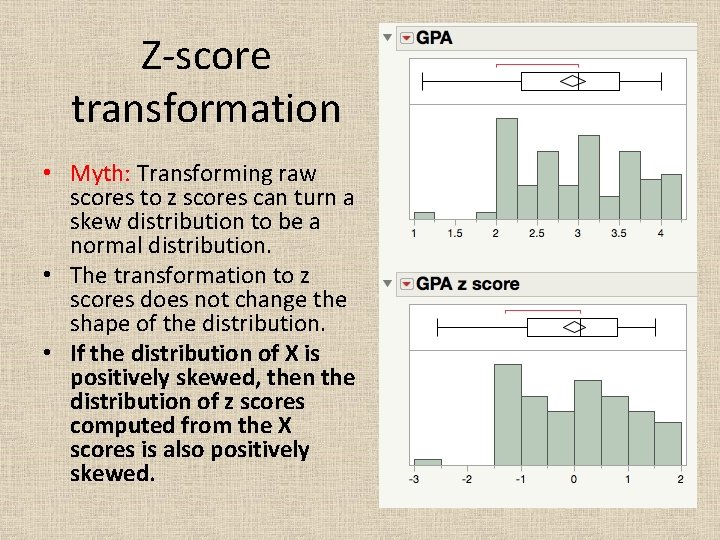
Z-score transformation • Myth: Transforming raw scores to z scores can turn a skew distribution to be a normal distribution. • The transformation to z scores does not change the shape of the distribution. • If the distribution of X is positively skewed, then the distribution of z scores computed from the X scores is also positively skewed.
Computation of John’s position • There are many online z calculator on the Internet: • http: //davidmlane. com/hyperstat/z_table. html • https: //homepage. stat. uiowa. edu/~mbognar/a pplets/normal. html
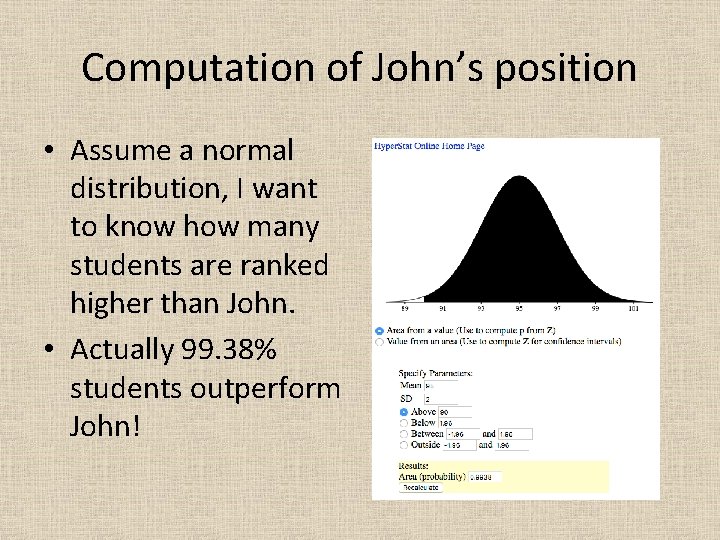
Computation of John’s position • Assume a normal distribution, I want to know how many students are ranked higher than John. • Actually 99. 38% students outperform John!
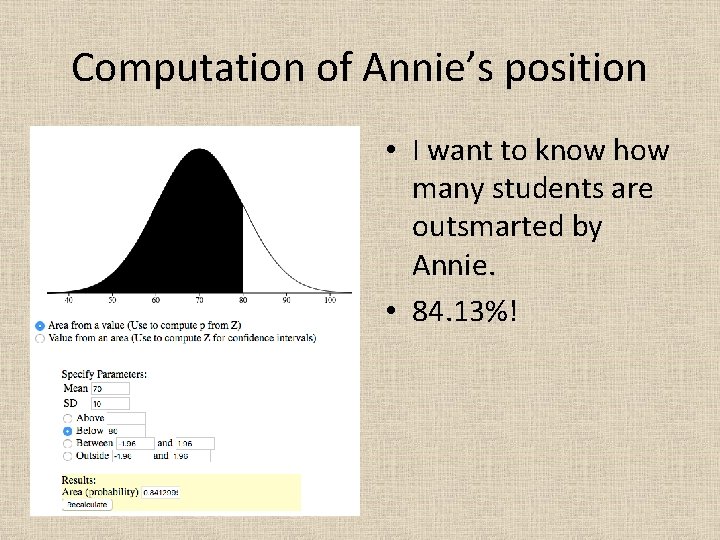
Computation of Annie’s position • I want to know how many students are outsmarted by Annie. • 84. 13%!
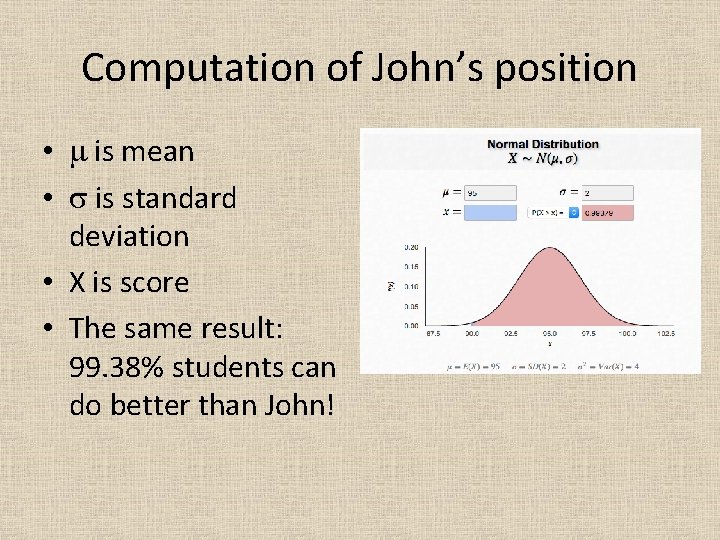
Computation of John’s position • m is mean • s is standard deviation • X is score • The same result: 99. 38% students can do better than John!
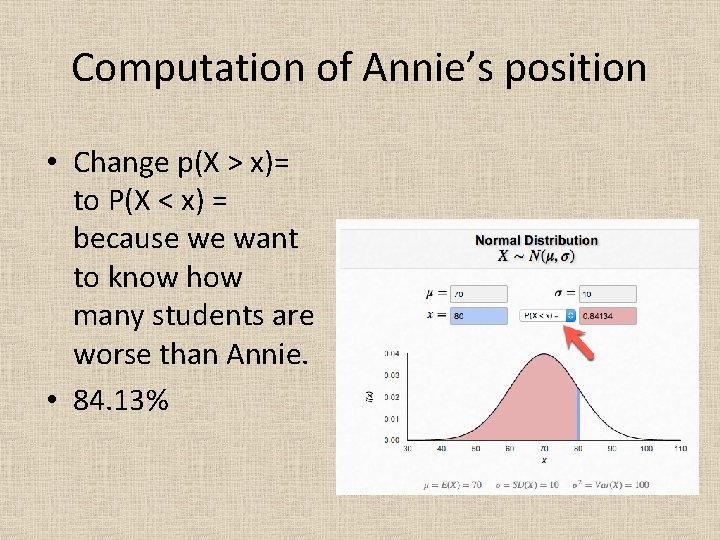
Computation of Annie’s position • Change p(X > x)= to P(X < x) = because we want to know how many students are worse than Annie. • 84. 13%
Assignment 4 (Canvas) • Use an online z to p calculator (NOT z score calculator). • Assume there is a normal curve. Sarah’s IQ is 140. How many people (in terms of percentage) in the general population does she outsmart? (Hints: The mean of IQ is 100 and the SD is 15). • Assume there is a normal curve. The mean is 75 and the SD is 5. 3. What is the proportion of the students whose scored between 60 and 90?
- Slides: 34