
Normal Distribution 1 Learn about the properties of
Normal Distribution 1. Learn about the properties of a normal distribution. 2. Solve problems using tables of the normal distribution. 3. Meet some other examples of problems using normal distribution.
Vocabulary Bell(n) Curve Skew Stretch Extended Shaded‘
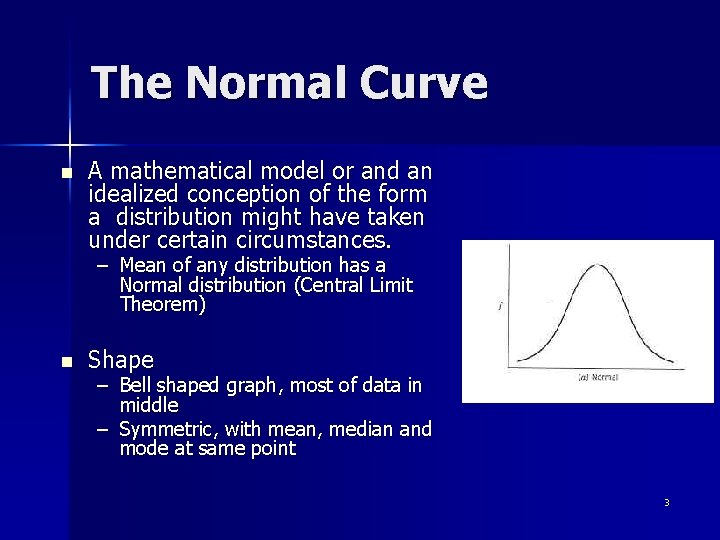
The Normal Curve n A mathematical model or and an idealized conception of the form a distribution might have taken under certain circumstances. – Mean of any distribution has a Normal distribution (Central Limit Theorem) n Shape – Bell shaped graph, most of data in middle – Symmetric, with mean, median and mode at same point 3
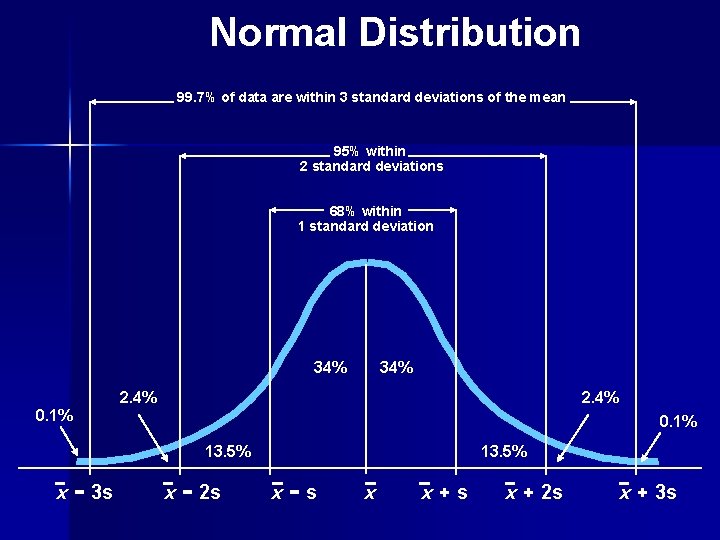
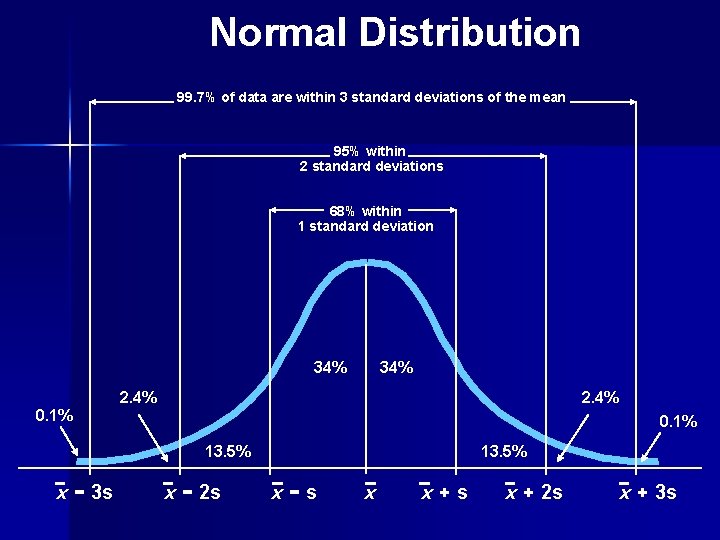
Normal Distribution 99. 7% of data are within 3 standard deviations of the mean 95% within 2 standard deviations 68% within 1 standard deviation 34% 2. 4% 0. 1% 13. 5% x - 3 s x - 2 s 13. 5% x -s x x + s x + 2 s x + 3 s
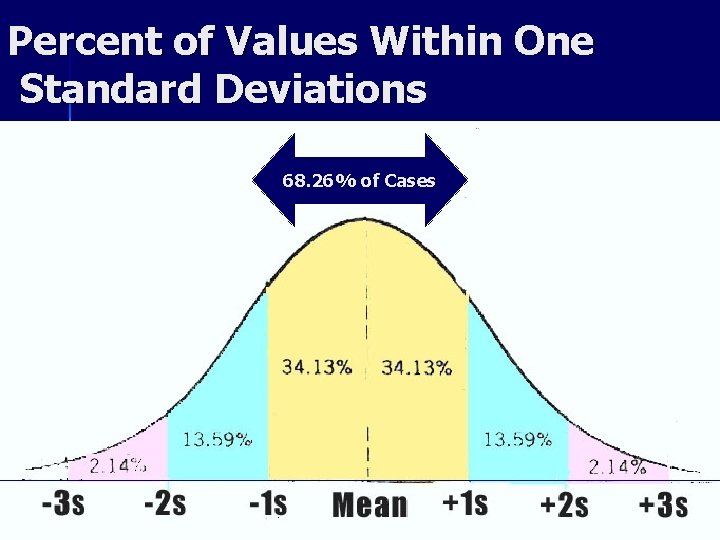
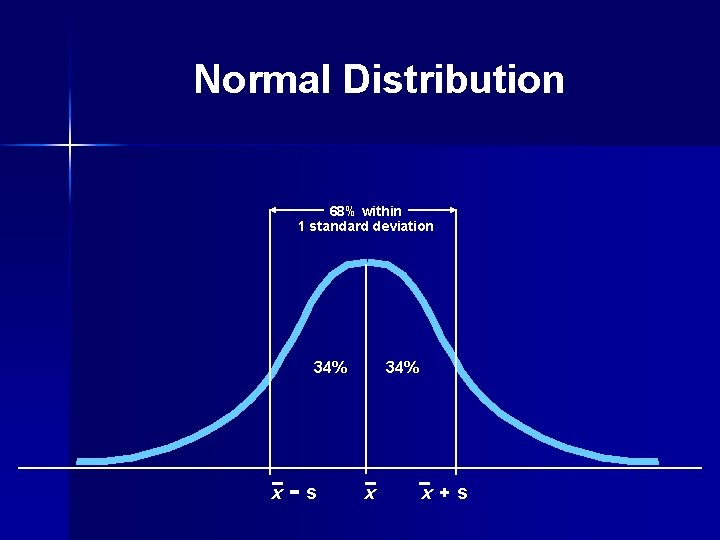
Percent of Values Within One Standard Deviations 68. 26% of Cases 5
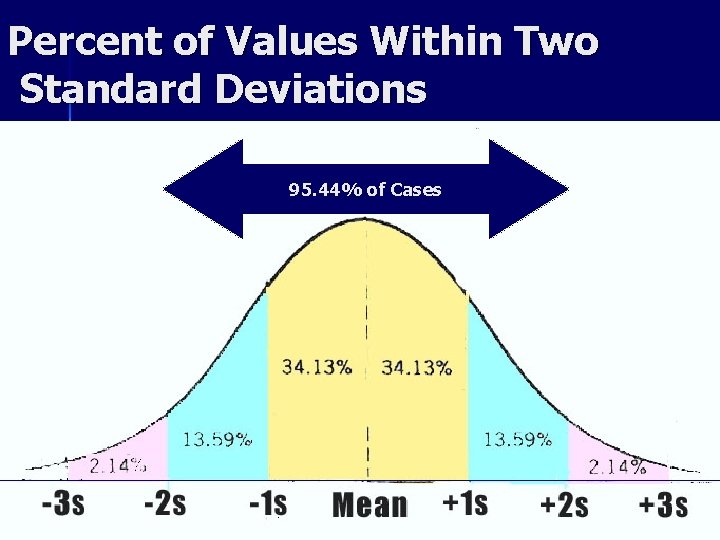
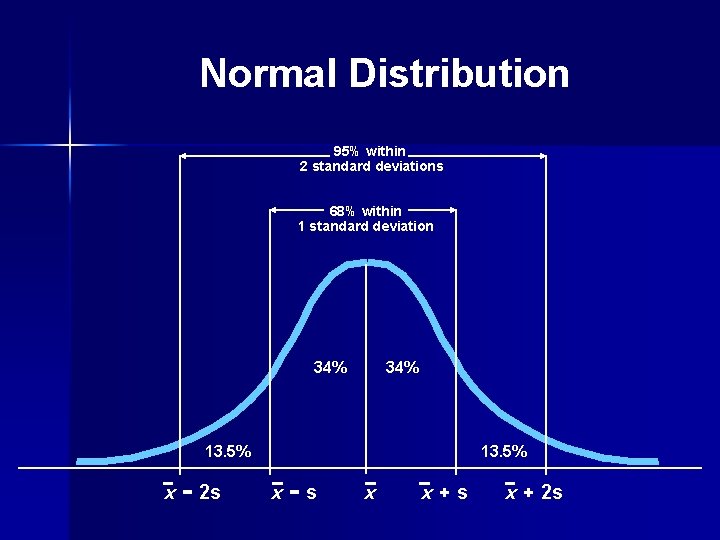
Percent of Values Within Two Standard Deviations 95. 44% of Cases 6
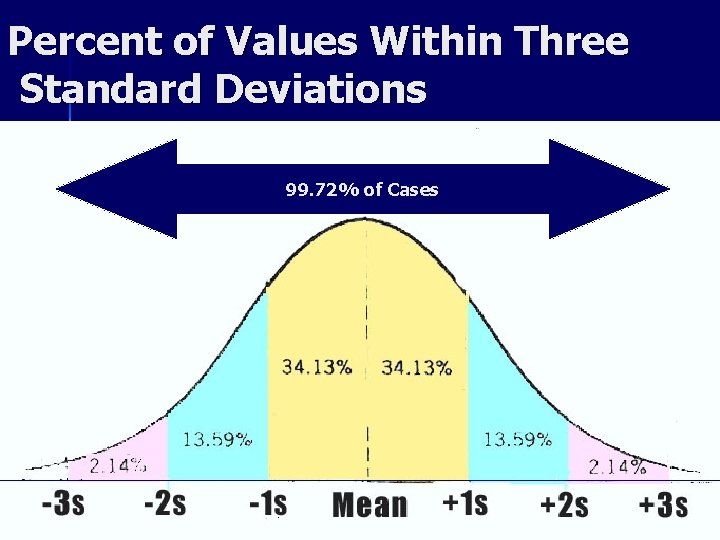
Percent of Values Within Three Standard Deviations 99. 72% of Cases 7
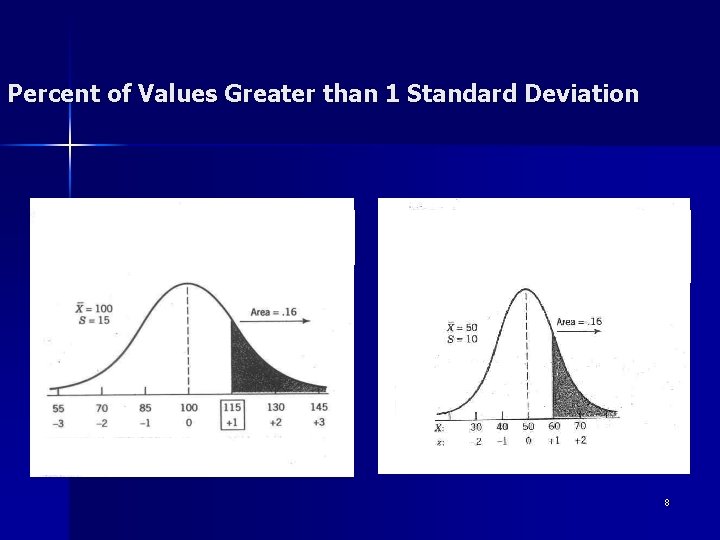
Percent of Values Greater than 1 Standard Deviation 8
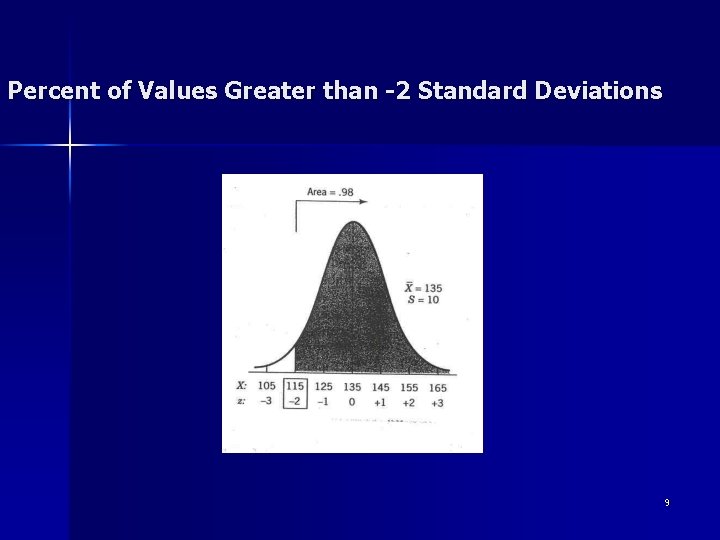
Percent of Values Greater than -2 Standard Deviations 9
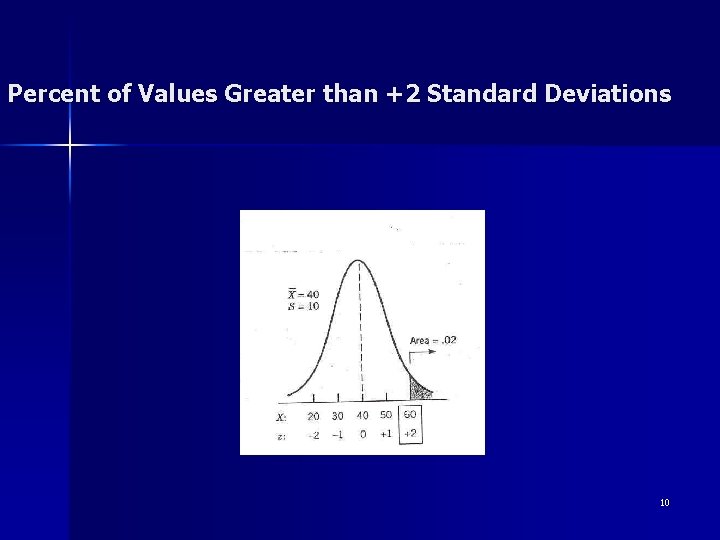
Percent of Values Greater than +2 Standard Deviations 10
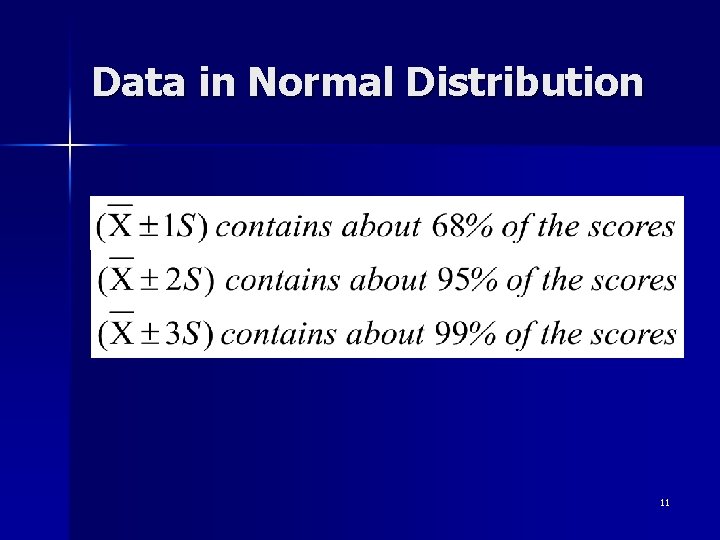
Data in Normal Distribution 11
Properties Of Normal Curve Normal curves are symmetrical. n Normal curves are unimodal. n Normal curves have a bell-shaped form. n Mean, median, and mode all have the same value. n 12
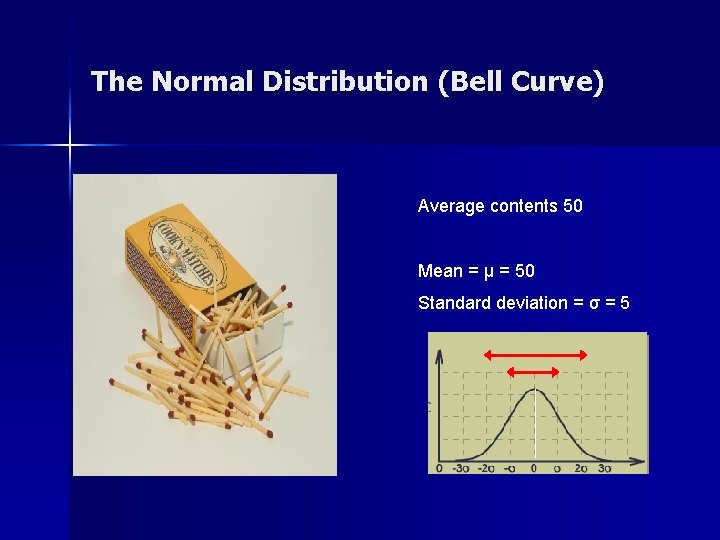
The Normal Distribution (Bell Curve) Average contents 50 Mean = μ = 50 Standard deviation = σ = 5
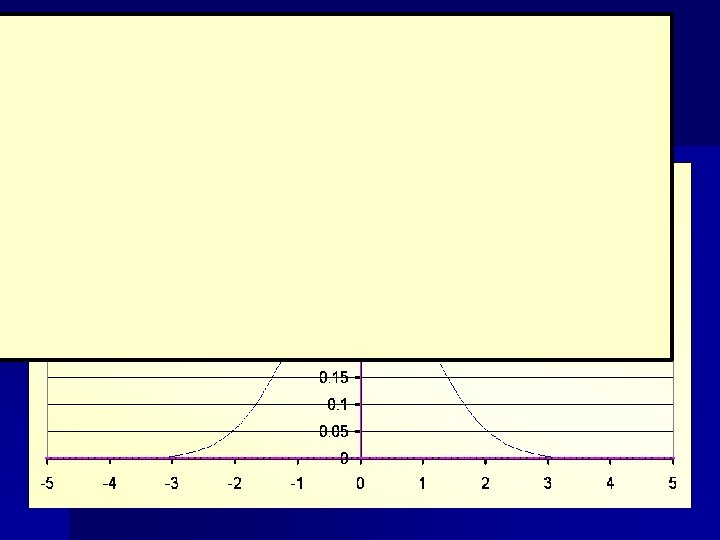
The normal distribution is a theoretical probability. (the area under the curve adds up to one)
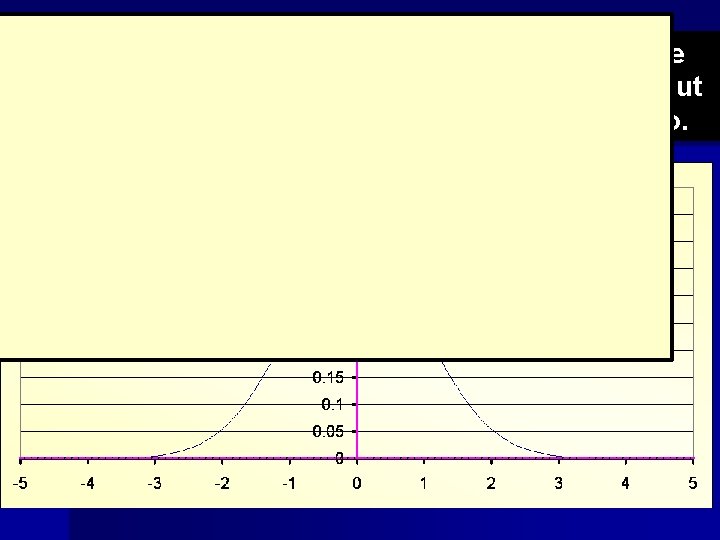
The normal distribution is a Thedistribution normalisdistribution isofathe A Normal a theoretical model wholetheoretical population. It isprobability perfectly symmetrical about the central value; the mean μ represented by zero. the area under the curve adds up to one

The X axis is divided up into deviations from the As well as the mean area the is standard mean. Below the shaded one deviation (σ)from must the also mean. be known.

Two standard deviations from the mean

Three standard deviations from the mean
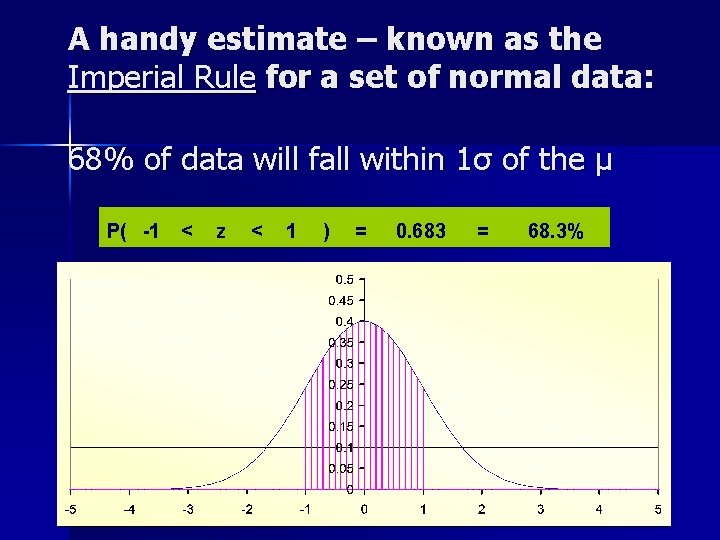
A handy estimate – known as the Imperial Rule for a set of normal data: 68% of data will fall within 1σ of the μ P( -1 < z < 1 ) = 0. 683 = 68. 3%
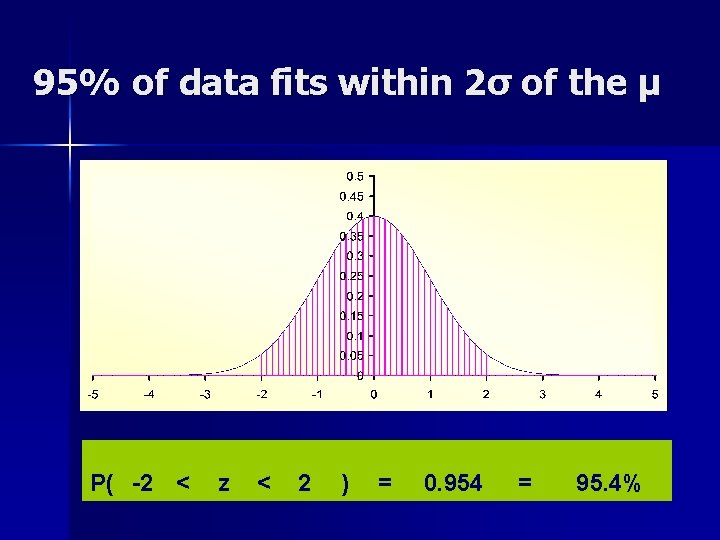
95% of data fits within 2σ of the μ P( -2 < z < 2 ) = 0. 954 = 95. 4%
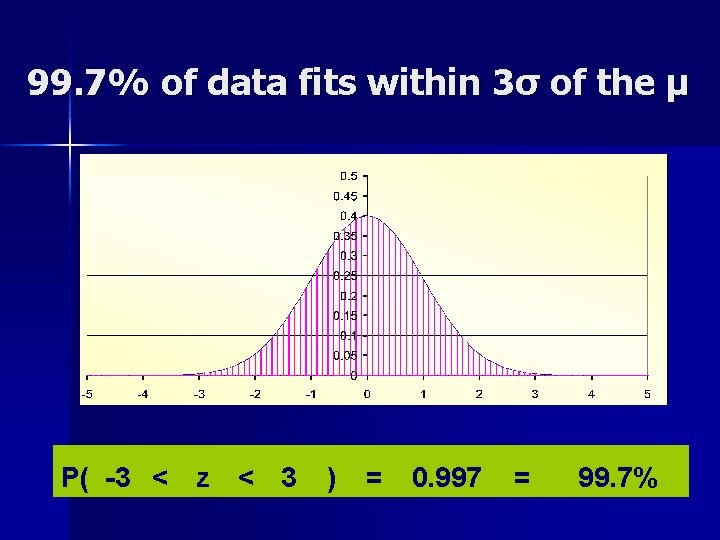
99. 7% of data fits within 3σ of the μ P( -3 < z < 3 ) = 0. 997 = 99. 7%
Examples
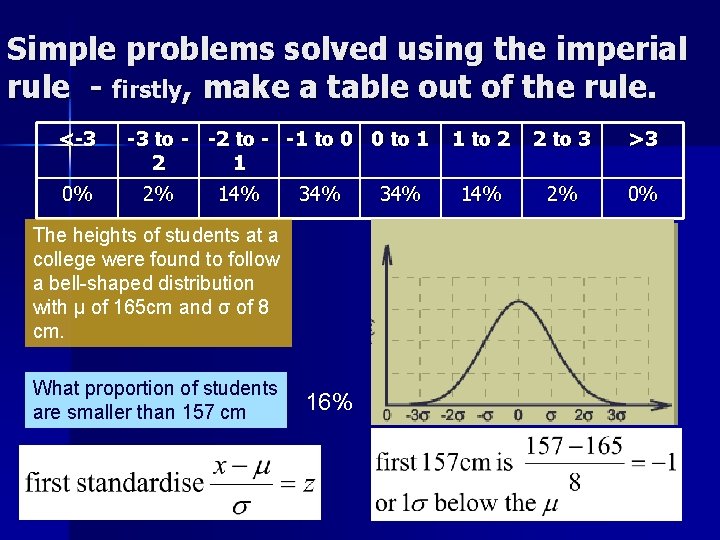
Simple problems solved using the imperial rule - firstly, make a table out of the rule. <-3 0% -3 to - -2 to - -1 to 0 0 to 1 2% 14% 34% The heights of students at a college were found to follow a bell-shaped distribution with μ of 165 cm and σ of 8 cm. What proportion of students are smaller than 157 cm 16% 34% 1 to 2 2 to 3 >3 14% 2% 0%
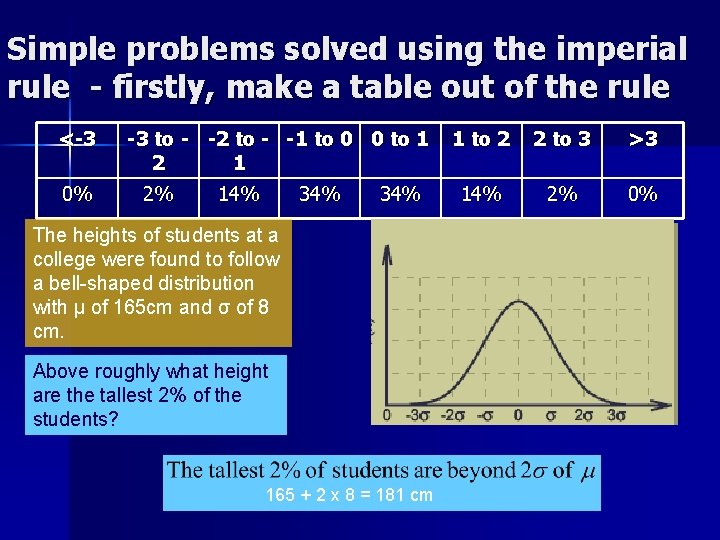
Simple problems solved using the imperial rule - firstly, make a table out of the rule <-3 0% -3 to - -2 to - -1 to 0 0 to 1 2% 14% 34% The heights of students at a college were found to follow a bell-shaped distribution with μ of 165 cm and σ of 8 cm. Above roughly what height are the tallest 2% of the students? 165 + 2 x 8 = 181 cm 1 to 2 2 to 3 >3 14% 2% 0%
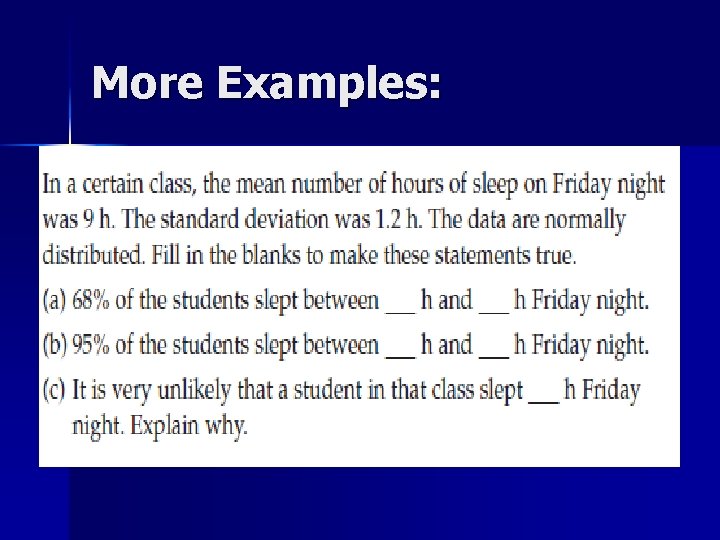
More Examples:

Practice Exercise: Answer CYU # 10 -14 on pages 38 -39.
Summary
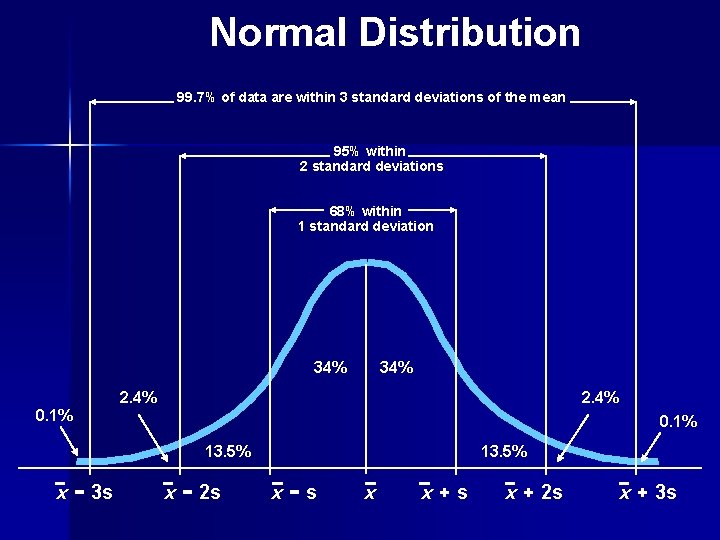
Normal Distribution 99. 7% of data are within 3 standard deviations of the mean 95% within 2 standard deviations 68% within 1 standard deviation 34% 2. 4% 0. 1% 13. 5% x - 3 s x - 2 s 13. 5% x -s x x + s x + 2 s x + 3 s
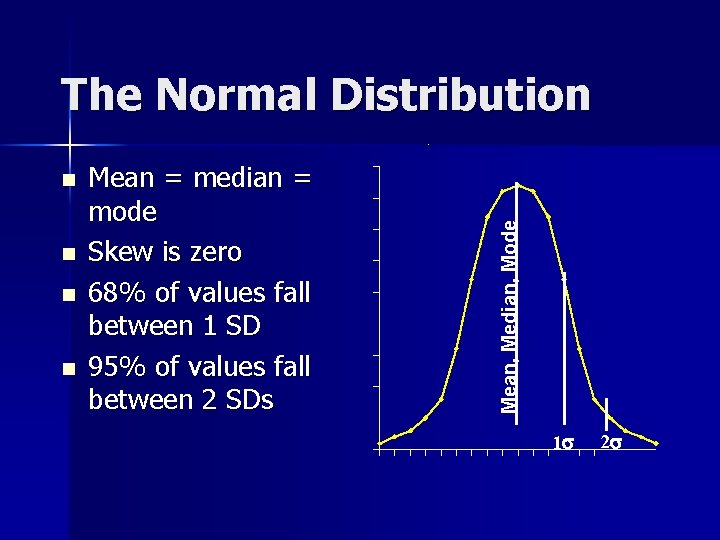
The Normal Distribution n n Mean = median = mode Skew is zero 68% of values fall between 1 SD 95% of values fall between 2 SDs Mean, Median, Mode . 1 2
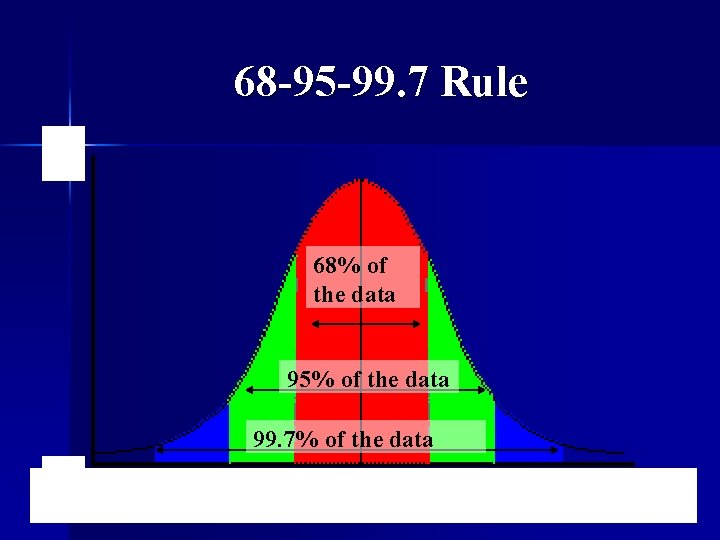
68 -95 -99. 7 Rule 68% of the data 95% of the data 99. 7% of the data
Distinguishing Features n The mean ± 1 standard deviation covers 66. 7% of the area under the curve n The mean ± 2 standard deviation covers 95% of the area under the curve n The mean ± 3 standard deviation covers 99. 7% of the area under the curve
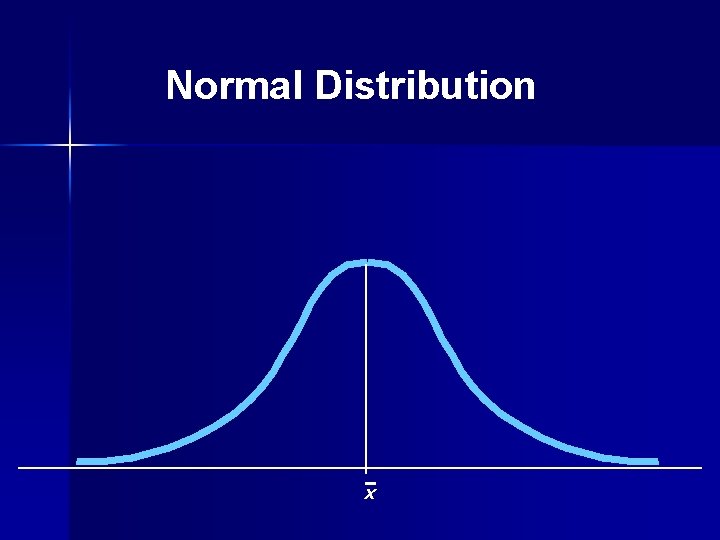
Normal Distribution x
Normal Distribution 68% within 1 standard deviation 34% x -s 34% x x + s
Normal Distribution 95% within 2 standard deviations 68% within 1 standard deviation 34% 13. 5% x - 2 s 13. 5% x -s x x + s x + 2 s
Normal Distribution 99. 7% of data are within 3 standard deviations of the mean 95% within 2 standard deviations 68% within 1 standard deviation 34% 2. 4% 0. 1% 13. 5% x - 3 s x - 2 s 13. 5% x -s x x + s x + 2 s x + 3 s

Practice Exercises: n CYU # 10, & 13 on page 38.

Homework: n CYU # 12, & 14 on page 37 -38.
- Slides: 37