
Normal Conducting magnets for particle accelerators Part I

- Slides: 33
Normal Conducting magnets for particle accelerators Part I A. Vorozhtsov
Magnet types by working principle • Superconducting Magnets. They work only at very low temperatures (liquid or superfluid helium). The high current density possible in their special cables produces a high magnetic field not possible with resistive magnets. • Permanent Magnets. No current flows into these magnets. The field is produced by means of the permanent residual magnetization of special materials. This technology allows the construction of compact magnets with a relatively strong field. No cooling is required. • Normal conducting. They are not magnetic unless a certain current flows into their coils. The field can be increased and concentrated by means of a ferromagnetic yoke. The resistance of the windings dissipates some energy and the resulting heat has to be removed with a water circuit or air flow
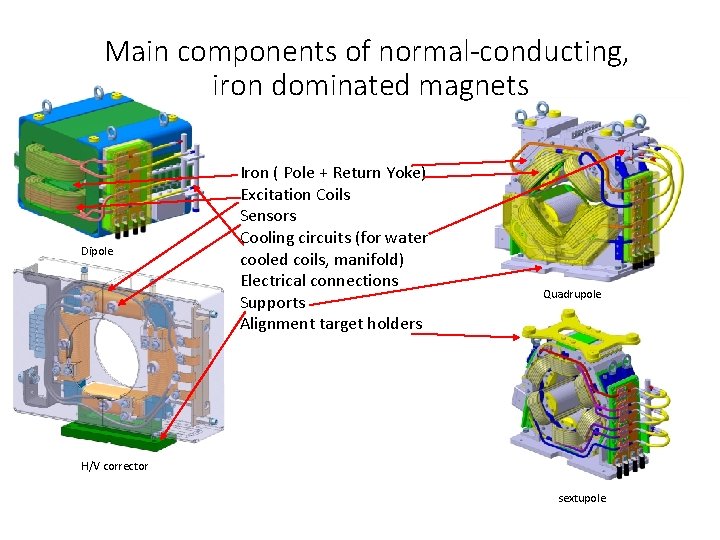
Main components of normal-conducting, iron dominated magnets Dipole Iron ( Pole + Return Yoke) Excitation Coils Sensors Cooling circuits (for water cooled coils, manifold) Electrical connections Supports Alignment target holders Quadrupole H/V corrector sextupole
MAX IV Magnets MAX IV LINAC DIPOLE magnet DIB MAX IV LINAC quadrupole QF MAX IV R 1 magnet block MAX IV LINAC one plane corrector COD MAX IV sextupole SXH MAX IV R 3 magnet block
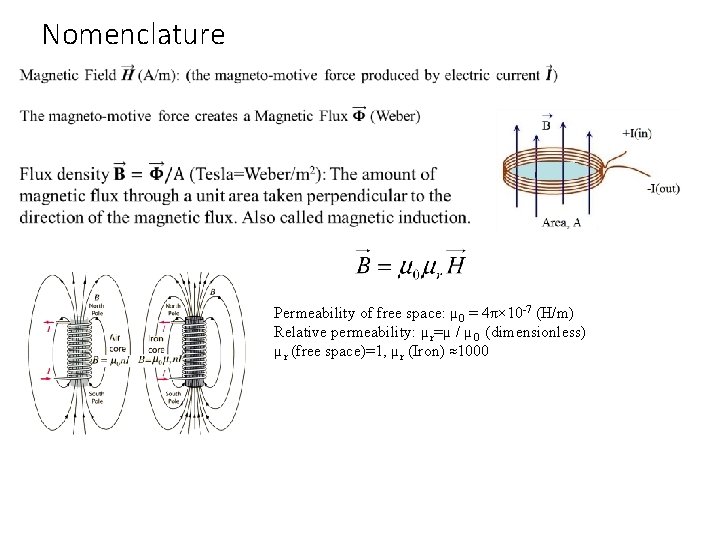
Nomenclature Permeability of free space: µ 0 = 4π× 10 -7 (H/m) Relative permeability: µr=µ / µ 0 (dimensionless) µr (free space)=1, µr (Iron) ≈1000
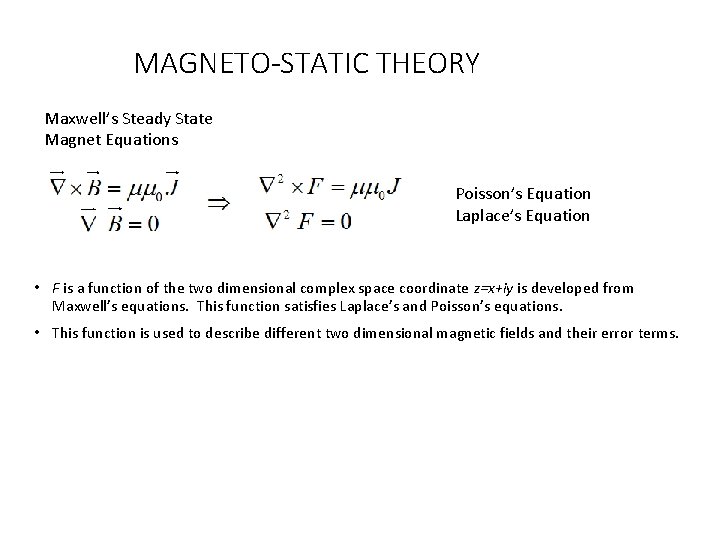
MAGNETO-STATIC THEORY Maxwell’s Steady State Magnet Equations Poisson’s Equation Laplace’s Equation • F is a function of the two dimensional complex space coordinate z=x+iy is developed from Maxwell’s equations. This function satisfies Laplace’s and Poisson’s equations. • This function is used to describe different two dimensional magnetic fields and their error terms.
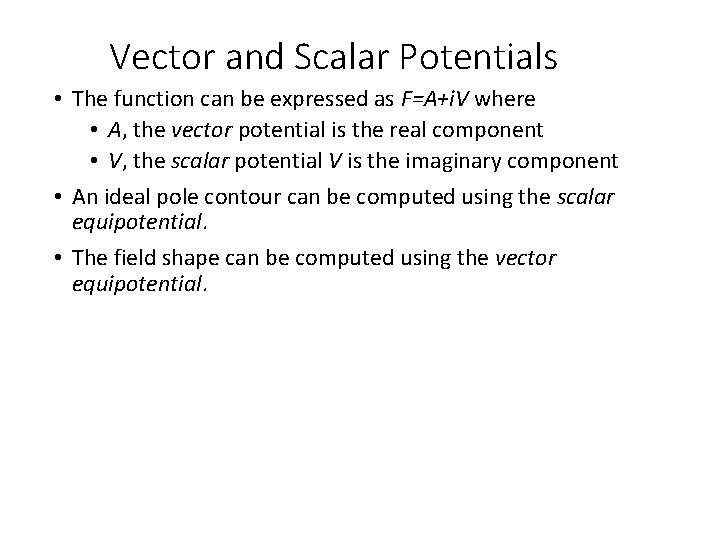
Vector and Scalar Potentials • The function can be expressed as F=A+i. V where • A, the vector potential is the real component • V, the scalar potential V is the imaginary component • An ideal pole contour can be computed using the scalar equipotential. • The field shape can be computed using the vector equipotential.
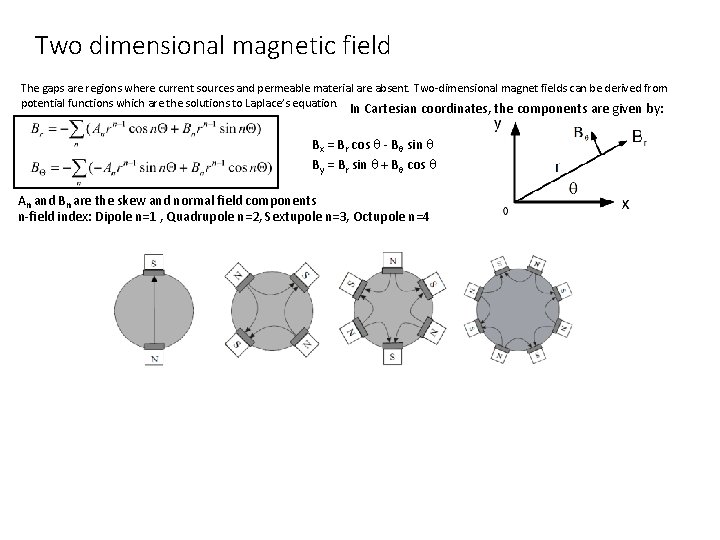
Two dimensional magnetic field The gaps are regions where current sources and permeable material are absent. Two‐dimensional magnet fields can be derived from potential functions which are the solutions to Laplace’s equation. In Cartesian coordinates, the components are given by: Bx = Br cos ‐ B sin By = Br sin + B cos An and Bn are the skew and normal field components n‐field index: Dipole n=1 , Quadrupole n=2, Sextupole n=3, Octupole n=4
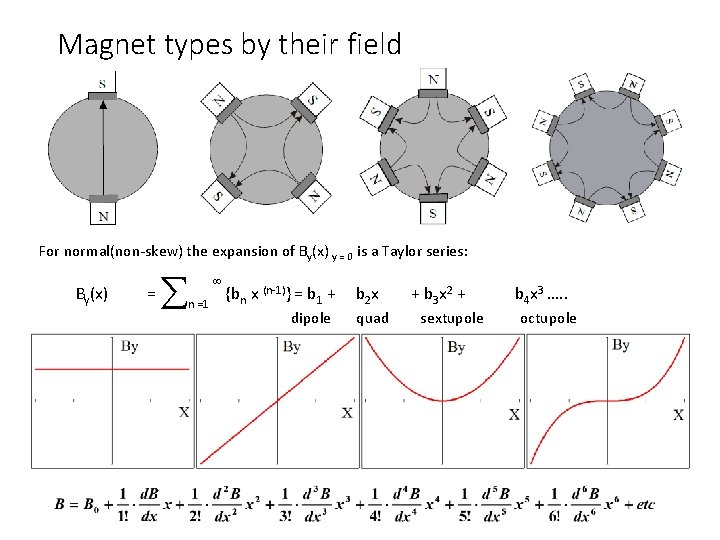
Magnet types by their field For normal(non‐skew) the expansion of By(x) y = 0 is a Taylor series: By(x) = (n‐ 1)} = b + b x 2 + b x 3 …. . {b x n 1 2 3 4 n =1 dipole quad sextupole octupole
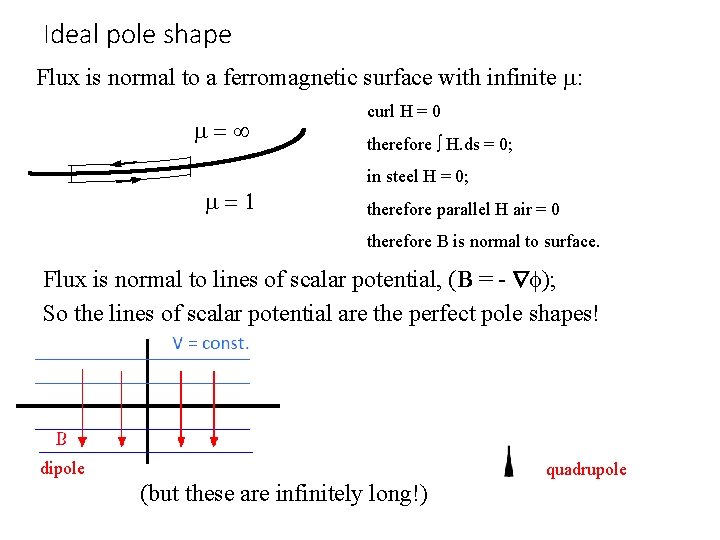
Ideal pole shape Flux is normal to a ferromagnetic surface with infinite : = =1 curl H = 0 therefore H. ds = 0; in steel H = 0; therefore parallel H air = 0 therefore B is normal to surface. Flux is normal to lines of scalar potential, (B = - ); So the lines of scalar potential are the perfect pole shapes! dipole quadrupole (but these are infinitely long!)
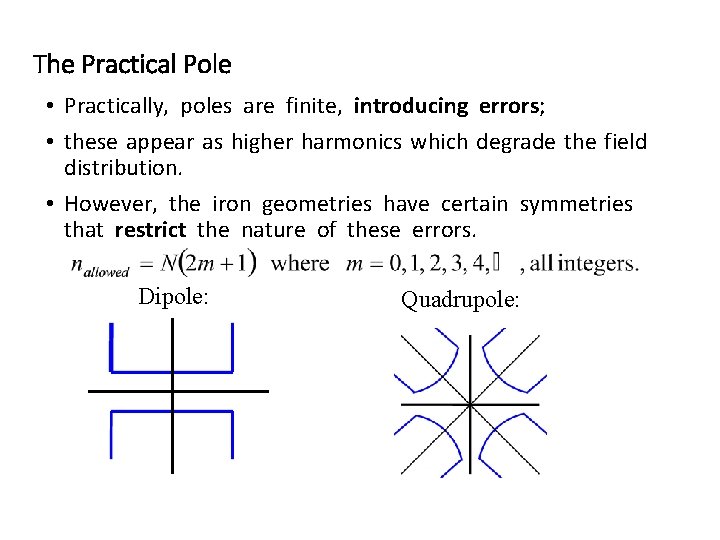
The Practical Pole • Practically, poles are finite, introducing errors; • these appear as higher harmonics which degrade the field distribution. • However, the iron geometries have certain symmetries that restrict the nature of these errors. Dipole: Quadrupole:
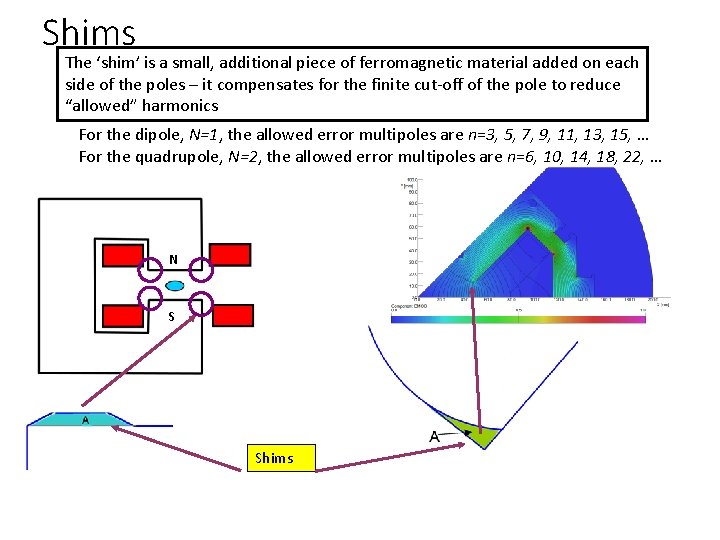
Shims The ‘shim’ is a small, additional piece of ferromagnetic material added on each side of the poles – it compensates for the finite cut‐off of the pole to reduce “allowed” harmonics For the dipole, N=1, the allowed error multipoles are n=3, 5, 7, 9, 11, 13, 15, … For the quadrupole, N=2, the allowed error multipoles are n=6, 10, 14, 18, 22, … N S Shims
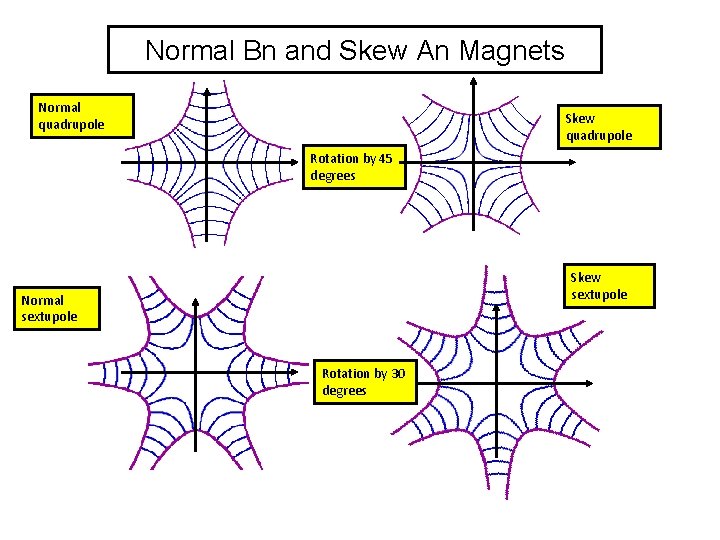
Normal Bn and Skew An Magnets Normal quadrupole Skew quadrupole Rotation by 45 degrees Skew sextupole Normal sextupole Rotation by 30 degrees
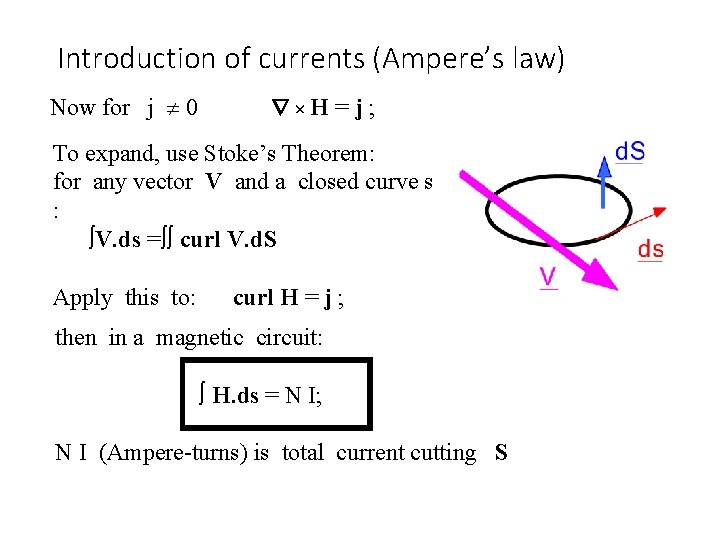
Introduction of currents (Ampere’s law) Now for j 0 × H = j ; To expand, use Stoke’s Theorem: for any vector V and a closed curve s : V. ds = curl V. d. S Apply this to: curl H = j ; then in a magnetic circuit: H. ds = N I; N I (Ampere-turns) is total current cutting S
Magnet types • Dipoles • Quadrupoles • Sextupoles • Octupoles • Combined function
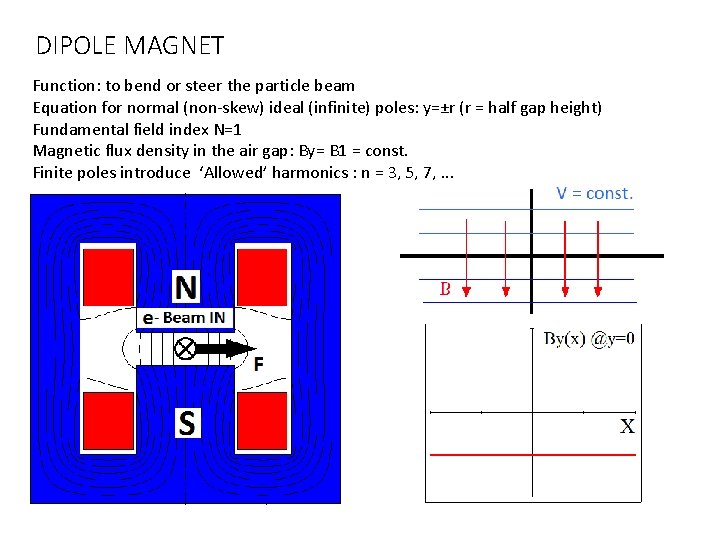
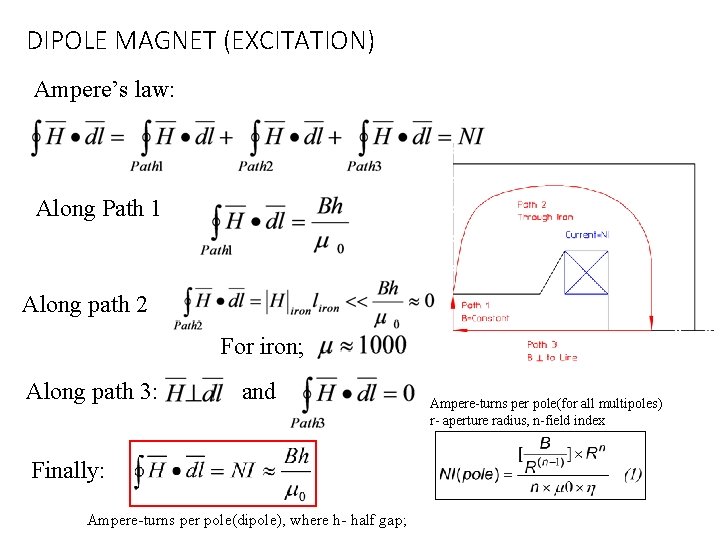
DIPOLE MAGNET Function: to bend or steer the particle beam Equation for normal (non‐skew) ideal (infinite) poles: y=±r (r = half gap height) Fundamental field index N=1 Magnetic flux density in the air gap: By= B 1 = const. Finite poles introduce ‘Allowed’ harmonics : n = 3, 5, 7, . . .
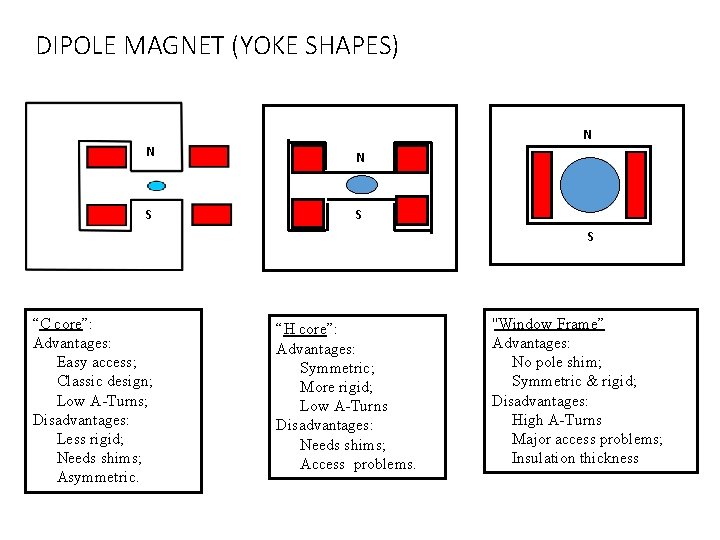
DIPOLE MAGNET (YOKE SHAPES) N N N S S S “C core”: Advantages: Easy access; Classic design; Low A-Turns; Disadvantages: Less rigid; Needs shims; Asymmetric. “H core”: Advantages: Symmetric; More rigid; Low A-Turns Disadvantages: Needs shims; Access problems. ''Window Frame” Advantages: No pole shim; Symmetric & rigid; Disadvantages: High A-Turns Major access problems; Insulation thickness
DIPOLE MAGNET (EXCITATION) Ampere’s law: Along Path 1 Along path 2 For iron; Along path 3: and Finally: Ampere-turns per pole(dipole), where h- half gap; Ampere-turns per pole(for all multipoles) r- aperture radius, n-field index
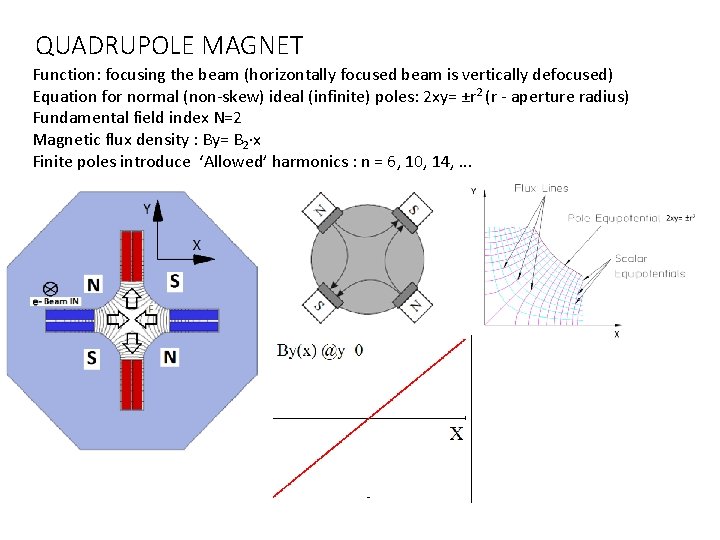
QUADRUPOLE MAGNET Function: focusing the beam (horizontally focused beam is vertically defocused) Equation for normal (non‐skew) ideal (infinite) poles: 2 xy= ±r 2 (r ‐ aperture radius) Fundamental field index N=2 Magnetic flux density : By= B 2·x Finite poles introduce ‘Allowed’ harmonics : n = 6, 10, 14, . . .
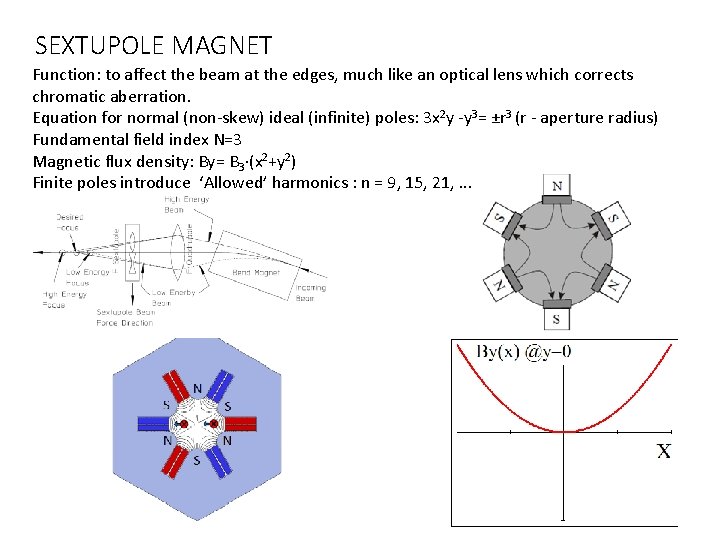
SEXTUPOLE MAGNET Function: to affect the beam at the edges, much like an optical lens which corrects chromatic aberration. Equation for normal (non‐skew) ideal (infinite) poles: 3 x 2 y ‐y 3= ±r 3 (r ‐ aperture radius) Fundamental field index N=3 Magnetic flux density: By= B 3·(x 2+y 2) Finite poles introduce ‘Allowed’ harmonics : n = 9, 15, 21, . . .
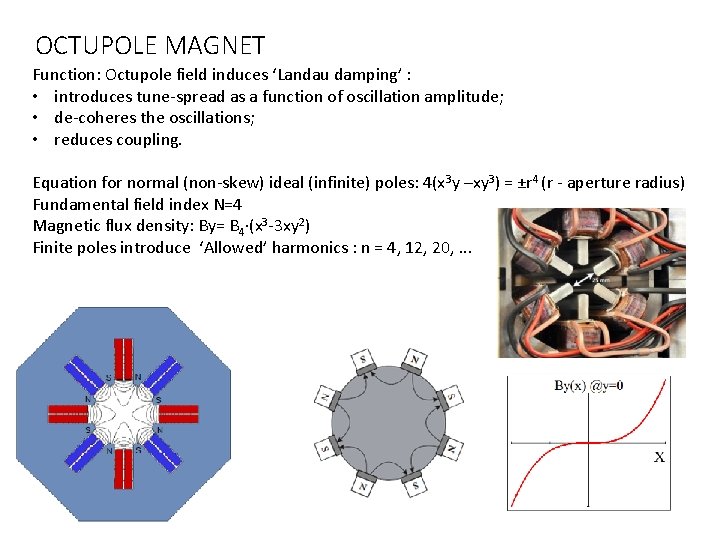
OCTUPOLE MAGNET Function: Octupole field induces ‘Landau damping’ : • introduces tune‐spread as a function of oscillation amplitude; • de‐coheres the oscillations; • reduces coupling. Equation for normal (non‐skew) ideal (infinite) poles: 4(x 3 y –xy 3) = ±r 4 (r ‐ aperture radius) Fundamental field index N=4 Magnetic flux density: By= B 4·(x 3‐ 3 xy 2) Finite poles introduce ‘Allowed’ harmonics : n = 4, 12, 20, . . .
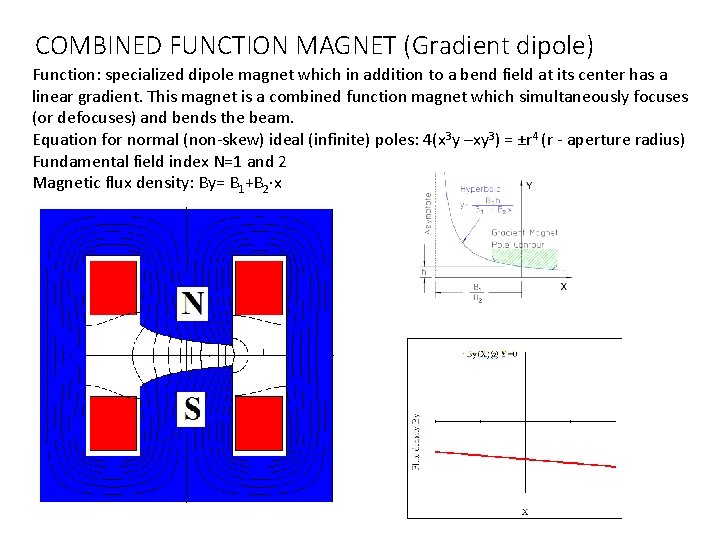
COMBINED FUNCTION MAGNET (Gradient dipole) Function: specialized dipole magnet which in addition to a bend field at its center has a linear gradient. This magnet is a combined function magnet which simultaneously focuses (or defocuses) and bends the beam. Equation for normal (non‐skew) ideal (infinite) poles: 4(x 3 y –xy 3) = ±r 4 (r ‐ aperture radius) Fundamental field index N=1 and 2 Magnetic flux density: By= B 1+B 2·x
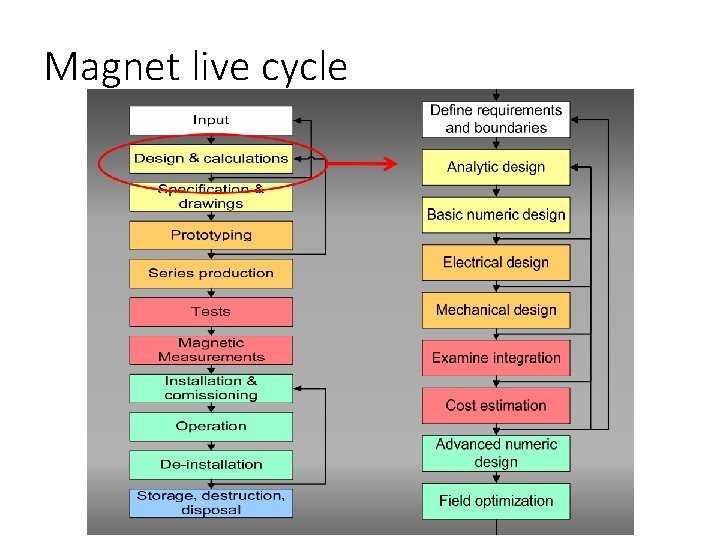
Magnet live cycle
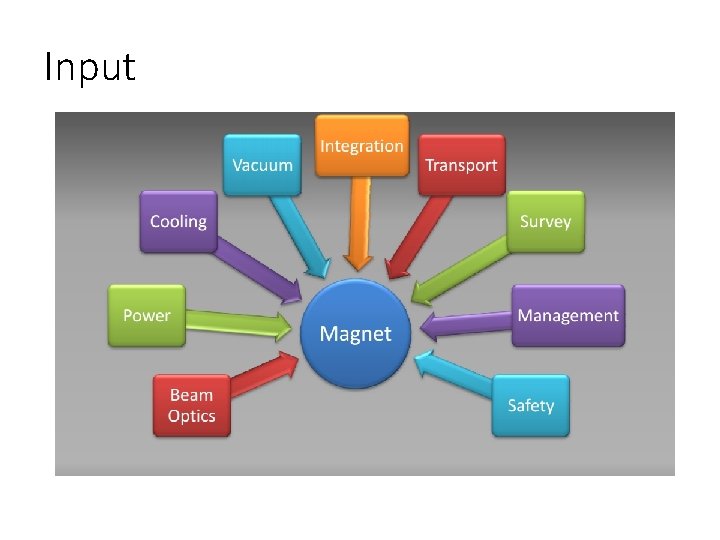
Input
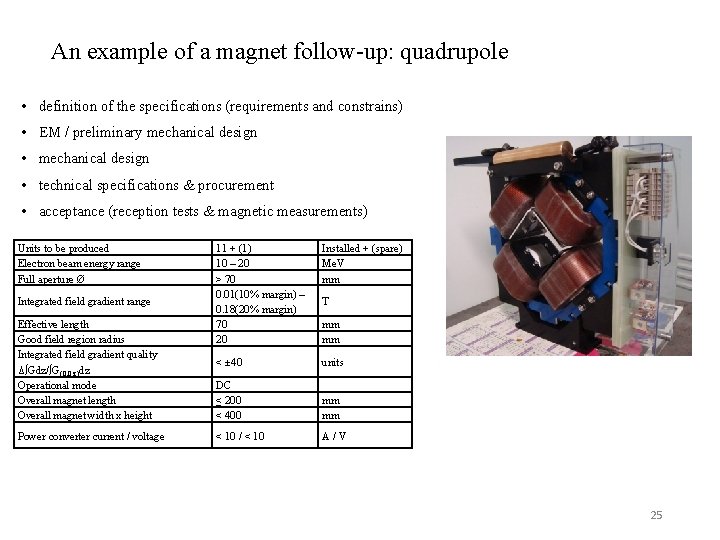
An example of a magnet follow-up: quadrupole • definition of the specifications (requirements and constrains) • EM / preliminary mechanical design • technical specifications & procurement • acceptance (reception tests & magnetic measurements) Units to be produced Electron beam energy range Full aperture Ø Integrated field gradient range Effective length Good field region radius Integrated field gradient quality Δ∫Gdz/∫G(0, 0, z)dz Operational mode Overall magnet length Overall magnet width x height Power converter current / voltage 11 + (1) 10 – 20 ≥ 70 0. 01(10% margin) – 0. 18(20% margin) 70 20 Installed + (spare) Me. V mm < ± 40 units DC ≤ 200 < 400 mm mm < 10 / < 10 A / V T mm mm 25
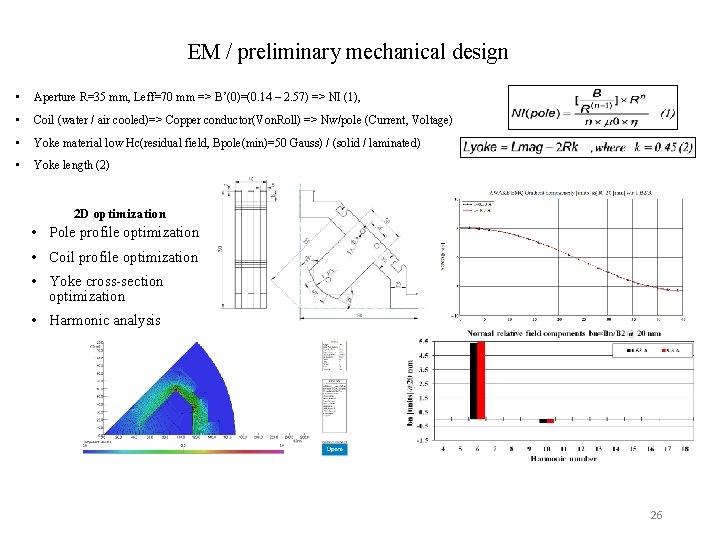
EM / preliminary mechanical design • Aperture R=35 mm, Leff=70 mm => B’(0)=(0. 14 – 2. 57) => NI (1), • Coil (water / air cooled)=> Copper conductor(Von. Roll) => Nw/pole (Current, Voltage) • Yoke material low Hc(residual field, Bpole(min)=50 Gauss) / (solid / laminated) • Yoke length (2) 2 D optimization • Pole profile optimization • Coil profile optimization • Yoke cross-section optimization • Harmonic analysis 26
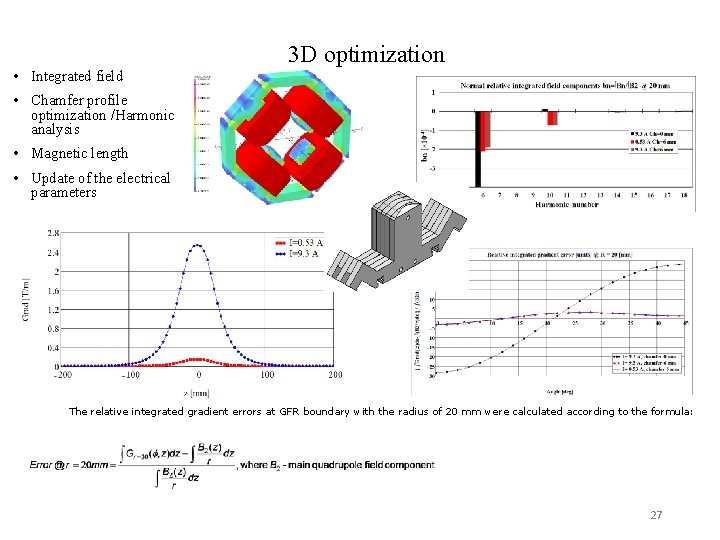
• Integrated field 3 D optimization • Chamfer profile optimization /Harmonic analysis • Magnetic length • Update of the electrical parameters The relative integrated gradient errors at GFR boundary with the radius of 20 mm were calculated according to the formula: 27
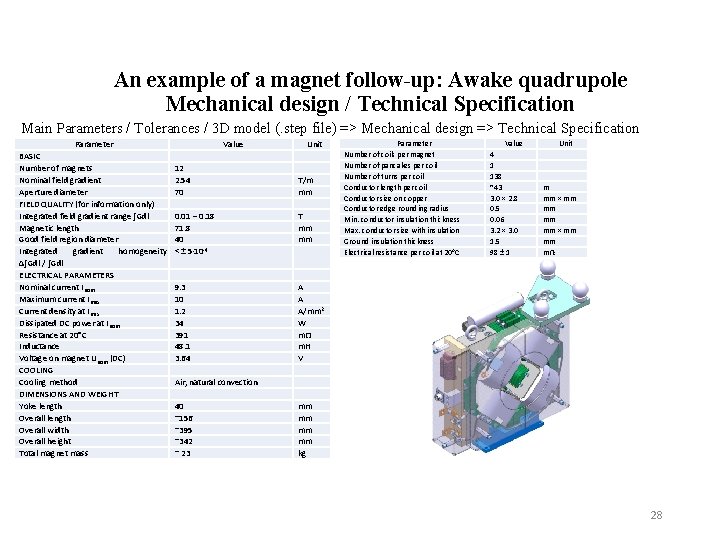
An example of a magnet follow-up: Awake quadrupole Mechanical design / Technical Specification Main Parameters / Tolerances / 3 D model (. step file) => Mechanical design => Technical Specification Parameter BASIC Number of magnets Nominal field gradient Aperture diameter FIELD QUALITY (for information only) Integrated field gradient range ∫Gdl Magnetic length Good field region diameter Integrated gradient homogeneity Δ∫Gdl / ∫Gdl ELECTRICAL PARAMETERS Nominal current Inom Maximum current Imax Current density at Imax Dissipated DC power at Inom Resistance at 20°C Inductance Voltage on magnet Unom (DC) COOLING Cooling method DIMENSIONS AND WEIGHT Yoke length Overall width Overall height Total magnet mass 12 2. 54 70 0. 01 – 0. 18 71. 8 40 < ± 5· 10‐ 4 Value Unit T/m mm T mm mm 9. 3 10 1. 2 34 391 48. 1 3. 64 Air, natural convection 40 ~156 ~395 ~342 ~ 23 A A A/mm 2 W mΩ m. H V mm mm kg Parameter Number of coils per magnet Number of pancakes per coil Number of turns per coil Conductor length per coil Conductor size on copper Conductor edge rounding radius Min. conductor insulation thickness Max. conductor size with insulation Ground insulation thickness Electrical resistance per coil at 20°C Value 4 1 138 ~43 3. 0 × 2. 8 0. 5 0. 06 3. 2 × 3. 0 1. 5 98 ± 1 Unit m mm × mm mm mΩ 28
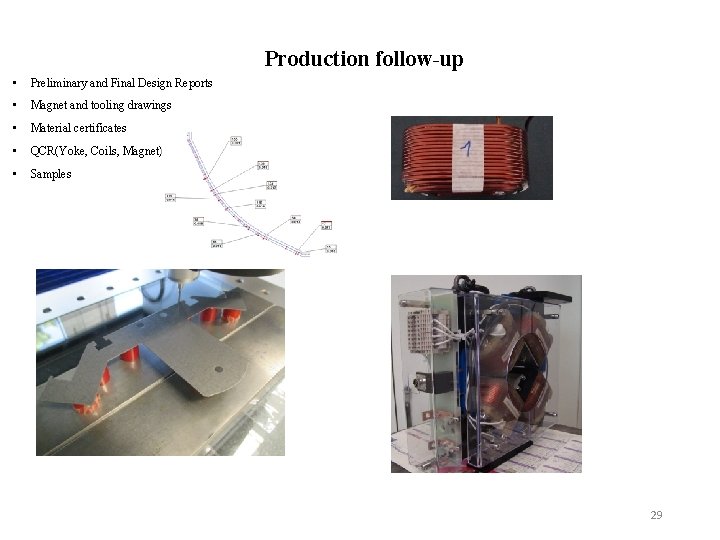
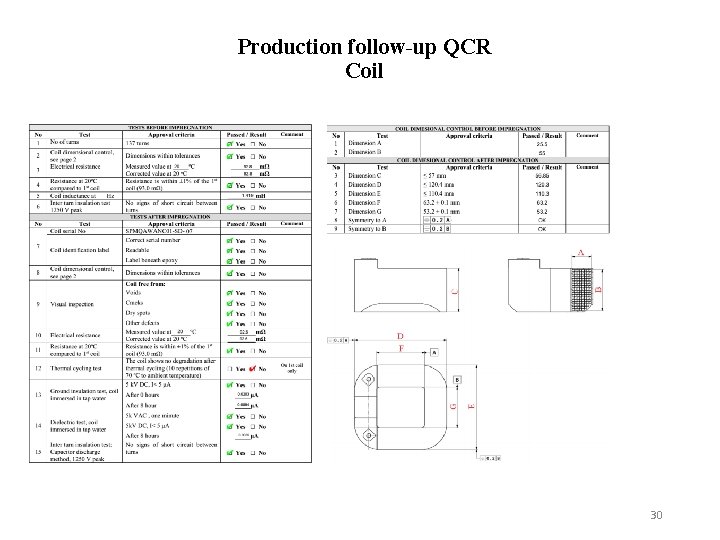
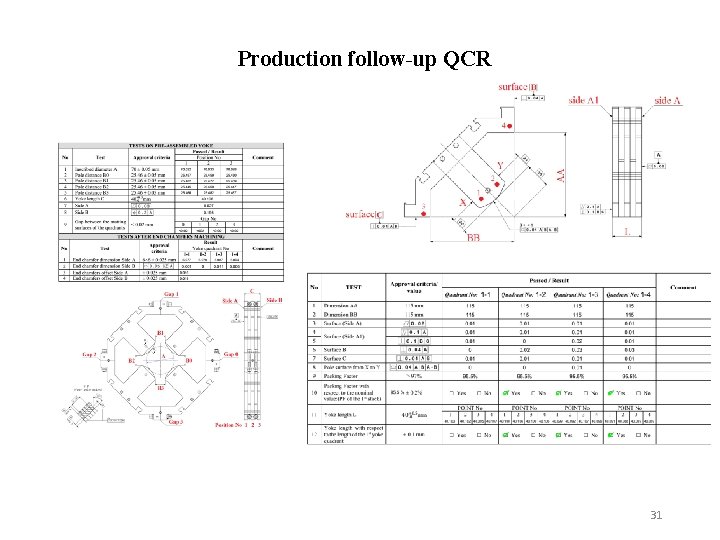
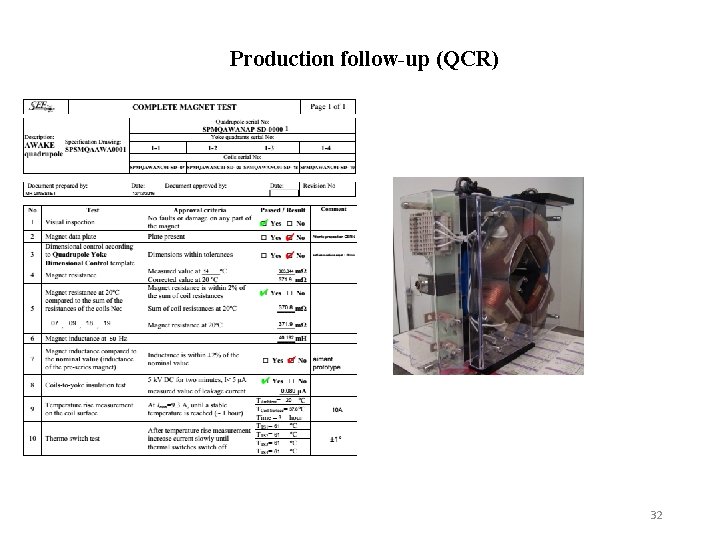
Production follow-up • Preliminary and Final Design Reports • Magnet and tooling drawings • Material certificates • QCR(Yoke, Coils, Magnet) • Samples 29
Production follow-up QCR Coil 30
Production follow-up QCR 31
Production follow-up (QCR) 32
REFERENCES 1) Jack T. Tanabe “Iron Dominated Electromagnets” Design, Fabrication, assembly and measurements. 2) T. Zickler (CERN) “Basic design and engineering of normal‐conducting, iron‐dominated electro‐magnets”. CERN Accelerator School Specialized Course on Magnets. Bruges, Belgium, 16‐ 25 June 2009 3) Neil Marks. “Conventional magnets for Accelerators”. Lecture to Cockcroft Institute. 2005 33