
NORMAL CELLS OF THE CNS Color index Slides
- Slides: 11
NORMAL CELLS OF THE CNS Color index: Slides. . Important. . Notes. . Extra. .
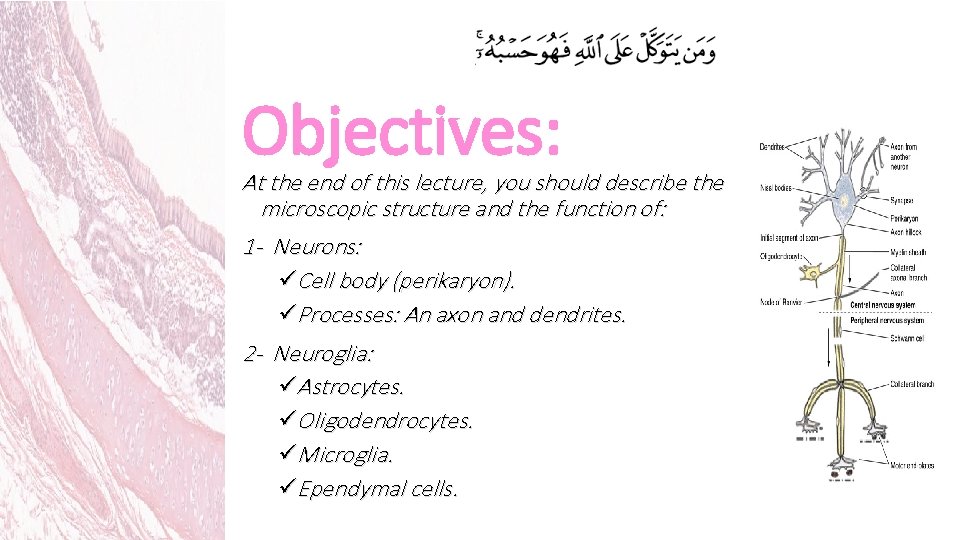
Objectives: At the end of this lecture, you should describe the microscopic structure and the function of: 1 - Neurons: üCell body (perikaryon). üProcesses: An axon and dendrites. 2 - Neuroglia: üAstrocytes. üOligodendrocytes. üMicroglia. üEpendymal cells.
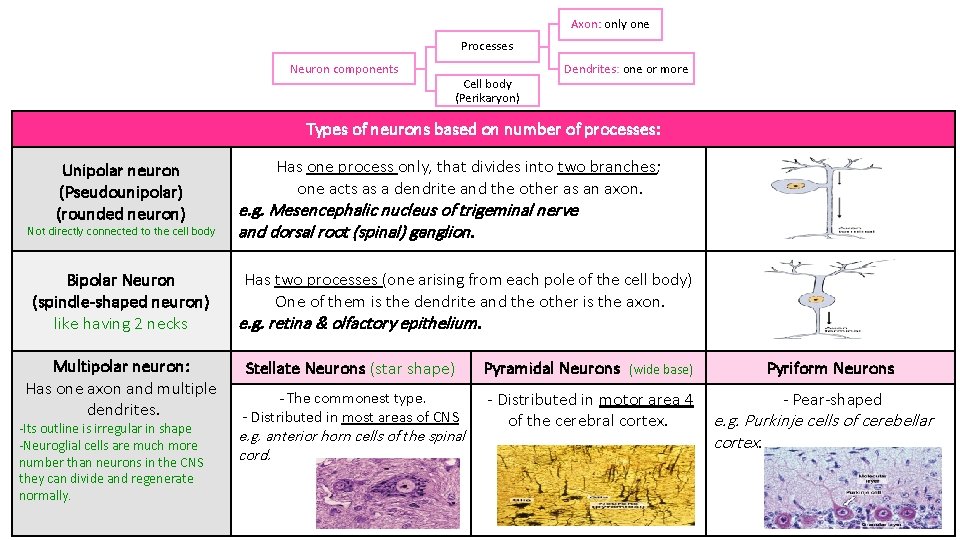
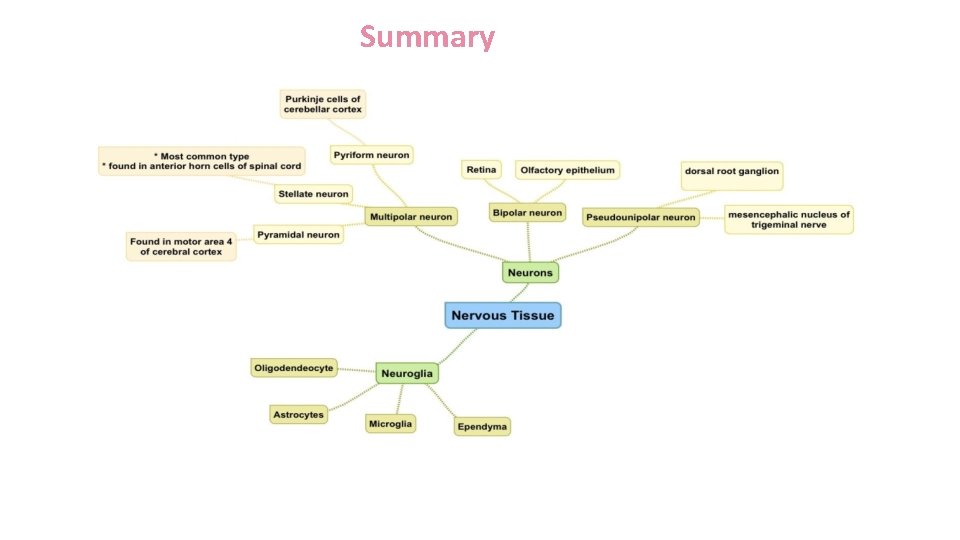
Axon: only one Processes Neuron components Cell body (Perikaryon) Dendrites: one or more Types of neurons based on number of processes: Unipolar neuron (Pseudounipolar) (rounded neuron) Not directly connected to the cell body Bipolar Neuron (spindle-shaped neuron) like having 2 necks Multipolar neuron: Has one axon and multiple dendrites. -Its outline is irregular in shape -Neuroglial cells are much more number than neurons in the CNS they can divide and regenerate normally. Has one process only, that divides into two branches; one acts as a dendrite and the other as an axon. e. g. Mesencephalic nucleus of trigeminal nerve and dorsal root (spinal) ganglion. Has two processes (one arising from each pole of the cell body) One of them is the dendrite and the other is the axon. e. g. retina & olfactory epithelium. Stellate Neurons (star shape) - The commonest type. - Distributed in most areas of CNS e. g. anterior horn cells of the spinal cord. Pyramidal Neurons (wide base) - Distributed in motor area 4 of the cerebral cortex. Pyriform Neurons - Pear-shaped e. g. Purkinje cells of cerebellar cortex.
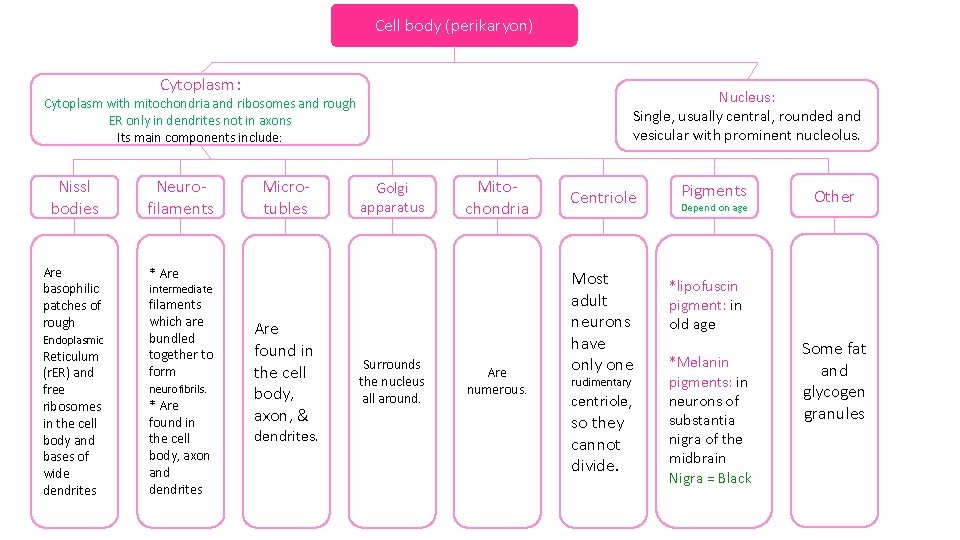
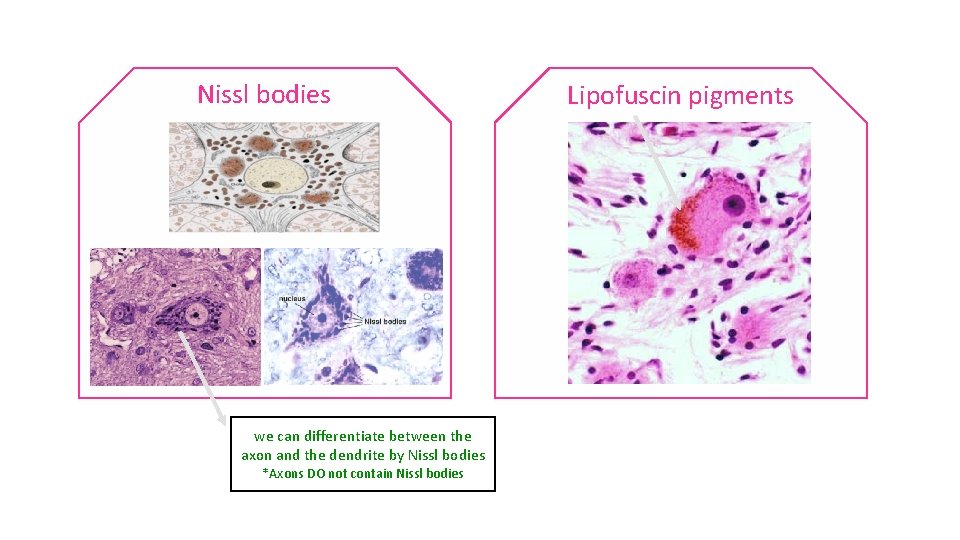
Cell body (perikaryon) Cytoplasm: Nucleus: Single, usually central, rounded and vesicular with prominent nucleolus. Cytoplasm with mitochondria and ribosomes and rough ER only in dendrites not in axons Its main components include: Nissl bodies Are basophilic patches of rough Endoplasmic Reticulum (r. ER) and free ribosomes in the cell body and bases of wide dendrites Neurofilaments Microtubles Golgi apparatus Mitochondria * Are intermediate filaments which are bundled together to form neurofibrils. * Are found in the cell body, axon and dendrites Are found in the cell body, axon, & dendrites. Surrounds the nucleus all around. Are numerous. Centriole Most adult neurons have only one rudimentary centriole, so they cannot divide. Pigments Depend on age Other *lipofuscin pigment: in old age *Melanin pigments: in neurons of substantia nigra of the midbrain Nigra = Black Some fat and glycogen granules
Nissl bodies we can differentiate between the axon and the dendrite by Nissl bodies *Axons DO not contain Nissl bodies Lipofuscin pigments
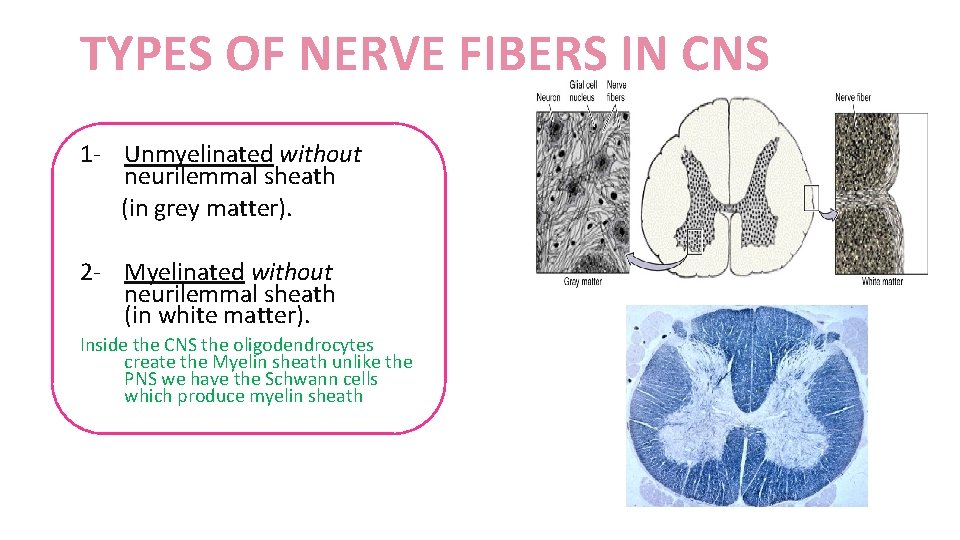
TYPES OF NERVE FIBERS IN CNS 1 - Unmyelinated without neurilemmal sheath (in grey matter). 2 - Myelinated without neurilemmal sheath (in white matter). Inside the CNS the oligodendrocytes create the Myelin sheath unlike the PNS we have the Schwann cells which produce myelin sheath
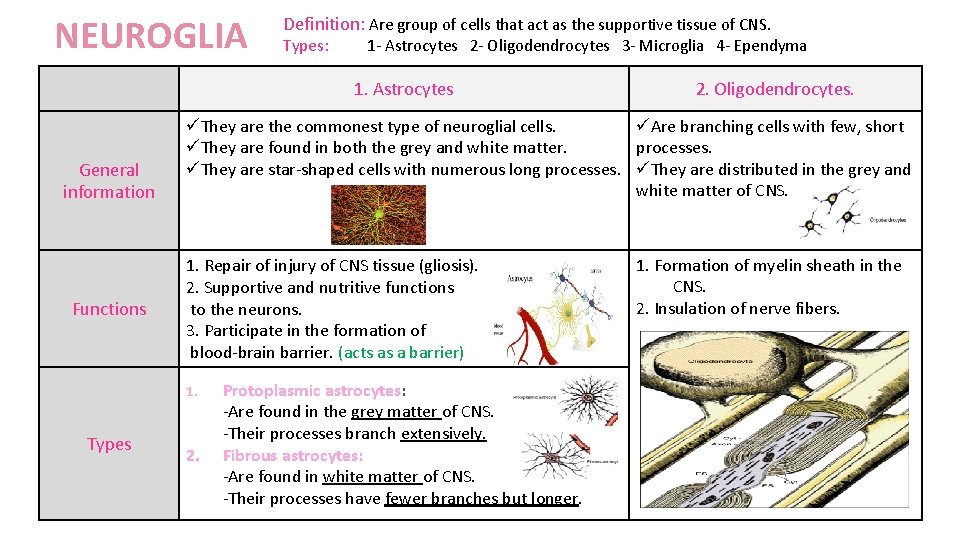
NEUROGLIA Definition: Are group of cells that act as the supportive tissue of CNS. Types: 1 - Astrocytes 2 - Oligodendrocytes 3 - Microglia 4 - Ependyma 1. Astrocytes General information Functions üThey are the commonest type of neuroglial cells. üAre branching cells with few, short üThey are found in both the grey and white matter. processes. üThey are star-shaped cells with numerous long processes. üThey are distributed in the grey and white matter of CNS. 1. Repair of injury of CNS tissue (gliosis). 2. Supportive and nutritive functions to the neurons. 3. Participate in the formation of blood-brain barrier. (acts as a barrier) 1. Types 2. Oligodendrocytes. 2. Protoplasmic astrocytes: -Are found in the grey matter of CNS. -Their processes branch extensively. Fibrous astrocytes: -Are found in white matter of CNS. -Their processes have fewer branches but longer. 1. Formation of myelin sheath in the CNS. 2. Insulation of nerve fibers.
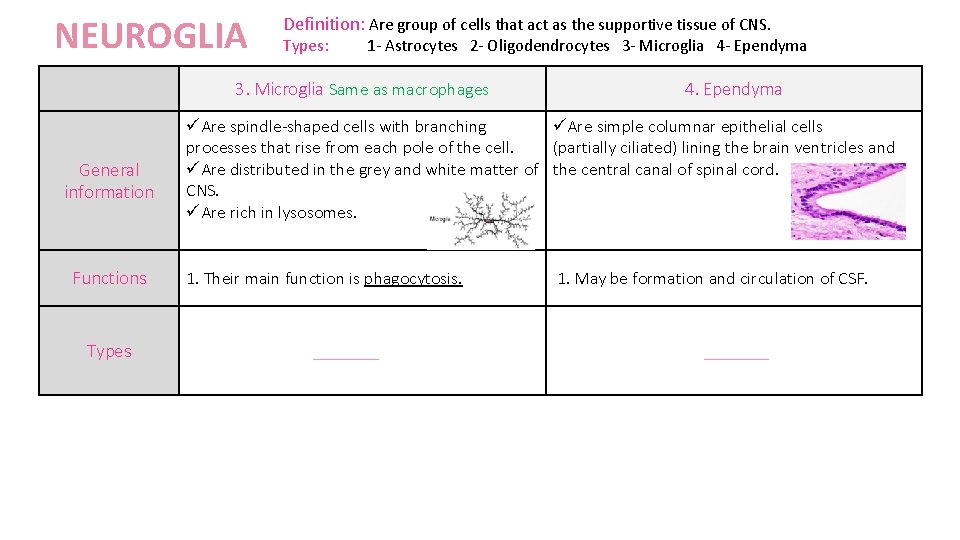
NEUROGLIA Definition: Are group of cells that act as the supportive tissue of CNS. Types: 1 - Astrocytes 2 - Oligodendrocytes 3 - Microglia 4 - Ependyma 3. Microglia Same as macrophages General information Functions Types 4. Ependyma üAre spindle-shaped cells with branching üAre simple columnar epithelial cells processes that rise from each pole of the cell. (partially ciliated) lining the brain ventricles and üAre distributed in the grey and white matter of the central canal of spinal cord. CNS. üAre rich in lysosomes. 1. Their main function is phagocytosis. 1. May be formation and circulation of CSF.
Summary
MCQ’s 1 - Which of the following contain Nissl Bodies? A. Dendrites and axon B. Dendrites and cell body C. Cell body and axon D. Only axon 2 - Types of nerve fibers that are found inside the CNS are? A. Myelinated with neurilemmal sheath B. Unmyelinated with neurilemmal sheath C. Myelinated and unmyelinated without neurilemmal sheath D. Non of above 3 - Which type of astrocyte is found in the grey matter of the CNS? A. Fibrous astrocytes B. Protoplasmic astrocytes C. Microglia D. Oligodendrocytes 4 - The supportive cells that form gliosis for repairing injuries in the CNS are? A. Astrocytes B. Oligodendrocytes C. Microglia D. Ependyma 5 - One of the functions of oligodendrocytes cells? A. Forming BBB B. Nutritive C. Phagocytosis D. Formation of myelin sheath 6 - The type of epithelium in the Ependymal cells is? A. Simple squamous non ciliated B. Simple columnar partially ciliated C. Simple cuboidal D. Pseudostratified 7 - Mesencephalic nucleus of trigeminal nerve and dorsal root ganglion are examples of example of? A. Unipolar neuron B. Bipolar neuron C. Spindle shaped neuron D. Multipolar neuron 8 - "Pyramidal neurons" are a type of multipolar neurons that are found in? A. Cerebellum cortex B. Brain steam C. Cerebral cortex D. All above 9 - Which one of the following is considered as the commonest type of neuron? A. stellate neuron B. Pyramidal neuron C. Pyriform neuron D. Bipolar neuron 1 -B 2 -C 3 -B 4 -A 5 - D 6 - B 7 - A 8 - C 9 -A
Thank you & good luck - Histology team Done by: Allulu Alsulayhim Amal Al. Garni Do’aa Walid Shahad Al. Anzan We’am Babaier Team leaders: Rana Barasain Faisal Alrabaii : ﻟﻼﻗﺘﺮﺍﺣﺎﺕ ﺃﻮ ﺍﻟﺸﻜﺎﻭﻱ https: //goo. gl/forms/fg 6 h. Lipif. Az. Vspuj 1 Please if you need anything or even further explanation contact us on: Histology. Team 436@gmail. com @histology 436