
Normal and Crosswind Takeoffs Private Pilot Curriculum Stephen

- Slides: 38
Normal and Crosswind Takeoffs Private Pilot Curriculum Stephen Saslow August 2020
Objective To understand the procedures and requirements for a normal and crosswind takeoff and climb. The student should be able to competently maintain control of the airplane and safely takeoff and climb with or without wind as described in the ACS/PTS.
Elements of the Takeoff • Normal Takeoff • Crosswind Takeoff KEY ELEMENTS: • 1. Takeoff into the Wind • 2. Left Turning Tendencies • 3. Rotation Speed (Vr - 55 knots)
Introduction The takeoff is one of the most basic and exciting parts of flying. Different situations regarding wind and weather, runway size and length, and the runway surface will provide different challenges for every flight.
What is a Takeoff, Why Do We Learn It? A normal takeoff is one in which the airplane is headed into the wind, or the wind is very light. Also, the takeoff surface is firm, and of sufficient length to permit the airplane to gradually accelerate to normal lift-off and climb-out speed, and there are no obstructions along the takeoff path. While it is preferable to takeoff into the wind, there will be many instances when circumstances dictate otherwise. A crosswind takeoff is a normal takeoff with the only exception being that the airplane is no longer headed directly into the wind. It is essential to every flight you will ever take! A smooth, skillful and safe takeoff is a key element of pilot proficiency. It is essential for the pilot to be able to perform a safe and smooth takeoff and have the ability to control the aircraft in varying conditions, starting with the basics. You need to be on your game while maneuvering close to the ground takeoffs are, by definition, performed at and near the ground.
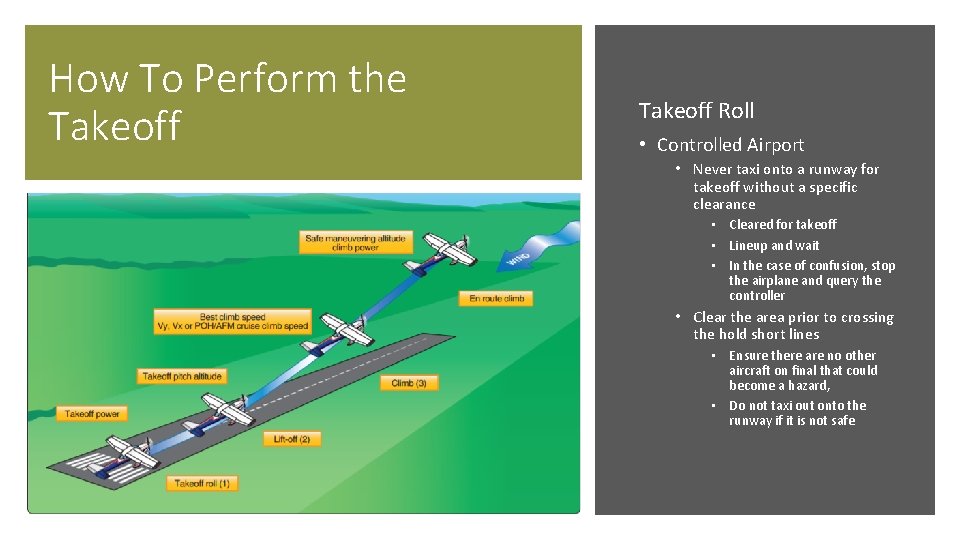
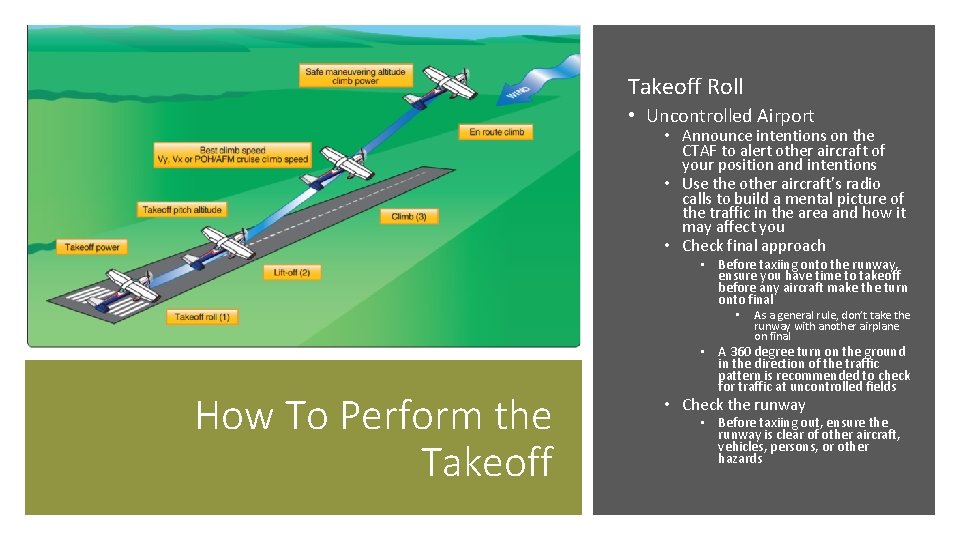
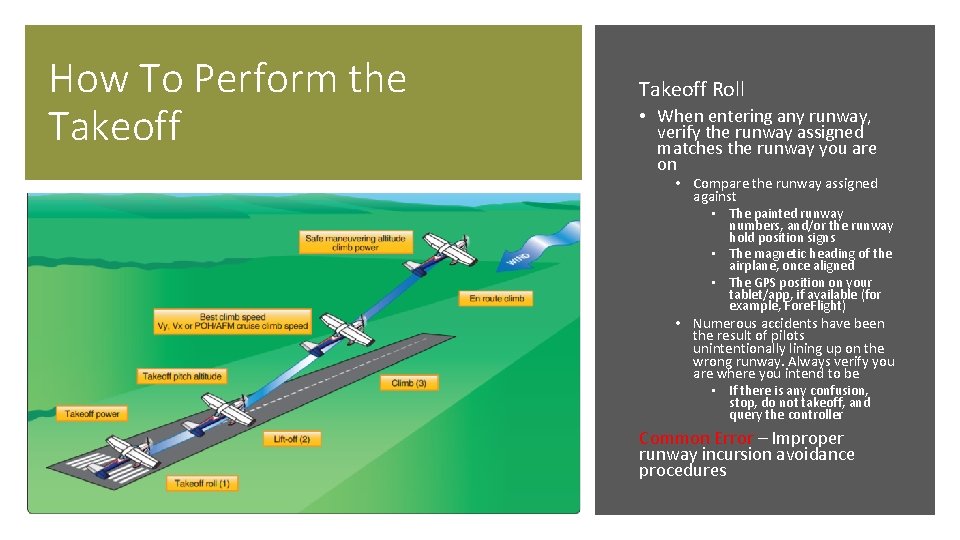
• A normal takeoff is one in which the airplane is headed into the wind, or the wind is very light. The takeoff surface is firm and of sufficient length to permit the airplane to gradually accelerate to normal lift-off and climb-out speed, and there are no obstructions on the takeoff path • There are times that a takeoff with a tail wind is necessary How To Perform the Takeoff • Consult the POH to ensure the airplane is approved for tail wind takeoffs, and if so, the maximum tailwind allowed. Also verify the runway length is sufficient for a tailwind takeoff • Reasons for taking off into the wind • Even with the airplane motionless, a headwind will provide some amount of airspeed as a result of wind moving over the wings • The airplane depends on airspeed to fly, a headwind provides some of that airspeed before the airplane starts moving • A headwind decreases the ground speed necessary to achieve flying speed • Results in a shorter ground roll and therefore less runway is required for takeoff • Shorter runways can be used • More runway is available in the case that the airplane needs to be stopped • The lower groundspeed also makes the airplane easier to stop • Reduces wear and stress on the landing gear • Slower ground speeds and less time spent on the runway
Runway Incursion Avoidance Controlled Airport • Request and receive the appropriate clearance to taxi • Request and receive the appropriate clearance before crossing any hold short bars onto a runway • Have a taxi diagram available for use • In the case of confusion, query the controller • Stop the airplane, if necessary, to prevent an incursion Uncontrolled Airport • Announce intentions on the CTAF when taxiing to alert other aircraft of your position and intentions • Use the other aircraft’s radio calls to build a mental picture of the traffic in the area and how they may affect you • Check Final Approach • Before taxiing onto the runway, ensure you have time to takeoff before any aircraft make the turn onto final • As a general rule, don’t take the runway with another airplane on final • A 360 degree turn on the ground in the direction of the traffic pattern is recommended to check for traffic at uncontrolled fields • Check the Runway • Before taxiing out, ensure the runway is clear of other aircraft, vehicles, persons, or other hazards • Common Error - Improper runway incursion avoidance
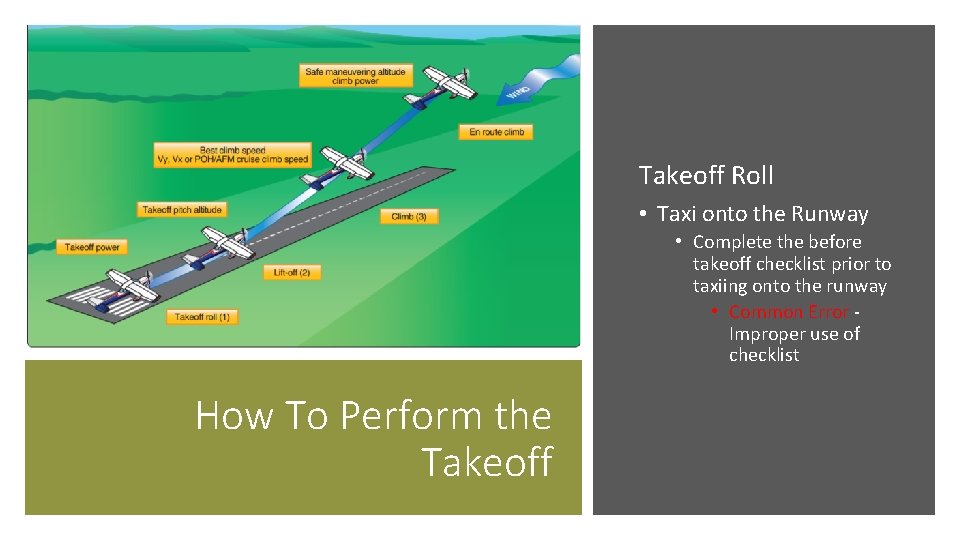
Takeoff Roll • Taxi onto the Runway • Complete the before takeoff checklist prior to taxiing onto the runway • Common Error Improper use of checklist How To Perform the Takeoff
How To Perform the Takeoff Roll • Controlled Airport • Never taxi onto a runway for takeoff without a specific clearance • Cleared for takeoff • Lineup and wait • In the case of confusion, stop the airplane and query the controller • Clear the area prior to crossing the hold short lines • Ensure there are no other aircraft on final that could become a hazard, • Do not taxi out onto the runway if it is not safe
Takeoff Roll • Uncontrolled Airport • Announce intentions on the CTAF to alert other aircraft of your position and intentions • Use the other aircraft’s radio calls to build a mental picture of the traffic in the area and how it may affect you • Check final approach • Before taxiing onto the runway, ensure you have time to takeoff before any aircraft make the turn onto final • How To Perform the Takeoff As a general rule, don’t take the runway with another airplane on final • A 360 degree turn on the ground in the direction of the traffic pattern is recommended to check for traffic at uncontrolled fields • Check the runway • Before taxiing out, ensure the runway is clear of other aircraft, vehicles, persons, or other hazards
How To Perform the Takeoff Roll • When entering any runway, verify the runway assigned matches the runway you are on • Compare the runway assigned against • The painted runway numbers, and/or the runway hold position signs • The magnetic heading of the airplane, once aligned • The GPS position on your tablet/app, if available (for example, Fore. Flight) • Numerous accidents have been the result of pilots unintentionally lining up on the wrong runway. Always verify you are where you intend to be • If there is any confusion, stop, do not takeoff, and query the controller Common Error – Improper runway incursion avoidance procedures
The Takeoff Aligning the Aircraft • The airplane should be carefully aligned with the intended takeoff direction, and the nose wheel positioned straight, or centered and stopped • Centerline site picture: Put the runway centerline between the pilot’s inner leg and throttle • This visual reference varies slightly from person to person and aircraft to aircraft; adjust as necessary to find a sight picture that works for you • While taxiing onto the runway, select ground reference points aligned with the runway to aid in maintaining directional control with the runway centerline during the climb • For example, runway lighting, distant trees, towers, buildings, mountains, etc. • Heading bug if equipped
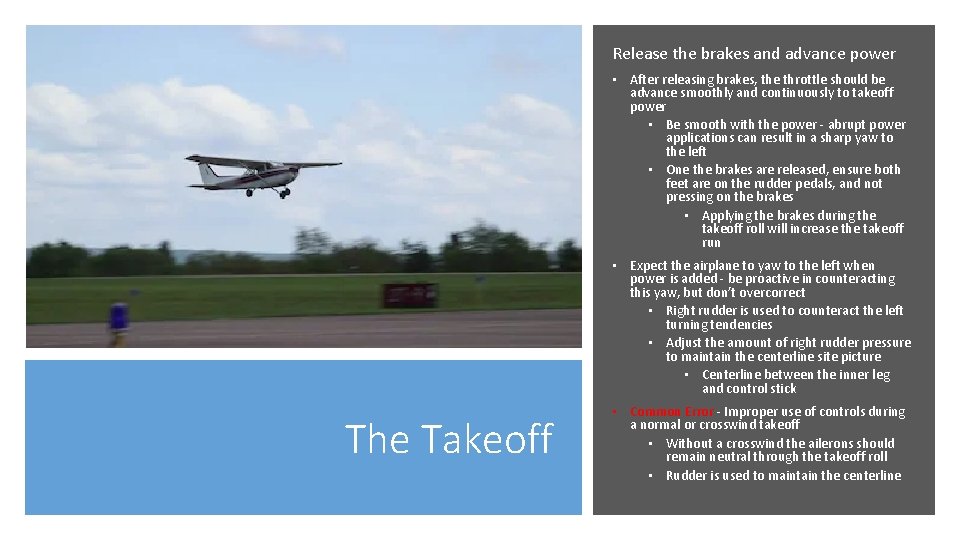
Release the brakes and advance power • After releasing brakes, the throttle should be advance smoothly and continuously to takeoff power • Be smooth with the power - abrupt power applications can result in a sharp yaw to the left • One the brakes are released, ensure both feet are on the rudder pedals, and not pressing on the brakes • Applying the brakes during the takeoff roll will increase the takeoff run • Expect the airplane to yaw to the left when power is added - be proactive in counteracting this yaw, but don’t overcorrect • Right rudder is used to counteract the left turning tendencies • Adjust the amount of right rudder pressure to maintain the centerline site picture • Centerline between the inner leg and control stick The Takeoff • Common Error - Improper use of controls during a normal or crosswind takeoff • Without a crosswind the ailerons should remain neutral through the takeoff roll • Rudder is used to maintain the centerline
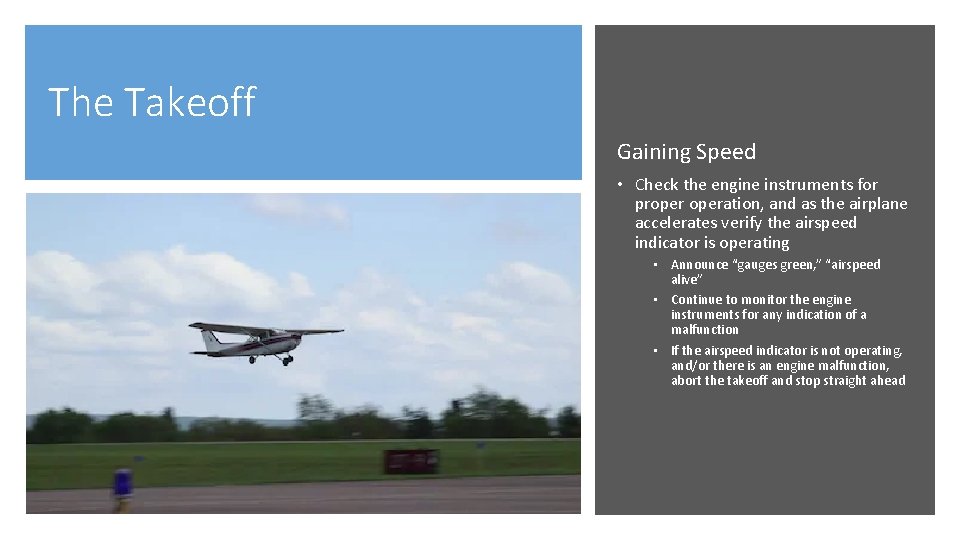
The Takeoff Gaining Speed • Check the engine instruments for properation, and as the airplane accelerates verify the airspeed indicator is operating • Announce “gauges green, ” “airspeed alive” • Continue to monitor the engine instruments for any indication of a malfunction • If the airspeed indicator is not operating, and/or there is an engine malfunction, abort the takeoff and stop straight ahead
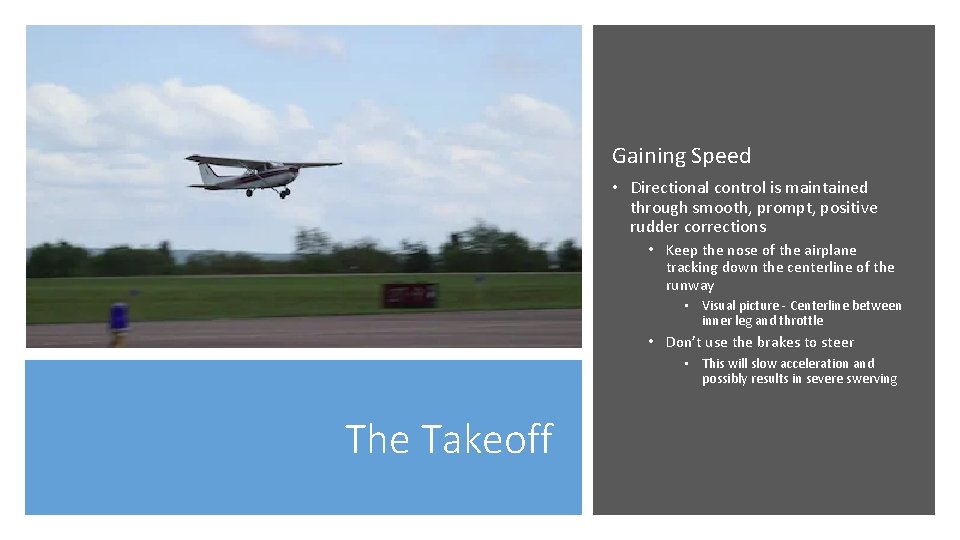
Gaining Speed • Directional control is maintained through smooth, prompt, positive rudder corrections • Keep the nose of the airplane tracking down the centerline of the runway • Visual picture - Centerline between inner leg and throttle • Don’t use the brakes to steer • This will slow acceleration and possibly results in severe swerving The Takeoff
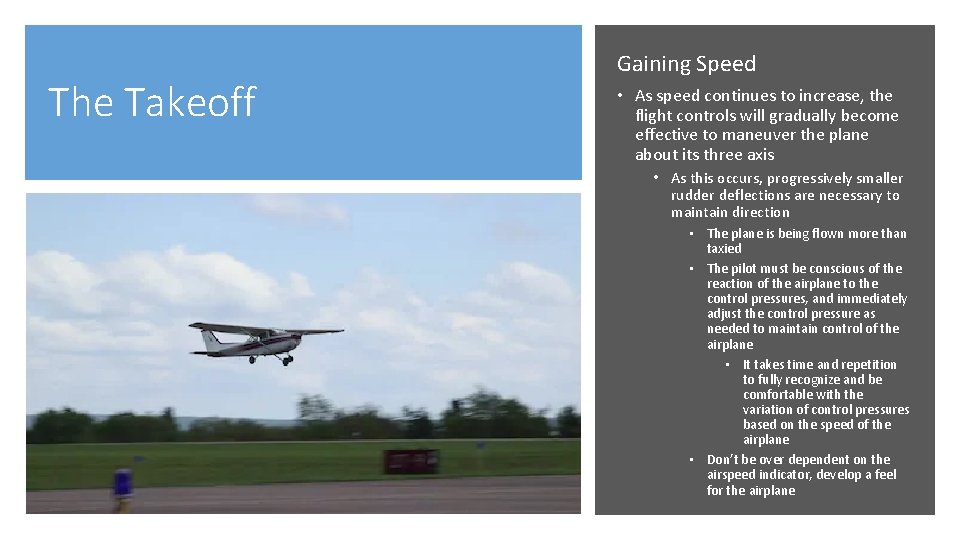
The Takeoff Gaining Speed • As speed continues to increase, the flight controls will gradually become effective to maneuver the plane about its three axis • As this occurs, progressively smaller rudder deflections are necessary to maintain direction • The plane is being flown more than taxied • The pilot must be conscious of the reaction of the airplane to the control pressures, and immediately adjust the control pressure as needed to maintain control of the airplane • It takes time and repetition to fully recognize and be comfortable with the variation of control pressures based on the speed of the airplane • Don’t be over dependent on the airspeed indicator, develop a feel for the airplane
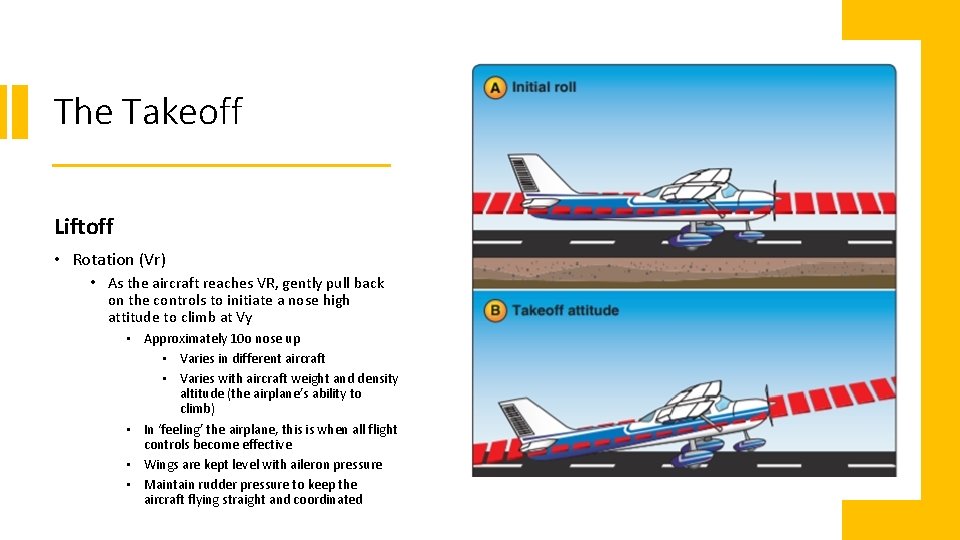
The Takeoff Liftoff • Rotation (Vr) • As the aircraft reaches VR, gently pull back on the controls to initiate a nose high attitude to climb at Vy • Approximately 10 o nose up • Varies in different aircraft • Varies with aircraft weight and density altitude (the airplane’s ability to climb) • In ‘feeling’ the airplane, this is when all flight controls become effective • Wings are kept level with aileron pressure • Maintain rudder pressure to keep the aircraft flying straight and coordinated
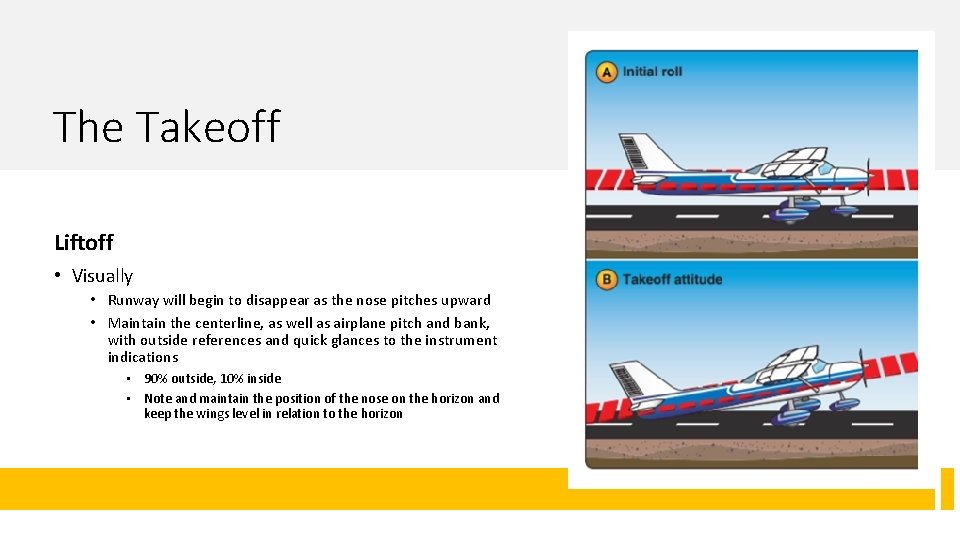
The Takeoff Liftoff • Visually • Runway will begin to disappear as the nose pitches upward • Maintain the centerline, as well as airplane pitch and bank, with outside references and quick glances to the instrument indications • 90% outside, 10% inside • Note and maintain the position of the nose on the horizon and keep the wings level in relation to the horizon
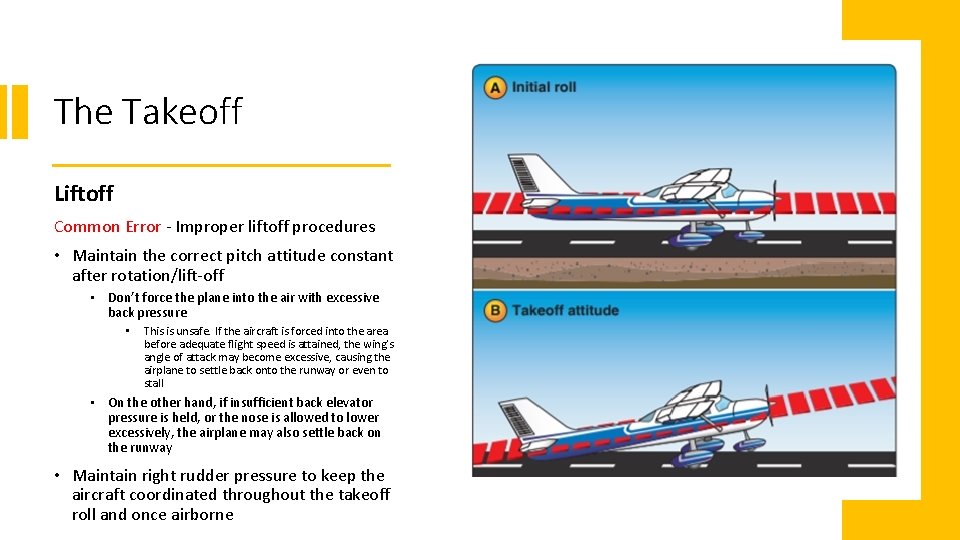
The Takeoff Liftoff Common Error - Improper liftoff procedures • Maintain the correct pitch attitude constant after rotation/lift-off • Don’t force the plane into the air with excessive back pressure • This is unsafe. If the aircraft is forced into the area before adequate flight speed is attained, the wing’s angle of attack may become excessive, causing the airplane to settle back onto the runway or even to stall • On the other hand, if insufficient back elevator pressure is held, or the nose is allowed to lower excessively, the airplane may also settle back on the runway • Maintain right rudder pressure to keep the aircraft coordinated throughout the takeoff roll and once airborne
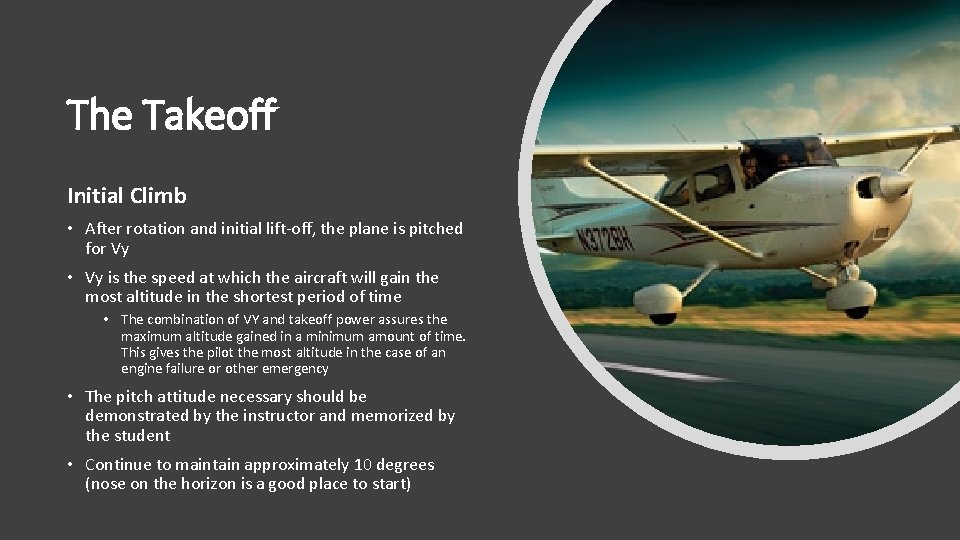
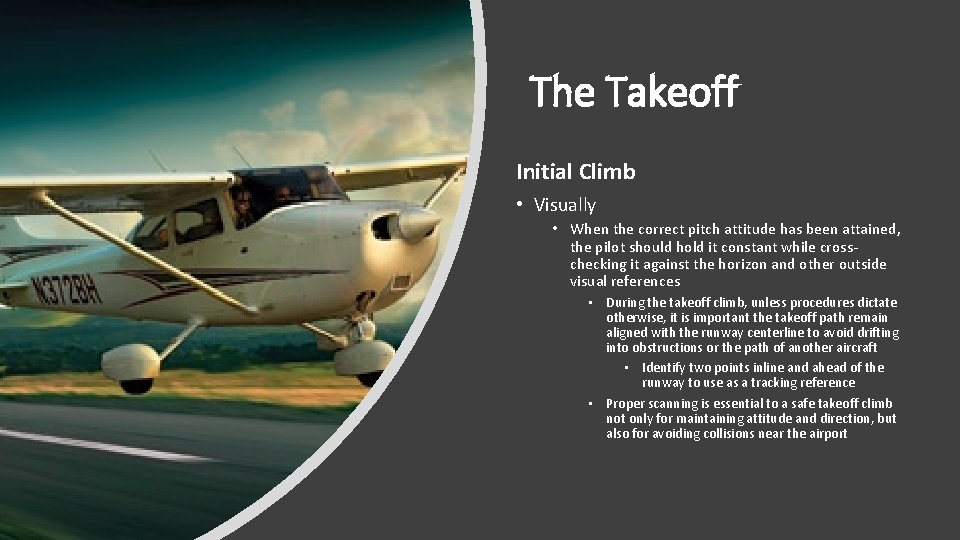
The Takeoff Initial Climb • After rotation and initial lift-off, the plane is pitched for Vy • Vy is the speed at which the aircraft will gain the most altitude in the shortest period of time • The combination of VY and takeoff power assures the maximum altitude gained in a minimum amount of time. This gives the pilot the most altitude in the case of an engine failure or other emergency • The pitch attitude necessary should be demonstrated by the instructor and memorized by the student • Continue to maintain approximately 10 degrees (nose on the horizon is a good place to start)
The Takeoff Initial Climb • Visually • When the correct pitch attitude has been attained, the pilot should hold it constant while crosschecking it against the horizon and other outside visual references • During the takeoff climb, unless procedures dictate otherwise, it is important the takeoff path remain aligned with the runway centerline to avoid drifting into obstructions or the path of another aircraft • Identify two points inline and ahead of the runway to use as a tracking reference • Proper scanning is essential to a safe takeoff climb not only for maintaining attitude and direction, but also for avoiding collisions near the airport
Since the power is set to takeoff power, the airspeed is controlled by slight pitch adjustments using the elevators How To Perform the Takeoff • The airspeed indicator is used as a check to ensure the pitch attitude is correct • Don’t focus on the instruments, continue to scan outside to adjust the airplane’s attitude in relation to the horizon. When a change needs to be made: • Make the necessary pitch change with reference to the natural horizon, and hold the new attitude momentarily • Due to inertia, the airplane won’t accelerate/decelerate immediately with pitch changes • Glance at the airspeed indicator to verify the new attitude is correct • If correct, maintain the current pitch attitude and crosscheck occasionally with the airspeed indicator to ensure it is maintained • If incorrect, the cross-checking and pitch-changing process must be repeated until the desired climb attitude is attained
The Takeoff Common Error - Improper climb attitude, power setting, and airspeed (Vy) • It is important to maintain Vy. • Attitude flying is important to avoid chasing the airspeed • Set the pitch that should give you Vy and make small adjustments as necessary • Right rudder will be necessary to prevent a side slip on the initial climb due to the left turning tendencies • Use right rudder to keep the aircraft coordinated
• Climb Checklist (Consult POH) The Takeoff • Speed – 70 -85 KIAS • Throttle Control - FULL • Micture – RICH (above 3000 feet pressure altitude, lean for maximum RPM) • Lights – As required • Common Error - Improper use of checklists • Wait until the aircraft is at a safe altitude and under control to accomplish any checklists • The checklist can be delayed to continue flying the aircraft, always fly the aircraft first • Aviate, Navigate, Communicate
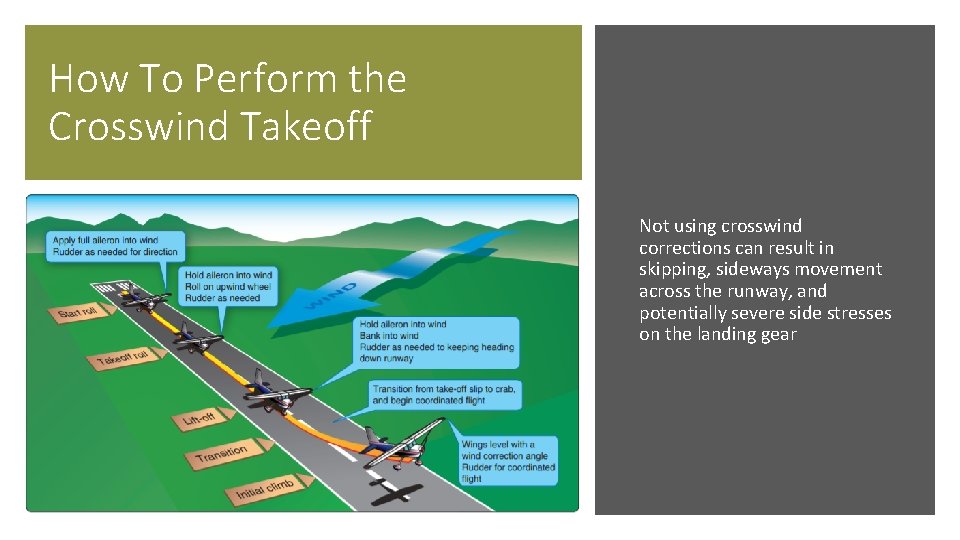
The Crosswind Takeoff The basic steps of a normal takeoff are the same for a crosswind takeoff Differences are in additional steps to ensure the airplane maintains the runway centerline and smoothly takes off with wind pushing across the runway • A crosswind affects the airplane during takeoff much as it does during taxi • The technique used for crosswind correction during takeoff closely parallels the crosswind corrections used for taxiing • Aileron is applied into the wind, and rudder is used to maintain the centerline • Aileron are used to keep the wings level during the takeoff roll • The ailerons start fully deflected into the wind • Aileron pressure will decrease as airspeed increases and the ailerons become more effective • Rudder is used to keep the nose of the airplane tracking down the centerline of the runway • On the ground the airplane weathervanes, or points, into the wind • There is more surface area behind the main wheels which act as a pivot point on the ground • Rudder is used to counter the weathervane and keep the airplane aligned with the runway centerline • Rudder is generally applied in the opposite direction of the ailerons • Right rudder is required to counter the left turning tendencies, but: • If there is a crosswind from the left, additional right rudder will be required • If there is a crosswind from the right, less right rudder than normal will be required • Once established in the climb, transition from the sideslip to a crab
How To Perform the Crosswind Takeoff Not using crosswind corrections can result in skipping, sideways movement across the runway, and potentially severe side stresses on the landing gear
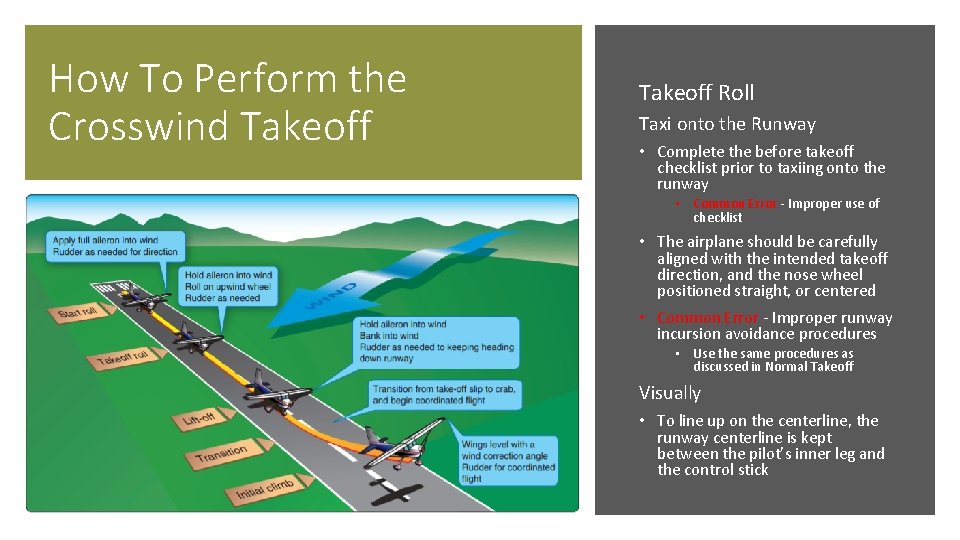
How To Perform the Crosswind Takeoff Roll Taxi onto the Runway • Complete the before takeoff checklist prior to taxiing onto the runway • Common Error - Improper use of checklist • The airplane should be carefully aligned with the intended takeoff direction, and the nose wheel positioned straight, or centered • Common Error - Improper runway incursion avoidance procedures • Use the same procedures as discussed in Normal Takeoff Visually • To line up on the centerline, the runway centerline is kept between the pilot’s inner leg and the control stick
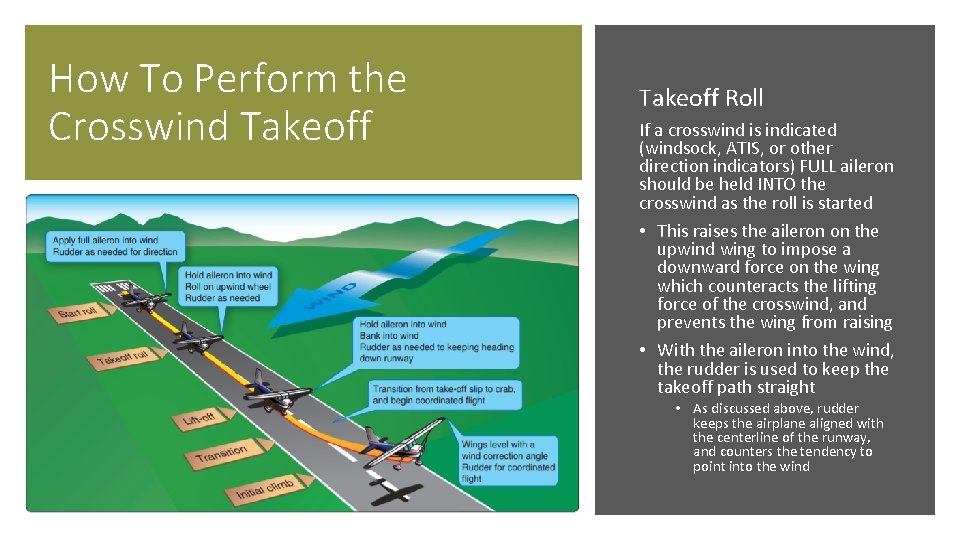
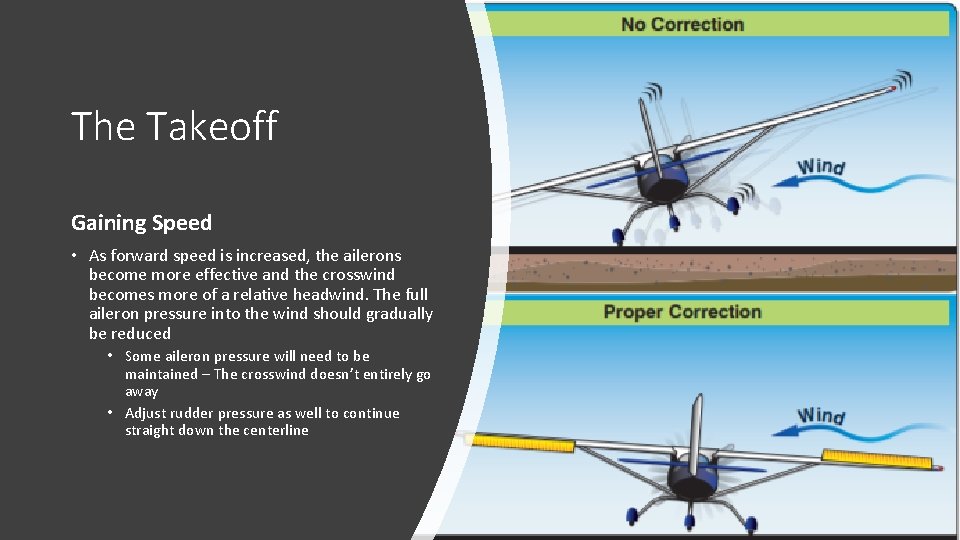
How To Perform the Crosswind Takeoff Roll If a crosswind is indicated (windsock, ATIS, or other direction indicators) FULL aileron should be held INTO the crosswind as the roll is started • This raises the aileron on the upwind wing to impose a downward force on the wing which counteracts the lifting force of the crosswind, and prevents the wing from raising • With the aileron into the wind, the rudder is used to keep the takeoff path straight • As discussed above, rudder keeps the airplane aligned with the centerline of the runway, and counters the tendency to point into the wind
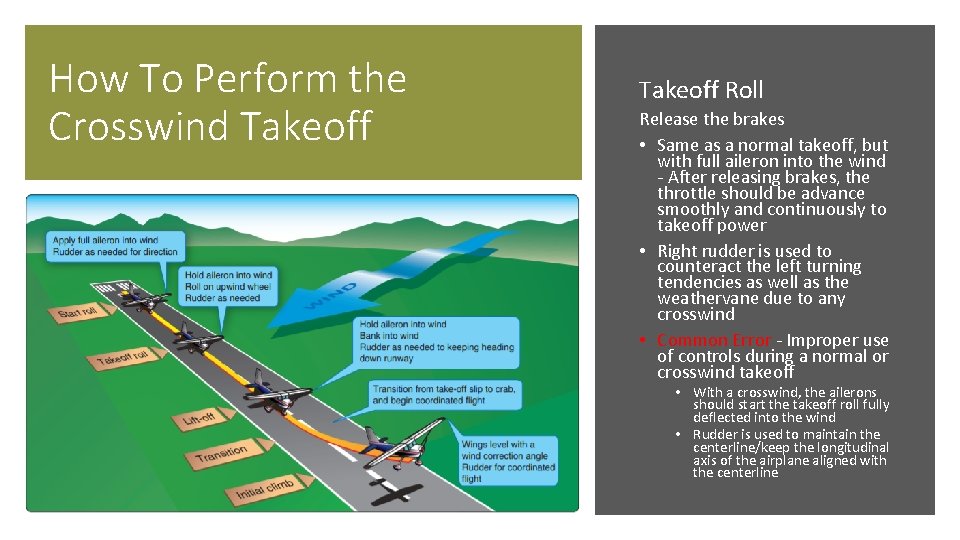
How To Perform the Crosswind Takeoff Roll Release the brakes • Same as a normal takeoff, but with full aileron into the wind - After releasing brakes, the throttle should be advance smoothly and continuously to takeoff power • Right rudder is used to counteract the left turning tendencies as well as the weathervane due to any crosswind • Common Error - Improper use of controls during a normal or crosswind takeoff • With a crosswind, the ailerons should start the takeoff roll fully deflected into the wind • Rudder is used to maintain the centerline/keep the longitudinal axis of the airplane aligned with the centerline
The Takeoff Gaining Speed • As forward speed is increased, the ailerons become more effective and the crosswind becomes more of a relative headwind. The full aileron pressure into the wind should gradually be reduced • Some aileron pressure will need to be maintained – The crosswind doesn’t entirely go away • Adjust rudder pressure as well to continue straight down the centerline
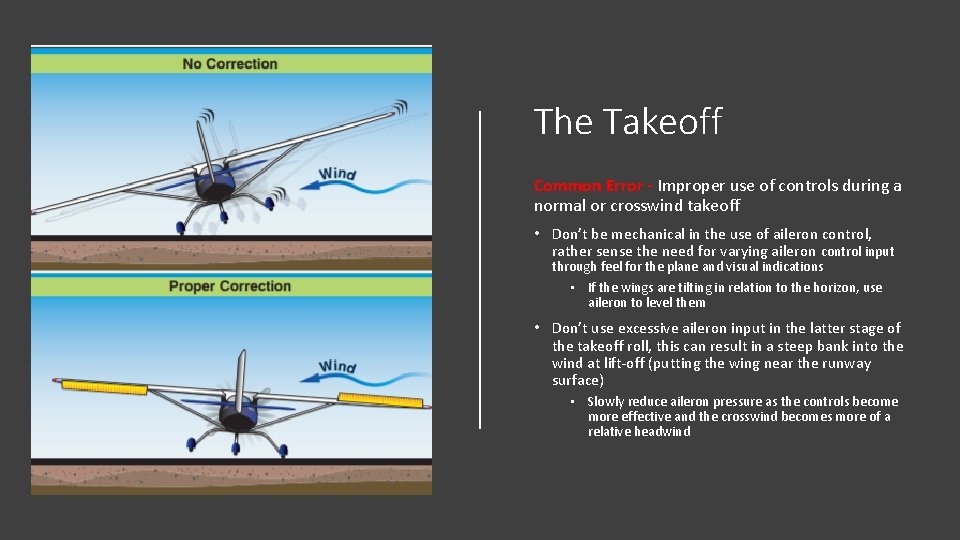
The Takeoff Common Error - Improper use of controls during a normal or crosswind takeoff • Don’t be mechanical in the use of aileron control, rather sense the need for varying aileron control input through feel for the plane and visual indications • If the wings are tilting in relation to the horizon, use aileron to level them • Don’t use excessive aileron input in the latter stage of the takeoff roll, this can result in a steep bank into the wind at lift-off (putting the wing near the runway surface) • Slowly reduce aileron pressure as the controls become more effective and the crosswind becomes more of a relative headwind
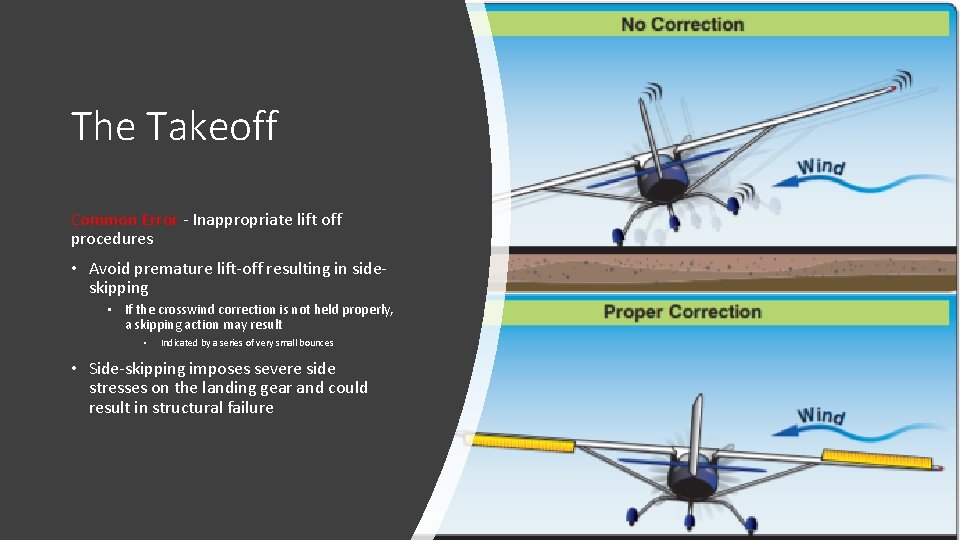
The Takeoff Common Error - Inappropriate lift off procedures • Avoid premature lift-off resulting in sideskipping • If the crosswind correction is not held properly, a skipping action may result • Indicated by a series of very small bounces • Side-skipping imposes severe side stresses on the landing gear and could result in structural failure
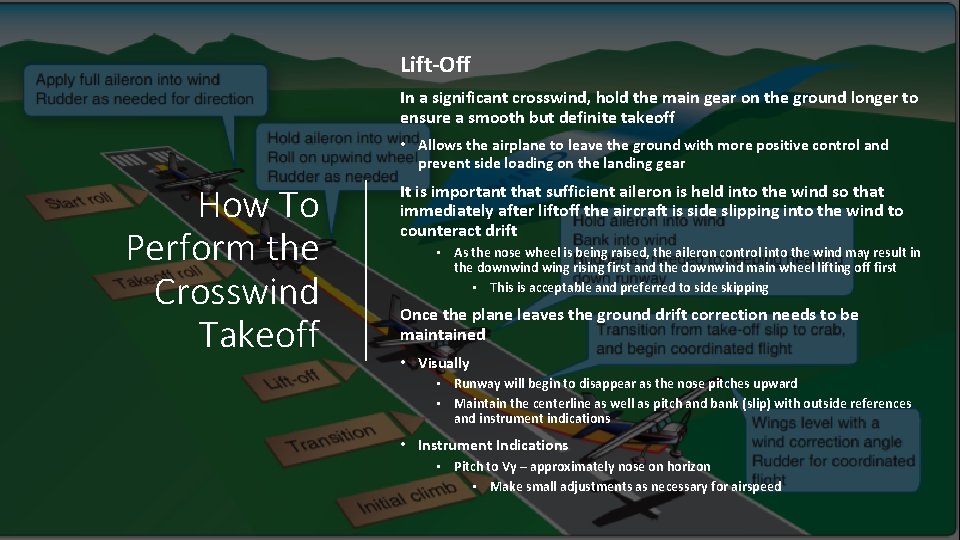
Lift-Off In a significant crosswind, hold the main gear on the ground longer to ensure a smooth but definite takeoff • Allows the airplane to leave the ground with more positive control and prevent side loading on the landing gear How To Perform the Crosswind Takeoff It is important that sufficient aileron is held into the wind so that immediately after liftoff the aircraft is side slipping into the wind to counteract drift • As the nose wheel is being raised, the aileron control into the wind may result in the downwind wing rising first and the downwind main wheel lifting off first • This is acceptable and preferred to side skipping Once the plane leaves the ground drift correction needs to be maintained • Visually • Runway will begin to disappear as the nose pitches upward • Maintain the centerline as well as pitch and bank (slip) with outside references and instrument indications • Instrument Indications • Pitch to Vy – approximately nose on horizon • Make small adjustments as necessary for airspeed
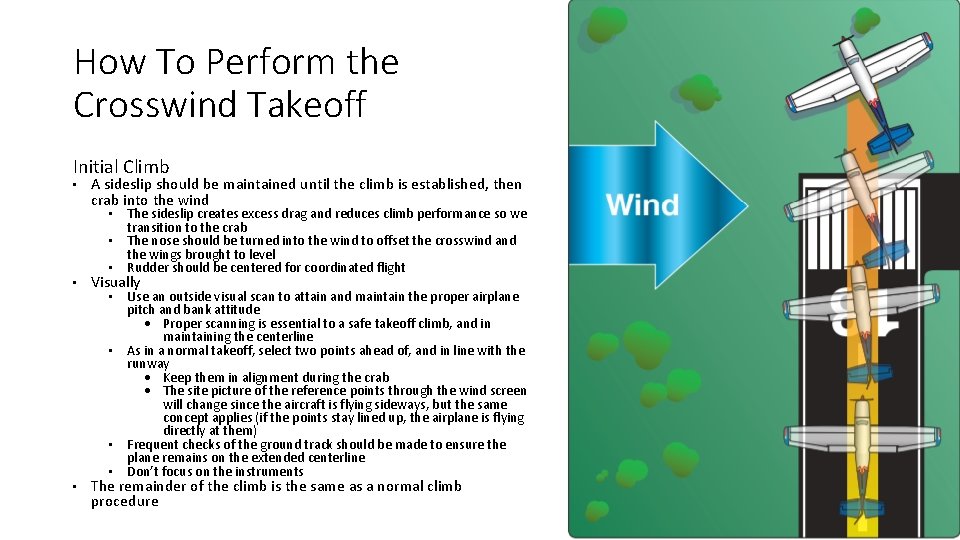
How To Perform the Crosswind Takeoff Initial Climb • A sideslip should be maintained until the climb is established, then crab into the wind • • Visually • • • The sideslip creates excess drag and reduces climb performance so we transition to the crab The nose should be turned into the wind to offset the crosswind and the wings brought to level Rudder should be centered for coordinated flight Use an outside visual scan to attain and maintain the proper airplane pitch and bank attitude Proper scanning is essential to a safe takeoff climb, and in maintaining the centerline As in a normal takeoff, select two points ahead of, and in line with the runway Keep them in alignment during the crab The site picture of the reference points through the wind screen will change since the aircraft is flying sideways, but the same concept applies (if the points stay lined up, the airplane is flying directly at them) Frequent checks of the ground track should be made to ensure the plane remains on the extended centerline Don’t focus on the instruments The remainder of the climb is the same as a normal climb procedure
• Climb Checklist (Consult POH) • Speed – 70 -85 KIAS • Throttle Control - FULL • Micture – RICH (above 3000 feet pressure altitude, lean for maximum RPM) • Lights – As required The Crosswind Takeoff • Common Error - Improper climb attitude, power setting, and airspeed (Vy) • Maintain drift correction after lift-off, and then transition to a crab • Power, airspeed, and climb attitude are the same as a normal takeoff • Common Error - Improper use of checklists • Wait until the aircraft is at a safe altitude and under control to accomplish any checklists • The checklist can be delayed to continue flying the aircraft, if things are busy fly the aircraft first • Aviate, Navigate, Communicate
Common Errors • Improper runway incursion avoidance procedures • Improper use of controls during a normal or crosswind takeoff • Inappropriate lift off procedures • Improper climb attitude, power setting, and airspeed (VY) • Improper use of checklist
Normal Takeoffs Objective: To understand the procedures and requirements for a normal and crosswind takeoff and climb. The student should be able to competently maintain control of the airplane and safely takeoff and climb with or without wind as described in the ACS/PTS. Purpose: It is essential to every flight you will ever take! A smooth, skillful and safe takeoff is a key element of pilot proficiency. It is essential for the pilot to be able to perform a safe and smooth takeoff and have the ability to control the aircraft in varying conditions, starting with the basics. You need to be on your game while maneuvering close to the ground - takeoffs are, by definition, performed at and near the ground. Private Pilot ACS Skills Standard s 1. Complete the appropriate checklist. 2. Make radio calls as appropriate. 3. Verify assigned/correct runway. 4. Ascertain wind direction with or without visible wind direction indicators. 5. Position the flight controls for the existing wind conditions. 6. Clear the area; taxi into takeoff position and align the airplane on the runway centerline. 7. Confirm takeoff power and proper engine and flight instrument indications prior to rotation. 8. Rotate and lift off at the recommended airspeed and accelerate to VY. 9. Establish a pitch attitude to maintain the manufacturer’s recommended speed, or VY +10/-5 knots. 10. Configure the airplane in accordance with manufacturer’s guidance. 11. Maintain VY +10/-5 knots to a safe maneuvering altitude. 12. Maintain directional control and proper wind-drift correction throughout takeoff and climb. 13. Comply with noise abatement procedures. Completion Standards Commercial Pilot ACS Skills Standards 1. Complete the appropriate checklist. 2. Make radio calls as appropriate. 3. Verify assigned/correct runway. 4. Ascertain wind direction with or without visible wind direction indicators. 5. Position the flight controls for the existing wind conditions. 6. Clear the area; taxi into takeoff position and align the airplane on the runway centerline. 7. Confirm takeoff power and proper engine and flight instrument indications prior to rotation. 8. Rotate and lift off at the recommended airspeed and accelerate to VY. 9. Establish pitch attitude to maintain the manufacturer’s recommended speed or VY ± 5 knots. 10. Configure the airplane in accordance with manufacturer’s guidance. 11. Maintain VY ± 5 knots to a safe maneuvering altitude. 12. Maintain directional control and proper wind drift correction throughout takeoff and climb. 13. Comply with noise abatement procedures. The lesson is complete when the student is able to walk through a normal or crosswind takeoff on the ground, providing knowledge of common errors regarding these procedures. The student also should be able to confidently demonstrate a takeoff and climb with or without a crosswind.
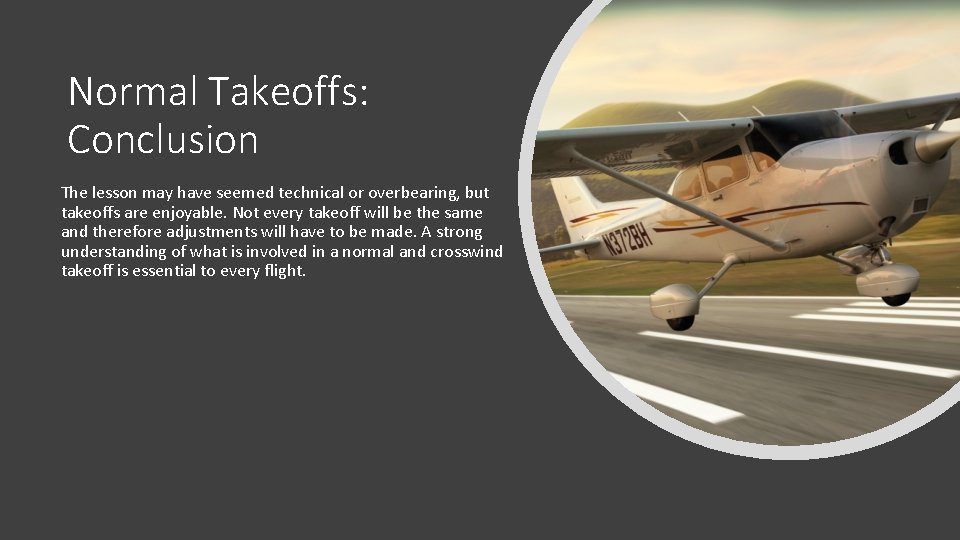
Normal Takeoffs: Conclusion The lesson may have seemed technical or overbearing, but takeoffs are enjoyable. Not every takeoff will be the same and therefore adjustments will have to be made. A strong understanding of what is involved in a normal and crosswind takeoff is essential to every flight.