
Normal and abnormal puberty Tariq Rabaya MD July
Normal and abnormal puberty Tariq Rabaya, MD July 2019
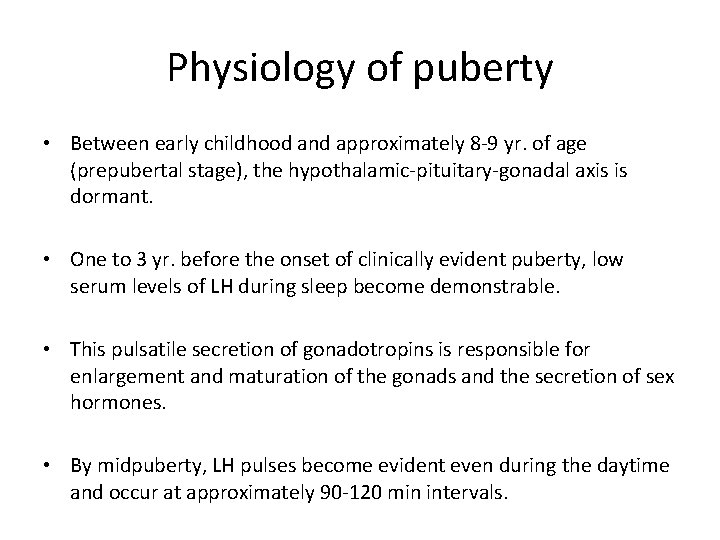
Physiology of puberty • Between early childhood and approximately 8 -9 yr. of age (prepubertal stage), the hypothalamic-pituitary-gonadal axis is dormant. • One to 3 yr. before the onset of clinically evident puberty, low serum levels of LH during sleep become demonstrable. • This pulsatile secretion of gonadotropins is responsible for enlargement and maturation of the gonads and the secretion of sex hormones. • By midpuberty, LH pulses become evident even during the daytime and occur at approximately 90 -120 min intervals.
• A second critical event occurs in middle or late adolescence in girls in whom cyclicity and ovulation occur. • A positive feedback mechanism develops whereby increasing levels of estrogen in midcycle cause a distinct increase of LH. • The increasing secretion of hypothalamic Gn. RH in a pulsatile fashion thus underlies the onset of pubertal development. • Serum levels of dehydroepiandrosterone (DHEA) and its sulfate (DHEAS) begin to increase at approximately 6 -8 yr. of age, before any increase in LH or sex hormones and before the earliest physical changes of puberty are apparent; this process is called adrenarche. • DHEAS is the most abundant adrenal steroid in the blood, and its serum concentration remains fairly stable over 24 hr.
• The effects of gonadal steroids (testosterone in boys, estradiol in girls) on bone growth and osseous maturation are critical. • Both aromatase deficiency and estrogen receptor defects result in delayed epiphyseal fusion and tall stature in affected males. • These observations suggest that estrogens, rather than androgens, are responsible for the process of bone maturation that ultimately leads to epiphyseal fusion and cessation of growth. • Estrogens also mediate the increased production of growth hormone, which along with a direct effect of sex steroids on bone growth, is responsible for the pubertal growth spurt.
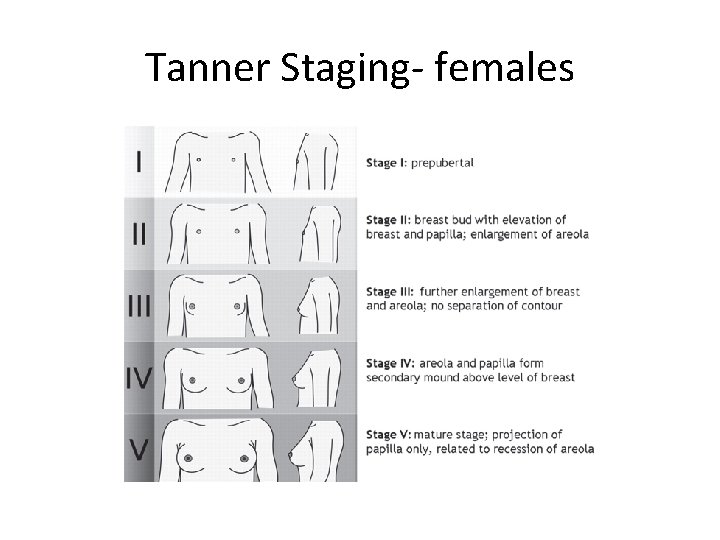
Normal puberty in females • The breast bud (thelarche) is usually the first sign of puberty (10 -11 yr of age) • Followed by the appearance of pubic hair (pubarche) 6 -12 mo later. • The interval to the onset of menstrual activity (menarche) is usually 2 -2. 5 yr. , but may be as long as 6 yr. • Peak height velocity occurs early (at breast stages II-III, typically between 11 and 12 yr. of age) in girls and always precedes menarche. • The mean age of menarche is approximately 12. 75 yr.
Tanner Staging- females
Normal puberty in males • Growth of the testes (≥ 4 m. L in volume or 2. 5 cm in longest diameter) and thinning of the scrotum are the first signs of puberty (11 -12 yr). • These are followed by pigmentation of the scrotum and growth of the penis and by pubarche. • Appearance of axillary hair usually occurs in midpuberty. • In males, unlike in females, acceleration of growth begins after puberty is well under way and is maximal at genital stages IV-V (typically between 13 and 14 yr of age). • In males, the growth spurt occurs approximately 2 yr later than in females, and growth may continue beyond 18 yr of age.
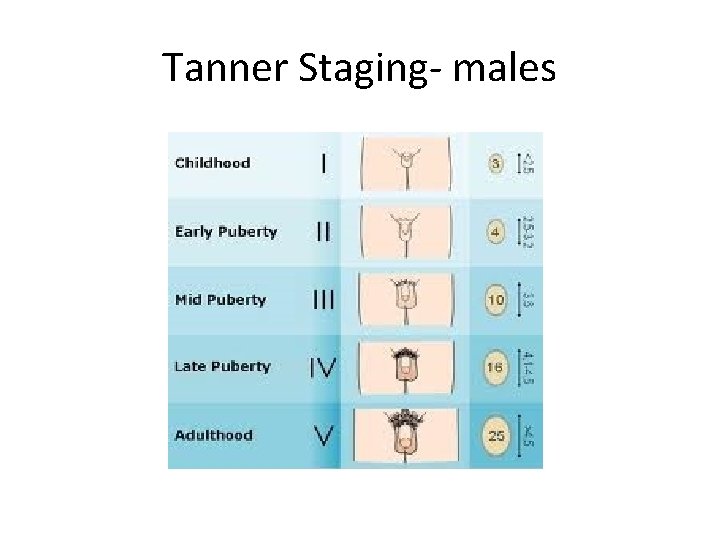
Tanner Staging- males

Precocious puberty • Precocious puberty is defined by the onset of secondary sexual characteristics before the age of 8 yr in girls and 9 yr in boys.

Classification • Depending on the primary source of the hormonal production, precocious puberty may be classified as: • Central (also known as gonadotropin dependent, or true) • Peripheral (also known as gonadotropin independent or precocious pseudopuberty)
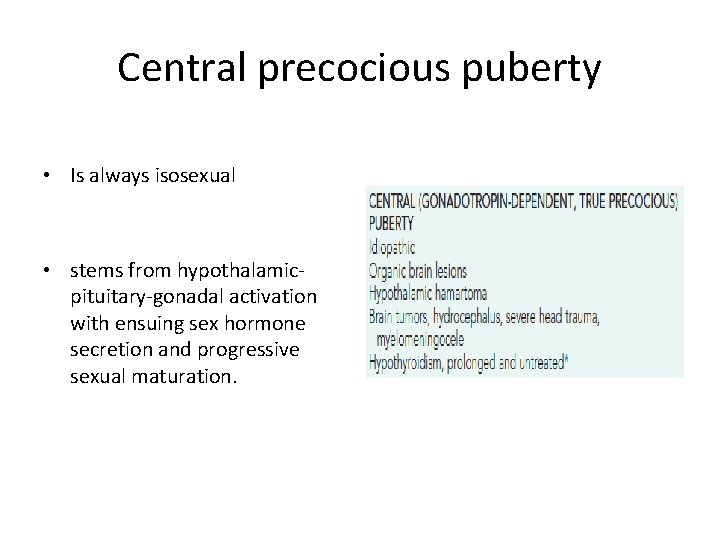
Central precocious puberty • Is always isosexual • stems from hypothalamicpituitary-gonadal activation with ensuing sex hormone secretion and progressive sexual maturation.
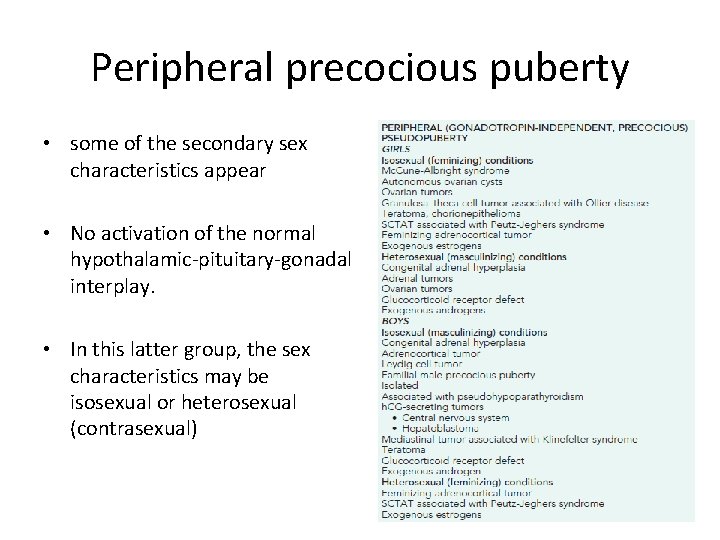
Peripheral precocious puberty • some of the secondary sex characteristics appear • No activation of the normal hypothalamic-pituitary-gonadal interplay. • In this latter group, the sex characteristics may be isosexual or heterosexual (contrasexual)
Combined peripheral and central • Peripheral precocious puberty can induce maturation of the hypothalamic-pituitary-gonadal axis and trigger the onset of central puberty. • This mixed type of precocious puberty occurs commonly in conditions such as: – Congenital adrenal hyperplasia – Mc. Cune-Albright syndrome – Familial male-limited precocious puberty
Central Precocious Puberty • Central precocious puberty is defined by: – the onset of breast development before the age of 8 yr in girls – and by the onset of testicular development (volume ≥ 4 m. L) before the age of 9 yr in boys – as a result of the early activation of the hypothalamic-pituitarygonadal axis.
Epidemiology • It occurs 5 -10–fold more frequently in girls than in boys and is usually sporadic. • Although approximately 90% of girls have an idiopathic form, a structural central nervous system (CNS) abnormality can be demonstrated in up to 75% of boys with central precocious puberty. • Beyond its etiology, which thus needs to be specifically addressed, central precocious puberty can impact linear growth and affect the child’s growth potential.
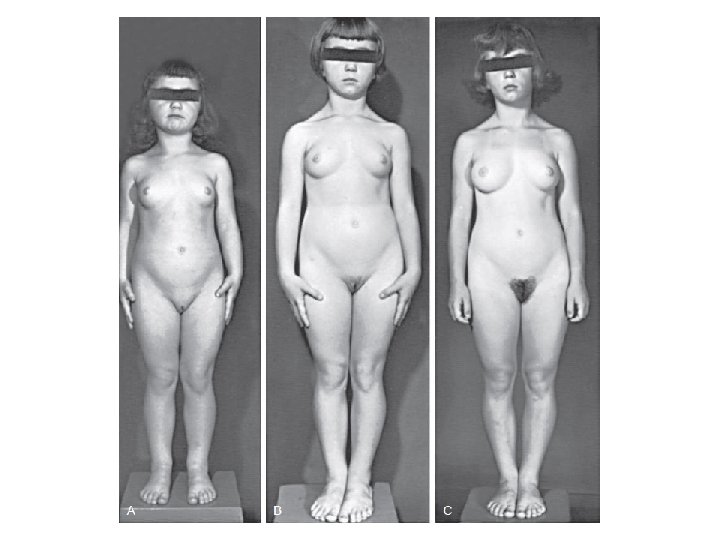
Clinical manifestations • Sexual development may begin at any age and generally follows the sequence observed in normal puberty. • In girls, early menstrual cycles may be more irregular than they are with normal puberty. • The initial cycles are usually anovulatory, but pregnancy has been reported as early as 5. 5 yr of age. • In boys, testicular biopsies have shown stimulation of all elements of the testes, and spermatogenesis has been observed as early as 56 yr of age.
Osseous maturation • In affected girls and boys, height, weight, and osseous maturation are advanced. • The increased rate of bone maturation results in early closure of the epiphyses, and the ultimate stature is less than it would have been otherwise. • Without treatment, approximately 30% of girls and an even larger percentage of boys achieve a height less than the 5 th percentile as adults.
Mental development • Mental development is usually compatible with chronological age. • Emotional behavior and mood swings are common, but serious psychological problems are rare.
Patterns of pubertal progression • Rapidly progressive puberty: in most girls (particularly those younger than 6 yr of age at the onset) and a large majority of boys. • Slowly progressive variant: in girls older than 6 yr of age at the onset with an idiopathic form. • Spontaneously regressive or unsustained central precocious puberty is quite rare.
Laboratory findings • Sex hormone concentrations are usually appropriate for the stage of puberty in both sexes. • Serum estradiol concentrations are low or undetectable in the early phase of sexual precocity in girls, as they are in normal puberty. • In boys, serum testosterone levels are usually detectable or clearly elevated by the time the parents seek medical attention, provided that an early morning blood sample is obtained. • Measurement of LH in serial blood samples obtained during sleep has greater diagnostic power than measurement in a single random sample, and it typically reveals a well-defined pulsatile secretion of LH.
Gn. RH stimulation test • By intravenous administration of gonadotropin releasing hormone (Gn. RH stimulation test) or a Gn. RH agonist (leuprolide stimulation test). • Then to measure LH and FSH at 0, 30, 60 and 120 minutes.
Other investigations • Left wrist x-ray: to asses osseous maturation which is variably advanced, often by more than 2 -3 SD. • Pelvic ultrasonography in girls reveals progressive enlargement of the ovaries, followed by enlargement of the fundus and then of the whole uterus to pubertal size. • An MRI scan usually demonstrates physiologic enlargement of the pituitary gland, as seen in normal puberty; it may also reveal CNS pathology
DIFFERENTIAL DIAGNOSIS Idiopathic Organic brain lesions Hypothalamic hamartoma Brain tumors, hydrocephalus, severe head trauma, • myelomeningocele • Hypothyroidism, prolonged and untreated • •
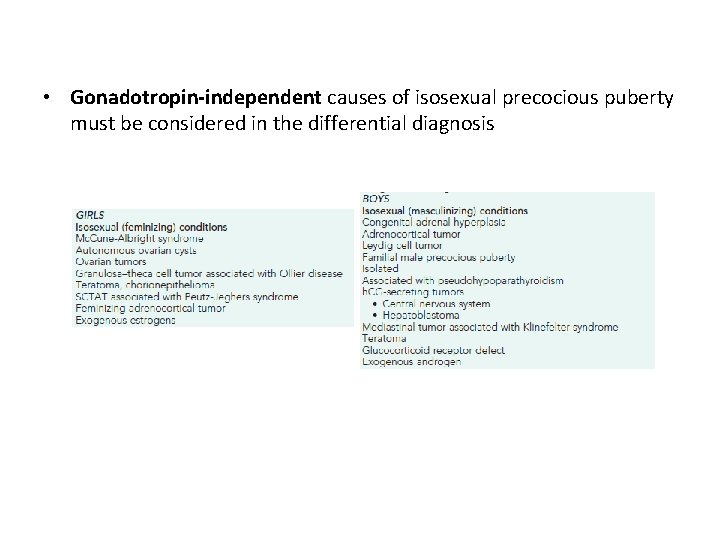
• Gonadotropin-independent causes of isosexual precocious puberty must be considered in the differential diagnosis
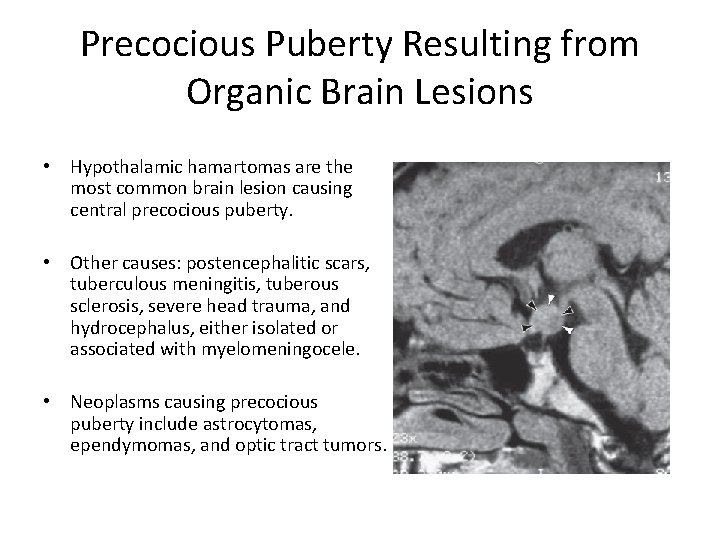
Precocious Puberty Resulting from Organic Brain Lesions • Hypothalamic hamartomas are the most common brain lesion causing central precocious puberty. • Other causes: postencephalitic scars, tuberculous meningitis, tuberous sclerosis, severe head trauma, and hydrocephalus, either isolated or associated with myelomeningocele. • Neoplasms causing precocious puberty include astrocytomas, ependymomas, and optic tract tumors.
How to asses a patient with PP • History • Physical exam • Investigations
History • • • Onset Progression Other associated pubertal changes Neurological symptoms History of previous CNS insult Abdominal pain Symptoms of hypothyroidism Growth velocity Family History Drug History

Physical exam • • • Growth Parameters Tanner Staging Dermatological exam Neurological exam Thyroid exam

Growth charts
Investigations • • Bone Age TFT LH, FSH Estradiol/Testosterone Gn. RH stimulation test Pelvic ultrasound Brain MRI Others: IGF-1, cortisol, DHEAS, 17 -OH progesterone
TREATMENT • Depends on : - etiology - Pace of sexual maturation - Predicted adult height - Psychosocial ?
Gn. RH agonist • slows accelerated puberty and improves final height - Leuprolide acetate - Triptorelin - Histrelin • Treatment should be given until it appears that it is safe appropriate for puberty to proceed.
GIPP - treatment • Tumors of the testis, adrenal gland, and ovary are treated by surgery. • h. CG-secreting tumors may require combination of surgery, radiation, and chemotherapy depending upon the site and histologic type
Mc. Cune-Albright syndrome • Rare disorder • Somatic mutation of the alpha subunit of the G 3 protein that activities adenylate cyclase. • Triad: - peripheral precocious puberty - café-au-lait skin pigmentation - fibrous dysplasia of bone. • Recurrent formation of follicular cysts and cyclic menses. • Skin manifestations and the bone lesions may increase over time. • May present with vaginal bleeding.
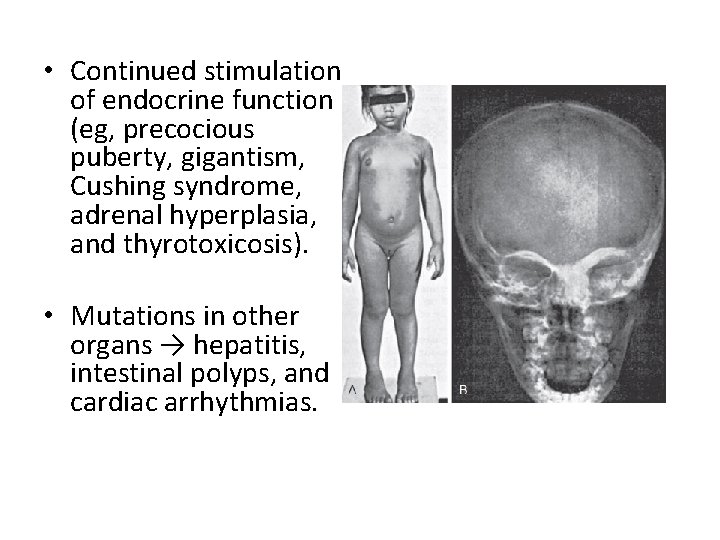
• Continued stimulation of endocrine function (eg, precocious puberty, gigantism, Cushing syndrome, adrenal hyperplasia, and thyrotoxicosis). • Mutations in other organs → hepatitis, intestinal polyps, and cardiac arrhythmias.
• Antiestrogen –tamoxifen-has been effective in reducing vaginal bleeding. - Long-term studies of outcomes such as skeletal growth ? • Fibrous dysplasia of bone → bone pain and increased fractures → bisphonate pamidronate

Familial male-limited precocious puberty (testotoxicosis) • • Rare disorder Autosomal Dominant Age of presentation at age 1 -4 year Activating mutation in the LH receptor gene → premature Leydig cell maturation → testosterone secretion.
Familial male-limited precocious puberty - Treatment • Combination of spironolactone and testolactone • Ketoconazole • In few cases a regimen of bicalutamide and anastrozole appeared to be effective in reducing growth velocity and decreasing secondary sexual characteristics without serious adverse effects.
Incomplete (Partial) Precocious Development • Isolated manifestations of precocity without development of other signs of puberty are not unusual • Development of the breasts in girls and growth of sexual hair in both sexes are the 2 most common forms. – PREMATURE THELARCHE – PREMATURE PUBARCHE (ADRENARCHE) – PREMATURE MENARCHE
Medicational Precocity • The most common cause of medicational precocity is currently related to the widespread use of testosterone gels or creams that are applied to the skin for treatment of male hypogonadism. • Less commonly, estrogens in cosmetics, hair creams, and breast augmentation creams have caused breast development in girls and gynecomastia in boys, via percutaneous absorption.

THANK YOU
- Slides: 43