
NORM IN PRODUCED WATERS BASICS OF PROBLEM AVOIDANCE
NORM IN PRODUCED WATERS: BASICS OF PROBLEM AVOIDANCE PRESENTATION TO THE SPE WATER AND WASTE WATER MANAGEMENT STUDY GROUP. 19 MAY 2014 GEORGE E. KING, P. E.
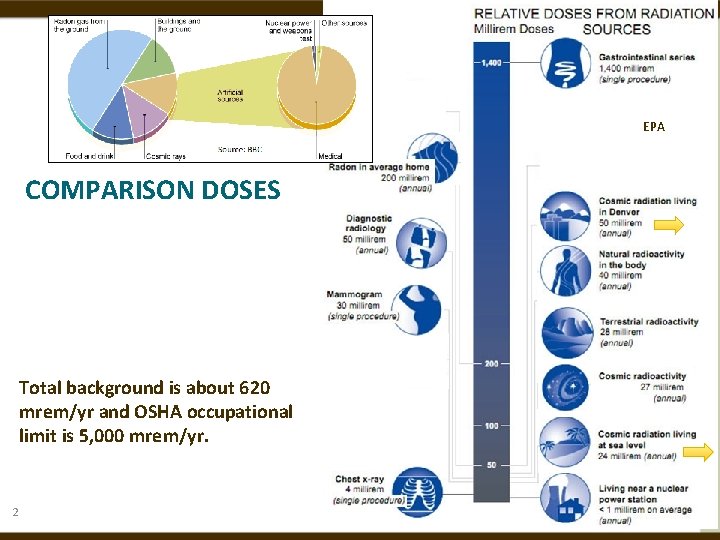
EPA BBC COMPARISON DOSES Total background is about 620 mrem/yr and OSHA occupational limit is 5, 000 mrem/yr. 2
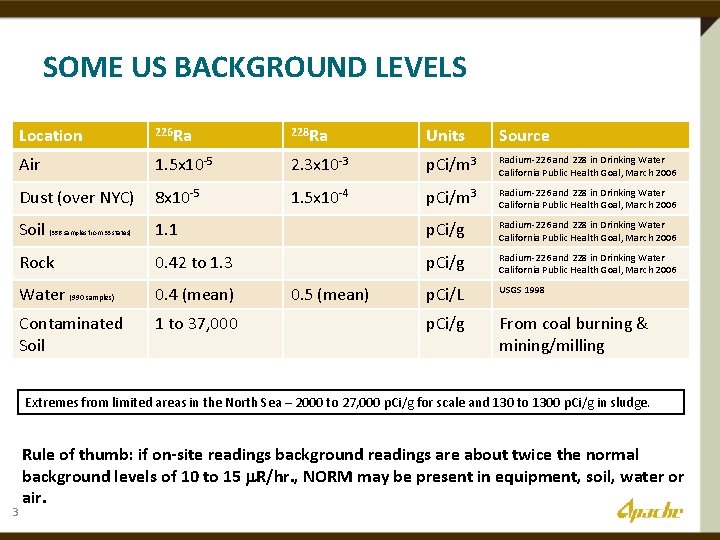
SOME US BACKGROUND LEVELS Location 226 Ra 228 Ra Units Source Air 1. 5 x 10 -5 2. 3 x 10 -3 p. Ci/m 3 Radium-226 and 228 in Drinking Water California Public Health Goal, March 2006 Dust (over NYC) 8 x 10 -5 1. 5 x 10 -4 p. Ci/m 3 Radium-226 and 228 in Drinking Water California Public Health Goal, March 2006 Soil 1. 1 p. Ci/g Radium-226 and 228 in Drinking Water California Public Health Goal, March 2006 Rock 0. 42 to 1. 3 p. Ci/g Radium-226 and 228 in Drinking Water California Public Health Goal, March 2006 Water (990 samples) 0. 4 (mean) p. Ci/L USGS 1998 Contaminated Soil 1 to 37, 000 p. Ci/g From coal burning & mining/milling (356 samples from 33 states) 0. 5 (mean) Extremes from limited areas in the North Sea – 2000 to 27, 000 p. Ci/g for scale and 130 to 1300 p. Ci/g in sludge. 3 Rule of thumb: if on-site readings background readings are about twice the normal background levels of 10 to 15 m. R/hr. , NORM may be present in equipment, soil, water or air.
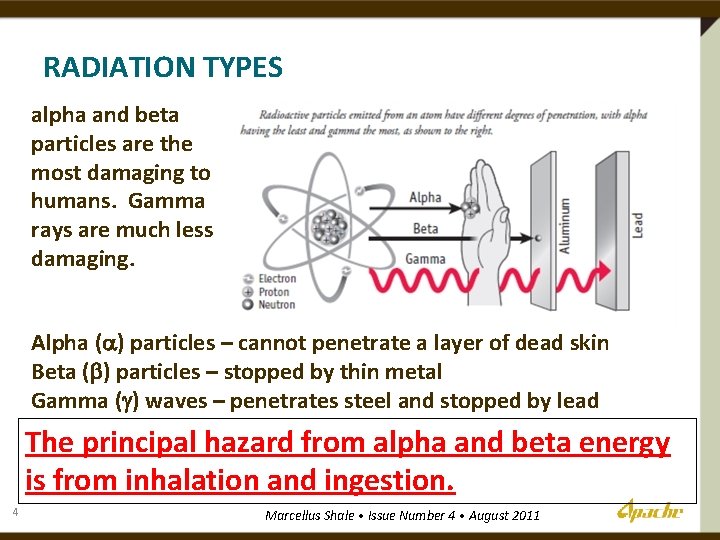
RADIATION TYPES alpha and beta particles are the most damaging to humans. Gamma rays are much less damaging. Alpha (a) particles – cannot penetrate a layer of dead skin Beta (b) particles – stopped by thin metal Gamma (g) waves – penetrates steel and stopped by lead The principal hazard from alpha and beta energy is from inhalation and ingestion. 4 Marcellus Shale • Issue Number 4 • August 2011
PARTICLE OR WAVE? z z z 5 gamma or (g) – small ray or wave, not a particle, travels far, very penetrating and can pass through most shielding except lead. When not highly concentrated, it is not felt to be damaging to humans (in small concentration). beta or ( ) – small particles, size of an electron, travels short distances (30 to 90 ft), can be carried further by wid. Not very penetrating and can be stopped by thin metal shielding (even aluminum). Route of contamination is ingestion and inhalation. Damage is from breaking bonds, tissue damage in humans and forms toxins. Attracted to calcium in bones. alpha ( ) – larger particles (2 protons and 2 neutrons), positive charge. Not transported by wind, but can pass through air for short distances. Cannot penetrate a layer of dead skin or a piece of paper. Causes 20 times more damage than beta particles. Route of contamination is ingestion and inhalation. Attracted to chloride in bones.
UNIT DESCRIPTIONS z Roentgen (R) - pronounced Ranken in the US y z Rem (Roentgen equivalent man) (Rem describes potential biological damage). y z z 6 A unit of exposure – the amount of gamma radiation to which a body is subjected (or that is emitted from an object). A unit of radiation dose equivalence. Rad (radiation absorbed dose) – the amount of any type of radiation which will deposit 100 ergs of energy per gram in any material. Curie (Ci) – the Curie is a unit of measurement for activity (expressed as per gram for soil, per m 3 for air and per liter for water.

UNITS FOR RADIOACTIVITY “SI” Unit What does it mean? US Unit Conversion Gray or Gy Amount of radiation rad (radiation adsorbed by a material absorbed dose) 1 Gy = 100 rad Sievert or Sv Exposure level or dose equivalent (& effect) Rem 1 Sv=100 Rem Becquerel or Bq Activity Level or Total energy from radioactivity Curie (Ci) 1 Bq = 2. 7 x 10 -11 Ci Coulomb/kilogram or C/kg Exposure Roentgen (R) 1 C/kg = 3876 R Common multiplier: kilo (k) = 10+3; mega = 10+6; giga = 10+9; tera = 10+12 Common sub-unit: Milli- (m) = 1/1, 000 th or 10 -3; micro- ( ) = 10 -6; nano (n) = 10 -9; pico (p) = 10 -12 7

NATURALLY OCCURRING RADIOACTIVE MATERIAL NORM IN THE GENERAL ENVIRONMENT 8 z Texas definition: Anything that constitutes, is contained in, or has contaminated oil and gas waste and exceeds the TDSHS of 50 R/hr. emanation rate or has a concentration of greater than 30 p. Ci/g. (TRC Ch 4, Subchapter F). z If NORM accumulates as result of technological (human) activity, such as oil & gas production, it is called Technologically Enhanced NORM or TENORM. z If TENORM accumulates to levels above natural background levels, it may present a human health risk and require removal. z The best way to treat NORM is to prevent its occurrence. z Inspection and removal must be done by a specialist.
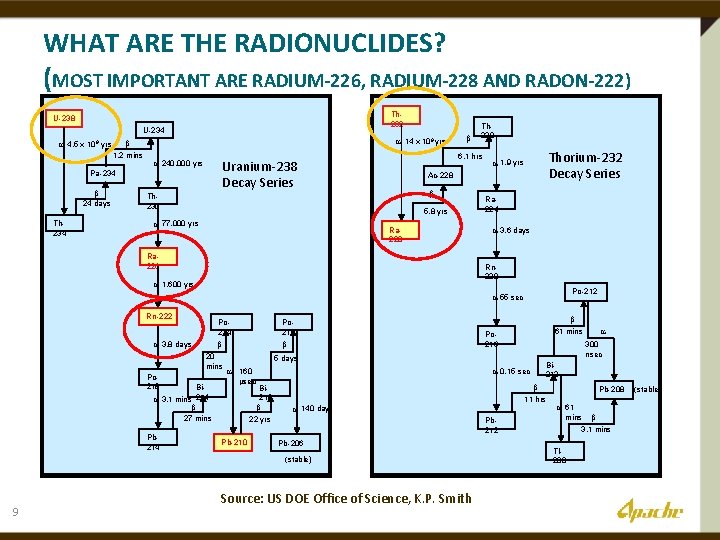
WHAT ARE THE RADIONUCLIDES? (MOST IMPORTANT ARE RADIUM-226, RADIUM-228 AND RADON-222) Th 232 U-238 U-234 4. 5 x 10 9 yrs 1. 2 mins 14 x 10 9 yrs Pa-234 24 days Th 234 Thorium-232 Decay Series 1. 9 yrs Ac-228 Th 230 5. 8 yrs 77, 000 yrs Th 228 6. 1 hrs Uranium-238 Decay Series 240, 000 yrs Ra 228 Ra 226 Ra 224 3. 6 days Rn 220 1, 600 yrs Po-212 55 sec Rn-222 3. 8 days Po 214 Po 210 20 mins Po 218 Bi 3. 1 mins 214 27 mins Pb 214 Po 216 Bi 210 22 yrs Pb-210 Bi 212 0. 15 sec 11 hrs 140 days Pb 212 Pb-206 Source: US DOE Office of Science, K. P. Smith 300 nsec 5 days 160 sec (stable) 9 61 mins Pb-208 61 mins 3. 1 mins Tl 208 (stable)
TENORM z z Technically enhanced NORM Concentrated downhole or at surface by: y Evaporation y Scales y Filtration y Precipitation y Sludge (silt stabilized emulsions) y Flocculation y Scale mill cuttings z 10 Prevention? - keep it in the water.
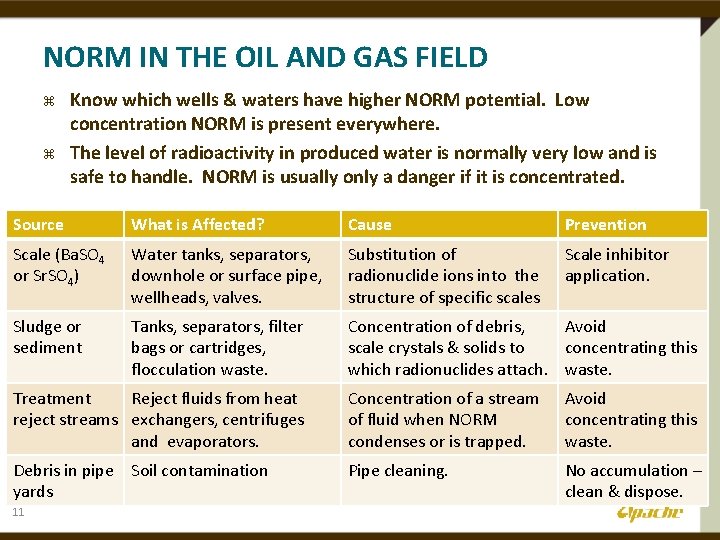
NORM IN THE OIL AND GAS FIELD z z Know which wells & waters have higher NORM potential. Low concentration NORM is present everywhere. The level of radioactivity in produced water is normally very low and is safe to handle. NORM is usually only a danger if it is concentrated. Source What is Affected? Cause Prevention Scale (Ba. SO 4 or Sr. SO 4) Water tanks, separators, downhole or surface pipe, wellheads, valves. Substitution of radionuclide ions into the structure of specific scales Scale inhibitor application. Sludge or sediment Tanks, separators, filter bags or cartridges, flocculation waste. Concentration of debris, Avoid scale crystals & solids to concentrating this which radionuclides attach. waste. Treatment Reject fluids from heat reject streams exchangers, centrifuges and evaporators. Concentration of a stream of fluid when NORM condenses or is trapped. Avoid concentrating this waste. Debris in pipe Soil contamination yards Pipe cleaning. No accumulation – clean & dispose. 11
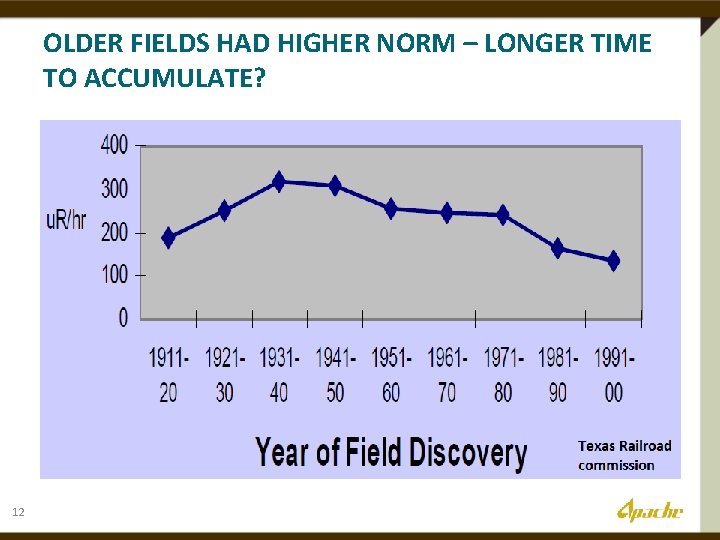
OLDER FIELDS HAD HIGHER NORM – LONGER TIME TO ACCUMULATE? 12
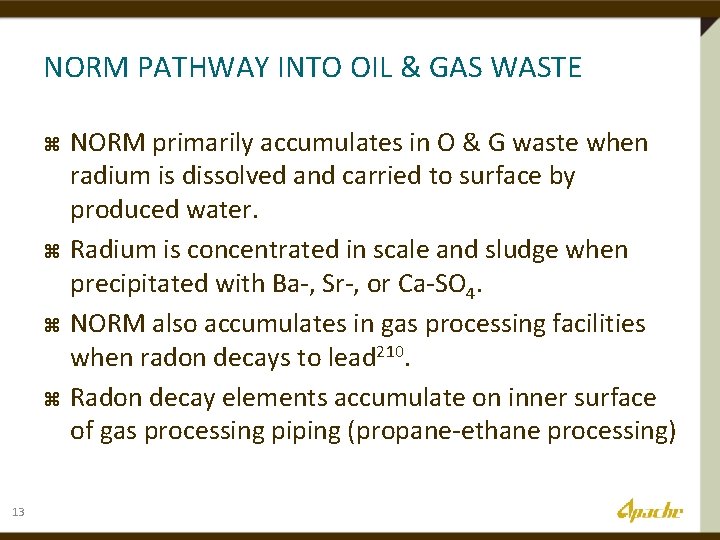
NORM PATHWAY INTO OIL & GAS WASTE z z 13 NORM primarily accumulates in O & G waste when radium is dissolved and carried to surface by produced water. Radium is concentrated in scale and sludge when precipitated with Ba-, Sr-, or Ca-SO 4. NORM also accumulates in gas processing facilities when radon decays to lead 210. Radon decay elements accumulate on inner surface of gas processing piping (propane-ethane processing)
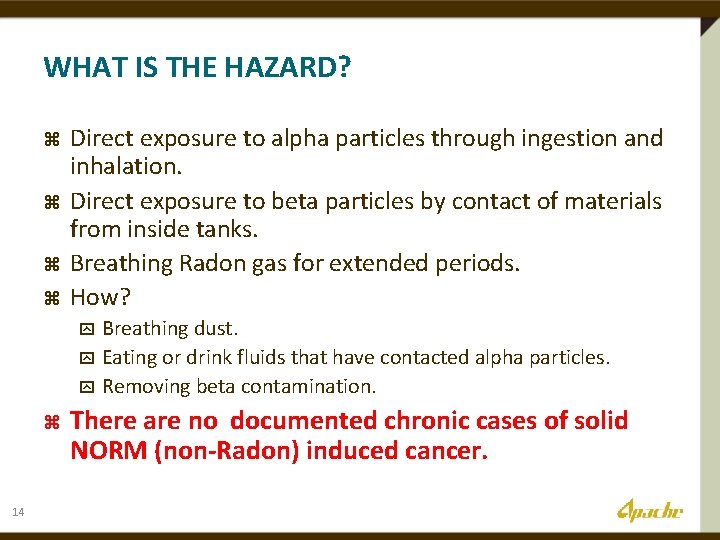
WHAT IS THE HAZARD? z z Direct exposure to alpha particles through ingestion and inhalation. Direct exposure to beta particles by contact of materials from inside tanks. Breathing Radon gas for extended periods. How? Breathing dust. y Eating or drink fluids that have contacted alpha particles. y Removing beta contamination. y z 14 There are no documented chronic cases of solid NORM (non-Radon) induced cancer.
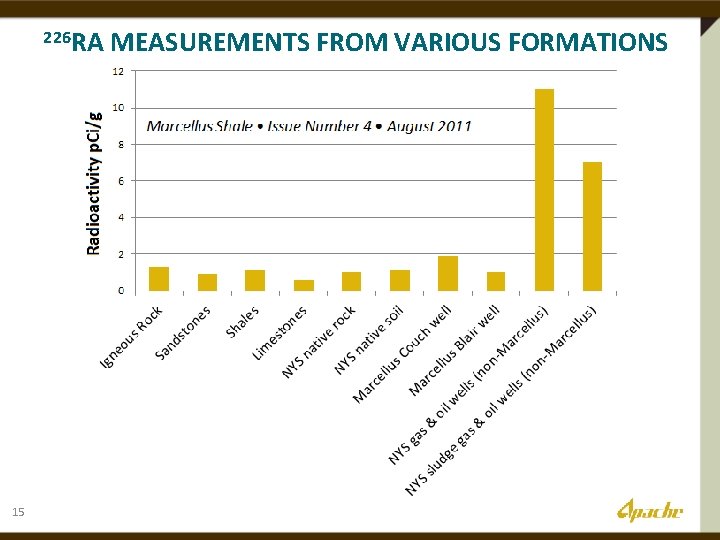
226 RA 15 MEASUREMENTS FROM VARIOUS FORMATIONS
TX NORM INSPECTION – CASE HISTORY z z z 16 In 2000, the Texas Railroad Commission surveyed >600 leases. 59 leases had surface equipment >59 R/hr. Of 6000 measurements, 3. 4% were above 50 R/hr. Max reading was >1000 R/hr. Water tanks, gun barrels and flow lines had highest readings.
WHY DO PRODUCED WATERS HAVE LOW ACTIVITY (COMMENTS FROM TBEG, 1995) z z z 17 The isotopes 226 Ra and 228 Ra produce most of the radioactivity in oil and gas facilities. Because the half-lives of 226 Ra and 228 Ra are geologically short (1, 622 yr. and 6. 7 yr. , respectively), Ra incorporated with sediments and original pore water does not survive to be produced. (Isotopes in water migrating out of high RA activity rocks decay quickly) – shale an exception?
WHERE SHOULD YOU EXPECT NORM? z Older surface equipment and used pipe with barium or strontium scales are prime candidates, HOWEVER: y Only a few areas are affected by NORM, y Some areas start with higher than normal radioactivity, y Even moderate to low radionuclide levels can be inadvertently concentrated to values above acceptable limits. y Evaporation, settling of solids, centrifuges, filtration, sludge formation, flocculation and precipitation all concentrate NORM. y Some produced waters (and even some virgin drinking waters) have higher than acceptable radioactivity values. The best approach for produced waters is not to concentrate the waters or solids from such waters. 18
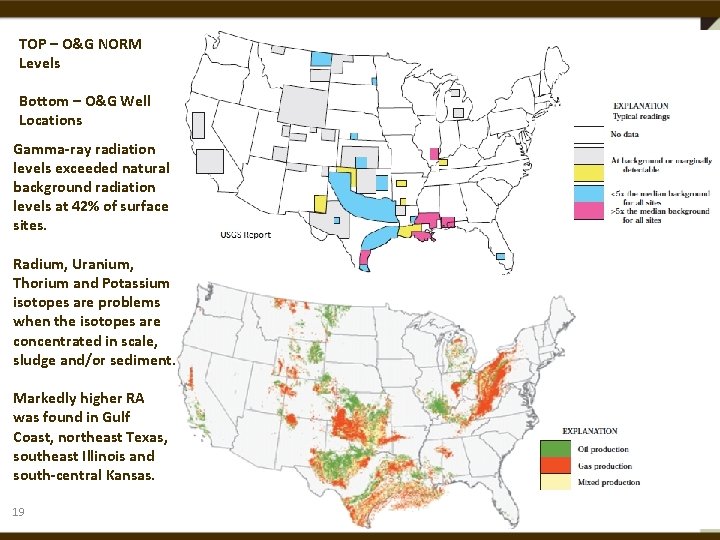
TOP – O&G NORM Levels Bottom – O&G Well Locations Gamma-ray radiation levels exceeded natural background radiation levels at 42% of surface sites. Radium, Uranium, Thorium and Potassium isotopes are problems when the isotopes are concentrated in scale, sludge and/or sediment. Markedly higher RA was found in Gulf Coast, northeast Texas, southeast Illinois and south-central Kansas. 19
WHAT DOES NORM LOOK LIKE? z Solid NORM can be: Crystalline, brittle & thin, may flake, mostly in pipes and tanks. y NORM scales are white to brown, and are typically calcium, barium or strontium sulfates. y NORM-rich sludge (tank bottoms) may have any appearance – can only identify with inspection instruments. y Evaporites and pipe cleaning residues (usually in pipe yards) may be higher than background NORM. y z 20 Radon-222 gas is colorless, but is short half life (3. 8 days) and can form lead-210 films (gray or black) on inside of pipe, valves, etc. in gas processing equipment.
NORM IN THE AIR z Largest source is airborne Radon y Emanates from ground (decay product of uranium) y Short half-life, avoid areas where Radon can concentrate and not disperse. y Unevenly distributed – some areas much higher – e. g. -Colorado. y Avg inhaled dose is 1. 26 m. Sv/yr. or 126 m. Rem/yr. y Second leading cause of lung cancer after smoking. 21
HOW DO YOU IDENTIFY NORM? z A trained person (8 hr. . . NORM surveyor course) surveys the area: Soil readings taken while walking slowly holding the probe a halfinch off the ground. y Readings of the background, generally taken with the probe at waist high. y Readings of tanks and mid level and at bottom at several points around the tank with the probe about a half-inch from the tank wall. Also check pipes, valves, pumps. Water knockouts, etc. y Compare readings with background to determine hazard level. y There is NORM everywhere and all materials have some level of radioactivity. y 22
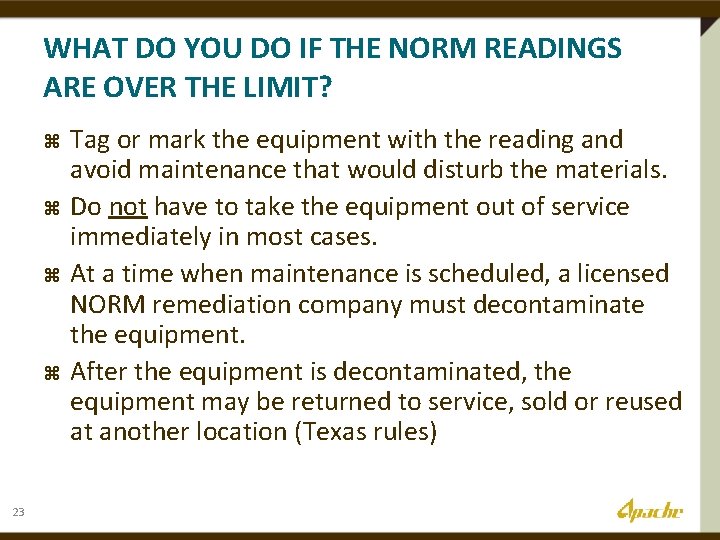
WHAT DO YOU DO IF THE NORM READINGS ARE OVER THE LIMIT? z z 23 Tag or mark the equipment with the reading and avoid maintenance that would disturb the materials. Do not have to take the equipment out of service immediately in most cases. At a time when maintenance is scheduled, a licensed NORM remediation company must decontaminate the equipment. After the equipment is decontaminated, the equipment may be returned to service, sold or reused at another location (Texas rules)
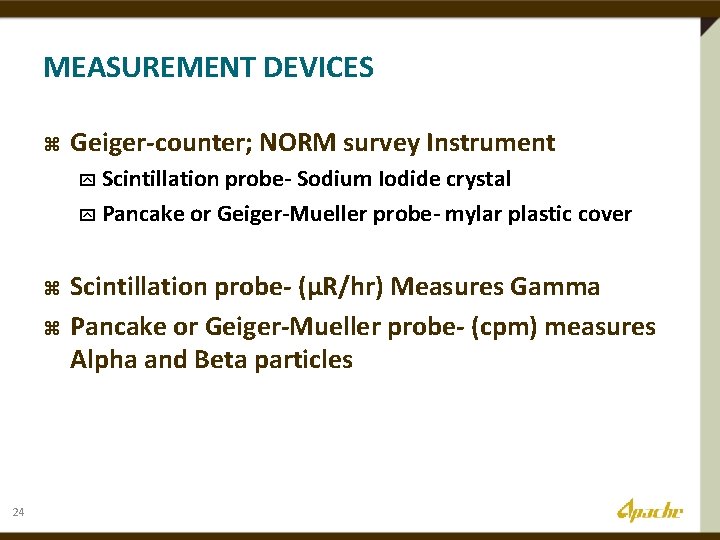
MEASUREMENT DEVICES z Geiger-counter; NORM survey Instrument y Scintillation probe- Sodium Iodide crystal y Pancake or Geiger-Mueller probe- mylar plastic cover z z 24 Scintillation probe- (µR/hr) Measures Gamma Pancake or Geiger-Mueller probe- (cpm) measures Alpha and Beta particles
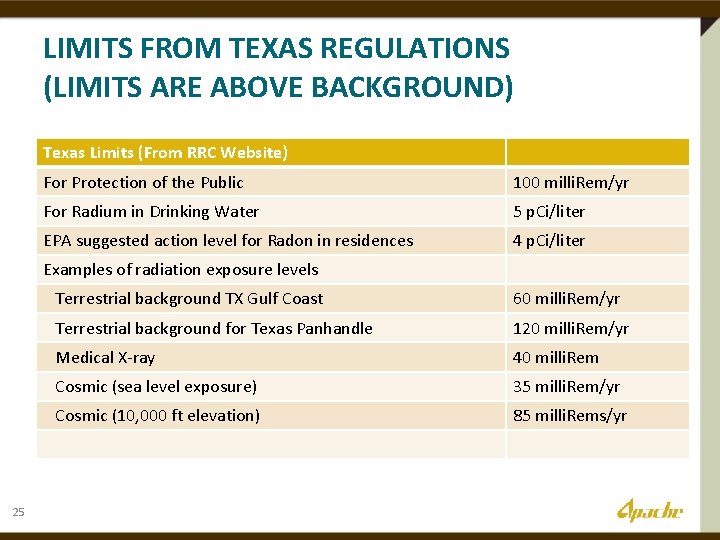
LIMITS FROM TEXAS REGULATIONS (LIMITS ARE ABOVE BACKGROUND) Texas Limits (From RRC Website) For Protection of the Public 100 milli. Rem/yr For Radium in Drinking Water 5 p. Ci/liter EPA suggested action level for Radon in residences 4 p. Ci/liter Examples of radiation exposure levels 25 Terrestrial background TX Gulf Coast 60 milli. Rem/yr Terrestrial background for Texas Panhandle 120 milli. Rem/yr Medical X-ray 40 milli. Rem Cosmic (sea level exposure) 35 milli. Rem/yr Cosmic (10, 000 ft elevation) 85 milli. Rems/yr
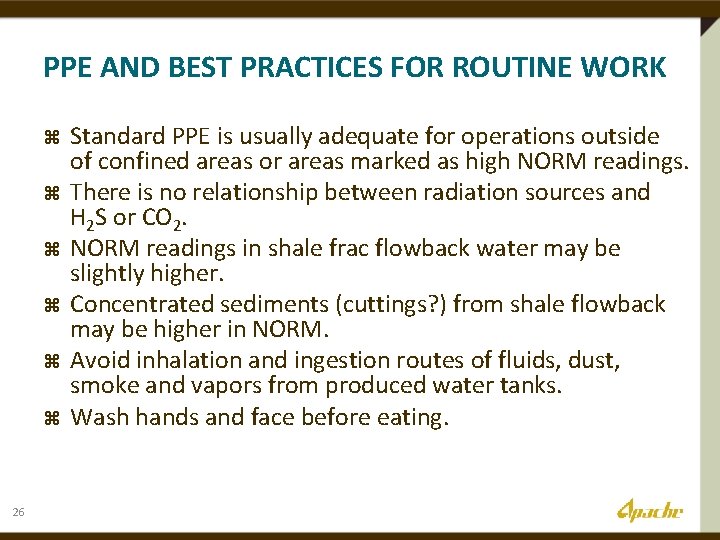
PPE AND BEST PRACTICES FOR ROUTINE WORK z z z 26 Standard PPE is usually adequate for operations outside of confined areas or areas marked as high NORM readings. There is no relationship between radiation sources and H 2 S or CO 2. NORM readings in shale frac flowback water may be slightly higher. Concentrated sediments (cuttings? ) from shale flowback may be higher in NORM. Avoid inhalation and ingestion routes of fluids, dust, smoke and vapors from produced water tanks. Wash hands and face before eating.
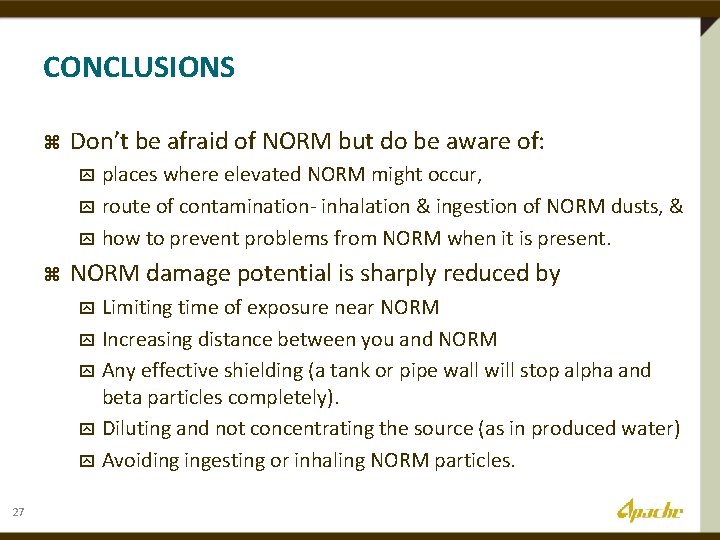
CONCLUSIONS z Don’t be afraid of NORM but do be aware of: places where elevated NORM might occur, y route of contamination- inhalation & ingestion of NORM dusts, & y how to prevent problems from NORM when it is present. y z NORM damage potential is sharply reduced by Limiting time of exposure near NORM y Increasing distance between you and NORM y Any effective shielding (a tank or pipe wall will stop alpha and beta particles completely). y Diluting and not concentrating the source (as in produced water) y Avoiding ingesting or inhaling NORM particles. y 27
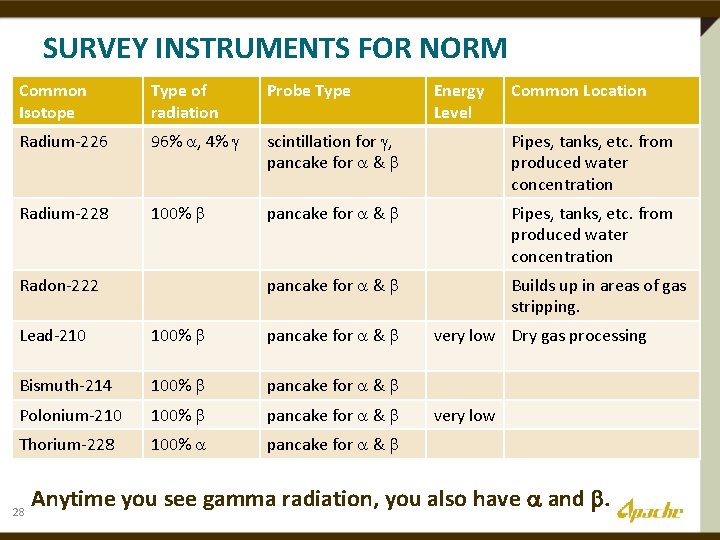
SURVEY INSTRUMENTS FOR NORM Common Isotope Type of radiation Probe Type Radium-226 96% , 4% g scintillation for g, pancake for & Pipes, tanks, etc. from produced water concentration Radium-228 100% pancake for & Pipes, tanks, etc. from produced water concentration pancake for & Builds up in areas of gas stripping. Radon-222 Lead-210 100% pancake for & Bismuth-214 100% pancake for & Polonium-210 100% pancake for & Thorium-228 100% pancake for & 28 Energy Level Common Location very low Dry gas processing very low Anytime you see gamma radiation, you also have a and b.
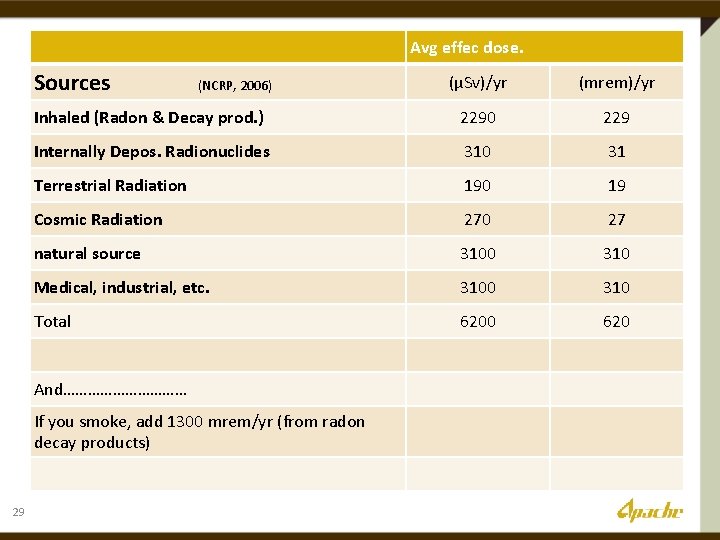
Avg effec dose. Sources (µSv)/yr (mrem)/yr Inhaled (Radon & Decay prod. ) 2290 229 Internally Depos. Radionuclides 310 31 Terrestrial Radiation 190 19 Cosmic Radiation 270 27 natural source 3100 310 Medical, industrial, etc. 3100 310 Total 6200 620 (NCRP, 2006) And…………… If you smoke, add 1300 mrem/yr (from radon decay products) 29
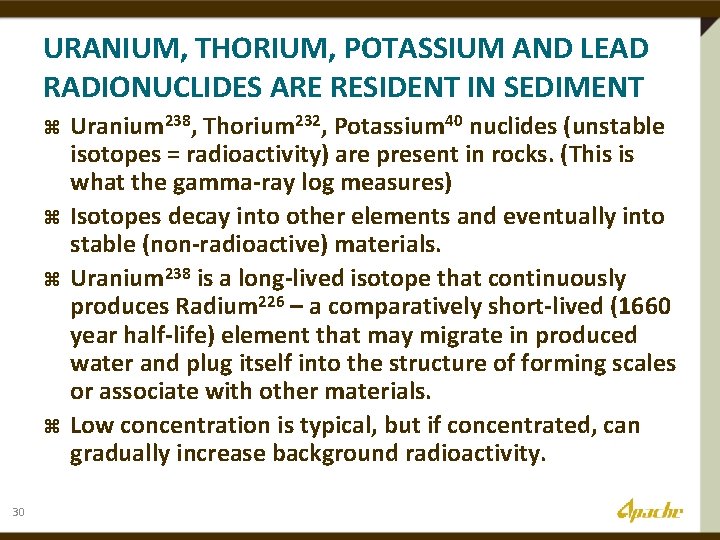
URANIUM, THORIUM, POTASSIUM AND LEAD RADIONUCLIDES ARE RESIDENT IN SEDIMENT z z 30 Uranium 238, Thorium 232, Potassium 40 nuclides (unstable isotopes = radioactivity) are present in rocks. (This is what the gamma-ray log measures) Isotopes decay into other elements and eventually into stable (non-radioactive) materials. Uranium 238 is a long-lived isotope that continuously produces Radium 226 – a comparatively short-lived (1660 year half-life) element that may migrate in produced water and plug itself into the structure of forming scales or associate with other materials. Low concentration is typical, but if concentrated, can gradually increase background radioactivity.
- Slides: 30