
Nordic Seating Symposium 2006 Prevention and Healing Seat
- Slides: 25
Nordic Seating Symposium 2006 Prevention and Healing Seat Sore Based on Masterthesis: Seating Assessment in a Social Integration Perspective Helle Dreier (OT, MSI) Center of Special Counselling – Technical Aids Holbaek, Denmark h. dreier@get 2 net. dk
Background Traditional pressure-relieving regimes or surgery n Psychological and physical sequelas and n Consequenses to their participation in everyday life High recurrence rate n No competences or insight n h. dreier@get 2 net. dk 2
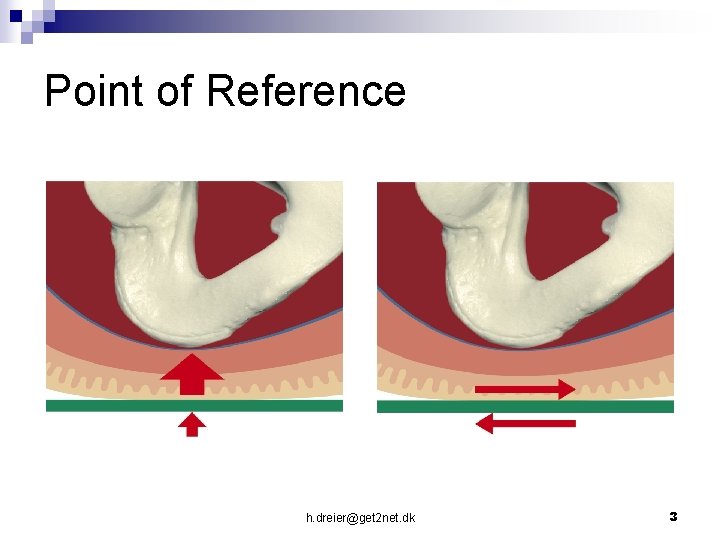
Point of Reference h. dreier@get 2 net. dk 3
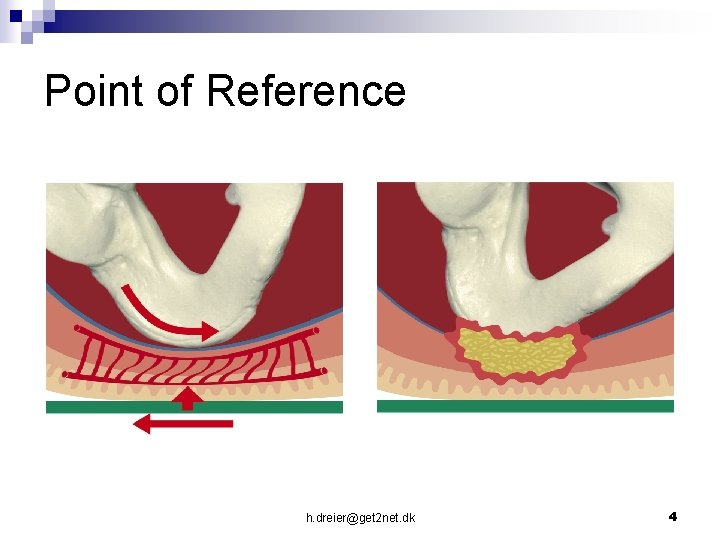
Point of Reference h. dreier@get 2 net. dk 4
The Aim of the Study To examine the potential of Seating Assessment as: n An alternative to traditional pressurerelieving regimes and surgery n A tool to sufficient intervention n To avoid inappropriate consequences of immobilisation concerning health n Participation in activities of everyday life h. dreier@get 2 net. dk 5
The Qualitative Part Interviewing 5 wheelchair users n to examine their insight and perspective on their own seat-sore prevention and recovery n related to their possibilities of participation in everyday life. n h. dreier@get 2 net. dk 6
The Qualitative Part Interviewing 3 professionals to examine their perspective and point of view concerning the phenomenon: Seating Assessment n A therapist – Technical Aids Center n A therapist – Rehabilitation Center n A surgeon – Hospital n with at least 10 years of experience h. dreier@get 2 net. dk 7
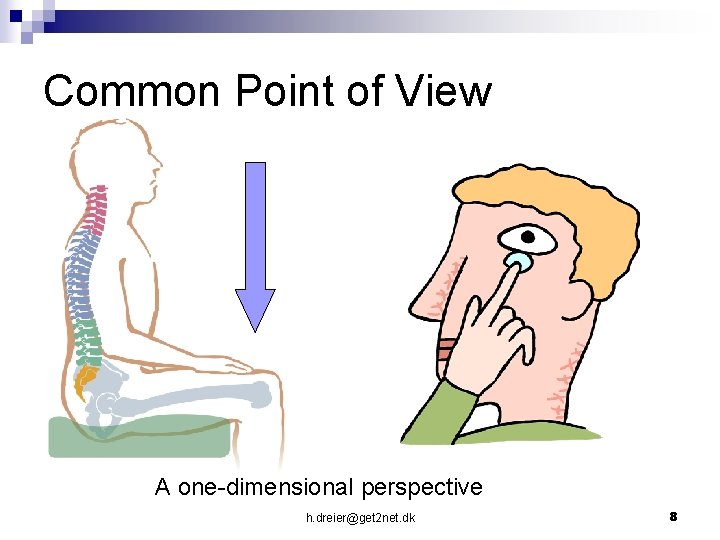
Common Point of View A one-dimensional perspective h. dreier@get 2 net. dk 8
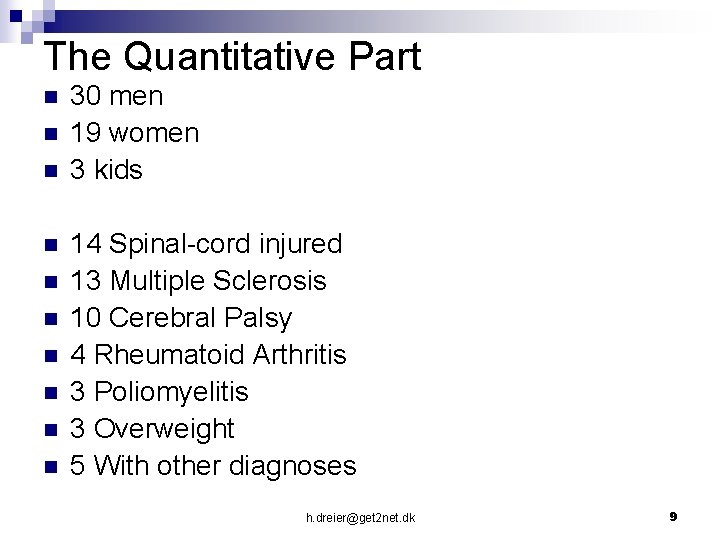
The Quantitative Part n n n n n 30 men 19 women 3 kids 14 Spinal-cord injured 13 Multiple Sclerosis 10 Cerebral Palsy 4 Rheumatoid Arthritis 3 Poliomyelitis 3 Overweight 5 With other diagnoses h. dreier@get 2 net. dk 9
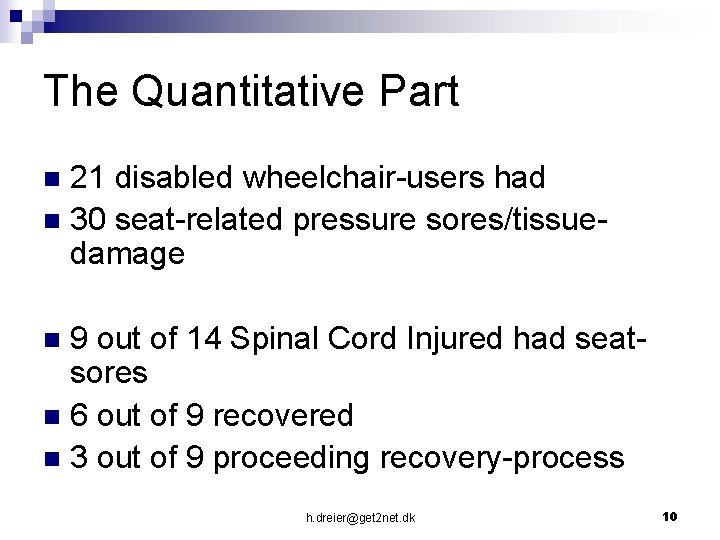
The Quantitative Part 21 disabled wheelchair-users had n 30 seat-related pressure sores/tissuedamage n 9 out of 14 Spinal Cord Injured had seatsores n 6 out of 9 recovered n 3 out of 9 proceeding recovery-process n h. dreier@get 2 net. dk 10
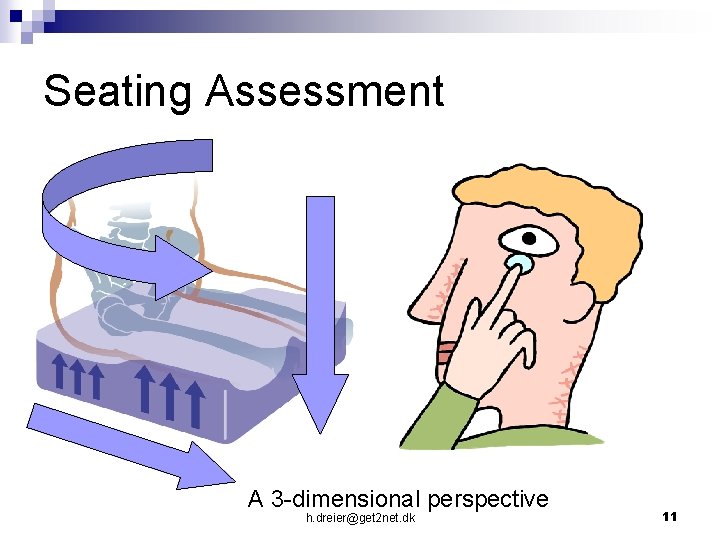
Seating Assessment A 3 -dimensional perspective h. dreier@get 2 net. dk 11
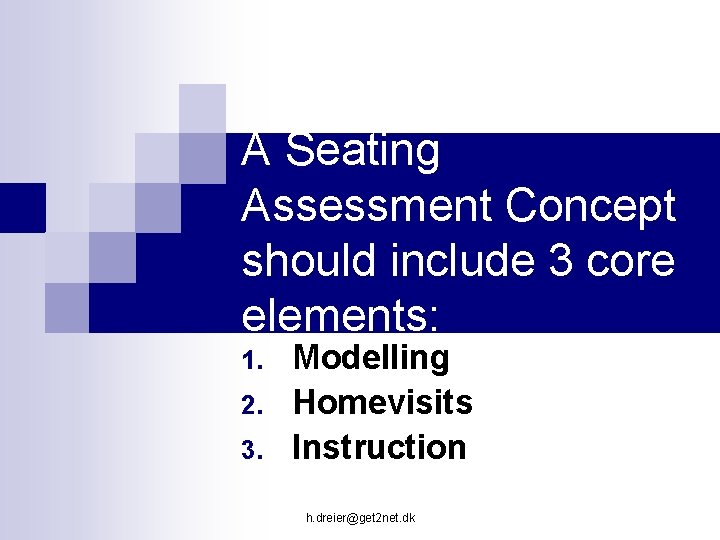
A Seating Assessment Concept should include 3 core elements: 1. 2. 3. Modelling Homevisits Instruction h. dreier@get 2 net. dk
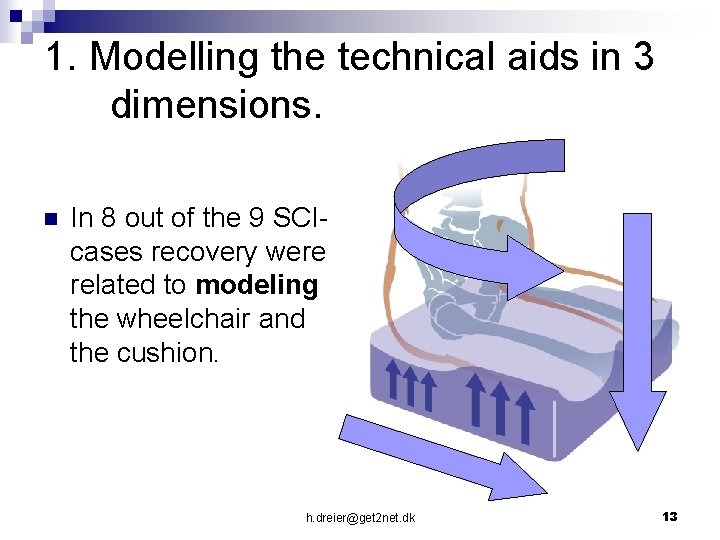
1. Modelling the technical aids in 3 dimensions. n In 8 out of the 9 SCIcases recovery were related to modeling the wheelchair and the cushion. h. dreier@get 2 net. dk 13
2. Homevisits day and night-concept 52 seating assessments caused n 44 homevisits in 39 homes n 20 homevisits had crucial influence on recovery n In 6 out of 9 with Spinal Cord Injured homevisits had crucial influence on recovery of seat-sores n h. dreier@get 2 net. dk 14
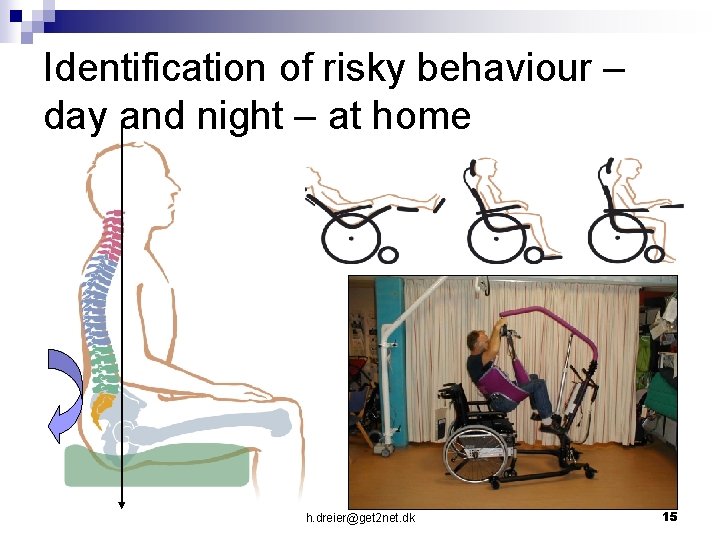
Identification of risky behaviour – day and night – at home h. dreier@get 2 net. dk 15
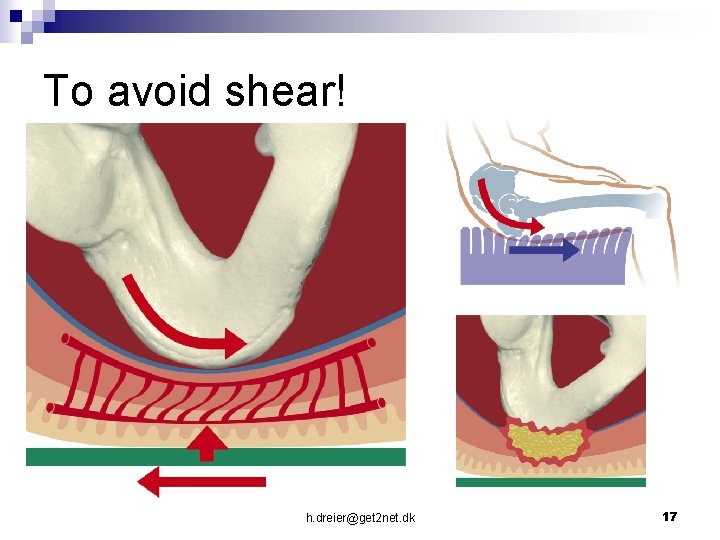
3. Instruction – self-care 9 have acquired a profound insight of the pressure/shear in an absolute concrete level n They all have improved their competences of self-care to obtain a permanent sore-free condition n Because the insight has moved from an abstract to a very concrete level n h. dreier@get 2 net. dk 16
To avoid shear! h. dreier@get 2 net. dk 17
Dogma 1 ”You get seat-sores because of too long and too heavy sitting”. n Wrong! – you must see it another way round to be able to change actions: n n You get seat-sores because of insufficient sitting positions with no stability and no sufficient pressure distribution for too long time. h. dreier@get 2 net. dk 18
Dogma 2 ”It is a condition to particular pre-disposed wheelchair-users to get seat-sores frequently – lifelong”. n That is a very depressing and paralysing point of view and perhaps wrong too n n It is a condition that wheelchair-users get seat-sores because of insufficient wheelchair-adjustment to a body with insufficient capacity. h. dreier@get 2 net. dk 19
Dogma 3 ”Seat-sores relate only to the contact between the buttocks and the cushion” n That is simply not the point! n n The point is that seat-sores appear on the buttocks but come from poor stability as well as insufficient pressure distribution h. dreier@get 2 net. dk 20
Dogma 4 ”You have to recover from seat-sores by means of 100 % pressure-relievingregimes which means staying in bed day and night”. n That is simply not necessary! n n You can recover (and prevent) seat-sores by sufficient adjustments of wheelchair and seat-related technical aids. h. dreier@get 2 net. dk 21
Prevention and recovery n Seat-sore prevention must take place in the seated position…… n Prevention and recovery imply exactly the same intervention h. dreier@get 2 net. dk 22
Conclusion n Seating Assessment has a potential as an alternative to traditional regimes including the following core elements: 1. Modelling in a 3 -dimensional perspective Homevisits as ”day and night” concept Instruction to improve concrete selfcare - competences 2. 3. h. dreier@get 2 net. dk 23
Relevance A sufficient Seating Assessment can: n Prevent social exclusion and physical and psychological damages n Enable the wheelchair-user to continue participating in everyday activities n Improve the wheelchair-user’s capacity of self-care n h. dreier@get 2 net. dk 24
The End h. dreier@get 2 net. dk 25