
NORDIANA ABD AZIZ Group Leader of Geospatial Technology
NORDIANA ABD AZIZ Group Leader of Geospatial Technology Group Malaysian Palm Oil Board Qualifications: • • Master of Environment, Universiti Putra Malaysia B. Sc. Remote Sensing, Universiti Teknologi Malaysia Experiences/Expertise: • 2 years as Research Officer in Malaysian Centre of Remote Sensing (MACRES) • 9 years as Research Officer in MPOB • Conducting remote sensing image analysis and GIS spatial modeling for foliar nutrient interpolation, biomass and carbon study • Involves in National Key Economic Area Project for Improving Oil Palm Yield Research Interest: • Remote Sensing & GIS for Earth Science, Environment and Natural Resources Management • Web-based GIS database development
APPLICATION of GEOSPATIAL TECHNOLOGY for OIL PALM PLANTATION DESIGN, PLANNING & MANAGEMENT Nordiana Abd Aziz nordiana@mpob. gov. my +603 - 8769 4754
Presentation Outline v Introduction Geospatial technology for land evaluation § Applications of GIS, GPS and RS § Objectives § v Material and Methods § § § Study area Satellite image and map Software and hardware Image processing Database development v Results and discussion v Conclusion 3
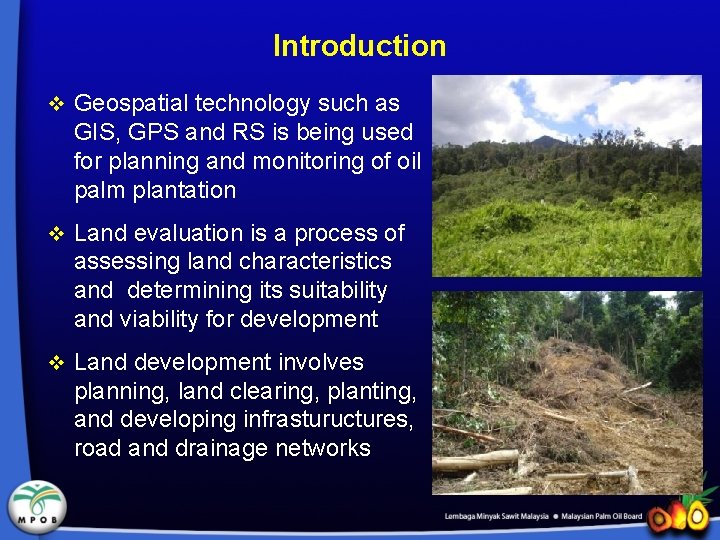
Introduction v Geospatial technology such as GIS, GPS and RS is being used for planning and monitoring of oil palm plantation v Land evaluation is a process of assessing land characteristics and determining its suitability and viability for development v Land development involves planning, land clearing, planting, and developing infrastuructures, road and drainage networks 4
Introduction v The GIS is a computer-based system to manipulate georeferenced data: ü Entering, storing, manipulating, analysing and displaying spatial data ü Decision support of oil palm natural resource development and management v GPS is a satellite-based radio-navigation system: ü Collecting field data ü Mapping of oil palm area v RS is the method of acquiring information without physical contact: ü Methods include aerial photography, radar, and satellite imaging 5

Objectives • To determine the effectiveness of geospatial technologies (GPS, GIS and RS) in evaluating and developing a land for new oil palm planting. • To map the land determining the extent of suitable and unsuitable areas for oil palm cultivation. • To determine the developmental requirements of the land in terms of blocking, road networks, terracing and number of planting points. 6
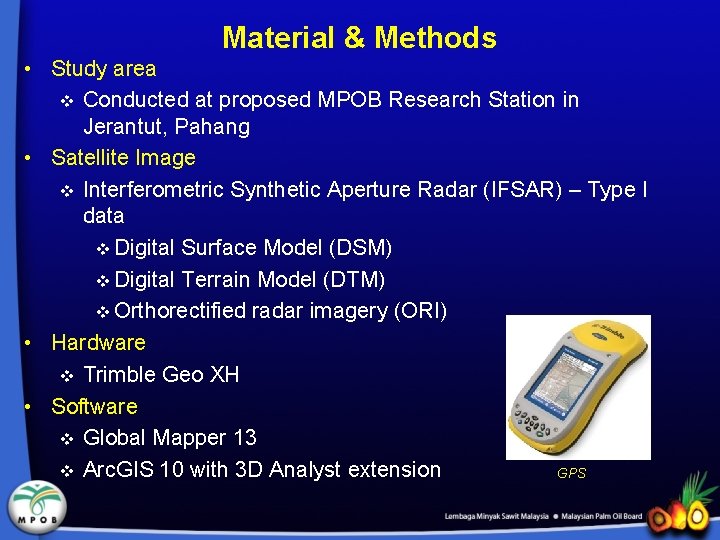
Material & Methods • Study area v Conducted at proposed MPOB Research Station in Jerantut, Pahang • Satellite Image v Interferometric Synthetic Aperture Radar (IFSAR) – Type I data v Digital Surface Model (DSM) v Digital Terrain Model (DTM) v Orthorectified radar imagery (ORI) • Hardware v Trimble Geo XH • Software v Global Mapper 13 v Arc. GIS 10 with 3 D Analyst extension GPS 7
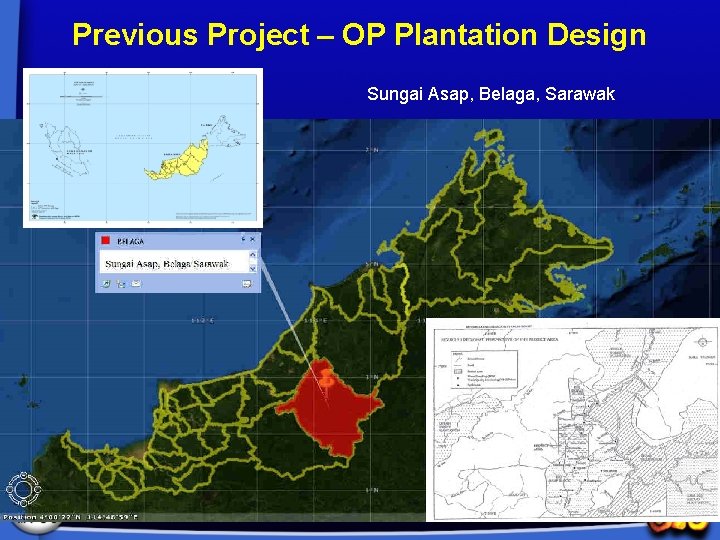
Previous Project – OP Plantation Design Sungai Asap, Belaga, Sarawak 8

Study Area • Subdistrict of Tembeling, Pahang at geographic location • (Upper left: 102° 23' 34. 512"E, 4° 18' 6. 175"N, and Lower right: 102° 25' 16. 84”E, 4° 16' 47. 763" N). Proposed MPOB Station, Jerantut 9
Material & Methods • Topographic Information v Kuala Tembeling map (sheet no 4061 of L 7030 series) v Site survey map of proposed Jerantut station • IFSAR data pre-processing v Onboard aircraft data processing from an inertial measurement unit (IMU) • to create an interferogram (phase radar difference) to produce DSM (Digital Surface Model) – carried out by image provider v Data conversion • BIL data format was converted into Geo. TIFF using Global Mapper 13 v Co-registration / geometric correction • WGS 1984 was reprojected into RSO projection 10
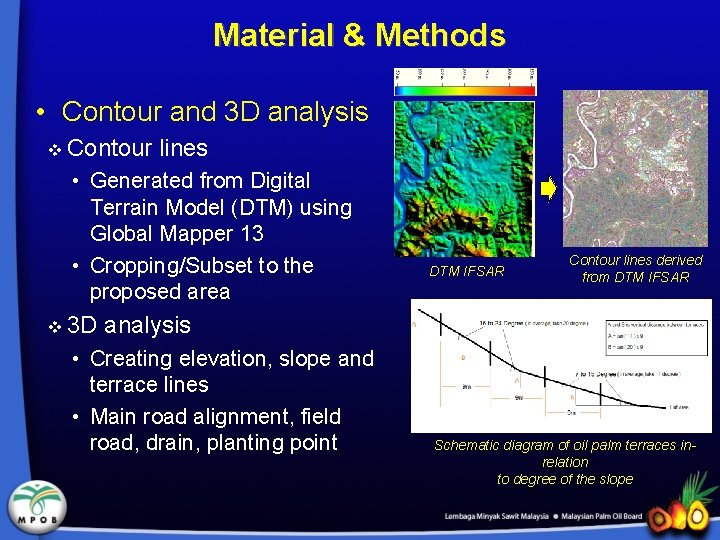
Material & Methods • Contour and 3 D analysis v Contour lines • Generated from Digital Terrain Model (DTM) using Global Mapper 13 • Cropping/Subset to the proposed area DTM IFSAR Contour lines derived from DTM IFSAR v 3 D analysis • Creating elevation, slope and terrace lines • Main road alignment, field road, drain, planting point Schematic diagram of oil palm terraces inrelation to degree of the slope 11
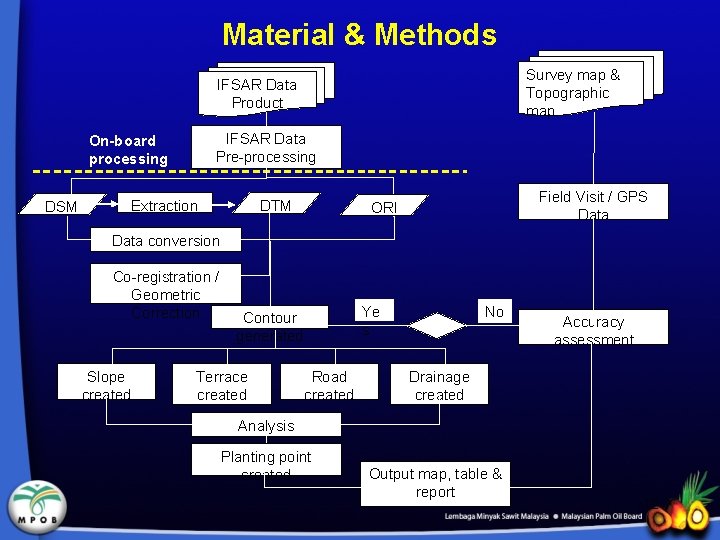
Material & Methods Survey map & Topographic map IFSAR Data Product IFSAR Data Pre-processing On-board processing DSM Extraction DTM Field Visit / GPS Data ORI Data conversion Co-registration / Geometric Correction Slope created Ye s Contour generated Terrace created Road created No Accuracy assessment Drainage created Analysis Planting point created Output map, table & report 12
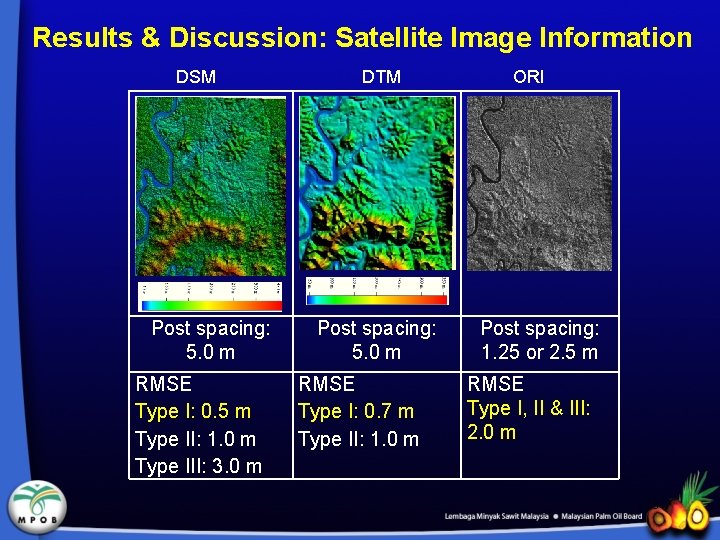
Results & Discussion: Satellite Image Information DSM Post spacing: 5. 0 m RMSE Type I: 0. 5 m Type II: 1. 0 m Type III: 3. 0 m DTM Post spacing: 5. 0 m RMSE Type I: 0. 7 m Type II: 1. 0 m ORI Post spacing: 1. 25 or 2. 5 m RMSE Type I, II & III: 2. 0 m 13
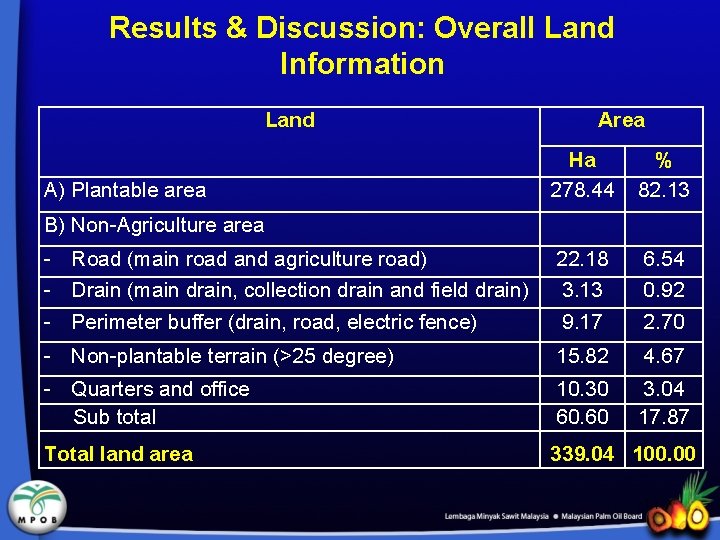
Results & Discussion: Overall Land Information Land Area Ha 278. 44 % 82. 13 - Road (main road and agriculture road) - Drain (main drain, collection drain and field drain) - Perimeter buffer (drain, road, electric fence) 22. 18 3. 13 6. 54 0. 92 9. 17 2. 70 - Non-plantable terrain (>25 degree) 15. 82 4. 67 - Quarters and office Sub total 10. 30 60. 60 3. 04 17. 87 Total land area 339. 04 100. 00 A) Plantable area B) Non-Agriculture area 14
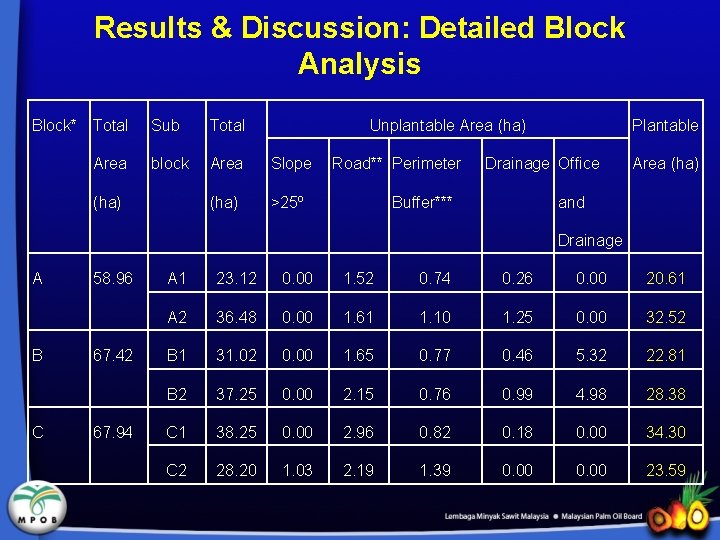
Results & Discussion: Detailed Block Analysis Block* Total Sub Total Area block Area Slope (ha) >25º (ha) Unplantable Area (ha) Road** Perimeter Plantable Drainage Office Buffer*** Area (ha) and Drainage A B C 58. 96 67. 42 67. 94 A 1 23. 12 0. 00 1. 52 0. 74 0. 26 0. 00 20. 61 A 2 36. 48 0. 00 1. 61 1. 10 1. 25 0. 00 32. 52 B 1 31. 02 0. 00 1. 65 0. 77 0. 46 5. 32 22. 81 B 2 37. 25 0. 00 2. 15 0. 76 0. 99 4. 98 28. 38 C 1 38. 25 0. 00 2. 96 0. 82 0. 18 0. 00 34. 30 C 2 28. 20 1. 03 2. 19 1. 39 0. 00 23. 59 15
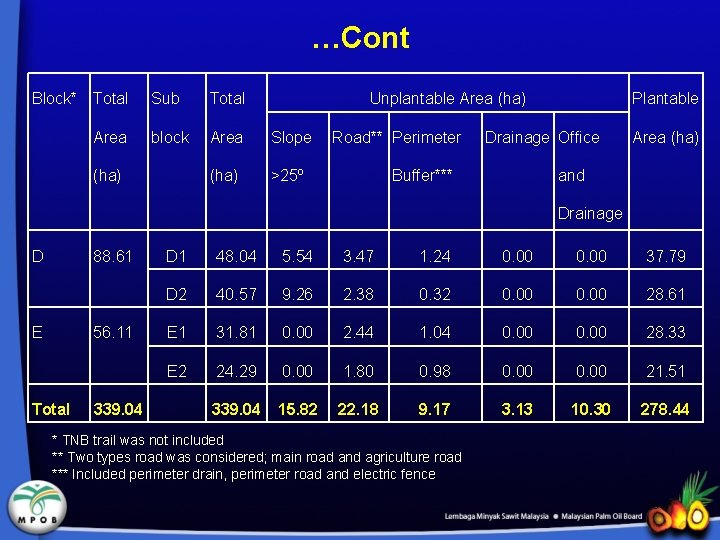
…Cont Block* Total Sub Total Area block Area Slope (ha) >25º (ha) Unplantable Area (ha) Road** Perimeter Plantable Drainage Office Buffer*** Area (ha) and Drainage D 88. 61 E 56. 11 Total 339. 04 D 1 48. 04 5. 54 3. 47 1. 24 0. 00 37. 79 D 2 40. 57 9. 26 2. 38 0. 32 0. 00 28. 61 E 1 31. 81 0. 00 2. 44 1. 04 0. 00 28. 33 E 2 24. 29 0. 00 1. 80 0. 98 0. 00 21. 51 339. 04 15. 82 22. 18 9. 17 3. 13 10. 30 278. 44 * TNB trail was not included ** Two types road was considered; main road and agriculture road *** Included perimeter drain, perimeter road and electric fence 16
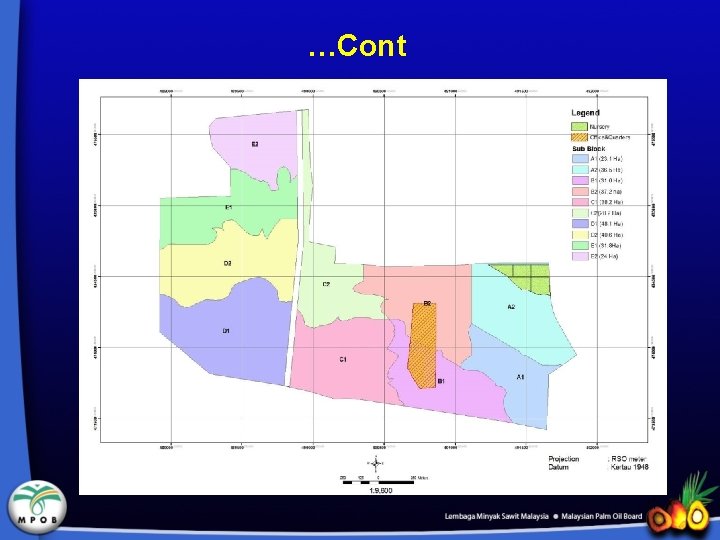
…Cont 17
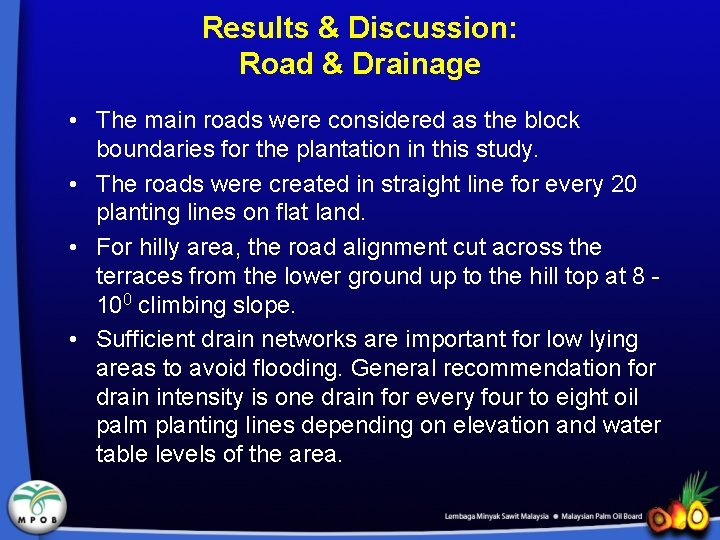
Results & Discussion: Road & Drainage • The main roads were considered as the block boundaries for the plantation in this study. • The roads were created in straight line for every 20 planting lines on flat land. • For hilly area, the road alignment cut across the terraces from the lower ground up to the hill top at 8 - 100 climbing slope. • Sufficient drain networks are important for low lying areas to avoid flooding. General recommendation for drain intensity is one drain for every four to eight oil palm planting lines depending on elevation and water table levels of the area. 18
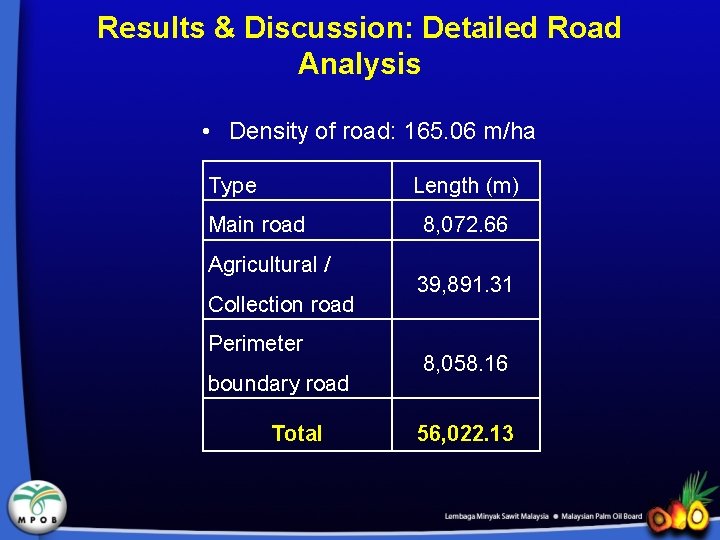
Results & Discussion: Detailed Road Analysis • Density of road: 165. 06 m/ha Type Length (m) Main road Agricultural / Collection road Perimeter boundary road Total 8, 072. 66 39, 891. 31 8, 058. 16 56, 022. 13 19
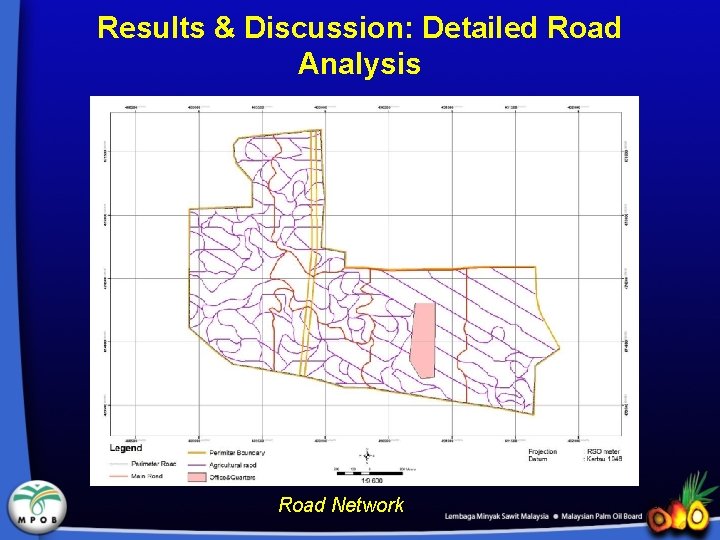
Results & Discussion: Detailed Road Analysis Road Network 20
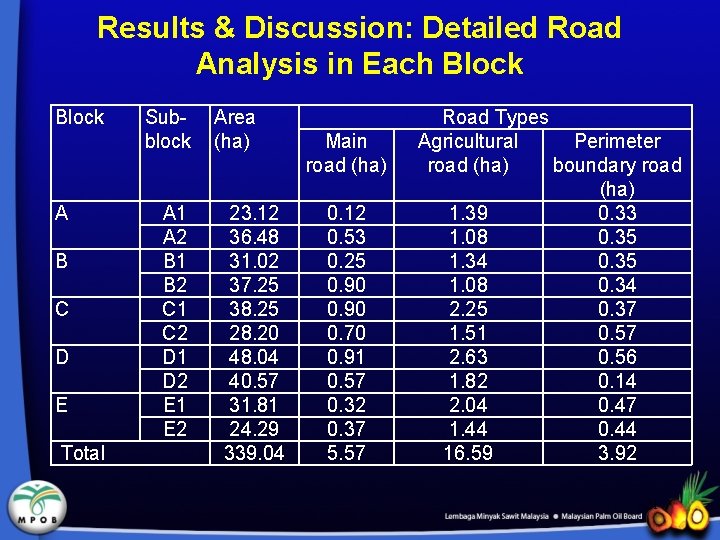
Results & Discussion: Detailed Road Analysis in Each Block A B C D E Total Sub- Area block (ha) A 1 A 2 B 1 B 2 C 1 C 2 D 1 D 2 E 1 E 2 23. 12 36. 48 31. 02 37. 25 38. 25 28. 20 48. 04 40. 57 31. 81 24. 29 339. 04 Main road (ha) 0. 12 0. 53 0. 25 0. 90 0. 70 0. 91 0. 57 0. 32 0. 37 5. 57 Road Types Agricultural Perimeter road (ha) boundary road (ha) 1. 39 0. 33 1. 08 0. 35 1. 34 0. 35 1. 08 0. 34 2. 25 0. 37 1. 51 0. 57 2. 63 0. 56 1. 82 0. 14 2. 04 0. 47 1. 44 0. 44 16. 59 3. 92 21
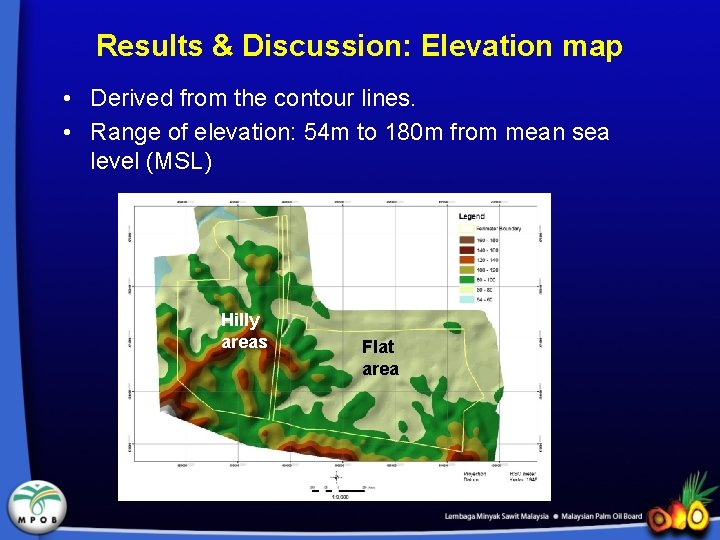
Results & Discussion: Elevation map • Derived from the contour lines. • Range of elevation: 54 m to 180 m from mean sea level (MSL) Hilly areas Flat area 22
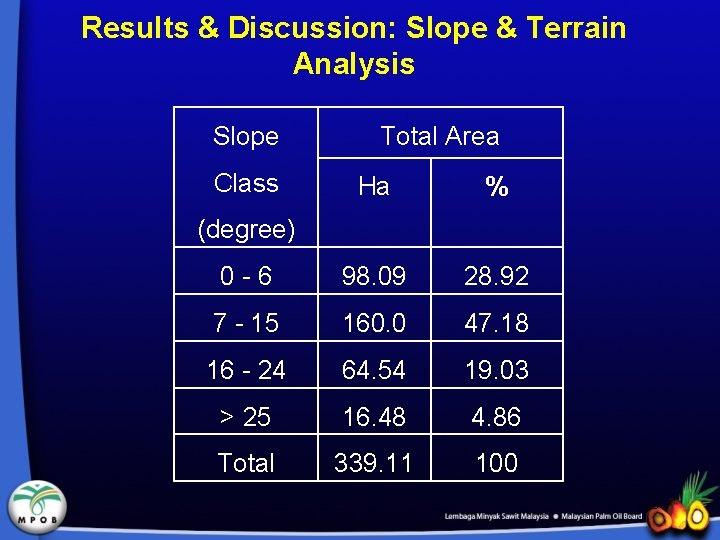
Results & Discussion: Slope & Terrain Analysis Slope Class Total Area Ha % 0 - 6 98. 09 28. 92 7 - 15 160. 0 47. 18 16 - 24 64. 54 19. 03 > 25 16. 48 4. 86 Total 339. 11 100 (degree) 23
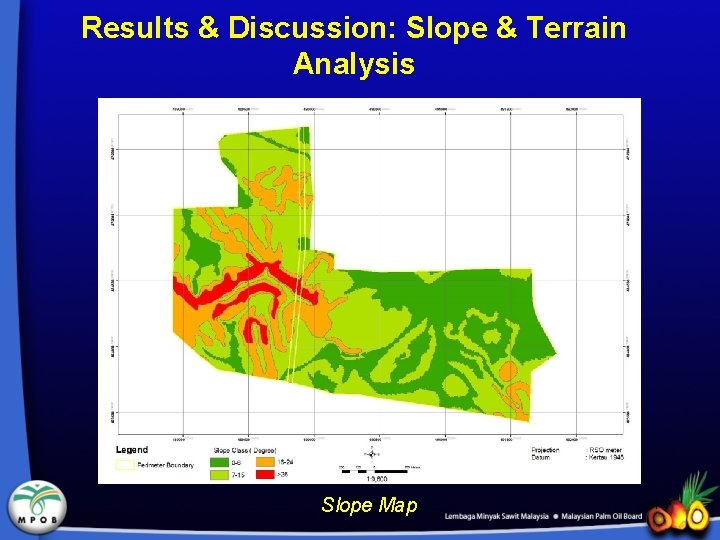
Results & Discussion: Slope & Terrain Analysis Slope Map 24
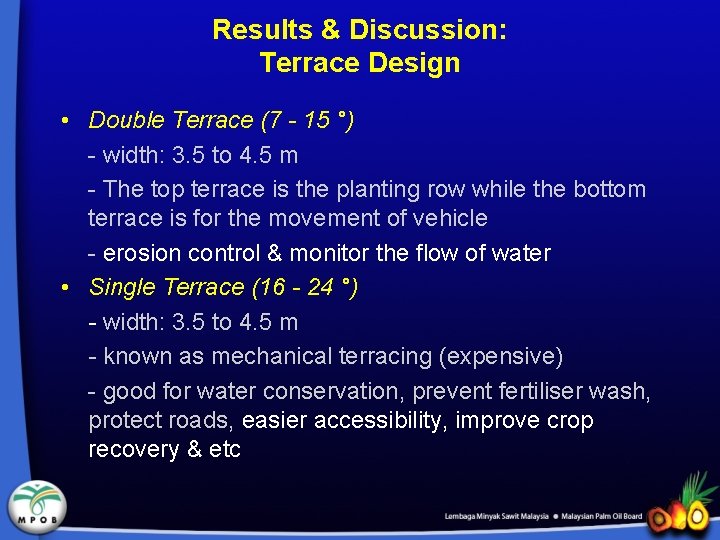
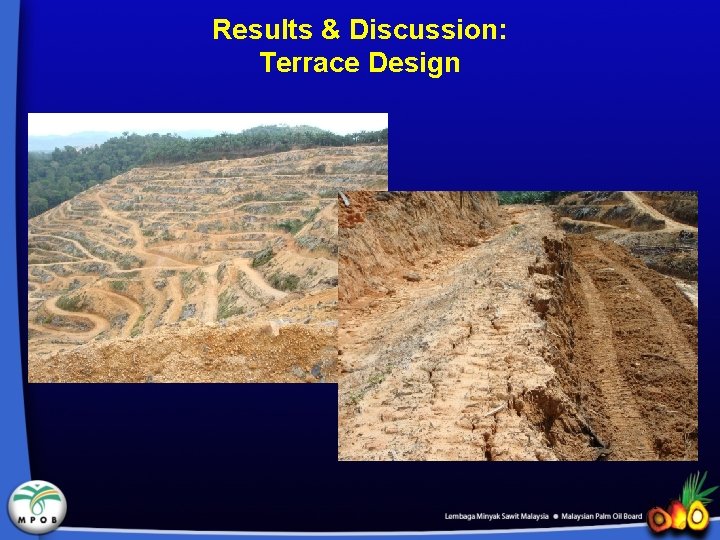
Results & Discussion: Terrace Design • Double Terrace (7 - 15 °) - width: 3. 5 to 4. 5 m - The top terrace is the planting row while the bottom terrace is for the movement of vehicle - erosion control & monitor the flow of water • Single Terrace (16 - 24 °) - width: 3. 5 to 4. 5 m - known as mechanical terracing (expensive) - good for water conservation, prevent fertiliser wash, protect roads, easier accessibility, improve crop recovery & etc 25
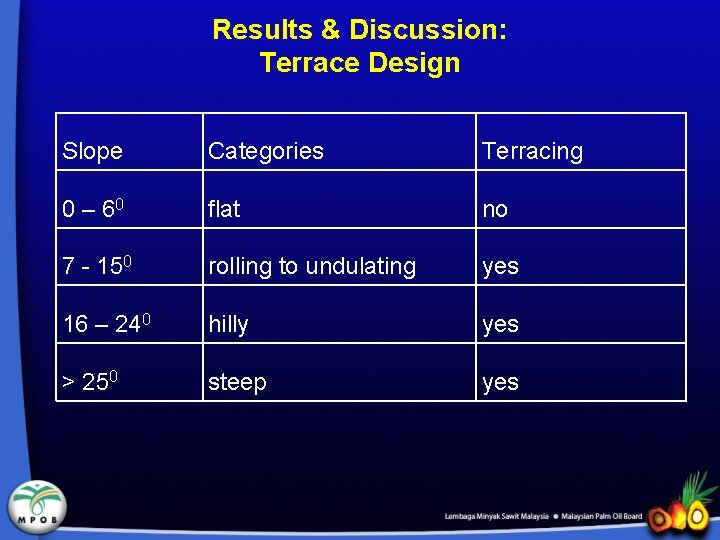
Results & Discussion: Terrace Design Slope Categories Terracing 0 – 60 flat no 7 - 150 rolling to undulating yes 16 – 240 hilly yes > 250 steep yes 26
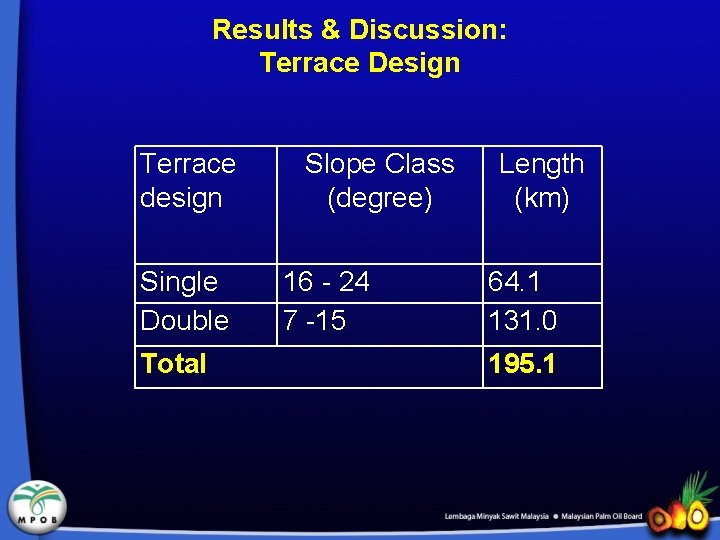
Results & Discussion: Terrace Design Terrace design Single Double Total Slope Class (degree) 16 - 24 7 -15 Length (km) 64. 1 131. 0 195. 1 27
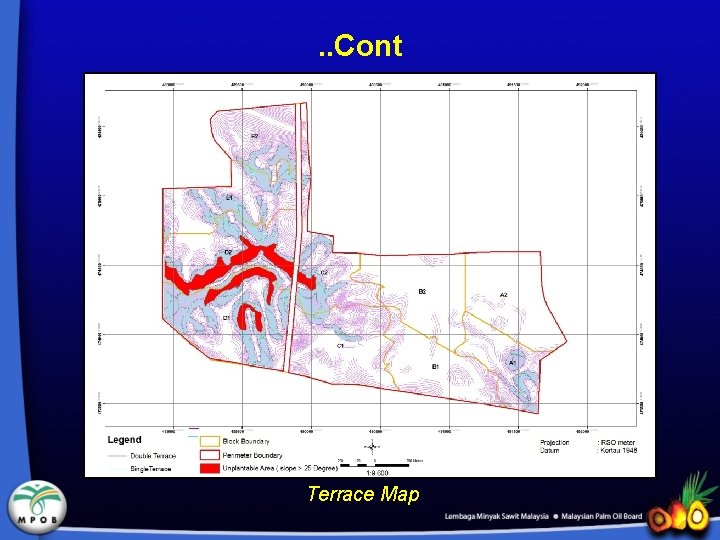
. . Cont Terrace Map 28
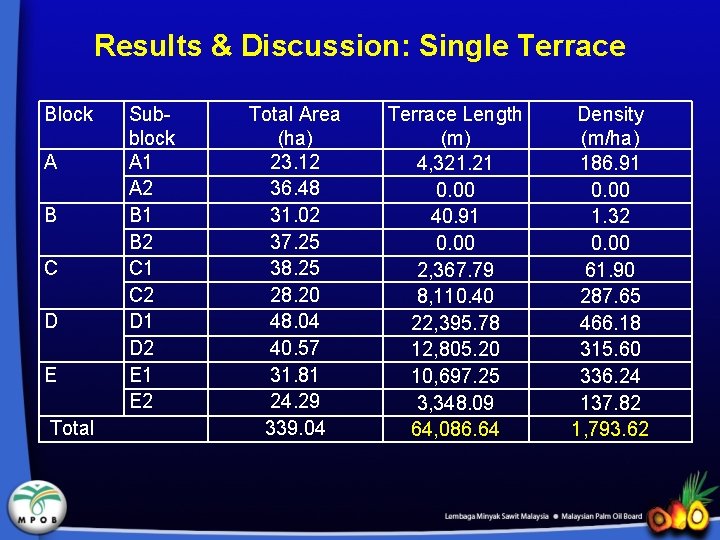
Results & Discussion: Single Terrace Block A B C D E Total Subblock A 1 A 2 B 1 B 2 C 1 C 2 D 1 D 2 E 1 E 2 Total Area (ha) 23. 12 36. 48 31. 02 37. 25 38. 25 28. 20 48. 04 40. 57 31. 81 24. 29 339. 04 Terrace Length (m) 4, 321. 21 0. 00 40. 91 0. 00 2, 367. 79 8, 110. 40 22, 395. 78 12, 805. 20 10, 697. 25 3, 348. 09 64, 086. 64 Density (m/ha) 186. 91 0. 00 1. 32 0. 00 61. 90 287. 65 466. 18 315. 60 336. 24 137. 82 1, 793. 62 29
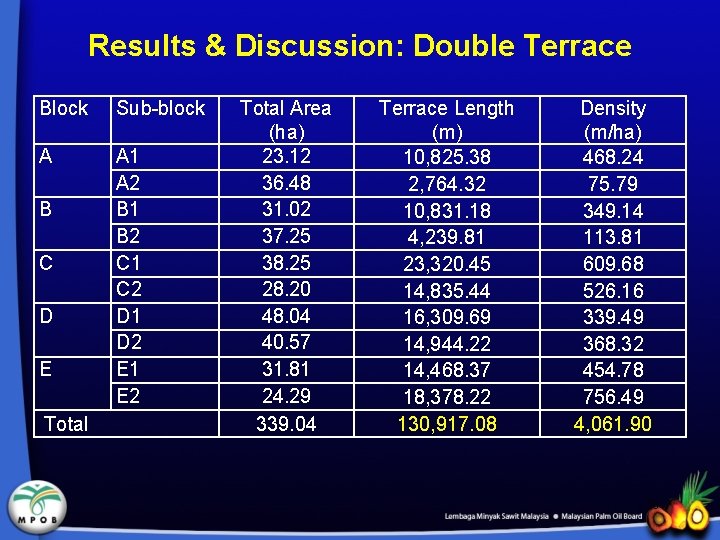
Results & Discussion: Double Terrace Block Sub-block A A 1 A 2 B 1 B 2 C 1 C 2 D 1 D 2 E 1 E 2 B C D E Total Area (ha) 23. 12 36. 48 31. 02 37. 25 38. 25 28. 20 48. 04 40. 57 31. 81 24. 29 339. 04 Terrace Length (m) 10, 825. 38 2, 764. 32 10, 831. 18 4, 239. 81 23, 320. 45 14, 835. 44 16, 309. 69 14, 944. 22 14, 468. 37 18, 378. 22 130, 917. 08 Density (m/ha) 468. 24 75. 79 349. 14 113. 81 609. 68 526. 16 339. 49 368. 32 454. 78 756. 49 4, 061. 90 30
Results & Discussion: Terrace Design 31
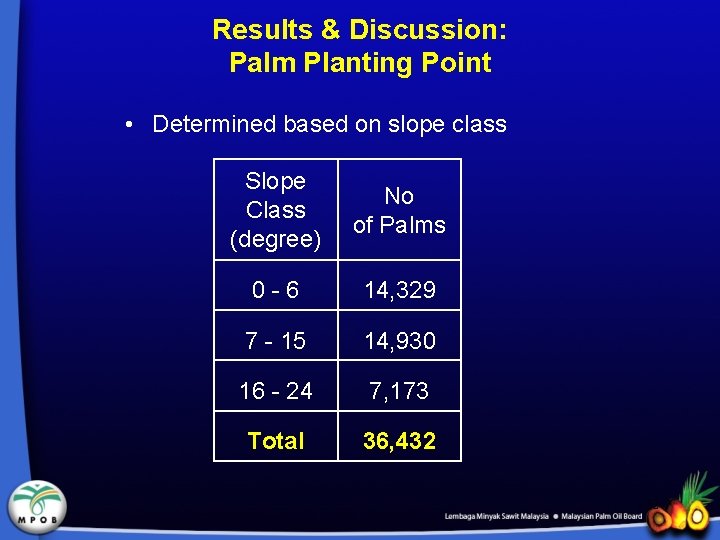
Results & Discussion: Palm Planting Point • Determined based on slope class Slope Class (degree) No of Palms 0 - 6 14, 329 7 - 15 14, 930 16 - 24 7, 173 Total 36, 432 32
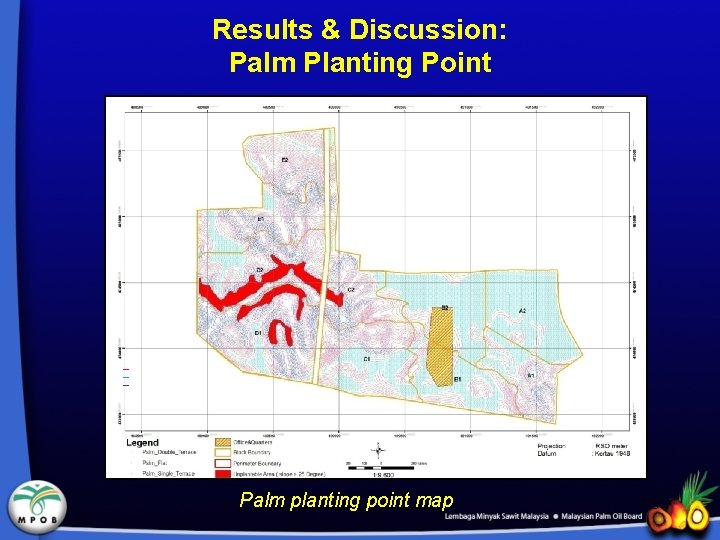
Results & Discussion: Palm Planting Point Palm planting point map 33
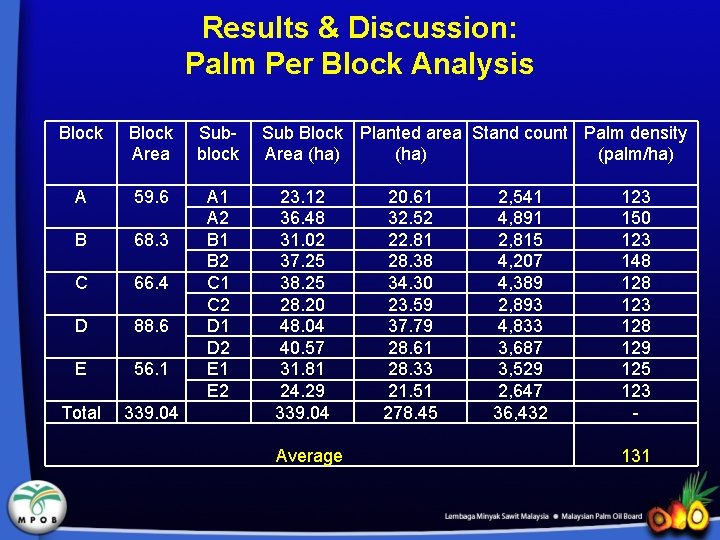
Results & Discussion: Palm Per Block Analysis Block Area Subblock A 59. 6 B 68. 3 C 66. 4 D 88. 6 E 56. 1 A 2 B 1 B 2 C 1 C 2 D 1 D 2 E 1 E 2 Total 339. 04 Sub Block Planted area Stand count Palm density Area (ha) (palm/ha) 23. 12 36. 48 31. 02 37. 25 38. 25 28. 20 48. 04 40. 57 31. 81 24. 29 339. 04 Average 20. 61 32. 52 22. 81 28. 38 34. 30 23. 59 37. 79 28. 61 28. 33 21. 51 278. 45 2, 541 4, 891 2, 815 4, 207 4, 389 2, 893 4, 833 3, 687 3, 529 2, 647 36, 432 123 150 123 148 123 128 129 125 123 131 34
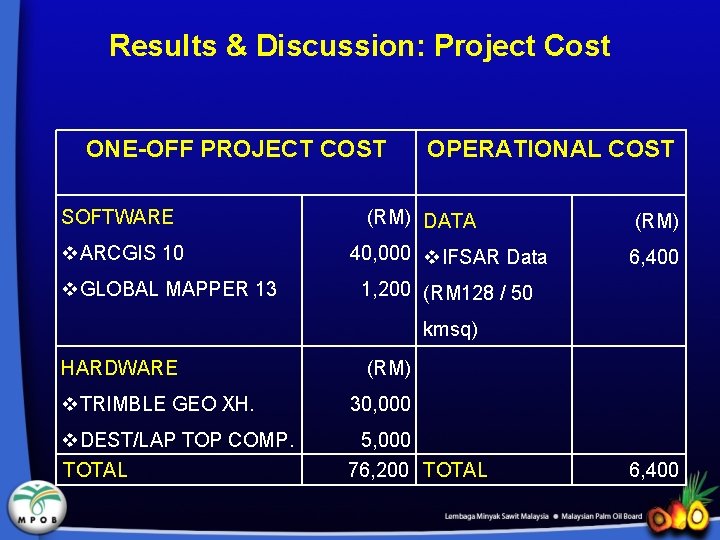
Results & Discussion: Project Cost ONE-OFF PROJECT COST SOFTWARE v. ARCGIS 10 v. GLOBAL MAPPER 13 OPERATIONAL COST (RM) DATA 40, 000 v. IFSAR Data (RM) 6, 400 1, 200 (RM 128 / 50 kmsq) HARDWARE (RM) v. TRIMBLE GEO XH. 30, 000 v. DEST/LAP TOP COMP. TOTAL 5, 000 76, 200 TOTAL 6, 400 35
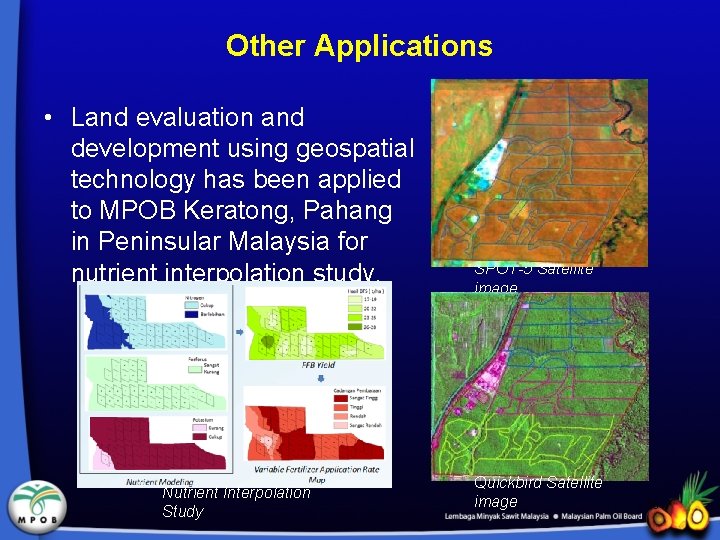
Other Applications • Land evaluation and development using geospatial technology has been applied to MPOB Keratong, Pahang in Peninsular Malaysia for nutrient interpolation study. Nutrient Interpolation Study SPOT-5 Satellite image Quickbird Satellite image 36

. . Cont Mapping of Oil Palm Cultivation In Malaysia – TT No. 473 Application of Information Technologies for Land Evaluation and Development - TS No. 100 Malaysian Unified Peat Classification Technique - TT No. 529 Remote Sensing Measurement for Oil Palm Detection of Bagworm Infestation in Oil Palm Plantation - TT No. 502 Immature palms www. mpob. gov. my

Conclusions • The advancement of IFSAR data associated with GPS and GIS technology is useful for land evaluation and development for oil palm cultivation • The technologies can predetermine the blocking, number planting points, roads, drains, terraces, conservation areas etc. based on land topography • The information is useful for preparing the budget and contracts for a new oil palm plantation • The database developed can be used for future management and monitoring of the plantation 38

THANK YOU 39
- Slides: 39