
Noranda Alumina LLC Agency Interest No 1388 Photo


- Slides: 29
Noranda Alumina LLC Agency Interest No. 1388 Photo credit: Advocate staff photo by Hilary Scheinuk
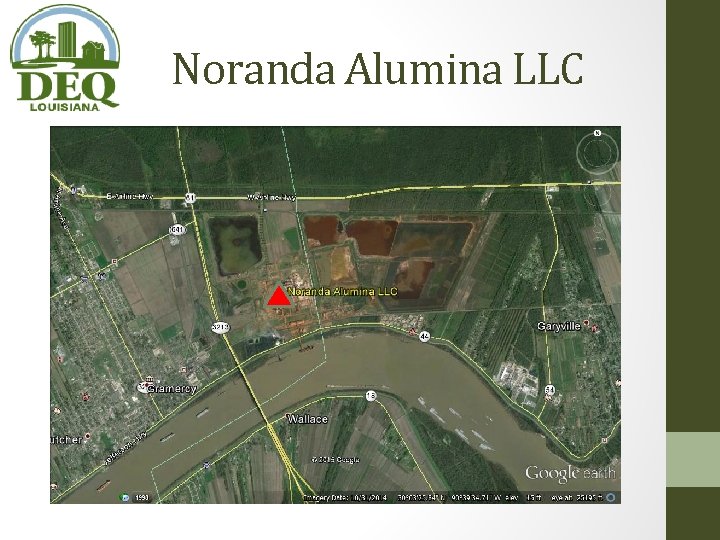
Noranda Alumina LLC
Facility Background • Noranda is located at 1111 East Airline Highway in Gramercy, St. James Parish, Louisiana • Facility construction began in 1957 and operations commenced in 1959 • The facility is an alumina refinery • Ownership and/or operator change effective September 30, 2004 • Old owner-Kaiser Aluminum & Chemical Corporation • New owner-Gramercy Alumina LLC • Company name change effective September 14, 2009 • Old company name: Gramercy Alumina LLC • New company name: Noranda Alumina LLC
Facility Description • The alumina refinery produces roughly 1. 2 million tons of alumina/year • Alumina is extracted from Jamaican bauxite via the Bayer Process (involves chemical and physical processes) • The Jamaican bauxite is obtained from Noranda Jamaica Bauxite Partners in Jamaica and is received at the facility’s dock on the Mississippi River • Mercury is a naturally occurring metal found in Jamaican Bauxite
Permitting • Air Permits • Raw material receiving and process area • Red mud processing area (processes raw material for use in various processes via drying, amending, transfer, and storage equipment) • Area that receives and impounds the washed mud in the mud lakes • The facility is not currently permitted for mercury emissions • Water Permits • Currently operating under an administratively continued LPDES permit • A draft renewal is under review for public notice. EPA has reviewed the draft permit • Noranda’s draft LPDES renewal contains 3 final outfalls which discharge to the Mississippi River and 4 which discharge to Blind River Swamp via local drainage • DEQ will require monitoring for Mercury in permit renewal
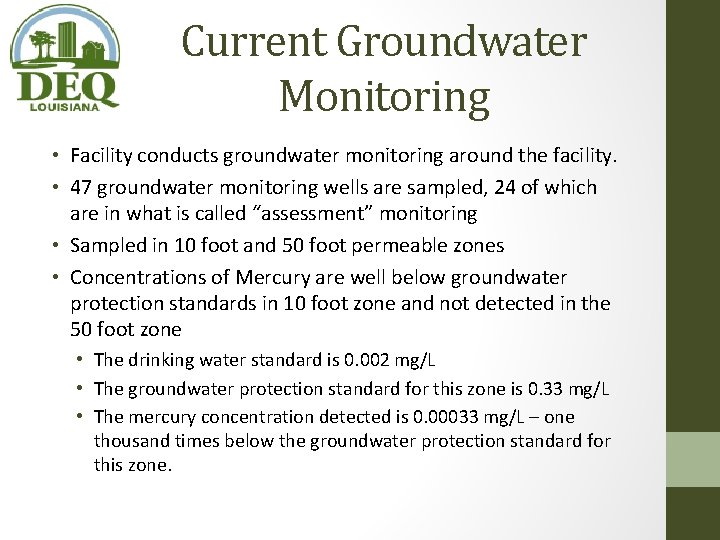
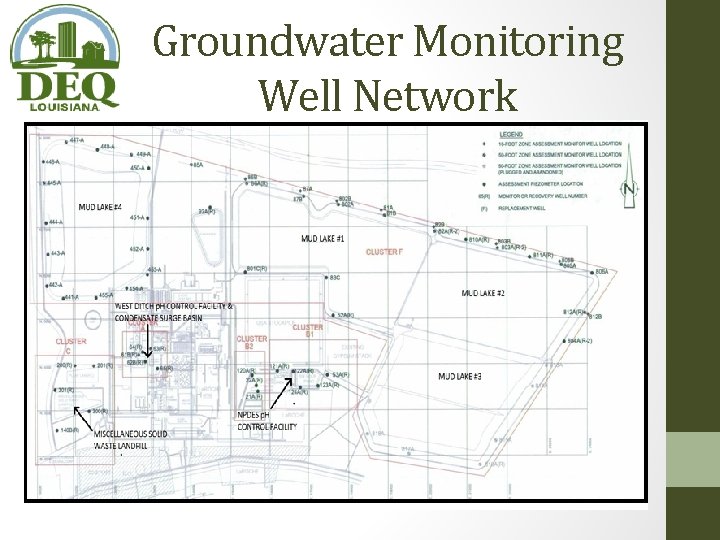
Current Groundwater Monitoring • Facility conducts groundwater monitoring around the facility. • 47 groundwater monitoring wells are sampled, 24 of which are in what is called “assessment” monitoring • Sampled in 10 foot and 50 foot permeable zones • Concentrations of Mercury are well below groundwater protection standards in 10 foot zone and not detected in the 50 foot zone • The drinking water standard is 0. 002 mg/L • The groundwater protection standard for this zone is 0. 33 mg/L • The mercury concentration detected is 0. 00033 mg/L – one thousand times below the groundwater protection standard for this zone.
Groundwater Monitoring Well Network
Noranda Reports Mercury Release • On April 25, 2014 Noranda submitted a release report for the potential release of small amounts of Mercury. • Subsequent to the report, Noranda contacted Enforcement to schedule a meeting. • A meeting was conducted May 8, 2014
Department Response • May 8, 2014 - In the meeting Noranda informed the Department of the following: • On March 26, 2014: 2 - 3 ounces of elemental mercury residue discovered by the facility during re-tubing of the No. 1 West Heater • On April 11, 2014: industrial hygiene survey conducted by the facility • The facility determined the following possible sources of mercury • Bauxite (primary source) • Caustic used in the Bayer Process (possible secondary source) • The facility identified up to 36 potential mercury emission points
Department Response • On June 4, 2014 the Department received an interim limits request for mercury dated May 28, 2014. • Requested interim limits: 250 lbs/year • DEQ requires analysis on mercury emission rates above 25 lbs/ year • On June 13, 2014 DEQ informed the facility that the interim limit request could not be acted upon without modeling to demonstrate compliance with Louisiana’s Toxic Air Pollutant (TAP) ambient air standards. • Prior to conducting modeling facilities must submit a modeling protocol to the Air Permits Division for approval.
Department Response • On February 20, 2015, DEQ issued a Consolidated Compliance Order & Notice of Potential Penalty based on unpermitted mercury emissions and ordered the following: • Submit a mercury modeling protocol for approval • Conduct air modeling exercises in accordance with approved protocol. Submit results within 30 days. • Based on the modeling results, submit the appropriate air permit application within 30 days of submitting the modeling results • The Compliance Order’s requirements were based on the Respondent’s interim limits request for 250 lb. /yr. for mercury.
Department Response • On March 17, 2015, Noranda provided the Department with additional information indicating mercury emissions are far less than the 250 lbs per year that was initially anticipated. • The revised estimates were based on process knowledge from other similar facilities. • The revised emission estimate was 20 lbs/year. • On March 25, 2015, DEQ amended its order to require the following: • Submit a written protocol for mercury quantification activities • Conduct mercury quantification activities in accordance with a DEQ approved protocol. Submit results within 30 days of completion. • Based on the mercury quantification activities, submit the appropriate air permit application within 30 days of submitting the results.
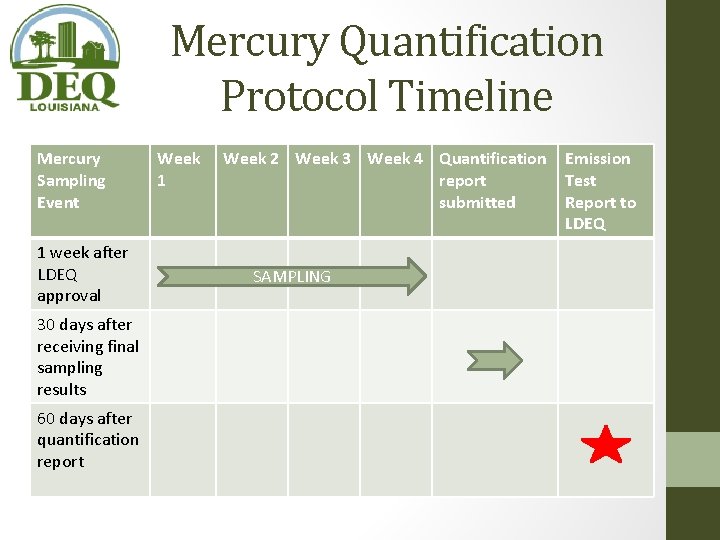
Mercury Quantification Protocol • The Department received the protocol on March 26, 2015 • A request for additional information was sent on March 31, 2015 • The Department received a revised protocol with the additional information included April 30, 2015 • The mercury quantification protocol was approved by the Department and issued on May 1, 2015. • The approval will expire 45 days after the issuance date. (Note: The facility has 45 days to complete the sampling process, not 45 days to complete all activities listed on the previous slide) • Sampling is currently taking place.
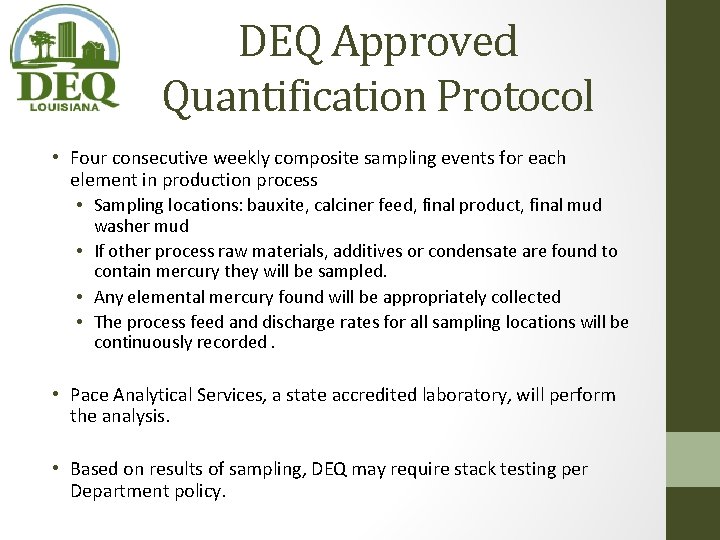
DEQ Approved Quantification Protocol • Four consecutive weekly composite sampling events for each element in production process • Sampling locations: bauxite, calciner feed, final product, final mud washer mud • If other process raw materials, additives or condensate are found to contain mercury they will be sampled. • Any elemental mercury found will be appropriately collected • The process feed and discharge rates for all sampling locations will be continuously recorded. • Pace Analytical Services, a state accredited laboratory, will perform the analysis. • Based on results of sampling, DEQ may require stack testing per Department policy.
Mercury Quantification Protocol Timeline Mercury Sampling Event 1 week after LDEQ approval 30 days after receiving final sampling results 60 days after quantification report Week 1 Week 2 Week 3 Week 4 Quantification report submitted SAMPLING Emission Test Report to LDEQ
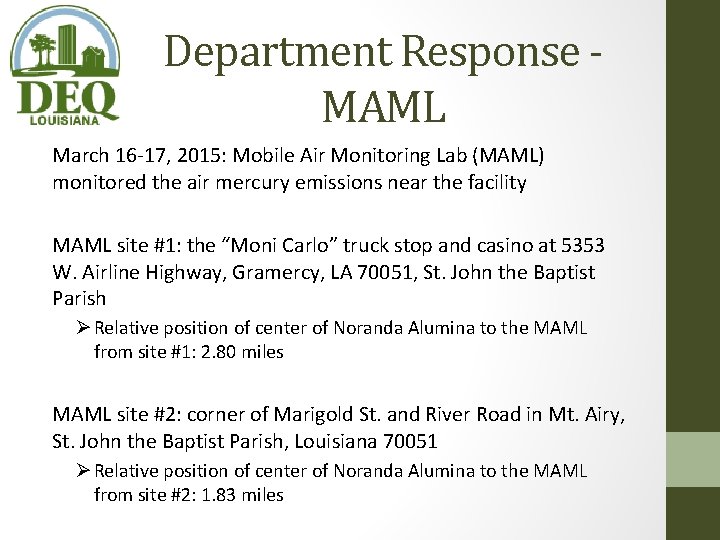
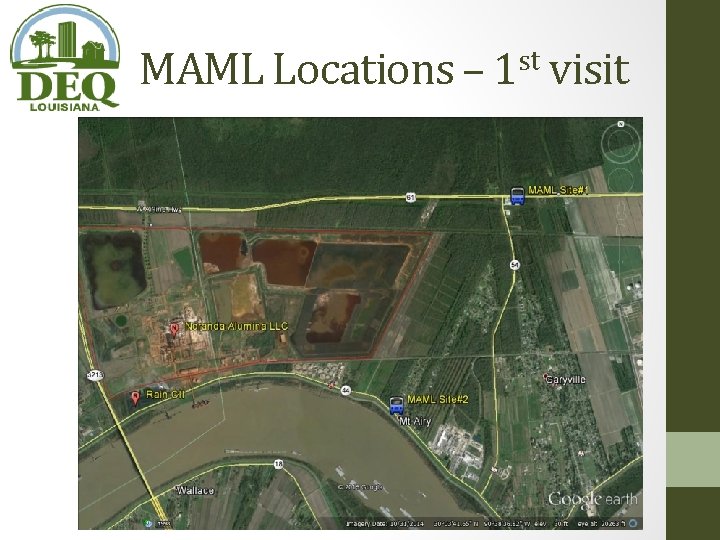
Department Response MAML March 16 -17, 2015: Mobile Air Monitoring Lab (MAML) monitored the air mercury emissions near the facility MAML site #1: the “Moni Carlo” truck stop and casino at 5353 W. Airline Highway, Gramercy, LA 70051, St. John the Baptist Parish Ø Relative position of center of Noranda Alumina to the MAML from site #1: 2. 80 miles MAML site #2: corner of Marigold St. and River Road in Mt. Airy, St. John the Baptist Parish, Louisiana 70051 Ø Relative position of center of Noranda Alumina to the MAML from site #2: 1. 83 miles
MAML Locations – 1 st visit
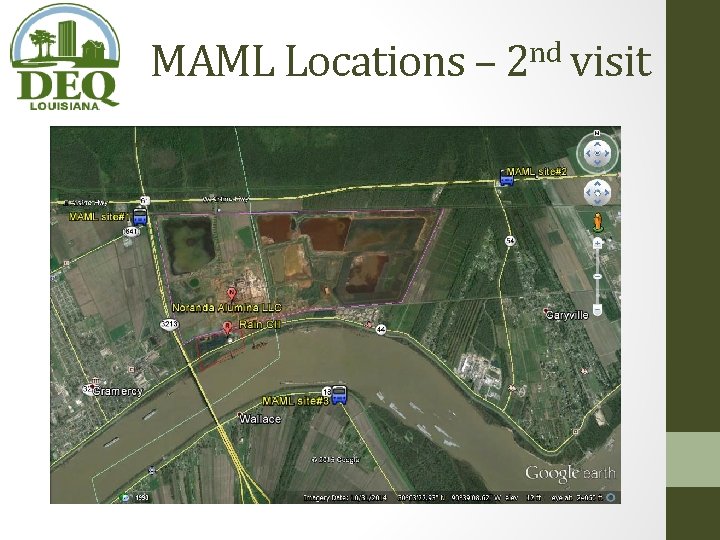
Department Response MAML May 18 -22, 2015: MAML again monitored the air mercury emissions near the facility MAML site #1: near the corner of Hwy 621 and Hwy 3213 in St. James Parish Ø Relative position of center of Noranda Alumina to the MAML from site #1: 1. 2 miles MAML site #2: the “Moni Carlo” truck stop and casino at 5353 W. Airline Highway, Gramercy, LA 70051, St. John the Baptist Parish Ø Relative position of center of Noranda Alumina to the MAML from site #2: 2. 80 miles MAML site #3: Wallace, St. John the Baptist Parish, Louisiana 70049 Ø Relative position of center of Noranda Alumina to the MAML from site #3: 1. 4 miles
nd MAML Locations – 2 visit
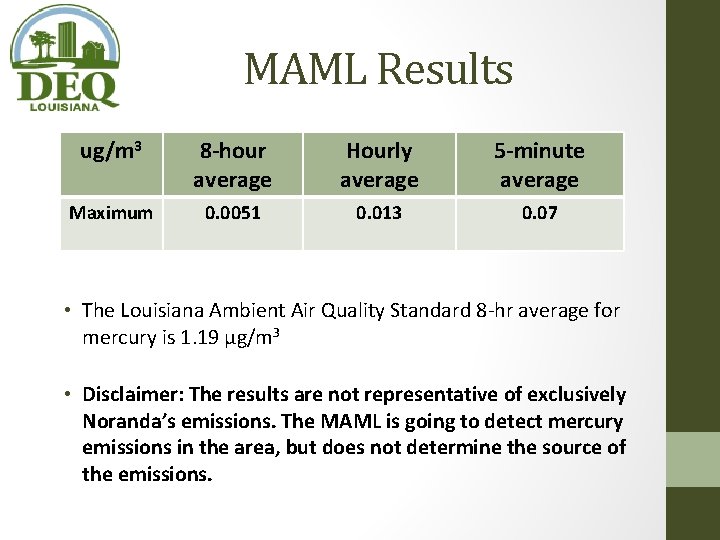
MAML Results ug/m 3 8 -hour average Hourly average 5 -minute average Maximum 0. 0051 0. 013 0. 07 • The Louisiana Ambient Air Quality Standard 8 -hr average for mercury is 1. 19 µg/m 3 • Disclaimer: The results are not representative of exclusively Noranda’s emissions. The MAML is going to detect mercury emissions in the area, but does not determine the source of the emissions.
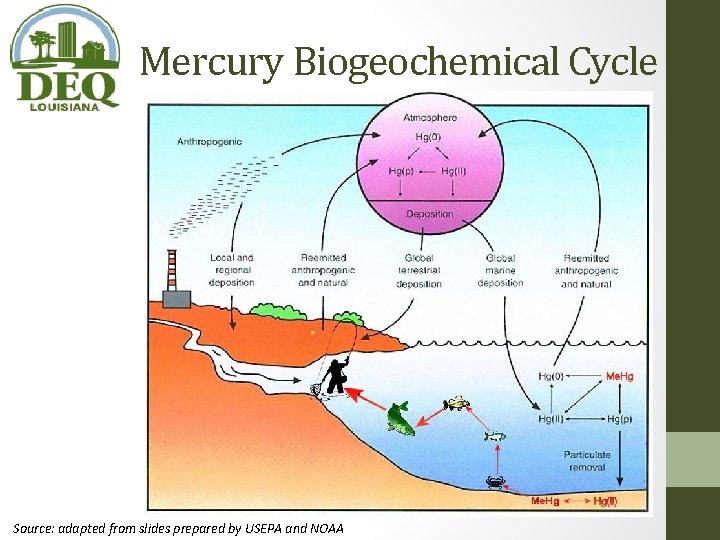
Mercury (Hg) • Mercury is a naturally occurring element that exists in three forms • Metallic mercury Hg (0) • Inorganic mercury Hg(II) • Organic mercury Me-Hg • Concentrations of mercury in the environment have increased over many years due to man-made activities world wide • Primarily due to atmospheric deposition from fossil fuel combustion, mining, smelting, and solid waste incineration
Mercury Biogeochemical Cycle Source: adapted from slides prepared by USEPA and NOAA
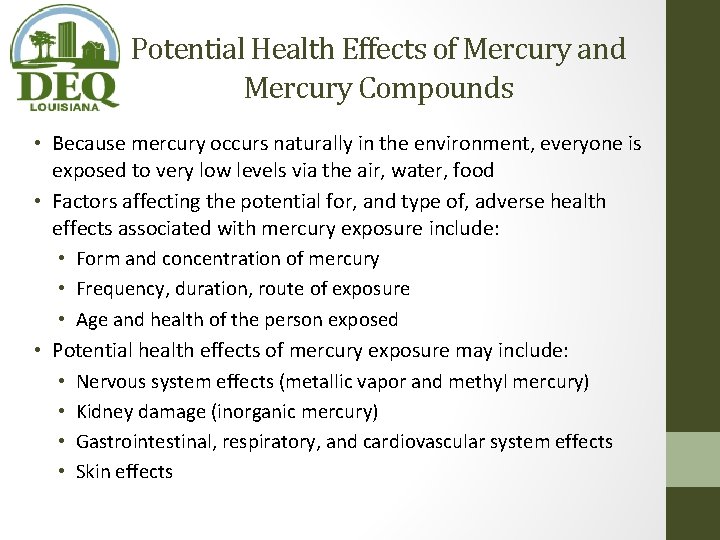
Potential Health Effects of Mercury and Mercury Compounds • Because mercury occurs naturally in the environment, everyone is exposed to very low levels via the air, water, food • Factors affecting the potential for, and type of, adverse health effects associated with mercury exposure include: • Form and concentration of mercury • Frequency, duration, route of exposure • Age and health of the person exposed • Potential health effects of mercury exposure may include: • Nervous system effects (metallic vapor and methyl mercury) • Kidney damage (inorganic mercury) • Gastrointestinal, respiratory, and cardiovascular system effects • Skin effects
Blind River Mercury Fish Consumption Advisory
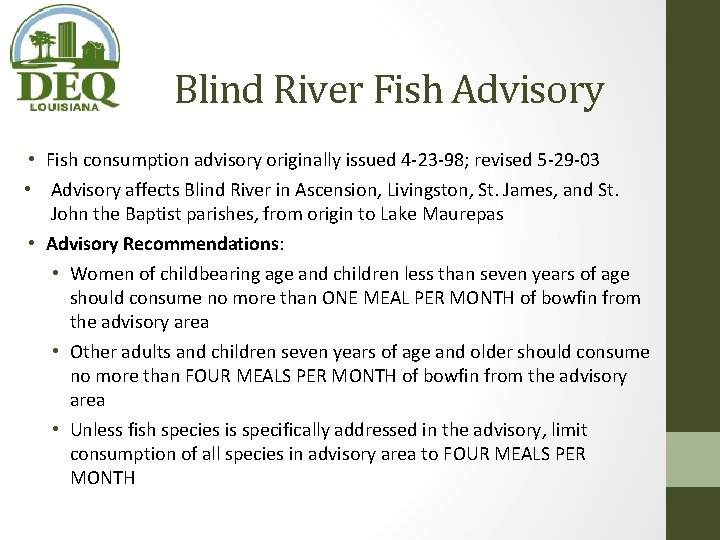
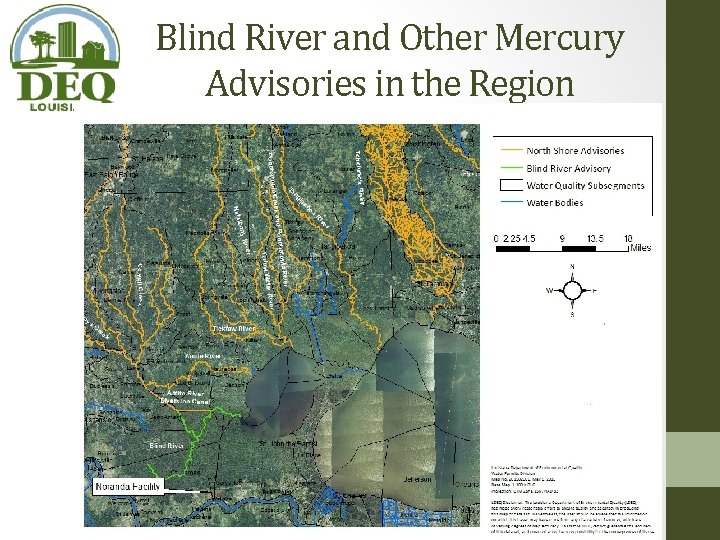
Blind River Fish Advisory • Fish consumption advisory originally issued 4 -23 -98; revised 5 -29 -03 • Advisory affects Blind River in Ascension, Livingston, St. James, and St. John the Baptist parishes, from origin to Lake Maurepas • Advisory Recommendations: • Women of childbearing age and children less than seven years of age should consume no more than ONE MEAL PER MONTH of bowfin from the advisory area • Other adults and children seven years of age and older should consume no more than FOUR MEALS PER MONTH of bowfin from the advisory area • Unless fish species is specifically addressed in the advisory, limit consumption of all species in advisory area to FOUR MEALS PER MONTH
Blind River and Other Mercury Advisories in the Region
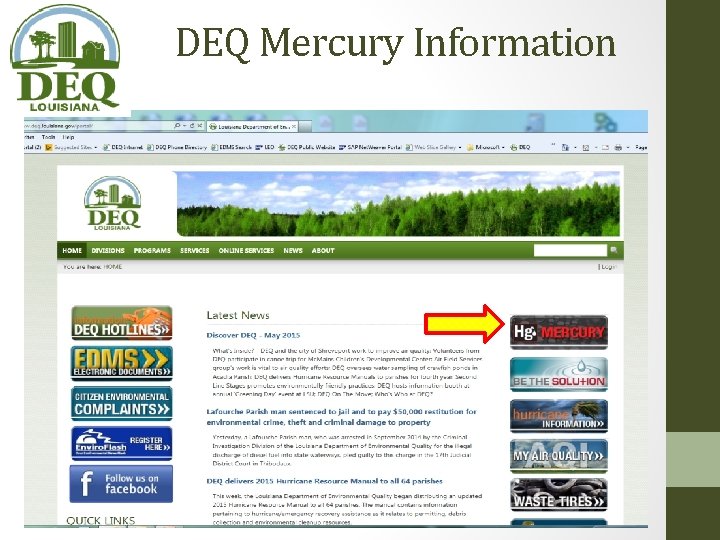
DEQ Mercury Information
Resources 1. U. S. Environmental Protection Agency (December 1997). Mercury Study Report to Congress Volume I: Executive Summary. Retrieved from US EPA website http: //www. epa. gov/mercury/report. htm 2. U. S. Environmental Protection Agency (December 1997). Mercury Study Report to Congress Volume III: Fate and Transport of Mercury in the Environment. Retrieved from US EPA website http: //www. epa. gov/mercury/report. htm 3. U. S. Environmental Protection Agency (December 1997) Mercury Study Report to Congress Volume V: Health Effects of Mercury and Mercury Compounds. Retrieved from US EPA website http: //www. epa. gov/mercury/report. htm 4. Cohen, M. of the National Oceanic and Atmospheric Administration (NOAA) Air Resources Laboratory (2006). Atmospheric Mercury: Emissions, Transport/Fate, Source. Receptor Relationships [Presentation]. Power. Point Presented at the Collaborative Meeting on Modeling Mercury in Freshwater Environments. Niagara Falls, NY.
Resources 5. University of Minnesota, Environmental & Occupational Health. Mercury: fate and transport-Environmental Health Sciences. Retrieved from University of Minnesota website http: //enhs. umn. edu/current/5103_spring 2003/mercury/mercfat e. html 6. Louisiana Department of Environmental Quality. DEQ Mercury Initiative. Retrieved from http: //www. deq. louisiana. gov/portal/PROGRAMS/Mercury. Initiati ve. aspx 7. ATSDR. 1999. Public Health Statement Mercury CAS# 7439 -97 -6. http: //www. atsdr. cdc. gov/Tox. Profiles/tp 46 -c 1 -b. pdf