
NonWovens BY ENGINEER MUHAMMAD IRFAN SIYAL NonWovens Nonwoven
Non-Wovens BY ENGINEER MUHAMMAD IRFAN SIYAL
Non-Wovens Non-woven production Fiber Fabric It eliminates the yarn production process and makes the fabric directly from fibers.
Advantages of Non-wovens The great advantages in non-woven fabrics is the speed with which the final fabric is produced. All yarn preparation steps are eliminated, and the fabric production itself is faster than conventional methods.
Applications Currently, the main areas of growth in nonwovens are in geo-textiles, medical and hospital uses, disposable products and filters.
Making Non-woven products There are normally two steps for making nonwoven products. They are: 1. 2. Web formation; and Bonding systems.
Web formation A nonwoven fabric is basically a web of fibers held together in some way. The web may be made of staple fibers or filaments, or from portions of polymer film. A plain homogenous arrangement of fibers that lie parallel to each other or mixed is bonded, Mechanically Chemically Thermally.
Web formation from Staple Fibers Webs from filament Methods of Web formation: Mechanically formed fiber webs (30 -60 mm) Aerodynamically formed fiber webs (5 – 40) Hydro-dynamically formed fiber webs Spun-bonded Nonwoven (Continuous)
Web Bonding Systems To produce a nonwoven out of a fiber web produced in the web-forming process, the fiber web has to be compacted. This can be done mechanically by; Needles or Water jet Chemically or Thermally.
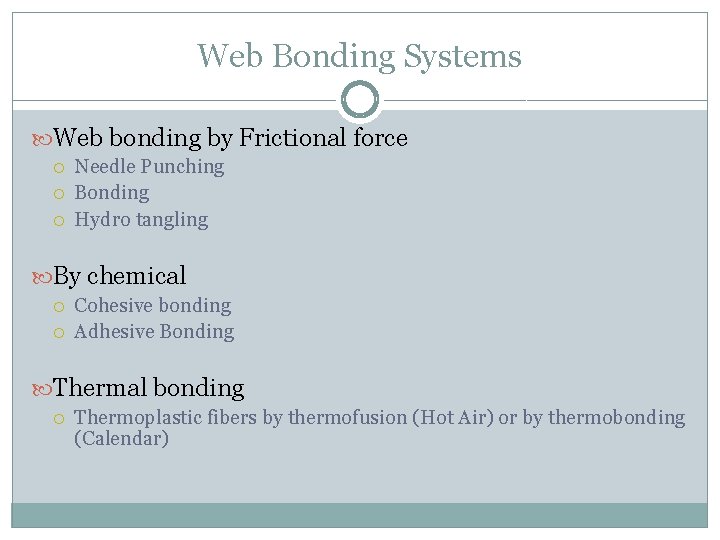
Web Bonding Systems Web bonding by Frictional force Needle Punching Bonding Hydro tangling By chemical Cohesive bonding Adhesive Bonding Thermal bonding Thermoplastic fibers by thermofusion (Hot Air) or by thermobonding (Calendar)
References Textile Technology, By: Burkhard Wolfhorst
- Slides: 10