
NONVERBAL SPEECH ANALYSIS OF INTERVIEWS WITH SCHIZOPHRENIC PATIENTS
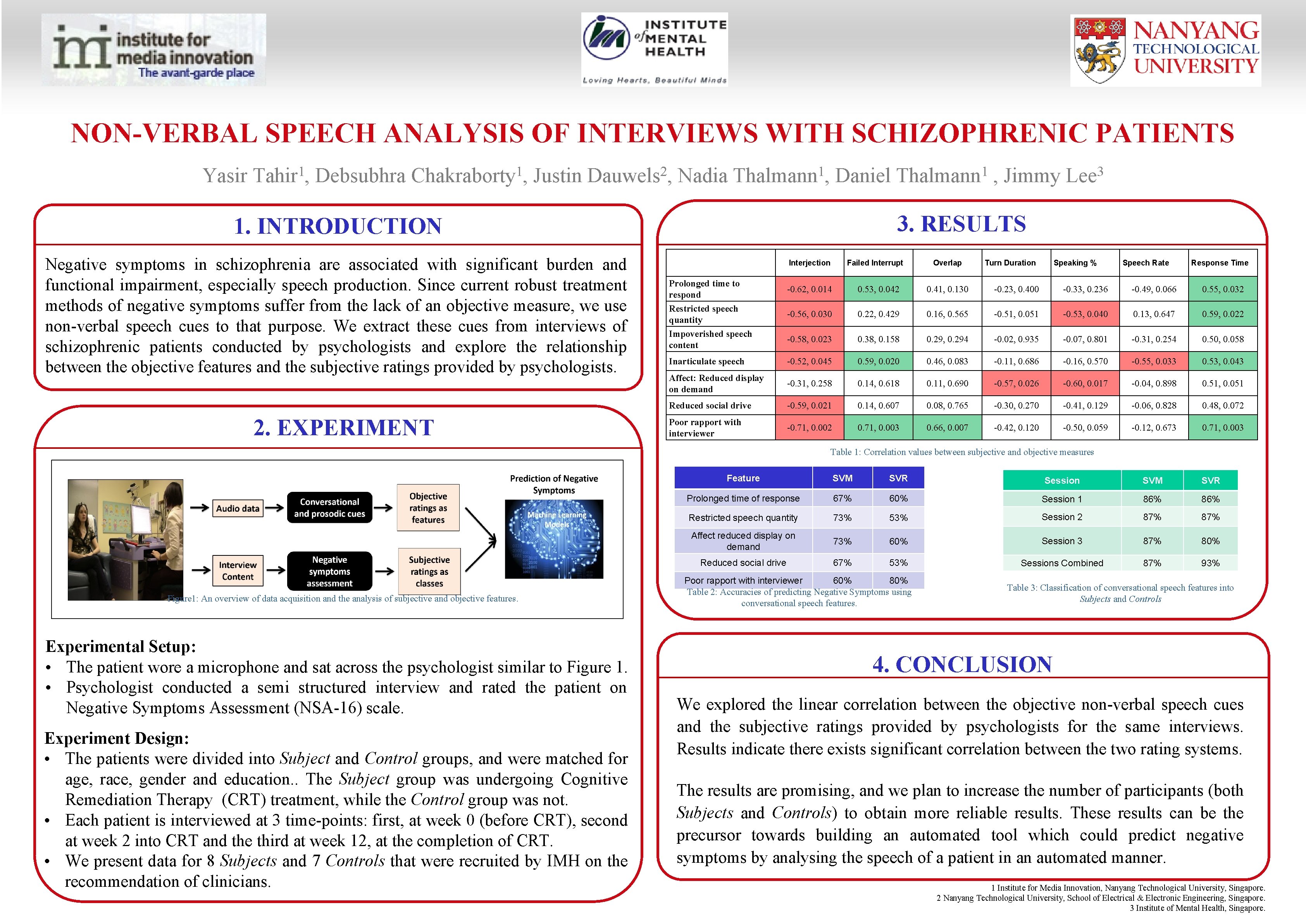
NON-VERBAL SPEECH ANALYSIS OF INTERVIEWS WITH SCHIZOPHRENIC PATIENTS Yasir 1 Tahir , Debsubhra 1 Chakraborty , Justin 2 Dauwels , Nadia 1 Thalmann , Daniel 2. EXPERIMENT , Jimmy 3 Lee 3. RESULTS 1. INTRODUCTION Negative symptoms in schizophrenia are associated with significant burden and functional impairment, especially speech production. Since current robust treatment methods of negative symptoms suffer from the lack of an objective measure, we use non-verbal speech cues to that purpose. We extract these cues from interviews of schizophrenic patients conducted by psychologists and explore the relationship between the objective features and the subjective ratings provided by psychologists. 1 Thalmann Interjection Prolonged time to respond Restricted speech quantity Failed Interrupt Overlap Turn Duration Speaking % Speech Rate Response Time -0. 62, 0. 014 0. 53, 0. 042 0. 41, 0. 130 -0. 23, 0. 400 -0. 33, 0. 236 -0. 49, 0. 066 0. 55, 0. 032 -0. 56, 0. 030 0. 22, 0. 429 0. 16, 0. 565 -0. 51, 0. 051 -0. 53, 0. 040 0. 13, 0. 647 0. 59, 0. 022 Impoverished speech content -0. 58, 0. 023 0. 38, 0. 158 0. 29, 0. 294 -0. 02, 0. 935 -0. 07, 0. 801 -0. 31, 0. 254 0. 50, 0. 058 Inarticulate speech -0. 52, 0. 045 0. 59, 0. 020 0. 46, 0. 083 -0. 11, 0. 686 -0. 16, 0. 570 -0. 55, 0. 033 0. 53, 0. 043 Affect: Reduced display on demand -0. 31, 0. 258 0. 14, 0. 618 0. 11, 0. 690 -0. 57, 0. 026 -0. 60, 0. 017 -0. 04, 0. 898 0. 51, 0. 051 Reduced social drive -0. 59, 0. 021 0. 14, 0. 607 0. 08, 0. 765 -0. 30, 0. 270 -0. 41, 0. 129 -0. 06, 0. 828 0. 48, 0. 072 Poor rapport with interviewer -0. 71, 0. 002 0. 71, 0. 003 0. 66, 0. 007 -0. 42, 0. 120 -0. 50, 0. 059 -0. 12, 0. 673 0. 71, 0. 003 Table 1: Correlation values between subjective and objective measures Figure 1: An overview of data acquisition and the analysis of subjective and objective features. Experimental Setup: • The patient wore a microphone and sat across the psychologist similar to Figure 1. • Psychologist conducted a semi structured interview and rated the patient on Negative Symptoms Assessment (NSA-16) scale. Experiment Design: • The patients were divided into Subject and Control groups, and were matched for age, race, gender and education. . The Subject group was undergoing Cognitive Remediation Therapy (CRT) treatment, while the Control group was not. • Each patient is interviewed at 3 time-points: first, at week 0 (before CRT), second at week 2 into CRT and the third at week 12, at the completion of CRT. • We present data for 8 Subjects and 7 Controls that were recruited by IMH on the recommendation of clinicians. Feature SVM SVR Session SVM SVR Prolonged time of response 67% 60% Session 1 86% Restricted speech quantity 73% 53% Session 2 87% Affect reduced display on demand 73% 60% Session 3 87% 80% Reduced social drive 67% 53% Sessions Combined 87% 93% Poor rapport with interviewer 60% 80% Table 2: Accuracies of predicting Negative Symptoms using conversational speech features. Table 3: Classification of conversational speech features into Subjects and Controls 4. CONCLUSION We explored the linear correlation between the objective non-verbal speech cues and the subjective ratings provided by psychologists for the same interviews. Results indicate there exists significant correlation between the two rating systems. The results are promising, and we plan to increase the number of participants (both Subjects and Controls) to obtain more reliable results. These results can be the precursor towards building an automated tool which could predict negative symptoms by analysing the speech of a patient in an automated manner. 1 Institute for Media Innovation, Nanyang Technological University, Singapore. 2 Nanyang Technological University, School of Electrical & Electronic Engineering, Singapore. 3 Institute of Mental Health, Singapore.
- Slides: 1