
NONTRADITIONAL MACHINING AND THERMAL CUTTING PROCESSES 1 2

- Slides: 32
NONTRADITIONAL MACHINING AND THERMAL CUTTING PROCESSES 1. 2. 3. 4. 5. Mechanical Energy Processes Electrochemical Machining Processes Thermal Energy Processes Chemical Machining Application Considerations © 2013 John Wiley & Sons, Inc. M P Groover, Principles of Modern Manufacturing 5/e
Nontraditional Processes Defined § A group of processes that remove excess material by techniques involving mechanical, thermal, electrical, or chemical energy (or combinations of these energies) § They do not use a sharp cutting tool in the conventional sense § Developed since World War II in response to new and unusual machining requirements that could not be satisfied by conventional machining methods © 2013 John Wiley & Sons, Inc. M P Groover, Principles of Modern Manufacturing 5/e
Importance of Nontraditional Processes § Need to machine newly developed metals and non‑metals with special properties that make them difficult or impossible to machine by conventional methods § Need for unusual and/or complex part geometries that cannot readily be accomplished by conventional machining § Need to avoid surface damage that often accompanies conventional machining © 2013 John Wiley & Sons, Inc. M P Groover, Principles of Modern Manufacturing 5/e
Classification of Nontraditional Processes § Mechanical ‑ mechanical erosion of work material by a high velocity stream of abrasives or fluid (or both) § Electrical ‑ electrochemical energy to remove material (reverse of electroplating) § Thermal – thermal energy applied to small portion of work surface, causing that portion to be fused and/or vaporized § Chemical – chemical etchants selectively remove material from portions of workpart, while other portions are protected by a mask © 2013 John Wiley & Sons, Inc. M P Groover, Principles of Modern Manufacturing 5/e
Mechanical Energy Processes § § § Ultrasonic machining Water jet cutting Abrasive water jet cutting Abrasive jet machining Abrasive flow machining © 2013 John Wiley & Sons, Inc. M P Groover, Principles of Modern Manufacturing 5/e
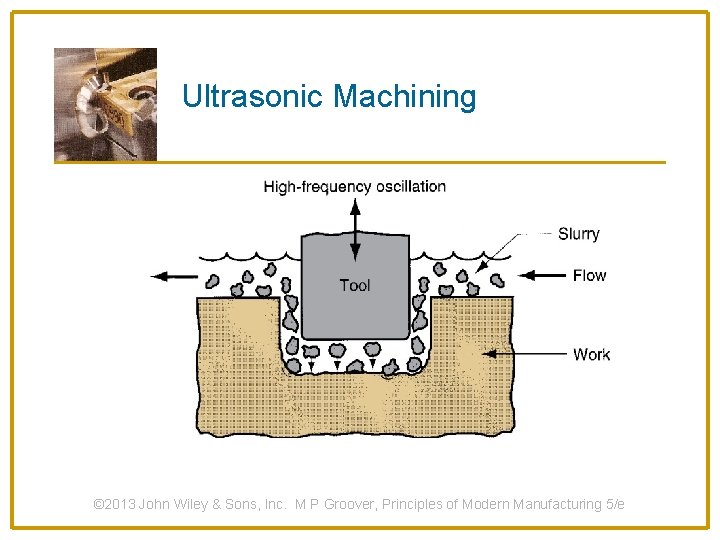
Ultrasonic Machining (USM) § Abrasives contained in a slurry are driven at high velocity against work by a tool vibrating at low amplitude and high frequency § Tool oscillation is perpendicular to work surface § Abrasives accomplish material removal § Tool is fed slowly into work § Shape of tool is formed into part © 2013 John Wiley & Sons, Inc. M P Groover, Principles of Modern Manufacturing 5/e
Ultrasonic Machining © 2013 John Wiley & Sons, Inc. M P Groover, Principles of Modern Manufacturing 5/e
USM Applications § Hard, brittle work materials such as ceramics, glass, and carbides § Also successful on certain metals, such as stainless steel and titanium § Shapes include non-round holes, holes along a curved axis § “Coining operations” - pattern on tool is imparted to a flat work surface © 2013 John Wiley & Sons, Inc. M P Groover, Principles of Modern Manufacturing 5/e
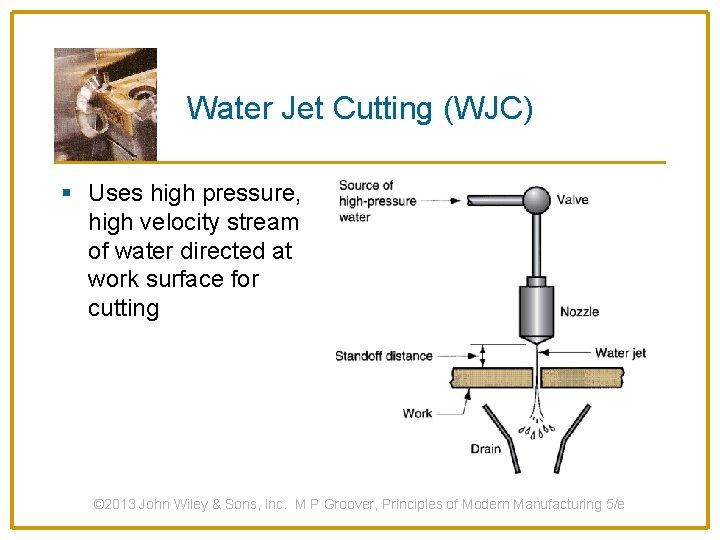
Water Jet Cutting (WJC) § Uses high pressure, high velocity stream of water directed at work surface for cutting © 2013 John Wiley & Sons, Inc. M P Groover, Principles of Modern Manufacturing 5/e
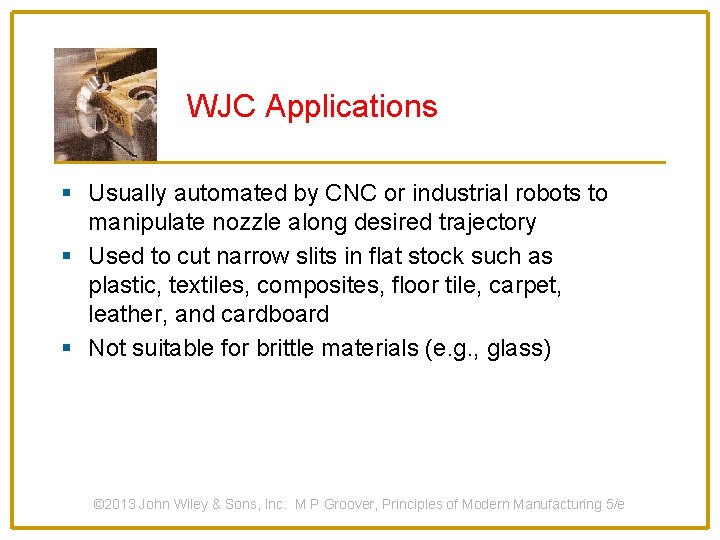
WJC Applications § Usually automated by CNC or industrial robots to manipulate nozzle along desired trajectory § Used to cut narrow slits in flat stock such as plastic, textiles, composites, floor tile, carpet, leather, and cardboard § Not suitable for brittle materials (e. g. , glass) © 2013 John Wiley & Sons, Inc. M P Groover, Principles of Modern Manufacturing 5/e
WJC Advantages § § No crushing or burning of work surface Minimum material loss No environmental pollution Ease of automation © 2013 John Wiley & Sons, Inc. M P Groover, Principles of Modern Manufacturing 5/e
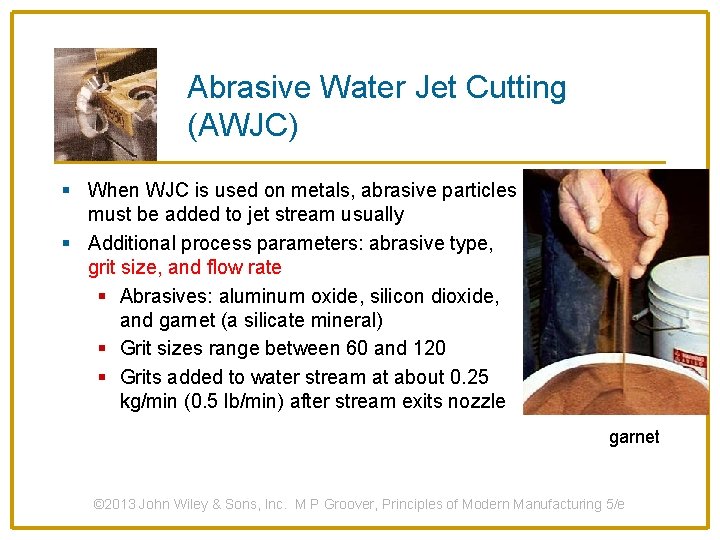
Abrasive Water Jet Cutting (AWJC) § When WJC is used on metals, abrasive particles must be added to jet stream usually § Additional process parameters: abrasive type, grit size, and flow rate § Abrasives: aluminum oxide, silicon dioxide, and garnet (a silicate mineral) § Grit sizes range between 60 and 120 § Grits added to water stream at about 0. 25 kg/min (0. 5 lb/min) after stream exits nozzle garnet © 2013 John Wiley & Sons, Inc. M P Groover, Principles of Modern Manufacturing 5/e
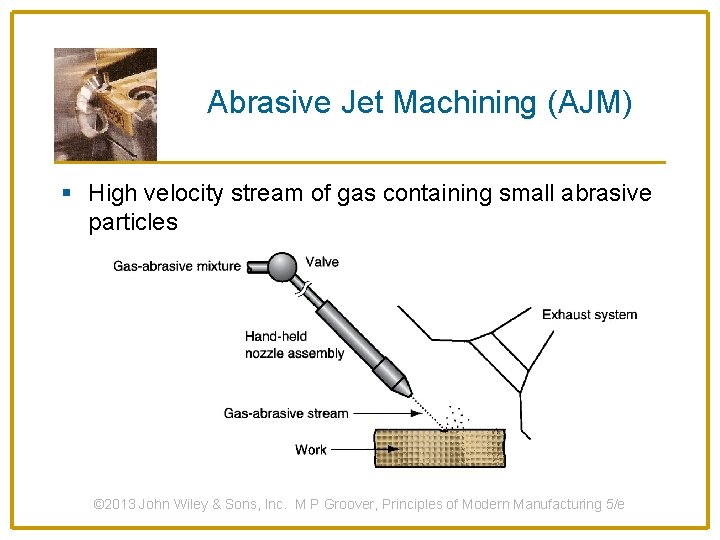
Abrasive Jet Machining (AJM) § High velocity stream of gas containing small abrasive particles © 2013 John Wiley & Sons, Inc. M P Groover, Principles of Modern Manufacturing 5/e
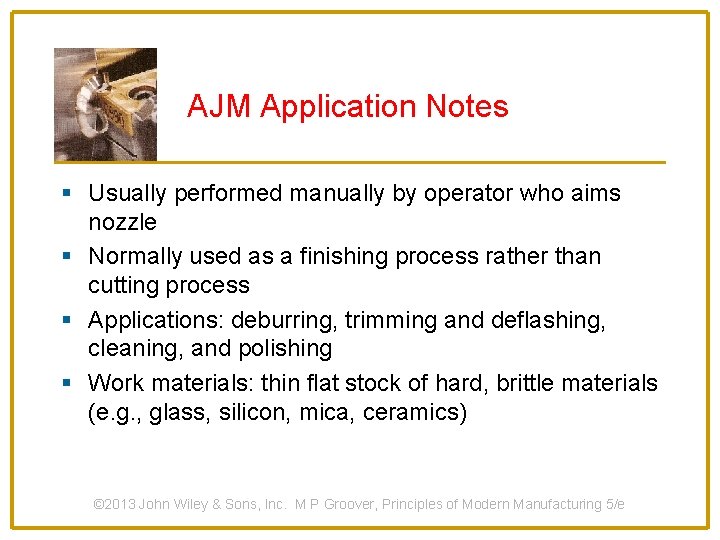
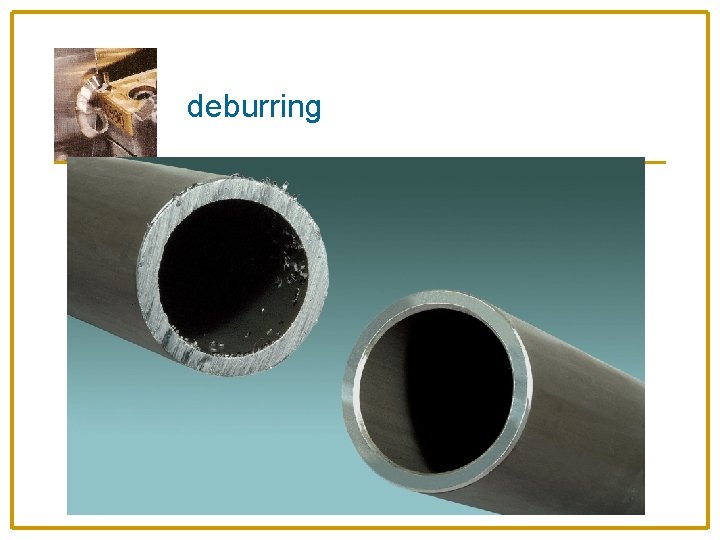
AJM Application Notes § Usually performed manually by operator who aims nozzle § Normally used as a finishing process rather than cutting process § Applications: deburring, trimming and deflashing, cleaning, and polishing § Work materials: thin flat stock of hard, brittle materials (e. g. , glass, silicon, mica, ceramics) © 2013 John Wiley & Sons, Inc. M P Groover, Principles of Modern Manufacturing 5/e
deburring © 2013 John Wiley & Sons, Inc. M P Groover, Principles of Modern Manufacturing 5/e
Electrochemical Machining Processes § A group of processes in which electrical energy is used in combination with chemical reactions to remove material § Reverse of electroplating § Work material must be a conductor § Processes: § Electrochemical machining (ECM) § Electrochemical deburring (ECD) § Electrochemical grinding (ECG) © 2013 John Wiley & Sons, Inc. M P Groover, Principles of Modern Manufacturing 5/e
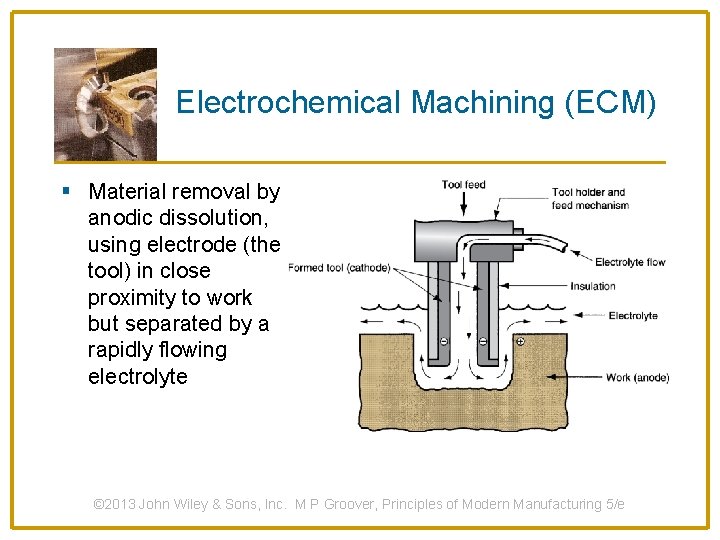
Electrochemical Machining (ECM) § Material removal by anodic dissolution, using electrode (the tool) in close proximity to work but separated by a rapidly flowing electrolyte © 2013 John Wiley & Sons, Inc. M P Groover, Principles of Modern Manufacturing 5/e
ECM Applications § Die sinking - irregular shapes and contours forging dies, plastic molds, and other tools § Multiple hole drilling - many holes can be drilled simultaneously with ECM § Holes that are not round § Rotating drill is not used in ECM § Deburring © 2013 John Wiley & Sons, Inc. M P Groover, Principles of Modern Manufacturing 5/e
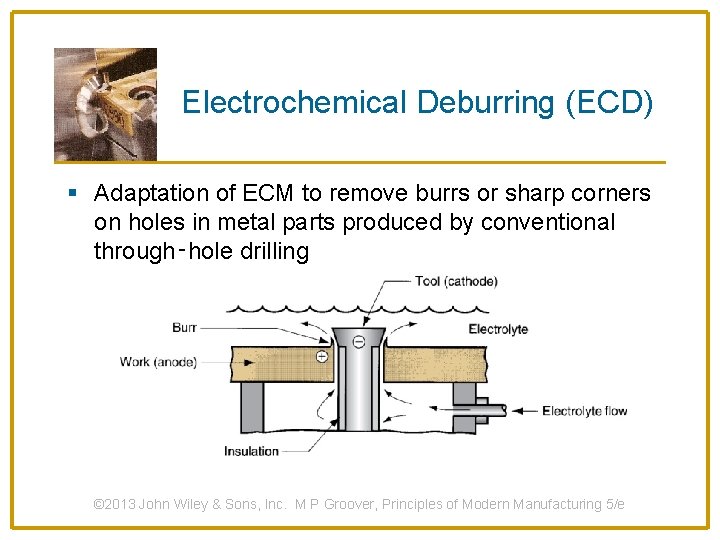
Electrochemical Deburring (ECD) § Adaptation of ECM to remove burrs or sharp corners on holes in metal parts produced by conventional through‑hole drilling © 2013 John Wiley & Sons, Inc. M P Groover, Principles of Modern Manufacturing 5/e
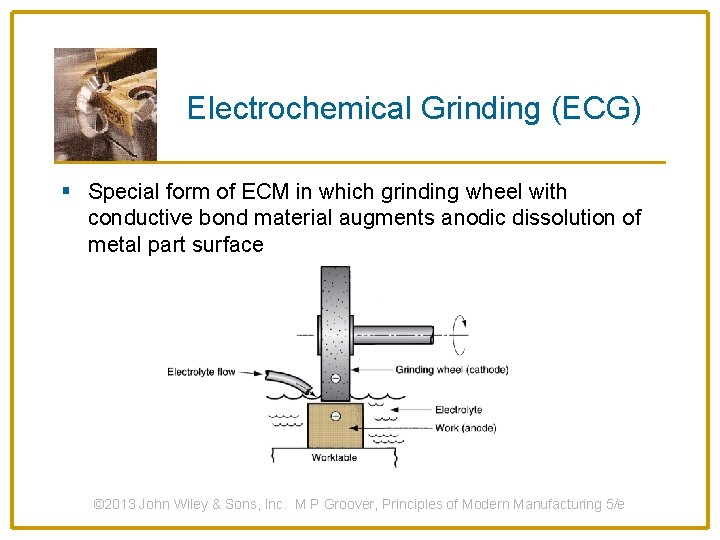
Electrochemical Grinding (ECG) § Special form of ECM in which grinding wheel with conductive bond material augments anodic dissolution of metal part surface © 2013 John Wiley & Sons, Inc. M P Groover, Principles of Modern Manufacturing 5/e
Applications and Advantages of ECG § Applications: § Sharpening of cemented carbide tools § Grinding of surgical needles and other thin-wall tubes, and fragile parts § Advantages: § Deplating responsible for 95% of metal removal § Because machining is mostly by electrochemical action, grinding wheel lasts much longer © 2013 John Wiley & Sons, Inc. M P Groover, Principles of Modern Manufacturing 5/e
Thermal Energy Processes Overview § Very high local temperatures § Material is removed by fusion or vaporization § Physical and metallurgical damage to the new work surface § In some cases, resulting finish is so poor that subsequent processing is required © 2013 John Wiley & Sons, Inc. M P Groover, Principles of Modern Manufacturing 5/e
Thermal Energy Processes § § § Electric discharge machining Electric discharge wire cutting Electron beam machining Laser beam machining Plasma arc machining Conventional thermal cutting processes © 2013 John Wiley & Sons, Inc. M P Groover, Principles of Modern Manufacturing 5/e
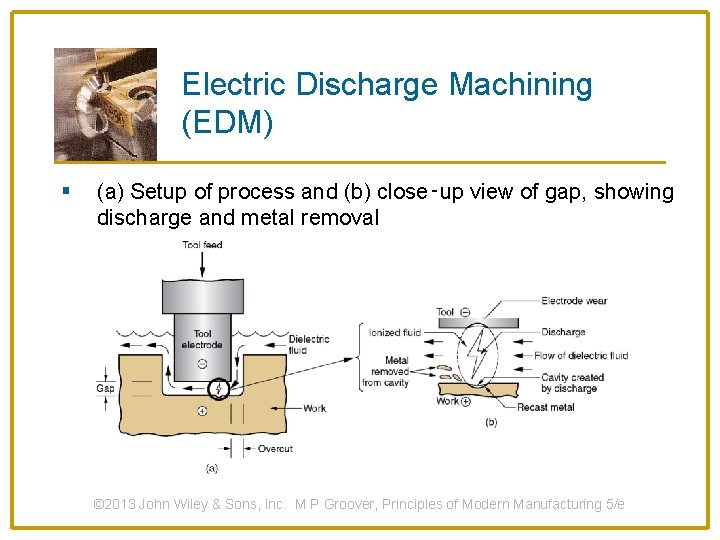
Electric Discharge Processes § Metal removal by a series of discrete electrical discharges (sparks) causing localized temperatures high enough to melt or vaporize the metal § Can be used only on electrically conducting work materials § Two main processes: § Electric discharge machining § Wire electric discharge machining © 2013 John Wiley & Sons, Inc. M P Groover, Principles of Modern Manufacturing 5/e
Electric Discharge Machining (EDM) § (a) Setup of process and (b) close‑up view of gap, showing discharge and metal removal © 2013 John Wiley & Sons, Inc. M P Groover, Principles of Modern Manufacturing 5/e
Work Materials in EDM § Work materials must be electrically conducting § Hardness and strength of work material are not factors in EDM § Material removal rate depends on melting point of work material © 2013 John Wiley & Sons, Inc. M P Groover, Principles of Modern Manufacturing 5/e
EDM Applications § Tooling for many mechanical processes: molds for plastic injection molding, extrusion dies, wire drawing dies, forging and heading dies, and sheetmetal stamping dies § Production parts: delicate parts not rigid enough to withstand conventional cutting forces, hole drilling where hole axis is at an acute angle to surface, and machining of hard and exotic metals © 2013 John Wiley & Sons, Inc. M P Groover, Principles of Modern Manufacturing 5/e
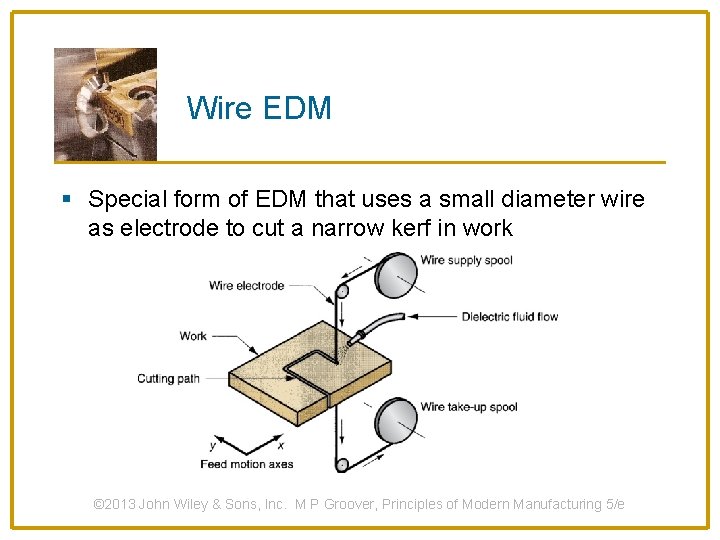
Wire EDM § Special form of EDM that uses a small diameter wire as electrode to cut a narrow kerf in work © 2013 John Wiley & Sons, Inc. M P Groover, Principles of Modern Manufacturing 5/e
Operation of Wire EDM § Work is fed slowly past wire along desired path § Similar to a bandsaw operation § CNC used for motion control § While cutting, wire is continuously advanced between supply spool and take‑up spool to maintain a constant diameter § Dielectric required, using nozzles directed at tool‑work interface or submerging workpart © 2013 John Wiley & Sons, Inc. M P Groover, Principles of Modern Manufacturing 5/e
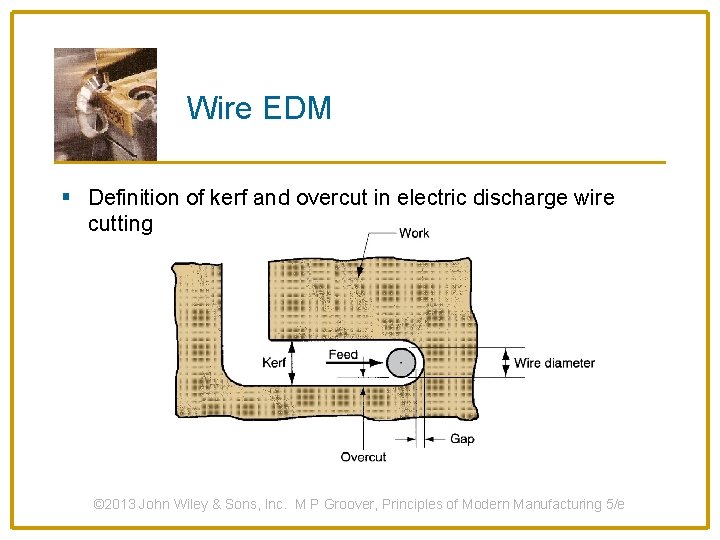
Wire EDM § Definition of kerf and overcut in electric discharge wire cutting © 2013 John Wiley & Sons, Inc. M P Groover, Principles of Modern Manufacturing 5/e
Wire EDM Applications § Ideal for stamping die components § Since kerf is so narrow, it is often possible to fabricate punch and die in a single cut § Other tools and parts with intricate outline shapes, such as lathe form tools, extrusion dies, and flat templates © 2013 John Wiley & Sons, Inc. M P Groover, Principles of Modern Manufacturing 5/e
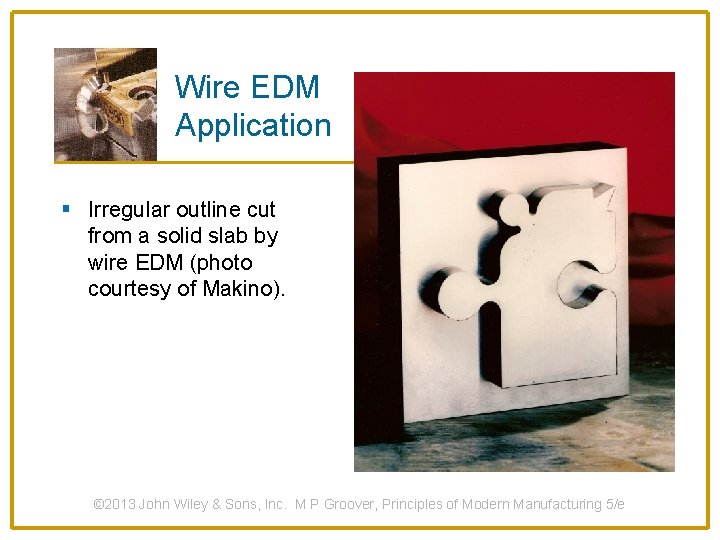
Wire EDM Application § Irregular outline cut from a solid slab by wire EDM (photo courtesy of Makino). © 2013 John Wiley & Sons, Inc. M P Groover, Principles of Modern Manufacturing 5/e