
NONSYNOSTOTIC OCCIPITAL PLAGIOCEPHALY Radiographic Changes of the StickySuture
- Slides: 1
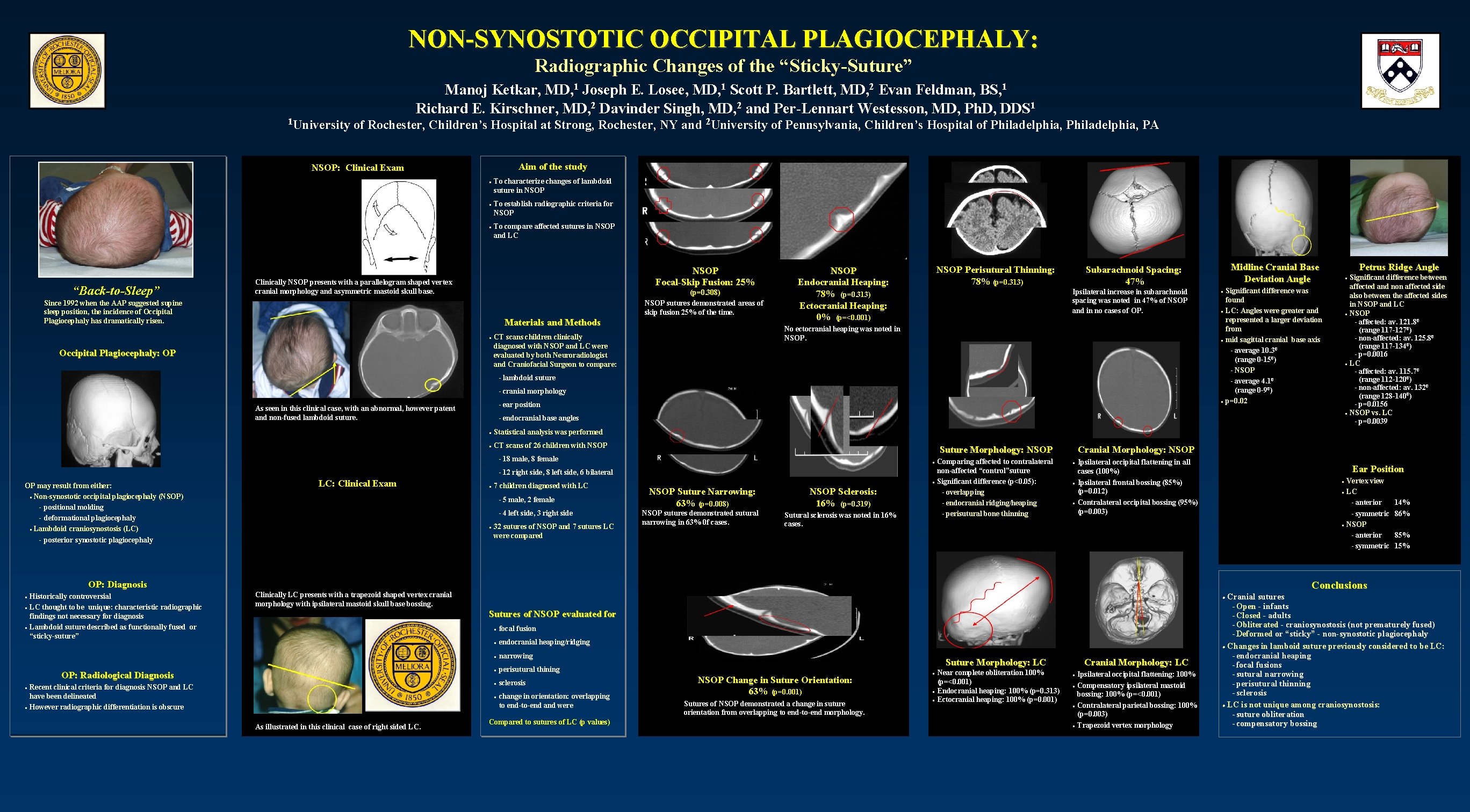
NON-SYNOSTOTIC OCCIPITAL PLAGIOCEPHALY: Radiographic Changes of the “Sticky-Suture” 1 University Manoj Ketkar, MD, 1 Joseph E. Losee, MD, 1 Scott P. Bartlett, MD, 2 Evan Feldman, BS, 1 Richard E. Kirschner, MD, 2 Davinder Singh, MD, 2 and Per-Lennart Westesson, MD, Ph. D, DDS 1 of Rochester, Children’s Hospital at Strong, Rochester, NY and 2 University of Pennsylvania, Children’s Hospital of Philadelphia, PA Aim of the study NSOP: Clinical Exam l l l “Back-to-Sleep” To characterize changes of lambdoid suture in NSOP To establish radiographic criteria for NSOP To compare affected sutures in NSOP and LC NSOP Focal-Skip Fusion: 25% Clinically NSOP presents with a parallelogram shaped vertex cranial morphology and asymmetric mastoid skull base. (p=0. 308) NSOP sutures demonstrated areas of skip fusion 25% of the time. Since 1992 when the AAP suggested supine sleep position, the incidence of Occipital Plagiocephaly has dramatically risen. Materials and Methods l Occipital Plagiocephaly: OP Ipsilateral increase in subarachnoid spacing was noted in 47% of NSOP and in no cases of OP. No ectocranial heaping was noted in NSOP. CT scans children clinically diagnosed with NSOP and LC were evaluated by both Neuroradiologist and Craniofacial Surgeon to compare: Midline Cranial Base Deviation Angle Subarachnoid Spacing: 47% NSOP Perisutural Thinning: 78% (p=0. 313) NSOP Endocranial Heaping: 78% (p=0. 313) Ectocranial Heaping: 0% (p=<0. 001) l l l - lambdoid suture - cranial morphology - ear position As seen in this clinical case, with an abnormal, however patent and non-fused lambdoid suture. l l Statistical analysis was performed l CT scans of 26 children with NSOP Suture Morphology: NSOP l l Historically controversial LC thought to be unique: characteristic radiographic findings not necessary for diagnosis Lambdoid suture described as functionally fused or “sticky-suture” l 7 children diagnosed with LC - 5 male, 2 female - 4 left side, 3 right side l l 32 sutures of NSOP and 7 sutures LC were compared l NSOP Suture Narrowing: 63% (p=0. 008) NSOP sutures demonstrated sutural narrowing in 63% 0 f cases. NSOP Sclerosis: 16% (p=0. 319) Sutural sclerosis was noted in 16% cases. Comparing affected to contralateral non-affected “control”suture Significant difference (p<0. 05): - overlapping - endocranial ridging/heaping - perisutural bone thinning l l l Ipsilateral occipital flattening in all cases (100%) Ipsilateral frontal bossing (85%) (p=0. 012) Contralateral occipital bossing (95%) (p=0. 003) l Ear Position l l l 14% 86% 85% 15% Cranial sutures - Open - infants - Closed - adults - Obliterated - craniosynostosis (not prematurely fused) - Deformed or “sticky” - non-synostotic plagiocephaly l Changes in lamboid suture previously considered to be LC: - endocranial heaping - focal fusions - sutural narrowing - perisutural thinning - sclerosis l LC is not unique among craniosynostosis: - suture obliteration - compensatory bossing l l focal fusion l endocranial heaping/ridging l narrowing l perisutural thining l l As illustrated in this clinical case of right sided LC. Vertex view LC - anterior - symmetric NSOP - anterior - symmetric Conclusions Sutures of NSOP evaluated for Recent clinical criteria for diagnosis NSOP and LC have been delineated However radiographic differentiation is obscure l l Clinically LC presents with a trapezoid shaped vertex cranial morphology with ipsilateral mastoid skull base bossing. OP: Radiological Diagnosis l Significant difference between affected and non affected side also between the affected sides in NSOP and LC NSOP - affected: av. 121. 80 (range 117 -1270) - non-affected: av. 125. 80 (range 117 -1340) - p=0. 0016 LC - affected: av. 115. 70 (range 112 -1200) - non-affected: av. 1320 (range 128 -1400) - p=0. 0156 NSOP vs. LC - p=0. 0039 Cranial Morphology: NSOP OP: Diagnosis l Significant difference was found LC: Angles were greater and represented a larger deviation from mid sagittal cranial base axis - average 10. 30 (range 0 -150) - NSOP - average 4. 10 (range 0 -90) p=0. 02 l - 12 right side, 8 left side, 6 bilateral LC: Clinical Exam l - endocranial base angles - 18 male, 8 female OP may result from either: l Non-synostotic occipital plagiocephaly (NSOP) - positional molding - deformational plagiocephaly l Lambdoid craniosynostosis (LC) - posterior synostotic plagiocephaly Petrus Ridge Angle sclerosis change in orientation: overlapping to end-to-end and were Compared to sutures of LC (p values) Suture Morphology: LC NSOP Change in Suture Orientation: 63% (p=0. 001) Sutures of NSOP demonstrated a change in suture orientation from overlapping to end-to-end morphology. l l l Near complete obliteration 100% (p=<0. 001) Endocranial heaping: 100% (p=0. 313) Ectocranial heaping: 100% (p=0. 001) Cranial Morphology: LC l l Ipsilateral occipital flattening: 100% Compensatory ipsilateral mastoid bossing: 100% (p=<0. 001) Contralateral parietal bossing: 100% (p=0. 003) Trapezoid vertex morphology