
NonStationary Single Channel Analysis Single Channel Traces First

- Slides: 11
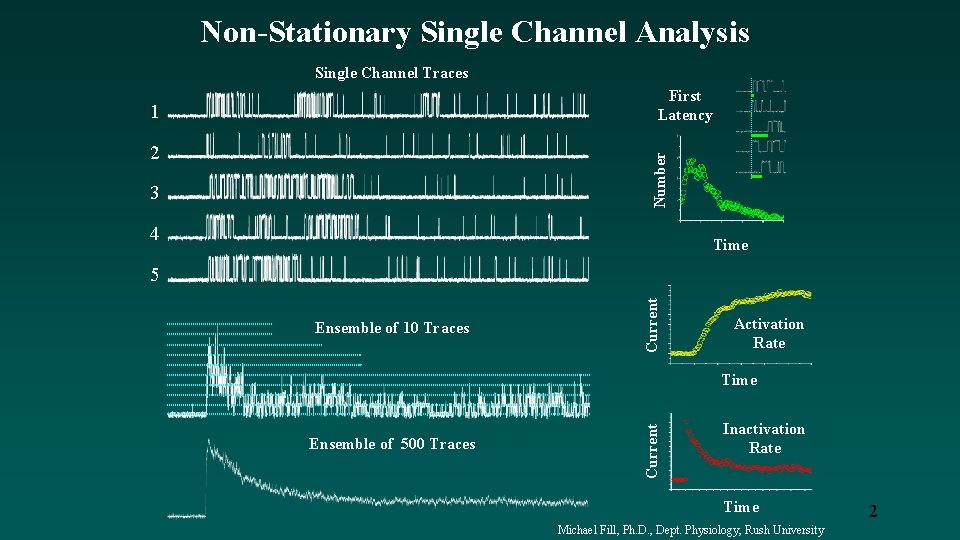
Non-Stationary Single Channel Analysis Single Channel Traces First Latency 1 Number 2 3 4 Time Ensemble of 10 Traces Current 5 Activation Rate Ensemble of 500 Traces Current Time Inactivation Rate Time Michael Fill, Ph. D. , Dept. Physiology, Rush University 2
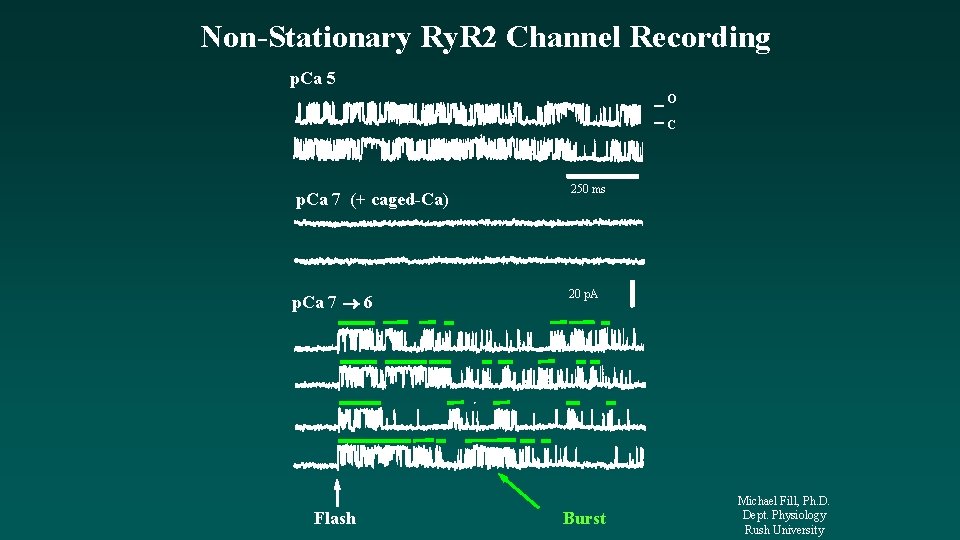
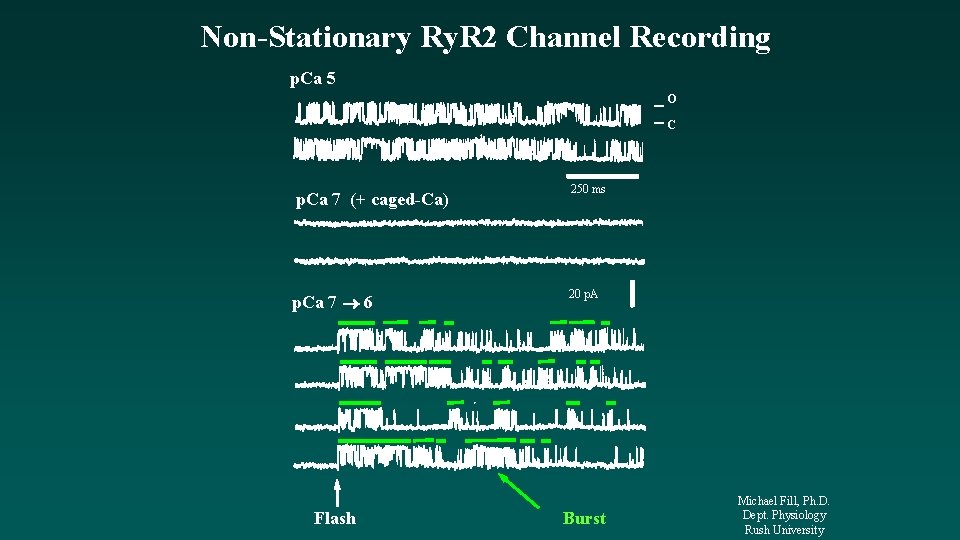
Non-Stationary Ry. R 2 Channel Recording p. Ca 5 O C p. Ca 7 (+ caged-Ca) p. Ca 7 6 Flash 250 ms 20 p. A Burst Michael Fill, Ph. D. Dept. Physiology Rush University
More? 4
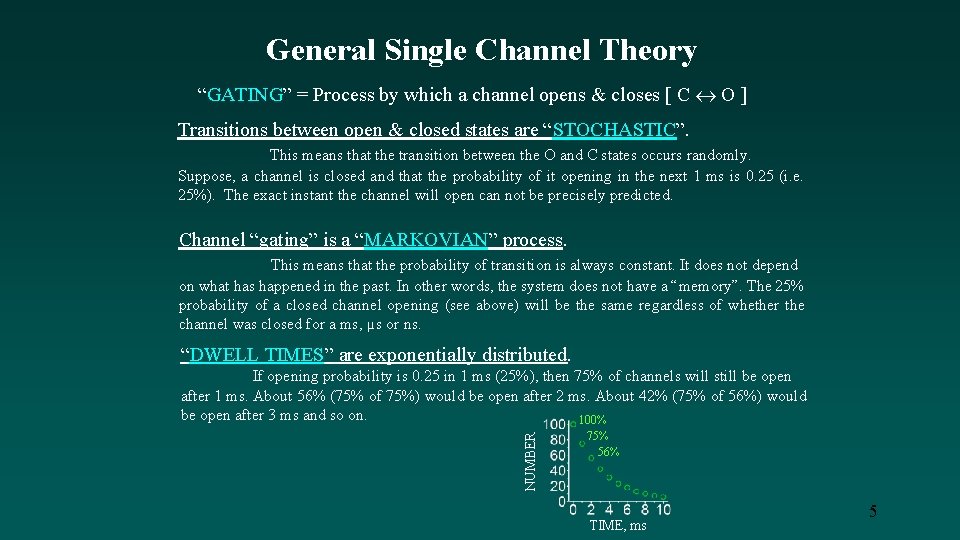
General Single Channel Theory “GATING” = Process by which a channel opens & closes [ C O ] Transitions between open & closed states are “STOCHASTIC”. This means that the transition between the O and C states occurs randomly. Suppose, a channel is closed and that the probability of it opening in the next 1 ms is 0. 25 (i. e. 25%). The exact instant the channel will open can not be precisely predicted. Channel “gating” is a “MARKOVIAN” process. This means that the probability of transition is always constant. It does not depend on what has happened in the past. In other words, the system does not have a “memory”. The 25% probability of a closed channel opening (see above) will be the same regardless of whether the channel was closed for a ms, µs or ns. “DWELL TIMES” are exponentially distributed. NUMBER If opening probability is 0. 25 in 1 ms (25%), then 75% of channels will still be open after 1 ms. About 56% (75% of 75%) would be open after 2 ms. About 42% (75% of 56%) would be open after 3 ms and so on. 100% 75% 56% TIME, ms 5
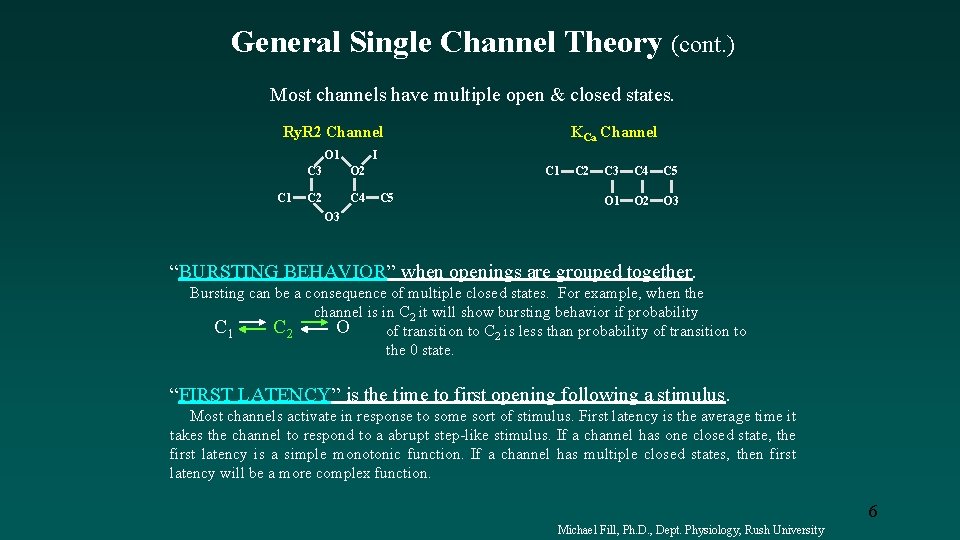
General Single Channel Theory (cont. ) Most channels have multiple open & closed states. Ry. R 2 Channel O 1 C 1 KCa Channel I C 3 O 2 C 4 C 1 C 5 C 2 C 3 C 4 C 5 O 1 O 2 O 3 “BURSTING BEHAVIOR” when openings are grouped together. Bursting can be a consequence of multiple closed states. For example, when the channel is in C 2 it will show bursting behavior if probability C 1 C 2 O of transition to C 2 is less than probability of transition to the 0 state. “FIRST LATENCY” is the time to first opening following a stimulus. Most channels activate in response to some sort of stimulus. First latency is the average time it takes the channel to respond to a abrupt step-like stimulus. If a channel has one closed state, the first latency is a simple monotonic function. If a channel has multiple closed states, then first latency will be a more complex function. 6 Michael Fill, Ph. D. , Dept. Physiology, Rush University
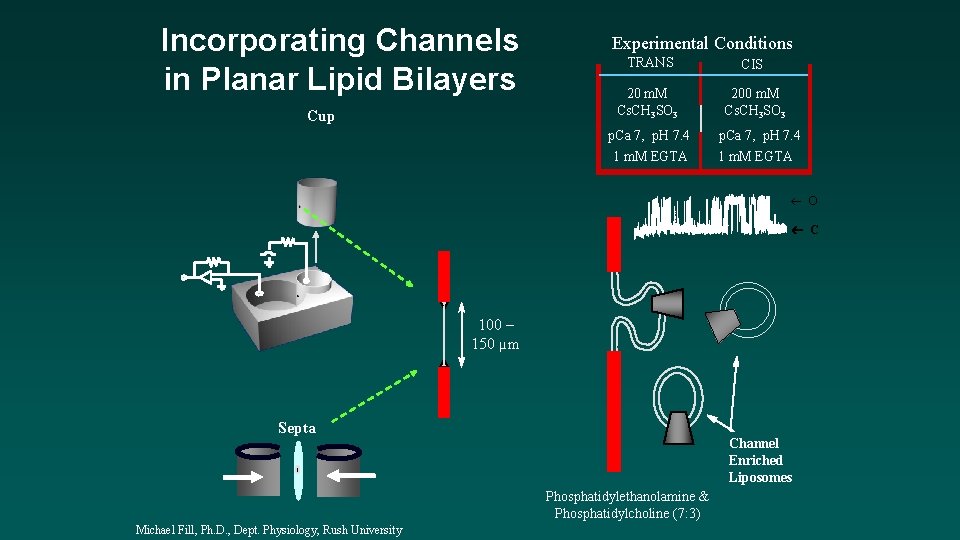
Incorporating Channels in Planar Lipid Bilayers Cup Experimental Conditions TRANS CIS 20 m. M Cs. CH 3 SO 3 200 m. M Cs. CH 3 SO 3 p. Ca 7, p. H 7. 4 1 m. M EGTA O C 100 – 150 µm Septa Channel Enriched Liposomes Phosphatidylethanolamine & Phosphatidylcholine (7: 3) Michael Fill, Ph. D. , Dept. Physiology, Rush University
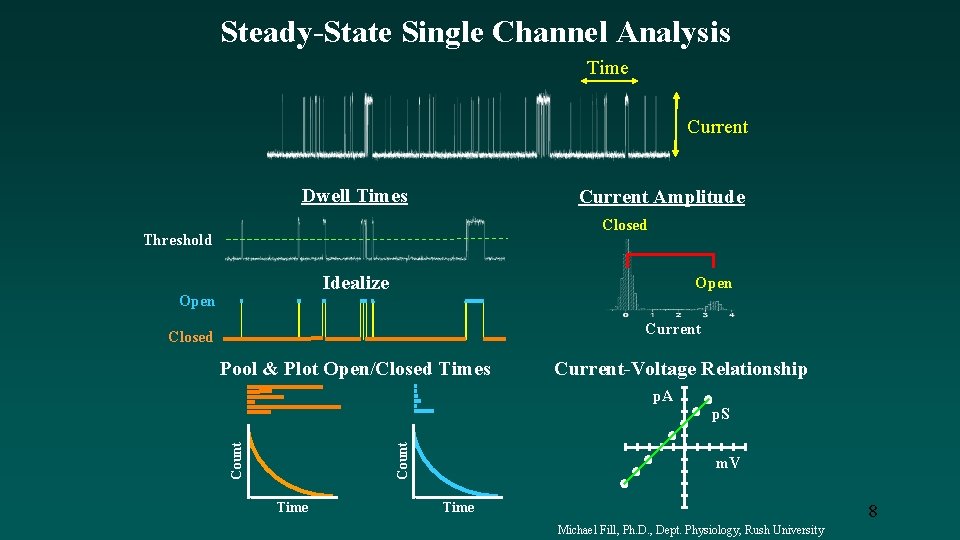
Steady-State Single Channel Analysis Time Current Dwell Times Current Amplitude Closed Threshold Idealize Open Current Closed Pool & Plot Open/Closed Times Current-Voltage Relationship p. A Count p. S Time m. V Time 8 Michael Fill, Ph. D. , Dept. Physiology, Rush University
Non-Stationary Single Channel Analysis Single Channel Traces First Latency 1 Number 2 3 4 Time Ensemble of 10 Traces Current 5 Activation Rate Ensemble of 500 Traces Current Time Inactivation Rate Time Michael Fill, Ph. D. , Dept. Physiology, Rush University 9
Non-Stationary Ry. R 2 Channel Recording p. Ca 5 O C p. Ca 7 (+ caged-Ca) p. Ca 7 6 Flash 250 ms 20 p. A Burst Michael Fill, Ph. D. Dept. Physiology Rush University
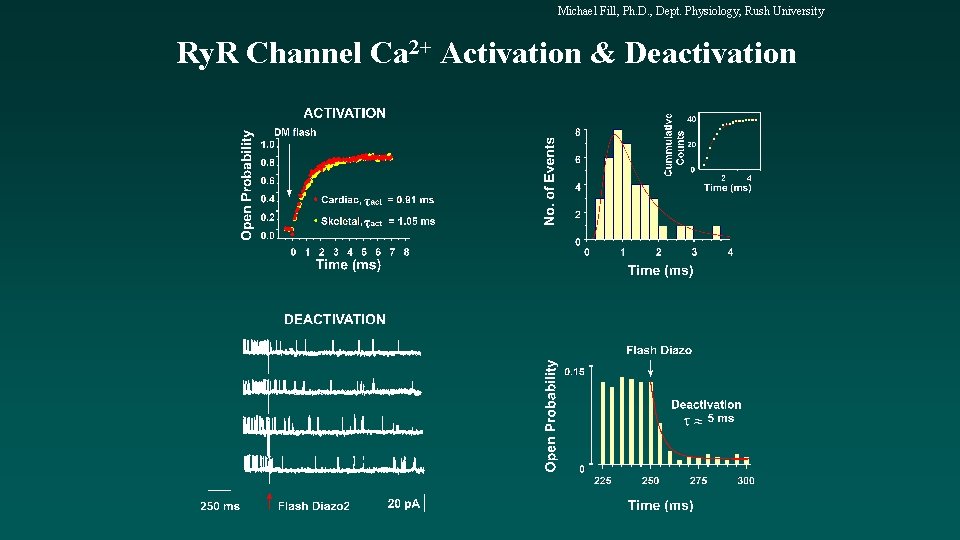
Michael Fill, Ph. D. , Dept. Physiology, Rush University Ry. R Channel Ca 2+ Activation & Deactivation