
NonSegmental Phonology sounds other than sound segments Kuiper
- Slides: 9
Non-Segmental Phonology sounds other than sound segments Kuiper and Allan Chapter 6
Sub areas of non-segmental phonology • Syllables (Kuiper an Allan, 6. 1) • Suprasegmentals (Kuiper and Allan, 6. 2) – pitch – intonation • Stress (Kuiper and Allan, 6. 3)
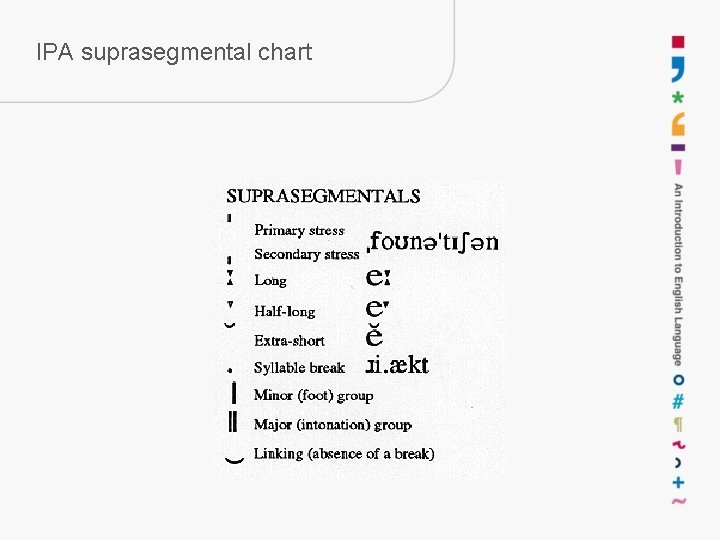
IPA suprasegmental chart
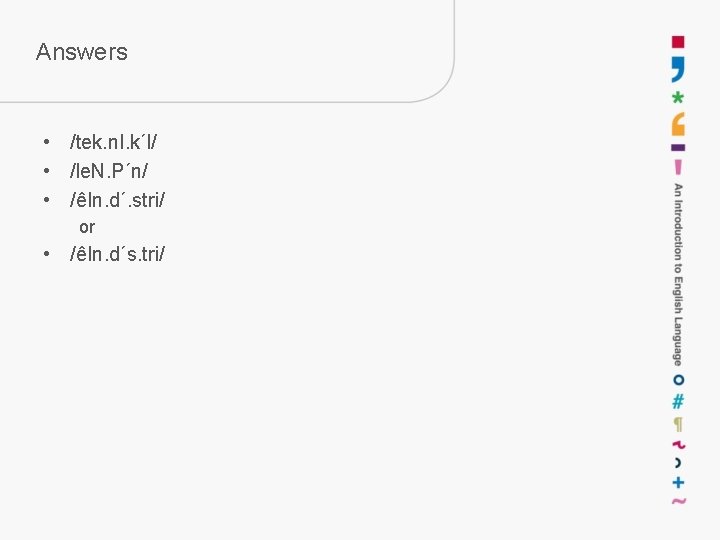
Exercise Transcribe the words below phonemically and place a syllable marker (a low dot) between the syllables: technical lengthen industry
Answers • /tek. n. I. k´l/ • /le. N. P´n/ • /êIn. d´. stri/ or • /êIn. d´s. tri/
Syllables • Native speakers have intuitions about where syllable boundaries are. • The number of syllables in a word is connected with the number of vowels. • Consonants are at syllable boundaries. • Sometimes a consonant can belong to either of two adjoining syllables.
Syllable structure and phonotactics • Acceptable consonant clusters (initially or finally in a syllable) are determined by the phonotactics of the language. – /skr/ is a permissible syllable initial consonant cluster in English. – /sbl/ is not.
Exercises 1. Why are the following syllable divisions bad? o. bscure infi. ltration unp. rete. ntious 2. Why are the following, optional syllable boundaries? re. tri. bu. tion vs ret. rib. u. tion
Ambisyllabic consonants • can belong to either the end of one or beginning of the next adjacent syllables. – su(s)tain