
Nonrelativistic and relativistic SUSY constructions in QM seminar





- Slides: 60
Non-relativistic and relativistic SUSY constructions in QM seminar May 5, 2005 Physics Institute, Prague
Collaborators: • B. Bagchi and A. Banerjee (India) • H. Bíla (Czechia) • E. Caliceti and F. Cannata (Italy) • H. B. Geyer (South Africa) • V. Jakubský (Czechia) • G. Lévai (Hungary) • S. Mallik (India) • C. Quesne (Belgium) • R. Roychoudhury (India) • A. Ventura (Italy) • M. Znojil (Czechia) seminar May 5, 2005 Physics Institute, Prague
TABLE OF CONTENTS I. ZOO OF SYMMETRIES II. SUSY PLUS PT-SYMMETRY III. NON-RELATIVISTIC MODELS IV. RELATIVISTIC WITTEN V. CONCLUSIONS seminar May 5, 2005 Physics Institute, Prague
idea (remember Darwin): from symmetries towards supersymmetries towards PT symmetries ie, for introduction: list parallels between the concepts of symmetry, supersymmetry and (up to now less common) PT symmetry seminar May 5, 2005 Physics Institute, Prague
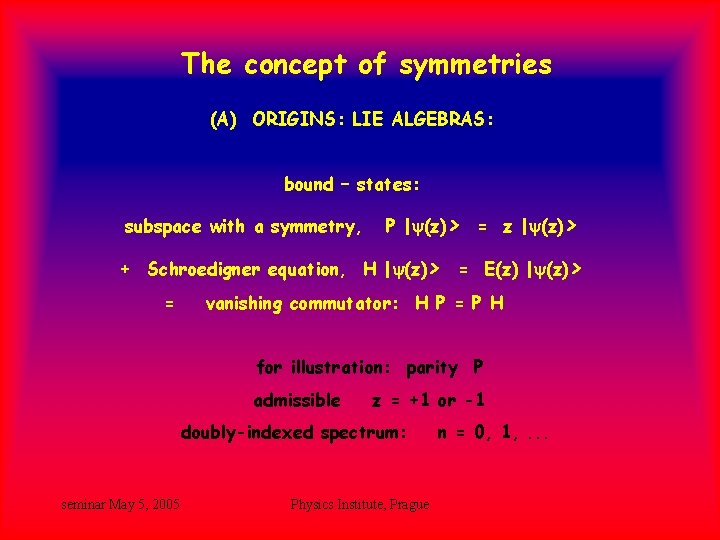
The concept of symmetries (A) ORIGINS: LIE ALGEBRAS: bound – states: subspace with a symmetry, P |y(z)> = z |y(z)> + Schroedigner equation, H |y(z)> = E(z) |y(z)> = vanishing commutator: H P = P H for illustration: parity P admissible z = +1 or -1 doubly-indexed spectrum: seminar May 5, 2005 Physics Institute, Prague n = 0, 1, . . .
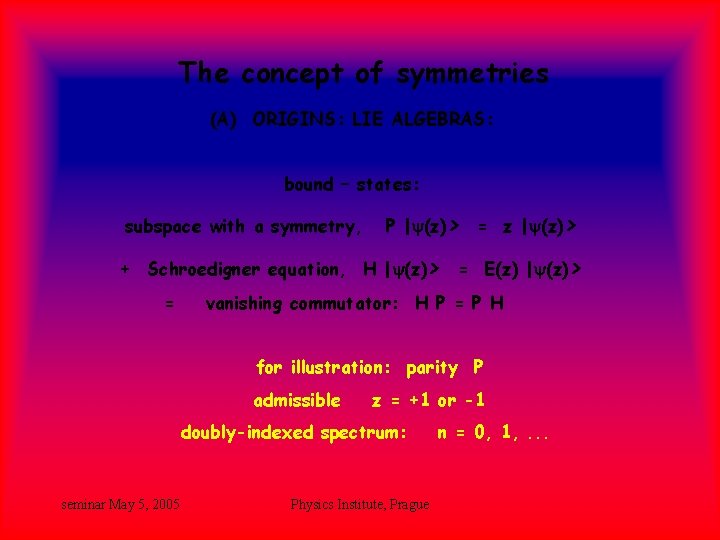
The concept of symmetries (A) ORIGINS: LIE ALGEBRAS: bound – states: subspace with a symmetry, P |y(z)> = z |y(z)> + Schroedigner equation, H |y(z)> = E(z) |y(z)> = vanishing commutator: H P = P H for illustration: parity P admissible z = +1 or -1 doubly-indexed spectrum: seminar May 5, 2005 Physics Institute, Prague n = 0, 1, . . .
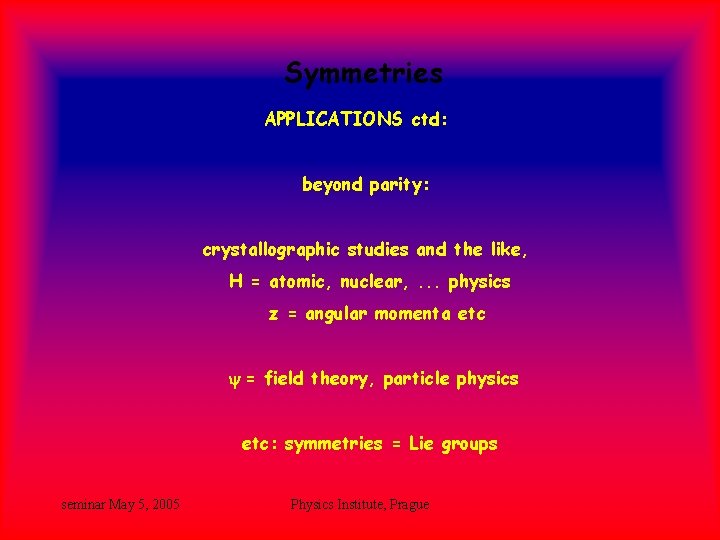
Symmetries APPLICATIONS ctd: beyond parity: crystallographic studies and the like, H = atomic, nuclear, . . . physics z = angular momenta etc y = field theory, particle physics etc: symmetries = Lie groups seminar May 5, 2005 Physics Institute, Prague
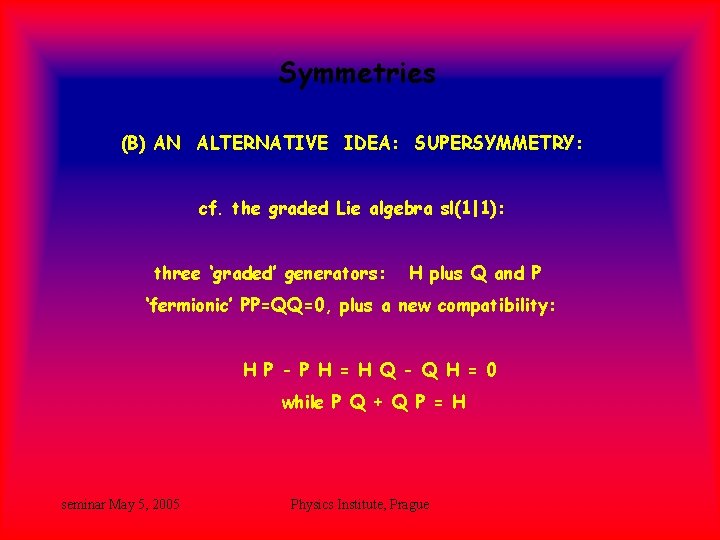
Symmetries (B) AN ALTERNATIVE IDEA: SUPERSYMMETRY: cf. the graded Lie algebra sl(1|1): three ‘graded’ generators: H plus Q and P ‘fermionic’ PP=QQ=0, plus a new compatibility: H P - P H = H Q - Q H = 0 while P Q + Q P = H seminar May 5, 2005 Physics Institute, Prague
Symmetries SUPERSYMMETRY and sl(1|1) ctd. specific representation of operators: SUSY QM: H = direct sum of the ‘left’ and ‘right’ H(L, R) Q (lower, a) and P (upper, c) are nilpotent, D=2 a = upper (annih. ), c = lower (creation), D=oo related representation of |y(z)>: two components in |y(z)>: z=(f, b), f = 0 or 1 conventional HO: f=1 if |b> = down, f=0 if up seminar May 5, 2005 Physics Institute, Prague
Symmetries SUPERSYMMETRY and sl(1|1) ctd. specific representation of operators: SUSY QM: H = direct sum of the ‘left’ and ‘right’ H(L, R) Q (lower, a) and P (upper, c) are nilpotent, D=2 a = upper (annih. ), c = lower (creation), D=oo related representation of |y(z)>: two components in |y(z)>: z=(f, b), f = 0 or 1 conventional HO: f=1 if |b> = down, f=0 if up seminar May 5, 2005 Physics Institute, Prague
Symmetries SUPERSYMMETRY, sl(1|1), 2 x 2 operators and 2 -D |y(f, b)> ctd. • solvable HO, field theory (Fock space): • non-vanishing Q |y(0, b)> = z |y(1, b-1)> non-vanishing • P |y(1, b)> = z’ |y(0, b+1)> applications beyond HO: two Schroedigner equations and a partnership E(L, R) partners H -> shape invariance, exact solvability seminar May 5, 2005 Physics Institute, Prague
Symmetries SUPERSYMMETRY, sl(1|1), 2 x 2 operators and 2 -D |y(f, b)> ctd. • solvable HO, field theory (Fock space): • non-vanishing Q |y(0, b)> = z |y(1, b-1)> non-vanishing • P |y(1, b)> = z’ |y(0, b+1)> applications beyond HO: two Schroedigner equations and a partnership E(L, R) partners H -> shape invariance, exact solvability seminar May 5, 2005 Physics Institute, Prague
Symmetries (C) Introduction of the third class of antilinear, so called PT - SYMMETRIES • a prelude: a return to time-reversal T-symmetry review QM note that T-operation coincides with h. c. -operation • pre-history: BW (‘ 68): natural complexification of perturbations CGM (‘ 80): real energies for imaginary cubic AHO B (‘ 92): numerical experiments with V(x) = i x^3 BG (‘ 93): real spectra at quartic repulsion V=-x^4 seminar May 5, 2005 Physics Institute, Prague
Symmetries (C) Introduction of the third class of antilinear, so called PT - SYMMETRIES • a prelude: a return to time-reversal T-symmetry review QM note that T-operation coincides with h. c. -operation • pre-history: BW (‘ 68): natural complexification of perturbations CGM (‘ 80): real energies for imaginary cubic AHO B (‘ 92): numerical experiments with V(x) = i x^3 BG (‘ 93): real spectra at quartic repulsion V=-x^4 seminar May 5, 2005 Physics Institute, Prague
Symmetries, use of PT symmetry: NON-HERMITIAN QUANTUM THEORIES: • idea: Hermiticity violated in pert. theory, in phenomenology (condensed matter, biology) etc. • the first implementations of PT symmetry: BM (‘ 97): delta-expansions (in field theory) BB (‘ 98): WKB (in quantum mechanics) CJT (‘ 98): exact (Bessel functions) FGRZ (‘ 98): perturbations (of imaginary cubic) BB (‘ 98): QES quartic seminar May 5, 2005 Physics Institute, Prague
Symmetries A RETURN TO CLASSICS: • representations: Wigner in 1960’s (+rediscoveries) • fights for an acceptance in physics: indefinite metric in 1940’s (Dirac etc) Gupta and Bleuler and their elimination trick relativistic QM and 2 x 2 KG equation: FV (‘ 58) field-models of Lie, Wick and Nishijima MHD: U. G. , cosmology: A. M. exceptional points (BW singularities, measured !) seminar May 5, 2005 Physics Institute, Prague
Symmetries PT - SYMMETRY’s SUMMARY: • an agreement on its consistency in physics: PQ (quasi-parity): Z (‘ 99), BQZ (‘ 01) CPT symmetry: BBJ (‘ 02) metric eta plus: M (‘ 02) a steady development of mathematics: proofs [DDT (‘ 02), S (‘ 03)] quasi-Hermiticity [SGH (‘ 92) + re-discoveries] systematics and classifications: ES, QES. . . manybody, multidimensional (Calogero, Henon-Heiles) seminar May 5, 2005 Physics Institute, Prague
Symmetries PT - SYMMETRY’s SUMMARY: • a steady development of mathematics: proofs [DDT (‘ 02), S (‘ 03)] quasi-Hermiticity [SGH (‘ 92) + re-discoveries] systematics and classifications: ES, QES. . . manybody, multidimensional (Calogero, Henon-Heiles) seminar May 5, 2005 Physics Institute, Prague
An interplay of symmetries (appendix) - 1 – (A-B interface) LIE vs. SUPER - SYMMETRY • key motivation in field theory: • multiplets, standard model • absence of SUSY partners in experiments • methodical laboratory: Witten’s SUSY QM seminar May 5, 2005 Physics Institute, Prague
An interplay of symmetries (a systematic review) - 2 A-C interface between LIE and PT - SYMMETRY typical for solvable models: sl(2, 2) [BQ (‘ 92)]: • new models, new Hermitian limits [ZT (‘ 91)] • methodical innovations: new boundary conditions • for SUSY: regularization of singularities seminar May 5, 2005 Physics Institute, Prague
An interplay of symmetries (a systematic review) - 3 B-C interface between SUSY and PT - SYMMETRY a core of our message - key points: • new classes of representations • efficient regularization recipes • explicit constructions • new models seminar May 5, 2005 Physics Institute, Prague
II. Impact of PT on SUSY Harmonic oscillators are, after PT symmetrization, numbered by (non-integer) parameter g or a = |g|: = 1/2 in Hermitian case sign-parameter q (= +1 or -1) added q = -1 (fixed) in Hermitian case • energies E = 4 n+2 -2 a q Laguerre-polynomial wavefunctions exceptional points = unavoided level crossings • seminar May 5, 2005 Physics Institute, Prague
PT and SUSY representations: SUSY HO example: • initial superpotential W(g) • partners: H(L)= H(a)-2 g-2, • H(R)= H(b)-2 g, a = |g|, b = |g+1|, • hierarchy E (+, a) < E (+, b) < E (-, a) < E (-, b), ground E(L)=min(0, -4 g) (right: deg. and neg. ) the first excited R-state: E=min(4, -4 g) the 2 nd excited: max(0, -4 g) (right: nedeg. 0) seminar May 5, 2005 Physics Institute, Prague
PT and SUSY representations: SUSY HO example: • initial superpotential W(g) • partners: H(L)= H(a)-2 g-2, • H(R)= H(b)-2 g, a = |g|, b = |g+1|, • hierarchy E (+, a) < E (+, b) < E (-, a) < E (-, b), ground E(L)=min(0, -4 g) (right: deg. and neg. ) the first excited R-state: E=min(4, -4 g) the 2 nd excited: max(0, -4 g) (right: nedeg. 0) seminar May 5, 2005 Physics Institute, Prague
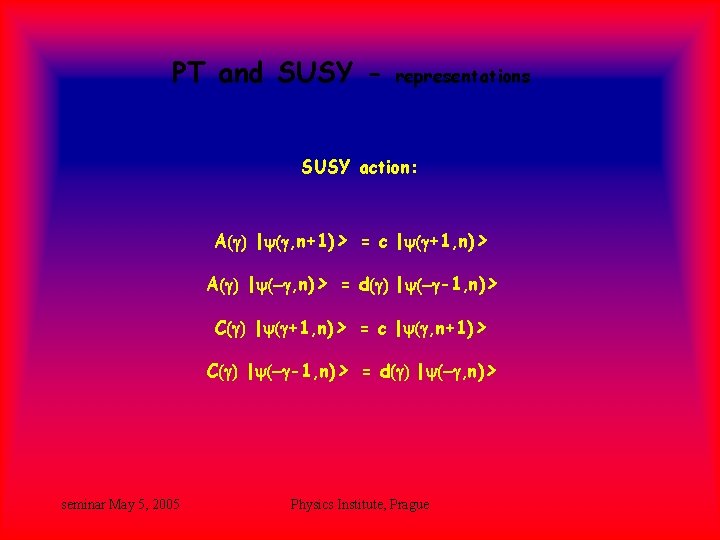
PT and SUSY - representations SUSY action: A(g) |y(g, n+1)> = c |y(g+1, n)> A(g) |y(-g, n)> = d(g) |y(-g-1, n)> C(g) |y(g+1, n)> = c |y(g, n+1)> C(g) |y(-g-1, n)> = d(g) |y(-g, n)> seminar May 5, 2005 Physics Institute, Prague
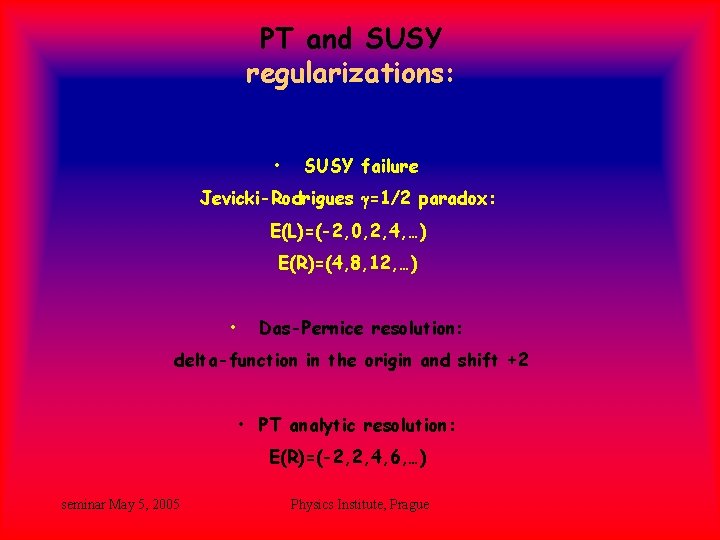
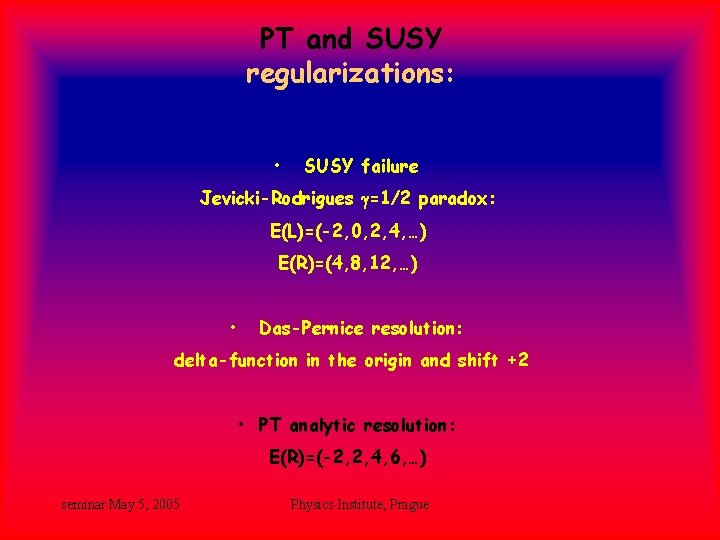
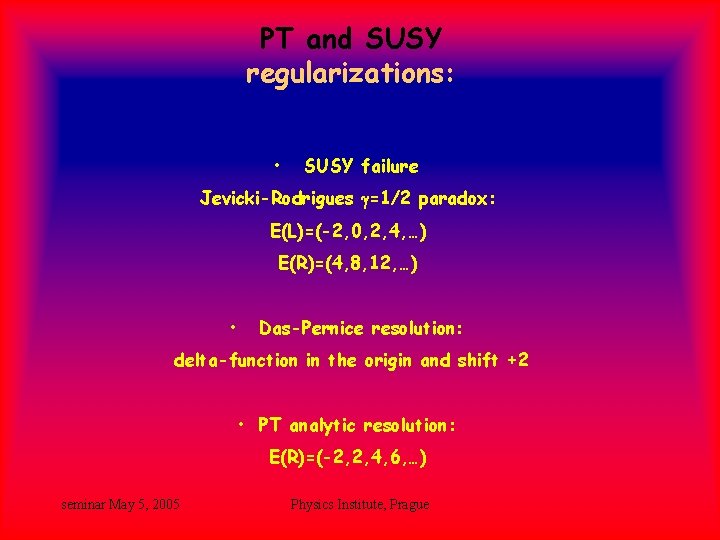
PT and SUSY regularizations: • SUSY failure Jevicki-Rodrigues g=1/2 paradox: E(L)=(-2, 0, 2, 4, …) E(R)=(4, 8, 12, …) • Das-Pernice resolution: delta-function in the origin and shift +2 • PT analytic resolution: E(R)=(-2, 2, 4, 6, …) seminar May 5, 2005 Physics Institute, Prague
PT and SUSY regularizations: • SUSY failure Jevicki-Rodrigues g=1/2 paradox: E(L)=(-2, 0, 2, 4, …) E(R)=(4, 8, 12, …) • Das-Pernice resolution: delta-function in the origin and shift +2 • PT analytic resolution: E(R)=(-2, 2, 4, 6, …) seminar May 5, 2005 Physics Institute, Prague
PT and SUSY regularizations: • SUSY failure Jevicki-Rodrigues g=1/2 paradox: E(L)=(-2, 0, 2, 4, …) E(R)=(4, 8, 12, …) • Das-Pernice resolution: delta-function in the origin and shift +2 • PT analytic resolution: E(R)=(-2, 2, 4, 6, …) seminar May 5, 2005 Physics Institute, Prague
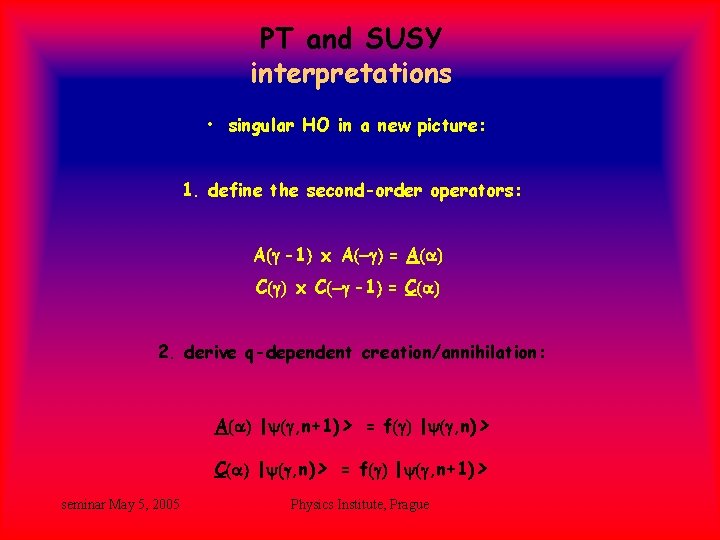
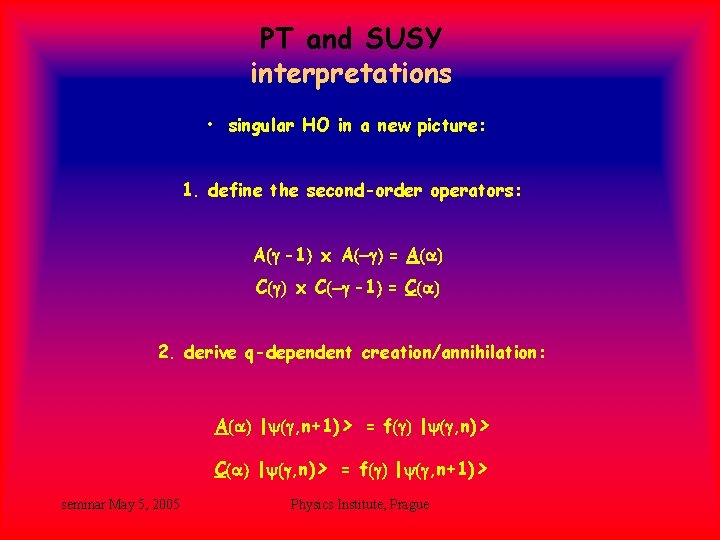
PT and SUSY interpretations • singular HO in a new picture: 1. define the second-order operators: A(g -1) x A(-g) = A(a) C(g) x C(-g -1) = C(a) 2. derive q-dependent creation/annihilation: A(a) |y(g, n+1)> = f(g) |y(g, n)> C(a) |y(g, n)> = f(g) |y(g, n+1)> seminar May 5, 2005 Physics Institute, Prague
PT and SUSY interpretations • singular HO in a new picture: 1. define the second-order operators: A(g -1) x A(-g) = A(a) C(g) x C(-g -1) = C(a) 2. derive q-dependent creation/annihilation: A(a) |y(g, n+1)> = f(g) |y(g, n)> C(a) |y(g, n)> = f(g) |y(g, n+1)> seminar May 5, 2005 Physics Institute, Prague
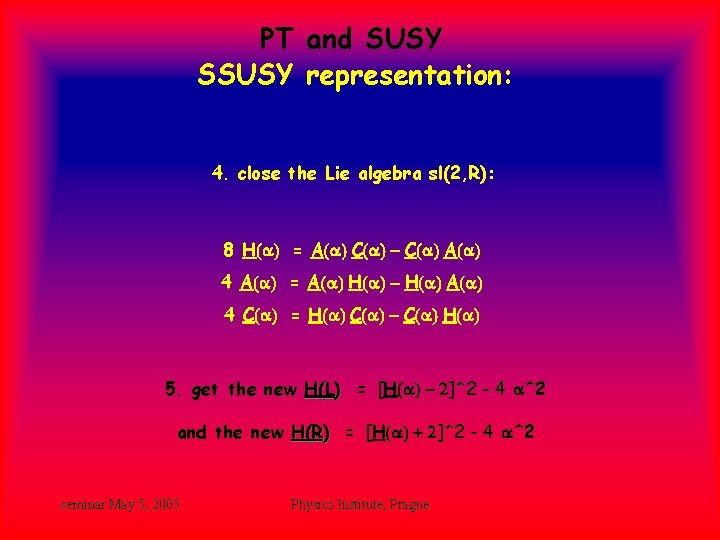
PT and SUSY SSUSY representation: 4. close the Lie algebra sl(2, R): 8 H(a) = A(a) C(a) - C(a) A(a) 4 A(a) = A(a) H(a) - H(a) A(a) 4 C(a) = H(a) C(a) - C(a) H(a) 5. get the new H(L) = [H(a) - 2]^2 - 4 a^2 and the new H(R) = [H(a) + 2]^2 - 4 a^2 seminar May 5, 2005 Physics Institute, Prague
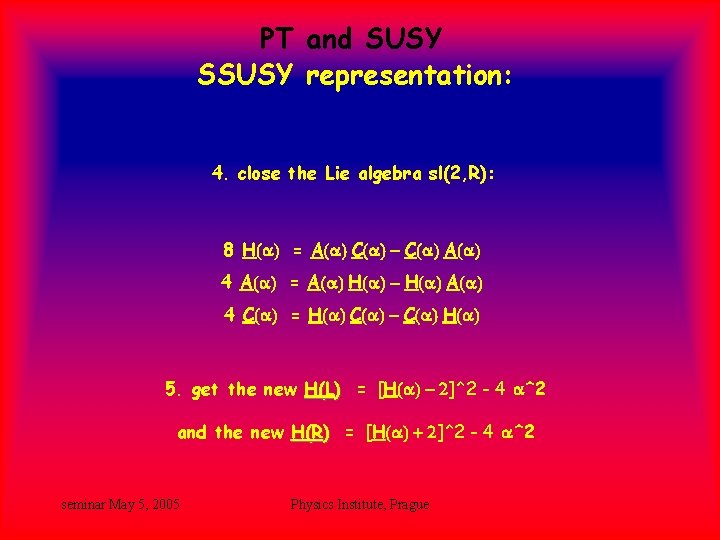
PT and SUSY SSUSY representation: 4. close the Lie algebra sl(2, R): 8 H(a) = A(a) C(a) - C(a) A(a) 4 A(a) = A(a) H(a) - H(a) A(a) 4 C(a) = H(a) C(a) - C(a) H(a) 5. get the new H(L) = [H(a) - 2]^2 - 4 a^2 and the new H(R) = [H(a) + 2]^2 - 4 a^2 seminar May 5, 2005 Physics Institute, Prague
PT and SUSY plans for future: weaken PT symmetry to CPT symmetry P -> P(gen) = C P, (PT broken: KM ‘ 91 etc) C -> any differential operator (A ‘ 92, KS ‘ 04) re-install SUSY (CCZV ‘ 04) seminar May 5, 2005 Physics Institute, Prague
III. Non-relativistic application: A. Witten’s model HAMILTONIANS? COUPLED CHANNELS! (two-by-two matrices) Example? Harmonic oscillator! (no singularity) (see standard reviews – skipped here) seminar May 5, 2005 Physics Institute, Prague
Non-relativistic application B. Beyond Witten HAMILTONIANS? PT COUPLED CHANNELS! (complexified two-by-two matrices) Example? Harmonic oscillator! (with centrifugal singularity) seminar May 5, 2005 Physics Institute, Prague
IV. Relativistic application: Klein-Gordon field HAMILTONIANS? FESHBACH - VILLARS! (two-by-two matrices) Alternatively? Peano-Baker! (stronger asymmetry) seminar May 5, 2005 Physics Institute, Prague
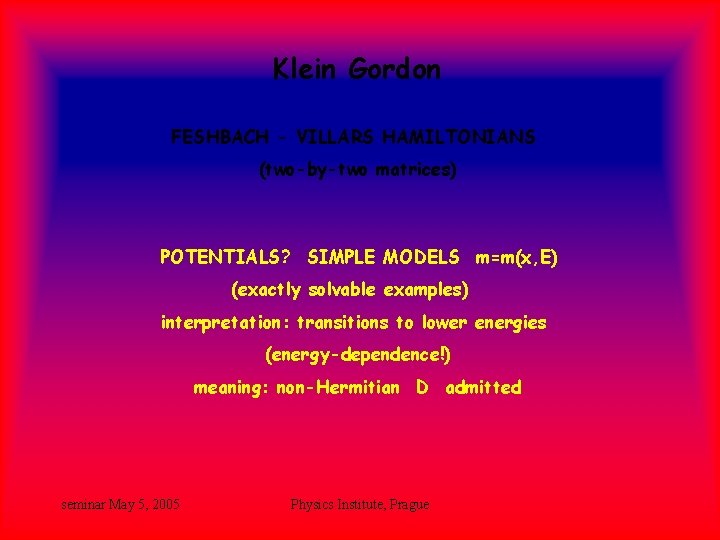
Klein Gordon FESHBACH - VILLARS HAMILTONIANS (two-by-two matrices) POTENTIALS? SIMPLE MODELS m=m(x, E) (exactly solvable examples) interpretation: transitions to lower energies (energy-dependence!) meaning: non-Hermitian D admitted seminar May 5, 2005 Physics Institute, Prague
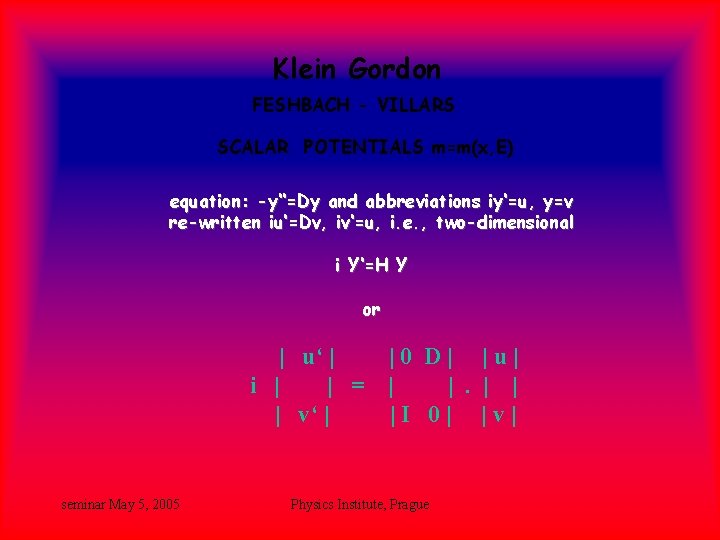
Klein Gordon FESHBACH - VILLARS SCALAR POTENTIALS m=m(x, E) equation: -y‘‘=Dy and abbreviations iy‘=u, y=v re-written iu‘=Dv, iv‘=u, i. e. , two-dimensional i Y‘=H Y or | u‘ | |0 D| |u| i | | = | | | v‘ | |I 0| |v| seminar May 5, 2005 Physics Institute, Prague
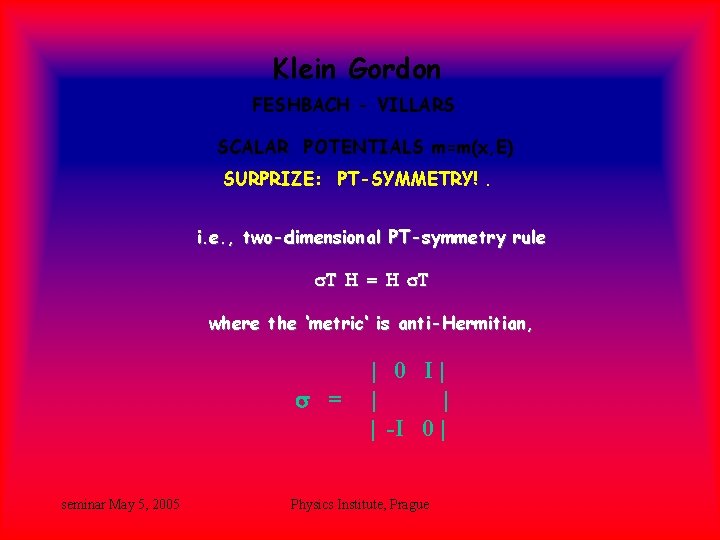
Klein Gordon FESHBACH - VILLARS SCALAR POTENTIALS m=m(x, E) SURPRIZE: PT-SYMMETRY!. i. e. , two-dimensional PT-symmetry rule s. T H = H s. T where the ‘metric‘ is anti-Hermitian, s = seminar May 5, 2005 | 0 I| | -I 0 | Physics Institute, Prague
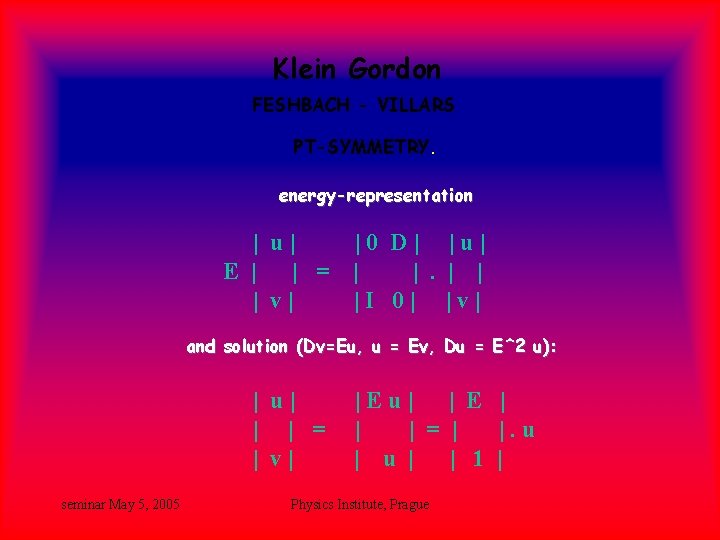
Klein Gordon FESHBACH - VILLARS PT-SYMMETRY. energy-representation | u| E | | = | v| |0 D| |u| | |I 0| |v| and solution (Dv=Eu, u = Ev, Du = E^2 u): | u| | | = | v| seminar May 5, 2005 |Eu| | E | | | = | |. u | | 1 | Physics Institute, Prague
Klein Gordon FESHBACH - VILLARS PT-SYMMETRY. D-spectrum positive (Du = E^2 u), H-spectrum in the positive/negative pairs, with remarkable wavefunctions, | Eu| | | , | u | seminar May 5, 2005 | -Eu| | u | Physics Institute, Prague
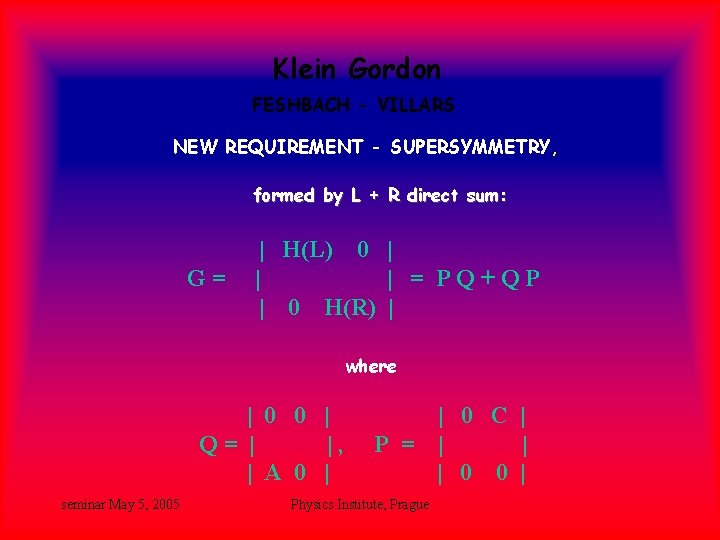
Klein Gordon FESHBACH - VILLARS NEW REQUIREMENT - SUPERSYMMETRY, formed by L + R direct sum: G= | H(L) 0 | | | = PQ+QP | 0 H(R) | where | 0 0 | Q= | |, | A 0 | seminar May 5, 2005 | 0 C | P = | | | 0 0 | Physics Institute, Prague
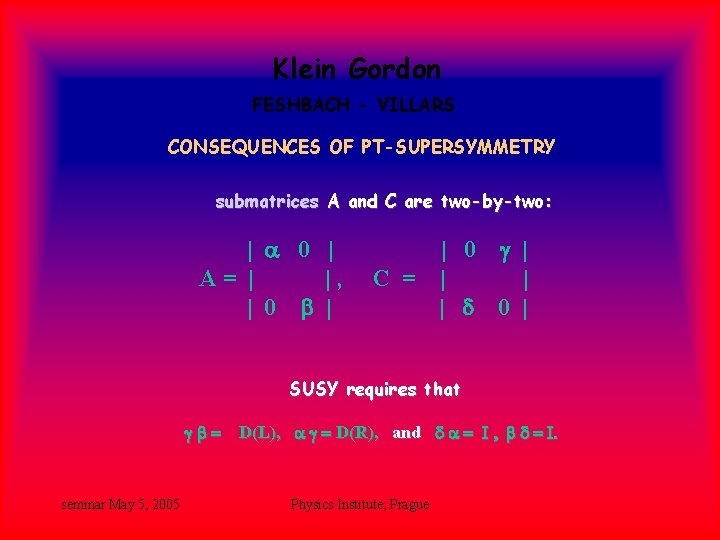
Klein Gordon FESHBACH - VILLARS CONSEQUENCES OF PT-SUPERSYMMETRY. submatrices A and C are two-by-two: | a 0 | A= | |, | 0 b | | 0 g | C = | | | d 0 | SUSY requires that g b = D(L), a g = D(R), and d a = I , b d = I. seminar May 5, 2005 Physics Institute, Prague
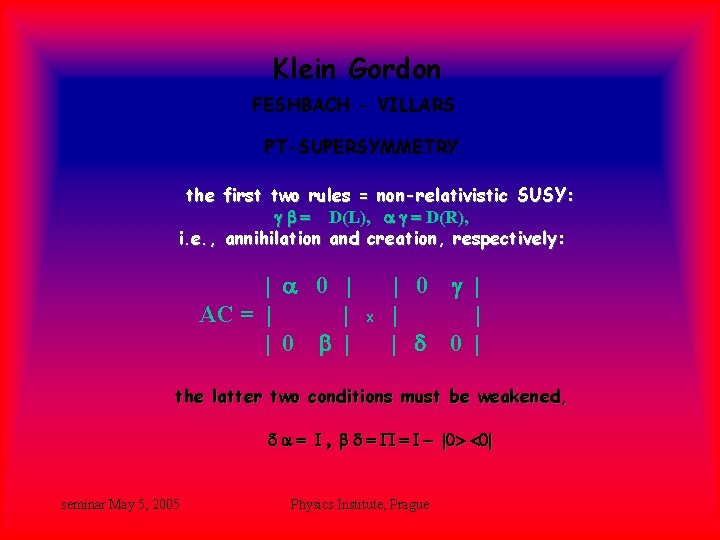
Klein Gordon FESHBACH - VILLARS PT-SUPERSYMMETRY. the first two rules = non-relativistic SUSY: g b = D(L), a g = D(R), i. e. , annihilation and creation, respectively: | a 0 | AC = | | | 0 b | x | 0 g | | d 0 | the latter two conditions must be weakened, d a = I , b d = P = I - |0> <0| seminar May 5, 2005 Physics Institute, Prague
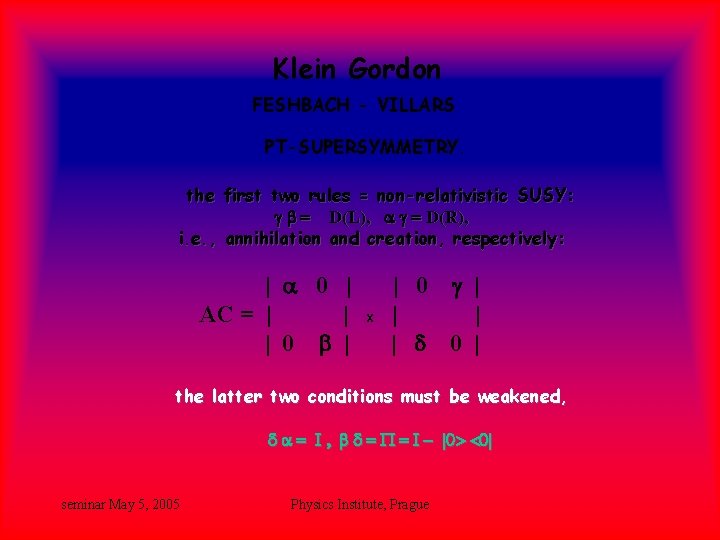
Klein Gordon FESHBACH - VILLARS PT-SUPERSYMMETRY. the first two rules = non-relativistic SUSY: g b = D(L), a g = D(R), i. e. , annihilation and creation, respectively: | a 0 | AC = | | | 0 b | x | 0 g | | d 0 | the latter two conditions must be weakened, d a = I , b d = P = I - |0> <0| seminar May 5, 2005 Physics Institute, Prague
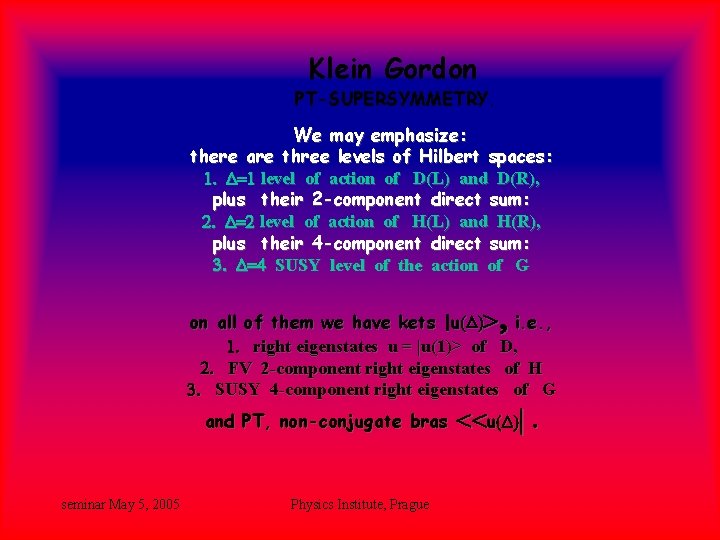
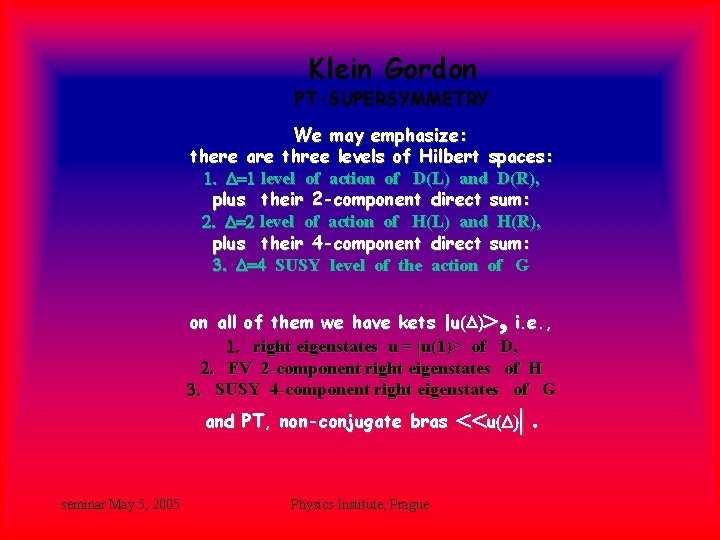
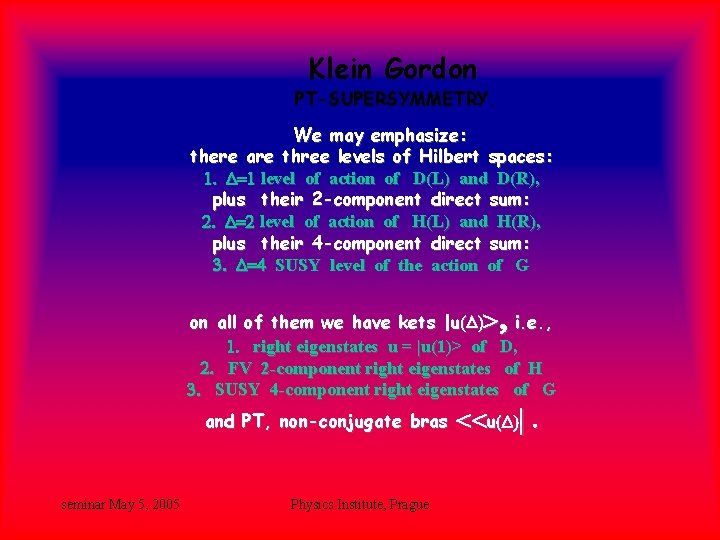
Klein Gordon PT-SUPERSYMMETRY. We may emphasize: there are three levels of Hilbert spaces: 1. D=1 level of action of D(L) and D(R), plus their 2 -component direct sum: 2. D=2 level of action of H(L) and H(R), plus their 4 -component direct sum: 3. D=4 SUSY level of the action of G , on all of them we have kets |u(D)> i. e. , 1. right eigenstates u = |u(1)> of D, 2. FV 2 -component right eigenstates of H 3. SUSY 4 -component right eigenstates of G and PT, non-conjugate bras seminar May 5, 2005 Physics Institute, Prague <<u(D)|.
Klein Gordon PT-SUPERSYMMETRY. We may emphasize: there are three levels of Hilbert spaces: 1. D=1 level of action of D(L) and D(R), plus their 2 -component direct sum: 2. D=2 level of action of H(L) and H(R), plus their 4 -component direct sum: 3. D=4 SUSY level of the action of G , on all of them we have kets |u(D)> i. e. , 1. right eigenstates u = |u(1)> of D, 2. FV 2 -component right eigenstates of H 3. SUSY 4 -component right eigenstates of G and PT, non-conjugate bras seminar May 5, 2005 Physics Institute, Prague <<u(D)|.
Klein Gordon PT-SUPERSYMMETRY. We may emphasize: there are three levels of Hilbert spaces: 1. D=1 level of action of D(L) and D(R), plus their 2 -component direct sum: 2. D=2 level of action of H(L) and H(R), plus their 4 -component direct sum: 3. D=4 SUSY level of the action of G , on all of them we have kets |u(D)> i. e. , 1. right eigenstates u = |u(1)> of D, 2. FV 2 -component right eigenstates of H 3. SUSY 4 -component right eigenstates of G and PT, non-conjugate bras seminar May 5, 2005 Physics Institute, Prague <<u(D)|.
Klein Gordon PT-SUPERSYMMETRY. In all these three cases, the action of G(D) may be both right and left: , G(D) |u(D)> = E(D) |u(D)> <<u(D)| G(D) = <<u(D)| . E(D) As long as h. c. (G) = h G 1/h , we may assume Im E = 0 and get quasi-parities, |u(D, m)>> = q(D, m). [h |u(D, m)>]. Insertions give relations between q(1, m), q(2, m) and q(3, m). seminar May 5, 2005 Physics Institute, Prague
Klein Gordon PT-SUPERSYMMETRY. In all these three cases, the action of G(D) may be both right and left: , G(D) |u(D)> = E(D) |u(D)> <<u(D)| G(D) = <<u(D)| . E(D) As long as h. c. (G) = h G 1/h , we may assume Im E = 0 and get quasi-parities, |u(D, m)>> = q(D, m). [h |u(D, m)>]. Insertions give relations between q(1, m), q(2, m) and q(3, m). seminar May 5, 2005 Physics Institute, Prague
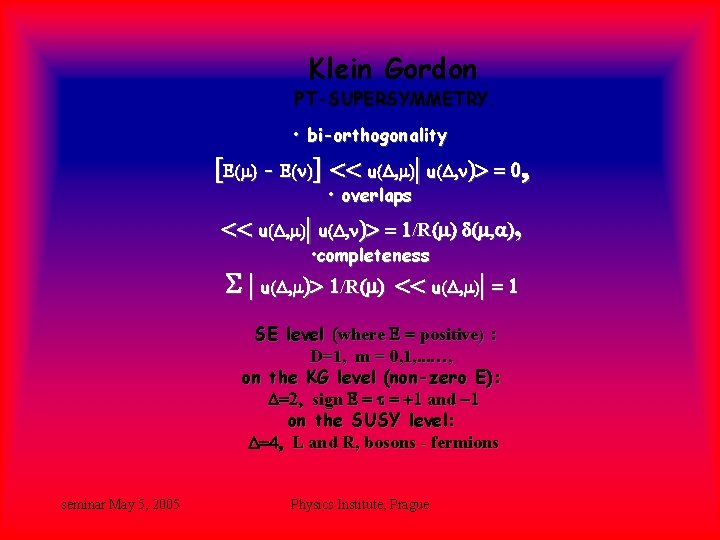
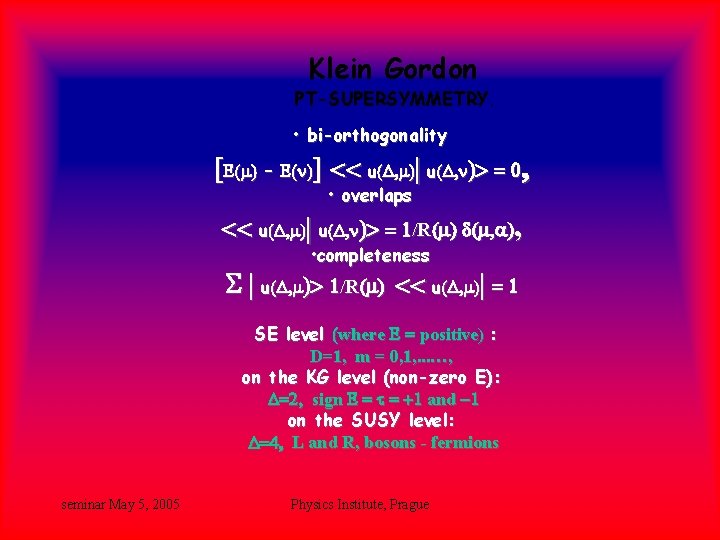
Klein Gordon PT-SUPERSYMMETRY. • bi-orthogonality [E(m) - E(n)] << u(D, m)| u(D, n)> = 0, • overlaps << u(D, m)| u(D, n)> = 1/R(m) d(m, a), • completeness S | u(D, m)> 1/R(m) << u(D, m)| = 1 SE level (where E = positive) : D=1, m = 0, 1, . . . …, on the KG level (non-zero E): D=2, sign E = t = +1 and -1 on the SUSY level: D=4, L and R, bosons - fermions seminar May 5, 2005 Physics Institute, Prague
Klein Gordon PT-SUPERSYMMETRY. • bi-orthogonality [E(m) - E(n)] << u(D, m)| u(D, n)> = 0, • overlaps << u(D, m)| u(D, n)> = 1/R(m) d(m, a), • completeness S | u(D, m)> 1/R(m) << u(D, m)| = 1 SE level (where E = positive) : D=1, m = 0, 1, . . . …, on the KG level (non-zero E): D=2, sign E = t = +1 and -1 on the SUSY level: D=4, L and R, bosons - fermions seminar May 5, 2005 Physics Institute, Prague
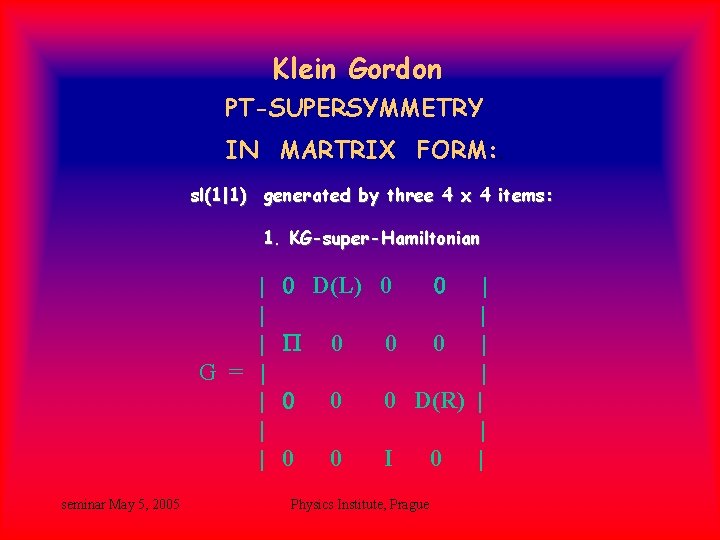
Klein Gordon PT-SUPERSYMMETRY IN MARTRIX FORM: . sl(1|1) generated by three 4 x 4 items: 1. KG-super-Hamiltonian | | | G = | | seminar May 5, 2005 0 D(L) 0 P 0 0 0 | | 0 D(R) | | I 0 | Physics Institute, Prague
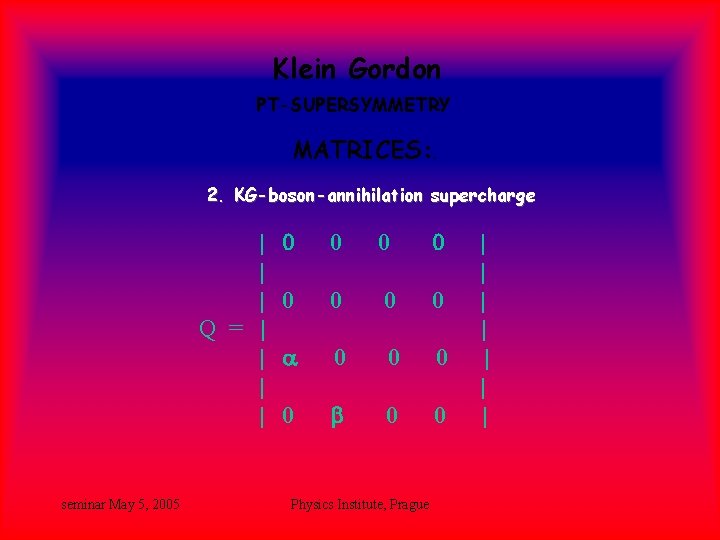
Klein Gordon PT-SUPERSYMMETRY MATRICES: . 2. KG-boson-annihilation supercharge | | | Q = | | seminar May 5, 2005 0 0 0 0 a 0 0 b 0 0 Physics Institute, Prague | | | |
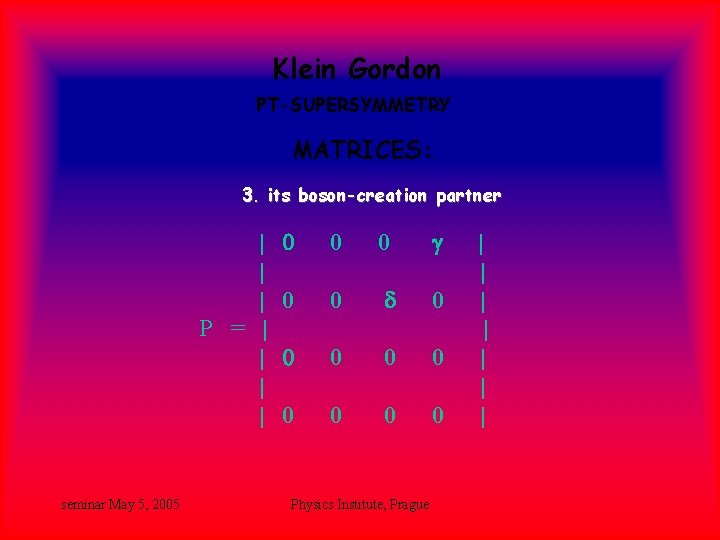
Klein Gordon PT-SUPERSYMMETRY MATRICES: . 3. its boson-creation partner | | | P = | | seminar May 5, 2005 0 0 0 g 0 0 d 0 0 0 0 0 Physics Institute, Prague | | | |
Klein Gordon PT-SUPERSYMMETRY SUMMARY: There exists a remarkable physical interpretation of the exceptional E=0 ground-state. Due to our transition to relativistic kinematics, it becomes unstable against decay! OPEN QUESTION: DOES THIS EXPLAIN THE EXPERIMENTALLY OBSERVED ABSENCE OF SUSY PARTNERS IN PARTICLE PHYSICS? seminar May 5, 2005 Physics Institute, Prague
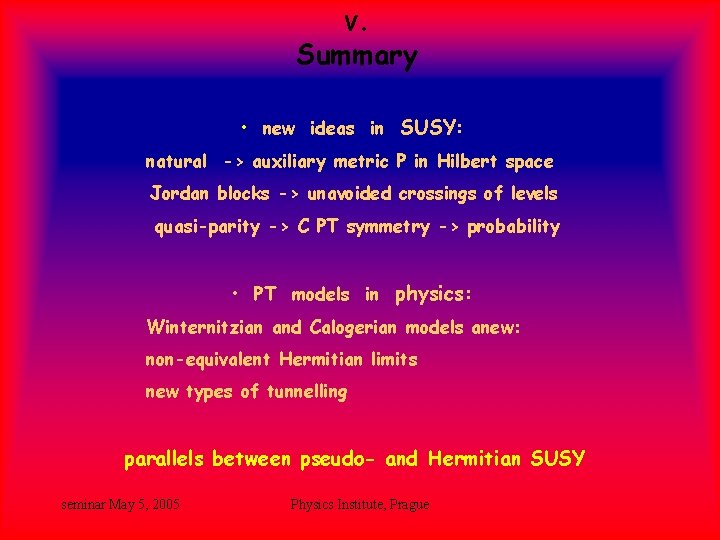
V. Summary • new ideas in SUSY: natural -> auxiliary metric P in Hilbert space Jordan blocks -> unavoided crossings of levels quasi-parity -> C PT symmetry -> probability • PT models in physics: Winternitzian and Calogerian models anew: non-equivalent Hermitian limits new types of tunnelling parallels between pseudo- and Hermitian SUSY seminar May 5, 2005 Physics Institute, Prague
V. Summary • new ideas in SUSY: natural -> auxiliary metric P in Hilbert space Jordan blocks -> unavoided crossings of levels quasi-parity -> C PT symmetry -> probability • PT models in physics: Winternitzian and Calogerian models anew: non-equivalent Hermitian limits new types of tunnelling parallels between pseudo- and Hermitian SUSY seminar May 5, 2005 Physics Institute, Prague
V. Summary • new ideas in SUSY: natural -> auxiliary metric P in Hilbert space Jordan blocks -> unavoided crossings of levels quasi-parity -> C PT symmetry -> probability • PT models in physics: Winternitzian and Calogerian models anew: non-equivalent Hermitian limits new types of tunnelling parallels between pseudo- and Hermitian SUSY seminar May 5, 2005 Physics Institute, Prague
V. Summary • new ideas in SUSY: natural -> auxiliary metric P in Hilbert space Jordan blocks -> unavoided crossings of levels quasi-parity -> C PT symmetry -> probability • PT models in physics: Winternitzian and Calogerian models anew: non-equivalent Hermitian limits new types of tunnelling parallels between pseudo- and Hermitian SUSY seminar May 5, 2005 Physics Institute, Prague